Nicolas Verieul & Marguerite Hyardin
Discover the remarkable story of Nicolas Verieul, a Norman sailor from Dieppe, and Marguerite Hyardin, a Fille du roi from Joinville, who married in New France in 1665. Follow their lives on the Côte de Beaupré and Île d’Orléans and learn how they became the founding ancestors of the Veilleux family in North America.
Cliquez ici pour la version en français
Nicolas Verieul & Marguerite Hyardin
A Norman Sailor and a Fille du roi: Founders of the Veilleux Family
Nicolas Verieul, son of Nicolas Verieul and Colette Roussel (also recorded as Perette/Pierrette), was baptized on October 17, 1632, in the parish of Saint-Jacques in Dieppe, Normandy, France. His godparents were Thomas [illegible] and Catherine [Guelinot?].
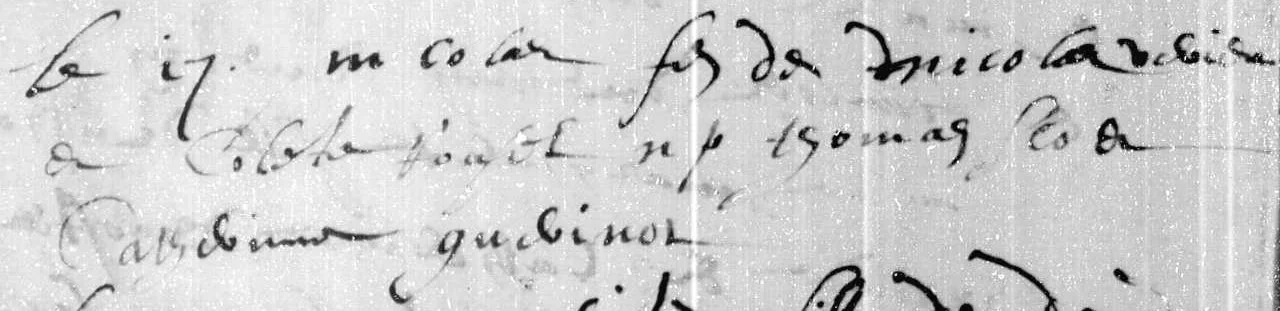
1632 baptism of Nicolas Verieul (Archives départementales de la Seine-Maritime)
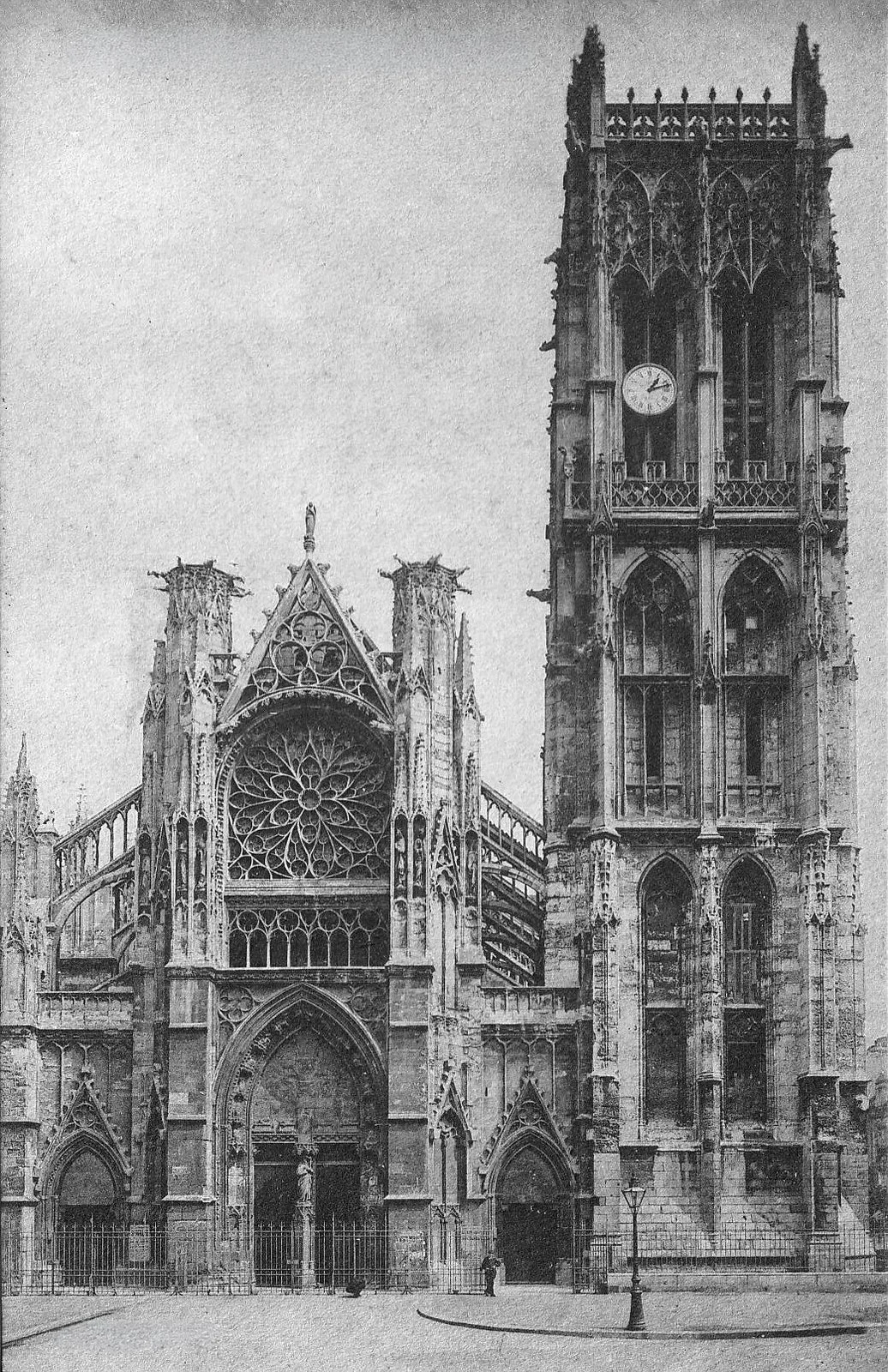
Church of Saint-Jacques in Dieppe, undated postcard (Geneanet)
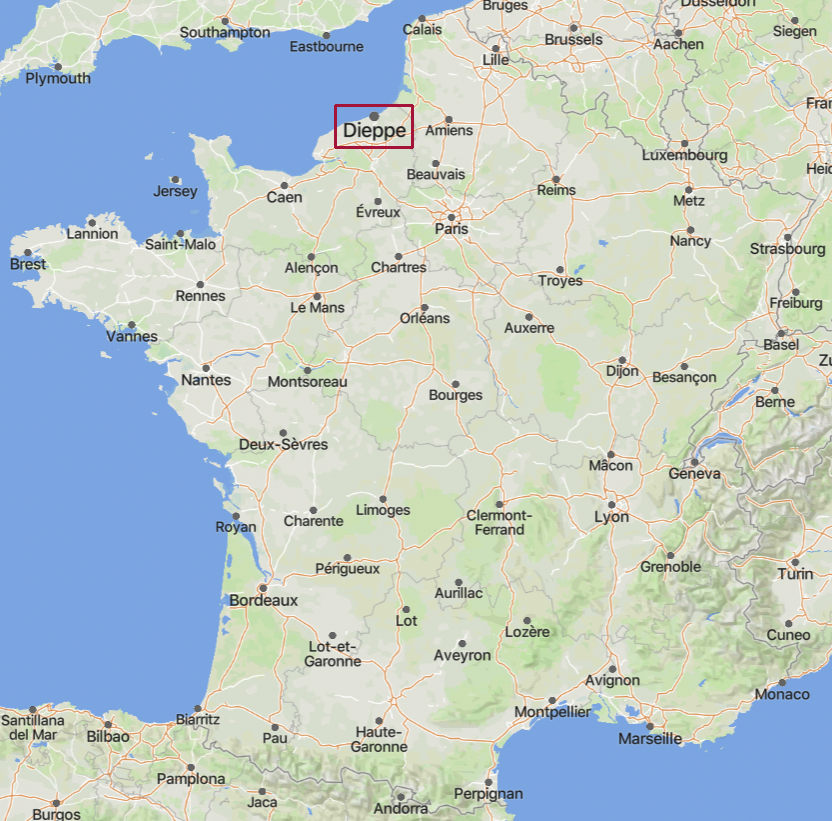
Location of Dieppe in France (Mapcarta)
Nicolas grew up in Dieppe alongside at least five siblings: Thomas, baptized on February 9, 1629; Jean, who married Madeleine Blondel in Dieppe on June 22, 1656; Catherine, baptized on September 26, 1638; Thomas, baptized on October 25, 1640; and Marie, baptized on April 25, 1642. Their father was buried in the Saint-Jacques parish cemetery on August 4, 1662, and their mother on December 27, 1673.
Dieppe sits in northern France, in the Seine-Maritime department. Today, the city has approximately 30,000 inhabitants, known as Dieppois. As a major port, it distinguished itself in the 16th century for its contribution to the French school of cartography.
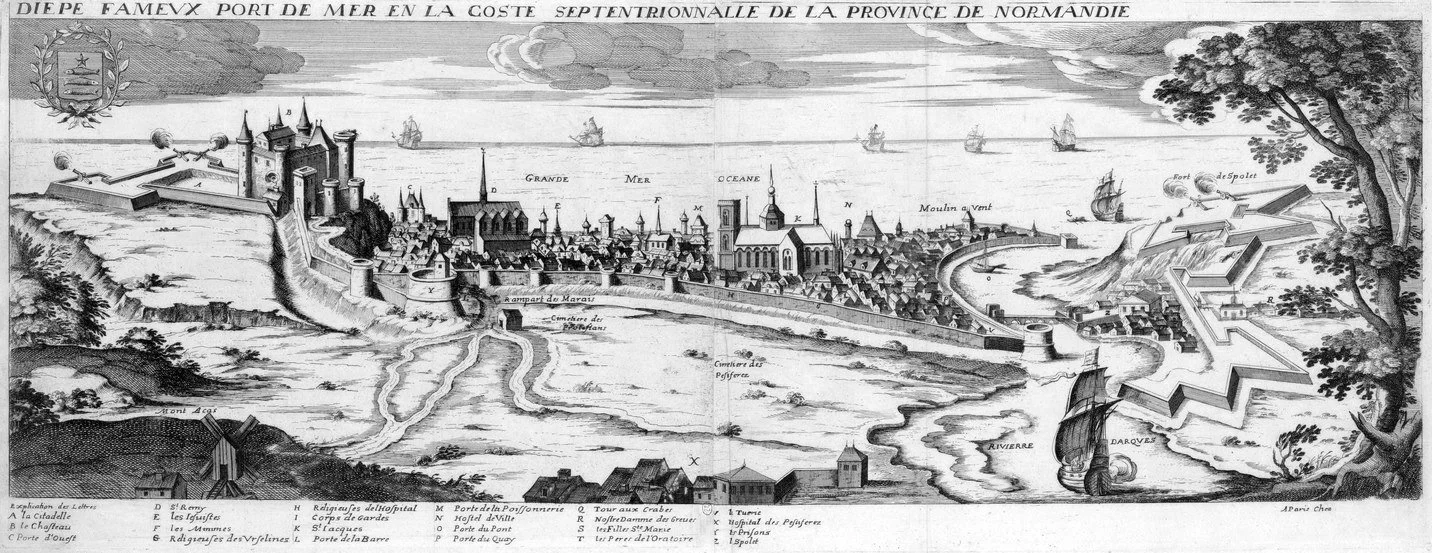
“Diepe, a famous seaport on the northern coast of the province of Normandy,” 1650 (Bibliothèque nationale de France)
Arrival in New France
Nicolas likely arrived in New France in 1656, although no record of his passage has been located. He is first documented in the colony on May 13, 1657, when he served as a witness to two notarial acts at Château-Richer. Since the first known vessel to reach Québec in 1657 did not arrive until May 27, Nicolas must already have been in the colony by that time. Further evidence comes from the June 22, 1656, marriage of his brother Jean Verieul in Dieppe: Nicolas was absent but had previously given his consent to the marriage. He may therefore already have left France, or have been preparing to depart, by June 1656. Taken together, the evidence suggests that 1656 was the most likely year of his arrival in New France.
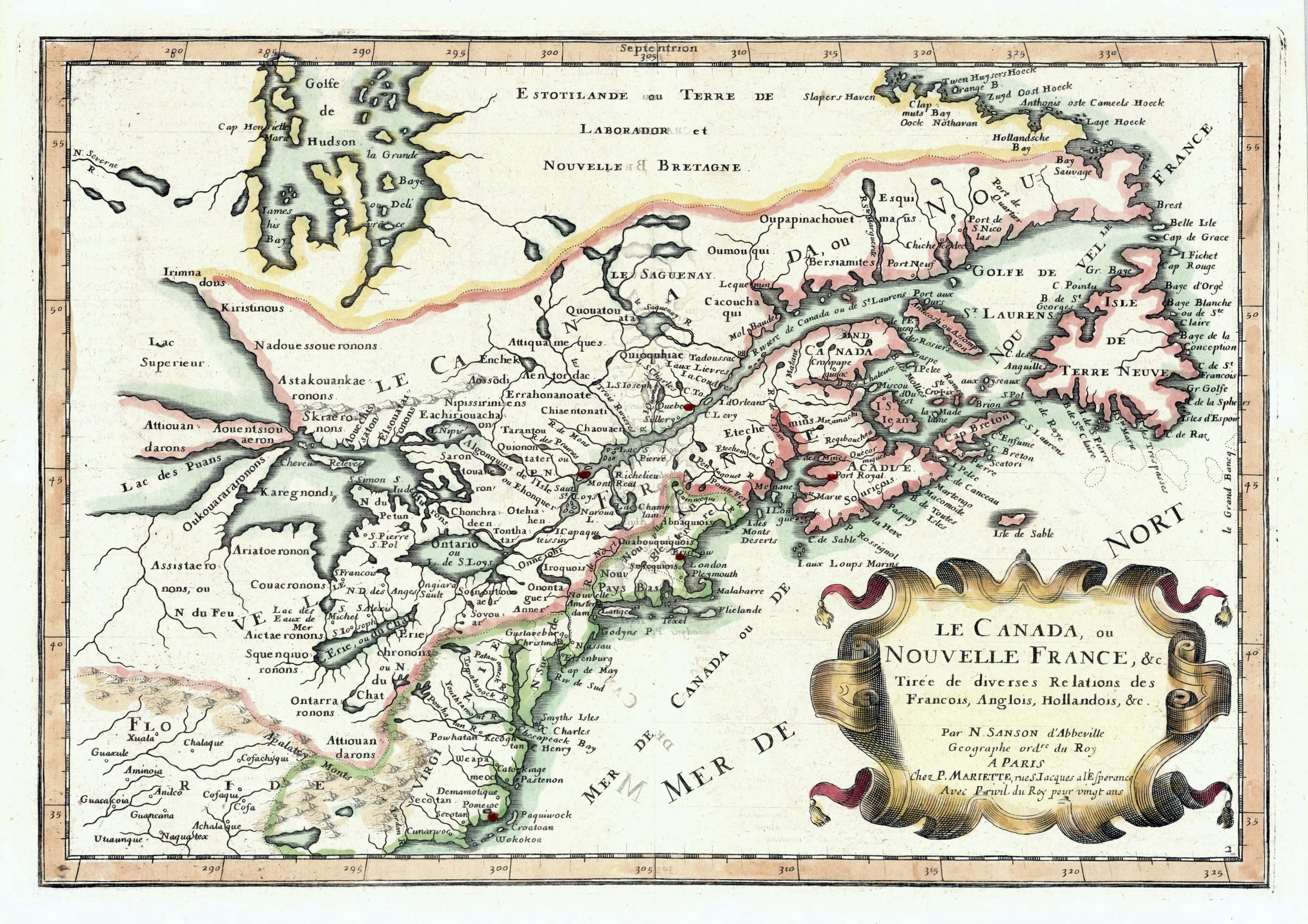
“Canada, or New France,” map created by Nicolas Sanson and Pierre Mariette, circa 1662 (Bibliothèque et Archives nationales du Québec)
The Verieul surname appears in records with a variety of phonetic spellings, including Vérieu, Veurieul, Vériolle, Vérieur, Vergueur, Verielle, Verdrieul, Voidiou, and Vidieu. Nicolas signed "Verieul." Over the generations that followed, these variants gradually gave way to the spelling Veilleux, which became established as the standard form of the surname among his descendants in Québec.
A Foothold in the French Colony
On April 25, 1659, in Québec, Nicolas “Vérieul,” described as a matelot, or sailor, entered into an agreement with Pierre Enjouys, sieur de Saint-Jacques. Beginning the following day, Nicolas agreed to serve Enjouys for four months aboard a chaloupe, or shallop, that Enjouys had acquired from Julien Fortin. In return, Nicolas was to receive 27 livres per month, as well as a pair of French shoes for the four-month term. The agreement was conditional upon Enjouys’s associates approving his transaction with Fortin; if they did not, Nicolas’s wages for any service already performed were to take precedence over other debts against the boat’s freight earnings. The contract was executed at Québec in the maison de la communauté du Magasin, and Nicolas signed the act.
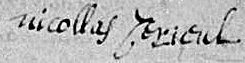
Nicolas’s signature in 1659
On February 2, 1660, Nicolas received the sacrament of confirmation from “François de Montmorency-Laval, Monsignor the Illustrious and Most Reverend Bishop of Petrée, Vicar Apostolic in the whole of New France,” alongside 153 other men, women and children. He is recorded as “Nicolas Verieul, son of Nicolas Verieul and Perette Rousel, from the archdiocese of Rouen, parish of St. Jacques in Dieppe.”
The following month, on March 18, 1660, Nicolas made a substantial donation toward the chapel of Sainte-Anne at the Petit-Cap. He transferred to the chapel a debt of 60 livres that was owed to him by Marin Nourrice, with payment to be obtained from Claude Bouchard. Étienne de Lessard accepted the donation on behalf of the chapel and was identified in the act as the donateur du fond d’icelle, the donor of the land on which it was being established. Nicolas was described as an habitant living in the seigneurie of Beaupré. He, Lessard, and the witnesses signed the agreement.
On June 26 of the same year, as he was preparing to depart for France, Nicolas transferred to Richard Dumesnil, écuyer, the portion of grain due to him from the harvest on the farm of the “widow Bacon” [Marie Tavernier] at Château-Richer. In return, Dumesnil agreed to discharge Nicolas’s debts of 32 livres 10 sols to Madame Sevestre and 33 livres to Antoine François dit Le Gascon. Nicolas was described in the act as a travaillant, or labourer, residing in the côte and seigneurie of Beaupré. Nicolas and Dumesnil would remain closely associated for years, conducting business together and eventually acquiring and working land jointly on the côte de Beaupré.
The exact dates of Nicolas’s voyage to France are unknown, but he was back in New France by May of 1662. Between 1662 and 1664, Nicolas appeared in several more notarial records:
On May 18, 1662, in Québec, Nicolas appointed Mathieu d’Amours, écuyer, sieur de Chauffour, as his general and special attorney. He authorized d’Amours to collect money owed to him, including 27 livres from Gilles Moyneau under a promise dated November 28, 1661, and 29 livres from Henry [Brauz?]. D’Amours was empowered to issue receipts, pursue the debts through legal proceedings if necessary, and otherwise act on Nicolas’s behalf in the matter. Nicolas was described in the act as a matelot, or sailor.
On August 11, 1662, Nicolas Chavigneau acknowledged owing Nicolas 40 livres for money Nicolas had advanced on his behalf to satisfy his creditors and meet his pressing needs.
On April 25, 1663, Nicolas and Richard Dumesnil jointly purchased a property from Louis Gagnier [Gagné] for 130 livres. Located at “Petit Cap” on the côte de Beaupré, the land measured three arpents of frontage, facing the St. Lawrence. It was subject to annual seigneurial dues of 20 sols in rente and 6 deniers in cens per arpent of frontage, together with two live capons, payable on the feast of Saint Martin in winter.
On March 23, 1664, in the Québec study of notary Michel Fillion, Charles Aubert de la Chesnaye, co-seigneur of the seigneurie of Beaupré and Île d’Orléans, granted Nicolas and Richard Dumesnil a land concession on the Côte de Beaupré. The property measured three arpents of frontage on the St. Lawrence River by a league and a half in depth. It was subject to annual seigneurial dues of 20 sols in rente per arpent of frontage, together with three live capons and three sols in cens for the entire concession, payable on the feast of Saint Martin in winter. In addition to the annual seigneurial dues, Nicolas and Richard were required to have their grain ground at the seigneurial mill and to submit to the jurisdiction of the seigneurs’ court. They were also responsible for providing Charles Aubert with a copy of the concession contract at their own expense.
On April 19, 1664, Richard Dumesnil, acting on behalf of his associate Nicolas Verieul, reached an agreement with their neighbour Jean Lepicart [Picard] to resolve a property-boundary dispute and, as the act stated, to “re-establish peace and friendship.” Picard’s barn had encroached upon their property, and Nicolas and Richard agreed to cede him the affected land, together with sufficient space to turn a cart. In compensation, Picard agreed to transfer land from his own property to them.
Marguerite Hyardin, daughter of René Hyardin and Jeanne Sarrey (or Serré), was baptized on August 30, 1645, in the parish of Notre-Dame in Joinville, Champagne, France. Her godparents were François [Berraud?] and Marguerite [Petitjean?]. Marguerite’s parents were married in the same church on October 15, 1644. Marguerite’s father, René Hyardin, was buried in Joinville on January 25, 1646, less than five months after her baptism. Her paternal grandparents were Nicolas Yardin and Marguerite Simon.
Marguerite’s surname is spelled in a variety of phonetic ways on documents, most often Hiardin and Yardin.
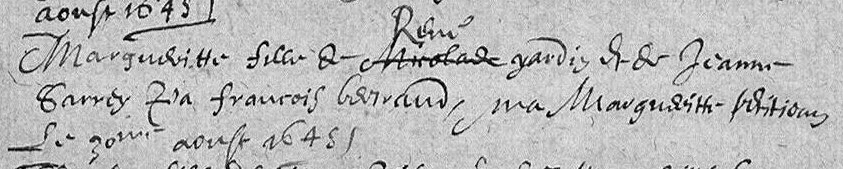
1645 baptism of Marguerite Hyardin (Archives départementales de la Haute-Marne)
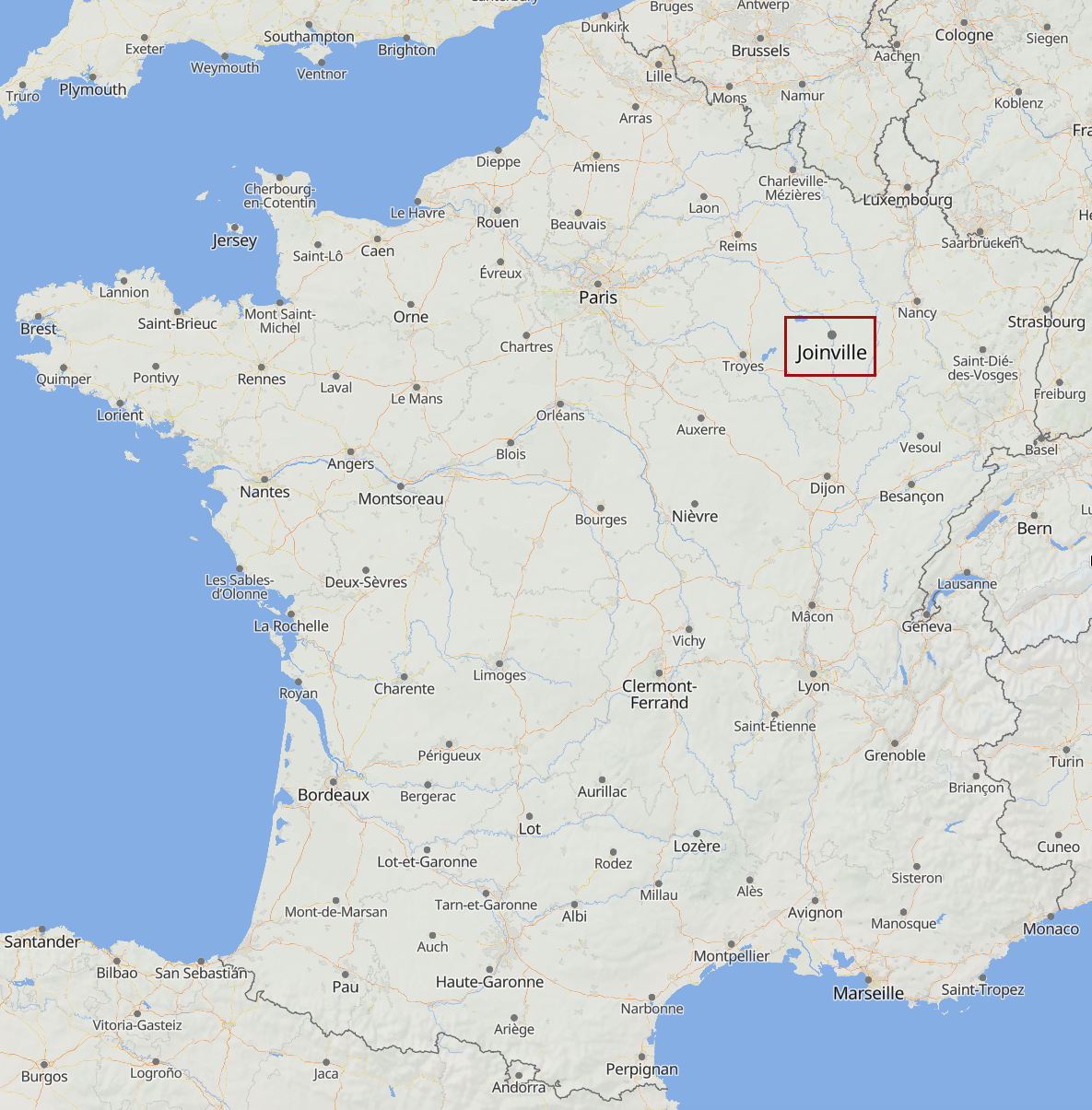
Location of Joinville in France (Mapcarta)
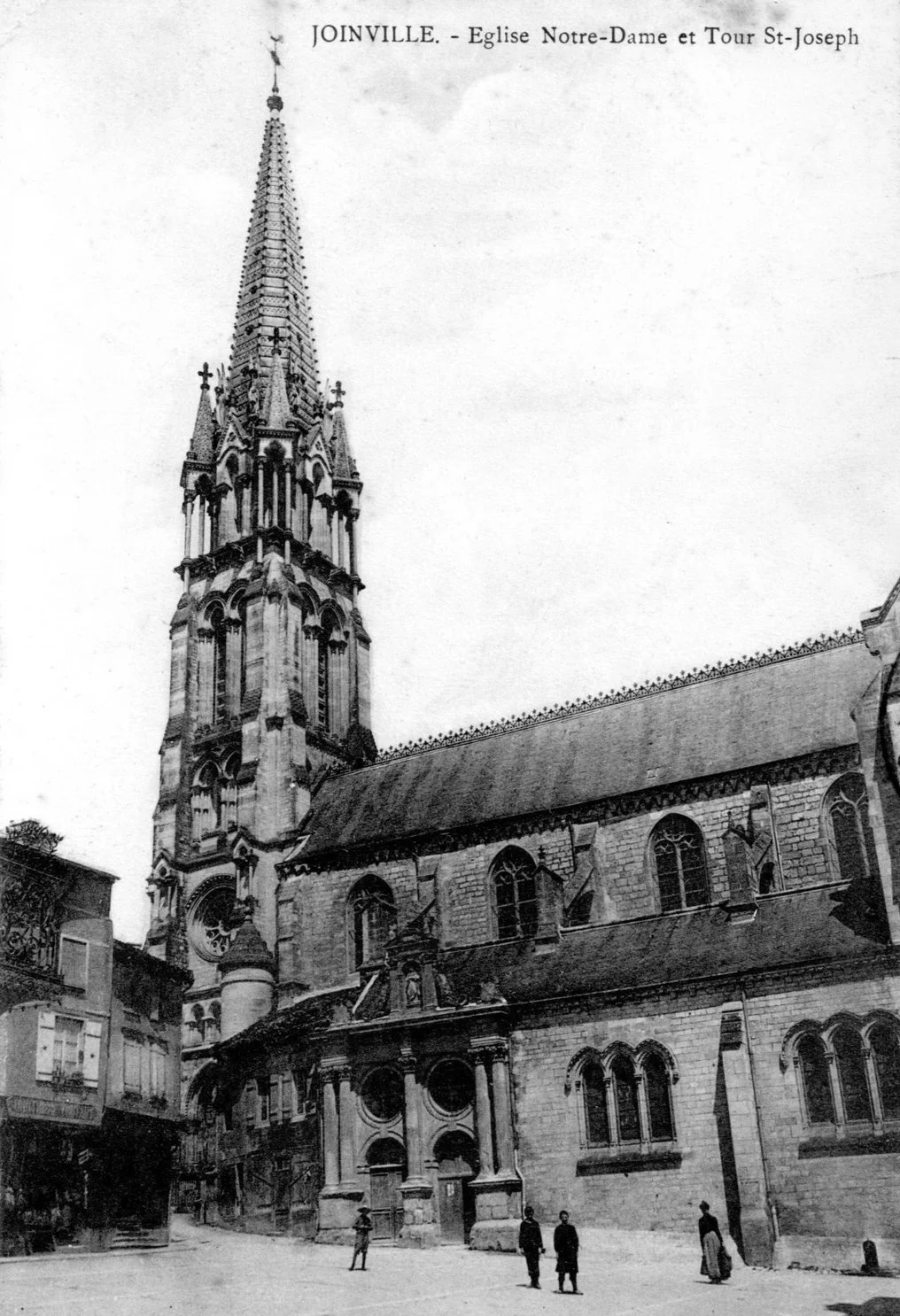
Church of Notre-Dame in Joinville (Geneanet)
Founded around the year 1000 beneath a castle overlooking the Marne valley, Joinville developed into an important medieval and Renaissance town associated with the powerful House of Guise. Located about 210 kilometres southeast of Paris, Joinville is part of the present-day department of Haute-Marne and the Grand Est region of France. It has less than 3,000 residents, called Joinvillois.
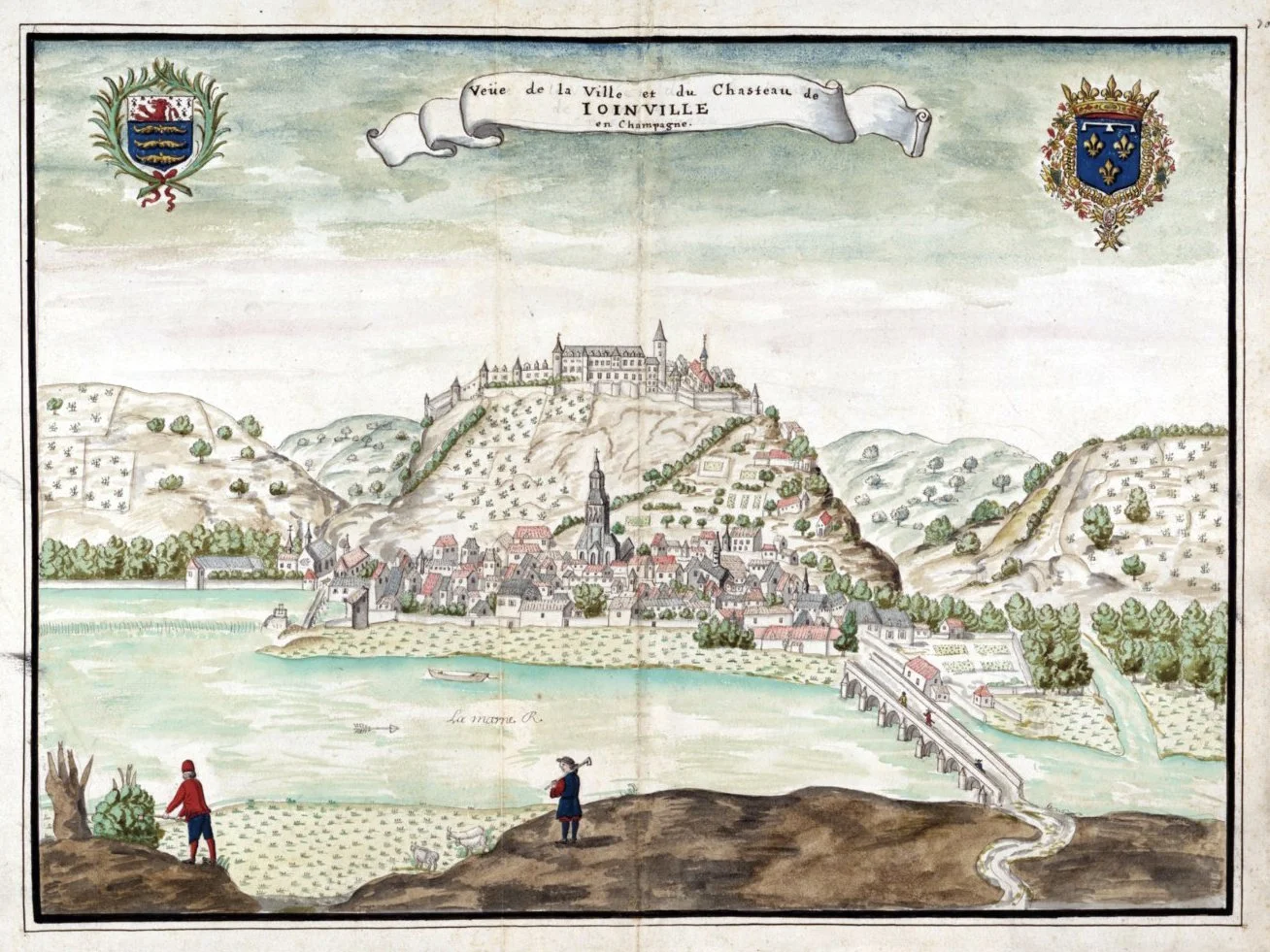
“View of the Town and Castle of Joinville in Champagne,” 17th-century watercolour (Bibliothèque nationale de France)
Not much is known about Marguerite’s life in France. She likely left her home country for New France in 1665, arriving at Québec as a Fille du roi.
Marriage and Children
On October 5, 1665, in Québec, notary Claude Auber drew up a marriage contract between “Nicollas Verieul” and “Marguerite Yerdain.” He was a 32-year-old habitant from the côte de Beaupré, living in the parish of Sainte-Anne; she was 20. The contract associated Marguerite’s parents with the parish of Saint-Sulpice in Paris, although the reason for this reference is unclear: her father had died in Joinville in 1646, while her religious marriage record correctly identified her as a native of Notre-Dame in Joinville. Nicolas’s witnesses were Julien Fortin dit Bellefontaine, Claude Bouchard, Richard Dumesnil and Nicolas [Gasse?]. Marguerite’s witnesses were “Nosseigneurs de Tracy, Gouverneur et Intendant” (Alexandre de Prouville de Tracy, Daniel de Rémy de Courcelle, governor of New France, and Jean Talon, intendant), as well as “Madame Dailleboust” [Marie Barbe de Boullongne, widow of former governor Louis d’Ailleboust] and “Madame Bourdon” [Anne Gasnier, wife of Jean Bourdon]. [Gasnier is best known as the chaperone for the Filles du roi during the 1660s. She made several trips to France to recruit young women eager to start a family in Canada and then provided them with room and board in Quebec City.]
The contract followed the standards of the Coutume de Paris, which governed the transmission of family property in New France. Unless modified by a marriage contract, spouses were subject to the “community of goods.” Movable property and property acquired during the marriage generally formed part of the community, while certain immovable property owned before the marriage or inherited by either spouse remained separate property. When the community was dissolved by the death of one spouse, the surviving spouse retained half of the community property, while the deceased spouse’s half passed to his or her heirs, normally the children in equal shares, both sons and daughters. After a death, an inventory was commonly drawn up to identify and value the property belonging to the community.
The contract between Nicolas and Marguerite also contained a reciprocal gift providing that, if either spouse died without heirs, the survivor would inherit all of the deceased spouse’s property. Nicolas and several witnesses were able to sign their names, but Marguerite could not, so she left her mark.
The couple married two months later in December 1665 in the home of Julien Fortin dit Bellefontaine at Cap Tourmente, “serving as a church.” Nicolas was described as a matelot, or sailor, from the parish of Saint-Jacques in Dieppe. Marguerite was described as a native of the parish of Notre-Dame in “Jouenville,” Champagne.
Nicolas and Marguerite settled on the côte de Beaupré, where they had at least nine children:
Nicolas (1667–1719)
Marie (1669–1677)
Marguerite (1671–1753)
Angélique (1673–1743)
Marie (1679–1775)
Joseph (ca. 1681–1736)
Marie Madeleine (1683–1746)
René (1685–1685)
Jean Baptiste (1688–1689)
Several months after his marriage, Nicolas and Richard Dumesnil formally divided the two properties they held jointly on the Côte de Beaupré. In an agreement recorded by notary Claude Auber on April 3, 1666, Nicolas received the property located between the lands of Sylvain Le Veau and Jean Lepicart, while Richard received the property situated between Jean Barrette and the heirs of the late Louis Guimont. Because Nicolas’s property was considered more valuable, he was required, as compensation, to have four arpents of land cleared and made ready for cultivation for Richard.
The Verieul Family in the Census
Nicolas and Marguerite are erroneously recorded in the 1666 census. Nicolas appears in a list of Beaupré habitants who were either “not married or married in France.” He is enumerated as a 32-year-old matelot, or sailor, while Marguerite is recorded as the 20-year-old wife of Richard Dumesnil.
1666 Census
Canada’s first census was conducted in 1666, under the direction of Jean Talon, the colony’s intendant. Despite having arrived in New France only the year before and having no prior experience with population enumeration, Talon was undeterred. France itself had never conducted a census. He assembled a team of census takers equipped with quill pens, ink, and paper. The enumerators travelled throughout the colony, visiting small villages and the countryside and going from household to household. They recorded each resident’s name, age, profession, and relationship to the head of the household. The census was conducted during one of the harshest winters in 30 years, presenting additional challenges. The cold and snow may also have worked to the enumerators’ advantage, however, as most residents remained close to home and were therefore easier to count. Over several months, Talon’s team successfully enumerated 3,418 colonists living in New France.
The 1666 census contained numerous errors, most significantly an estimated population undercount of 25–30%. Another census was conducted the following year. This time, Nicolas and Marguerite were correctly enumerated together in Beaupré, along with their one-year-old son Nicolas and a 20-year-old domestic servant named Jean de la Fond. The couple had eight arpents of developed land (cleared or under cultivation).
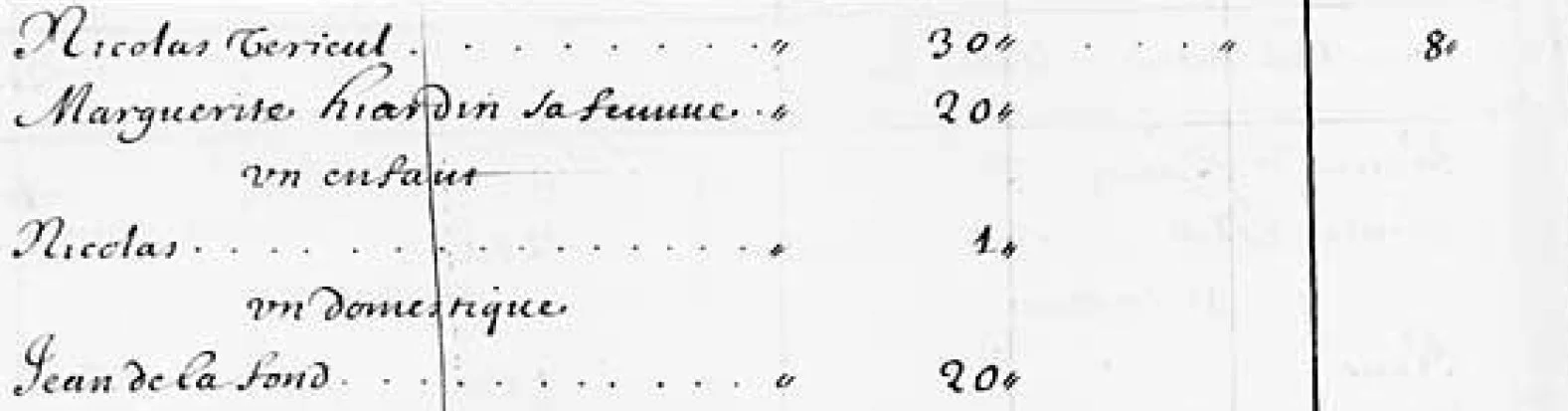
1667 census for the Verieul family (Library and Archives Canada)
The accounts of the chapel of Sainte-Anne also record a contribution of 2 livres in 1670 from “la femme de Vedieu” (the wife of Verieul), an apparent reference to Marguerite.
On July 17, 1672, Jacques Lesot, an habitant of Beaupré, transferred his rights and interest in a barque (boat) named the Sainte-Anne to Nicolas.
On December 22, 1673, Nicolas acknowledged owing 50 livres, 15 sols, to merchant Jean Picard, who had paid the same amount on Nicolas’s behalf to Pierre Butaud [Buteau] and Jean Boutin. Nicolas agreed to repay the debt by August 1 of the following year.
Move to Île-d’Orléans
In early 1676, Nicolas and Marguerite disposed of their property interests on the Côte de Beaupré in a series of transactions that appear to have preceded their move to Île-d’Orléans.
On March 7, 1676, Nicolas and Marguerite sold a land concession to Jean Cloutier Jr. for 635 livres, with an additional 15 livres payable to the fabrique of Sainte-Anne. The property measured two arpents of frontage on the St. Lawrence River by approximately a league and a half in depth, making up two-thirds of a three-arpent concession that the sellers had acquired from Pierre Gaingnon [Gagnon] by an exchange concluded the preceding day. The property included arable land, meadows, woods, pastures, and a “small habitable house.”
On March 22, 1676, Nicolas and Marguerite sold a plot of land in Château-Richer to Jean Gaignon [Gagnon], an habitant from Cap Tourmente, for a principal price of 430 livres, plus 12 livres in customary gratuities (pot-de-vin et épingles), for a total of 442 livres. The property measured one arpent of frontage on the St. Lawrence River by a league and a half in depth. It bordered Jean Gagnon’s own land on one side and that of Jean Cloutier Jr. on the other. The sale agreement was drawn up by notary Romain Becquet in his Québec study. Nicolas signed the document; Marguerite declared that she was unable to sign.
Sometime between 1676 and 1679, the Verieul family moved to Île-d’Orléans. A later biographical account places the Verieul family’s move to Saint-François on Île-d’Orléans in 1676, although the original concession confirming the date has not been located. In 1681, Nicolas and Marguerite were recorded in the census of New France living on the island with their five children and a 40-year-old domestic servant named Michel. The family owned one gun and six arpents of cleared land.
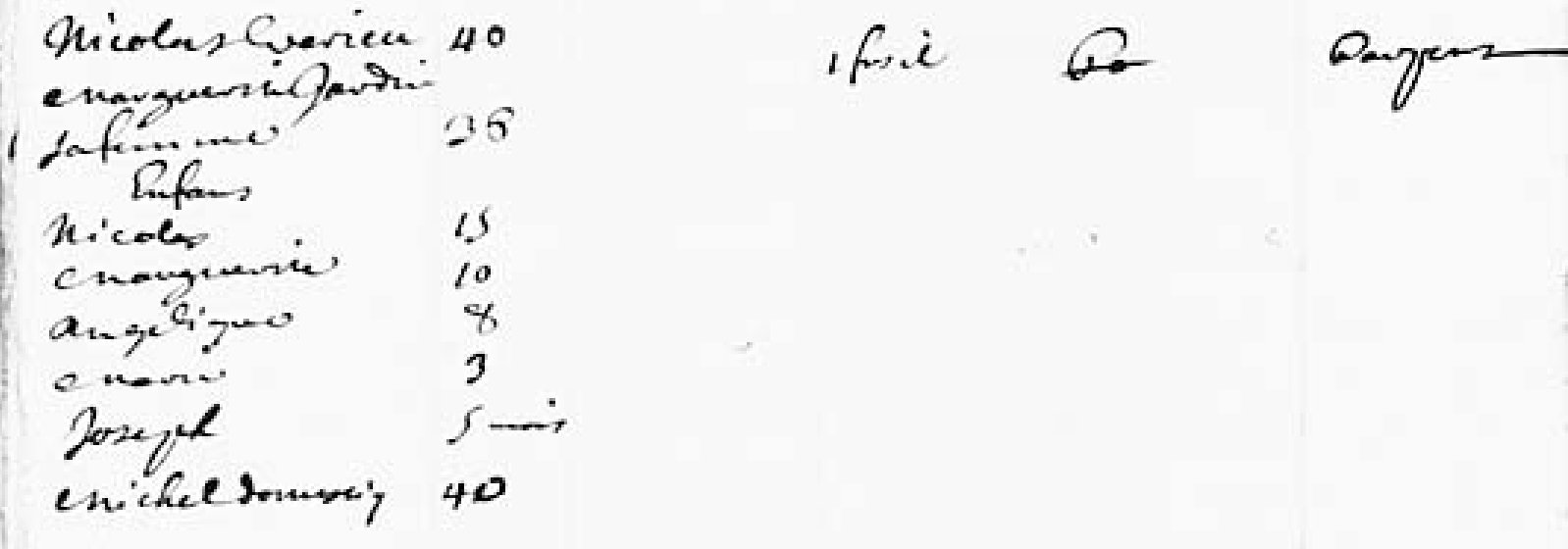
1681 census for the “Verieu” family (Library and Archives Canada)
Sailor, Sawyer & Boat Captain
Notarial records from the 1680s provide an unusually detailed glimpse into Nicolas’s working life and the economic activities of his household. They show him contracting for maritime transport, lumber production, vessel ownership and command, while also entering into agreements on behalf of family members.
On March 6, 1683, Nicolas entered into a contract with Louis Rouer de Villeray, councillor of the Conseil souverain, to transport stone to Québec. Nicolas was described as a matelot, or sailor, residing in the comté de Saint-Laurens (Île-d’Orléans). He agreed to deliver the stone to a location designated by Villeray in Québec’s Lower Town, at a rate of 6 livres, 10 sols, per chaloupée chargée raisonnablement (reasonably loaded boatload). The contract may have been related to the rebuilding of Villeray’s Québec residence, which had been destroyed by fire the previous year.
On July 30, 1683, Nicolas and carpenter Jean Rouleau settled their mutual accounts before notary Gilles Rageot. After accounting for the sums and obligations between them, Rouleau was found to owe Nicolas a balance of 42 livres, which he acknowledged and agreed to pay. Nicolas was described as a matelot (sailor) and habitant of the parish of Saint-François on Île-d’Orléans.
On March 11, 1684, an agreement was penned between Nicolas and Québec merchant Jean Lepicart [Picard]. The latter leased Nicolas a barque named the Sainte-Anne for “the next season.” Picard agreed to have the vessel caulked, properly fitted out and supplied with all necessary equipment before the start of navigation. Nicolas was to command the vessel and care for it as though it were his own. After the initial outfitting, the two men would share responsibility for maintaining the Sainte-Anne, including losses or breakage involving its cables, anchors and rigging. The contract also set out how profits and losses would be divided, depending on whether another man was hired to work aboard the vessel.
On October 27, 1684, Nicolas entered into a contract with Québec merchant Jean Gitton, together with Joseph Bonneau dit Labécasse and Alexandre Boissard, the latter acting on behalf of the absent Nicolas Menanteau. All were residents of Saint-François on Île-d’Orléans. They agreed to supply Gitton with 2,000 pine boards, each measuring approximately ten feet long, ten inches wide, and one inch thick, together with 500 madriers (heavy planks) of the same length and width and about two and a half inches thick. The agreement set a price of 32 livres per hundred madriers and 24 livres per hundred ordinary boards. Payment was to be made one-third in cash and two-thirds in merchandise. Gitton also agreed to advance the men up to 300 livres, and somewhat more according to their needs. The wood was to be delivered by April 15 of the following year, and Gitton agreed to make his chaloupe available to them for the work.
On February 3, 1685, Nicolas and his associates Joseph Bonneau and Nicolas Menanteau entered into a lumber contract with Jacques de Meulles, chevalier, seigneur de La Source, councillor to the King and intendant of justice, police and finance in New France. The three men, described as scieurs de long, or long sawyers, agreed to produce as much pine lumber as they could between the date of the contract and the next planting season, working continuously in the meantime. The lumber was to be delivered on the riverbank behind the intendant’s residence in Québec. Certain twenty-foot pine madriers were priced at 100 livres per hundred; other madriers of ordinary dimensions at 40 livres per hundred; and ordinary pine boards at 30 livres per hundred.
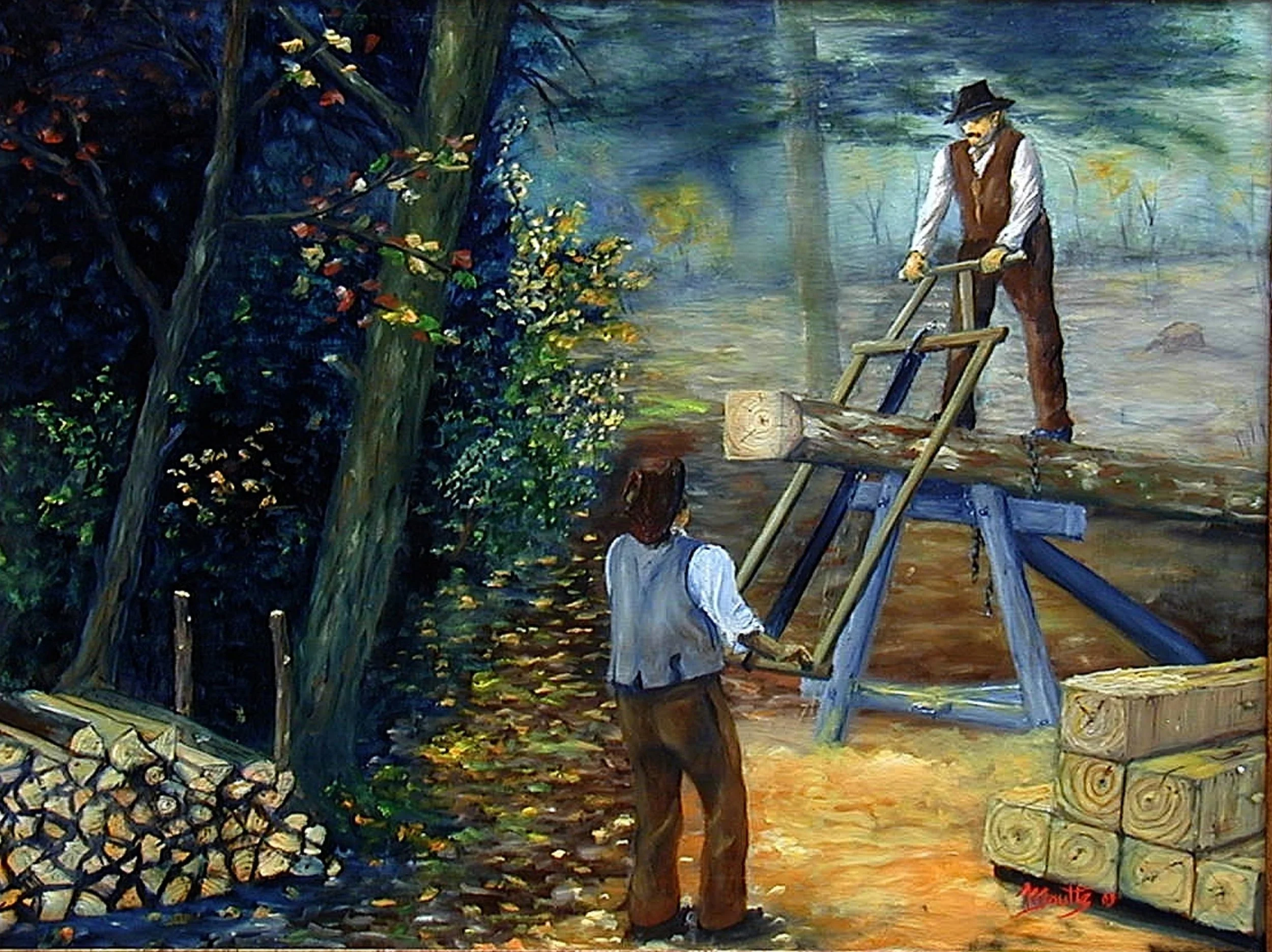
"Scieurs de long dans la montagne de Lure" (Long-sawyers in the Lure Mountains), painting by Michel Moutte, 2013 (Wikimedia Commons)
On November 6, 1686, Nicolas signed a contract placing his 15-year-old daughter Marguerite in domestic service with Québec merchant Mathieu de Linot [Delino] and his wife Catherine Nolan. Marguerite was engaged to serve them for one year, for which de Linot agreed to pay her 50 livres.
On June 10, 1688, Nicolas purchased a 10-ton barque from Pierre Asseline [Asselin] for 300 livres, payable in two equal instalments. Nicolas is described in the act as a maître de barque, or boat captain, for the first time. The sale included the vessel’s rigging, grappling hooks, sails, a new cable, other cordage and equipment, together with a one-half interest in a chaloupe and a cannon.
Ten days later, on June 20, 1688, Nicolas purchased from René Bauché [Baucher] a one-half interest in a chaloupe with a carrying capacity of seven cords of wood, for 300 livres, payable in two equal instalments. The sale included one-half of the vessel’s rigging, tackle and equipment, including a new cable. As part of the agreement, Nicolas also undertook to make two voyages with the chaloupe for Baucher, one of them to the Cap-Rouge River.
Settling Property and Family Affairs
On September 26, 1688, Nicolas and Marguerite sold Québec merchants Jean Lepicart [Picard] and Lucien Boutteville their right to an annual rente of 16 livres owed to them in France by Magdelaine [Tion?], widow of Jean Dubuc. The rente had been established by a contract drawn up in Dieppe in 1678. In exchange for the right to collect the annual payment, Lepicart and Boutteville paid Nicolas and Marguerite 320 livres, partly in cash and partly in merchandise. In effect, Nicolas and Marguerite converted a continuing annual income of 16 livres into a lump-sum payment equal to twenty years of that income.
In July 1692, Marguerite was admitted to the Hôtel-Dieu in Québec. Although the cause of her hospitalization is unknown, she remained there for 61 days.

Hôtel-Dieu patient register, entry for Marguerite “Jourdin” (Ancestry)
On the afternoon of November 11, 1694, Nicolas and Marguerite sold a plot of land and a house on Île-d’Orléans to their son-in-law Jacques Baudon, husband of Marguerite, for 300 livres. The land, located in the parish of Saint-François, measured three arpents of frontage facing the St. Lawrence River by a depth “up to the line or road that crosses the said island in the middle from point to point.” It was located between Nicolas and Marguerite’s own land and that of René Edmond [Émond], in the seigneurie of D’Argentenay, owned by Dames hospitalières of Québec’s Hôtel-Dieu. The land was part of an original concession measuring five arpents and eight perches granted under seing privé (private agreement). As part of the agreement, Jacques undertook to provide Nicolas and Marguerite with lodging for the remainder of their lives and to share certain produce from the property with them. Nicolas and Marguerite also retained the right to remove some building materials from the existing house for use on the adjoining land they continued to own.
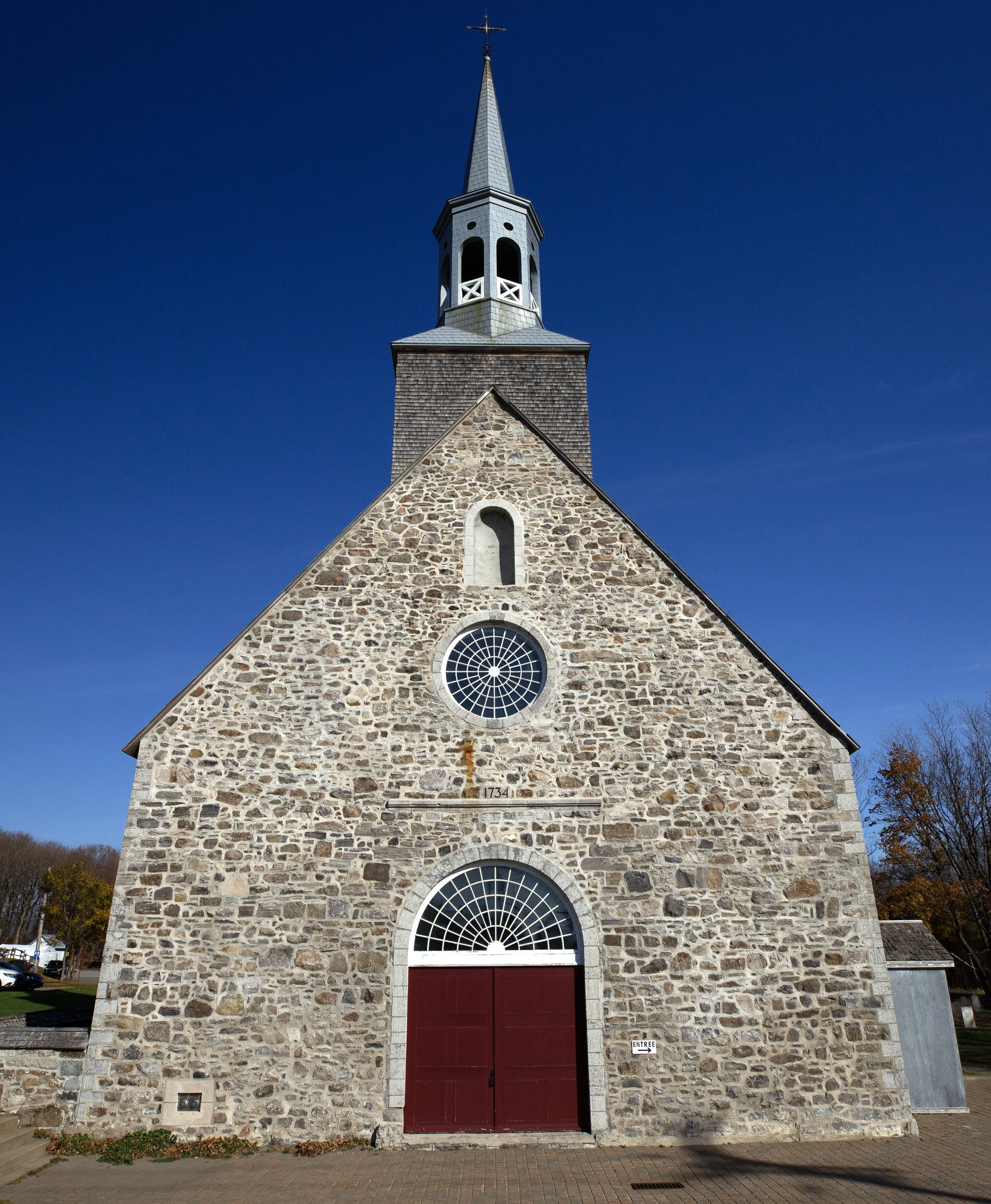
The parish church of Saint-François as it appears today (© The French-Canadian Genealogist)
Over two years later, on March 20, 1697, notary Étienne Jacob drew up another agreement between Nicolas and Marguerite and their son-in-law Jacques Baudon. The couple sold Jacques a plot of land and habitation in Saint-François measuring three arpents of frontage on the St. Lawrence River and extending inland approximately halfway across the island. The property lay between land retained by Nicolas and Marguerite and that of René Raymont [Émond]. Like the parcel conveyed to Jacques in 1694, it formed part of the original concession of five arpents and eight perches of frontage, granted sous seing privé by the Dames hospitalières of Québec’s Hôtel-Dieu. Jacques assumed responsibility for the seigneurial cens and rentes attached to the property. As in the earlier transaction, the purchase price was 300 livres. Nicolas also agreed to lend Jacques two oxen for the first ploughing, while the contract set out arrangements governing the use and produce of the land during the transition year.
In an appeal before the Conseil souverain on July 6, 1699, Thomas Asselin challenged an earlier judgment of the Prévôté de Québec ordering him to pay Nicolas 40 livres, plus costs, for cedar trees he had taken from Nicolas’s property. Nicolas was represented by his wife, assisted by LaCetière, while Thomas was represented by his brother Jacques Asselin. By agreement of the parties, the Council set aside the earlier judgment and ordered Thomas to pay Nicolas 30 livres in total, covering both the value of the trees and legal costs.
On March 27, 1708, Nicolas and Marguerite donated two arpents of land in the parish of Saint-François on Île-d’Orléans to their son Joseph, with the consent and agreement of their other children and sons-in-law. Nicolas is described as “having been blind for several years,” aged seventy-five. Joseph agreed to care for his parents for the rest of their lives by feeding, supporting, housing, and providing heat for them. He also pledged to care for them when sick and provide them with medication. He would be responsible for the land’s cens and rente payments going forward and agreed to have his parents buried upon their deaths. Each Verieul child promised to have two Masses said for the repose of their parents’ souls. Despite his blindness, Nicolas still managed to sign the document, albeit in an unsteady hand.
Deaths of Nicolas and Marguerite
Nicolas Verieul died at the age of 81. He was buried on October 11, 1714, in the parish cemetery of Saint-François on Île-d’Orléans.
His burial record reads:
“On October 11, 1714, I, the undersigned parish priest, buried Nicolas Verieulle, aged about eighty, in the parish cemetery, as he had not received the sacraments because he had fallen into childhood some time ago [...]”
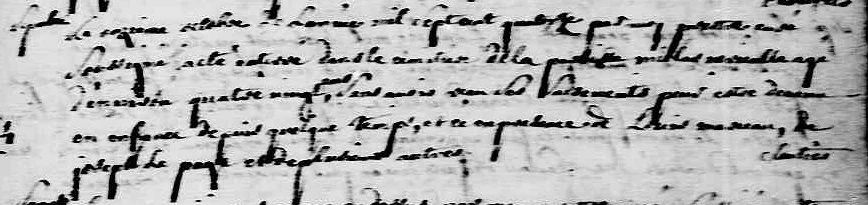
1714 burial of Nicolas Verieul (Généalogie Québec)
In seventeenth- and eighteenth-century French records, the expression être devenu en enfance was used to describe an elderly person who had lost some or all of their mental faculties, roughly corresponding to what would now be described as severe cognitive decline or dementia. It did not mean that the individual had literally returned to childhood, but rather that they were no longer considered capable of exercising normal judgment or reason.
Marguerite Hyardin died at the age of 74 on May 29, 1720. She was buried the following day in the parish cemetery of Saint-François on Île-d’Orléans. She was mistakenly recorded as being 90 years of age.
Her burial record reads:
“On the thirtieth day of May in the year one thousand seven hundred and twenty, I, the undersigned parish priest, buried Marguerite Hyardin, widow of Verieul, aged approximately ninety, in the parish cemetery; she had died the previous day after receiving all the sacraments [...]”

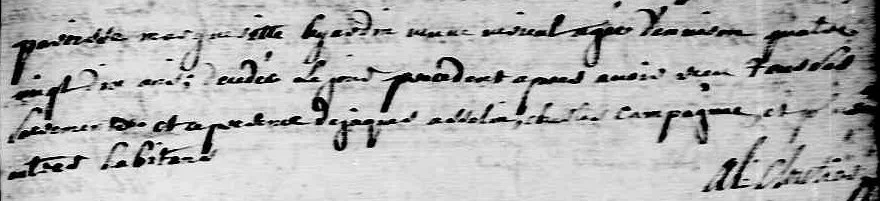
1720 burial of Marguerite Hyardin (Généalogie Québec)
Verieul Heritage
Several monuments and plaques commemorate the ancestors of the Veilleux family:
In 1994, the Association des familles Veilleux mounted a plaque dedicated to Marguerite in her hometown of Joinville, on rue Sprendlingen.
In 2003, the Association installed a monument and plaque in memory of Nicolas and Marguerite in Beaupré.
In 2011, in celebration of the 335th anniversary of Nicolas and Marguerite’s settlement on Île-d’Orléans, the Association unveiled a plaque on the grounds of the Maison de nos Aïeux in Sainte-Famille on Île-d’Orléans.
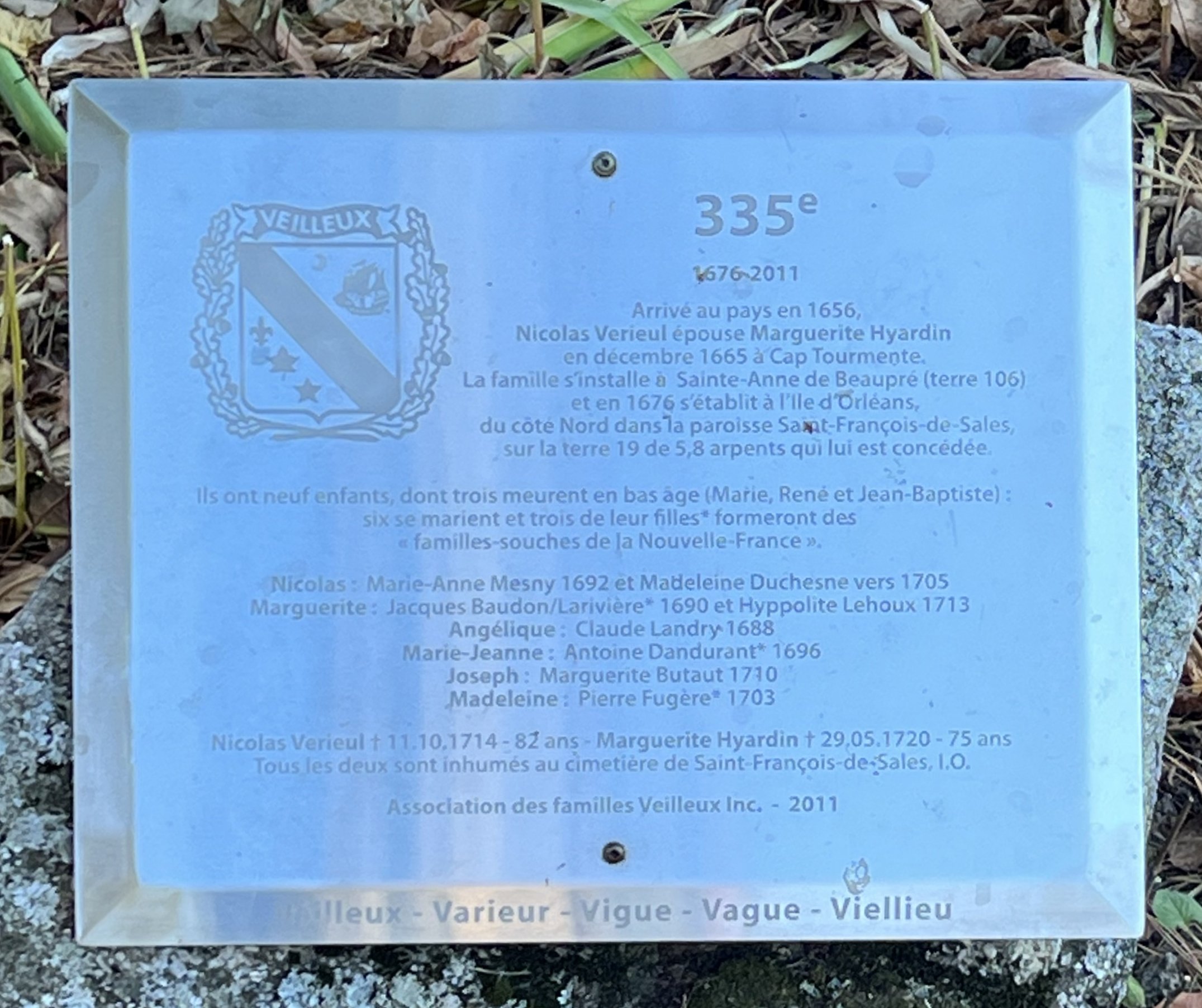
Plaque in Sainte-Famille (© The French-Canadian Genealogist)
The Veilleux Family Takes Root
Nicolas Verieul and Marguerite Hyardin came to New France from very different corners of France and under very different circumstances. Nicolas, a Norman sailor from the port of Dieppe, had already spent years establishing himself in the colony before Marguerite arrived from Champagne as a Fille du roi in 1665. Their marriage joined two individual migration stories into one of settlement, work and family building along the St. Lawrence.
Together they made their first home on the Côte de Beaupré before moving to Saint-François on Île-d’Orléans. Nicolas continued to earn his living through the river economy—as a sailor, boat captain, transporter and sawyer—while the couple acquired and transferred land, raised a large family and gradually secured a place for the next generation. By the end of their lives, the family they had established was firmly rooted in New France. From Nicolas and Marguerite descended the Veilleux families who would spread from Île-d’Orléans into the Beauce and, in later generations, far beyond Québec, leaving them an enduring place among the founding couples of French Canada.
PDF version of biography located at: https://www.tfcg.ca/nicolasverieul-and-marguerite-hyardin.
Are you enjoying our articles and resources? Show your support by making a donation. Every contribution, regardless of its size, goes a long way in covering our website hosting expenses and enables us to create more content related to French-Canadian genealogy and history. Thank you! Merci!
Sources:
État civil, Dieppe, registre paroissial, "Dieppe - 01/01/1629-31/12/1634 (paroisse Saint-Jacques)," digital images, Archives départementales de la Seine-Maritime (https://www.archivesdepartementales76.net/ark:/50278/e210c7d9f930977f39d352725b6054dd/img:AD76_EC_8Mi0101_R1_01_0315 : accessed 31 Aug 2026), baptism of Nicolas Vérieul, 17 Oct 1632, image 43 of 68, reference 4 E 240.
"Joinville : Baptêmes (Notre-Dame) 1626-1655," digital images, Archives départementales de la Haute Marne (https://recherche.archives.haute-marne.fr/viewer/series/E/Edepot/AD52_Edepot16479_01/?img=AD52_Edepot16479_01_0178.jpg : accessed 1 Sep 2026), baptism of Margueritte Yardin, 30 Aug 1645, Joinville (Notre-Dame), image 178 of 254.
"Joinville : Mariages, sépultures (Notre-Dame) 1608-1657," digital images, Archives départementales de la Haute Marne (https://recherche.archives.haute-marne.fr/viewer/series/E/Edepot/AD52_Edepot16480_01/?img=AD52_Edepot16480_01_0040.jpg : accessed 8 Sep 2026), marriage of René Yardin and Jeanne Sarrey, 15 Oct 1644, Joinville (Notre-Dame), image 40 of 100.
"Joinville : Mariages, sépultures (Notre-Dame) 1608-1657," digital images, Archives départementales de la Haute Marne (https://recherche.archives.haute-marne.fr/viewer/series/E/Edepot/AD52_Edepot16480_02/?img=AD52_Edepot16480_02_0033.jpg : accessed 8 Sep 2026), burial of René Yardin, 25 Jan 1646, Joinville (Notre-Dame), image 33 of 42.
“Le LAFRANCE (Baptêmes, Mariages, Sépultures)," database and digital images, Généalogie Québec. (https://www.genealogiequebec.com/Membership/LAFRANCE/acte/30162 : accessed 2 Sep 2026), marriage of Nicolas VERDIEUX and Marguerite QUERDIN, Dec 1665, Château-Richer (La-Visitation-de-Notre-Dame); citing original data: Institut généalogique Drouin.
“Le LAFRANCE (Baptêmes, Mariages, Sépultures)," database and digital images, Généalogie Québec. (https://www.genealogiequebec.com/Membership/LAFRANCE/acte/37963 : accessed 7 Sep 2026), burial of Nicolas VERIEULLE, 11 Oct 1714, St-François (Île d'Orléans); citing original data: Institut généalogique Drouin.
“Le LAFRANCE (Baptêmes, Mariages, Sépultures)," database and digital images, Généalogie Québec. (https://www.genealogiequebec.com/Membership/LAFRANCE/acte/38009 : accessed 7 Sep 2026), burial of Marguerite HYARDIN, 30 May 1720, St-François (Île d'Orléans); citing original data: Institut généalogique Drouin.
"Registre des confirmations 1649-1662," digital images, Généalogie Québec (https://www.genealogiequebec.com/membership/fr/fonds-drouin/REGISTRES : accessed 31 Aug 2026), confirmation of Nicolas Verieul, 2 Feb 1660, Château-Richer; citing original data: Registre des confirmations, Diocèse de Québec, Registres du Fonds Drouin.
"Actes de notaire, 1653-1659 // Jean-Baptiste Peuvret," digital images, FamilySearch (https://www.familysearch.org/ark:/61903/3:1:3Q9M-CSVN-Q8JW?cat=koha%3A1176009&view=explore&lang=en&groupId=M9DC-CWH : accessed 31 Aug 2026), agreement between Pierre Enjouys de St Jacques and Nicolas Verieul, 25 Apr 1659, images 996-997 of 2056 ; citing original data: Bibliothèque et Archives nationales du Québec.
"Actes de notaire, 1652-1692 // Claude Auber," digital images, FamilySearch (https://www.familysearch.org/ark:/61903/3:1:3QHV-R3L2-697P-W?cat=koha%3A1175225&view=explore&lang=en&groupId=TH-7765-100513-27662-88 : accessed 31 Aug 2026), donation by Nicolas Verieul to Etienne de Lessard, 18 Mar 1660, image 203 of 1368; citing original data: Bibliothèque et Archives nationales du Québec.
"Actes de notaire, 1652-1692 // Claude Auber," digital images, FamilySearch (https://www.familysearch.org/ark:/61903/3:1:3QHV-R3L2-697C-X?cat=koha%3A1175225&view=explore&lang=en&groupId=TH-7765-100513-27662-88 : accessed 1 Sep 2026), transfer of grain by Nicolas Verieul to Richard du Mesnil, 26 Jun 1660, image 217 of 1368; citing original data: Bibliothèque et Archives nationales du Québec.
"Actes de notaire, 1634, 1649-1663 // Guillaume Audouart," digital images, FamilySearch (https://www.familysearch.org/ark:/61903/3:1:3QHV-J3DQ-J9S6-1?cat=koha%3A1171569&view=explore&lang=en&groupId=TH-7758-91937-30238-21 : accessed 1 Sep 2026), power of attorney by Nicolas Verieul to Mathieu d’Amours sieur des Chaufour, 18 May 1662, image 895 of 1431; citing original data: Bibliothèque et Archives nationales du Québec.
"Actes de notaire, 1634, 1649-1663 // Guillaume Audouart," digital images, FamilySearch (https://www.familysearch.org/ark:/61903/3:1:3QHV-V3DQ-J93Y-J?cat=koha%3A1171569&view=explore&lang=en&groupId=TH-7758-91937-30238-21 : accessed 1 Sep 2026), obligation by Nicolas Chavigneau to Nicolas Voidiou, 11 Aug 1662, images 1014-1015 of 1431; citing original data: Bibliothèque et Archives nationales du Québec.
"Actes de notaire, 1634, 1649-1663 // Guillaume Audouart," digital images, FamilySearch (https://www.familysearch.org/ark:/61903/3:1:3QHV-J3DQ-J9QT-S?cat=koha%3A1171569&view=explore&lang=en&groupId=TH-7758-91937-30238-21 : accessed 1 Sep 2026), land purchase by Nicolas Veydieu and Richard Dumesnyl from Louis Gagnier, 25 Apr 1663, images 1290-1292 of 1431; citing original data: Bibliothèque et Archives nationales du Québec.
"Actes de notaire, 1660-1688 // Michel Fillion," digital images, FamilySearch (https://www.familysearch.org/ark:/61903/3:1:3Q9M-CSVN-QZ77?cat=koha%3A1176077&view=explore&lang=en&groupId=M9DC-CW6 : accessed 1 Sep 2026), land concession to Nicolas Verieul and Richard Dumesnil, 23 Mar 1664, image 1497 of 2056; citing original data: Bibliothèque et Archives nationales du Québec.
"Actes de notaire, 1652-1692 // Claude Auber," digital images, FamilySearch (https://www.familysearch.org/ark:/61903/3:1:3QHV-R3L2-69QH-T?cat=koha%3A1175225&view=explore&lang=en&groupId=TH-7765-100513-27662-88 : accessed 31 Aug 2026), transaction between Jean Picard and Richard Dumesnil, acting on behalf of Nicolas Verieul, 19 Apr 1664, images 495-496 of 1368; citing original data: Bibliothèque et Archives nationales du Québec.
"Actes de notaire, 1652-1692 // Claude Auber," digital images, FamilySearch (https://www.familysearch.org/ark:/61903/3:1:3QHV-53L2-699M-G?cat=koha%3A1175225&view=explore&lang=en&groupId=TH-7765-100513-27662-88 : accessed 2 Sep 2026), marriage contract of Nicollas Verieul and Marguerite Yerdain, 5 Oct 1665, images 628-629 of 1368; citing original data: Bibliothèque et Archives nationales du Québec.
"Actes de notaire, 1652-1692 // Claude Auber," digital images, FamilySearch (https://www.familysearch.org/ark:/61903/3:1:3QHV-R3L2-69SN-P?cat=koha%3A1175225&view=explore&lang=en&groupId=TH-7765-100513-27662-88 : accessed 2 Sep 2026), division of land between Richard Dumesnil and Nicolas Verieul, 3 Apr 1666, images 713-714 of 1368; citing original data: Bibliothèque et Archives nationales du Québec.
"Archives de notaire : Romain Becquet (1665-1682)," digital images, Bibliothèque et Archives nationales du Québec (https://numerique.banq.qc.ca/patrimoine/details/52327/4064891?docref=HfezI4_cGA3t1kgSQJ52KA : accessed 3 Sep 2026), transfer of rights in the boat named “La Ste Anne” from Jacques Lesot to Nicolas Verieul, 17 Jul 1672, folder “14 avril 1671 - 31 octobre 1672,” images 577-578 of 881.
"Archives de notaire : Paul Vachon (1655-1693)," digital images, Bibliothèque et Archives nationales du Québec (https://numerique.banq.qc.ca/patrimoine/details/52327/4215636?docref=-hId2k2lvLSSc_5YVA1ajg : accessed 3 Sep 2026), obligation of Nicolas Verieul to Jean Picard, 22 Dec 1673, images 70-71 of 1185.
"Archives de notaire : Romain Becquet (1665-1682)," digital images, Bibliothèque et Archives nationales du Québec (https://numerique.banq.qc.ca/patrimoine/details/52327/4064893?docref=367MOObbHuT4ufaHU-gZ1Q : accessed 3 Sep 2026), land sale by Nicolas Verieul and Marguerite Yarden to Jean Gaignon, 22 Mar 1676, folder " 5 septembre 1675 - 31 octobre 1678," image 120 of 881.
"Archives de notaire : Gilles Rageot (1666-1691)," digital images, Bibliothèque et Archives nationales du Québec (https://numerique.banq.qc.ca/patrimoine/details/52327/4083921?docref=AbUKi9iWFZ9JG5TYCBSZPA : accessed 3 Sep 2026), contract for the transport of stones between Louis Rouer de Villeray and Nicolas Verieul, 6 Mar 1683, folder "7 avril 1681 - 15 mars 1685," image 568 of 1169.
"Archives de notaire : Gilles Rageot (1666-1691)," digital images, Bibliothèque et Archives nationales du Québec (https://numerique.banq.qc.ca/patrimoine/details/52327/4083921?docref=1gpFCuiGBQcJEMgYd6T_vA : accessed 3 Sep 2026), settling of accounts between Nicolas Verieul and Jean Roulleau, 30 Jul 1683, folder "7 avril 1681 - 15 mars 1685," image 699 of 1169.
"Actes de notaire, 1663-1687 // Pierre Duquet," digital images, FamilySearch (https://www.familysearch.org/ark:/61903/3:1:3Q9M-CSTC-P9R2-5?cat=koha%3A1175224&view=explore&lang=en&groupId=TH-909-77693-47912-69 : accessed 3 Sep 2026), boat lease by Jean Picard to Nicolas Verieul, 11 Mar 1684, images 1937-1938 of 2640; citing original data: Bibliothèque et Archives nationales du Québec.
"Actes de notaire, 1666-1691 // Gilles Rageot," digital images, FamilySearch (https://www.familysearch.org/ark:/61903/3:1:3QHV-L3NF-49W8-2?cat=koha%3A1171570&view=explore&lang=en&groupId=TH-7761-95857-32193-21 : accessed 3 Sep 2026), wood delivery contract between Jean Gitton, and Nicolas Verieul, Joseph Bonneau dit Labécasse and Nicolas Menanteau, 27 Oct 1684, images 605-607 of 1327; citing original data: Bibliothèque et Archives nationales du Québec.
"Actes de notaire, 1682-1709 // François Genaple," digital images, FamilySearch (https://www.familysearch.org/ark:/61903/3:1:3Q9M-CS56-LQP9-4?cat=koha%3A1168969&view=explore&lang=en&groupId=TH-909-76011-123237-36 : accessed 4 Sep 2026), wood delivery contract between Jacques de Meulles, and Nicolas Verieul, Joseph Bonneau and Nicolas Menanteau, 3 Feb 1685, images 895-896 of 3419; citing original data: Bibliothèque et Archives nationales du Québec.
"Actes de notaire, 1666-1691 // Gilles Rageot," digital images, FamilySearch (https://www.familysearch.org/ark:/61903/3:1:3QHV-P3NF-498Y-Q?cat=koha%3A1171570&view=explore&lang=en&groupId=TH-7761-95857-32193-21 : accessed 4 Sep 2026), domestic service contract between Marguerite Verieul, daughter of Nicolas Verieul, and Mathieu de Linot and Catherine Nolan, 6 Nov 1686, image 1316 of 1327; citing original data: Bibliothèque et Archives nationales du Québec.
"Actes de notaire, 1666-1691 // Gilles Rageot," digital images, FamilySearch (https://www.familysearch.org/ark:/61903/3:1:3QHV-L3NF-4922-X?cat=koha%3A1171570&view=explore&lang=en&groupId=TH-7763-95857-44837-1 : accessed 4 Sep 2026), boat purchase by Nicolas Verieul from Pierre Asseline, 10 Jun 1688, images 552-553 of 1370; citing original data: Bibliothèque et Archives nationales du Québec.
"Actes de notaire, 1666-1691 // Gilles Rageot," digital images, FamilySearch (https://www.familysearch.org/ark:/61903/3:1:3QHV-P3NF-49L9-Y?cat=koha%3A1171570&view=explore&lang=en&groupId=TH-7763-95857-44837-1 : accessed 4 Sep 2026), boat purchase by Nicolas Verieul from René Bauché, 20 Jun 1688, images 564-565 of 1370; citing original data: Bibliothèque et Archives nationales du Québec.
"Actes de notaire, 1666-1691 // Gilles Rageot," digital images, FamilySearch (https://www.familysearch.org/ark:/61903/3:1:3QHV-P3NF-4956-Y?cat=koha%3A1171570&view=explore&lang=en&groupId=TH-7763-95857-44837-1 : accessed 4 Sep 2026), sale of rights to a French rente by Nicolas Verieul and Marguerite Hiardin to Jean Lepicart and Lucien Boutteville, 26 Sep 1688, images 707-708 of 1370; citing original data: Bibliothèque et Archives nationales du Québec.
"Actes de notaire, 1692-1716 // Louis Chambalon," digital images, FamilySearch (https://www.familysearch.org/ark:/61903/3:1:3Q9M-CS56-LW9H?cat=koha%3A1170051&view=explore&lang=en&groupId=TH-909-76011-4955-47 : accessed 7 Sep 2026), land sale by Nicolas Verieul and Marguerite Hyardin to Jacques Baudon, 11 Nov 1694, images 2076-2078 of 3409; citing original data: Bibliothèque et Archives nationales du Québec.
"Actes de notaire, 1680-1726 // Etienne Jacob," digital images, FamilySearch (https://www.familysearch.org/ark:/61903/3:1:3QHV-L3NX-WRK?cat=koha%3A678814&view=explore&lang=en&groupId=M9DC-S3J : accessed 7 Sep 2026), land sale by Nicolas Verieul and Marguerite Hyardin to Jacques Baudon, 20 Mar 1697, images 2056-2059 of 3044; citing original data: Bibliothèque et Archives nationales du Québec.
"Actes de notaire, 1680-1726 // Etienne Jacob," digital images, FamilySearch (https://www.familysearch.org/ark:/61903/3:1:3QHV-R3LD-D9CR-5?cat=koha%3A678814&view=explore&lang=en&groupId=M9DC-SCN : accessed 7 Sep 2026), donation by Nicolas Verieul and Marguerite des Yardins to Joseph Verieul, 27 Mar 1708, images 231-233 of 2869; citing original data: Bibliothèque et Archives nationales du Québec.
“Quebec, Canada, Vital and Church Records (Drouin Collection), 1621-1968,” digital images, Ancestry (https://www.ancestry.ca/imageviewer/collections/1091/images/d13p_31480069?usePUB=true&_phsrc=Tap10144 : accessed 8 Sep 2026), Hôtel-Dieu patient register, entry for Marguerite Jourdin, Jul 1692; citing original data: Drouin Collection, Institut Généalogique Drouin, Montréal.
"Fonds Conseil souverain - Archives nationales à Québec," digital images, Bibliothèque et Archives nationales du Québec (https://advitam.banq.qc.ca/notice/406384 : accessed 7 Sep 2026), "Jugement qui met une sentence de la Prévôté de Québec au néant, entre Thomas Asselin, habitant de l'île et comté de Saint-Laurent et Nicolas Vérieul (Vérieu, Veilleux), habitant du même lieu," 6 Jul 1699, reference TP1,S28,P6296, Id 406384.
"Recensement du Canada, 1666," digital images, Library and Archives Canada (https://recherche-collection-search.bac-lac.gc.ca/fra/accueil/notice?idnumber=2318856&app=fonandcol : accessed 2 Sep 2026), entries for Nicolas Vivier and Marguerite Guyardin, 1666, Beaupré, pages 63-64 (of PDF), Finding aid no. MSS0446, MIKAN no. 2318856; citing original data: Centre des archives d'outre-mer (France) vol. 460.
"Recensement du Canada, 1667," digital images, Library and Archives Canada (https://www.bac-lac.gc.ca/eng/CollectionSearch/Pages/record.aspx?app=fonandcol&IdNumber=2318857&new=-8585951843764033676 : accessed 2 Sep 2026), household of Nicolas Verieul, 1667, Beaupré, page 152 (of PDF), Finding aid no. MSS0446, Item ID number: 2318857; citing original data: Centre des archives d'outre-mer (France) vol. 460.
"Recensement du Canada fait par l'intendant Du Chesneau," digital images, Library and Archives Canada (https://www.bac-lac.gc.ca/eng/CollectionSearch/Pages/record.aspx?app=fonandcol&IdNumber=2318858&new=-8585855146497784530 : accessed 3 Sep 2026), household of Nicolas Verieu, 14 Nov 1681, Île-d’Orléans, page 335 (of PDF), Finding aid no. MSS0446, MIKAN no. 2318858; citing original data: Centre des archives d'outre-mer (France) vol. 460.
Fédération québécoise des sociétés de généalogie, Fichier Origine online database (https://www.fichierorigine.com/fr/repertoire/veilleux/-verieul : accessed 31 Aug 2026), entry for Nicolas VEILLEUX / VÉRIEUL (person 244051), updated on 18 Jan 2026.
Fédération québécoise des sociétés de généalogie, Fichier Origine online database (https://www.fichierorigine.com/fr/repertoire/hiardin/-hyardin/-yardin : accessed 1 Sep 2026), entry for Marguerite HIARDIN / HYARDIN / YARDIN (person 242060), updated on 19 Jun 2020.
Université de Montréal, Programme de recherche en démographie historique (PRDH) online database (https://www-prdh-igd-com.res.banq.qc.ca/Membership/en/PRDH/Famille/2027 : accessed 2 Sep 2026), dictionary entry for Nicolas VERIEUL and Marguerite HYARDIN, union 2027.
Claude Le May, adaptation, “La vie de Nicolas Vérieul, ancêtre des familles Veilleux,” L’Ancêtre 31, number 4 (summer 2005): 313–318, Société de généalogie de Québec (https://www.sgq.qc.ca/client_file/upload/L-Ancetre/Les-premieres-annees/V31-N04.pdf : accessed 31 Aug 2026); adapted from texts by Suzanne Veilleux and Wilfrid E. Varieur.
Gilles Brassard, Conversations avec mes ancêtres (https://conversationsancetres.wordpress.com/tag/nicolas-verieul/ : accessed 8 Sep 2026).
Raoul Clouthier, Les CLOUTIER de Mortagne-au-Perche en France et leurs descendants au Canada: essai de généalogie portant sur la lignée de Raoul Clouthier et de sa famille (research, compilation and writing completed Jan 1973; digitized by Pierre Cloutier, 2002), 131–132, online PDF (https://kyber.ca/downloads/clouHist.pdf : accessed 3 Sep 2026), transcription and discussion of the 7 Mar 1676 sale by Nicolas Verieul and Marguerite Hyardin to Jean Cloutier.
Christopher Moore, "Making it Count," Canada's History (https://www.canadashistory.ca/explore/business-industry/making-it-count), posted online 12 Mar 2021; original appeared in the Apr-May 2021 issue of Canada's History.
"Maison Louis-Fornel," Répertoire du patrimoine culturel du Québec (https://www.patrimoine-culturel.gouv.qc.ca/rpcq/detail.do?methode=consulter&id=92647&type=bien : accessed 3 Sep 2026), Ministère de la Culture et des Communications, Gouvernement du Québec.


