The Sailor in New France
Discover the world of the matelot in New France and learn how sailors worked, trained and lived aboard vessels ranging from small chaloupes to ocean-going ships. This article explores their duties, maritime skills, wages and contracts, crew hierarchy, discipline, working conditions, fishing and coastal trade, as well as the dangers of life at sea.
Cliquez ici pour la version française
Le matelot | The Sailor
The matelot, or sailor, was a seaman responsible for helping to navigate and manoeuvre a vessel, working under the authority of the pilote, or pilot. The term could also refer to one of two sailors paired by the captain, each expected to assist his companion in all circumstances, in life and in death.
The Many Lives of a Sailor
The word matelot identifies a man’s occupation, but it does not by itself tell us what his working life looked like. Sailors served on vessels of widely varying sizes, travelled very different distances, and worked in several distinct branches of the maritime economy. A man carrying goods between neighbouring ports might spend only a few days away from home, while another could be at sea for months on an Atlantic voyage. Others worked seasonally in the fisheries or served aboard the king’s warships.
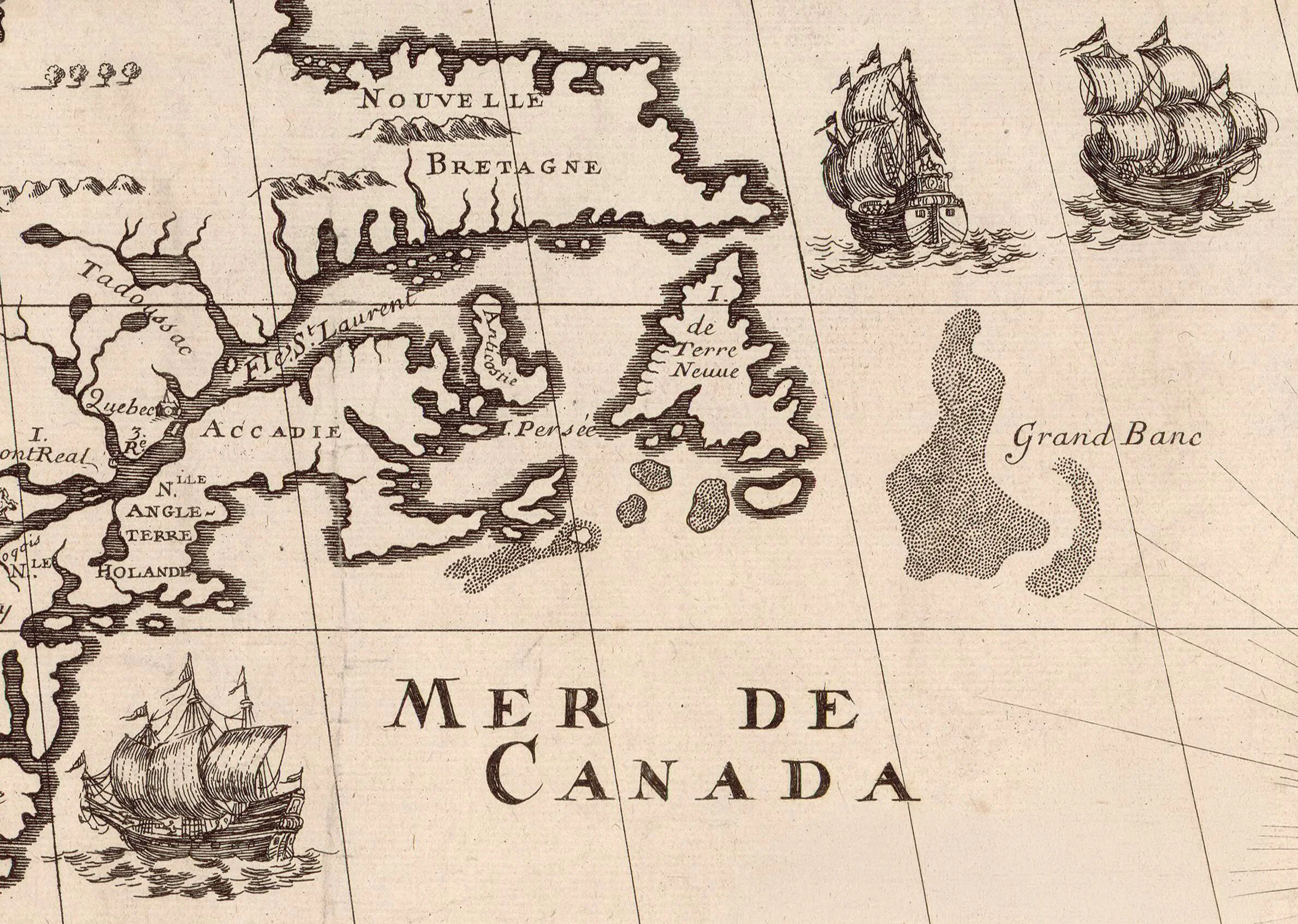
Detail from 1683 Map of New France and Louisiana by Louis Hennepin (Bibliothèque nationale de France)
Coastal and river navigation, or cabotage, involved the movement of people and merchandise over comparatively short distances. Much of this traffic was conducted aboard small vessels. A sailor might help handle the sails and rigging, steer, anchor and moor the vessel, load and unload cargo, shift ballast, operate pumps, and perform whatever maintenance was required. Because these voyages generally remained relatively close to shore, working conditions could be very different from those experienced on an ocean crossing.
Long-distance merchant shipping also employed some sailors living in New France. As the colony's maritime economy developed, vessels sailed from Québec to destinations such as Île Royale, the Antilles and occasionally France. By the eighteenth century, Canadian-born men could make careers in this trade as sailors, pilots and ship captains, although the colony's seafaring population remained relatively small and many merchant vessels continued to arrive from France with their own crews. Longer voyages could keep sailors away from home for weeks or months and expose them to storms, shipwreck, disease and the other hazards of extended travel at sea.
Fishing formed another important branch of maritime employment in New France. Some men fished in the St. Lawrence and its estuary, while others were employed in the developing commercial cod fisheries of the Gulf, particularly in places such as Gaspé, Percé, Mont-Louis and along the Labrador coast. By the eighteenth century, fishermen recruited in Québec and surrounding communities, including the Côte-du-Sud, supplied a significant part of the colonial fishing workforce. These men combined ordinary seamanship with the specialized work involved in catching, handling and preparing fish for preservation and sale.
Naval and wartime service also provided employment for men with maritime skills living in New France. Canadian-born men served in the French royal navy, while colonial sailors could be employed aboard supply and escort vessels, privateers and locally organized armed craft, particularly during periods of war.
These categories were not separate professions with fixed boundaries. Maritime employment was often seasonal and opportunistic. During his working life, the same man might sail on a merchant vessel, participate in a fishing voyage, work in coastal transport and later serve aboard a naval ship. He might also alternate maritime employment with work ashore.
For this reason, the occupation of matelot should not automatically conjure the image of a man spending his life aboard a large ocean-going sailing ship. It indicates instead that he possessed a set of practical maritime skills. His actual experience depended upon the vessel on which he served, the waters in which it sailed, the purpose and duration of the voyage, and the terms under which he had been hired.
Additionally, occupational terminology was not necessarily consistent throughout a man’s life: the same individual might be described in different records as a matelot, navigateur, or by a more specialized maritime rank as his experience and responsibilities changed.
Where Did the Sailor Stand in the Crew Hierarchy?
The matelot occupied the working level of a ship’s hierarchy, below the officers responsible for command and navigation. The capitaine (captain), maître (master) or patron (skipper) exercised overall authority; the pilote (pilot) was responsible for navigation; and the contre-maître or nocher (boatswain) supervised much of the vessel’s day-to-day handling and the work of the crew. The sailors carried out the practical labour required to sail and maintain the vessel, working under the direction of these officers. The 1681 Ordonnance de la Marine reflects this structure by treating the captain, pilot, boatswain and matelots as distinct ranks or functions within the ship’s company.
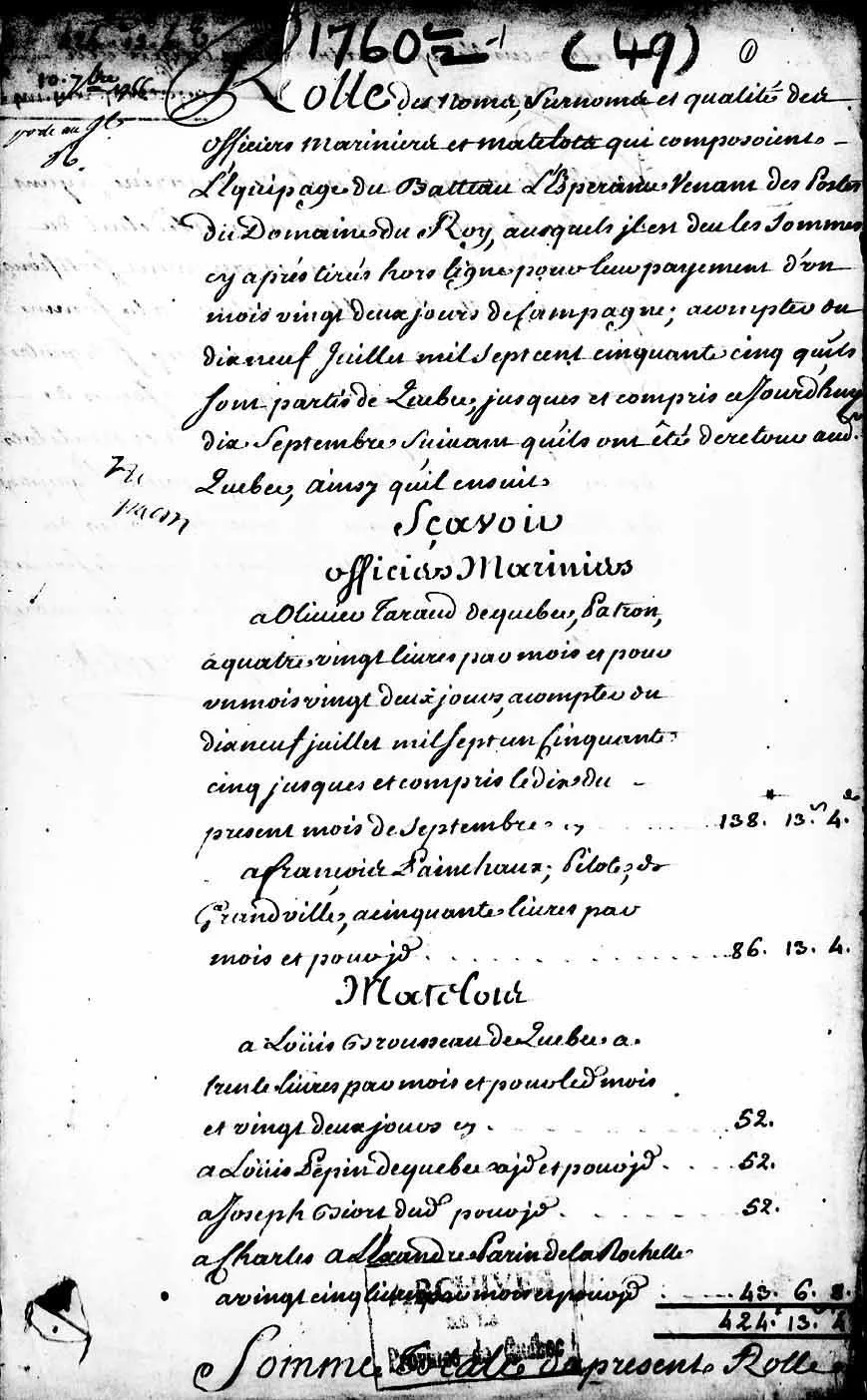
1755 roll of names, nicknames and ranks of the petty officers and sailors aboard L’Espérance, returning from the trading posts of the Domaine du Roi. The sailors were Louis Brousseau, Louis Pépin and Joseph Biort, all from Québec, and Charles-Alexandre Parin from La Rochelle. (Bibliothèque et Archives nationales du Québec)
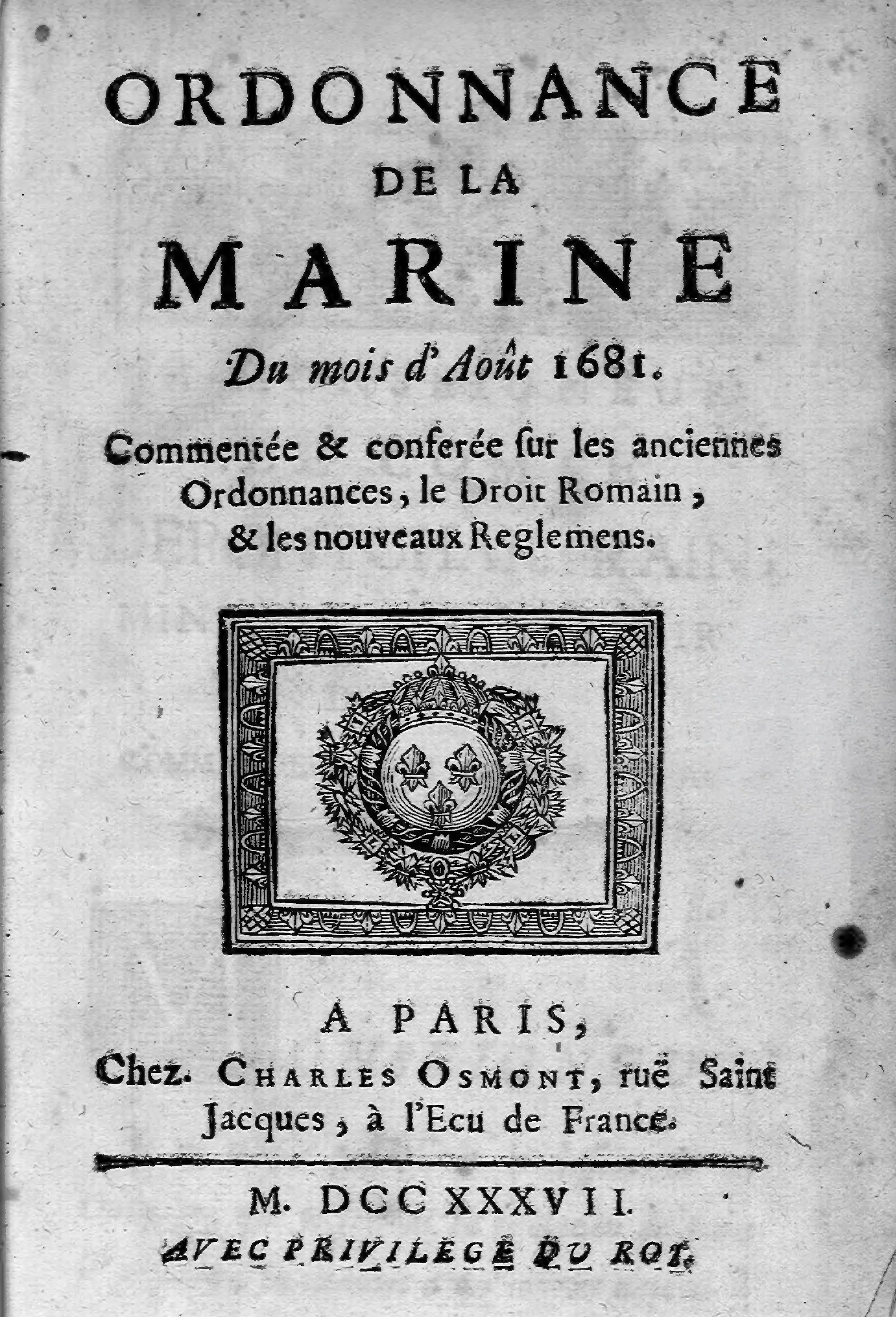
Louis XIV’s Ordonnance de la Marine du mois d’août 1681 (Wikimedia Commons)
What Work Did a Matelot Actually Perform?
The work of a sailor was physical, varied and skilled. Depending on the vessel and his particular assignment, a sailor helped handle and adjust the sails, yards, ropes and rigging; raise and drop anchor; steer when directed; operate pumps and remove water; move cargo and ballast; and carry out the routine maintenance necessary to keep the vessel seaworthy. He might also row or handle smaller boats used to reach shore or move between vessels. Much of this work required sailors to respond quickly and collectively when changes in wind, current or weather demanded a sudden manoeuvre. A sailor was therefore not simply an unskilled labourer: effective seamanship relied upon practical knowledge of rigging, ropes, sails and the handling of a vessel, acquired largely through experience at sea.
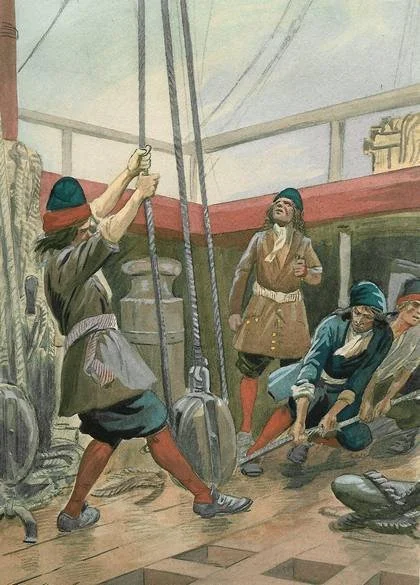
"French navy sailors, circa 1690" (Canadian Military History Gateway)
From Chaloupes to Ocean-Going Ships
Chaloupe — the essential small craft
The chaloupe à quille, or keel boat, was one of the most versatile small craft used in New France. Propelled by both sail and oars, it served as a harbour lighter and was widely used for river transport, cabotage and fishing. Because the St. Lawrence River formed the colony’s principal transportation corridor, chaloupes played an essential role in moving people and goods efficiently between settlements.
Physically, the chaloupe à quille was a substantial wooden craft built around a true keel and internal framing. Its hull was constructed with carvel planking, meaning that the wooden planks were fitted edge to edge to create a relatively smooth outer surface, and fastened to the structure with iron nails. Archaeological examples uncovered at Québec and dating to about 1740 show that these boats were considerably larger than a modern recreational rowboat: Québec river chaloupes could reach roughly 10 to 11 metres (33 to 36 feet) in length. Their shape, dimensions, construction and ability to use both sails and oars were adapted to the particular demands of navigation on the St. Lawrence, combining carrying capacity with the manoeuvrability required for river and coastal travel.
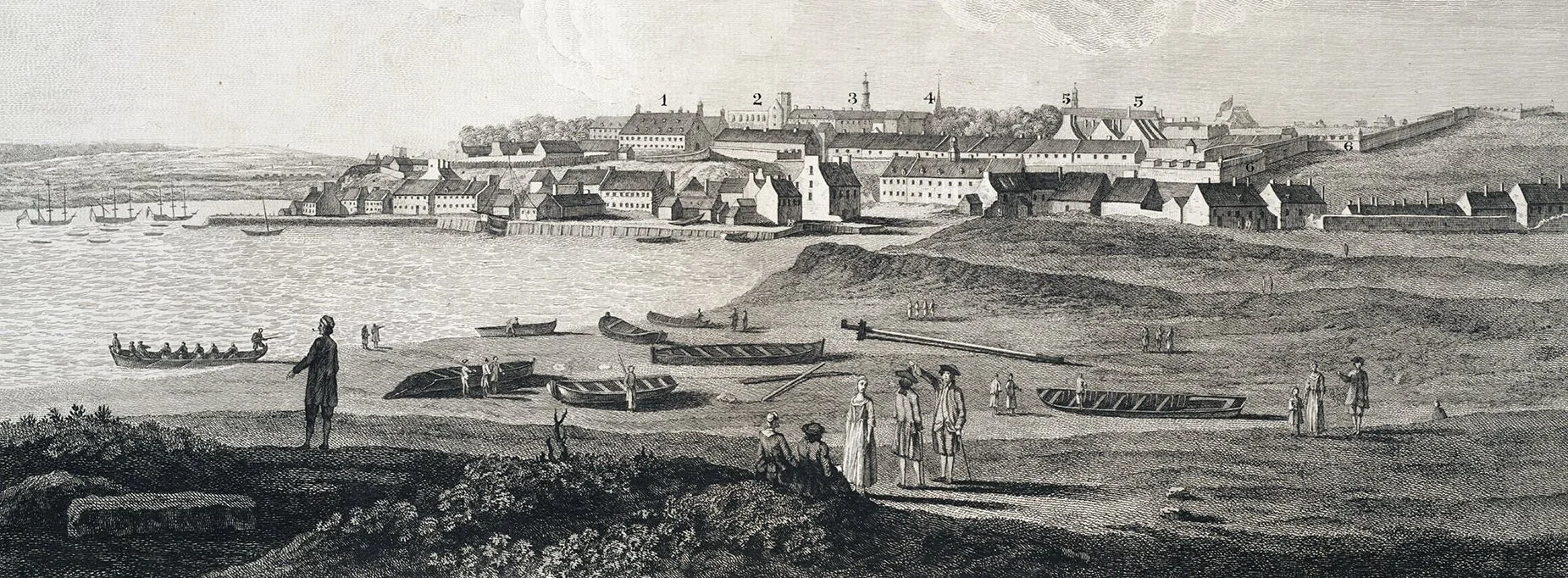
Detail from Richard Short’s “A View of the North West part of the City of Quebec, taken from St. Charles River,” 1761, showing multiple chaloupes on the shoreline (Wikimedia Commons)
Barque — a larger working vessel
The term barque was used rather broadly in New France and did not describe one rigidly standardized type of vessel. It could refer to a small open boat, but more substantial barques were decked sailing vessels used to transport people and goods along the St. Lawrence and elsewhere in the colony. In general, a barque offered greater carrying capacity and protection from the weather than the typically open chaloupe, while remaining far smaller than the large ships engaged in transatlantic navigation. Colonial barques could reach about 40 tons, commonly had a single deck and sometimes carried two masts. After about 1713, the term barque largely disappeared from Québec shipbuilding records and was replaced, within the same general size and functional category, by goélette and brigantin.
Goélette — a fast and versatile sailing vessel
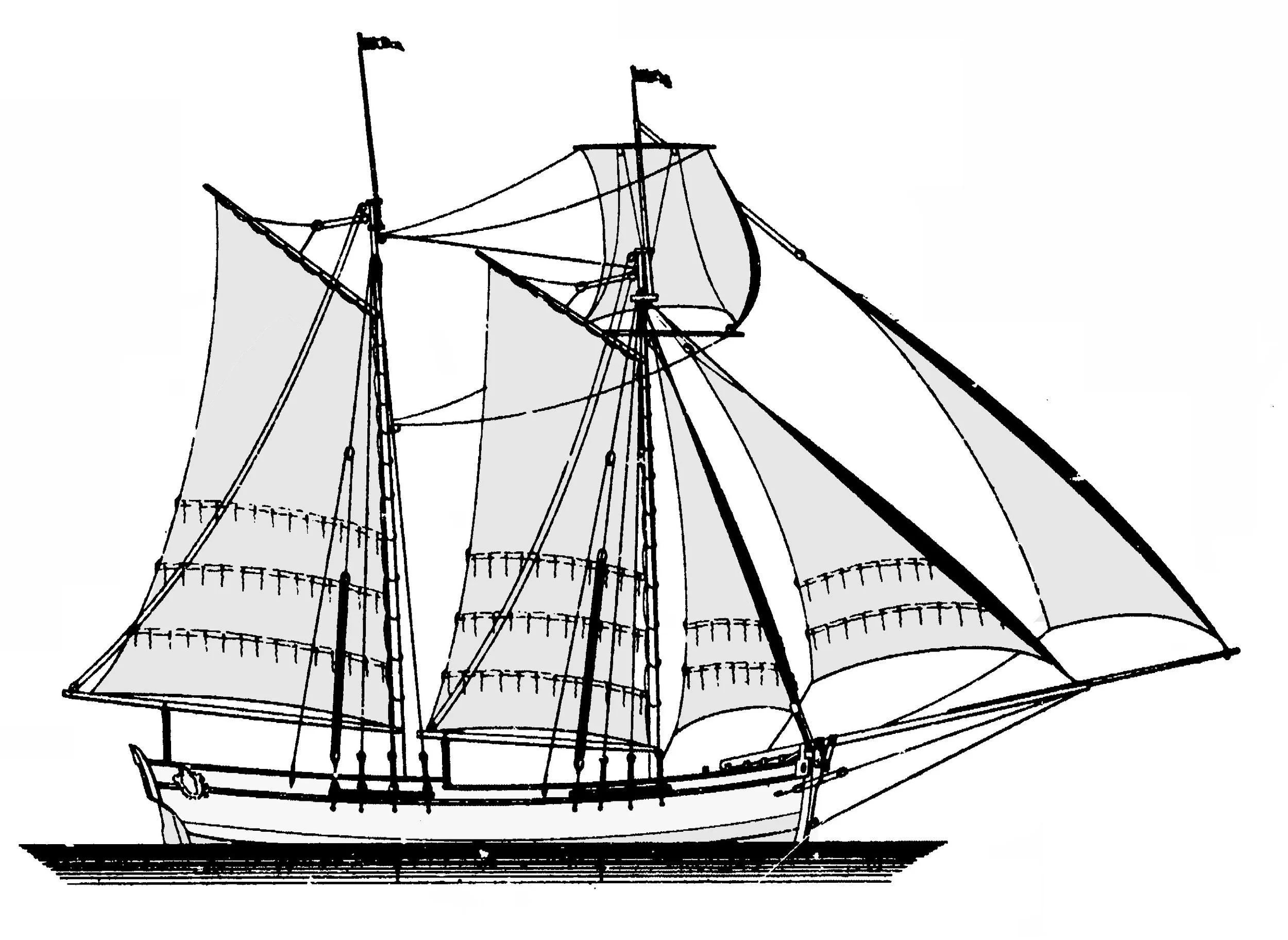
“Small schooner,” 1768 drawing by Fredrik Henrik af Chapman (Wikimedia Commons)
The goélette, or schooner, became increasingly common in New France during the eighteenth century, particularly for fishing, cabotage and coastal commerce. Unlike the more broadly defined barque, the term referred increasingly to a vessel distinguished by its rig: a goélette normally carried two masts with fore-and-aft sails, supplemented by a jib extending forward from the foremast. This arrangement made the vessel comparatively manoeuvrable and well suited to coastal waters. Contemporary descriptions give tonnages of about 50 to 60 tons for many goélettes, although examples in Île Royale [present-day Cape Breton Island] included vessels of about 30 to 50 tons. They could carry substantial cargoes while remaining small enough for regional trade and fishing operations.
Brigantin — a versatile small sailing vessel
The brigantin, or brigantine, became increasingly common in New France during the eighteenth century, when it joined the goélette among the vessel types replacing the older barque in Québec shipbuilding records. The term was not completely standardized: earlier brigantins could be relatively small, open craft propelled by both sails and oars, while by the eighteenth century the name was also being applied to larger sailing vessels used for commerce, transport and privateering. In New France, brigantins could therefore vary considerably in size and configuration. One built at Québec in 1736, the Saint-Michel, measured 68 tons and carried merchandise between Québec and Île Royale. Colonial brigantins were also used as armed vessels and privateers.
Flûte — a large ocean-going cargo vessel
The flûte was a large sailing vessel designed principally to carry cargo over long distances. Unlike the smaller chaloupe, barque, goélette and brigantin, it belonged to the world of ocean-going navigation and could carry substantial quantities of merchandise, provisions or military supplies. Its hull was broad and full, with relatively flat floors and rounded ends, creating a large hold for cargo. An eighteenth-century description gives a typical flûte a length of about 130 French feet, a width of roughly 26½ feet and a depth of about 13½ feet, although vessels varied considerably in size. The type was also used by the French navy for transporting troops and supplies. New France itself built flûtes: in 1739 construction began at Québec on the Canada, a flute of 500 tons.
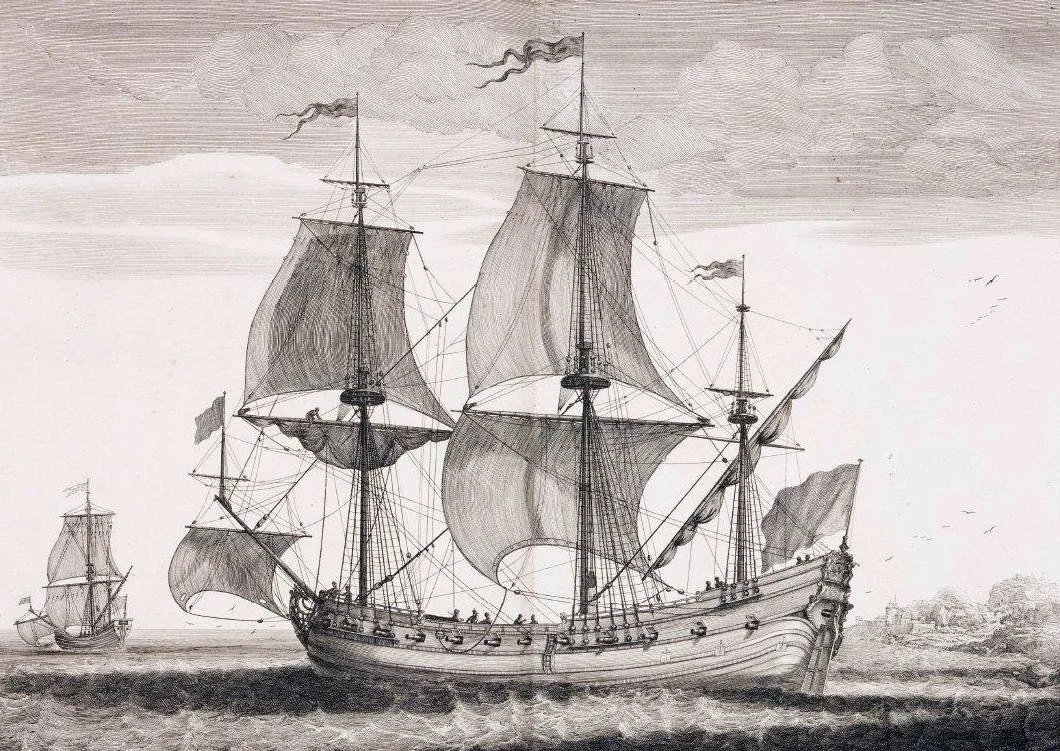
French royal flûte, by Henri Sbonski de Passebon, circa 1690 (Wikimedia Commons)
How Did a Man Become a Matelot?
For an ordinary sailor, learning the trade took place primarily aboard ship. A young boy might begin as a mousse (ship’s boy or apprentice sailor), while an older, inexperienced entrant was classed as a novice (apprentice sailor). These were not necessarily successive ranks: both represented periods of practical training before a sailor was recognized as a matelot. French maritime regulations attempted to formalize this progression, but the essential method remained learning “on the job,” through repeated voyages and work alongside experienced sailors. This system can also be seen in New France. In 1742, for example, a small vessel sent from Québec to the Îles de la Madeleine carried, alongside its captain, a fishing master, a ship’s carpenter, a cooper, five matelots and one mousse.
A sailor’s education was therefore largely experiential. By participating in the daily work of the crew, he gradually learned how to handle sails and rigging, work with ropes and knots, anchor and moor a vessel, steer, operate pumps, handle small boats and respond to changing wind and weather. Experience also brought familiarity with currents, tides, coastlines and the behaviour of different vessels. There was no single examination that transformed an inexperienced apprentice into an accomplished sailor: competence accumulated through time at sea, repetition and instruction from more experienced members of the crew.
With experience, some sailors went on to serve in positions of greater responsibility, such as boatswain, pilot, master or captain, although there was no single prescribed career path.
Hiring, Wages and the Terms of Service
A matelot might be hired for a particular voyage, a fixed number of months, the navigation season, or a longer engagement (a formal contract). The terms could specify not only his wages, but also the vessel aboard which he was to serve or the employer for whom he was to work, the duration and geographical limits of the work, when he would be paid, and sometimes additional compensation such as clothing or an advance on his wages. Surviving contracts from New France show that there was no single standard arrangement.
One particularly detailed example is the 1659 engagement of Nicolas Vérieul. He agreed to serve Pierre Enjouys and his associates aboard a chaloupe for four months at 27 livres per month. In addition to his wages, Enjouys promised him a pair of French shoes for the duration of the engagement. The shoes may seem like a minor detail, but they illustrate how compensation could extend beyond a simple cash wage.
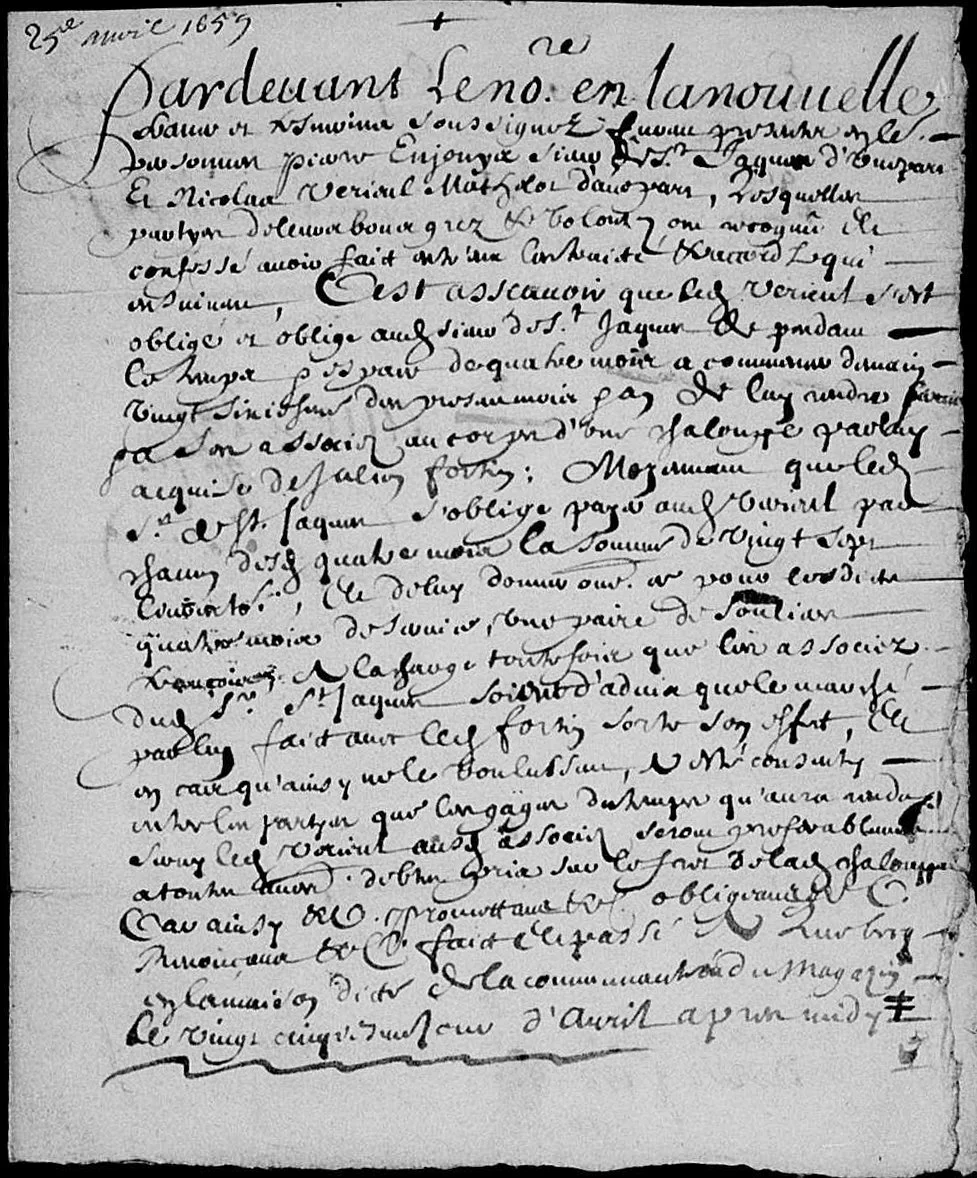
Page one of Nicolas Vérieul’s 1659 engagement (FamilySearch)
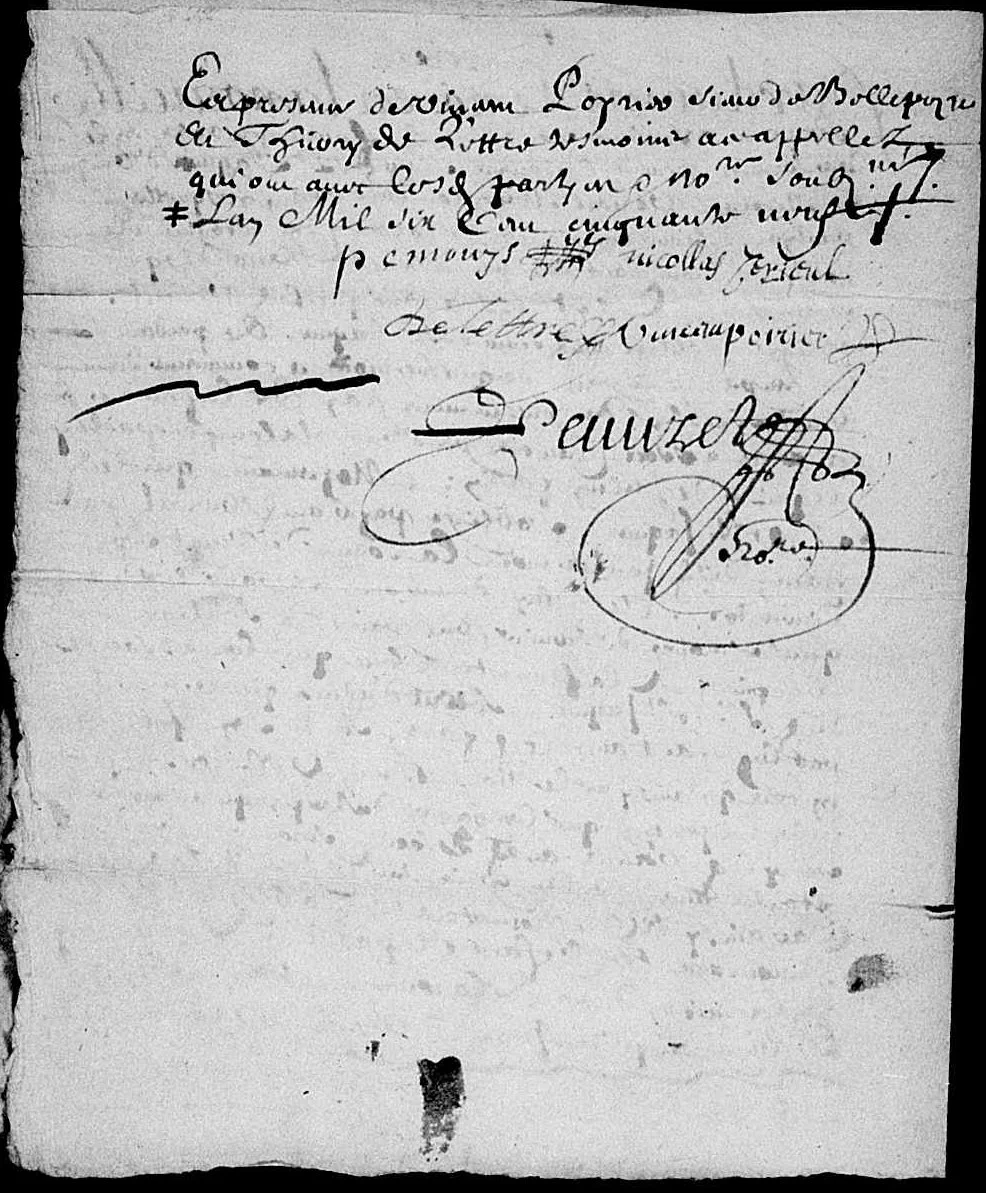
Page two of Nicolas Vérieul’s 1659 engagement (FamilySearch)
Other contracts reveal very different arrangements. In 1671, Julien Mathieu of Brittany was hired at La Rochelle as a matelot to go to New France and serve Intendant Jean Talon for three years. His employment formed part of a much broader, multi-year engagement rather than a short contract tied to one particular voyage. At the other end of the spectrum, Étienne Martin, a navigator living at Neuville, agreed in 1722 to serve as a matelot during that year’s navigation season, sailing on the St. Lawrence between Québec, Montréal and Tadoussac. His wage was set at 20 livres per month, payable at the end of each month.
French maritime law provided a broader framework for these arrangements. The 1681 Ordonnance de la Marine devoted an entire title to the “engagement and wages of sailors” (De l’Engagement et des Loyers des Matelots). Sailors’ wages were also afforded significant legal protection: when a vessel was judicially sold, wages owed to the sailors employed on its most recent voyage took priority over the claims of other creditors. The surviving contracts from New France therefore reflect a maritime labour system in which wages, advances, terms of service and the obligations of both employer and sailor were matters of contract and law.
Discipline and Authority Aboard the Ship
Life aboard a sailing vessel depended upon coordinated action. When sails had to be raised or shortened, an anchor dropped, or a vessel manoeuvred in changing wind or current, individual sailors could not simply choose when or how to work. The matelot therefore served under the authority of the master or captain and the officers who directed the vessel’s navigation and manoeuvres. Once a ship was loaded and preparing to sail, French maritime law specifically required sailors to remain aboard unless they had the master’s permission to leave.
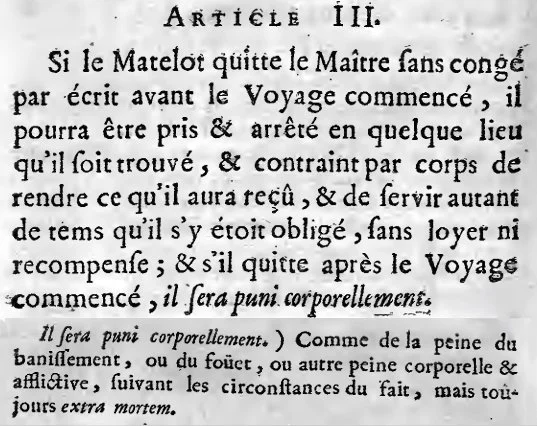
Detail from L’Ordonnance de la Marine du mois d’août 1681 (Wikimedia Commons)
On merchant vessels, discipline was closely connected to a sailor’s engagement contract and to the maritime law governing masters and crews. The 1681 Ordonnance de la Marine provided that a sailor who abandoned his master without written permission before the voyage began could be arrested, required to repay any advance he had received, and compelled to complete the period of service to which he had agreed without wages or reward. Leaving after the voyage had begun could result in corporal punishment. The ordinance also prohibited sailors from leaving a loaded vessel without the master’s permission, imposing a fine of 100 sols and, for repeat offences, the possibility of corporal punishment.
Colonial records show these rules being enforced in New France. In May 1721, Guillaume Lemelin, captain of the Sainte-Anne, was preparing to sail for Île Royale when one of his matelots, Louis Portelance, deserted the vessel. Intendant Michel Bégon authorized Portelance’s arrest and imprisonment in Québec. Six years later, another matelot, Baptiste Bernier Dubord, was ordered by Intendant Dupuy to board the Saint-Pierre immediately in accordance with his engagement; refusal could lead to his arrest and imprisonment. Such cases show that leaving a vessel or failing to honour an engagement could become a matter for colonial authorities, not merely a dispute between sailor and captain.
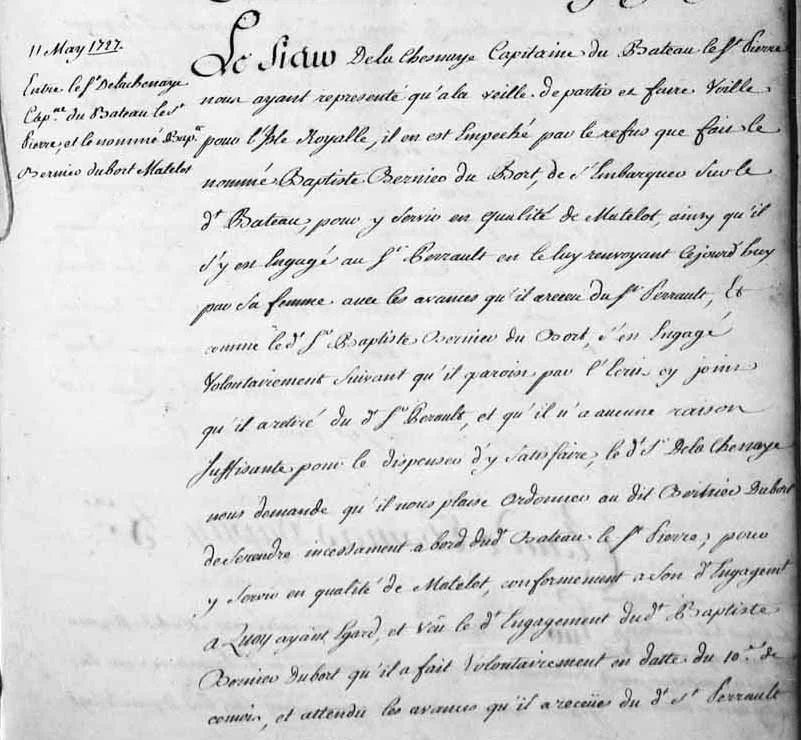
Page one of the 1727 order requiring Baptiste Bernier Dubord to board the ship Le Saint-Pierre (Bibliothèque et Archives nationales du Québec)
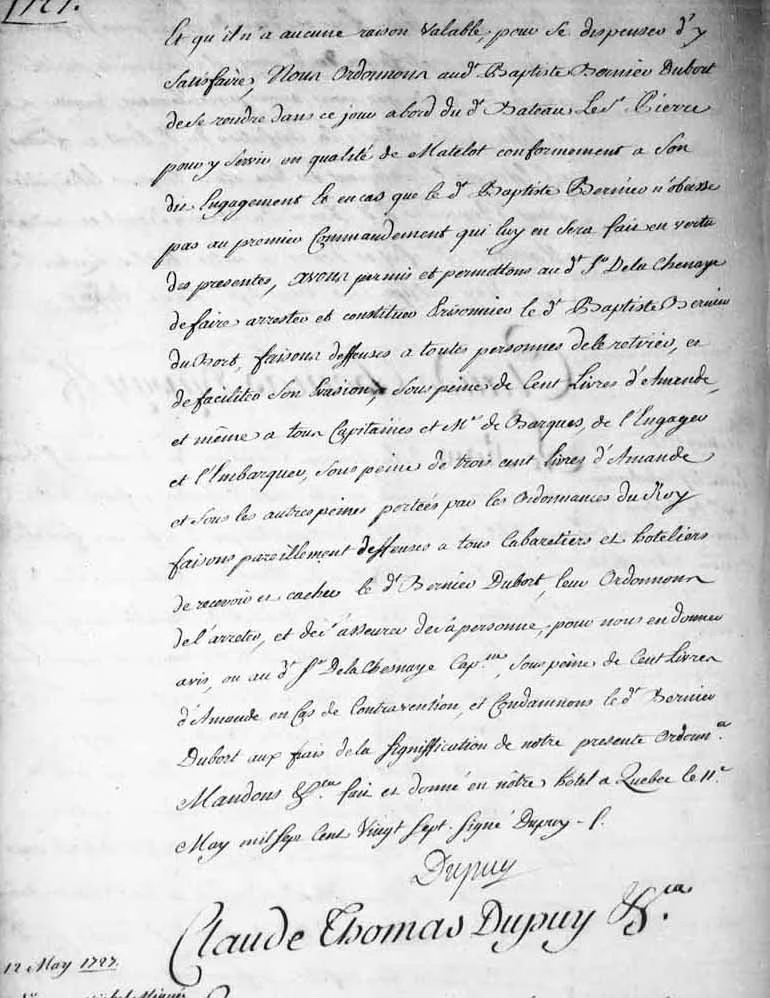
Page two of the 1727 order requiring Baptiste Bernier Dubord to board the ship Le Saint-Pierre (Bibliothèque et Archives nationales du Québec)
A Dangerous Occupation
Working as a matelot carried risks that were inseparable from the maritime environment. Sailors could be injured while handling heavy sails, rigging, anchors or cargo; swept or knocked overboard; or lost when vessels foundered in storms. Drowning was an ever-present danger, while men undertaking longer voyages also faced illness, contaminated food or water, prolonged exposure to cold and wet conditions, and, during wartime, capture or death at the hands of an enemy. Maritime historian Alain Cabantous emphasizes that for early modern seafarers, violent and unexpected death was not an exceptional possibility but a persistent feature of working life at sea.
Records from New France give this danger a human face. In August 1716, Antoine Quirié, a Rochefort sailor, was found drowned at Québec, and his body was examined. Two years later, the maître de barque Joseph Gagnon formally reported the drowning of a sailor named Boisvert. In September 1728, colonial authorities likewise recorded the drowning of matelot Jacques Lalande and ordered his burial. Such records are stark reminders that even sailors working in and around the St. Lawrence faced one of the occupation’s most basic hazards: a fall or accident on the water could quickly become fatal.
“On the tenth of this month, while stopped with his vessel off Cap à l’Arbre [near present-day Deschaillons-sur-Saint-Laurent], he had gone ashore with his sailors to fetch wood. After they had returned from shore to the vessel, a man named Boisvert, a sailor aboard the said vessel, took hold of the shroud chains in order to climb aboard. There being a very strong current, Boisvert let go of the said shroud chains and fell into the water, even though the declarant had told him several times to hold on tightly and not to let go. The current being very strong, and the declarant still being in the chaloupe with his other sailors, they set about trying to save Boisvert, but were unable to do so [...]”
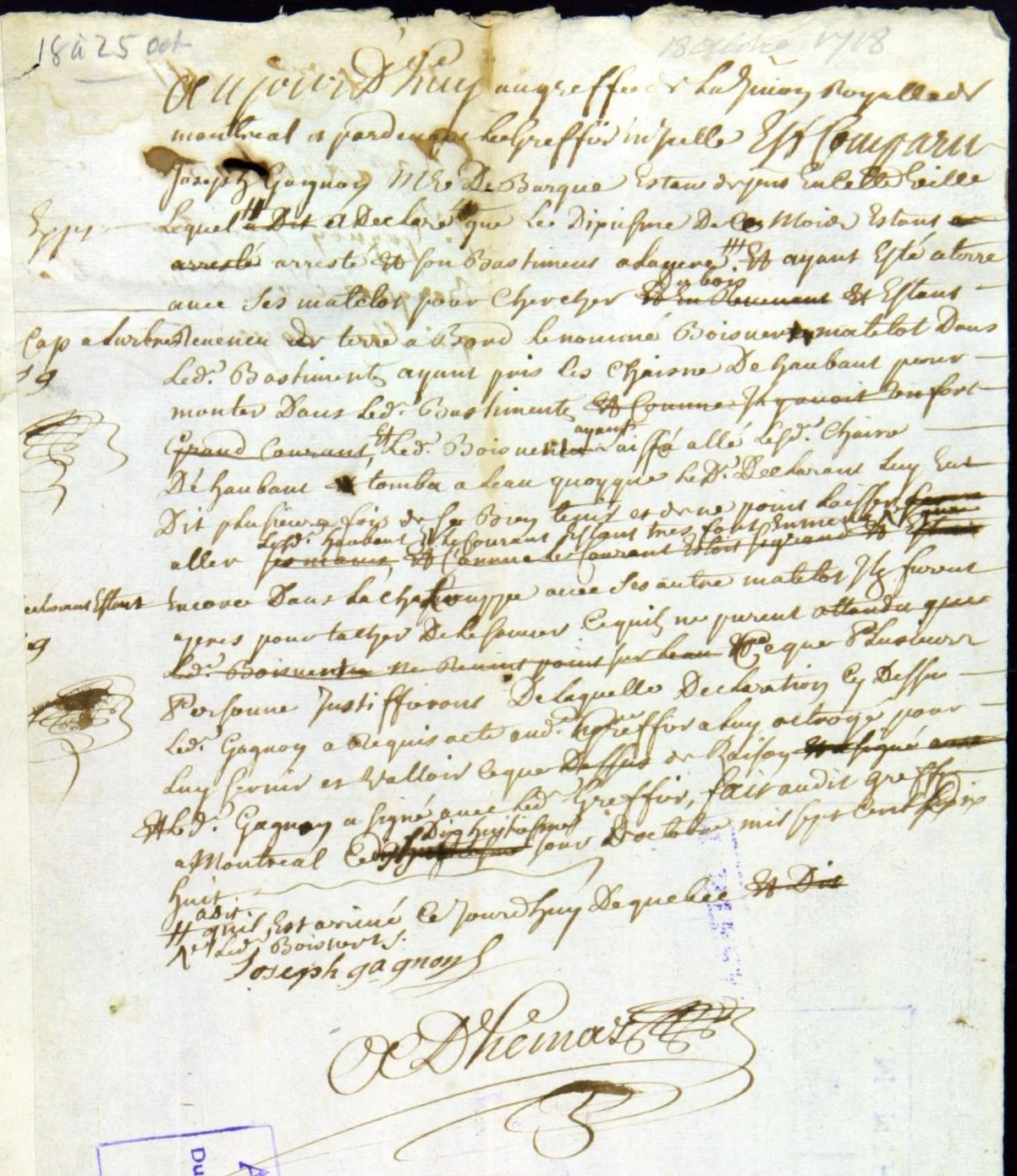
1718 declaration of Joseph Gagnon regarding the drowning of Boisvert (Bibliothèque et Archives nationales du Québec)
Interestingly, swimming was not an uncommon skill among some early modern sailors. In his 1696 treatise on swimming, Melchisédech Thévenot associated swimming and diving particularly with matelots and boatmen, who practised these skills out of occupational necessity. Swimming was by no means universal, however. In one documented accident in France in 1790, only two of four matelots aboard a chaloupe submerged by a wave were able to swim. Whether swimming was similarly common among sailors living in New France is difficult to determine from the surviving records.
Violence and the Law
The close quarters, rigid hierarchy and physical demands of maritime work could also give rise to serious conflict. Colonial court records preserve several cases in which sailors were involved in violent crimes, both as accused men and as victims. In 1678, matelot Jean Brière dit Périgourdin was convicted at Québec of striking another sailor, LeBreton, on the head, causing him to fall into the water and drown. He was sentenced to be hanged and strangled in the Lower Town of Québec.
In 1723, Michel Duzeau, second officer aboard the Notre-Dame de Bon Secours, was prosecuted for the murder of matelot Jean Caseau; the archival inventory for the case indicates that Duzeau was initially sentenced to death but was later acquitted.
These cases should not be taken to mean that sailors constituted an unusually criminal population. Court records preserve the incidents in which ordinary working relationships broke down. They do, however, show that violence between members of a ship’s company could become a matter for the colonial criminal courts, sometimes with the most serious possible consequences.
Did you know?
Rue du Sault-au-Matelot in Québec City takes its name from a waterfall that once descended the cliff near the Côte de la Canoterie. In the early seventeenth century, the word sault was used to mean a waterfall. The name Sault au Matelot first referred to this natural feature, then to the fief of the same name, and later to the street.
The origin of Matelot in the place name is less certain. Stories that a sailor—or perhaps a dog named Matelot—fell from the top of the cliff have long been regarded as legends. One possibility is that the name refers to Guillaume Couillard, who worked as a matelot and arrived in New France around 1613. He married Guillemette Hébert, daughter of Louis Hébert, in 1621. After Hébert’s death in 1627, Couillard succeeded him in working his lands. The fief that later took the name Sault-au-Matelot lay, on the heights of Québec, between two streams. The stream flowing near the Côte de la Canoterie was probably the one that received the name Sault au Matelot.
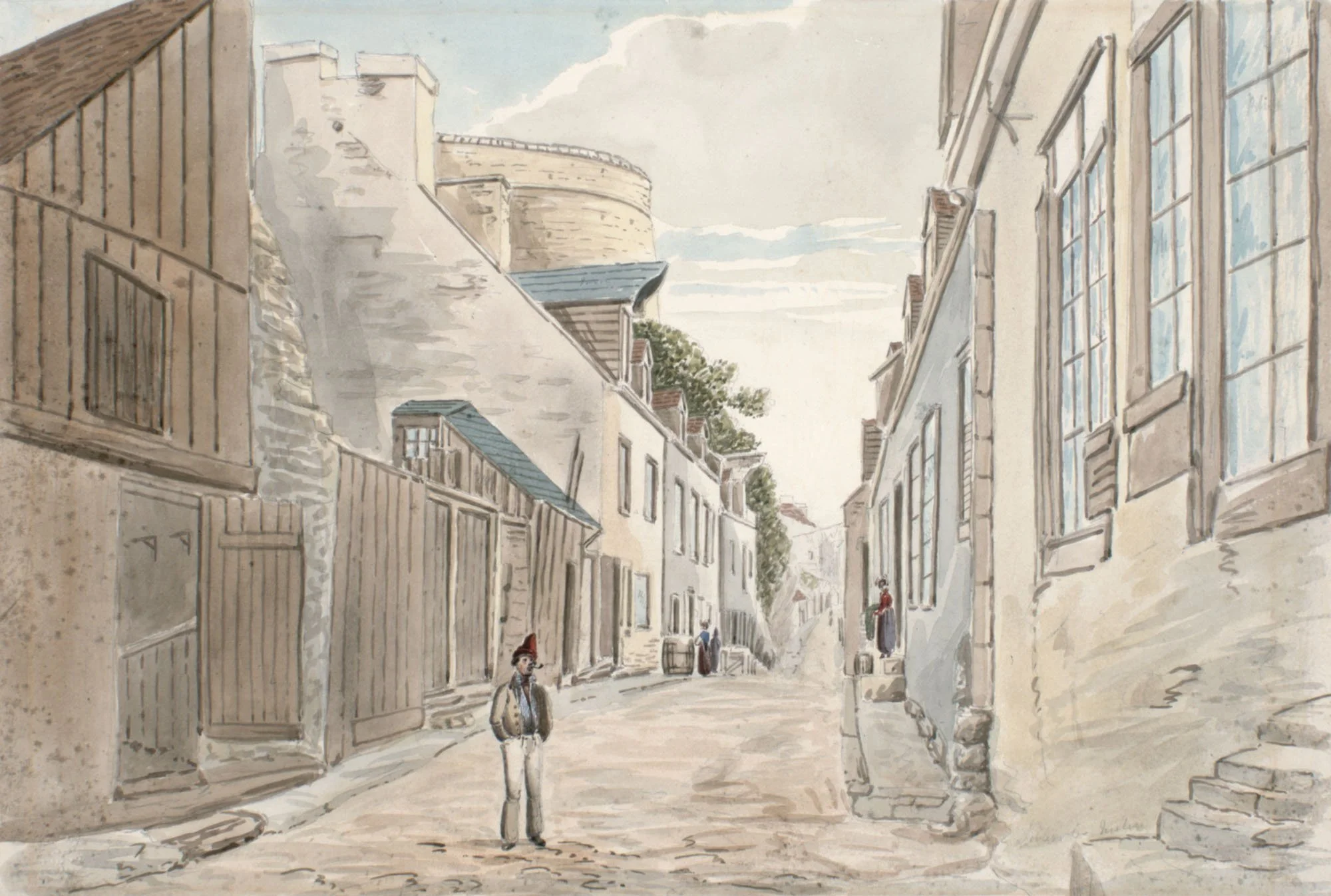
Rue Sault-au-Matelot, watercolour by James Pattison Cockburn (Library and Archives Canada)
Known men who had this occupation: Pierre Aigron, Paul Alary / Allary, François Allaire, Jean Alouette, Jean Arrérat, Jean Aulonne, Richard Avoine, Nicolas Baillargeon, Simon Balets, Jean Barault, René Barbeau / Barbou, Philippe Benoist, Baptiste Bernier Dubord, Pierre Berthelot / Bartelais, Jacques Biort, Joseph Biort, François Blouin, Jean Bœuf, Charles Bois, Jacques Boisseau, Marc Bouchet, Jacques Boulard, Pierre Boulet, Gabriel Bourget, Mathurin Brault, Thomas Briand / Briant, Jean Brière dit Périgourdin, Guillaume Brocart, Louis Brousseau, Jacques Cadou, Jean Cadou, Jean Cailleteau, Vincent Carace, Jean Caseau, Nicolas Certain, Guillaume Chaumeau, Simon Chef, Jean Cheneleau, Martin Chennequi / Chiniquy / Detchenique, Jacques Chevalier, Olivier Chotart, Joannis de Clausset, Pierre de Claverie, Jean Clouet, Jacques Cochu, Louis Corbin / Lacroix, Raymond Cornu, Guillaume Corruble, Ignace Côté, François Couillard / Couilleau, Guillaume Couillard, Jean-Anselme Damphous / Amphoux (b. Jean-Arsène), Pierre Denon, Jean Derome dit Descarreaux, Étienne Domingo dit Caraby, Pierre Dorion, Jean Dubeau, Jean Dudouet, Pierre Dufresne, Gaspard Dujean, Jacques Dupont, Gabriel Durepos (b. Louis-Gabriel), Élie Dussault / Dusseau / Lafleur, André Dutault, Bonaventure Étoile, Jean Fernand, Pierre Ferré / Feray, Jacques Figer / Figet, Jean Fleury, Louis Fontaine, Antoine Forestier, Pierre Foucher, Jean Fougereau / Fouchereau dit Petitjean, Joseph Galerno dit Vilmer, Gilles Gallien, Jean Gauthier, Jean Gautron, Jean Glinel, Nicolas Godbout, Jean Goron, Charles Goury, Jean Gouvreau, Olivier Gueguin / Gueguen (b. Ollivier), Pierre Guérin, René Hardy, Pierre Héraut, Jean Hérisson, Pierre Hubé, François Janus, Robert Jeanne / Ridout, Joseph Joly, Julien Joly, Jean Labrecque, Pierre Labrecque, Raphaël Lafontaine, André Laforge, Augustin Laîné / Laisné / Briard, Pierre Laizeau / Lezeau, Jacques Lalande, Bernard Landron / Landeron, Germain Langlois, Jean Larose, Guillaume Lasue / Lasne, Jean-Baptiste Laurent, Jacques Lauzin / Lauzier, Pierre Lavaux, Jean-Baptiste Le Normand / Froget / Forget, Pierre Lefebvre dit Lajeunesse, Antoine Lemoine, Jacques Lesot, René-Nicolas Levasseur, Jacques Lozier, Jean Martel, Charles Martin, Étienne Martin, Henri Martin dit Provençal, Jean Massé, Jacques Massie, Julien Mathieu, François Mazureau / Mazeraud / La Barre, Thomas McKermic, Étienne Morel, Pierre Mosnier, Pierre Nicolet, Charles O’Neil, Charles-Alexandre Parin, Jacques Payant, Louis Pépin, Jacques Perrotin, Pierre Petit, Marc Antoine Picot, Louis Poitras, François Poingreau, Louis Portelance, Antoine Quirié, Pierre Rabasse, Jean Emmanuel Racet / Racette, Jean-Baptiste Raimbault, Jean Rateau, Élie Rémy, François Renoulau, Jean Ribreteau, Maurice Richard, François Rodrigue, Baptiste Rogerie (b. Jean), Jacques Roguet, Mathurin Rondel, Sébastien de Rosmadeq dit Lachenaye Courtebotte, Jean Roussin, Michel Roy, Jean Sabatier, Louis Saint-Jorre / Sergerie, Isaac Salomon, Olivier Santier, Augustin Savay, Thomas Shaw, Guillaume Simon, Jean Soudain, Joachim Tessier, François Thaumur dit Nantois, Jean-Jacques Thierry dit Paris, Jacques Turbay, Charles Turgeon, François Valois / Le Valois / Levallois, Nicolas Vérieul, Joseph Villemers, Antoine Virmontois, Élie Voisin, Geffin Voisin.

PDF version of article located at: https://www.tfcg.ca/old-occupation-sailor.
Are you enjoying our articles and resources? Show your support by making a donation. Every contribution, regardless of its size, goes a long way in covering our website hosting expenses and enables us to create more content related to French-Canadian genealogy and history. Thank you! Merci!
Sources:
“Matelot,” definition, Dictionnaire de l’Académie française (https://www.dictionnaire-academie.fr/article/A1M0114 : accessed 13 Sep 2026), First Edition, 1694.
Antoine Furetière, “Matelot,” Dictionnaire universel (1690), reproduced in Le Robert (https://dictionnaire.lerobert.com/definition/matelot : accessed 13 Sep 2026).
“Goélette,” in Encyclopédie, ou Dictionnaire raisonné des sciences, des arts et des métiers, vol. 7 (1757), 729–30, digitized by Wikisource (https://fr.wikisource.org/wiki/L%E2%80%99Encyclop%C3%A9die/1re_%C3%A9dition/GOELETTE : accessed 16 Sep 2026)
“Brigantin,” in Encyclopédie, ou Dictionnaire raisonné des sciences, des arts et des métiers, vol. 2 (1751), 420, digitized by Wikisource (https://fr.wikisource.org/wiki/L%E2%80%99Encyclop%C3%A9die/1re_%C3%A9dition/BRIGANTIN : accessed 21 Sep 2026).
“Flûte,” in Encyclopédie, ou Dictionnaire raisonné des sciences, des arts et des métiers, vol. 6 (1756), 892–902, Wikisource (https://fr.wikisource.org/wiki/L%E2%80%99Encyclop%C3%A9die/1re_%C3%A9dition/FLUTE : accessed 16 Sep 2026)
J. F. Bosher, “CADET, JOSEPH-MICHEL,” in Dictionary of Canadian Biography (https://www.biographi.ca/en/bio/cadet_joseph_michel_4E.html : accessed 13 Sep 2026), vol. 4, University of Toronto/Université Laval, 2003–.
Jacques-Michel Bréard, "Lettre de Jacques-Michel Bréard, contrôleur de la Marine, au ministre," Québec, 3 nov. 1749, Archives de la Nouvelle-France (https://nouvelle-france.org/eng/item/details?id=30542 : accessed 21 Sep 2026), COL C11A 125/fol. 527–530v; citing original data: Archives nationales d’outre-mer (France).
Josette Brun, "Les femmes d’affaires en Nouvelle-France au 18e siècle : le cas de l’Île Royale," Université de Montréal, digitized by Acadiensis (https://journals.lib.unb.ca/index.php/Acadiensis/article/download/10856/11687?inline=1 : accessed 14 Sep 2026), volume 27, number 1 (1997): 44–66.
Alain Cabantous, “Le corps introuvable. Mort et culture maritime (XVIe–XIXe siècles),” Histoire, économie et société 9, no. 3 (1990): 321–336, digitized by Persée (https://www.persee.fr/doc/hes_0752-5702_1990_num_9_3_1550: accessed 17 Sep 2026).
Jean-Baptiste Michel Cherfils, “Rapport par M. Cherfils relativement à un acte de courage d’un marin de Saint-Valery-en-Caux, lors de la séance du 29 janvier 1791,” Archives parlementaires de la Révolution Française, 1885, 563-564, digitized by Persée (https://www.persee.fr/doc/arcpa_0000-0000_1885_num_22_1_9988_t1_0563_0000_6 : accessed 17 Sep 2026).
Georges Fournier, Hydrographie contenant la théorie et la practique de toutes les parties de la navigation (Paris: Michel Soly, 1643), chapter 4, “De l’équipage d’un navire,” 119-126, digitized by Google Books (https://books.google.ca/books?id=-t8z0Feevj0C&pg=PA116&source=gbs_toc_r&cad=2#v=onepage&q&f=false : accessed 16 Sep 2026).
Dominic Gagnon, “Le navigateur Joseph Gagnon,” L’Ancêtre, number 303, volume 39, summer 2013, p. 257, Société de généalogie de Québec (https://sgq.qc.ca/client_file/upload/L-Ancetre/Les-premieres-annees/V39-N303.pdf : accessed 17 Sep 2026).
Gilles Hocquart, “Lettre de Hocquart au ministre concernant la construction d’une flûte de 500 tonneaux (le Canada) pour le compte du roi,” Québec, 22 September 1739, Archives de la Nouvelle-France, COL C11A 71/fol.122–127v (https://nouvelle-france.org/eng/item/details?id=24441 : accessed 16 Sep 2026), citing Archives nationales d’outre-mer (France).
Donald J. Horton and Bernard Pothier, "DENYS DE LA RONDE (La Ronde Denys), LOUIS," in Dictionary of Canadian Biography (https://www.biographi.ca/en/bio/denys_de_la_ronde_louis_3E.html : accessed 14 Sep 2026), vol. 3, Université Laval/University of Toronto, 2003–.
André Lachance, “POULIN DE COURVAL, FRANÇOIS-LOUIS,” in Dictionary of Canadian Biography (https://www.biographi.ca/en/bio/poulin_de_courval_francois_louis_3F.html : accessed 21 Sep 2026), vol. 3, University of Toronto/Université Laval, 2003–.
Nicolas Landry, "La course et les corsaires à Plaisance (Terre-Neuve) durant la Guerre de la ligue d’Augsbourg, 1688–1698," Newfoundland and Labrador Studies 36, no 1 (2021) : 51–86, digitized by Journals at UNB (https://journals.lib.unb.ca/index.php/NFLDS/article/download/32553/1882528051 : accessed 14 Sep 2026).
Nicolas Landry, "Processus d’inventaire des biens chez les gens de mer à l’Île Royale au 18e siècle," Université de Moncton à Shippagan, digitized by Acadiensis (https://journals.lib.unb.ca/index.php/Acadiensis/article/download/10816/11615 : accessed 13 Sep 2026), volume 28, number 2 (1999): 71–92.
Anne-Marie Larochelle, La chaloupe à quille en Nouvelle-France : une embarcation et son milieu (master’s thesis [M.Sc.], Université de Montréal, 2008), digitized by the Division de la gestion de documents et des archives de l’Université de Montréal, made available by Library and Archives Canada (https://collectionscanada.gc.ca/obj/thesescanada/vol2/QMU/TC-QMU-7340.pdf : accessed 16 Sep 2026).
Brad Loewen, “La construction navale en Nouvelle-France,” in Marc St-Hilaire, Alain Roy, Mickaël Augeron and Dominique Guillemet, eds., Les traces de la Nouvelle-France (Québec: Les Presses de l’Université Laval, 2008), 153–155, digitized by Érudit (https://depot.erudit.org/bitstream/006080dd/1/la-construction-navale-en-nouvelle-france.pdf : accessed 16 Sep 2026).
Louis XIV, Ordonnance de la Marine du mois d’août 1681, book 1 (title 14), book 2 (titles 1, 4, 5 and 7), book 3 (title 4), digitized by Wikimedia Commons (https://commons.wikimedia.org/wiki/File%3AOrdonnance_de_la_Marine_Du_mois_d%27%CC%81Ao%C3%BBt_1681_-_comment%C3%A9e_%26_confer%C3%A9e_sur_les_anciennes_Ordonnances%2C_Le_Droit_Romain%2C_%26_les_nouveaux_Reglemens_%28IA_A255078%29.pdf : accessed 16 Sep 2026).
Mario Mimeault, “La pêche à la morue des Français d’Amérique du Nord de 1500 à 1763: un atout dans la géopolitique française," digitized by Acadiensis (https://journals.lib.unb.ca/index.php/Acadiensis/article/download/28831/1882521637?inline=1 : accessed 14 Sep 2026), volume 47, no 2 (2018) : 26–49.
Dale Miquelon, “GOGUET, DENIS,” in Dictionary of Canadian Biography (https://www.biographi.ca/en/bio/goguet_denis_4E.html : accessed 16 Sep 2026), vol. 4, University of Toronto/Université Laval, 2003–.
Patricia Payn-Echalier, “Chapitre 3. Formation et carrière des marins arlésiens,” in Les marins d’Arles à l’époque moderne (Aix-en-Provence: Presses universitaires de Provence, 2007), 137–141, digitized by OpenEdition Books (https://books.openedition.org/pup/pdf/6506: accessed 16 Sep 2026).
James S. Pritchard, “AILLEBOUST DE CERRY (Cery, Cerry d’Argenteuil), PHILIPPE-MARIE D’,” in Dictionary of Canadian Biography (https://www.biographi.ca/en/bio/ailleboust_de_cerry_philippe_marie_d_4E.html : accessed 13 Sep 2026), vol. 4, University of Toronto/Université Laval, 2003–.
James S. Pritchard, “SALLABERRY (Salaberry), MICHEL DE,” Dictionary of Canadian Biography, vol. 3 (https://www.biographi.ca/fr/bio/sallaberry_michel_de_3F.html : accessed 16 Sep 2026)
Alain Roy, “Des trames dans le paysage : transports et communications en Nouvelle-France,” in Marc St-Hilaire, Alain Roy, Mickaël Augeron and Dominique Guillemet, eds., Les traces de la Nouvelle-France (Québec: Les Presses de l’Université Laval, 2008), digitized by Érudit (https://depot.erudit.org/bitstream/006061dd/1/des-trames-dans-le-paysage--transports-et-communications-en-nouvelle-france.pdf : accessed 13 Sep 2026).
Dale Standen, “Canoes and Canots in New France: Small Boats, Material History and Popular Imagination,” Material Culture Review 68 (2008): 34–47, digitized by the University of New Brunswick (https://journals.lib.unb.ca/index.php/MCR/article/download/18132/19496 : accessed 16 Sep 2026).
Jean Talon, “Mémoire de Talon au roi sur le Canada" (memorandum to the king), Archives de la Nouvelle-France (https://nouvelle-france.org/eng/item/details?id=6982 : accessed 13 Sep 2026), 2 November 1671, COL C11A 3/fol.159–171v; citing: Archives nationales d'outre-mer (France).
Melchisédech Thévenot, L’Art de nager, démontré par figures, avec des avis pour se baigner utilement (Paris: Thomas Moette, 1696), digitized by Google Play (https://play.google.com/store/books/details/Melchis%C3%A9dec_Th%C3%A9venot_L_art_de_nager?id=BMOuDGOPG9QC : accessed 17 Sep 2026).
"Actes de notaire, 1653-1659 // Jean-Baptiste Peuvret," digital images, FamilySearch (https://www.familysearch.org/ark:/61903/3:1:3Q9M-CSVN-Q8JW?cat=koha%3A1176009&view=explore&lang=en&groupId=M9DC-CWH : accessed 31 Aug 2026), agreement between Pierre Enjouys de St Jacques and Nicolas Verieul, 25 Apr 1659, images 996-997 of 2056 ; citing original data: Bibliothèque et Archives nationales du Québec.
“Collection Pièces judiciaires et notariales - Archives nationales à Québec," digital images, Bibliothèque et Archives nationales du Québec (https://advitam.banq.qc.ca/notice/386993 : accessed 17 Sep 2026), "Engagement de Julien Mathieu, matelot et chasseur, natif de Landinissieau, en Bretagne, à Antoine Allaire, marchand de La Rochelle, procureur de Toussaint Quenet, marchand de Rouen, pour servir l'intendant Jean Talon," 10 Jun 1671, reference TL5,D91, Id 386993.
“Collection Pièces judiciaires et notariales - Archives nationales à Québec," digital images, Bibliothèque et Archives nationales du Québec (https://advitam.banq.qc.ca/notice/387804 : accessed 17 Sep 2026), "Procès-verbal du chirurgien Jourdain Lajus de la visite du cadavre de feu Antoine Quirié, matelot de Rochefort, trouvé noyé par Louis Prat, capitaine de port à Québec et propriétaire du navire «le Raudot»," 4 Aug 1716, reference TL5,D553.2, Id 387804.
“Collection Pièces judiciaires et notariales - Archives nationales à Québec," digital images, Bibliothèque et Archives nationales du Québec (https://advitam.banq.qc.ca/notice/375415 : accessed 17 Sep 2026), "Procédures criminelles contre Jean Brière dit Périgourdin (Porigoudis) pour avoir causé la mort d'un nommé Le Breton (LeBreton), noyé," 22 Aug 1678 to 22 Oct 1678, reference TL5,D131, Id 387039.
“Collection Pièces judiciaires et notariales - Archives nationales à Québec," digital images, Bibliothèque et Archives nationales du Québec (https://advitam.banq.qc.ca/notice/387924 : accessed 17 Sep 2026), "Procès criminel contre Michel Duzeau, second du navire le «Notre-Dame de Bon Secours», accusé du meurtre de Jean Caseau, matelot," 21 Jul 1723 to 30 Aug 1723, reference TL5,D651, Id 387924.
"Fonds Intendants - Archives nationales à Québec," digital images, Bibliothèque et Archives nationales du Québec (https://advitam.banq.qc.ca/notice/87439 : accessed 17 Sep 2026), " Ordonnance de l'intendant Bégon qui permet à Guillaume Lemelin, capitaine de la caiche (bateau) "la Sainte-Anne" sur le point de partir pour l'île Royale, de faire arrêter et constituer prisonnier dans les prisons de Québec Louis Portelance, matelot, qui a déserté de son bord," 2 May 1721, reference E1,S1,D7A,P1264, Id 87439.
“Fonds Intendants - Archives nationales à Québec," digital images, Bibliothèque et Archives nationales du Québec (https://advitam.banq.qc.ca/notice/88026 : accessed 17 Sep 2026), "Ordonnance de l'intendant Dupuy qui condamne Baptiste Bernier Dubord, matelot, à s'embarquer aujourd'hui même à bord du bateau "le Saint-Pierre", capitaine de la Chesnaye (Lachesnaye), conformément à son engagement...," 11 May 1727, reference E1,S1,D12A,P1850, Id 88026.
“Fonds Juridiction royale de Montréal - Archives nationales à Montréal," digital images, Bibliothèque et Archives nationales du Québec (https://advitam.banq.qc.ca/notice/700347 : accessed 17 Sep 2026), "Déclaration par Joseph Gagnon, maître de barque, concernant la noyade de Boisvert, matelot," 18 Oct 1718, reference TL4,S1,D2296, Id 700347.
“Fonds Juridiction royale de Montréal - Archives nationales à Montréal," digital images, Bibliothèque et Archives nationales du Québec (https://advitam.banq.qc.ca/notice/701523 : accessed 17 Sep 2026), "Constat de la noyade de Jacques Lalande, matelot et ordre de l'inhumer," 15 Sep 1728, reference TL4,S1,D3471, Id 701523.
“Toponymie : Rue du Sault-au-Matelot,” Ville de Québec (https://www.ville.quebec.qc.ca/citoyens/patrimoine/toponymie/fiche.aspx?IdFiche=1104 : accessed 17 Sep 2026); citing: Ville de Québec. Guide odonymique de la ville de Québec 1608-1988, 1989; Roy, Pierre-Georges. Les rues de Québec, 130; Poirier, Jean. Noms de rues de Québec au XVIIe siècle. Origine et histoire, Dossiers toponymiques, 27, Québec, Commission de toponymie, 2000, 35-36.