Jacques Lévèque dit Sansoucy & Marguerite Laire
Discover the story of Jacques Lévèque dit Sansoucy and Marguerite Laire, a couple who established their family in Repentigny at the end of the seventeenth century. Jacques came to New France from France as a soldier, while Marguerite was born into a family already rooted in the Montréal region. Their story follows the transition from military service to rural life, the raising of a large family, the acquisition and transfer of land, and the close family networks that shaped life in early New France.
Cliquez ici pour la version en français
Jacques Lévèque dit Sansoucy & Marguerite Laire
From the Troupes de la Marine to a New Life in Repentigny
Jacques Lévèque (or Lévesque) dit Sansoucy, son of Louis Lévêque and Anne Gélinot, was born in the former province of Saintonge in France, likely around 1667.
His year of birth is uncertain. Only four Canadian documents provide his age and origin:
The patient list at the Hôtel-Dieu in Québec in 1690 records him as a 23-year-old from Saintonge (born circa 1667).
His marriage contract in 1698 describes him as a native of Jarnac sur Charente, in the diocese of Xaintes [Saintes].
His marriage record in 1698 identifies him as a 27-year-old from the parish of Saint-Pierre, in the diocese of Xaintes (born circa 1671).
His burial record in 1744 indicates that he was 78 years old (born circa 1666).
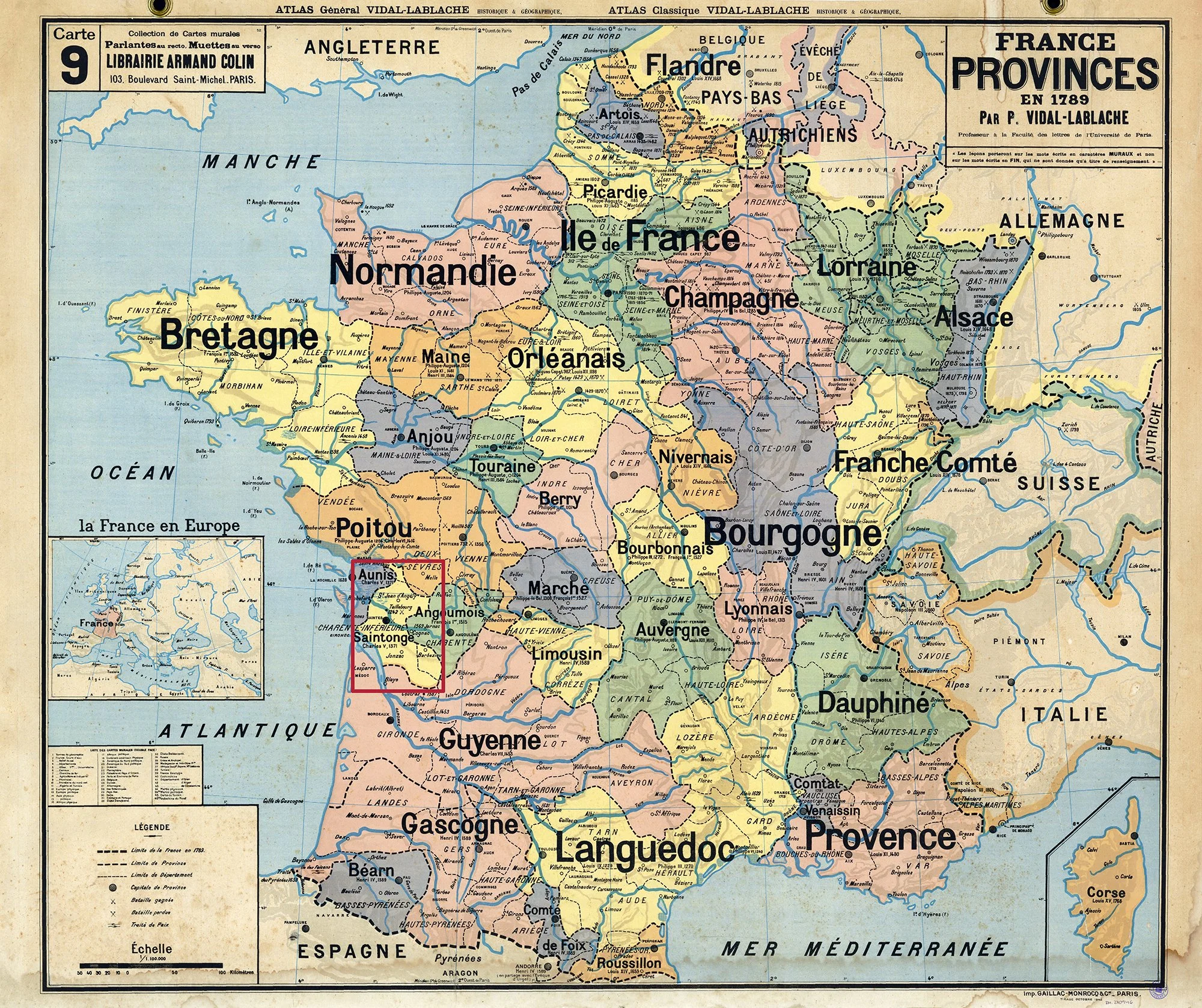
Location of the former province of Saintonge in France, framed in red (Wikimedia Commons)
A Soldier in New France
Jacques was in New France by 1690, serving as a soldier in the Troupes de la Marine in the company of de La Chassaigne (also spelled Chassagne). The year and circumstances of his arrival are unknown, but he first appears in the public record in 1690.
Jacques’s individual movements cannot be reconstructed, but the activities of La Chassaigne’s company provide some indication of the military environment in which he served. Jean Bouillet de La Chassaigne obtained command of a compagnie franche de la marine serving in Canada around 1687. By 1690 he was commandant at Fort Lachine.
On November 1, 1690, Jacques was recorded in the patient register of the Hôtel-Dieu hospital in Québec, leaving the hospital after a five-day stay. He is described as a 23-year-old from “Cherande, Ste onge.”

“Jacque levesque dit Cent sousy” in the 1690 Hôtel-Dieu patient register (Ancestry)
Just two weeks earlier, Quebec had endured Sir William Phips’s siege (16–24 October 1690), the culmination of that year’s Massachusetts campaign against New France. In the days before the English fleet arrived, Frontenac marched down from Montréal with a reinforcement of 300 men to bolster the city’s defence. La Chassaigne’s company was based in the Montréal region at Fort Lachine, and Montréal-area troops were among those summoned to Québec. In his account of the siege, Ernest Myrand lists Jacques Lévèque dit “Sanssoucy” among the wounded soldiers of La Chassaigne’s company. This indicates that Jacques took part in the defence of Québec and was wounded there, which likely explains his stay at the Hôtel-Dieu a few days later.
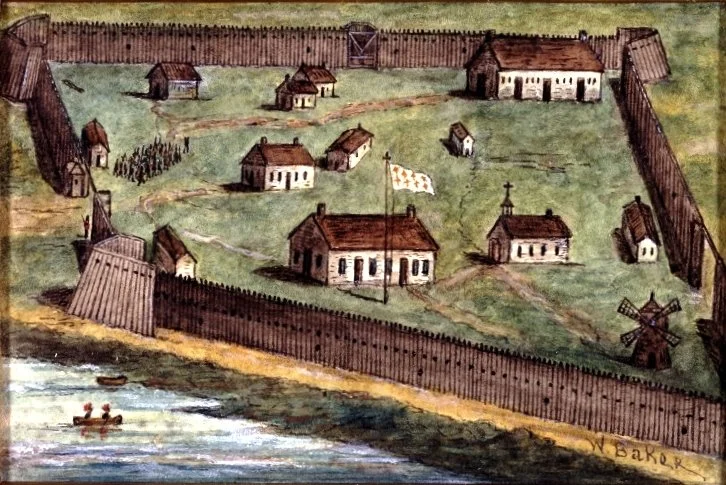
“The Pallisaded Village of Lachine 1689,” watercolour by Walter Baker (Wikimedia Commons)
La Chassaigne led a raid against the Iroquois out of Fort Lachine in the winter of 1690–1691. If Jacques had recovered and rejoined his company by then, he may have taken part. The 1691–1696 period was one of sustained low-intensity war on the island of Montréal and its outskirts. Iroquois raiding parties struck the region repeatedly: Lachenaie in May 1691 and again in July 1692, with the population there falling to a fraction of its pre-1689 level and survivors living under constant military protection. The best-known pitched engagement was the Battle of La Prairie (August 1691), a major clash between French/Canadian forces and an Iroquois-allied English raiding party. A company garrisoned in the Lachine and Montréal sectors through these years would routinely have been drawn on for exactly this kind of local defence and pursuit work.
The most significant French offensive of King William's War (1689–1697, the North American theatre of the Nine Years' War between France and England) came in summer 1696. Governor General Louis de Buade de Frontenac personally led a large expedition, including regular troops, militia, and allied warriors, against the Onondaga and Oneida villages south of Lake Ontario. Given the scale of that mobilization, drawing heavily on the colonial regular companies, it's plausible Jacques's company contributed men and that he participated in this excursion.
The Treaty of Ryswick (September 1697) ended King William's War between France and England, though hostilities with the Iroquois continued until the Great Peace of Montréal in 1701.
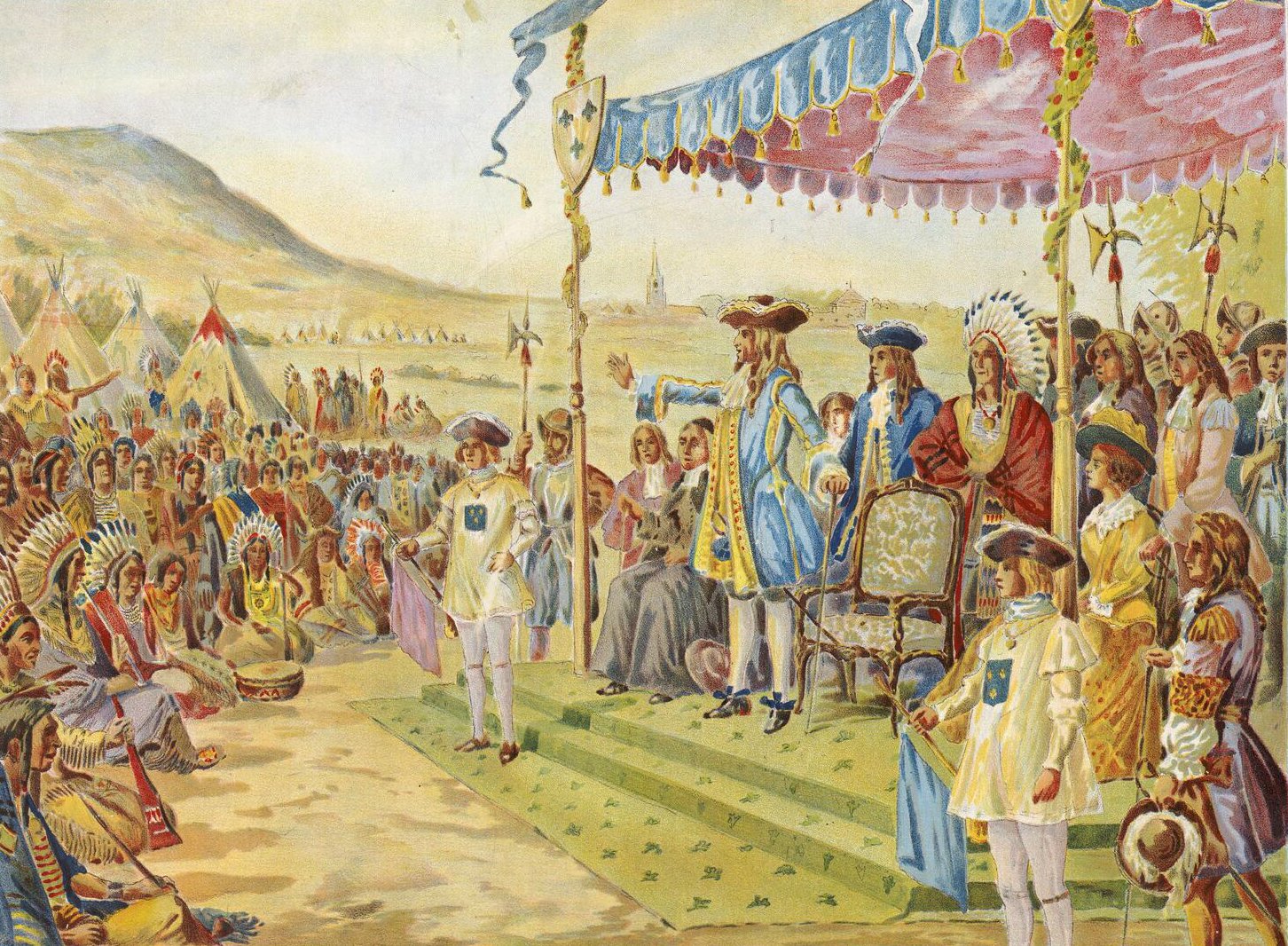
"La paix de Montréal" (The peace of Montréal), painting by Jean-Baptiste Lagacé (Bibliothèque et Archives nationales du Québec)
Marguerite Laire, daughter of Étienne Laire and Marie Loiron, was baptized on February 13, 1678, in the mission of Saint-Enfant-Jésus in Pointe-aux-Trembles, in Canada, New France (then a French colony). Her father was an “habitant de la côte Saint-Jean.” Her godparents were Nicolas Desroche [Desroches] and Marguerite Celle [Decelles].
She grew up in Pointe-aux-Trembles, alongside nine siblings, although one brother died in infancy. The family name was spelled in a variety of phonetic ways: Lert, Lairt, Ler, Lair, etc.
Marriage and Children
On December 3, 1698, notary Antoine Adhémar de Saint-Martin drew up a marriage contract between Marguerite and Jacques Lévèque (or Lévesque) dit Sansoucy, following the norms of the Coutume de Paris. The prefix dower was set at 400 livres, and the preciput at 200 livres.
The Coutume de Paris (Custom of Paris) governed the transmission of family property in New France. Whether or not a couple had a marriage contract, they were subject to the “community of goods,” meaning all property acquired during the marriage became part of the community. Upon the death of the parents, the community property was divided equally among all children, both sons and daughters. If one spouse died, the surviving spouse retained half of the community property, while the other half was shared among the children. When the surviving spouse passed away, their share was also divided equally among the children. Inventories are drawn up following a death in order to list all the assets of the estate.
The dower referred to the portion of property reserved by the husband for his wife in the event she outlived him. The preciput, under the regime of community of property, was a benefit conferred by the marriage contract, usually on the surviving spouse, granting them the right to claim a specified sum of money or property from the community before the rest was divided.
Jacques and several witnesses were able to sign the marriage contract, but Marguerite could not.
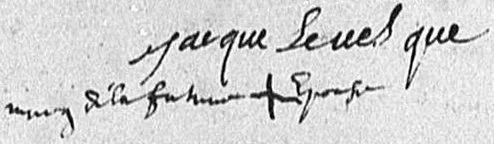
Jacques’s signature and Marguerite’s mark on the 1698 marriage contract (FamilySearch)
The couple was married the following day, on December 4, 1698, in the parish church of Notre-Dame in Montréal. The groom, a 27-year-old soldier in the company of Mr. de La Chassaigne, was described as a native of the parish of Saint-Pierre in the diocese of Xaintes. The bride was a 20-year-old resident of Montréal. Their witnesses were Jean Ferré (Jacques’ half-brother and Marguerite’s brother-in-law), habitant Jean Tessier, Pierre Desautels (Marguerite’s uncle), Pierre and Gilbert Desautels (her cousins), “and many other relatives and friends.” The couple received a dispensation from the three marriage banns, as well as a dispensation for marrying during Advent.
Jacques and Marguerite settled in Repentigny, where they had at least 13 children. Six did not survive to adulthood:
Jacques Louis (1699–1700)
Marie Josèphe (1701–1784)
Jacques (1702–1727)
Pierre (1704–1706)
Marie Marguerite (1706–1758)
Marie Barbe (1708–1729)
Nicolas (1709–1766)
Anne (1711–1714)
Charles (1713–1713)
Jean Baptiste (1715–1715)
Marie Charlotte (1717–1778)
Michel (1720–1797)
Marie Louise (1723–1723)
Land and Legal Transactions
About six months after their marriage, on June 28, 1699, Jacques and Marguerite were involved in a series of closely connected transactions before notary Antoine Adhémar. First, Jacques exchanged land with Jean Lescarbeau. Jacques received a 60-arpent property in Repentigny, measuring three arpents of frontage by twenty deep and fronting the St. Lawrence River. The deed refers to hay then growing on the property, suggesting that at least part of the land was already in agricultural use. In return, Jacques transferred an 80-arpent property, measuring four arpents of frontage by twenty deep and fronting the L'Assomption River. This latter property appears to have originated in a concession billet issued to Jacques by the seigneur de Repentigny in 1698. Jacques was also required to pay Lescarbeau 120 livres as part of the exchange.
In the next act, Jacques and Marguerite sold Marguerite’s rights in the succession of her late mother, Marie Loiron, to her sister Catherine Laire and Catherine’s husband, Jean Ferré dit Lachapelle (Jacques’s half-brother) for 285 livres. The transaction therefore took place between two closely connected couples: the two women were sisters, while the two men were half-brothers. The payment terms directly linked this transaction to the preceding land exchange: 120 livres of the purchase price were paid to Lescarbeau on Jacques's behalf, satisfying the sum Jacques owed him under the exchange.
Finally, the seigneur de Repentigny issued a provisional concession billet to Jacques and his half-brother Jean Ferré for new lands fronting the L’Assomption River. Each man received a concession measuring four arpents of frontage by twenty deep. The billet describes the two holdings together as eight arpents of frontage, indicating that they were adjoining. Formal concession contracts were to follow, subject to the customary seigneurial dues.
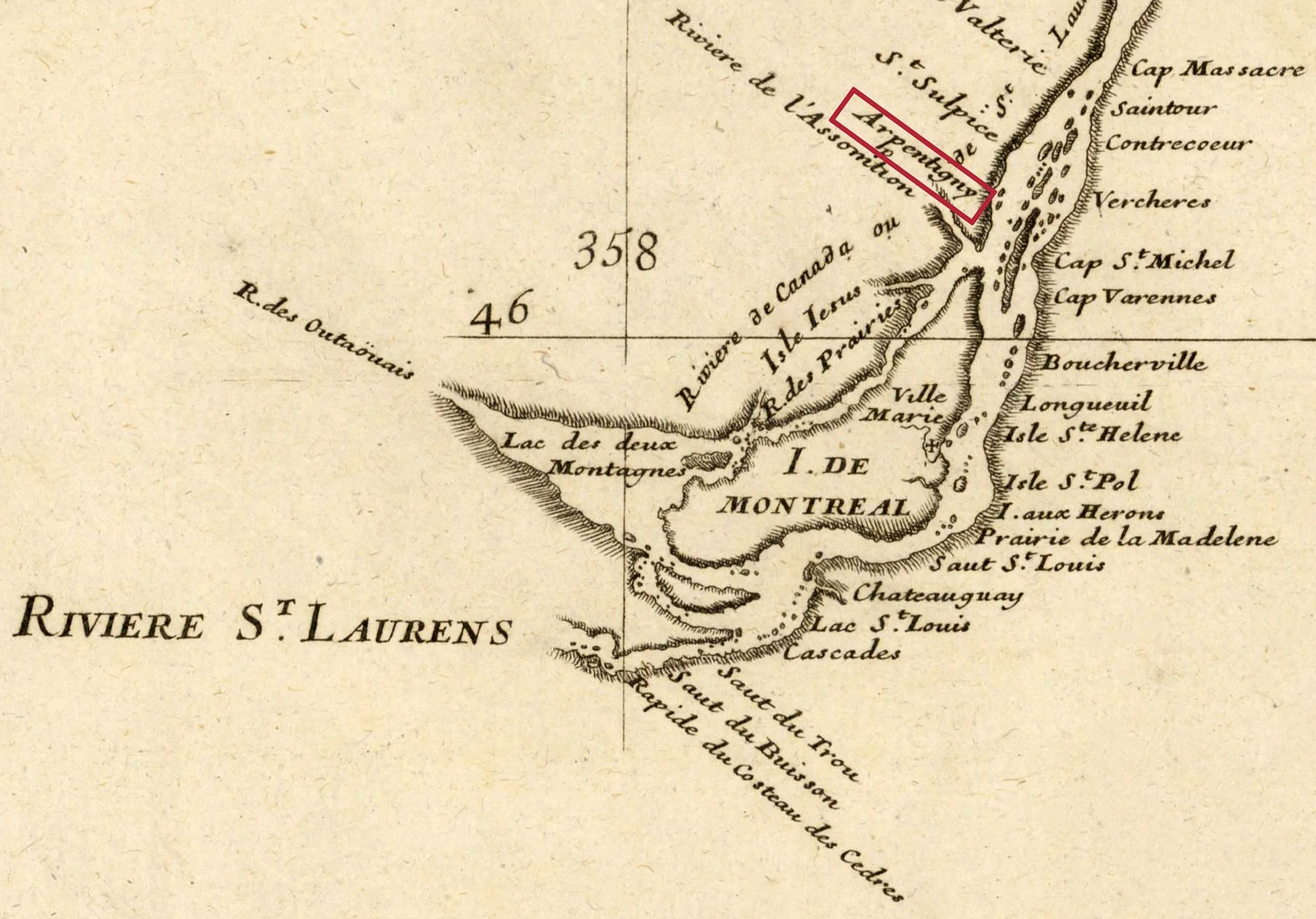
Detail from “Of the Great River of Canada, known to Europeans as the St Lawrence,” by Jean Deshayes and Nicolas de Fer, published in 1715. Repentigny appears as “d’Arpentigny,” near the mouth of the Rivière de l’Assomption, highlighted in red. (Bibliothèque et Archives nationales du Québec)
Debt, Litigation, and Final Settlement
On the afternoon of October 1, 1704, Jacques appeared before Montréal notary Pierre Raimbault and acknowledged owing merchant Charles de Couagne 194 livres, 15 sols and 4 deniers, in “this country’s money,” for merchandise previously supplied. Jacques acted both in his own name and on behalf of Marguerite, whom he promised would ratify the obligation and bind herself jointly with him. The debt was to be paid at de Couagne’s Montréal residence by September 6, 1705, failing which costs, damages and interest could be incurred. Jacques signed the agreement himself.
After de Couagne's death in 1706, his widow, Marie Godé (or Gaudet), pursued Jacques and Marguerite for the unpaid debt. On April 23, 1707, acting both in her own right and as legal guardian of her children, Godé obtained a judgment against the couple in Montréal's royal court. The judgment referred to their 1704 obligation for 194 livres, 15 sols and 4 deniers and ordered Jacques and Marguerite to satisfy the debt, together with interest and costs. The judgment was subsequently served at their home in Repentigny, where the court officer found Marguerite.
The debt remained unresolved into the following year. Marie Godé subsequently transferred her rights in the claim to Raymond Martel, seigneur of Lachenaie, and later enforcement proceedings refer to approximately 184 livres still owing. The assignment was likely connected to debts owed by the late Charles de Couagne to Martel, who had himself obtained a judgment against de Couagne in 1706. Court officer Nicolas Senet dit Laliberté was involved in serving or enforcing the judgment, and the surviving papers indicate that proceedings continued at least until May 24, 1708.
On August 3, 1710, Jacques and Marguerite entered into a surety arrangement concerning an outstanding debt of 184 livres. Montréal butcher Joseph Guyon dit Desprez had agreed to act as their guarantor toward Jacques Barbel, royal notary at Québec and representative of the creditors of the late Raymond Martel. The amount corresponds to the balance previously owing on Jacques and Marguerite's debt to Charles de Couagne, whose widow had transferred her rights in the claim to Martel.
To protect Desprez against his guarantee, Jacques and Marguerite pledged all of their present and future property and specifically identified two 8-year-old work oxen (one with red hair, one with black hair) and a 7-year-old red-haired cow as security. They undertook to provide Desprez with the 184 livres by July 1711, before the debt to Barbel became payable the following month. A later notation on the act indicates that the 184 livres were ultimately received through Desprez for the benefit of Martel's creditors and that Jacques and th e other obligors were discharged, apparently on July 5, 1713.
Over three years later, on the afternoon of January 15, 1714, Jacques entered into a three-year farm lease with Pierre Derivon de Budemont, lieutenant in the Troupes de la Marine, and his wife Marie Godé, widow of Charles de Couagne. Godé acted both in her own name and as guardian of her minor children by de Couagne. The Repentigny property had formerly belonged to Jacques’s half-brother, Jean Ferré dit Lachapelle. It measured three arpents of frontage by twenty deep, although only about seven arpents were then under cultivation. The farm included a house and barn. Jacques was responsible for maintaining the property, paying its cens et rentes, and delivering fifteen minots of wheat annually as rent.
On the afternoon of July 3, 1725, Jacques and Marguerite sold to their son Jacques an extension, or “continuation,” of a concession in Repentigny. The parcel was three arpents wide and extended from approximately the midpoint of the larger tract to the Rivière de l’Assomption, on which it fronted. It was bounded on either side by the lands of Louis Gautié [Gauthier] and Charles Miheux [Maheu]. Jacques had acquired the property from the seigneur of Repentigny by a concession contract dated November 16, 1718. It was subject to an annual seigneurial rente of three livres in cash and three capons, together with three sols in cens for each sixty arpents in area, payable on November 11. Jacques and Marguerite reserved for themselves, for the remainder of their lives, the right to take from the property all the firewood they required. The sale price was 150 livres, payable after the deaths of both parents to their son Jacques’s co-heirs—the other children of the couple.
Why Capons?
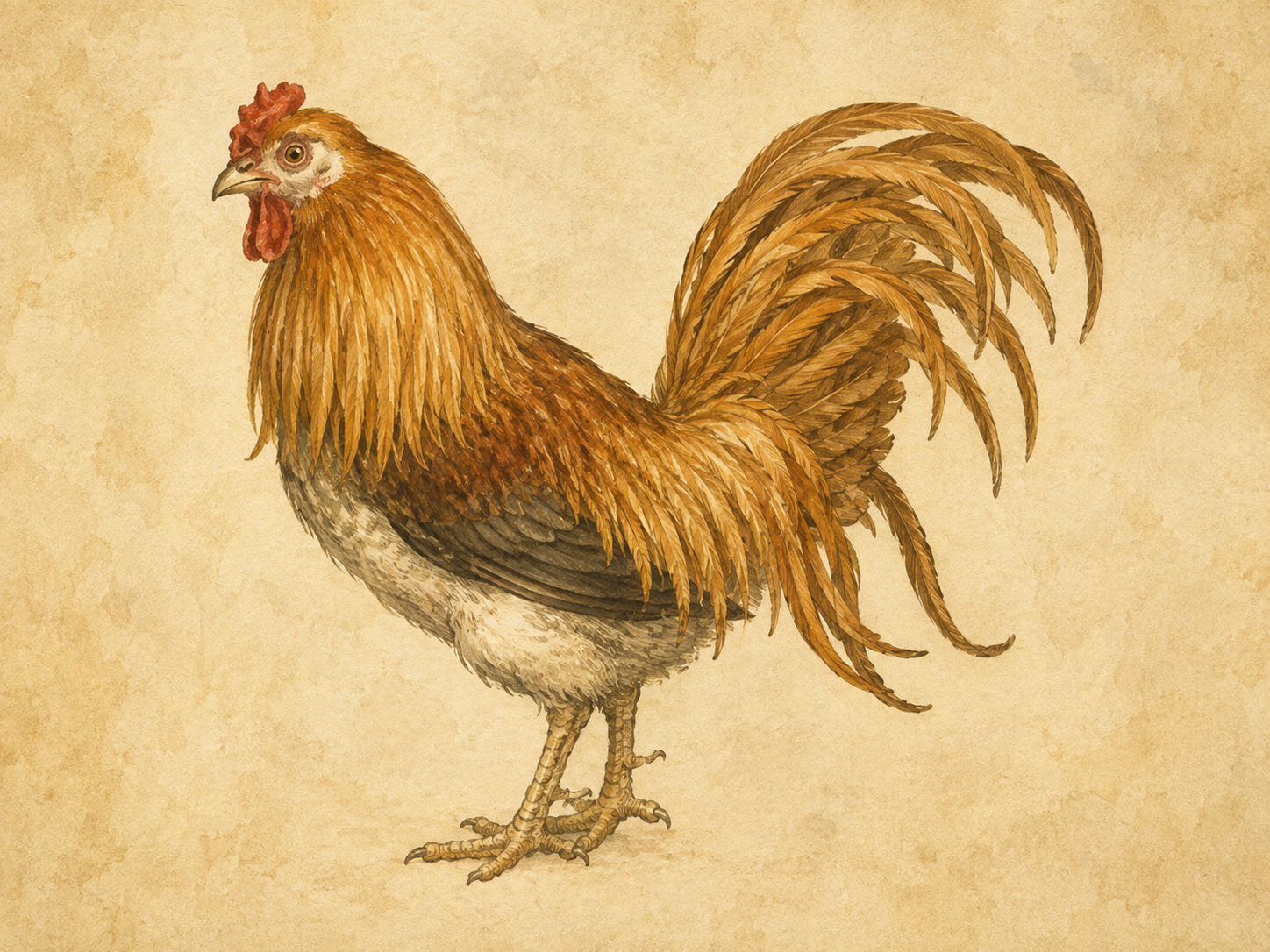
Illustration generated with artificial intelligence by the author, August 2026 (ChatGPT)
A capon was a castrated rooster that was then fattened for the table. Caponizing produced a less active bird that accumulated more fat and retained tender meat longer than an ordinary mature rooster, making capons a particularly desirable form of poultry.
In New France, capons became a common form of seigneurial rent paid in kind, often assessed at one fat capon per arpent of frontage. The bird had a recognized monetary equivalent, frequently 20 sols, so the obligation could sometimes be satisfied in cash instead. Wheat could sometimes be substituted as well. In effect, the capon functioned as both food and a convenient standardized unit of value in an economy where annual obligations were not always paid entirely in cash.
The timing was also practical. Seigneurial rents were frequently due on St. Martin’s Day, November 11, after the agricultural season. Caponizing was practiced toward the end of summer, which meant the birds could be fattened and ready when autumn rents fell due.
Sadly, Jacques Jr. died on October 2, 1727, only two years after receiving land from his parents and less than three months after marrying Marie Josèphe Masson. He was just 25 years old; no cause of death was recorded.
The following year, Jacques appeared in another role within the extended family. In April 1728, he was identified in a Montréal court case as the tuteur, or legal guardian, of Marie Ferré, daughter of Jean Ferré and Catherine Laire. Marie was therefore his niece through both sides of the family: her father was Jacques’s half-brother, while her mother was Marguerite’s sister. The case concerned Jacques’s administration of her property as tutor.
On July 11, 1732, Marie Josèphe Masson and her second husband, Charles Renaud dit Deslauriers, transferred the Repentigny property back to Jacques and Marguerite. The act noted that the 150-livre purchase price for the land acquired by the late Jacques Jr. in 1725 had never been paid, and Marie Josèphe and Charles declared themselves unable to satisfy the 150-livre purchase price and the other obligations attached to it. Jacques and Marguerite accepted the property back and agreed to assume the outstanding seigneurial dues, including 30 livres in arrears.
On the very same day, Jacques and Marguerite sold the land to their son Nicolas for 150 livres, payable to his parents as they required it.
Jacques’s final known notarial transaction came on June 25, 1740. He and Marguerite acknowledged that they still owed their son-in-law, Pierre Labbé dit Chevalier, 60 livres promised under his 1737 marriage contract to their daughter Marie Charlotte Lévesque, as an advance on her future inheritance.
Death of Jacques
Jacques Levesque dit Sansoucy died at approximately 77 years of age. He was buried on September 13, 1744, in the parish cemetery of Repentigny. The date of death was not recorded.
The burial record reads:
“On the thirteenth day of September in the year one thousand seven hundred and forty-four, Jacque LEveque, aged seventy-eight, was buried in the cemetery of this parish, having died in the faith and communion of the Church, after having received the Sacraments of Penance and Extreme Unction. The witnesses to the burial were Jean Magneron, François Magneron and Maurice Marchand, who declared that they were unable to sign this record.”
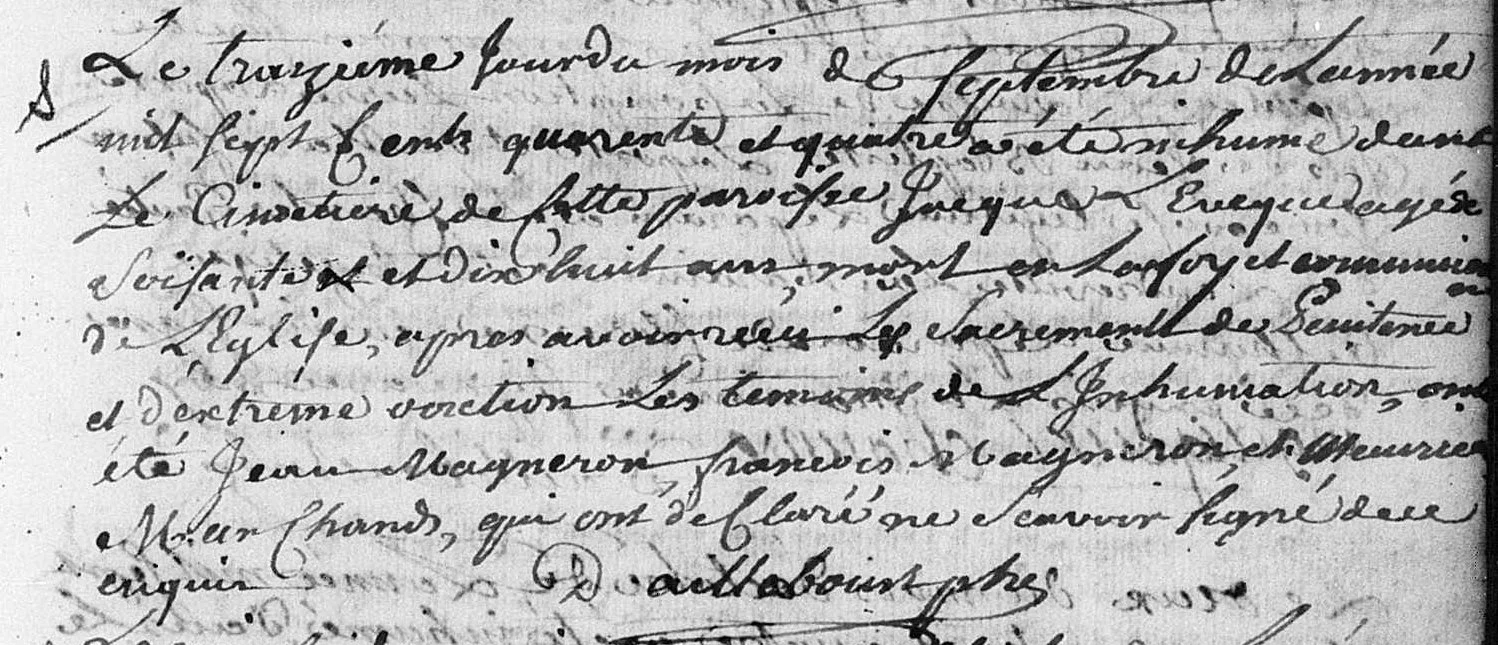
1744 burial of Jacques Levesque dit Sansoucy (FamilySearch)
Marguerite’s Final Years
Marguerite would outlive her husband by 23 years. Marguerite appears only twice more in the surviving public record before her death.
On March 5, 1745, she sold half a plot of land in Repentigny to her son Nicolas for 900 livres. It measured one arpent of frontage by 24 arpents deep, facing the Rivière de l’Assomption on the front and the St. Lawrence on the back, with the lands of Louis Gautier [Gauthier] and the heirs of Charles Maheu on either side.
Marguerite, who said she was “of very advanced age and unable to work,” also “wished to secure a fixed annuity to provide for her food and upkeep for the rest of her days. She had sought all the most suitable means to this end and, having found none better than to place and leave the said sum of nine hundred livres in the hands of the said Nicolas Levesque. She is said to have declared her intention to him, namely that the said sum should remain in his hands as cash received from her, and that he should be responsible for feeding and maintaining her, in health and in sickness, and for providing her with lodging, heating and laundry.”
If Marguerite found that living with Nicolas and his wife did not suit her, she was free to live elsewhere, in which case Nicolas agreed to pay her an annual lifetime pension of 100 livres. He also promised to arrange her burial and have 75 masses said for the repose of her soul. Marguerite, in turn, left Nicolas all of the furniture, household goods and other effects that belonged to her at the time of her death.
A decade later, on November 16, 1755, Marguerite appeared before notary Jean-Baptiste Daguilhe at L’Assomption and gave Nicolas a formal quittance (receipt) for the 900 livres arising from their 1745 agreement. She acknowledged having received the amount through payments, lodging and other provisions supplied to her. The act nevertheless reaffirmed Nicolas’s continuing obligation to provide for his mother for the remainder of her life.
Death of Marguerite
Marguerite Laire died at the age of 89. She was buried on October 29, 1767, in the parish cemetery of Repentigny. The burial record mistakenly calls her “Leclaire” and lists her age as 95.
The burial record reads:
“On the twenty-ninth of October in the year one thousand seven hundred and sixty-seven, Marguerite Leclaire, widow of Sans Soucy, aged ninety-five, was buried in the cemetery of this parish by us, the parish priest of Repentigny, parish of L’Assomption. Present at her burial were messire François Dailleboust de Lamagdelaine and Pierre Morisseau, the latter having declared that he did not know how to sign, as required by the ordinance.”
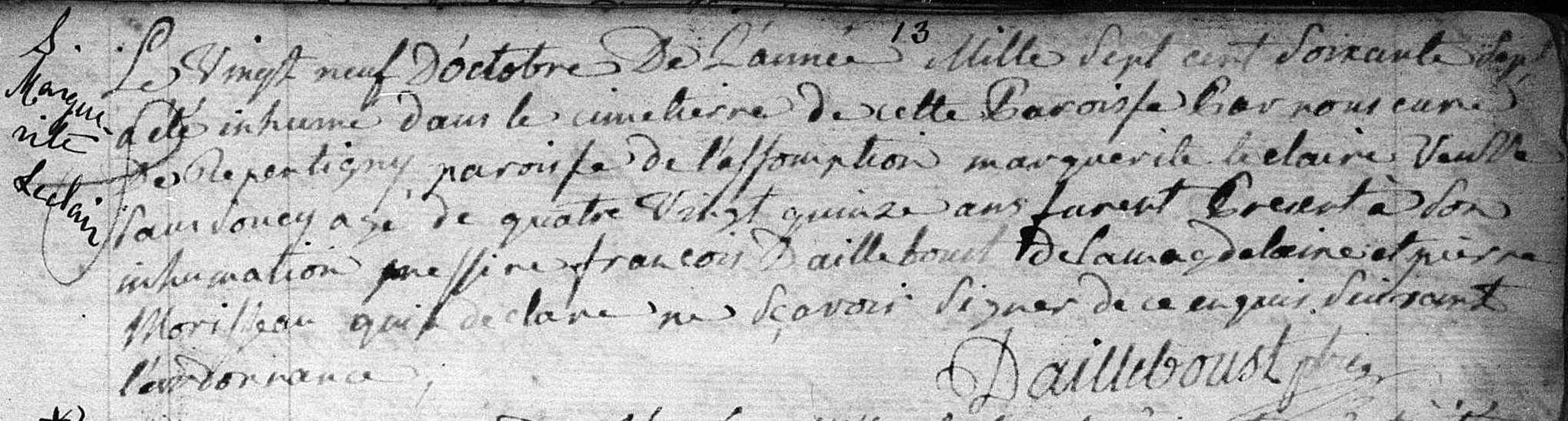
1767 burial of Marguerite Laire (FamilySearch)
A Family Rooted in Repentigny
Jacques Lévèque dit Sansoucy and Marguerite Laire built their life together at a moment when New France was still a small, vulnerable colony shaped as much by war as by agriculture and family networks. Jacques arrived from France as a young soldier, serving during years of conflict with the English and Iroquois before settling into civilian life. Marguerite, born into one of the earlier Montréal families, brought deep local roots of her own. Their marriage joined two closely connected families, and their subsequent move to Repentigny placed them within a developing rural community along the St. Lawrence and Rivière de l’Assomption.
Their decades together were marked by the ordinary uncertainties of colonial life: raising a large family while losing several children young, acquiring and transferring land, managing debt, and relying on a close network of siblings, children and in-laws. By the time Jacques died in 1744, the former soldier had spent more than half a century in Canada and had helped establish a family that would remain in Québec for generations. Marguerite survived him by another 23 years, eventually arranging for her son Nicolas to provide for her in old age. Their story is therefore not simply one of immigration, but of transition—from soldier to settler, from the fragile world of seventeenth-century New France to a firmly established family rooted in Repentigny.
PDF version of biography located at: https://www.tfcg.ca/jacqueslevequesansoucy-and-margueritelaire.
Are you enjoying our articles and resources? Show your support by making a donation. Every contribution, regardless of its size, goes a long way in covering our website hosting expenses and enables us to create more content related to French-Canadian genealogy and history. Thank you! Merci!
Sources:
“Le LAFRANCE (Baptêmes, Mariages, Sépultures)," database and digital images, Généalogie Québec. (https://www.genealogiequebec.com/Membership/LAFRANCE/acte/10094 : accessed 5 Aug 2026), baptism of Marguerite LAIR, 13 Feb 1678, Montréal, Pointe-aux-Trembles (St-Enfant-Jésus); citing original data: Institut généalogique Drouin.
“Le LAFRANCE (Baptêmes, Mariages, Sépultures)," database and digital images, Généalogie Québec. (https://www.genealogiequebec.com/Membership/LAFRANCE/acte/47734 : accessed 5 Aug 2026), marriage of Jacques LEVEQUE SANSSOUCY and Marguerite LAIR, 4 Dec 1698, Montréal (Notre-Dame-de-Montréal); citing original data: Institut généalogique Drouin.
“Le LAFRANCE (Baptêmes, Mariages, Sépultures)," database and digital images, Généalogie Québec. (https://www.genealogiequebec.com/Membership/LAFRANCE/acte/20330 : accessed 8 Aug 2026), burial of Jacques LEVESQUE, 2 Oct 1727, Repentigny (La-Purification-de-la-Bienheureuse-Vierge-Marie); citing original data: Institut généalogique Drouin.
"Canada, Québec, registres paroissiaux catholiques, 1621-1979," digital images, FamilySearch (https://www.familysearch.org/ark:/61903/3:1:3QSQ-G99Q-39WL-K?lang=en&i=378&groupId=1321742 : accessed 8 Aug 2026), burial of Jacques LEVEQUE, 13 Sep 1744, Repentigny > La Purification-de-Repentigny > Baptêmes, mariages, sépultures 1679-1766 > image 379 of 657; citing original data : Archives nationales du Québec, Montréal.
"Canada, Québec, registres paroissiaux catholiques, 1621-1979," digital images, FamilySearch (https://www.familysearch.org/ark:/61903/3:1:3Q9M-CS54-5F5Q?lang=en&i=16 : accessed 9 Aug 2026), burial of Marguerite Leclaire, 29 Oct 1767, Repentigny > La Purification-de-Repentigny > Baptêmes, mariages, sépultures 1679-1876 > image 17 of 190; citing original data : Archives nationales du Québec, Montréal.
“Quebec, Canada, Vital and Church Records (Drouin Collection), 1621-1968,” digital images, Ancestry.ca (https://www.ancestry.ca/imageviewer/collections/1091/images/d13p_31480857?usePUB=true&_phsrc=jbw42634&pId=1655033898 : accessed 5 Aug 2026), Hôtel-Dieu Registry (1689-1698), entry for Jacque levesque dit Cent sousy, 1 Nov 1690; citing original data: Drouin Collection, Institut Généalogique Drouin.
"Actes de notaire, 1668-1714 // Antoine Adhémar," digital images, FamilySearch (https://www.familysearch.org/ark:/61903/3:1:3Q9M-CS5F-BS94-8?cat=koha%3A541271&view=explore&lang=en&groupId=TH-909-76078-51963-0 : accessed 5 Aug 2026), marriage contract of Jacques Levesque and Marguerite Laire, 3 Dec 1698, images 1380-1384 of 3037; citing original data: Bibliothèque et Archives nationales du Québec.
"Actes de notaire, 1668-1714 // Antoine Adhémar," digital images, FamilySearch (https://www.familysearch.org/ark:/61903/3:1:3Q9M-CS5F-BS3M-T?cat=koha%3A541271&view=explore&lang=en&groupId=TH-909-76078-51963-0 : accessed 7 Aug 2026), land exchange between Jean Lescarbot and Anne Baudouin, and Jacques Levesque dit Sansoucy and Marguerite Laire, 28 Jun 1699, images 2353-2358 of 3037; citing original data: Bibliothèque et Archives nationales du Québec.
"Actes de notaire, 1668-1714 // Antoine Adhémar," digital images, FamilySearch (https://www.familysearch.org/ark:/61903/3:1:3Q9M-CS5F-B9BG-6?cat=koha%3A541271&view=explore&lang=en&groupId=TH-909-76078-51963-0 : accessed 7 Aug 2026), sale of succession rights in movable and immovable property by Jacques Levesque dit Sansoucy and Marguerite Laire to Catherine Laire and Jean Ferré dit Lachapelle, 28 Jun 1699, images 2359-2366 of 3037; citing original data: Bibliothèque et Archives nationales du Québec.
"Actes de notaire, 1668-1714 // Antoine Adhémar," digital images, FamilySearch (https://www.familysearch.org/ark:/61903/3:1:3Q9M-CS5F-B914-Q?cat=koha%3A541271&view=explore&lang=en&groupId=TH-909-76078-51963-0 : accessed 7 Aug 2026), land concession by Repentigny to Sansoucy and Lachapelle, 28 Jun 1699, image 2367 of 3037; citing original data: Bibliothèque et Archives nationales du Québec.
"Actes de notaire, 1697-1727 // Pierre Raimbault," digital images, FamilySearch (https://www.familysearch.org/ark:/61903/3:1:3QHV-V36Q-6QF2?cat=koha%3A675517&view=explore&lang=en&groupId=TH-7757-92833-1205-16 : accessed 7 Aug 2026), obligation by Jacques Levesque dit Sansoucy and Marguerite Laire to Charles de Couagne, 1 Oct 1704, images 260-261 of 2966; citing original data: Bibliothèque et Archives nationales du Québec.
"Actes de notaire, 1701-1732 // Michel-Laferté Lepailleur," digital images, FamilySearch (https://www.familysearch.org/ark:/61903/3:1:3Q9M-CS5F-T352-H?cat=koha%3A538127&view=explore&lang=en&groupId=TH-909-76076-100371-7 : accessed 7 Aug 2026), surety bond by Jacques Levesque and Marguerite Laire to Jacques Barbel, 3 Aug 1710, image 2757 of 3110; citing original data: Bibliothèque et Archives nationales du Québec.
"Actes de notaire, 1668-1714 // Antoine Adhémar," digital images, FamilySearch (https://www.familysearch.org/ark:/61903/3:1:3Q9M-CS5F-B9VG-N?cat=koha%3A541271&view=explore&lang=en&groupId=M9M4-6D2 : accessed 7 Aug 2026), farm lease by Pierre Derivon de Budemont and Marie Godé to Jacques Levesque, 15 Jan 1714, images 1406-1408 of 3080; citing original data: Bibliothèque et Archives nationales du Québec.
"Actes de notaire, 1704-1731 // Nicolas Senet," digital images, FamilySearch (https://www.familysearch.org/ark:/61903/3:1:3Q9M-CSTW-D7Q6-M?cat=koha%3A529332&view=explore&lang=en&groupId=TH-909-77592-135864-35 : accessed 8 Aug 2026), sale of a plot of land by Jacques Levesque and Marguerite Lhaire to Jacques Leveque, their son, 3 Jul 1725, images 772-773 of 2911; citing original data: Bibliothèque et Archives nationales du Québec.
"Actes de notaire, 1714-1754 // Jean-Baptiste Adhémar," digital images, FamilySearch (https://www.familysearch.org/ark:/61903/3:1:3Q9M-CSTW-D9R5-9?cat=koha%3A679139&view=explore&lang=en&groupId=TH-909-77592-49795-94 : accessed 8 Aug 2026), transfer of land by Charles Renaud dit Deslauriers and Marie Josèphe Masson to Jacques Leveque and Marguerite Laire, 11 Jul 1732, images 2000-2002 of 3274; citing original data: Bibliothèque et Archives nationales du Québec.
"Actes de notaire, 1714-1754 // Jean-Baptiste Adhémar," digital images, FamilySearch (https://www.familysearch.org/ark:/61903/3:1:3Q9M-CSTW-DSS6-D?cat=koha%3A679139&view=explore&lang=en&groupId=TH-909-77592-49795-94 : accessed 8 Aug 2026), land sale by Jacques Levesque and Marguerite Laire to son Nicolas Levesque, 11 Jul 1732, images 1997-1999 of 3274; citing original data: Bibliothèque et Archives nationales du Québec.
"Actes de notaire, 1736-1755 // François Comparet," digital images, FamilySearch (https://www.familysearch.org/ark:/61903/3:1:3QHV-53L3-J8H3?cat=koha%3A701795&view=explore&lang=en&groupId=TH-7765-100007-8690-40 : accessed 8 Aug 2026), debt acknowledgement by Jacques Levesque and Marguerite Laire, 25 Jun 1740, images 540-541 of 3064; citing original data: Bibliothèque et Archives nationales du Québec.
"Actes de notaire, 1714-1754 // Jean-Baptiste Adhémar," digital images, FamilySearch (https://www.familysearch.org/ark:/61903/3:1:3Q9M-CSTH-P8BZ?cat=koha%3A679139&view=explore&lang=en&groupId=TH-909-77663-9624-99 : accessed 8 Aug 2026), land sale by Marguerite Laire to son Nicolas Levesque, 5 Mar 1745, images 781-783 of 3073; citing original data: Bibliothèque et Archives nationales du Québec.
"Actes de notaire, 1749-1783 // Jean-Baptiste Daguilhe," digital images, FamilySearch (https://www.familysearch.org/ark:/61903/3:1:3QHV-53L8-RQG5?cat=koha%3A723003&view=explore&lang=en&groupId=TH-7764-100254-33743-9 : accessed 9 Aug 2026), receipt from Marguerite Laire to son Nicolas Levesque, 16 Nov 1755, images 600-602 of 2857; citing original data: Bibliothèque et Archives nationales du Québec.
“Fonds Juridiction royale de Montréal - Archives nationales à Montréal,” digital images, Bibliothèque et Archives nationales du Québec (https://advitam.banq.qc.ca/notice/699025 : accessed 7 Aug 2026), "Procès entre Marie Godé, veuve de Charles de Couagne, demanderesse, et Jacques Levesque dit Sansoucy, de Repentigny, défendeur, pour dette," 23 Aug 1707 - 30 Oct 1708, reference TL4,S1,D1044, Id 699025.
"Fonds Juridiction royale de Montréal - Archives nationales à Montréal," digital images, Bibliothèque et Archives nationales du Québec (https://advitam.banq.qc.ca/notice/701469 : accessed 9 Aug 2026), "Procès entre Charles Desmarais, époux de Marie Ferré, de Saint-Sulpice, demandeur, et Jacques Levesque dit Sansoucy, tuteur de Marie Ferré, habitant de Repentigny, défendeur, pour gestion des biens de mineurs," 26 Apr 1728, reference TL4,S1,D3417, Id 701469.
Université de Montréal, Programme de recherche en démographie historique (PRDH) online database (https://www-prdh-igd-com.res.banq.qc.ca/Membership/en/PRDH/famille/8219 : accessed 7 Aug 2026), dictionary entry for Jacques LEVEQUE SANSOUCY and Marguerite LAIRE, union 8219.
Ulric Lévesque, “BOUILLET DE LA CHASSAIGNE (Chassagne), JEAN,” in Dictionary of Canadian Biography, vol. 2 (https://www.biographi.ca/en/bio/bouillet_de_la_chassaigne_jean_2E.html : accessed 5 Aug 2026), University of Toronto/Université Laval, 2003–.
Ernest Myrand, Sir William Phips devant Québec : histoire d’un siège (Québec: Imprimerie de L.-J. Demers, 1893), 249–250, digitized by Internet Archive (https://archive.org/details/sirwilliamphipsd00myra/page/250/mode/2up : accessed 10 Aug 2026).
Robert-Lionel Séguin, “La basse-cour en Nouvelle-France," Les Cahiers des dix, number 38, 1973, digitized by Érudit (https://www.erudit.org/fr/revues/cdd/1973-n38-cdd01427/1025312ar.pdf : accessed 8 Aug 2026).
Marcel Trudel, "Les obligations du censitaire, à l’époque des Cent-Associés," Revue d'histoire de l'Amérique française, volume 27, number 1, June 1973, digitized by Érudit (https://www.erudit.org/fr/revues/haf/1973-v27-n1-haf1997/303230ar.pdf : accessed 8 Aug 2026).