Isaac Étienne Paquet (or Pasquier) dit Lavallée & Élisabeth “Isabelle” Meunier
Biography of Isaac Étienne Paquet dit Lavallée, originally from Poitou, and Élisabeth Meunier, early settlers on Île-d’Orléans in 17th-century New France.
Cliquez ici pour la version en français
Isaac Étienne Paquet dit Lavallée & Élisabeth “Isabelle” Meunier
A Soldier and Settler of New France
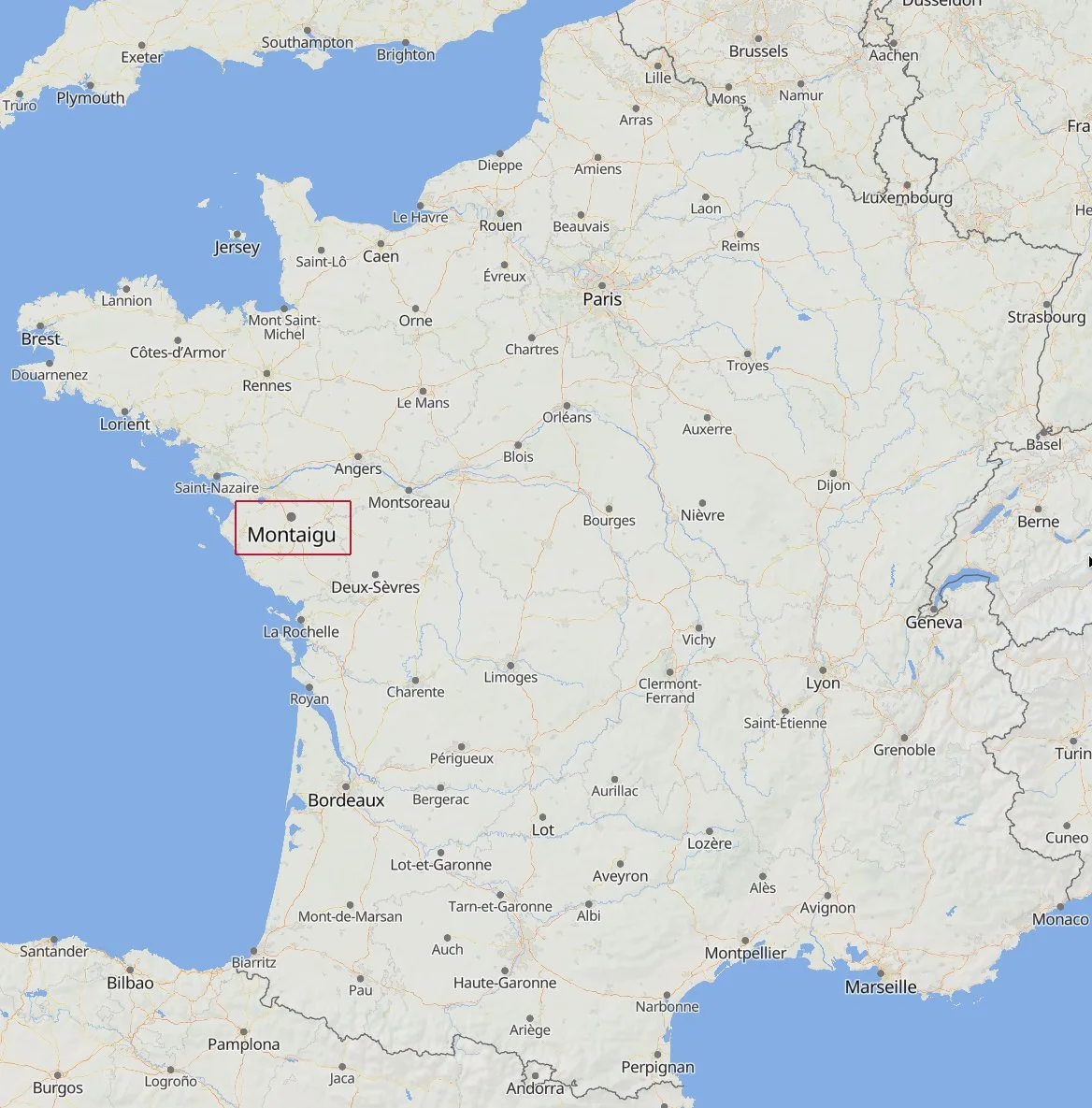
Location of Montaigu in France (Mapcarta)
Isaac Étienne Paquet (or Pasquier) dit Lavallée, son of Mathurin Paquet (or Pasquier) and Marie Fremillon, was born around 1636 in the parish of Saint-Jean in Montaigu, Poitou, France.
Located in western France, in the present-day department of Vendée, Montaigu now forms part of Montaigu-Vendée. The village has a population of approximately 5,000 residents, known as Montacutain(e)s or Montaigusien(e)s.

Postcard of Montaigu, circa 1905–1914 (Geneanet)

Postcard of Montaigu, 1915 (Geneanet)
Isaac Étienne likely grew up in a rural, parish-centred environment shaped by small-scale agriculture. From an early age, he would have contributed to household labour, tending animals, assisting in the fields, or learning a trade. He likely did not attend formal schooling, instead receiving basic religious instruction and sufficient literacy to sign his name. His adolescence unfolded during a period of broader instability in France, including the economic strain and disruptions associated with the Fronde (1648–1653). By early adulthood, he likely faced limited prospects, particularly if he was not the primary heir, with restricted access to land and few avenues for advancement in the Montaigu area.
It was in this context that Isaac Étienne enlisted in the Carignan-Salières Regiment. Military service offered immediate and tangible benefits: regular pay, food and clothing. Recruitment typically drew from young, unmarried men of modest means, for whom enlistment represented both subsistence and mobility. The Crown’s broader colonial policy further enhanced its appeal: soldiers who agreed to remain in New France after their service were offered land, financial incentives, and the possibility of marriage, providing a realistic path to social and economic advancement otherwise difficult to attain in France.
A Soldier in New France
Isaac Étienne served as a soldier in the Lamotte Company, commanded by Captain Pierre Lamotte de Saint-Paul. Sailing aboard L’Aigle d’Or from the port city of La Rochelle, he and his companions arrived at Québec on August 18, 1665. In the fall of that year, Lamotte was tasked with constructing a road from Fort Sainte-Thérèse to Fort Saint-Louis, later known as Fort Chambly. The following spring, Lamotte and his men built Fort Sainte-Anne on an island in Lake Champlain, which would later bear his name: Isle Lamotte, located in present-day Vermont.
Life at Fort Sainte-Anne quickly proved unforgiving. In late summer 1666, Mohawk warriors attacked a small detachment of French soldiers hunting near the fort, killing several and taking others prisoner. That autumn, Isaac Étienne joined a large expedition assembled at the fort to strike Mohawk villages; however, the enemy withdrew before their arrival, and the French burned abandoned settlements before returning in November.
With the campaign unsuccessful, the fort remained exposed and, critically, undersupplied for the winter. Unlike other posts along the Richelieu, the garrison had no opportunity to establish crops and relied on provisions sent from the St. Lawrence valley, which arrived irregularly. Rations deteriorated to little more than spoiled bread and bacon, and by winter a severe outbreak of scurvy had spread among the roughly sixty men stationed there. Many became too ill to stand, and several died despite efforts to relieve them.
In early 1667, missionaries and medical assistance arrived from Montréal. Dollier de Casson, a Sulpician priest sent to minister to the sick and dying, reported that “death agony lasted eight days, during which the stench was so great that it reached almost to the center of the fort, although the patients were shut up in their rooms.” Soon after, a fragile system was established in which the sick were transported south while recovered soldiers were sent back to the fort. Even so, conditions remained precarious until peace was concluded later that year, bringing an end to the immediate threat and setting the stage for the fort’s eventual abandonment.

Illustration generated with artificial intelligence by the author, April 2026 (ChatGPT)
The Lamotte Company was eventually withdrawn from the fort and redistributed. Some men were reassigned to more sustainable posts along the Richelieu corridor, such as Fort Saint-Louis, while others were incorporated into the regiment’s remaining garrisons. The exact posting of Isaac Étienne after the abandonment of Fort Sainte-Anne is not known.
Of the approximately 1,200 to 1,300 soldiers of the Carignan-Salières Regiment who arrived in New France, roughly 350 died, about 350 returned to France in 1668, and at least 446 chose to remain, with an additional 100 soldiers continuing in the colonial troops. The decision to settle was likely driven in large part by economic considerations, particularly the opportunity to obtain a concession of land—something largely unattainable for men of modest means in France. Isaac Étienne remained in the colony, his name appearing on the Rolle des Soldats du Regiment de Carignan Salière qui se sont faits habitans de Canada en 1668 (List of the Soldiers of the Carignan-Salières Regiment who became inhabitants of New France in 1668).

List of the Soldiers of the Carignan-Salières Regiment who became inhabitants of New France in 1668 (Library and Archives Canada). There were two Pasquier soldiers in the Lamotte Company: Isaac Étienne, known as Lavallée, and Étienne (no known dit name, born circa 1621), possibly a relative.
Building a New Life in New France
Isaac Étienne entered into his first known civilian contract on April 23, 1669. Before notary Claude Auber, he agreed with the fabrique of the parish of L’Ange-Gardien to lease a parcel of land under a bail à ferme. The property, measuring two arpents of frontage along the St. Lawrence River, was to be cleared and brought into cultivation at his expense. In exchange, he undertook to provide the church annually with six minots of wheat, peas, or corn.
For reasons unknown, Isaac Étienne left L’Ange-Gardien shortly thereafter, abandoning this arrangement. Within a few months, he was recorded in Québec City.
On July 26, 1669, Isaac Étienne and three fellow soldiers were hired by Valentin Frappier on behalf of the intendant, Jean Talon, to dig a ditch in support of his brewery in Québec. With the necessary tools supplied, the men were to construct a trench measuring 70 feet in length, five feet in width, and six feet in depth. They were paid 150 livres, to be divided among them.
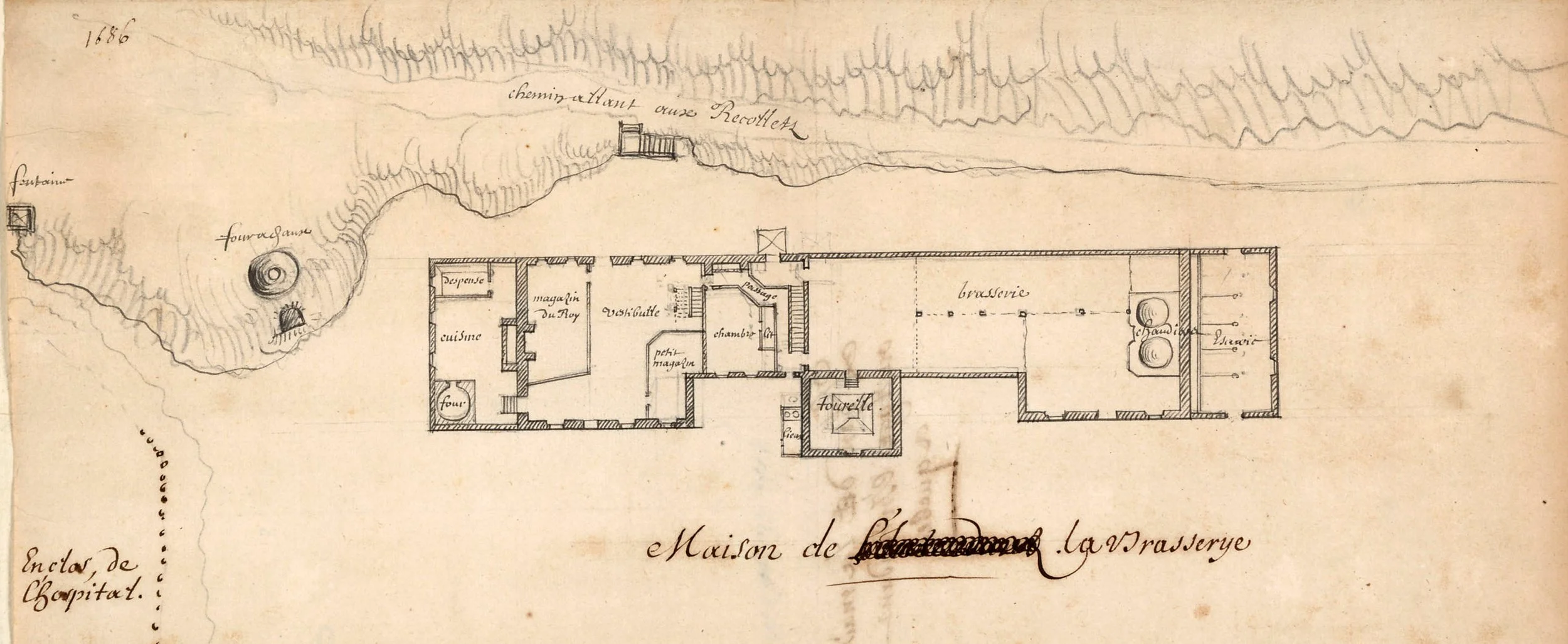
Plan of the Brasserie du Roy (King’s Brewery), attached to the Intendant’s first palace. 1686 drawing, artist unknown (Archives nationales d'outre-mer).
Isaac Étienne received his first land concession on March 10, 1670, from Monseigneur de Laval. The land was located on the southwestern coast of Île-d’Orléans, near the future site of the parish church of Saint-Laurent. It measured three arpents of frontage along the St. Lawrence River.
Élisabeth “Isabelle” Meunier, daughter of Mathurin Meunier (or Monier) and Françoise Fafard, was born on February 17, 1656, and received an emergency baptism at birth from Françoise Lehoux, wife of Robert Paré. She was conditionally baptized on March 13, 1656, at the home of Louis Gasnier in Sainte-Anne. Her godparents were Toussaint Toupin and Marie François, who declared that they did not know how to sign. [The baptism is in the register of Notre-Dame in Québec.]

1656 baptism of Élisabeth "Meusnier" (Généalogie Québec)
Élisabeth likely grew up in Château-Richer. She had eight siblings, three of whom died in infancy. She and her family were recorded in the 1666 census of New France living on the côte de Beaupré [her father is mistakenly called "Jean"].

1666 Census of New France (Library and Archives Canada)
The Meunier family was recorded again in the census the following year, still living on the côte de Beaupré. They owned 15 arpents of “valuable” land (cleared or under cultivation) and four head of livestock.
Marriage and Family Life
On April 13, 1670, notary Paul Vachon drew up a marriage contract between Isaac Étienne Paquet (or Pasquier) dit Lavallée and Élisabeth Meunier at her parents’ home in Sainte-Anne-de-Beaupré. Élisabeth’s parents consented on her behalf. Their witnesses included their son Jean Meunier and Charles Pouliot (husband of their daughter Françoise Meunier), as well as neighbours and friends Pierre Picard, mason Pierre Simard, and Pierre [Boivin?]. Isaac Étienne’s witnesses were Nicolas Quentin dit Lafontaine, Pierre Gendron dit Lapoussière, and Maurice Crépeau. Élisabeth’s parents gave her 100 livres for her future marriage, while Isaac Étienne provided a 300-livre prefix dower. The contract followed the standards of the Coutume de Paris.
The Coutume de Paris (Custom of Paris) governed the transmission of family property in New France. Whether or not a couple had a marriage contract, they were subject to the “community of goods,” meaning all property acquired during the marriage became part of the community. Upon the death of the parents, the community property was divided equally among all children, both sons and daughters. If one spouse died, the surviving spouse retained half of the community property, while the other half was shared among the children. When the surviving spouse passed away, their share was also divided equally among the children. Inventories are drawn up following a death in order to list all the assets of the estate. The dower referred to the portion of property reserved by the husband for his wife in the event she outlived him.
Among the official witnesses were master ropemaker Pierre [Brulon?], master edge-tool maker Barthélémy Verreau, and master miller Daniel Estourneau. Isaac Étienne signed the marriage contract, as did several witnesses. Élisabeth could not sign and instead made her mark.

Signature portion of the 1670 marriage contract (Bibliothèque et Archives nationales du Québec)
Isaac Étienne and Élisabeth were married on June 30, 1670, in the parish of La-Visitation-de-Notre-Dame in Château-Richer. The groom was about 34 years old, while the bride was 14. Their witnesses were Pierre Gendron [dit Lapoussière], Nicolas Quentin [dit Lafontaine], Pierre Lombret [Simard dit Lombrette], and Pierre [Boisvin?].
Legal Age to Marry and Age of Majority
In New France, the legal minimum age for marriage was 14 for boys and 12 for girls. These requirements remained unchanged during the eras of Lower Canada and Canada East. In 1917, the Catholic Church revised its code of canon law, setting the minimum marriage age at 16 for men and 14 for women. The Code civil du Québec later raised this age to 18 for both sexes in 1980. Throughout these periods, minors required parental consent to marry.
The age of majority has also evolved over time. In New France, the age of legal majority was 25, following the Coutume de Paris (Custom of Paris). This was reduced to 21 under the British Regime. Since 1972, the age of majority in Canada has been set at 18 years old, although this age can vary slightly between provinces.
The couple settled on Isaac Étienne’s land on Île-d’Orléans, where they had at least 14 children:
Marie Élisabeth “Isabelle” (1671–1750)
Charles (1673–1745)
Marie Marguerite (1675–1739)
Jeanne (1677–before 1681)
Antoine (1678–1721)
François (1680–1762)
Marie Françoise (1682–1731)
Marie Angélique (1686–1753)
Marie (1688–1688)
Jean (1689–1760)
Joseph (ca. 1691–1715)
Paul (1693–1693)
Pierre (1695–1695)
Marie Madeleine (1696–1748)
The Succession of Mathurin Meunier
Élisabeth’s father, Mathurin Meunier, died in 1679. His succession took several years to settle among his heirs. On July 27, 1679, Mathurin’s surviving children (and their spouses) agreed to sell their shares of the inheritance to their brother Mathurin for the sum of 50 livres each. A notation at the bottom of the notarial agreement, drawn up by Paul Vachon, indicates that Isaac Étienne and Élisabeth received that sum on July 13, 1686.
On March 5, 1684, notary Pierre Duquet drew up an agreement between François and Mathurin Meunier, Élisabeth’s brothers, and Isaac Étienne and Charles Pouliot (husband of Françoise Meunier, Élisabeth’s sister), in which the latter two paid the former two 50 livres each for the sale of the property that belonged to them as part of the estate.
Life and Work on Île-d’Orléans
Isaac Étienne (age 45) and Élisabeth (25) were recorded in the 1681 census of New France living on Île-d’Orléans with their five children: Élisabeth (11), Charles (9), Marguerite (6), Antoine (3), and François (1). They owned seven arpents of “valuable” land, seven head of cattle, and one gun.
In addition to farming, and likely fishing, Isaac Étienne also sold lumber from his land. On September 20, 1683, master joiner René Pasquier purchased twelve cherry wood planks from him, measuring ten feet long by one foot wide and three inches thick, for the sum of 12 livres. Isaac Étienne agreed to deliver the planks in Québec.

Illustration generated with artificial intelligence by the author, April 2026 (ChatGPT)
Disputes also arose between neighbouring families. On July 29, 1687, notary Pierre Duquet drafted an agreement between Isaac Étienne and his neighbour Guillaume Chartier to resolve “some quarrels between their wives.” Although the exact details are unknown, Chartier agreed to pay Isaac Étienne 20 livres in interest and 40 livres for “all legal costs and expenses,” in exchange for Isaac Étienne abandoning any legal action he was pursuing against him.
A further agreement followed on July 9, 1690. Notary Étienne Jacob drew up an act between François and Mathurin Meunier, Élisabeth’s brothers, and Isaac Étienne and Pierre Labbé (husband of Marguerite Meunier, Élisabeth’s sister), in which the latter two renounce their rights to the succession of Françoise Fafard, Élisabeth’s mother, both movable and immovable property. In exchange, François and Mathurin agreed to feed, care for, and look after their mother until her death and to arrange for her burial at their expense.
Deaths of Isaac Étienne and Élisabeth
Isaac Étienne Paquet (or Pasquier) dit Lavallée died at approximately 66 years of age. He was buried on June 18, 1702, in the parish cemetery of Saint-Laurent on Île-d’Orléans.

1702 burial of Isaac Étienne Paquet (or Pasquier) dit Lavallée (Généalogie Québec)
The details of Élisabeth “Isabelle” Meunier’s death remain unknown. She died sometime after January 21, 1715, the date of her daughter Madeleine’s marriage to Joseph Lessard. [In this record, Madeleine’s father is described as deceased, whereas her mother is not.]
A Life Rooted on Île-d’Orléans
Isaac Étienne Paquet dit Lavallée came to New France as a soldier and remained as a settler, establishing himself on Île-d’Orléans and building a life through land, labour, and family. With Élisabeth Meunier, he formed a household rooted in the early colony, where daily life was shaped by clearing and cultivating land, working with neighbouring families, and maintaining close ties within a small rural community along the St. Lawrence. Their lives unfolded within a landscape still in the process of settlement, where survival and stability depended on steady work and cooperation.
Together, they established a family that took lasting root in the colony. Their descendants are now found across North America, extending far beyond the shores where their story began.
PDF version of biography located at: https://www.tfcg.ca/isaacpaquetlavalle-and-elisabethmeunier.
Are you enjoying our articles and resources? Show your support by making a donation. Every contribution, regardless of its size, goes a long way in covering our website hosting expenses and enables us to create more content related to French-Canadian genealogy and history. Thank you! Merci!
Sources:
“Le LAFRANCE (Baptêmes, Mariages, Sépultures)," Généalogie Québec (https://www.genealogiequebec.com/Membership/LAFRANCE/acte/57551 : accessed 12 Apr 2026), baptism of Elisabeth Meusnier, 13 Mar 1656, Québec (Notre-Dame-de-Québec); citing original data: Institut généalogique Drouin.
“Le LAFRANCE (Baptêmes, Mariages, Sépultures)," Généalogie Québec (https://www.genealogiequebec.com/Membership/LAFRANCE/acte/30178 : accessed 12 Apr 2026), marriage of Isaac PASQUIER and Elisabeth MUSNIER, 30 Jun 1670, Château-Richer (La-Visitation-de-Notre-Dame); citing original data: Institut généalogique Drouin.
“Le LAFRANCE (Baptêmes, Mariages, Sépultures)," Généalogie Québec (https://www.genealogiequebec.com/Membership/LAFRANCE/acte/35707 : accessed 13 Apr 2026), burial of Isaac PAQUIER LAVALLE, 18 Jun 1702, St-Laurent (Île d'Orléans); citing original data: Institut généalogique Drouin.
"Recensement du Canada, 1666," digital images, Library and Archives Canada (https://recherche-collection-search.bac-lac.gc.ca/fra/accueil/notice?idnumber=2318856&app=fonandcol : accessed 13 Apr 2026), household of Jean Mounier, 1666, côte de Beaupré, page 54 (of PDF), Finding aid no. MSS0446, MIKAN no. 2318856; citing original data: Centre des archives d'outre-mer (France) vol. 460.
[1] "Recensement du Canada, 1667," digital images, Library and Archives Canada (https://www.bac-lac.gc.ca/eng/CollectionSearch/Pages/record.aspx?app=fonandcol&IdNumber=2318857&new=-8585951843764033676 : accessed 13 Apr 2026), household of Mathurin Musnier, 1667, côte de Beaupré, page 147-148 (of PDF), Finding aid no. MSS0446, Item ID number: 2318857; citing original data: Centre des archives d'outre-mer (France) vol. 460.
"Recensement du Canada fait par l'intendant Du Chesneau," digital images, Library and Archives Canada (https://www.bac-lac.gc.ca/eng/CollectionSearch/Pages/record.aspx?app=fonandcol&IdNumber=2318858&new=-8585855146497784530 : accessed 13 Apr 2026), household of Ignace Paquer, 14 Nov 1681, Île-d’Orléans, pages 320-321 (of PDF), Finding aid no. MSS0446, MIKAN no. 2318858; citing original data: Centre des archives d'outre-mer (France) vol. 460.
“Actes de notaire, 1652-1692 // Claude Auber,” digital images, FamilySearch (https://www.familysearch.org/ark:/61903/3:1:3QHV-53L2-618S?cat=koha%3A1175225&i=912&lang=en : accessed 13 Apr 2026), farm lease by the churchwardens of L’Ange-Gardien to Isaac Pasquier, 23 Apr 1669 ; images 913-914 of 1368 ; citing original data : Bibliothèque et Archives nationales du Québec.
"Archives de notaires : Romain Becquet (1665-1682)," digital images, Bibliothèque et Archives nationales du Québec (https://numerique.banq.qc.ca/patrimoine/details/52327/4064889?docref=zy_czR7Ia_4Abml1HHoIzw : accessed 13 Apr 2026), work agreement between Isaac Pasquier (and three others) and Valentin Frappier (for Jean Talon), 26 Jul 1669, images 923-924 of 1081.
"Archives de notaires : Paul Vachon (1655-1693)," digital images, Bibliothèque et Archives nationales du Québec (https://numerique.banq.qc.ca/patrimoine/details/52327/4215635?docref=vhhcG7uQyGtOmLXogFMiAg : accessed 13 Apr 2026), marriage contract of Isaac Pasquet and Elisabet Munié, 13 Apr 1670, images 399-401 of 1169.
“Actes de notaire, 1644-1693 // Paul Vachon,” digital images, FamilySearch (https://www.familysearch.org/ark:/61903/3:1:3Q9M-CS56-LY5K?cat=koha%3A1170052&i=143&lang=en : accessed 14 Apr 2026), agreement between the heirs of Mathurin Meunier, 27 Jul 1679; images 144-148 of 2174 ; citing original data : Bibliothèque et Archives nationales du Québec.
“Actes de notaire, 1663-1687 // Pierre Duquet,” digital images, FamilySearch (https://www.familysearch.org/ark:/61903/3:1:3Q9M-CSTC-P9T5-J?cat=koha%3A1175224&i=1934&lang=en : accessed 14 Apr 2026), agreement between Isaac Pasquier and Charles Pouliot, and François and Mathurin Meunier, 5 Mar 1684; images 1935-1936 of 2640 ; citing original data : Bibliothèque et Archives nationales du Québec.
“Actes de notaire, 1663-1687 // Pierre Duquet,” digital images, FamilySearch (https://www.familysearch.org/ark:/61903/3:1:3Q9M-CSTC-P9TS-4?cat=koha%3A1175224&i=1750&lang=en : accessed 14 Apr 2026), sale of cherry wood planks by Isaac Pasquier to René Pasquier, 20 Sep 1683; image 1751 of 2640 ; citing original data : Bibliothèque et Archives nationales du Québec.
“Actes de notaire, 1663-1687 // Pierre Duquet,” digital images, FamilySearch (https://www.familysearch.org/ark:/61903/3:1:3Q9M-CSTC-P9Y9-6?cat=koha%3A1175224&i=2610&lang=en : accessed 14 Apr 2026), agreement between Isaac Pasquier and Guillaume Chartier, 29 Jul 1687 ; image 2611 of 2640 ; citing original data : Bibliothèque et Archives nationales du Québec.
“Actes de notaire, 1680-1726 // Etienne Jacob,” digital images, FamilySearch (https://www.familysearch.org/ark:/61903/3:1:3QHV-P3NX-W7MC?cat=koha%3A678814&i=838&lang=en : accessed 14 Apr 2026), agreement between Isaac Pasquier and Pierre Labbé and François and Mathurin Meunier, 9 Jul 1690 ; images 839-841 of 3044; citing original data : Bibliothèque et Archives nationales du Québec.
Peter J. Gagné, From Soldiers to Settlers: The Carignan-Salières Regiment in Canada 1665-1668, volume 2 (Woonsocket, Rhode Island, American-French Genealogical Society, 2025), 516.
“Rolle des Soldats du Regiment de Carignan Salière qui se sont faits habitans de Canada en 1668", digital images, Library and Archives Canada (https://www.bac-lac.gc.ca/eng/discover/exploration-settlement/new-france-new-horizons/Documents/Warfare/rolle-soldats-carignansalieres-roll-soldiers.pdf : accessed 12 Apr 2026).
Jean-Jacques Lefebvre, “LAMOTTE DE SAINT-PAUL, PIERRE,” in Dictionary of Canadian Biography, vol. 1 (https://www.biographi.ca/en/bio/lamotte_de_saint_paul_pierre_1E.html : accessed 12 Apr 2026), University of Toronto/Université Laval, 2003–.
Jessica R. Desany, “Enshrining the Past: The Early Archaeology of Fort St. Anne, Isle La Motte, Vermont,” Vermont Archaeological Society (https://www.vtarchaeology.org/wp-content/uploads/v7_ch3_reduced.pdf : accessed 12 Apr 2026).
Mark Bushnell, “Then Again: A winter wracked by scurvy and cold,” VTDigger (https://vtdigger.org/2017/03/05/winter-wracked-scurvy-cold/ : accessed 12 Apr 2026), published 5 Mar 2017.
Université de Montréal, Programme de recherche en démographie historique (PRDH) database (https://www-prdh-igd-com.res.banq.qc.ca/Membership/fr/PRDH/Famille/3173 : accessed 12 Apr 2026), dictionary entry for Isaac Etienne PAQUET LAVALLEE PASQUIER and Elisabeth Isabelle MEUNIER, union 3173.
Gérard Lebel, Nos Ancêtres volume 5 (Ste-Anne-de-Beaupré, Éditions Ste-Anne-de-Beaupré, 1982), 133.
Jacqueline Sylvestre, "L’âge de la majorité au Québec de 1608 à nos jours," Le Patrimoine, Feb 2006, volume 1, number 2, page 3, Société d’histoire et de généalogie de Saint-Sébastien-de-Frontenac.