André Chauvet dit Camirand & Marie Anne Pastorel
André Chauvet dit Camirand, a French soldier from Guyenne, arrived in New France by 1707 and became the immigrant ancestor of all Camirands in North America. Discover his story and the origins of the Camirand name.
Cliquez ici pour la version en français
André Chauvet dit Camirand & Marie Anne Pastorel
Soldier, Settler, and Founder of the Camirand Line
André Chauvet dit Camirand, son of Jean Chauvet (or Chouvet) and Françoise Touzet (or Touzel), was born on March 29, 1667. He was baptized on April 2, 1667, in the parish of Saint-Pierre in Camiran, Guyenne, France. His godparents were André Chouvet and Olive Charlot, his paternal grandparents.
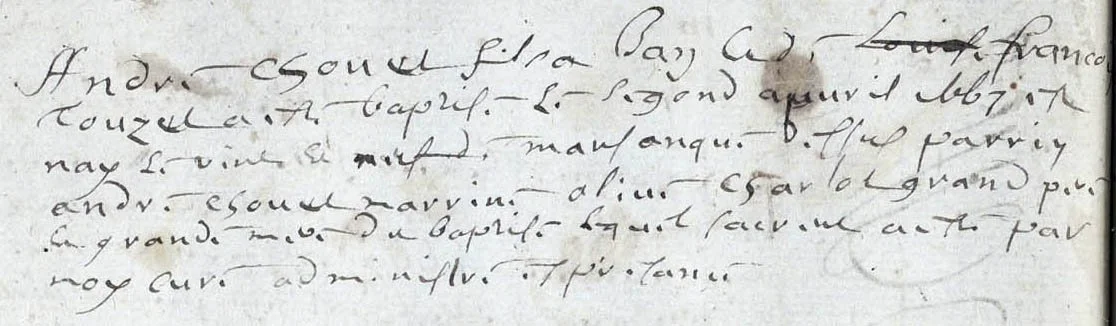
1667 baptism of André “Chouvet” (Archives départementales de la Gironde)
Origins in Camiran
André grew up in Camiran alongside at least four siblings: Joseph (baptized in 1669), Guirande (born in 1672), Marguerite (baptized in 1675), and Bertrande (born in 1676).
The church of Saint-Pierre, where André was baptized, dates to the medieval period and is among the oldest surviving landmarks in Camiran. Built in the Romanesque style, it features a distinctive two-bay bell gable, or clocher-mur, a sculpted stone portal, and an interior divided into two naves by pointed arches resting on octagonal pillars. Over the centuries the building was altered several times, including the addition of a porch in the seventeenth century. In 1907, the French government designated its façade and bell gable as historic monuments, a recognition of their architectural significance.
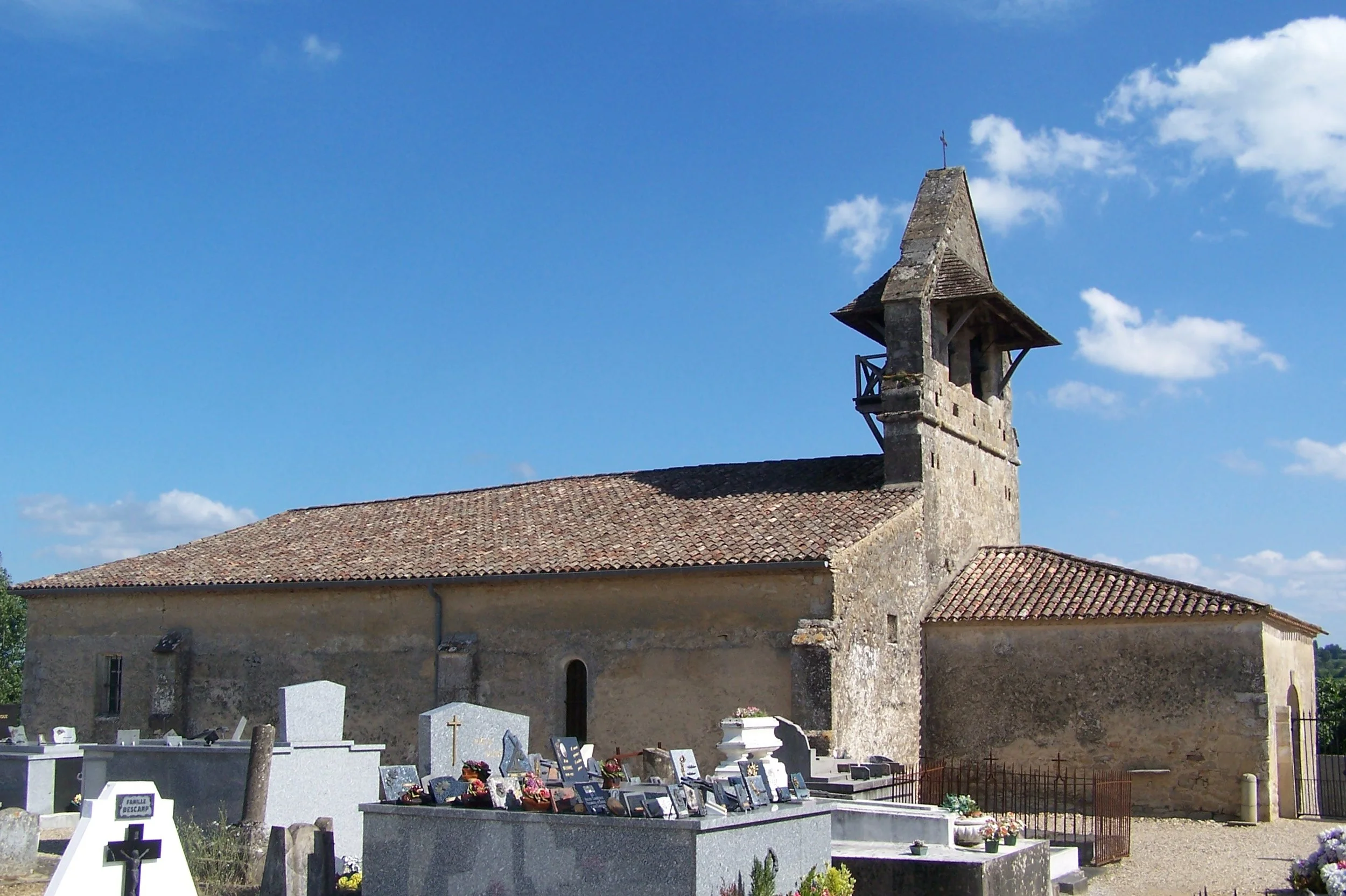
Saint-Pierre Church in Camiran (2011 photo by Henry Salomé, Wikimedia Commons, CC BY-SA 3.0)
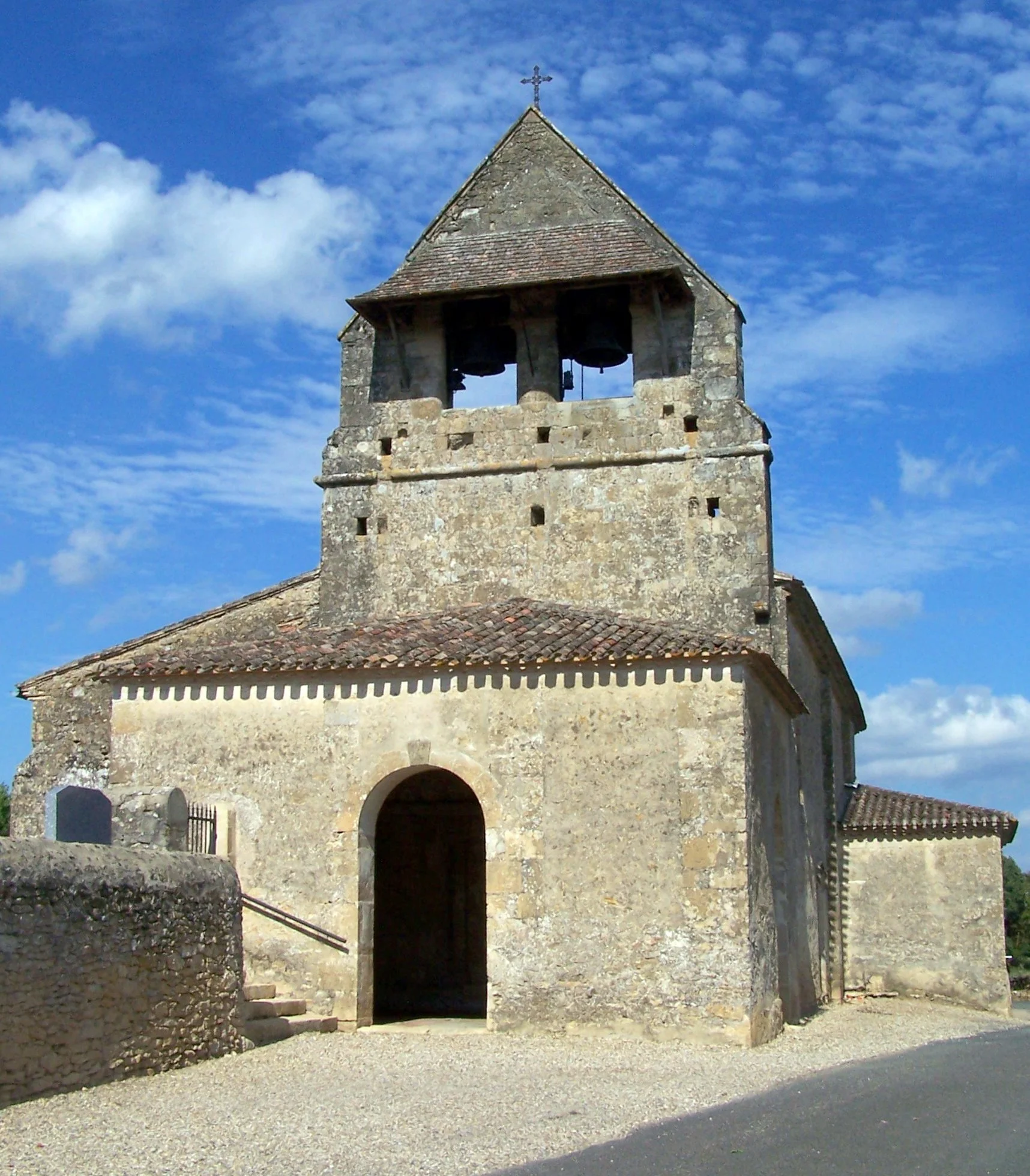
Saint-Pierre Church in Camiran (2011 photo by Henry Salomé, Wikimedia Commons, CC BY-SA 3.0)
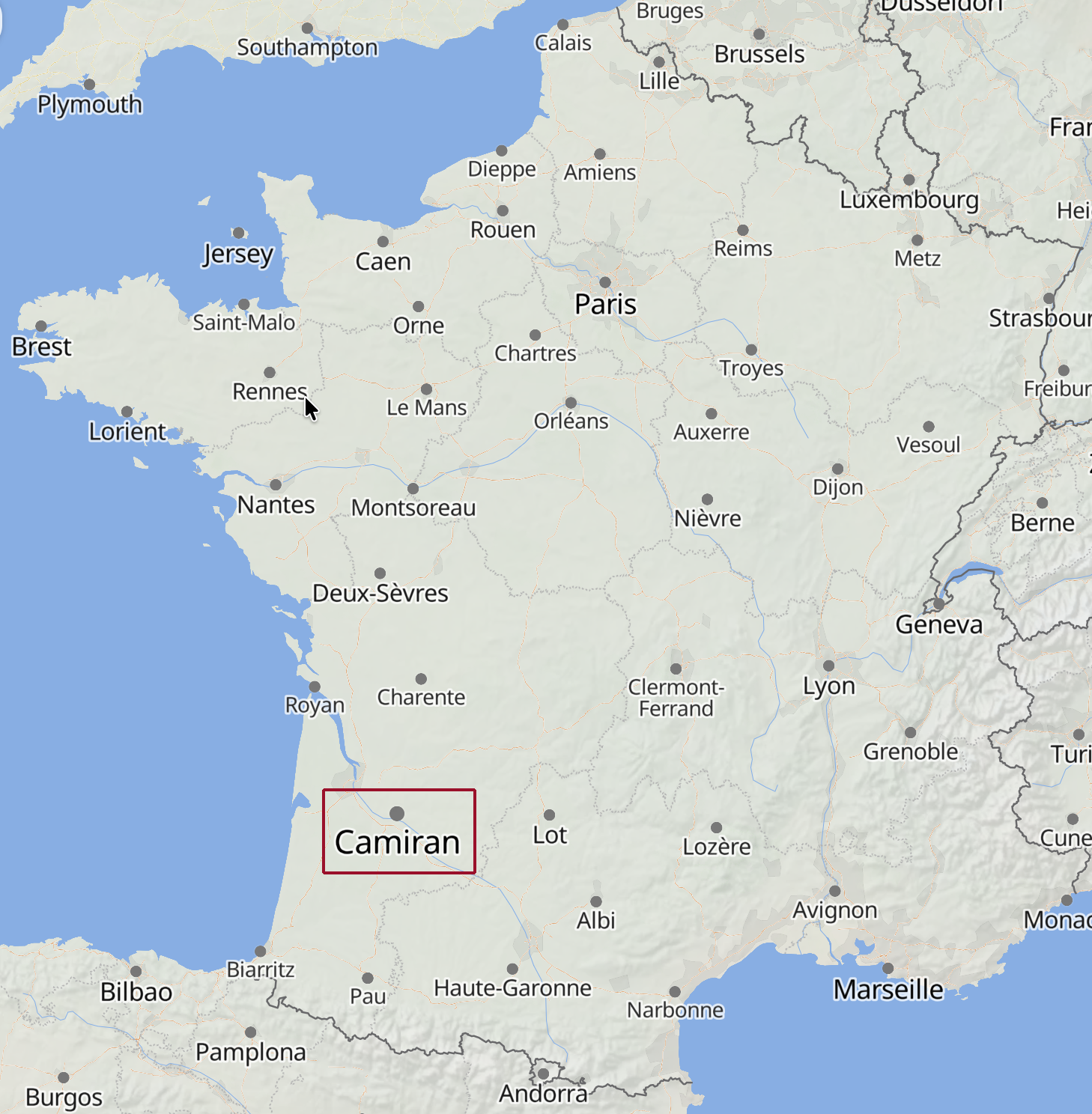
Location of Camiran in France (Mapcarta)
Camiran lies about 50 kilometres southeast of Bordeaux, in the present-day department of Gironde in southwestern France. The rural commune is home to fewer than 500 residents, known as Camiranais. Although the family bore the surname Chauvet, or Chouvet, in France, the dit name Camirand by which they became known in New France almost certainly derives from the name of this village.
In the seventeenth century, Camiran lay within the province of Guyenne, a region shaped by agriculture and by the wine trade centred on nearby Bordeaux. Most residents made their living cultivating the land, tending livestock, or labouring for local landowners, and life followed the rhythms of the agricultural calendar, its year marked by planting, harvesting, and religious observance. Like most children of the period, André likely received little formal education, learning practical skills from his family instead. At the centre of community life stood the parish church of Saint-Pierre, which served not only as a place of worship but also as the setting for baptisms, marriages, burials, and important social gatherings.
A Sergeant in New France
André was in New France by 1707, though his exact date of arrival is unknown. He served as a sergeant in the company de Repentigny, a captain in the Compagnies franches de la Marine. Established in 1683, these colonial troops formed the backbone of New France's military forces, responsible for defending the colony, garrisoning its forts, and supporting French interests throughout the St. Lawrence Valley and the Great Lakes region.
By the early eighteenth century, in the years following the Great Peace of Montréal in 1701, their duties consisted largely of maintaining military posts, escorting travellers and supplies, and securing the colony's expanding frontier settlements. As a sergeant, André held a position of responsibility within the company, assisting the officers by supervising the soldiers, maintaining discipline, organizing guard duty, and overseeing the daily routines of military life. The rank marked him as a trusted and experienced soldier, ranking above the ordinary troops but below the commissioned officers—a relatively uncommon position that carried real authority and respect within the military hierarchy of New France.
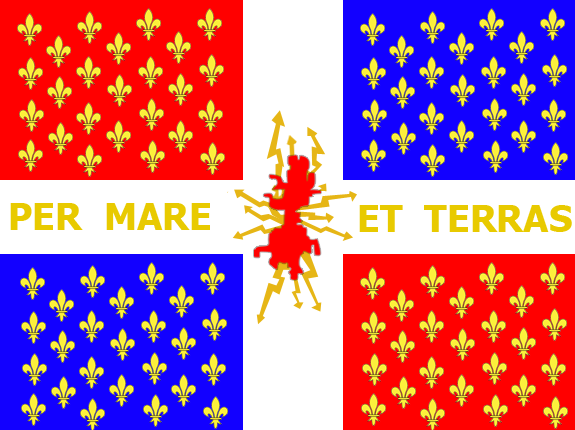
Flag of the Compagnies franches de la Marine (Wikimedia Commons)
Marie Anne Pastorel (or Pastourelle), daughter of Claude Pastorel (or Pastourelle) dit Lafranchise and Marie Leclerc, was born on March 28, 1677. She was baptized the following day in the parish of Sainte-Famille in Boucherville. Her godparents were Nicolas le Baron and Marie Chauvin, the wife of Jean Denoyon. [Marie Anne is recorded as Lafranchise, her father’s dit name, only twice on genealogical records.]
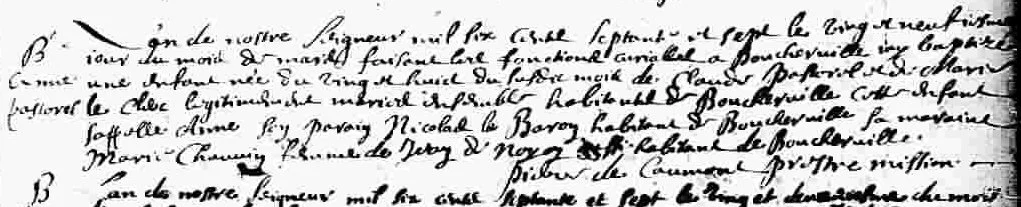
1677 baptism of “Anne Pastorel” (Généalogie Québec)
Marie Anne’s First Marriage
Marie Anne married her first husband, Jean Morisseaux, on June 19, 1698, in the parish of Sainte-Famille in Boucherville. She was 21 years old; he was 23. Marie Anne’s witnesses were her father and her brother Pierre. Also present were Pierre Boucher, seigneur of Boucherville; Mr. Labaume, surgeon; and Mr. Moreau, notary.
The couple settled in Repentigny, where they had three children: Vincent, Jacques, and Marie Catherine. Jean worked as an interpreter and voyageur.
Jean Morisseaux died at the age of about 28 in 1703. According to his burial entry on Généalogie Québec, “his body was moved on June 27, 1717. Jean Morisseau, who had died fourteen years earlier and had been buried outside the cemetery, was reburied.” His cause of death is unknown, as is the reason for his reburial.
On August 27, 1703, Marie Anne was hired by Antoine de Lamothe Cadillac, “to go to Fort Pontchartrain on the détroit of Lake Erie to nurse and breastfeed the child with whom Madame de La Motte is pregnant.” For her services as a wet nurse over a period of two years, Marie Anne was to receive 450 livres per year, as well as a robbe de chambre (a dressing gown).
Marie Anne likely met her future husband during her stay at Fort Pontchartrain. By 1705, however, she was back in Repentigny.
Marriage of André and Marie Anne
On July 11, 1707, notary Michel Lepailleur de LaFerté drew up a marriage contract between "André Chauvet de Camirant," sergeant in the Navy detachment at the garrison of Détroit on Lake Erie, and "Anne Pastourel." His parents were recorded as Jean Chauvet, ploughman, and Françoise Thouzet, of the parish of Camiran. Marie Anne was described as the widow of Jean "Mauriceau" and the daughter of Claude Pastourel and Marie Leclerc of the parish of Boucherville.
André's witnesses were Pierre Picard and the soldier Bernard Philipe de Belhumeur. Marie Anne's witnesses were her father-in-law Vincent Morisseaux and his wife Marie Anne Basmont; her brothers-in-law Pierre and Jean Baptiste Morisseaux; her sister-in-law Marie Catherine Morisseaux; and Barbe and Jeanne Bousquet. Nearly all of Marie Anne's witnesses came from her late husband's family, a sign of the close ties she maintained with them after his death.
The contract followed the standards of the Coutume de Paris. The prefix dower was set at 500 livres, and the préciput at 250 livres.
Coutume de Paris
The Coutume de Paris (Custom of Paris) governed the transmission of family property in New France. Whether or not a couple had a marriage contract, they were subject to the "community of goods," meaning that all property acquired during the marriage became part of the community. Upon the death of the parents, the community property was divided equally among all the children, both sons and daughters. When one spouse died, the surviving spouse retained half of the community property, while the other half was shared among the children; when the surviving spouse died, their share too was divided equally among the children. Following a death, an inventory was drawn up to list all the assets of the estate.
The dower was the portion of property the husband reserved for his wife should she outlive him. The préciput, under the regime of community of property, was a benefit conferred by the marriage contract, usually on the surviving spouse, granting the right to claim a specified sum of money or property from the community before the remainder was divided.
In the contract, Marie Anne declared that she had no movable or immovable property from her first marriage, with the exception of a wooded plot of land at Saint-Sulpice. She also stated that her deceased husband had left several debts and that she needed her father-in-law's help for her own subsistence and that of her children. She officially renounced the community of goods between herself and her late husband.
Marie Anne was able to sign her name ("Pastourelle"), albeit in an unsteady hand, as were a handful of witnesses. André did not sign.

Marie Anne’s signature on the marriage contract
André and Marie Anne were married six days later, on July 17, 1707, in the parish of Notre-Dame in Montréal. André was recorded as a 37-year-old sergeant in the company of Mr. de Repentigny (he was in fact 40). Marie Anne was recorded as the 28-year-old widow of Jean Morisseaux (she was in fact 30). André's witnesses were his captain, de Repentigny; the fellow soldier Bernard Philipe Belhumeur; Captain de Laforest; and Jacques Choagne Lafrance, a soldier in the de Laforest company. Marie Anne's witnesses were her brother-in-law Jean Baptiste Morisseaux and the beadle Jean Queneville.
The couple had at least six children, the first three born in Détroit and the last three in Canada:
André (1709-bef. 1733)
Pierre (1710–1792)
Marie Josèphe (ca. 1712–1714)
Marie Madeleine (1714–1764)
Thérèse (1716–?)
Marguerite (1719–1757)
On August 29, 1707, André acknowledged owing François Brissonnet, marchand perruquier de la ville de Villemarie (merchant wig-maker of Villemarie), 324 livres for goods delivered for his upcoming voyage. The obligation, drafted by notary Michel Lepailleur de LaFerté, recorded that André was a resident of Détroit on Lake Erie. The debt was recorded before his departure for Détroit and he agreed to pay it by the following July.
Return to Fort Pontchartrain
André and Marie Anne likely left for Détroit shortly after this obligation was drawn up, almost certainly by canoe along the waterways linking Montréal to the Pays d'en Haut—a journey both had made before. In the days of New France, the Pays d'en Haut ("up country," or "upper country") referred to the vast territory west of Montréal, taking in most of the Great Lakes region—both north and south of the lakes—and extending farther west and south as the French explored deeper into the continent.
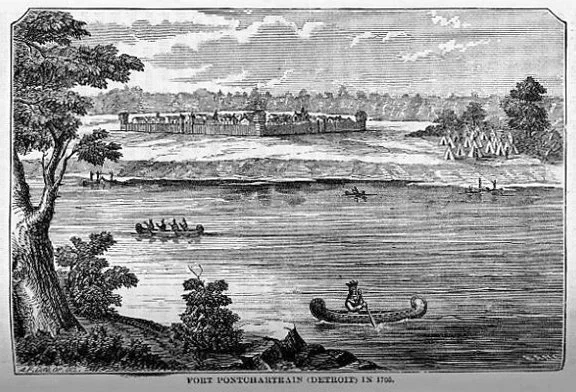
Fort Pontchartrain, 1706 (Wikimedia Commons)
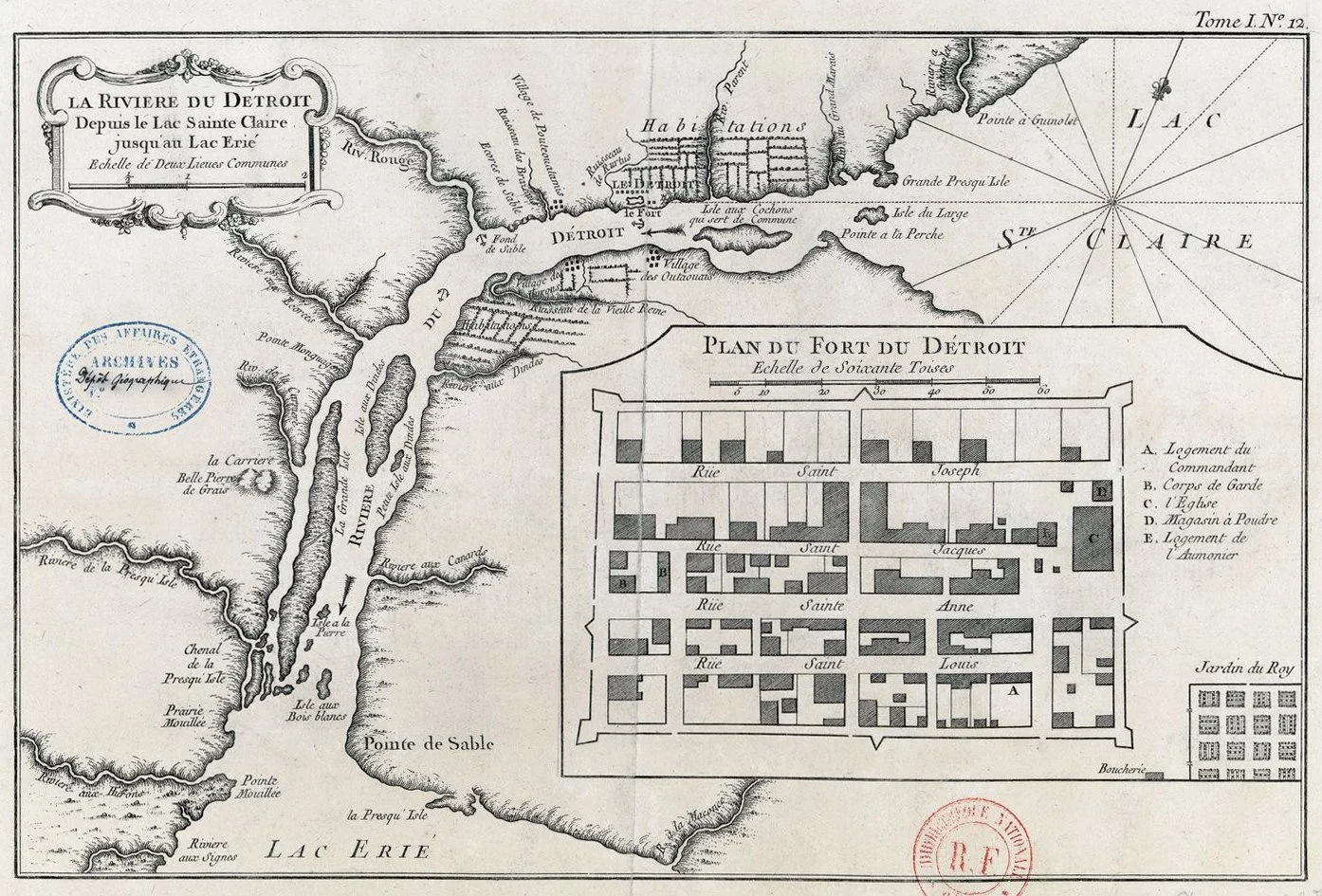
“The Detroit River from Lake St. Clair to Lake Erie,” 1764 map by Jacques-Nicolas Bellin (Bibliothèque nationale de France)
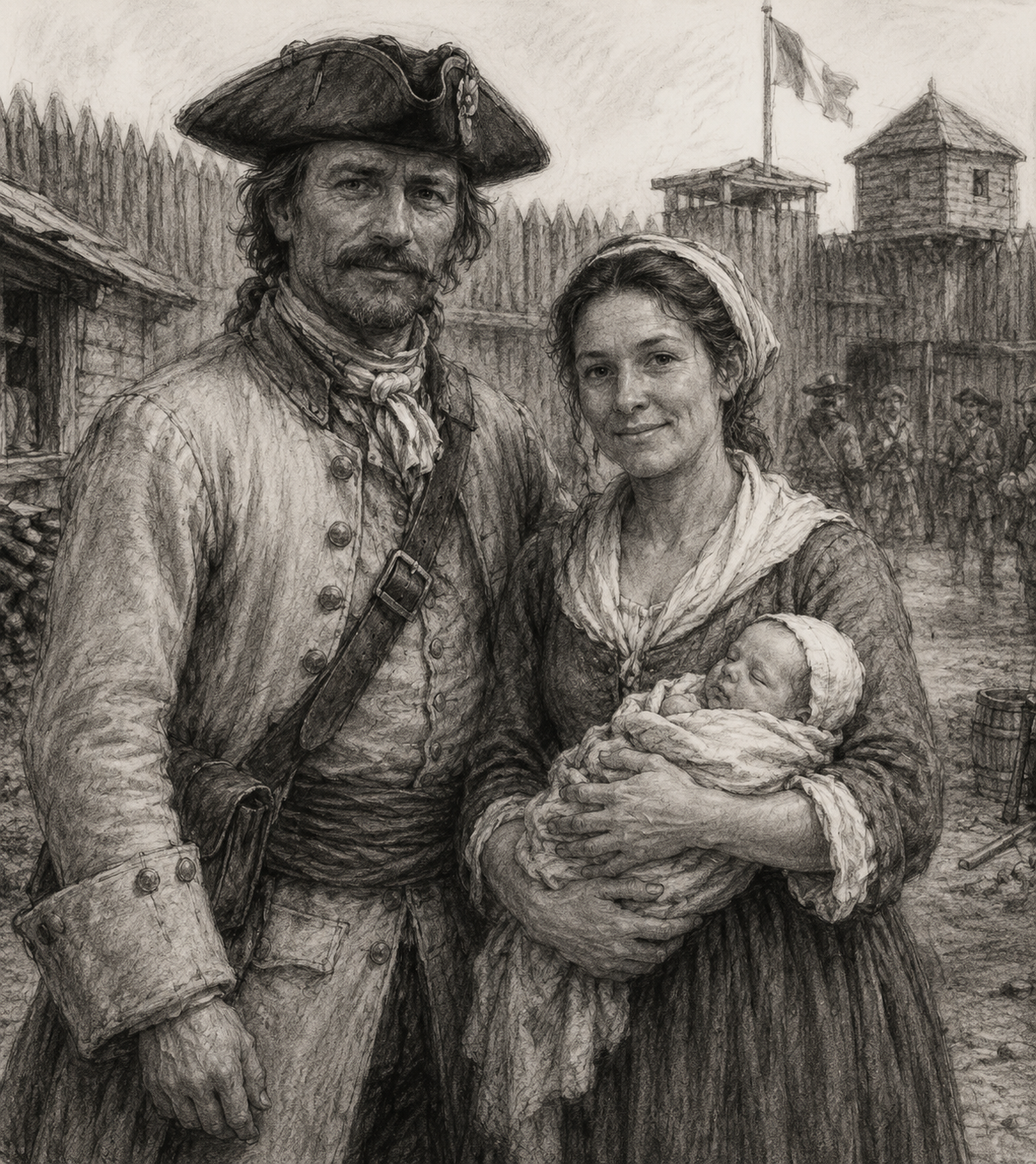
Illustration generated with artificial intelligence by the author, June 2026 (ChatGPT)
When André served as a sergeant at Fort Pontchartrain du Détroit between 1707 and 1714, he and his family were living on one of the most remote and strategic frontiers of New France. Founded only a few years earlier, in 1701, by Antoine de Lamothe Cadillac, Détroit was intended to block English expansion, control the western fur trade, and establish a permanent French presence in the Pays d'en Haut. The community comprised a small garrison alongside a growing number of French settlers, missionaries, and fur traders, as well as thousands of Indigenous allies and trading partners, among them the Odawa, Wyandot, Potawatomi, Ojibwe, and Miami peoples.
As a sergeant, André was a non-commissioned officer responsible for the day-to-day discipline and administration of the soldiers under his command. His duties likely included supervising guard rotations, inspecting weapons and supplies, organizing work details, relaying officers' orders, keeping order within the fort, and assisting in its defence. Because the garrison was small, soldiers often took on tasks well beyond purely military ones, including construction, maintenance, and the transport of supplies.
For Marie Anne and her young children, life would have been both challenging and unfamiliar compared with the St. Lawrence Valley. In these years, most French families still lived within or immediately beside the fort's wooden palisade for protection. Their home would have been a modest timber dwelling crowded among the soldiers' quarters, storehouses, workshops, and the parish church of Sainte-Anne.
Return to Canada
On May 10, 1714, Pierre Morisseaux, brother of the late Jean Morisseaux, met with six other relatives and friends to name a guardian and a substitute guardian for the minor children of Jean Morisseaux and Marie Anne Pastorel, so that the division of the estate of Pierre and Jean's late parents could proceed. Pierre Morisseaux was elected guardian, and Alexis Bissonnet substitute guardian. It is unclear why Marie Anne was not named legal guardian of her own minor children; it is possible that she and her family had not yet returned from Détroit.
By July 1714, when her daughter Marie Madeleine was born, André and Marie Anne were back in Canada, likely living in or near Trois-Rivières.
Land Leases and Acquisitions
On May 15, 1718, André leased a farm from master blacksmith Antoine Bouton for a term of three years. The land measured three arpents of frontage and lay in the seigneurie of Tonnancour (Pointe-du-Lac, today part of Trois-Rivières), adjoining the property of Mr. Jutras. On it stood a thatched house and a thatched barn, both in need of repair. The two men agreed to divide the hay and grain harvests equally: Bouton would supply a wheeled plough and oxen, while André would clear and sow the land, and Bouton would continue to pay the cens et rente on the property.
Six years after taking up the Bouton lease, André acquired land of his own in the same seigneurie. On March 20, 1724, he received a concession in the fief of Tonnancour from René Godefroy, seigneur of Tonnancour, king's councillor and lieutenant general in the jurisdiction of Trois-Rivières. André was recorded as an habitant of the town of "Quatre-Rivières" (almost certainly a rare variant or clerical rendering of Trois-Rivières). The land measured three arpents of frontage, facing the St. Lawrence River, by twenty arpents deep. In return, André agreed to pay an annual due of twenty sols in cash plus one capon (or twenty sols) for each arpent of frontage. He further agreed to build a house on the land within a year and a half and to maintain the seigneurial roads crossing it for public use. The seigneur, for his part, reserved the right to take wood from the property to build a church, gristmill, or manor. André received hunting and fishing rights on the land.
Land Sales and Transfers
On March 25, 1729, André and Marie Anne sold part of their land concession at Pointe-du-Lac, in the fief of Tonnancour, to their son André for 200 livres. They sold two arpents of frontage and retained one. André Jr. agreed to pay the sum upon his return from a voyage to the Outaouais country, which he did, on April 15, 1730.
André Jr. died sometime between April 15, 1730, and the following transaction in 1733.
On July 20, 1733, André and Marie Anne sold one arpent of land at Pointe-du-Lac to Pierre Gladu and his wife Magdelaine Brouillet for 80 livres in cash or wheat.
On January 2, 1735, André and Marie Anne sold to their son Pierre, for 200 livres, the two arpents of land at Pointe-du-Lac previously sold to their son André. This document appears to be the only one that confirms André Jr.'s death. As part of the sale, Pierre agreed to pay his late brother's debts.
A month later, on February 4, 1735, André and Marie Anne sold their son Pierre a lot in the lower town of Trois-Rivières, in a place commonly called le Marquisat du Sablé, for 250 livres. Their son André had acquired this lot in 1730 from François Dalpé dit Sincerny. It measured half an arpent of frontage by about one arpent in depth and included a house roughly 25 feet long by 20 feet wide, as well as a stable. André and Marie Anne agreed to use the proceeds to pay off their late son André's debts.
On April 4, 1746, André and Marie Anne sold a plot of land in le Marquisat du Sablé to the voyageur Claude Césire. They were recorded as residents of Trois-Rivières. [Unfortunately, bleed-through ink on the documents makes the details impossible to decipher. It is unclear whether this is the same lot as above.]
Death of Marie Anne
Marie Anne Pastorel (or Pastourelle) died at the age of 69 on the morning of April 22, 1746. She was buried the following day in the parish cemetery of Immaculée-Conception in Trois-Rivières.
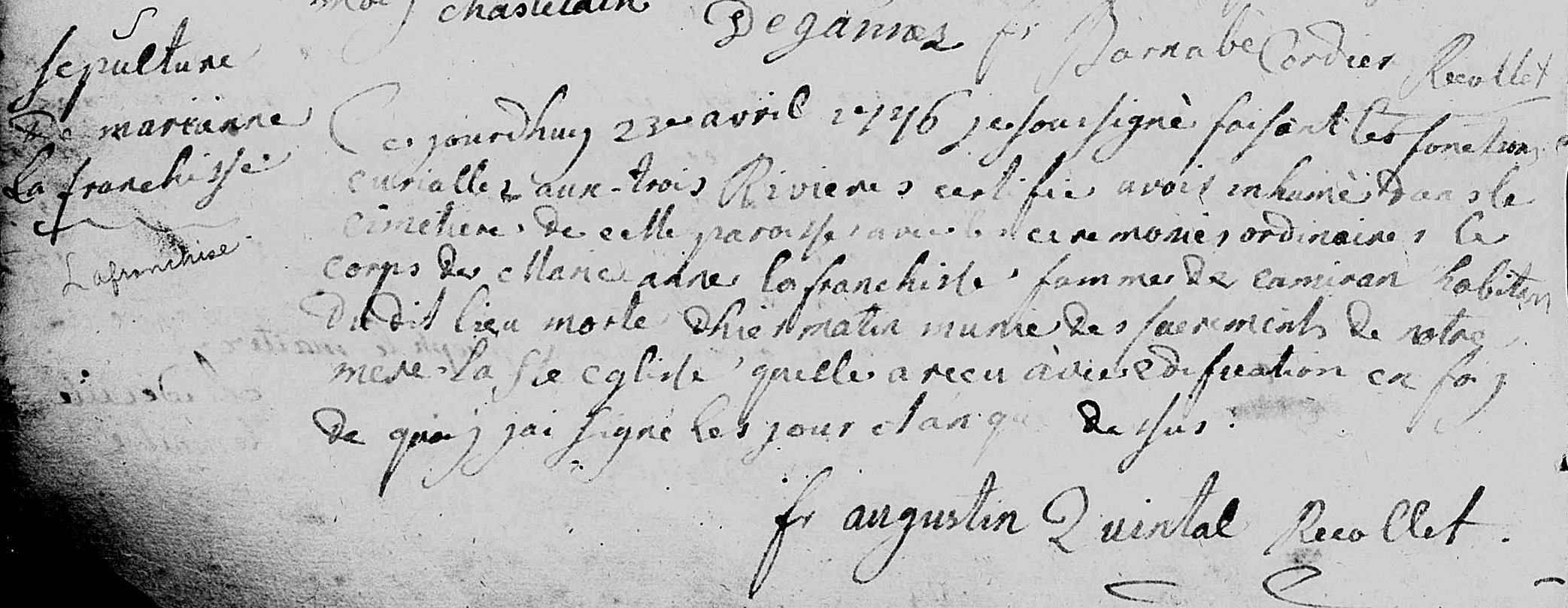
1746 burial of “Marianne Lafranchise” (FamilySearch)
On November 7, 1746, notary Louis Pillard drew up an inventory of the community of goods belonging to André and his late wife. The relatively short document enumerated all the assets and debts belonging to the couple. [Unfortunately, bleed-through ink on the documents makes the details impossible to decipher.]
André's Final Years
On June 17, 1747, André purchased the lot at Trois-Rivières, in the place called le Marquisat du Sablé, from his son Pierre for 250 livres. It measured half an arpent of frontage by about one arpent in depth. The lot contained an old house and other small buildings in poor condition. The seigneurial rent on the lot was four livres or two live capons annually, which André agreed to pay thereafter.
The timing of this repurchase, coming after Marie Anne's death and the settlement of the couple's community of goods, suggests that André was reacquiring the family lot for his own use in his widowerhood. He would live there for the remaining years of his life.
Death of André
André Chauvet dit Camirand died at the age of 87. He was buried on March 28, 1755, one day shy of his 88th birthday, in the parish cemetery of Immaculée-Conception in Trois-Rivières. [His date of death was omitted from the burial record.]
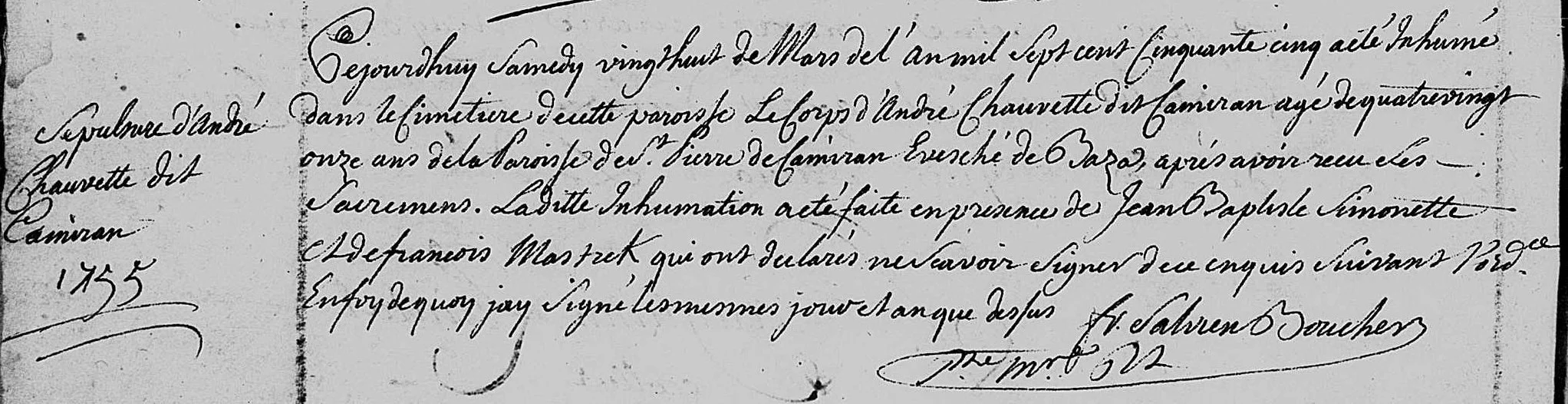
1755 burial of André "Chauvette dit Camiran" (FamilySearch)
Where All Camirands Begin
André Chauvet dit Camirand and Marie Anne Pastorel lived lives shaped by movement, hardship, and resilience. Marie Anne had already buried a first husband, crossed the wilderness to Détroit as a wet nurse, and raised three small children before she and André married in Montréal in 1707. André, a soldier from the Guyenne wine country of southwestern France, had made the long Atlantic crossing and found himself posted to one of the furthest edges of New France. Together, they built something lasting. They raised children at Fort Pontchartrain du Détroit, returned to the St. Lawrence Valley, cleared and farmed land at Pointe-du-Lac, and settled in Trois-Rivières, where Marie Anne died in the spring of 1746 and André followed nine years later, one day shy of his 88th birthday.
André and Marie Anne are the ancestral couple of all Camirands in North America today. Every person who carries the Camirand name — or descends from someone who did — traces that name back to a soldier from a small village in southwestern France and the resourceful widow he married on the banks of the St. Lawrence.
PDF version of biography located at: https://www.tfcg.ca/andrechauvetcamirand-and-marieannepastorel.
Are you enjoying our articles and resources? Show your support by making a donation. Every contribution, regardless of its size, goes a long way in covering our website hosting expenses and enables us to create more content related to French-Canadian genealogy and history. Thank you! Merci!
Sources:
"Camiran-Cultes, instruction publique, assistance publique-Paroisse Saint-Pierre-Baptêmes - Mariages - Sépultures -1667-1675 1667-1675," digital images, Archives départementales de la Gironde (https://archives.gironde.fr/ark:/25651/vta1c55eebebbc9f316/daogrp/0/3 : accessed 3 Jun 2026), baptism of André Chouvet, 2 Apr 1667, Camiran (St-Pierre), image 3 of 42, reference E DEPOT 1118.
"Église Saint-Pierre de Camiran," Musée du Patrimoine de France (https://museedupatrimoine.fr/eglise-saint-pierre-de-camiran-gironde/4842.html : accessed 3 Jun 2026).
"Le LAFRANCE (Baptêmes, mariages et sépultures)," database and digital images, Généalogie Québec (https://www.genealogiequebec.com/Membership/LAFRANCE/acte/2093 : accessed 3 Jun 2026), baptism of Anne PASTOREL, 29 Mar 1677, Boucherville (Ste-Famille); citing original data: Institut généalogique Drouin and PRDH.
"Le LAFRANCE (Baptêmes, mariages et sépultures)," database and digital images, Généalogie Québec (https://www.genealogiequebec.com/Membership/LAFRANCE/acte/3869 : accessed 3 Jun 2026), marriage of Jean MORICEAU and Anne PASTOREL, 19 Jun 1698, Boucherville (Ste-Famille); citing original data: Institut généalogique Drouin and PRDH.
"Le LAFRANCE (Baptêmes, mariages et sépultures)," database and digital images, Généalogie Québec (https://www.genealogiequebec.com/Membership/LAFRANCE/acte/21208 : accessed 3 Jun 2026), burial of Jean MORISSEAU, 1703, St-Sulpice (L'Assomption); citing original data: Institut généalogique Drouin and PRDH.
"Le LAFRANCE (Baptêmes, mariages et sépultures)," database and digital images, Généalogie Québec (https://www.genealogiequebec.com/Membership/LAFRANCE/acte/47950 : accessed 3 Jun 2026), marriage of Andre CHUVET CAMIRAND and Anne PASTOUREL, 11 Jul 1707, Montréal (Notre-Dame); citing original data: Institut généalogique Drouin and PRDH.
"Canada, Québec, registres paroissiaux catholiques, 1621-1979," digital images, FamilySearch (https://www.familysearch.org/ark:/61903/3:1:3QS7-899Q-H9QS-C?cat=242611&i=659&lang=en : accessed 4 Jun 2026), burial of Marianne Lafranchise, 23 Apr 1746, Trois-Rivières > Immaculée Conception > Baptêmes, mariages, sépultures 1749-1797 > image 87 of 786; citing original data : Archives nationales du Québec, Montréal.
"Canada, Québec, registres paroissiaux catholiques, 1621-1979," digital images, FamilySearch (https://www.familysearch.org/ark:/61903/3:1:3QS7-899Q-HL1C?cat=242611&i=86&lang=en : accessed 4 Jun 2026), burial of André Chauvette dit Camiran, 28 Mar 1755, Trois-Rivières > Immaculée Conception > Baptêmes, mariages, sépultures 1634-1749 > image 660 of 684; citing original data : Archives nationales du Québec, Montréal.
"Actes de notaire, 1668-1714 // Antoine Adhémar," digital images, FamilySearch (https://www.familysearch.org/ark:/61903/3:1:3Q9M-CSTC-2SL9-1?cat=koha%3A541271&i=1937&lang=en : accessed 4 Jun 2026), engagement of Anne Pastourel as a wet-nurse by Captain de Lamothe and his wife, 27 Aug 1703; image 1938 of 3100; citing original data : Bibliothèque et Archives nationales du Québec
"Actes de notaire, 1701-1732 // Michel-Laferté Lepailleur," digital images, FamilySearch (https://www.familysearch.org/ark:/61903/3:1:3Q9M-CS5F-T3P2-M?cat=koha%3A538127&i=1674&lang=en : accessed 3 Jun 2026), marriage contract of André Chauvet de Camirant and Anne Pastourel, 11 Jul 1707, images 1675-1676 of 3110 ; citing original data : Bibliothèque et Archives nationales du Québec
"Actes de notaire, 1701-1732 // Michel-Laferté Lepailleur," digital images, FamilySearch (https://www.familysearch.org/ark:/61903/3:1:3Q9M-CS5F-T35L-G?cat=koha%3A538127&i=1746&lang=en : accessed 3 Jun 2026), obligation of André Chauvet de Camiran to François Brissonnet, 29 Aug 1707, image 1747 of 3110 ; citing original data : Bibliothèque et Archives nationales du Québec.
"Actes de notaire, 1705-1721 // Étienne Véron de Grandmesnil," digital images, FamilySearch (https://www.familysearch.org/ark:/61903/3:1:3QHV-P3V7-TSZC?cat=koha%3A538072&i=2663&lang=en : accessed 3 Jun 2026), farm lease from Antoine Bouton to André Chauvet dit Camirand., 15 May 1718, images 2664-2665 of 2856; citing original data : Bibliothèque et Archives nationales du Québec.
"Actes de notaire, 1706-1735 // Pierre Petit," digital images, FamilySearch (https://www.familysearch.org/ark:/61903/3:1:3QHV-P3VW-34L8?cat=koha%3A538087&i=1340&lang=en : accessed 3 Jun 2026), land concession by René Godefroy to André Chauvet, 20 Mar 1724, images 1341-1343-of 2804; citing original data : Bibliothèque et Archives nationales du Québec.
"Actes de notaire, 1706-1735 // Pierre Petit," digital images, FamilySearch (https://www.familysearch.org/ark:/61903/3:1:3QHV-L3JH-F8S2?cat=koha%3A538087&i=38&lang=en : accessed 3 Jun 2026), land sale by André Chauvet dit Camirand and Anne Pastourelle to their son André Chauvet, 25 Mar 1729, images 39-43 of 2786; citing original data : Bibliothèque et Archives nationales du Québec.
"Actes de notaire, 1706-1735 // Pierre Petit," digital images, FamilySearch (https://www.familysearch.org/ark:/61903/3:1:3QHV-L3JH-F4X?cat=koha%3A538087&i=1324&lang=en : accessed 4 Jun 2026), land sale by André Chauvet dit Camirand and Anne Pastourelle to Pierre Gladu and Magdelaine Brouillet, 20 Jul 1733, images 1325-1328 of 2786; citing original data : Bibliothèque et Archives nationales du Québec.
"Actes de notaire, 1706-1735 // Pierre Petit," digital images, FamilySearch (https://www.familysearch.org/ark:/61903/3:1:3QHV-P3JH-F8MZ?cat=koha%3A538087&i=1614&lang=en : accessed 3 Jun 2026), land sale by André Chauvet-Camirand and Anne Pastourelle to their son Pierre Chauvet, 2 Jan 1735, images 1615-1617 of 2786; citing original data : Bibliothèque et Archives nationales du Québec.
"Actes de notaire, 1706-1735 // Pierre Petit," digital images, FamilySearch (https://www.familysearch.org/ark:/61903/3:1:3QHV-L3JH-X9BW-N?cat=koha%3A538087&i=1634&lang=en : accessed 4 Jun 2026), sale of a lot by André Chauvet-Camirand and Anne Pastourelle to their son Pierre Chauvet, 4 Feb 1735, images 1635-1638 of 2786; citing original data : Bibliothèque et Archives nationales du Québec.
"Actes de notaire, 1736-1767 // Louis Pillard," digital images, FamilySearch (https://www.familysearch.org/ark:/61903/3:1:3QHV-P3JH-D9CX-8?cat=koha%3A538090&i=1924&lang=en : accessed 4 Jun 2026), land sale by André Chauvet-Camirand and Anne Pastourelle to Claude Sesure, 4 Apr 1746, images 1925-1926 of 2708; citing original data : Bibliothèque et Archives nationales du Québec.
"Actes de notaire, 1736-1767 // Louis Pillard," digital images, FamilySearch (https://www.familysearch.org/ark:/61903/3:1:3QHV-L3JH-D94C-W?cat=koha%3A538090&i=2221&lang=en : accessed 4 Jun 2026), inventory of the community of goods belonging to André Chauvet dit Camirand and the late Marie Anne Pastorel, 7 Nov 1746, images 2222-2225 of 2708; citing original data : Bibliothèque et Archives nationales du Québec.
"Actes de notaire, 1744-1761 // Jean Leproust," digital images, FamilySearch (https://www.familysearch.org/ark:/61903/3:1:3Q9M-CSTH-J79C-C?cat=koha%3A538079&i=857&lang=en : accessed 4 Jun 2026), sale of a lot by Pierre Chauvet dit Camiran to his father André Chauvet dit Camiran, 17 Jun 1747, images 858-859 of 995; citing original data : Bibliothèque et Archives nationales du Québec.
"Fonds Juridiction royale de Montréal - Archives nationales à Montréal," digital images, Bibliothèque et Archives nationales du Québec (https://advitam.banq.qc.ca/notice/699627 : accessed 3 Jun 2026), guardianship of the children of the late Jean Morisseau and Anne Pastorel, 10 May 1714, reference TL4,S1,D1578, Id 699627.
Fédération québécoise des sociétés de généalogie, Fichier Origine online database (https://www.fichierorigine.com/fr/repertoire/chauvet/-chouvet/-camirand : accessed 4 Jun 2026), entry for CHAUVET / CHOUVET / CAMIRAND, André (person #240865), updated on 5 Feb 2017.
Université de Montréal, Programme de recherche en démographie historique (PRDH) online database (https://www-prdh-igd-com.res.banq.qc.ca/Membership/en/PRDH/Famille/8020 : accessed 3 Jun 2026), dictionary entry for Jean MORISSEAUX and Marie Anne PASTOREL LAFRANCHISE, union 8020.
Université de Montréal, Programme de recherche en démographie historique (PRDH) online database (https://www-prdh-igd-com.res.banq.qc.ca/Membership/en/PRDH/Famille/10061 : accessed 3 Jun 2026), dictionary entry for Andre CHAUVET CAMIRAND and Marie Anne PASTOREL LAFRANCHISE, union 10061.
"Founding of Detroit," Detroit Historical Society (https://www.detroithistorical.org/learn/online-research/encyclopedia-of-detroit/founding-detroit : accessed 4 Jun 2026).