20 Legends That Frightened Our French-Canadian Ancestors
Step into the darker side of French-Canadian history through 20 legends of ghosts, devils, werewolves, mysterious lights and other supernatural beings. Drawing on stories from Québec, Acadia and Métis traditions, this article explores the fears, beliefs and moral lessons that shaped everyday life for earlier generations. From La Corriveau and the chasse-galerie to the loup-garou, the ghost ship and the Rougarou, these tales reveal how folklore, religion, danger and local history became intertwined.
Cliquez ici pour la version en français
20 Legends That Frightened Our French-Canadian Ancestors
Ghosts, devils, werewolves and other things that went bump in the night
For generations, French-Canadian families told stories of ghosts, devils, werewolves, mysterious lights and other creatures that appeared after dark. Some warned against breaking religious rules or wandering too far from home, while others grew from dangerous places and occupations, from winter crossings of the St. Lawrence to isolated lumber camps and stormy coastal waters.
These legends were told in Québec, French-speaking Ontario, Acadia and farther west in Métis communities, where French-Canadian traditions mingled with Indigenous beliefs. Some were frightening, some moralizing and some simply strange, but all offer a glimpse into the fears, values and imaginations of the people who came before us.
Part 1: The Restless Dead
Ghosts, revenants and those who never quite left
La Dame Blanche (The White Lady)
According to legend, during the siege of Québec in 1759, a young woman named Mathilde was preparing to marry her fiancé, Louis. Instead, Louis joined the fighting against the British and was killed at the Battle of Montmorency on July 31. When Mathilde learned of his death, she was overcome with grief. Dressed in the white gown she had intended to wear at their wedding, she made her way to the nearby Montmorency Falls, just east of Québec City, and threw herself into the rushing water below.
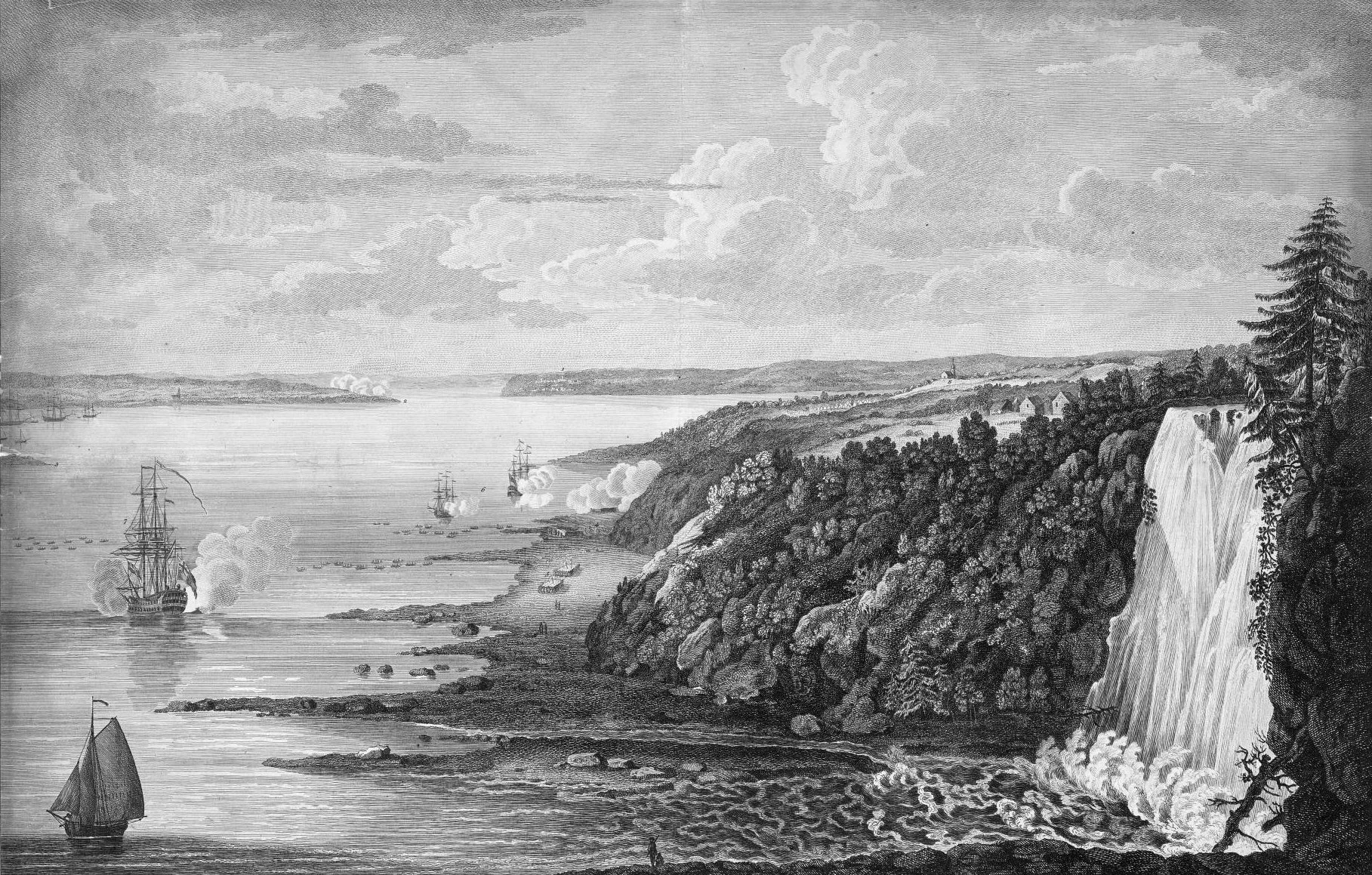
A view of the Fall of Montmorenci and the attack made by General Wolfe, print by Hervey Smyth and William Elliott, 1760 (Bibliothèque et Archives nationales du Québec)
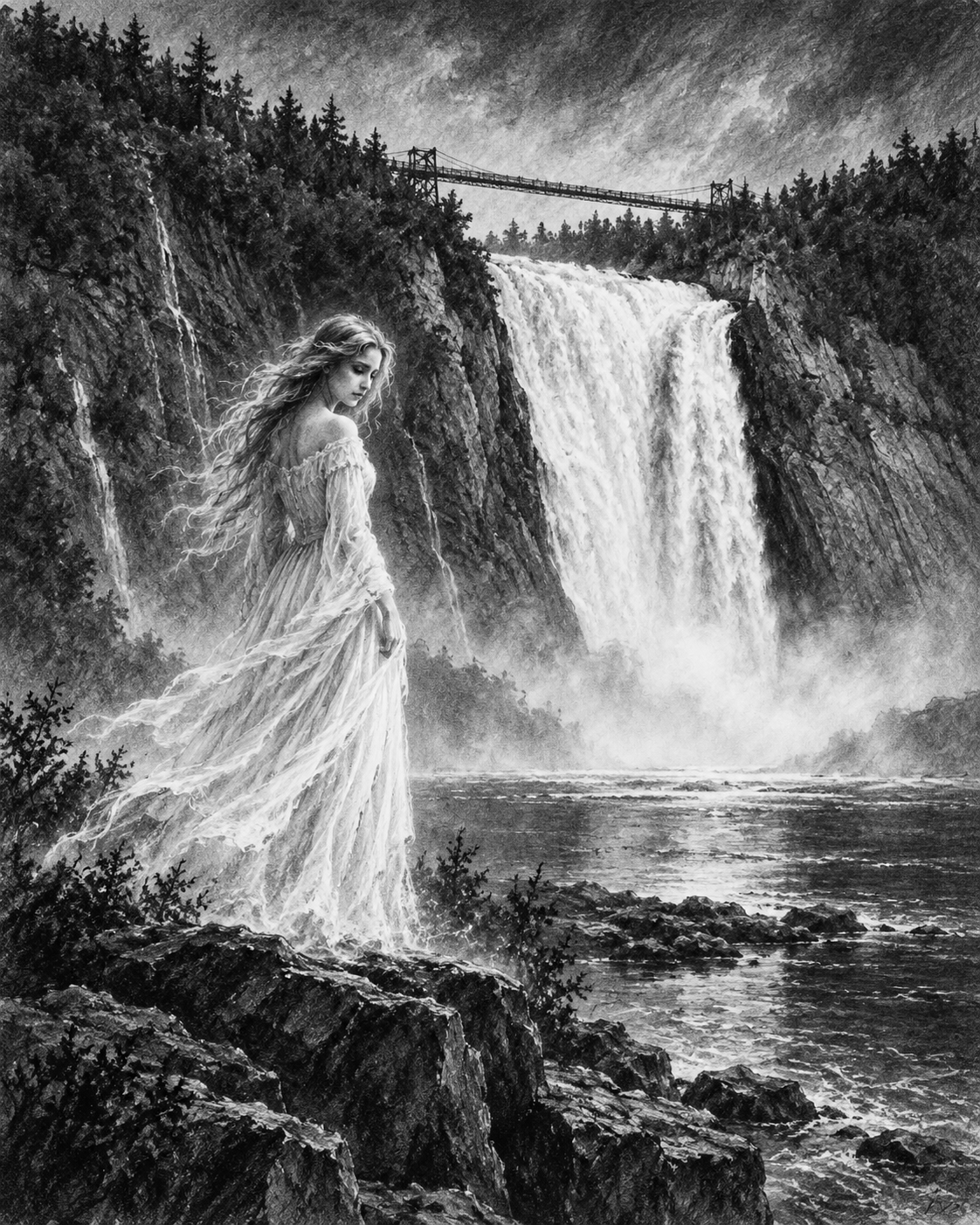
Illustration generated with artificial intelligence by the author, October 2026 (ChatGPT)
Her story did not end there. On certain nights, especially under a full moon, people were said to see the ghostly figure of a woman dressed in white near the falls. Some versions say that her wedding veil was swept away as she fell and landed on the rocks nearby. This is said to have inspired the name Chute de la Dame Blanche, a smaller cascade near Montmorency Falls whose white water resembles a bride’s veil. The apparition became one of Québec’s best-known white-lady legends, a grieving bride condemned to remain near the place where love, war and death came together.
Le Revenant de Gentilly (The Ghost of Gentilly)
In 1823, a group of students were spending a late summer evening at the presbytery in Gentilly when they heard a horse and carriage approaching outside. It seemed to stop at the front steps, followed by footsteps on the porch and a knock at the door. Yet when one of the young men looked outside in the moonlight, there was no carriage and no visitor. The front door then opened and closed by itself. Heavy footsteps crossed the room and climbed the staircase, accompanied by a sound like the rustling of a cassock. The unseen visitor seemed to enter a bedroom upstairs.
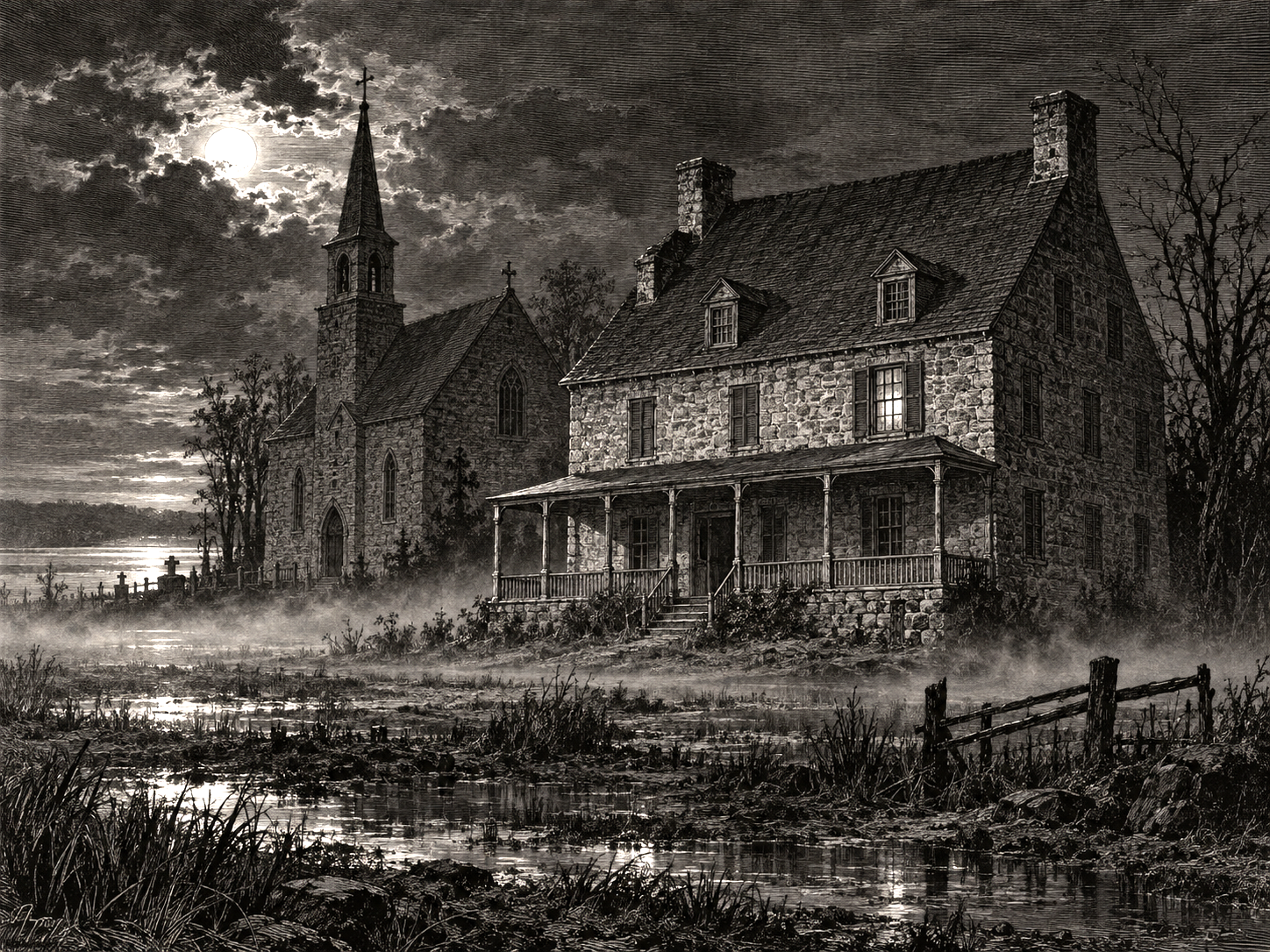
Illustration generated with artificial intelligence by the author, October 2026 (ChatGPT)
The priest and one of the young men searched the upstairs room but found nothing. Moments later, a tremendous crash came from the same room. The priest went back upstairs alone and returned pale, while the others below heard chains rattling and groans coming from the empty bedroom. The disturbances continued every night for more than a week. Even some of the village’s least superstitious men came to spend the night at the presbytery and reportedly left the next morning badly shaken. Stranger still, fresh wheel tracks from the mysterious carriage were found in the carefully raked sand outside.
Finally, the priest travelled to Québec to consult church authorities. When he returned, he waited for the haunting to begin again around midnight. He put on his surplice and stole, told the others to kneel and pray, and went upstairs alone. Almost immediately, screams, howls and tremendous crashing noises came from the bedroom, as though wild animals were fighting and the furniture were being smashed to pieces. When the noise suddenly stopped, the priest came back downstairs drenched in sweat, his hair dishevelled and his surplice torn. According to the account, he looked as though he had aged ten years.
The haunting never returned. The priest refused to explain what had happened upstairs and asked everyone to speak of it as little as possible. But for the rest of his life, on the first Friday of every month, he celebrated a Requiem Mass for someone whose name he would never reveal. Who the revenant had been, and what it wanted from the priest, remained a mystery.
La Corriveau
Few figures in Québec folklore are as macabre as La Corriveau. Over generations, she was transformed into a witch, a murderess and a ghostly figure who roamed the countryside, sometimes still burdened by the iron cage in which her corpse had once been displayed. In one of the best-known literary versions of the legend, La Corriveau appeared at night near Pointe-Lévy still imprisoned in her iron cage. She climbed onto the back of a terrified traveller and begged him to carry her across the St. Lawrence to Île d'Orléans, where she wanted to join her friends at a witches' sabbath. Her rattling cage became inseparable from her supernatural image and helped transform a real eighteenth-century execution into one of Québec's most enduring ghost stories.
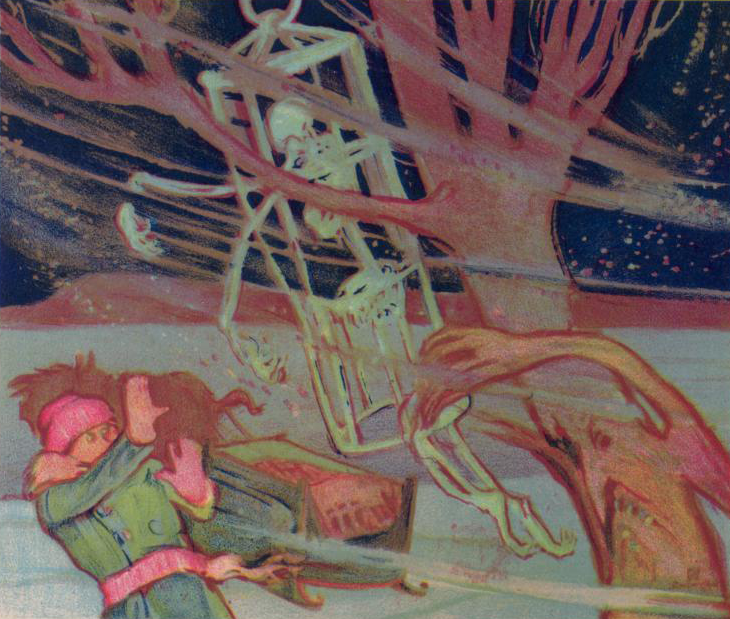
The skeleton of "La Corriveau," in her iron cage, terrifying a traveller, from Charles Walter Simpson’s Légendes du Saint-Laurent (Wikimedia Commons)
Unlike many monsters of folklore, however, La Corriveau was a real person. Marie Josèphe Corriveau was born around 1733 in Saint-Vallier, near Québec. After the death of her first husband, Charles Bouchard, she married Louis Hélène Dodier in 1761. Their marriage was troubled, and records indicate that Dodier had conflicts with Marie Josèphe and her family; in December 1762, she even fled their home, reportedly because of his mistreatment. A few weeks later, Dodier was found dead in the stable. Although his death was initially blamed on a horse, an examination revealed severe wounds to his head. Marie Josèphe eventually confessed to killing him with a hatchet while he slept, telling the military court that her husband's ill treatment had contributed to her actions.
She was condemned to death in 1763 and hanged near Québec. But it was what happened afterward that helped create the legend. Instead of being buried, Marie Josèphe's body was enclosed in an iron gibbet and displayed prominently at a crossroads in Pointe-Lévy, across the St. Lawrence from Québec. For about five weeks, travellers and local residents passed the decomposing body suspended inside its cage before authorities finally permitted its burial. The extraordinary spectacle proved far more enduring than the crime itself.
As the story passed from one generation to another, one murdered husband became several. Marie Josèphe was transformed into a witch and serial killer who, according to some versions, had dispatched as many as seven husbands by increasingly imaginative methods. The legend grew even further after her iron cage was rediscovered in 1851 and exhibited for paying audiences in Canada and the United States. Nineteenth-century writers then gave La Corriveau a supernatural afterlife, portraying her as a ghost haunting the place where her body had once hung. Today, historians generally distinguish the documented story of a woman convicted of murdering one husband from the much darker, and considerably more colourful legend that Québec created around her.
Le Petit Bonhomme sans tête de l’Isle-aux-Grues (The Little Headless Man of Isle-aux-Grues)
On Isle-aux-Grues, in the St. Lawrence opposite Cap-Saint-Ignace, people once told of a strange apparition known simply as the Petit Bonhomme sans tête, the Little Headless Man. He was described as short and stout, dressed in grey trousers and a black coat, but with one deeply unsettling feature: his head could not be seen. He never spoke, never threatened anyone, and yet he terrified the islanders for decades.
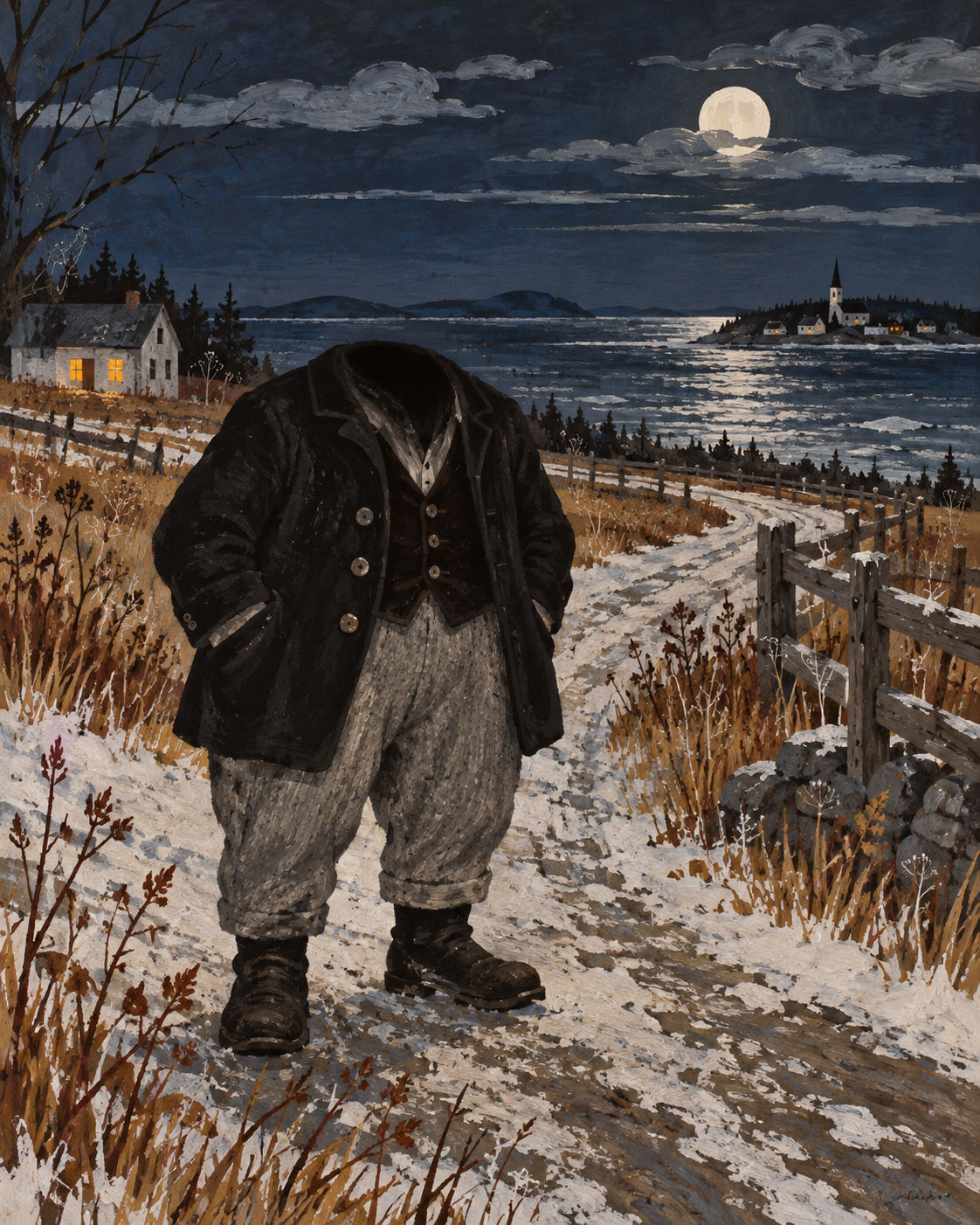
Illustration generated with artificial intelligence by the author, October 2026 (ChatGPT)
According to the tradition, he first appeared around 1810 and continued to haunt the island until 1841. He showed himself only at night, usually along the same stretch of road near the coast. People claimed to see him walking lightly over the snow without leaving any footprints. The first person said to have encountered him was Catherine “Catin” Gagné, and many others later insisted that they too had seen the same silent figure.
What made the legend so powerful was not violence, but persistence. The Petit Bonhomme kept appearing over and over again, always at night, always in the same general place, and always looking exactly the same. One of the best-known witnesses was Louis Lebel, nicknamed Carleton. According to a later retelling, he encountered the apparition near a cliff and, while trying to escape it, tumbled down the rocky slope. He was found the following morning bruised, bloodied and unconscious. He survived, but like Catin Gagné, he reportedly insisted until his death that what he had seen was the Devil. The Petit Bonhomme was said to have made his final appearance in 1841 and was never seen again.
La Tête à Pitre (Pitre’s Head)
Among the canotiers who once made the dangerous winter crossing between Québec and Lévis, few legends were more chilling than that of La Tête à Pitre. The story centred on a man called Pitre Soulard, a bold and reckless boatman who would rather take a risk than appear cowardly. One winter crossing, that recklessness cost him dearly. A moving sheet of ice struck him with terrible force and severed his head, sending it skidding across the frozen river and leaving a trail of blood behind.
According to legend, Pitre’s head continued to appear on the St. Lawrence, especially in fog, drifting snow and bad weather. Canotiers claimed to see it carried along on a large sheet of drifting ice in the stretch of river between Québec and Lévis known as “between the two churches.” The apparition was considered a terrible omen. Anyone who saw La Tête à Pitre was believed to be marked for death within the year, most often in an accident.
Some versions of the legend are darker still. Rather than Pitre returning alone, thirteen headless men were said to wander the river on winter nights, trying to reach shore but never succeeding. In these versions, the legend becomes more than the haunting of one unlucky canotier. The St. Lawrence itself becomes
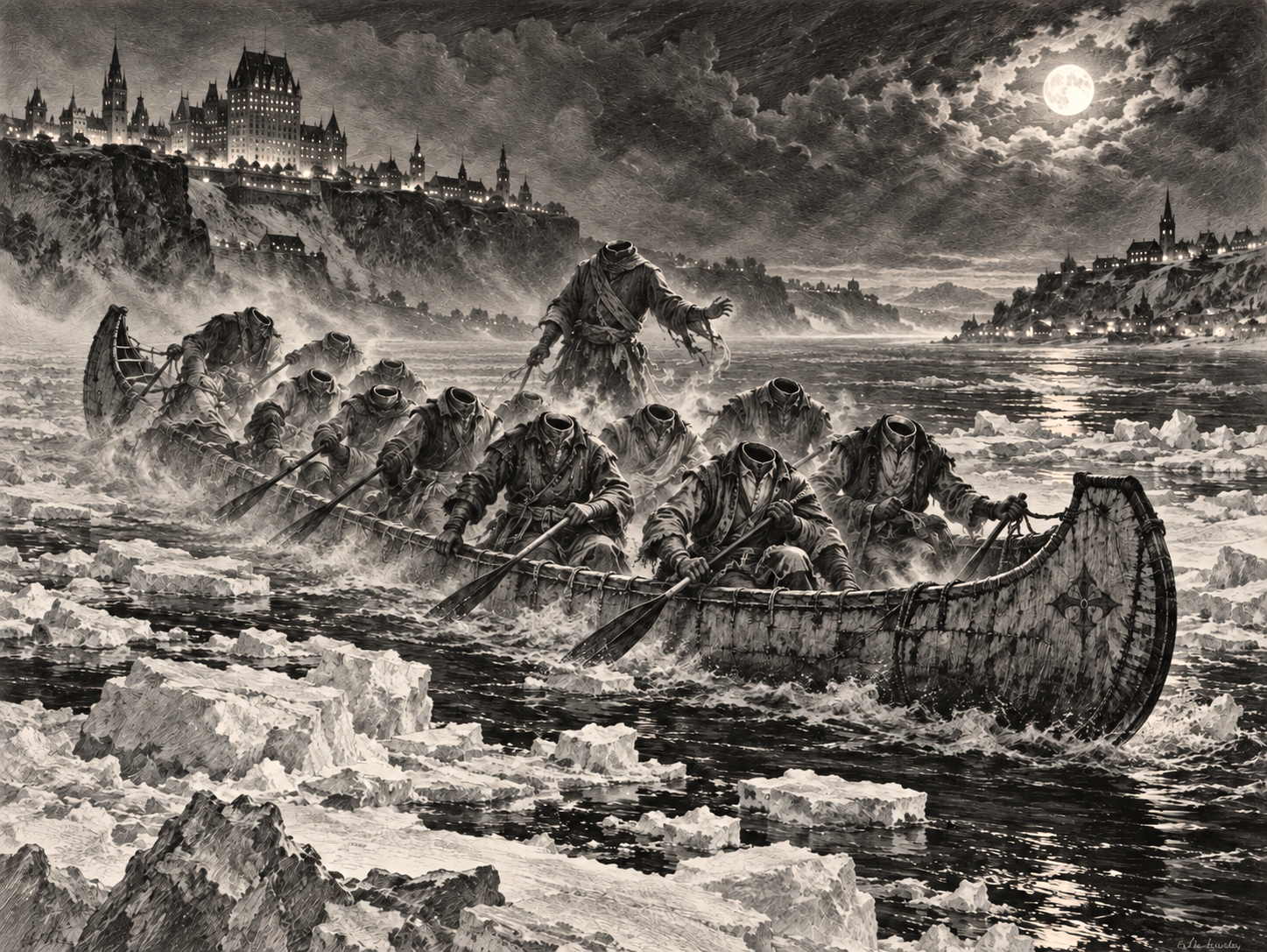
Illustration generated with artificial intelligence by the author, October 2026 (ChatGPT)
Part 2: The Devil, the Cursed and the Condemned
When breaking the rules could have supernatural consequences
The Devil at the Forges du Saint-Maurice
At the Forges du Saint-Maurice, the Devil was less an occasional visitor than a permanent resident. Established near Trois-Rivières in the 1730s, the Forges became Canada’s first industrial community and remained in operation until 1883. By the nineteenth century, however, they had also acquired a remarkably sinister reputation. One of the earliest substantial written accounts was published by the Abbé Napoléon Caron in 1872, drawing on stories already circulating orally around the Forges. Caron described an isolated settlement surrounded by thick forest, its workers blackened by smoke and charcoal and its blast furnace casting flames and an eerie light over the village at night, the perfect setting for stories about the Devil.
According to Caron, the Devil gained his hold over the Forges through a woman known as Mademoiselle Poulin. During Mathew Bell’s tenure at the Forges, she supposedly owned maple woods nearby that Bell’s workers were cutting to make charcoal. Unable to stop them, she finally declared that she was giving everything she owned to the Devil. After her death, Satan took the gift seriously and began behaving as master of the property. At a charcoal-burning clearing known as the Vente-au-diable, travellers passing after dark were said to see a great fire and hear rattling chains, howls, cries of rage and terrifying laughter. Horses sometimes stopped suddenly on the road and could not be made to move. From then on, the Forges became known as a place where the Devil had made himself at home.
And the Devil appeared in many forms. A huge black cat was said to stretch itself beside the blast furnace, in heat no ordinary animal could have endured. When workers tried to drive it away with iron bars, the cat swelled to an enormous size before rising and disappearing into the furnace. Another night, while the villagers were dancing late on a Saturday, the great forge hammer suddenly began working by itself. The Devil was even said to have placed his own leg beneath the hammer as though it were a bar of red-hot iron. Other stories told of the mysterious Beuglard, an unseen voice whose cries pursued travellers through the woods, a black bear that no weapon seemed able to harm, and strange men encountered along the roads. Édouard Tassé, a worker at the Forges, was even said to have fought the Devil himself in a violent battle in the middle of the night.
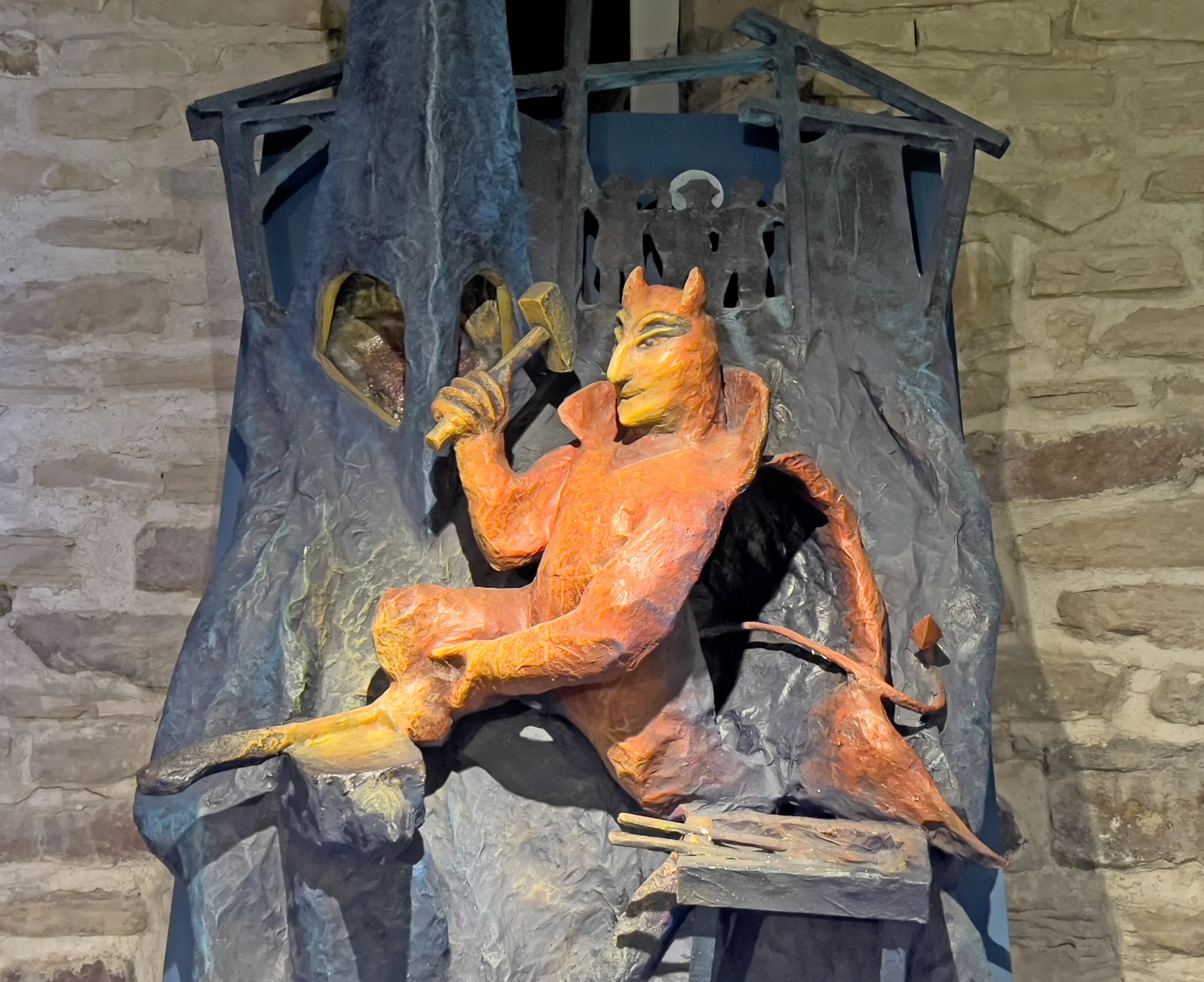
The devil at the Forges du Saint-Maurice National Historic Site (© The French-Canadian Genealogist)
The legends also served as warnings about proper behaviour. The Devil was said to appear when people danced into Sunday, worked instead of observing the Sabbath, blasphemed, or neglected their religious duties. The isolation of the Forges may have helped these stories flourish: for long periods, the predominantly Catholic community had no resident priest, and religious services were irregular. The Devil of the Forges was a distinctly local figure whose presence seemed to hang over the entire site. Even today, the Forges have a phenomenon that fits their infernal reputation perfectly: the “Devil’s Fountain,” where naturally occurring methane rises through an underground spring and can ignite at the water’s surface.
Rose Latulippe and the Devil at the Dance
On Mardi Gras, a handsome stranger dressed in black arrived at a lively house party and quickly set his sights on young Rose Latulippe. He danced with her for hours, but there were warning signs. He refused to remove his gloves, reacted badly to the names of Jesus and Mary, and seemed strangely disturbed by holy objects. Outside, the snow had melted around the hooves of his magnificent black horse.
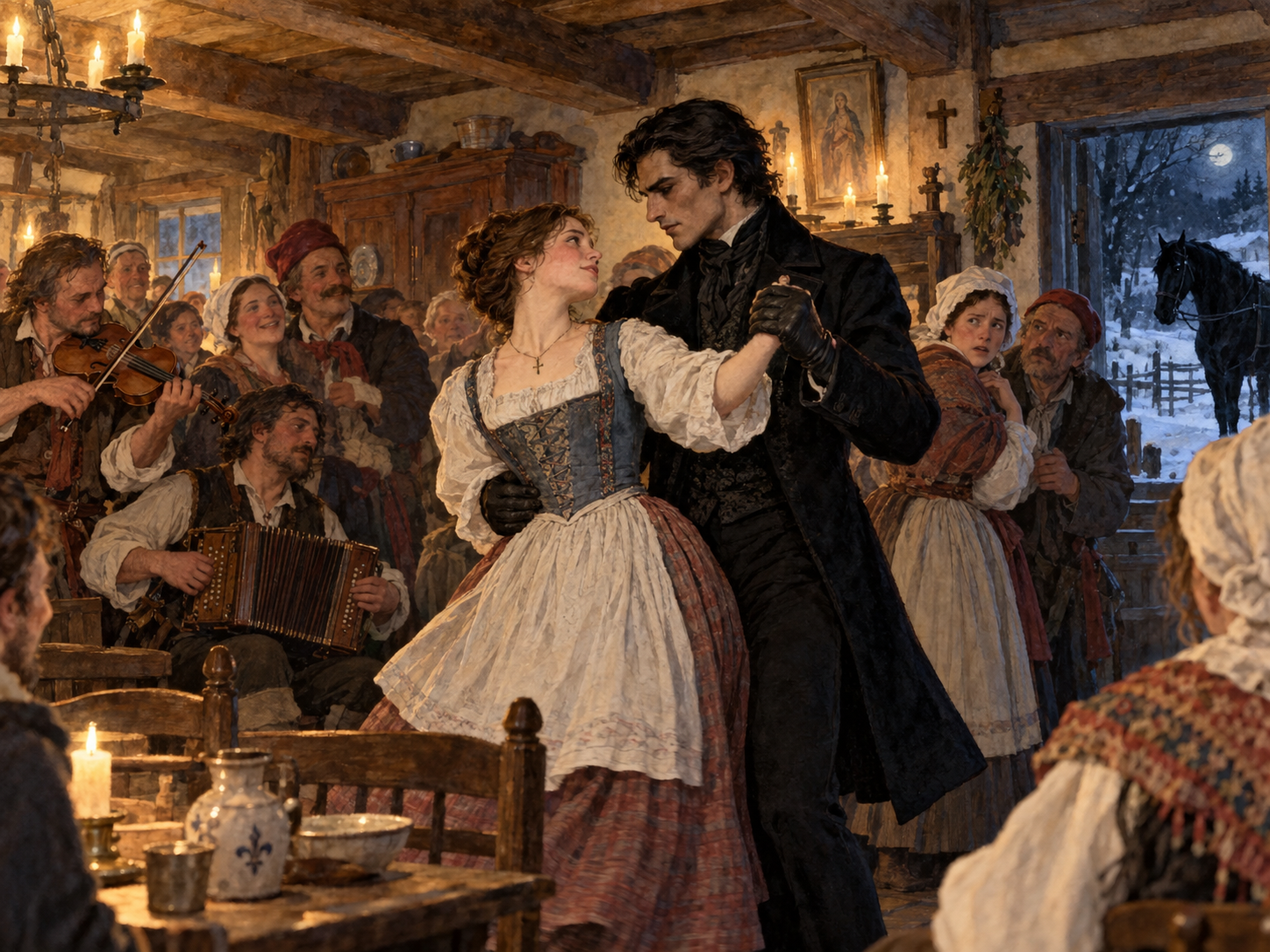
Illustration generated with artificial intelligence by the author, October 2026 (ChatGPT)
When midnight struck, the dancing was supposed to stop. Lent had begun. Rose ignored the warning and agreed to one last dance. The stranger asked her to give herself to him forever, and when she agreed, he revealed himself as the Devil. A priest arrived just in time, protected Rose with his stole and drove the Devil away. Rose survived, but the encounter changed her completely. According to the best-known version of the legend, she entered a convent and died only a few years later.
At its heart, the story was a warning: enjoy the festivities while they last, but respect the Church calendar, know when it is time to go home, and be wary of charming strangers who arrive after dark.
La Bête à grand'queue (The Long-Tailed Beast)
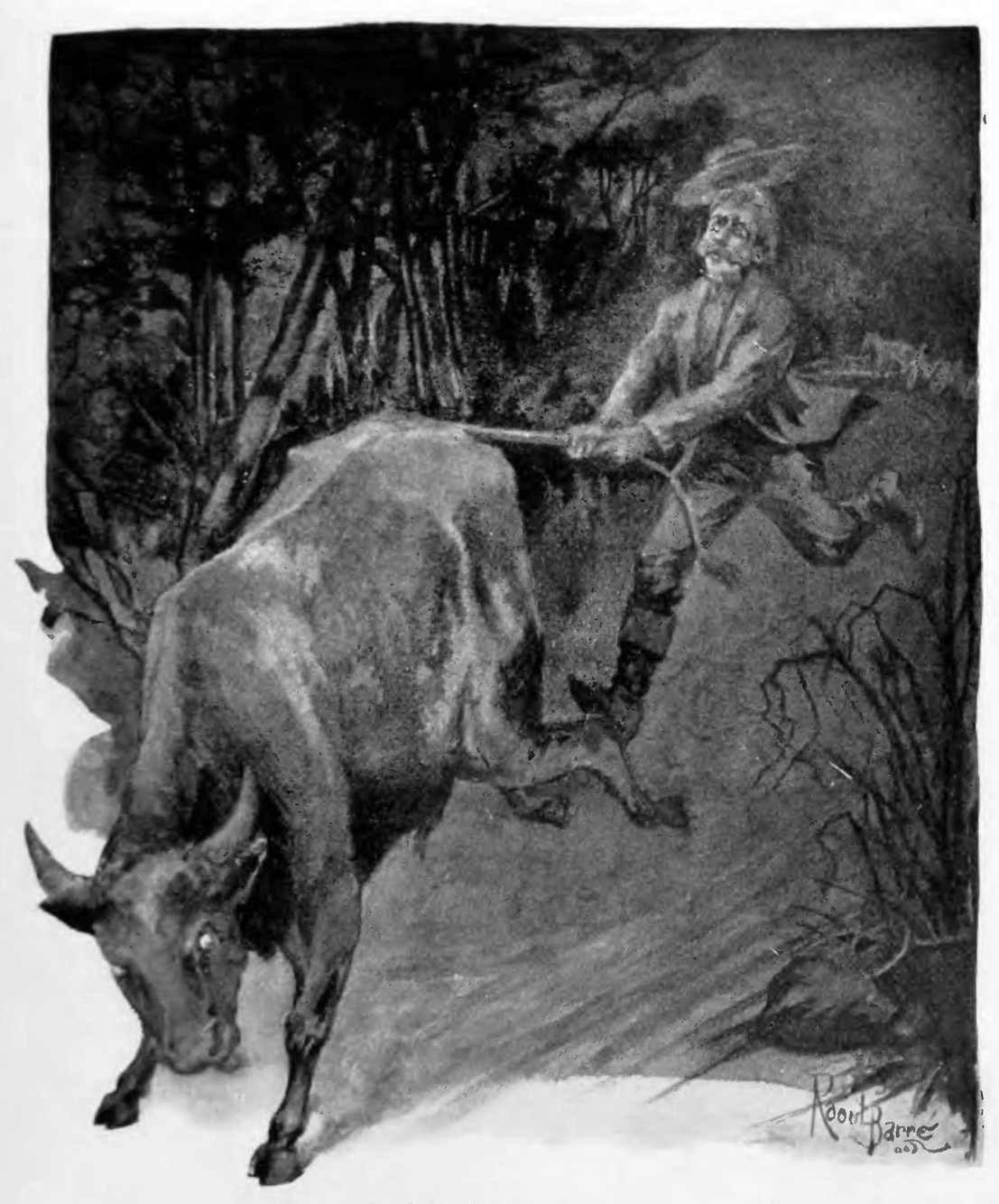
La Bête à grand'queue, illustration by Raoul Barré, in La Chasse-galerie: légendes canadiennes by Honoré Beaugrand (Wikisource)
The Bête à grand'queue (or la Hère) was said to lie in wait for people who had neglected their religious duties, particularly those who had gone years without making their Easter confession at the proper time. In one well-known tale, the unfortunate Fanfan Lazette had been doing exactly that for more than seven years when he encountered the creature on a dark and stormy road near Lanoraie.
The beast had glowing eyes and an enormous red tail, said to be six feet long. When it pursued Fanfan's wagon, he remembered that the only way to defeat it was to cut off its tail. After a frantic struggle, he managed to do just that, and the wounded creature disappeared into the Rivière Dautraye. Fanfan returned home with the scarlet tail as proof of his adventure.
There was, however, a problem. A neighbour's red bull had disappeared that same night, and its carcass was later found without a tail. The bull had recently rubbed itself against a freshly painted vermilion fence. Whether Fanfan had defeated a supernatural monster or simply encountered an angry bull in the darkness was left very much open to interpretation.
La Chasse-Galerie (The Flying Canoe)
For French-Canadian lumbermen spending the winter deep in the forest, home could be hundreds of kilometres away. According to the legend of the chasse-galerie, there was one very dangerous way to make the trip in a single night: strike a bargain with the Devil and take to the sky in a flying canoe.
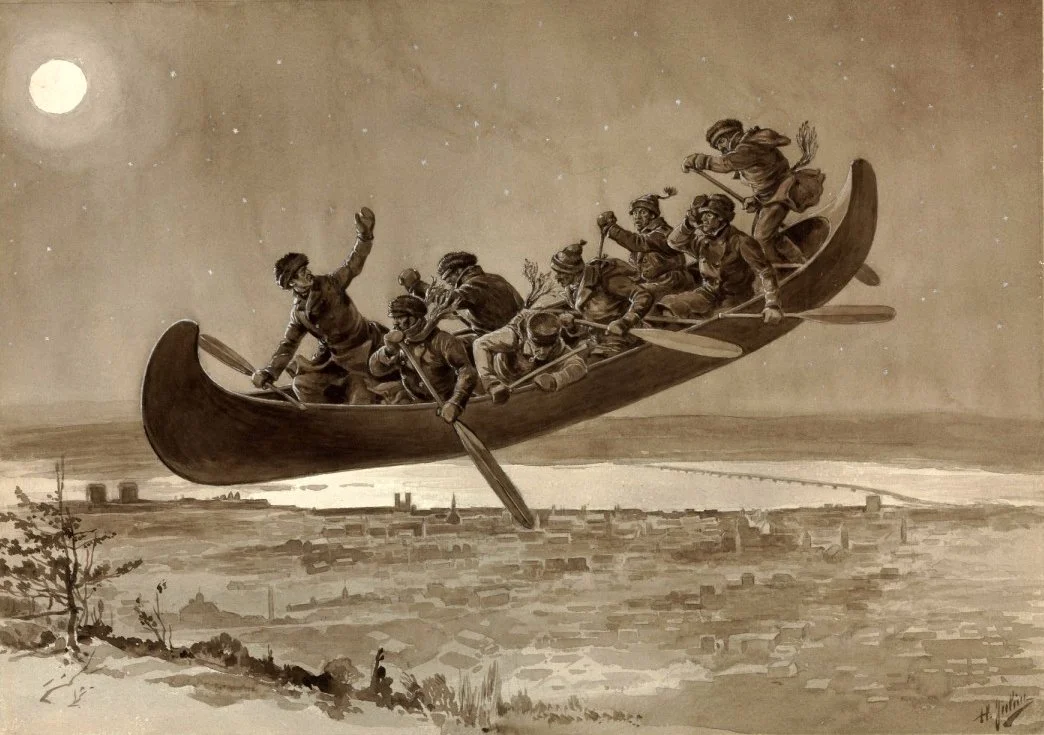
La Chasse-galerie by Henri Julien, 1906 (Wikimedia Commons)
In the best-known version, eight lumbermen working in a camp on the Gatineau want to return to Lavaltrie on New Year’s Eve to see their sweethearts. Their canoe will carry them through the air at extraordinary speed, but the bargain comes with strict rules. They must not invoke the name of God, and they must avoid touching any church cross or steeple. Most importantly, they must stay sober enough to control the canoe. If they break the agreement, their souls belong to the Devil.
The outward journey goes beautifully. The canoe rises hundreds of feet into the night sky and races over the dark forests and frozen rivers, eventually delivering the men to their New Year’s celebrations. The trouble begins on the return trip. Baptiste Durand, their pilot, has been drinking. He steers dangerously close to the steeple at Contrecœur and nearly strikes a large cross on Mont Saint-Hilaire. The frightened men finally tie him up and gag him to stop him from swearing and condemning them all. Even then, they do not quite make it safely home. The canoe crashes, and the men awaken the next morning in a snowbank near their lumber camp.
The flying canoe is now one of the most recognizable images in Québec folklore, but the story is older than this familiar version. Traditions surrounding the chasse-galerie were already associated with coureurs des bois and voyageurs before being carried into the nineteenth-century lumber camps. The story captured something very real about the lives of these men: months of isolation in the woods, homesickness, alcohol, religion and the powerful desire to get home, even if doing so meant borrowing transportation from the Devil himself.
Le Loup-Garou (The Werewolf)
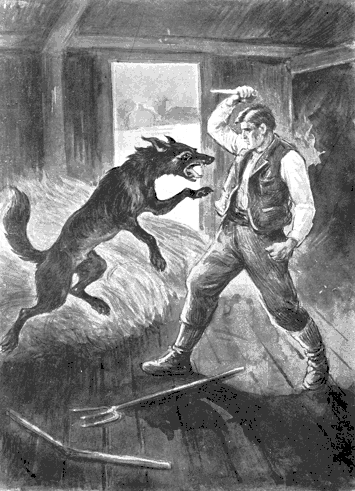
Illustration of a “loup-garou” by Henri Julien, 1899 (Wikimedia Commons)
The French-Canadian loup-garou was essentially a werewolf, although the folklore surrounding it was quite different from the version familiar from modern movies and novels. It was not created by a wolf bite, nor was its transformation tied to the full moon. According to a widespread belief, a person who neglected his religious duties for seven years, particularly by failing to make his Easter confession and communion, risked being condemned to “run the loup-garou.” At night, the sinner would be transformed into an animal and forced to wander until someone managed to break the curse. The belief made the loup-garou more troubling than an ordinary monster because, beneath the animal form, there was still a human being.
Despite its name, the loup-garou did not necessarily appear as a wolf. In Québec folklore, the most common form was a large black dog, although other traditions describe loups-garous taking the shape of horses, calves, cats, pigs, and other animals. A traveller might encounter one unexpectedly on a lonely road or near a barn, where its unusual size, intelligence or persistence revealed that it was no ordinary animal.
There was, fortunately, a way to save a loup-garou. According to one widespread tradition, the creature had to be wounded at the forehead just enough to draw blood. Once blood flowed, the spell was broken and the animal could return to human form. In some stories, the person who discovered the loup-garou's identity was also expected to keep it secret.
The loup-garou was therefore as much a moral warning as a monster story. It reinforced the importance of confession, communion, and obedience to the Church, while also giving people an explanation for frightening encounters on dark roads and in isolated forests. The most unsettling part of the legend was that the creature was not necessarily some unknown beast lurking in the wilderness. It might be a neighbour, a relative or someone from the same parish, outwardly ordinary by day but condemned to roam in animal form at night.
Part 3: Things That Came Out After Dark
Bogeymen, strange lights and creatures of the night
Le Bonhomme Sept-Heures (The Seven-O’Clock Man)
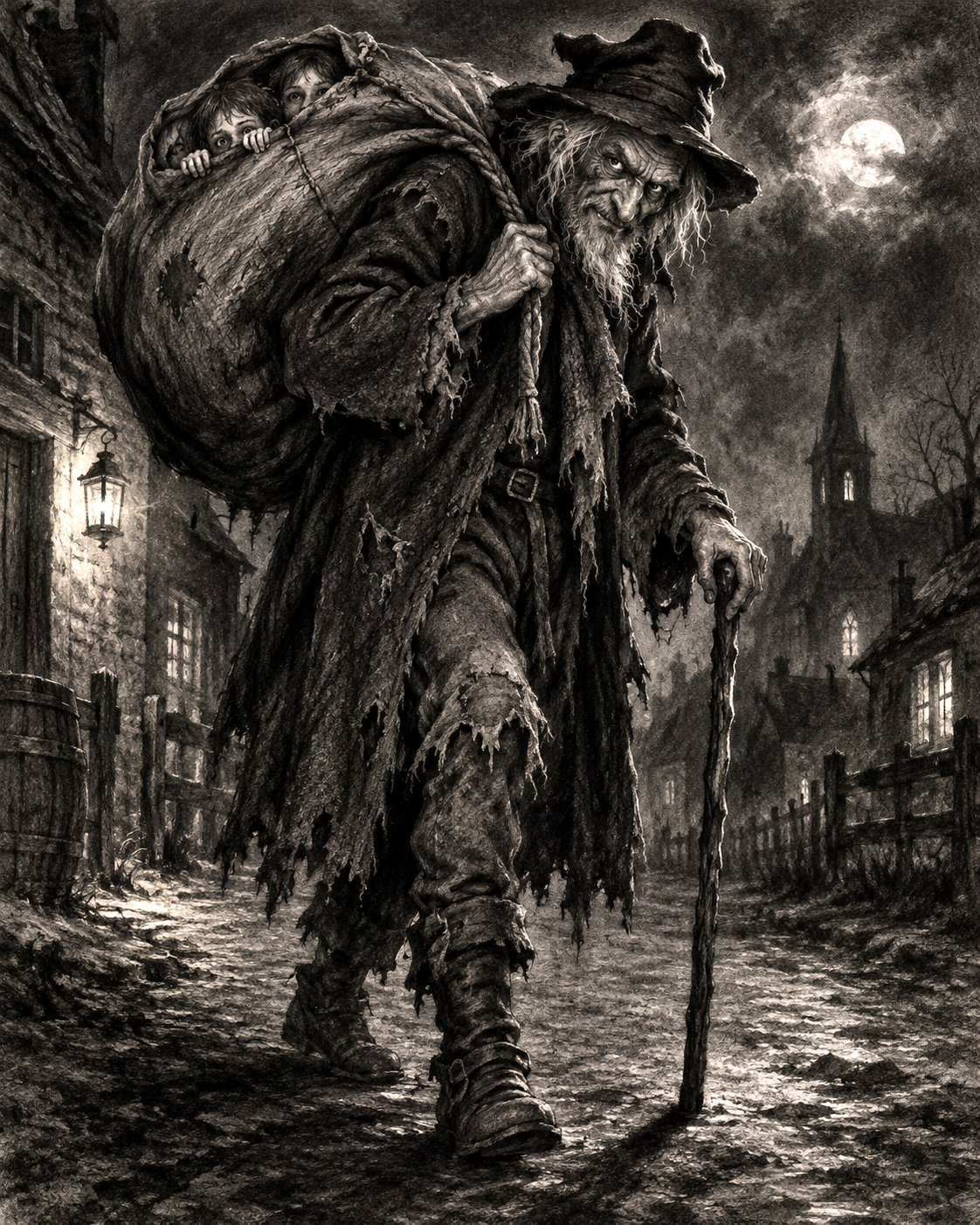
Illustration generated with artificial intelligence by the author, October 2026 (ChatGPT)
For generations of French-Canadian children, few threats were as effective as the Bonhomme Sept-Heures, Québec’s answer to the boogeyman. Parents warned that if children stayed outside too late, refused to go to bed, or simply behaved badly, the Bonhomme Sept-Heures might come looking for them after seven o’clock. He was often imagined as a sinister old man in worn clothing, carrying a cane and a large sack into which he stuffed disobedient children. In some versions, he carried sand that he could throw into their eyes before capturing them. Those he took away were never seen again.
Unlike the loup-garou, there was no complicated curse to explain the Bonhomme Sept-Heures. His purpose was much simpler: get home before dark, obey your parents, and go to bed when you were told. He belonged to a much wider family of frightening figures used throughout the French-speaking world to keep children in line. The character was known throughout Québec and French-speaking Canada, although his appearance and the details of what he did to unfortunate children varied from one family or region to another.
Les Feux Follets (Will-o’-the-Wisps)

Illustration generated with artificial intelligence by the author, October 2026 (ChatGPT)
Feux follets were mysterious wandering flames that appeared after dark. In French-Canadian folklore, they were sometimes believed to be the souls of people who had died as unbelievers. They delighted in tormenting travellers, leading them off the road and, in the more sinister stories, toward cliffs or other dangers. Travelling by water offered no protection either.
One Québec tale tells of a remarkably strong man named Dargis, who lived on the south shore of the St. Lawrence. One evening, he loaded his canoe with wheat and set out after dark to have it milled at Cap-de-la-Madeleine, on the opposite shore. In the middle of the channel, his canoe suddenly stopped, as though held by an invisible force. Dargis remembered that feux follets were said to haunt deep water and that calling them “culs grillés” (“scorched backsides”) would provoke them. Undaunted, he shouted the insult three times. Almost immediately, a flame began dancing at the bow of the canoe, then struck Dargis in the face with such force that he lost consciousness.
When he awoke, his canoe had somehow been carried to the opposite shore, only a short distance from the mill. But the feux follets were not finished with him. Until daylight, he found himself unable to move his sacks of wheat or even walk toward the inviting light of the nearby mill. Dargis eventually made it home safely, but the man who had once laughed at stories of ghosts and feux follets never again crossed the river after dark. Afterward, even a flickering candle was enough to frighten him.
Not every feu follet was imagined in quite the same way. Around Île d’Orléans, for example, distant, wavering lights seen along the shore were sometimes believed to be the souls of damned sailors returning to haunt the places where they had once travelled. In reality, some of those lights may simply have been the lanterns of fishermen working at night along the river.
Whatever their origin, feux follets were exactly the sort of thing that could turn an ordinary journey after dark into something terrifying. A faint light in the distance might promise a house, a road or safety. According to the legend, it might instead be leading you somewhere you very much did not want to go.
Les Lutins (The Elves)
In French-Canadian folklore, lutins were small supernatural creatures with a particular fascination for horses. They were said to live underground, behind tree stumps, among rocks and, especially, in stables. At night they might feed and groom a favourite horse, combing and braiding its mane and tail until its coat shone. But their attention was not always welcome. A horse could be found the next morning exhausted and panting, as though it had been ridden for miles while everyone slept.
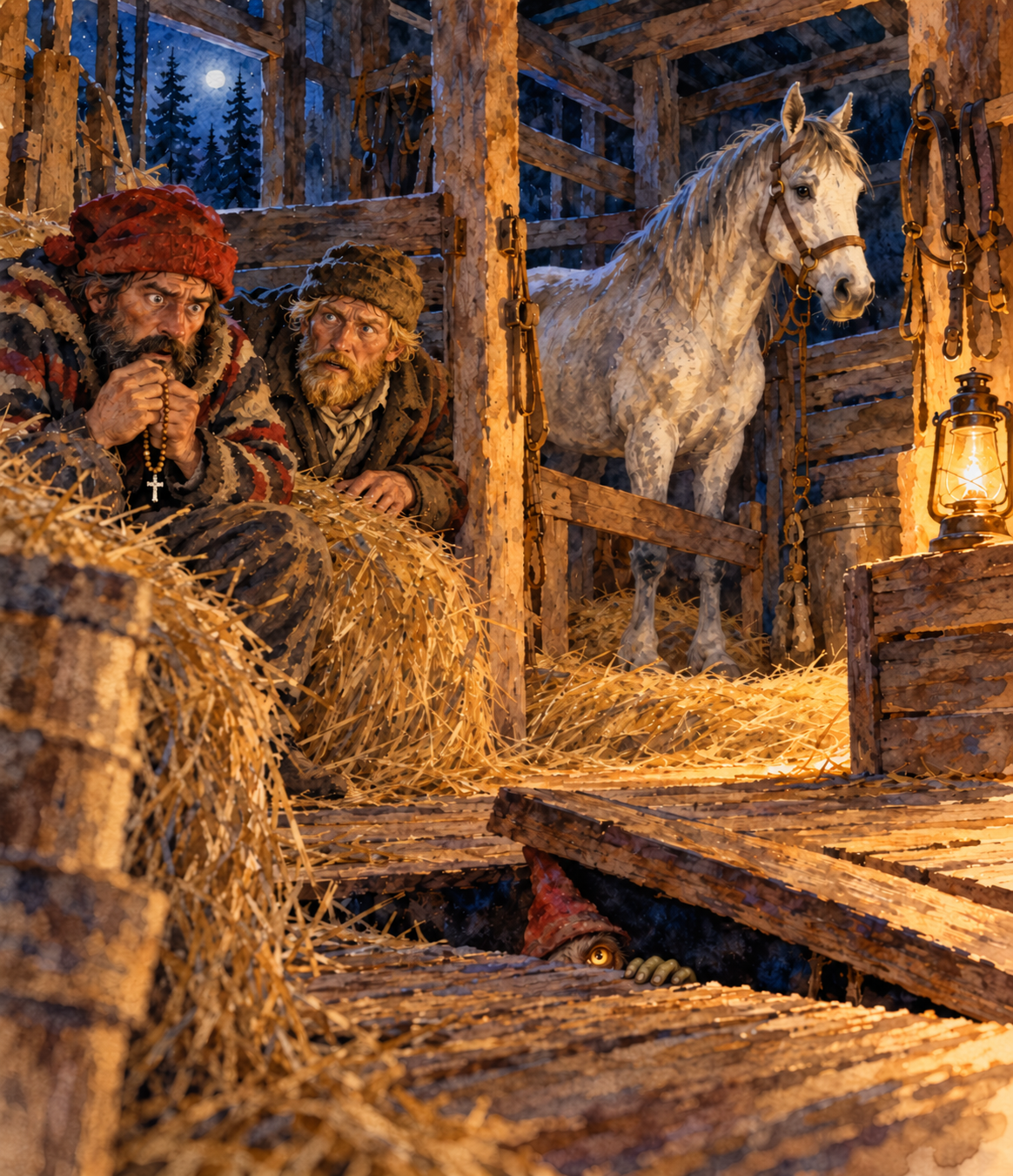
Illustration generated with artificial intelligence by the author, October 2026 (ChatGPT)
In one lumber-camp story, a mare named Belzémire began appearing every Monday morning beautifully groomed, with a full manger and her mane carefully curled, but completely out of breath. Two lumbermen, Zèbe Roberge and Jos Violon, eventually hid in the stable to discover what was happening. Late that evening, a floorboard slowly lifted and a tiny, pointed hat appeared, followed by the glowing eye of a lutin. The two men, who had originally hoped to capture one and perhaps earn a fortune, promptly abandoned the idea and fled.
The visits continued. On New Year's Day, Belzémire disappeared from her stall entirely, only to return the following morning looking perfectly content. Another lumberman claimed to have seen her racing high above the trees. For the men in the camp, that was more than enough evidence that the lutins had been taking their favourite horse on nighttime adventures through the forest.
Part 4: Dark Legends of the Acadian Coast
Monsters, omens, ghosts and sorcery by the sea
La Gougou
Along the shores of the Baie des Chaleurs, Indigenous people told of a terrifying female giant known as the Gougou. She was said to live on an island near the bay, often later identified as Miscou, and to be so enormous that the masts of a ship would not reach her waist. Anyone unfortunate enough to be caught by her could be stuffed into a huge pouch and carried away to be eaten later.

Illustration generated with artificial intelligence by the author, October 2026 (ChatGPT)
The legend was already circulating when Samuel de Champlain visited the region in 1603. He was sufficiently intrigued to devote an entire chapter of his account to “a terrifying monster which the Indigenous people call Gougou.” Champlain recorded that people who claimed to have seen her described horrible noises and strange whistling sounds coming from her island.
He also named a French witness: the Sieur Prévert of Saint-Malo. Prévert told Champlain that he had passed close enough to the Gougou’s supposed dwelling place to hear strange whistling noises himself. The Indigenous people travelling with him were so frightened that they hid aboard the vessel, afraid the creature would come and carry them away.
La Charrette de la Mort (The Death Cart)
On Lamèque Island, off the Acadian Peninsula of New Brunswick, people once told of an invisible cart that travelled along the shore after dark. No cart could be seen, but witnesses heard its wheels creaking, sometimes accompanied by the sound of a horse's hooves or a driver's voice. The legend became so closely associated with Lamèque that most of the surviving Acadian versions collected by folklorists came from the island.
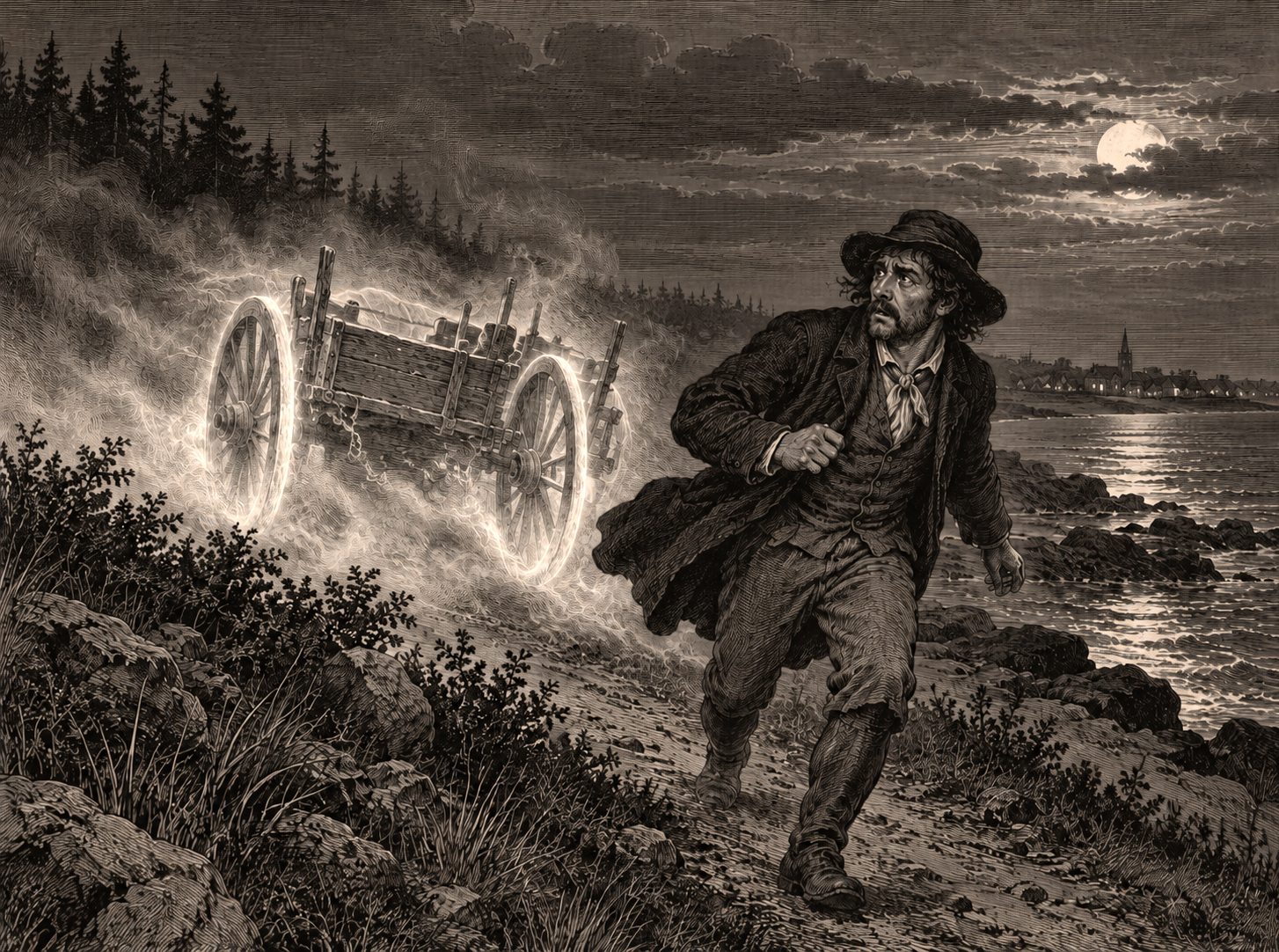
Illustration generated with artificial intelligence by the author, October 2026 (ChatGPT)
One story, said to have taken place around 1850, concerned a man named Octave Haché. As he walked along the coast one evening, the mysterious cart began pursuing him. He fled into a neighbour’s house, only to encounter it again after leaving. Eventually Haché gathered enough courage to confront whatever was following him. According to later accounts, he prayed and arranged for Masses to be said for the souls in purgatory, after which the haunting stopped. Years later, another man was reportedly pursued and even struck by the cart before seeing a mysterious black ball disappear along the water’s edge. The incident reinforced the belief that the cart was connected to restless souls, and that prayer and Masses could bring the haunting to an end.
No one agreed on exactly who or what was driving it. Some said it was connected to a woman whose soul could not rest; others blamed a man who had died without paying for a cart, or two brothers who had never settled a dispute over one. In these Lamèque stories, the cart was generally understood as a manifestation of restless souls asking the living for prayers. Elsewhere in Acadian New Brunswick, however, phantom carts sometimes appeared shortly before a death, making the sound of approaching wheels a particularly frightening omen.
The name “Charrette de la Mort” became especially common in literature, while in the oral tradition it was more often called the charrette fantôme, or ghost cart. The legend also resembles the Breton Ankou, a figure associated with death whose creaking cart was said to foretell someone’s approaching death. The Acadian tradition, however, developed its own versions and meanings.
Le Vaisseau fantôme (The Ghost Ship)
Along the shores of the Baie des Chaleurs and the Northumberland Strait, generations of people told stories of a ghost ship that appeared on the water after dark. It was usually described as a large sailing vessel surrounded by flames, sometimes with its masts and rigging clearly visible through the fire. Figures could be seen moving across the deck and climbing the rigging, yet the flames never consumed the ship. Anyone who tried to approach it might see it suddenly vanish or seem to recede farther into the distance.
One version recorded in the Gaspé links the apparition to a violent crime at sea. Off Port-Daniel, two men, both named Roussi, rowed out to a passing ship to sell a carcass of beef. The captain murdered them, sank their boat and took the meat. When a missionary aboard the ship tried to give the dying men absolution, the captain had him tied to the mast until the crew persuaded him to release the priest.
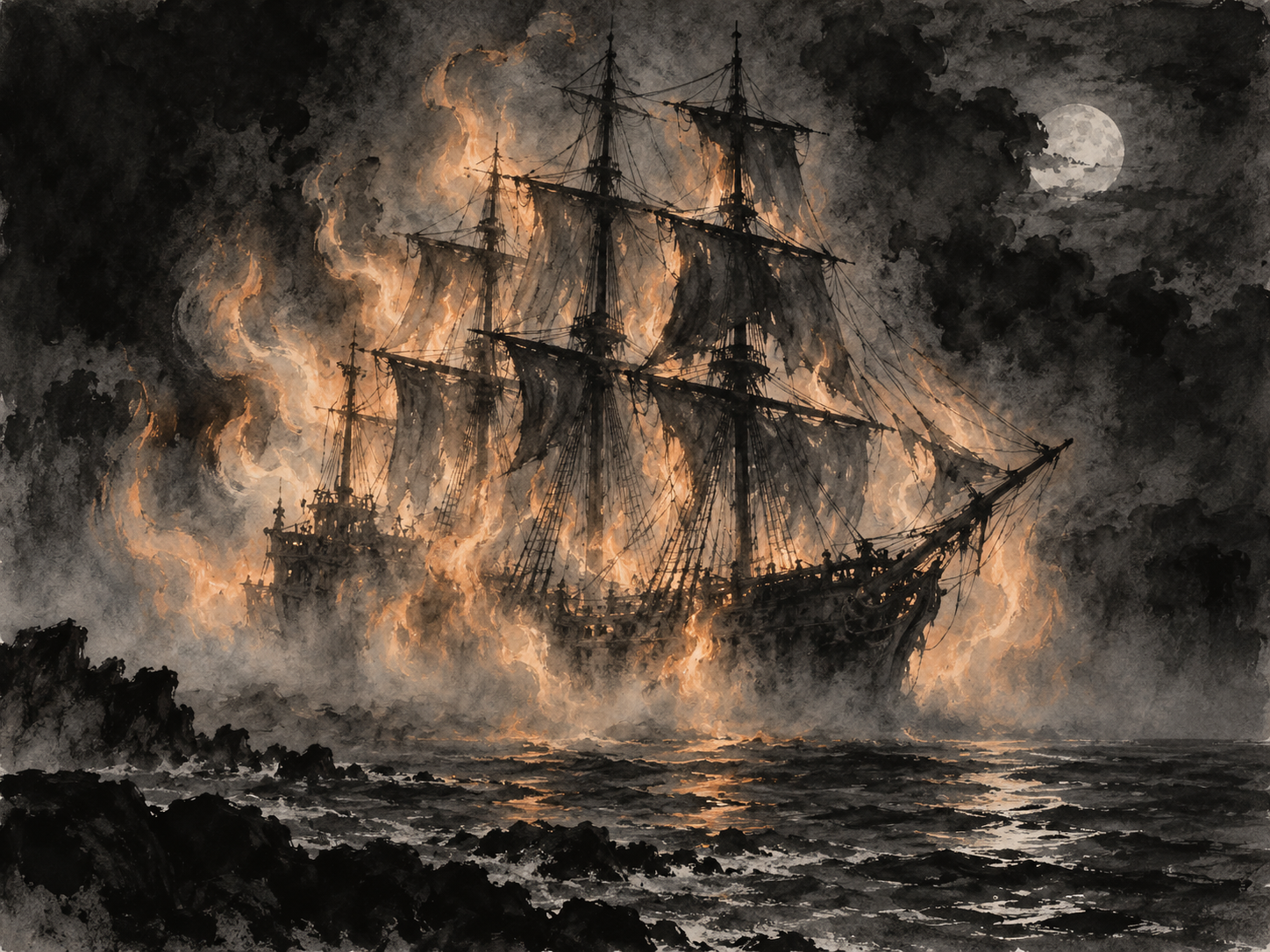
Illustration generated with artificial intelligence by the author, October 2026 (ChatGPT)
According to the story, a mysterious fire began appearing offshore after the murders, particularly before severe storms. Those who approached it claimed they could see a ship within the flames, with a priest tied to the mast, the crew on their knees and the captain’s terrible voice rising above them. This story became associated with the feu des Roussi, although traditions surrounding the mysterious fire and the ghost ship sometimes overlap and sometimes differ.
Elsewhere around the Baie des Chaleurs, particularly on the New Brunswick side, the burning apparition was also known as the feu du mauvais temps, or “bad-weather fire,” because its appearance was believed to warn of an approaching storm. Other versions blamed pirates, shipwrecks or crimes at sea. What remained remarkably constant was the image itself: a sailing ship wrapped in flames, appearing mysteriously on the dark water without ever being consumed by the fire.
Le Sorcier de Chéticamp (The Sorcerer of Chéticamp)
In the Acadian community of Chéticamp, on the western coast of Cape Breton, stories once circulated about a man simply remembered as the Sorcier de Chéticamp. He was not a creature from some distant mythical past. The people who recorded the stories in the early 1970s said that he had died only a few years earlier and that many people in the community had known him personally.
Strange things were blamed on him. One woman awoke at night to hear her sewing machine operating by itself while objects in the house moved and rattled. Later, the trouble shifted to the family's cows. The animals began jumping fences and dancing about wildly, and when they were milked, their milk came out thick like glue and could not be drunk. On another evening, two girls fetching the cows encountered a headless man wearing black boots who chased them toward home. As they arrived, the Sorcier de Chéticamp happened to pass along the road, laughing. One of the girls immediately accused him: "It was you!"
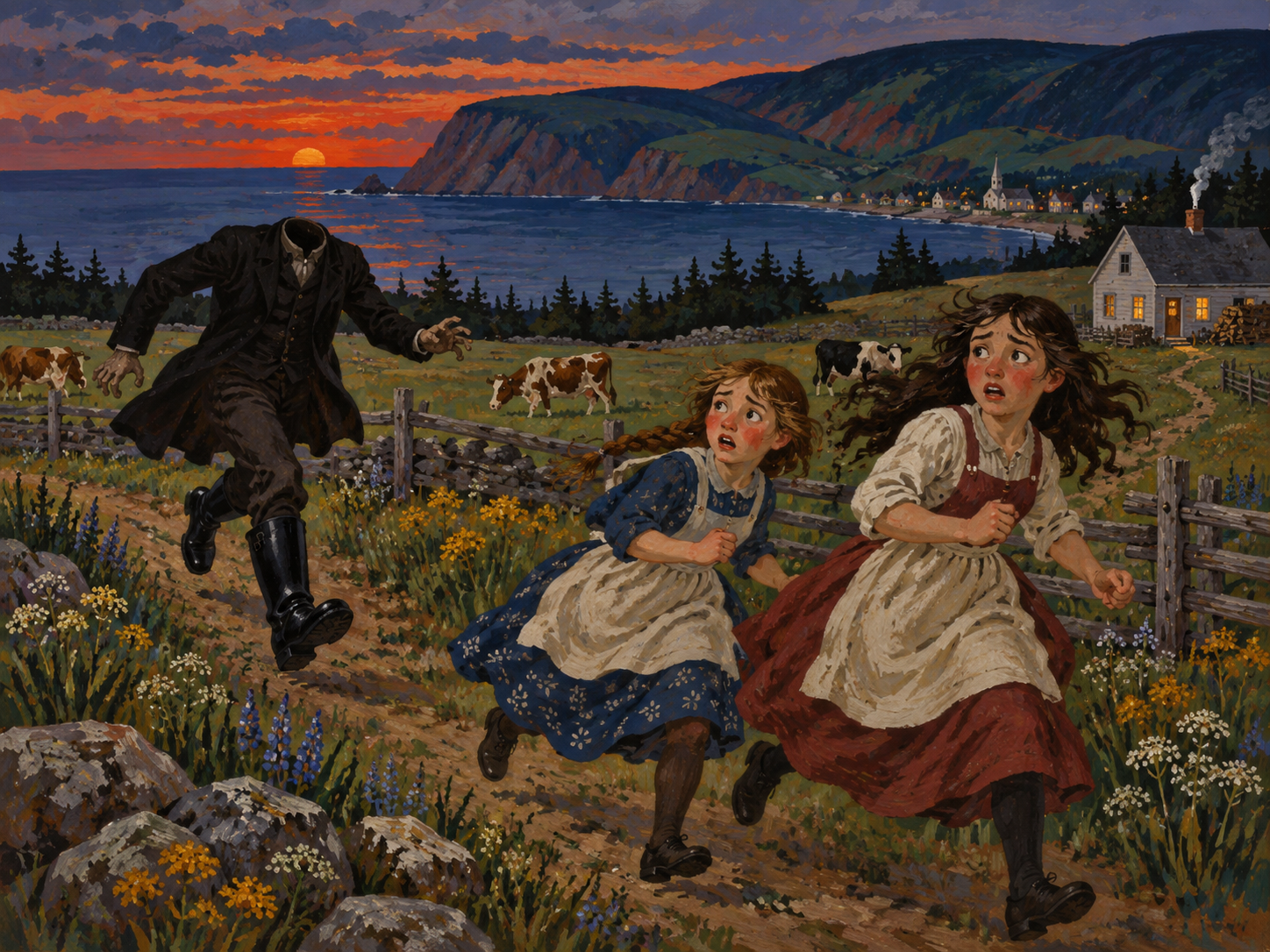
Illustration generated with artificial intelligence by the author, October 2026 (ChatGPT)
The sorcerer's supposed powers could sometimes be turned against him. When one family found that no amount of churning would make their cream turn into butter, the mother heated an iron rod in the stove and passed it around the butter churn. The following day, the sorcerer was seen with a large bandage around his neck. In another story, a local made a snowman, stabbed it in the side with a knife and left it in the sun to melt. The next day, the sorcerer was coughing up blood and people thought he would die. But because the snowman had not completely melted in the sun, the sorcerer recovered.
What makes these stories especially eerie is how recently they were still being told. When Cape Breton's Magazine published them in 1972, it deliberately withheld the man's name because people who had known him were still alive. The stories had been collected locally by young Acadians in Chéticamp, preserving a tradition in which sorcery was not confined to distant legends. The suspected sorcerer might be someone living just down the road.
Part 5: Legends of the French-Canadian West
Métis stories, supernatural creatures and the Devil on the Prairies
Li Roogaroo
As French-Canadian traditions moved west and became part of Métis culture, the familiar loup-garou took on a distinctly Métis life of its own. In Michif stories, it became li Roogaroo, also written Rougarou or Rugaroo. Like the French-Canadian loup-garou, it was a human being transformed into something unnatural, but Métis storytellers did not restrict it to the form of a wolf. A Roogaroo might appear as a huge black dog, another animal, or simply as a person with frightening supernatural powers. Métis storytelling blended French-Canadian Catholic folklore with Cree and Ojibway traditions, creating stories that were related to older loup-garou tales but had developed their own meanings and forms.
One story remembered by Métis Elder Agnes Pelletier concerned a mysterious black dog. Her father was returning home from a winter dance in a horse-drawn cutter when the dog appeared beside him. Although the horse was running, the dog merely walked alongside and somehow kept pace. Suddenly it leapt into the cutter, and the horse stopped dead. In this particular story, Pelletier recalled being told that drawing blood from the mysterious dog would save the human soul trapped within it.
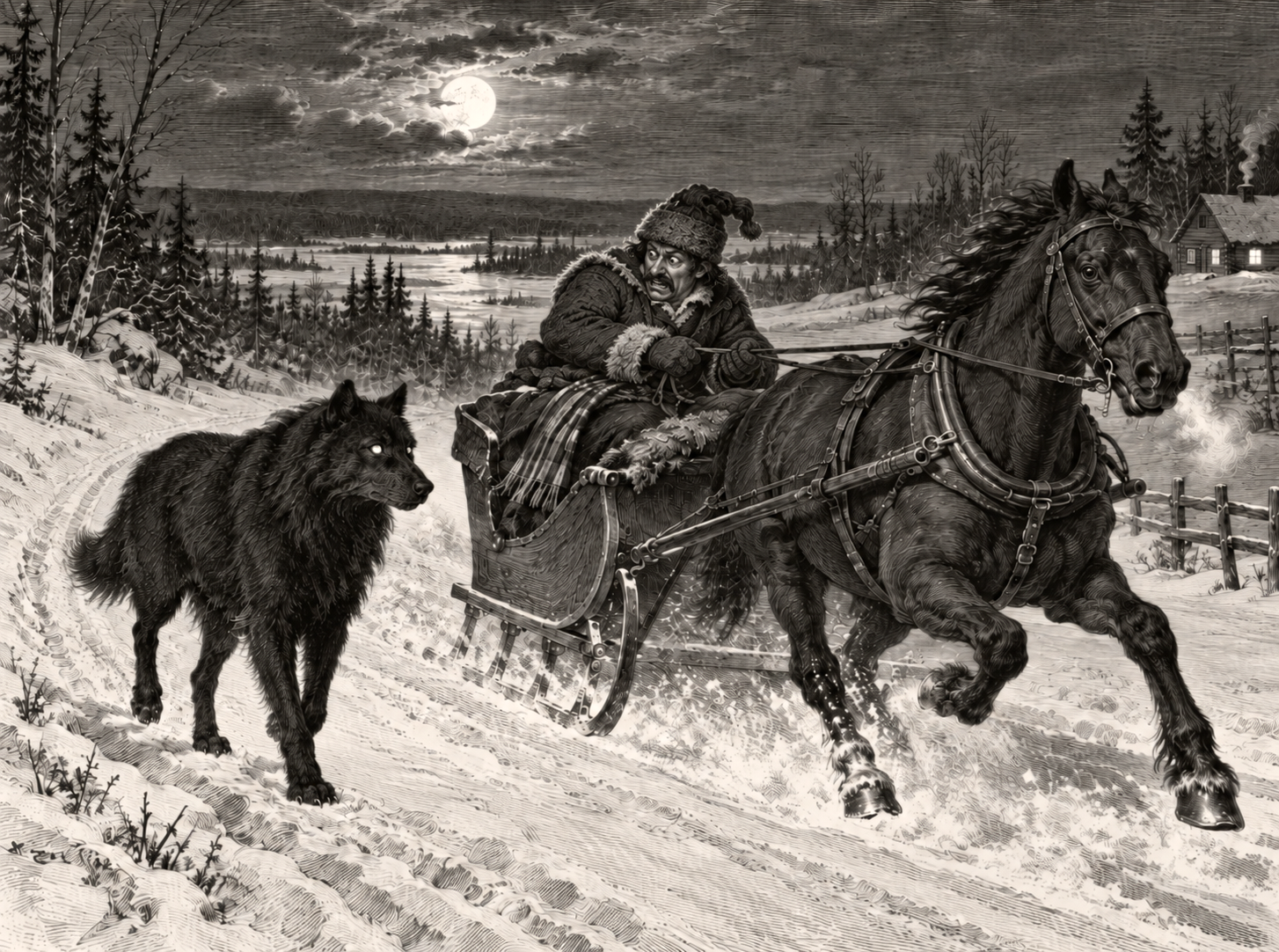
Illustration generated with artificial intelligence by the author, October 2026 (ChatGPT)
More generally, Métis tradition described somewhat different ways of curing a Roogaroo. A sharp poke on the nose or a cut on the ear could break the condition and restore the person inside. Unlike the French-Canadian loup-garou tradition, the emphasis was not necessarily on drawing blood or religious atonement. The restored person could instead be forgiven and welcomed back into the community.
Another Rougarou story, told to Agnes Pelletier by her grandmother, concerned a woman named Rosalie who was believed to possess impossible speed and strength. She could supposedly travel to Fort Qu’Appelle and back in the time it took water to boil, and split pieces of wood with a single blow. Such stories connected supernatural transformation with people who had somehow offended the Creator, fallen under an evil influence, or violated accepted religious and social behaviour. Like the French-Canadian loup-garou, li Rougarou could therefore be both a frightening creature and a cautionary tale.
Le Cheval noir de Saint-Boniface (the Black Horse of Saint-Boniface)
In the winter of 1862–1863, Bishop Alexandre-Antonin Taché was building a new cathedral at Saint-Boniface. The previous cathedral had burned in 1860, and men were sent east of the Red River settlement to cut and prepare timber for its replacement. According to a Métis legend preserved in Manitoba, the bitter winter made the work slow and exhausting until, one snowy morning, a magnificent black horse appeared from nowhere. No one knew who owned it, but the animal was taken in and put to work.
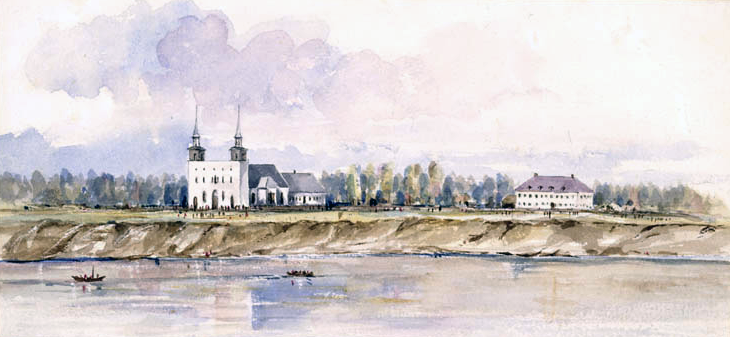
Sketch of Saint Boniface, Red River Settlement, drawn by William Henry Edward Napier, 1858 (Wikimedia Commons)
The horse proved astonishingly strong. At first it hauled an ordinary load of wood, then twice as much, and eventually three times the load carried by the other horses. Bishop Taché had given the men one peculiar instruction: its bridle was never to be removed, not even to allow the horse to eat.
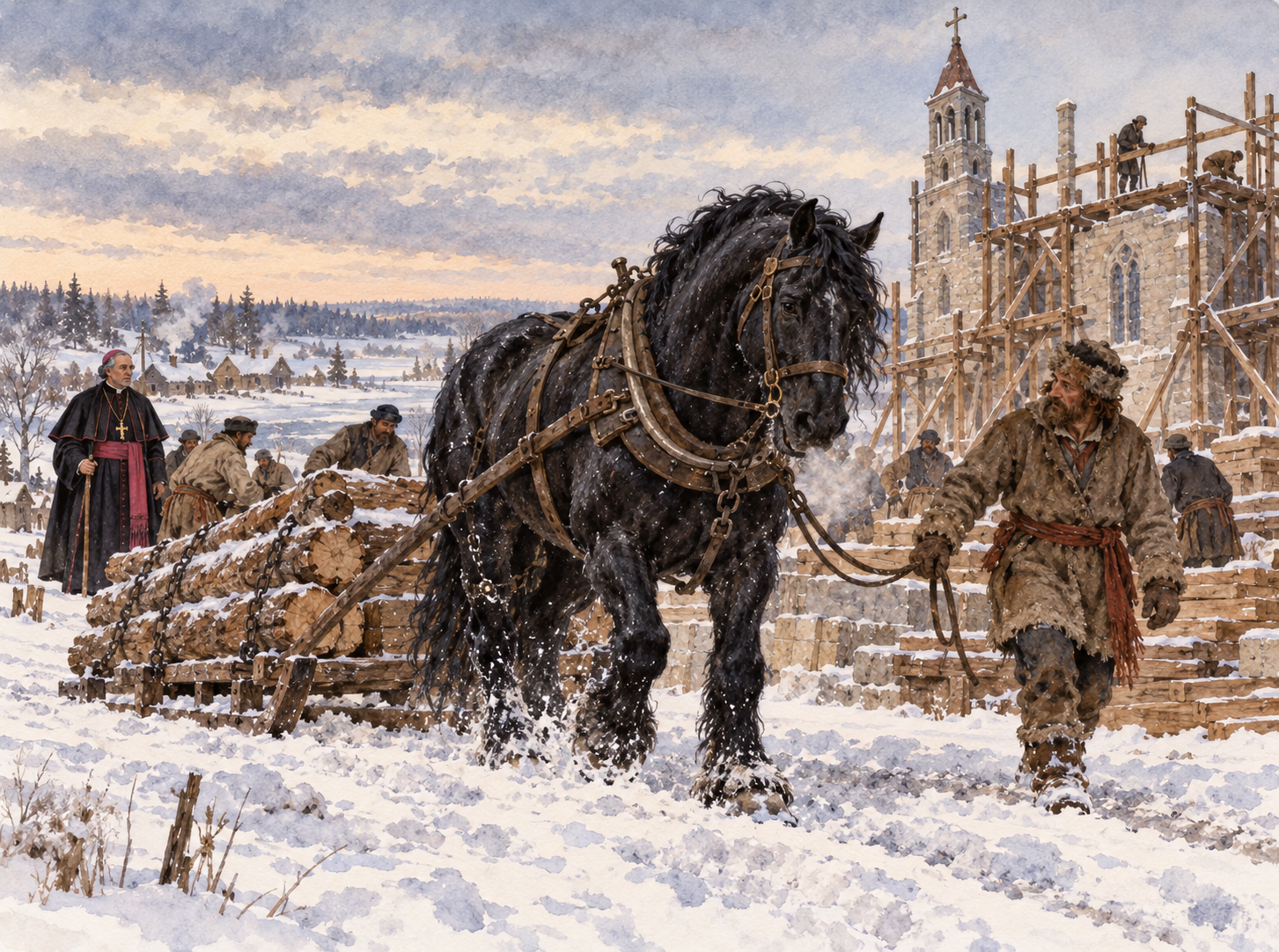
Illustration generated with artificial intelligence by the author, October 2026 (ChatGPT)
One evening, a man named Harrison took pity on the animal. Seeing it standing there with its bridle still on, he decided to remove it. The instant he did, the horse disappeared. There was simply no horse there anymore. Terrified, Harrison ran to Bishop Taché, who reminded him that he had been warned never to remove the bridle. The mysterious black horse, Taché told him, had been the Devil.
The story is particularly interesting because it connects western Métis and French-Canadian tradition: the Société historique de Saint-Boniface notes that a remarkably similar black-horse legend was also told around Trois-Pistoles, Québec.
Paakuks
Among the darker beings of Métis storytelling were the Paakuks, also known as Pakahks or Pakakoshs. They were described as horribly thin flying skeletons associated with disease. Unlike li Roogaroo, whose roots can be traced partly to French-Canadian loup-garou traditions, the Paakuk came from the Cree and Ojibway side of Métis culture. Over time, however, these traditions were woven together into a distinctly Métis body of stories.
Paakuks were creatures of the night. They were said to fly through the darkness and frighten unsuspecting people with eerie, demonic laughter. Métis storyteller Jeanne Pelletier remembered that her grandmother would tell Paakuk stories to the children after an evening of visiting, just as they were preparing to walk home. The timing could hardly have been better. After hearing about skeletal creatures flying through the night, the journey home through the darkness must have seemed considerably longer.
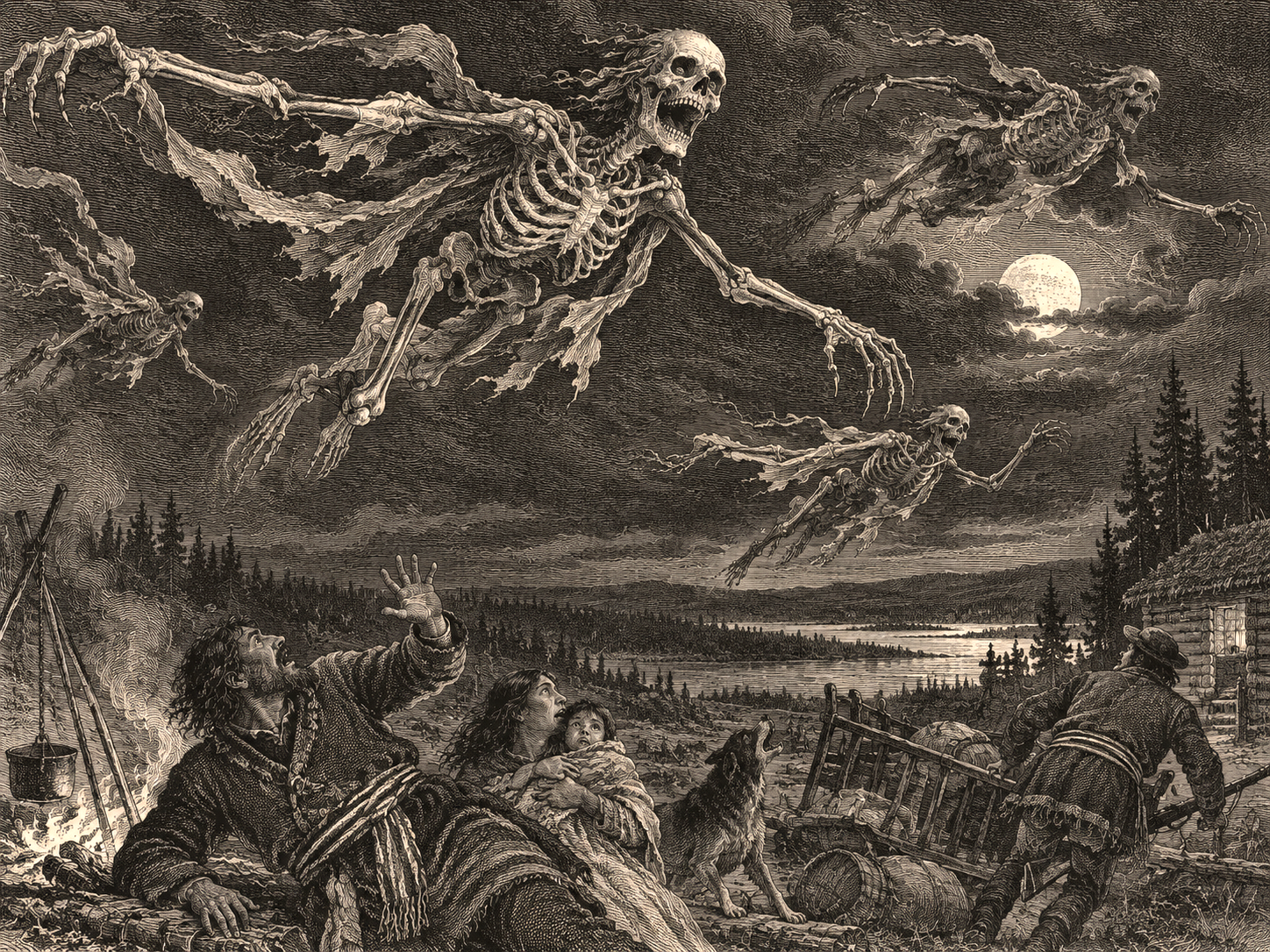
Illustration generated with artificial intelligence by the author, October 2026 (ChatGPT)
Paakuks also carried a more serious meaning. While the cannibal spirit Whiitigo represented the danger of starvation, Paakuks represented disease. They belonged to the frightening side of Métis storytelling, alongside li Roogaroo, Whiitigo and the Devil, figures used not simply to frighten listeners but to give supernatural form to dangers that could threaten a community.
Note: In Métis tradition, stories are the property of the storytellers and families who carry them. The accounts in this section come from Métis Elders and storytellers whose words were recorded and shared by the Gabriel Dumont Institute: Agnes Pelletier, interviewed by Norman Fleury in Yorkton, Saskatchewan, in 1999, and Jeanne Pelletier, whose recollections appear in Stories of Our People / Lii zistwayr di la naasyoon di Michif (2008). I am grateful to them, and to the Institute, for preserving these stories, and I encourage readers to seek out the original sources.
What These Stories Tell Us About Our Ancestors
It is tempting to look back at these legends and assume that people simply believed in monsters because they knew less about the world. The reality was more complicated. French Canadians lived in a landscape that could genuinely be frightening. Winter travel across the St. Lawrence was dangerous, forests and lumber camps were isolated, roads were poorly lit, storms could appear suddenly at sea, and illness or death might arrive with little warning. Strange noises, distant lights, an unfamiliar animal on a dark road or the disappearance of a neighbour could easily acquire a supernatural explanation.
Religion also shaped the way these dangers were understood. Many of the stories in this collection revolve around confession, Mass, Lent, the Sabbath, blasphemy, souls in purgatory and the Devil. The supernatural was therefore not entirely separate from everyday life. A loup-garou could embody the consequences of neglecting religious obligations, while a revenant might return because prayers or Masses were still needed. Other stories served more practical purposes. The Bonhomme Sept-Heures encouraged children to come home before dark. Tales of dangerous creatures made lonely roads, frozen rivers and unfamiliar places seem even more threatening, but they also warned listeners to be cautious.
That does not mean everyone accepted every story literally. Folklore could be frightening, entertaining, moralizing and humorous at the same time. An intriguing example appeared in the Quebec Gazette on July 21, 1766. The newspaper reported that a "Were Wolf" was wandering about Saint-Roch-des-Aulnaies, near Kamouraska, "in the Form of a Beggar." The creature supposedly had a talent for "persuading People to believe what he himself is ignorant of," promised what he could not perform, and still obtained what he wanted. It had reportedly travelled to Québec "by the Assistance of his two hind Legs" before setting out for Montréal, and readers were warned that it was as dangerous as the beast that had appeared the year before in Gévaudan, France. To modern ears, the notice reads like satire aimed at a smooth-talking swindler. The Québec archives, BAnQ, however, presents it as evidence that the loup-garou was still seen as a real threat. Either way, the article shows that the figure was familiar enough to newspaper readers in 1766 to need no explanation.
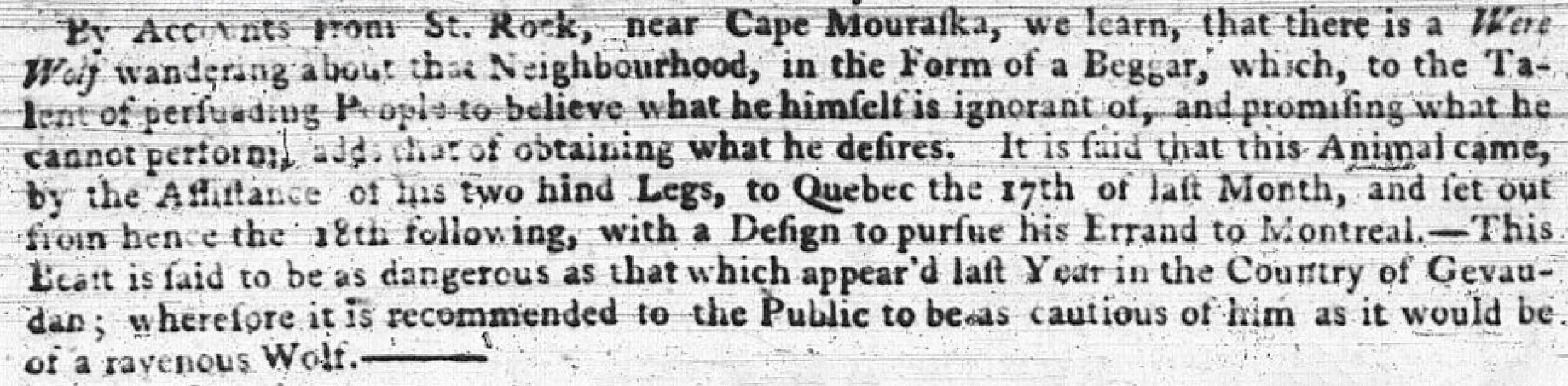
The Quebec Gazette, July 21, 1766 (Bibliothèque et Archives nationales du Québec)
For genealogists and family historians, these legends offer something records rarely capture. Parish registers tell us when our ancestors were baptized, married and buried. Censuses tell us where they lived. Notarial and court records tell us something about their property, work and disputes. Folklore reveals a different part of their world: what frightened them, what they warned their children about, how they explained the inexplicable, and the stories they told when darkness fell. Occasionally, the two kinds of sources meet. Marie Josèphe Corriveau can be followed through her 1733 baptism, her marriage contracts of 1749 and 1761, and the transcripts of her 1763 court martial, yet she is remembered today as a caged witch haunting the road at Pointe-Lévy. Behind many of these legends were real people, and their stories are still waiting in the records.

PDF version of article located at: https://www.tfcg.ca/20scarylegendsoffrenchcanada.
About this article: Generative AI was used as a research, drafting and editing aid in the preparation of this article, and to create some of the illustrations. The author reviewed the cited sources, fact-checked the historical content, and made all final editorial and interpretive decisions. AI-generated illustrations are identified in their captions.
About this article: Generative AI was used as a research, drafting and editing aid in the preparation of this article, and to create some of the illustrations. The author reviewed the cited sources, fact-checked the historical content, and made all final editorial and interpretive decisions. AI-generated illustrations are identified in their captions.
Sources
Ville de Québec, “Chute de la Dame blanche,” Découvrir les quartiers de Québec: Montmorency (https://www.ville.quebec.qc.ca/citoyens/patrimoine/quartiers/montmorency/interet/chute-de-la-dame-blanche.aspx : accessed 6 Oct 2026).
Commission de toponymie du Québec, “Chute de la Dame Blanche,” Banque de noms de lieux du Québec (https://toponymie.gouv.qc.ca/ct/ToposWeb/Fiche.aspx?no_seq=140785 : accessed 6 Oct 2026).
Louis Fréchette, “Le revenant de Gentilly,” first published in Canada-Revue, vol. III, no. 1 (Montréal, 1892), pp. 9–11, full text digitized by Tous les contes (https://touslescontes.com/biblio/conte.php?iDconte=182 : accessed 6 Oct 2026).
Dictionnaire des auteurs des littératures de l’imaginaire en Amérique française, “Le Revenant de Gentilly” (https://www.daliaf.com/oeuvres/revenant-de-gentilly-le-1892 : accessed 6 Oct 2026).
Kim Kujawski, “La Corriveau,” The French-Canadian Genealogist (https://www.tfcg.ca/la-corriveau-en : accessed 6 Oct 2026).
Philippe Aubert de Gaspé, Les Anciens Canadiens (Québec: Desbarats et Derbishire, 1863), chap. IV, “La Corriveau,” digitized by Wikisource (https://fr.wikisource.org/wiki/Les_Anciens_Canadiens/4 : accessed 7 Oct 2026).
Auguste Béchard, Histoire de l’Ile-aux-Grues et des îles voisines, digitized by Canadiana (https://www.canadiana.ca/view/oocihm.71646 : accessed 6 Oct 2026).
Damase Potvin, Le Saint-Laurent et ses îles (Québec: Éditions Garneau, 1945), retold in “Petit Bonhomme Sans Tête,” Grand Québec (https://grandquebec.com/legendes-du-quebec/homme-sans-tete/ : accessed 7 Oct 2026).
Mireille Thibault, Le petit bonhomme sans tête de l’Isle-aux-Grues: à la recherche d’une légende, summarized by Leslibraires.ca (https://www.leslibraires.ca/livres/petit-bonhomme-sans-tete-de-l-mireille-thibault-9782922132489.html : accessed 6 Oct 2026).
Louis Fréchette, “La Tête à Pitre,” in La Noël au Canada, digitized by BibeBook (https://bibebook.com/frechette_louis_-_la_noel_au_canada/index.html : accessed 6 Oct 2026).
Jean Du Berger, “Canot, canot à glace, canot à vapeur… et canot à moteur,” Rabaska, vol. 8 (2010), digitized by Érudit (https://www.erudit.org/fr/revues/rabaska/2010-v8-rabaska3976/045254ar.pdf : accessed 6 Oct 2026).
Napoléon Caron, “Légendes des Forges du Saint-Maurice,” L’Opinion publique, vol. III, nos. 17–19 (27 April–9 May 1872), pp. 194–207; later reprinted in Contes et légendes des Vieilles Forges (Trois-Rivières: Éditions du Bien Public, 1954), pp. 15–38.
Nicholas Hancock, Le diable dans les contes des Forges du Saint-Maurice, mémoire de maîtrise en études québécoises, Université du Québec à Trois-Rivières (https://depot-e.uqtr.ca/id/eprint/6762/ : accessed 6 Oct 2026), 1982.
Jean Du Berger, “Imaginaire traditionnel, imaginaire institutionnel,” in La construction d’une culture: le Québec et l’Amérique française, digitized by Érudit (https://www.erudit.org/fr/livres/culture-francaise-damerique/construction-dune-culture-quebec-lamerique-francaise/000360co.pdf : accessed 6 Oct 2026).
Parks Canada, Forges du Saint-Maurice National Historic Site of Canada (https://parks.canada.ca/lhn-nhs/qc/saintmaurice/gestion-management/plan : accessed 6 Oct 2026), Management Plan, 2020.
Jacques Dorion, Le folklore oral aux Forges du Saint-Maurice, Parcs Canada, 1977, digitized by Trois-Rivières numérique (https://troisrivieresnumerique.ca/wp-content/uploads/2024/09/1977_FSTM_Dorion_Folklore_oral.pdf : accessed 6 Oct 2026).
Philippe Aubert de Gaspé fils, L'Influence d'un livre (Québec: William Cowan et fils, 1837), chapter V, "L'Étranger," pp. 36–47, digitized by Wikisource (https://fr.wikisource.org/wiki/L%E2%80%99influence_d%E2%80%99un_livre/6 : accessed 6 Oct 2026).
Jean Du Berger, Le Diable à la danse (Québec: CÉLAT and Presses de l'Université Laval, 2006).
Honoré Beaugrand, “La Chasse-Galerie,” in La Chasse-galerie: légendes canadiennes (Montréal, 1900), digitized by Wikisource (https://fr.wikisource.org/wiki/La_Chasse-galerie_%28recueil%29/La_Chasse-galerie : accessed 6 Oct 2026).
Bibliothèque et Archives nationales du Québec, “La chasse-galerie,” Le Square: La Fabrique de créatures imaginaires (https://square.banq.qc.ca/la-fabrique-de-creature-imaginaires/chasse-galerie : accessed 6 Oct 2026).
Honoré Beaugrand, “La Bête à Grand’queue,” in La Chasse-galerie: légendes canadiennes (Montréal, 1900), digitized by Wikisource (https://fr.wikisource.org/wiki/La_Chasse-galerie_(recueil) : accessed 6 Oct 2026).
Honoré Beaugrand, “Le Loup-Garou,” in La Chasse-galerie: légendes canadiennes (Montréal, 1900), digitized by Wikisource (https://fr.wikisource.org/wiki/La_Chasse-galerie_%28recueil%29/Le_Loup-garou : accessed 6 Oct 2026).
Bibliothèque et Archives nationales du Québec, “Le loup-garou,” Le Square: La Fabrique de créatures imaginaires (https://square.banq.qc.ca/la-fabrique-de-creature-imaginaires/loup-garou : accessed 6 Oct 2026).
Office québécois de la langue française, “bonhomme Sept-Heures,” Vitrine linguistique: Grand dictionnaire terminologique (https://vitrinelinguistique.oqlf.gouv.qc.ca/fiche-gdt/fiche/8972202/bonhomme-sept-heures : accessed 6 Oct 2026).
Gouvernement du Québec, “Le bonhomme Sept-Heures,” Classe culturelle (https://classe.culture-education.ca/ressources/bonhomme-sept-heures/ : accessed 6 Oct 2026).
"Feux follets," Bulletin des recherches historiques, vol. XXXV, no 11 (Nov 1929), pp. 645–650, digitized by Trois-Rivières numérique (https://troisrivieresnumerique.ca/wp-content/uploads/2025/10/BRH_BAnQ_VolXXXV_No11Nov1929_Extract5-1041.pdf : accessed 11 Oct 2026).
Jean Du Berger, “Le folklore au Québec,” Usito, Université de Sherbrooke (https://usito.usherbrooke.ca/articles/th%C3%A9matiques/du_berger_1 : accessed 6 Oct 2026).
André Croteau, “Les îles du Saint-Laurent,” Usito, Université de Sherbrooke (https://usito.usherbrooke.ca/articles/th%C3%A9matiques/croteau_1 : accessed 6 Oct 2026).
Louis-Honoré Fréchette, “Les lutins,” in the 1905 issue of Almanach du peuple de la librairie Beauchemin, English translation published by Mysteries of Canada (https://mysteriesofcanada.com/quebec/les-lutins-the-goblins-by-louis-frechette-english-translation/ : accessed 6 Oct 2026).
Samuel de Champlain, “D’un monstre espouvantable que les Sauvages appellent Gougou,” chap. XIII in Des Sauvages ou Voyages du Sieur de Champlain faict en l’an 1603, digitized by Project Gutenberg (https://www.gutenberg.org/cache/epub/17258/pg17258-images.html : accessed 6 Oct 2026).
Jacques P. Ouellet, Le monstre de l’île Miscou, discussed in FousDeLire (https://fousdelire.ca/livres/le-monstre-de-lile-miscou/ : accessed 6 Oct 2026).
Norman Clermont, “Le gougou de Champlain et les croyances algonquiennes,” Revue d’histoire de l’Amérique française, vol. 35, no. 3 (December 1981), pp. 377–381, digitized by Érudit (https://www.erudit.org/en/journals/haf/1981-v35-n3-haf2324/303975ar.pdf : accessed 7 Oct 2026).
Carmen d’Entremont, “Mariaagélas, Pélagie-la-Charrette et le folklore acadien,” Port Acadie, nos. 22–23 (2012–2013), pp. 163–182, digitized by Érudit (https://www.erudit.org/fr/revues/pa/2012-n22-23-pa0515/1014980ar.pdf : accessed 7 Oct 2026).
Ronald Labelle, “Une charrette qui a traversé l’océan? Les reflets de l’Ankou breton en Acadie,” Port Acadie, nos. 13–14–15 (2008–2009), pp. 285–293, digitized by Érudit (https://www.erudit.org/fr/revues/pa/2008-n13-14-15-pa3491/038434ar.pdf : accessed 6 Oct 2026).
“L’énigme du vaisseau-fantôme: une légende acadienne,” archived by Library and Archives Canada (https://epe.lac-bac.gc.ca/100/205/301/ic/cdc/vaisseaufantome/temoignage/temoignage51.html?nodisclaimer=1 : accessed 7 Oct 2026).
Centre culturel Marie-Anne-Gaboury, “Le feu des Roussis,” in L’énigme du vaisseau-fantôme: une légende acadienne, archived by Library and Archives Canada (https://epe.lac-bac.gc.ca/100/205/301/ic/cdc/vaisseaufantome/legende/roussis.html?nodisclaimer=1 : accessed 6 Oct 2026).
Patrimoine Paspébiac, “Légendes et contes: Le feu des Roussy,” Quelques légendes et contes de la Baie-des-Chaleurs (https://patrimoinepaspebiac.com/patrimoine-culturel/legendes-et-contes/ : accessed 6 Oct 2026).
“Le Sorcier de Chéticamp,” Cape Breton’s Magazine, no. 1 (1972), pp. 13, 22 (https://capebretonsmagazine.com/modules/publisher/item_itemid-15.html and https://capebretonsmagazine.com/modules/publisher/item_itemid-24.html : accessed 6 Oct 2026).
Darren R. Préfontaine, “Introduction to Métis Stories,” in Stories of Our People / Lii zistwayr di la naasyoon di Michif: A Métis Graphic Novel Anthology (Saskatoon: Gabriel Dumont Institute, 2008), digitized by the Virtual Museum of Métis History and Culture (https://www.metismuseum.ca/resource.php/148343 : accessed 6 Oct 2026).
Gabriel Dumont Institute, Métis Story Tellers, including stories recounted by Agnes Pelletier from an interview by Norman Fleury, Yorkton, Saskatchewan, 25 April 1999, digitized by the Virtual Museum of Métis History and Culture (https://www.metismuseum.ca/media/document.php/00747.Traditional%20M%C3%A9tis%20Stories.pdf : accessed 7 Oct 2026).
Société historique de Saint-Boniface, “The Legend of the Horse who Helped Build the Church,” in Métis Stories and Traditions (https://www.sevenoakshouse.ca/uploads/1/0/7/5/107589883/recits_et_traditions_metis_en.pdf : accessed 6 Oct 2026).
Société historique de Saint-Boniface, “Archdiocese of St. Boniface Timeline” (https://shsb.mb.ca/diocese-de-saint-boniface-chronologie/?lang=en : accessed 6 Oct 2026).