Robert Boullay & Françoise Grenier
This biography explores the lives of Robert Boullay (also recorded as Boulay, Boulet, and Boulé) and Françoise Grenier (or Garnier), early settlers from the Perche region of France who established their family in New France in the seventeenth century. It follows their migration from France to Québec, their settlement on Île-d’Orléans and in the seigneurie of Rivière-du-Sud, and the development of the Boullay family in Canada.
Robert Boullay was born around 1631 in France. His name also appears in records as Boulay, Boulet, Boulé, and other phonetic variations.
A child named Robert Boullay, son of Marin Boullay and Charlotte Grattesac, was baptized on May 18, 1631, in the parish of Saint-Martin in Réveillon, Perche, France [present-day department of Orne]. Marin Boullay, reportedly the sieur des Marais, was the son of the merchant Marin Boullay and Madeleine Creste. Given that Canadian immigrant Robert Boullay was a laboureur, or ploughman, when he left France, this parentage is viewed with caution by some researchers. In 17th-century France, a laboureur typically belonged to a modest rural class, while a merchant—and especially one associated with a seigneurial title such as sieur des Marais—occupied a higher social and economic position. Although such a transition was not impossible, it would normally be supported by documentary evidence. In this case, no French or Canadian record links the immigrant to this family. Unfortunately, no surviving document identifies his specific place of birth or names his parents.

1631 baptism of Robert Boullay (Direction des archives et du patrimoine culturel de l'Orne)
Françoise Grenier (or Garnier) was born around 1637 in the parish of Saint-Germain in Loisé, Perche, France. Her parents’ names are unknown. Today, Loisé forms part of Mortagne-au-Perche, in the department of Orne.
Robert and Françoise were married on January 11, 1657, in the church of Saint-Pierre in Bivilliers, Perche. Among the witnesses were Gilles Garnier, Jean Juchereau, Denis Le Saisy, Madame des Moulineaux, and Marie Juchereau. In 2016, Bivilliers, then a village of fewer than 100 residents, was merged into the commune of Tourouvre-au-Perche, in the department of Orne.
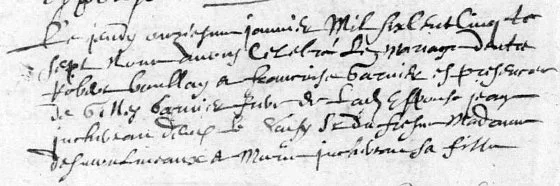
1657 marriage of Robert "Boullay" and Françoise "Garnier" (Direction des archives et du patrimoine culturel de l'Orne)
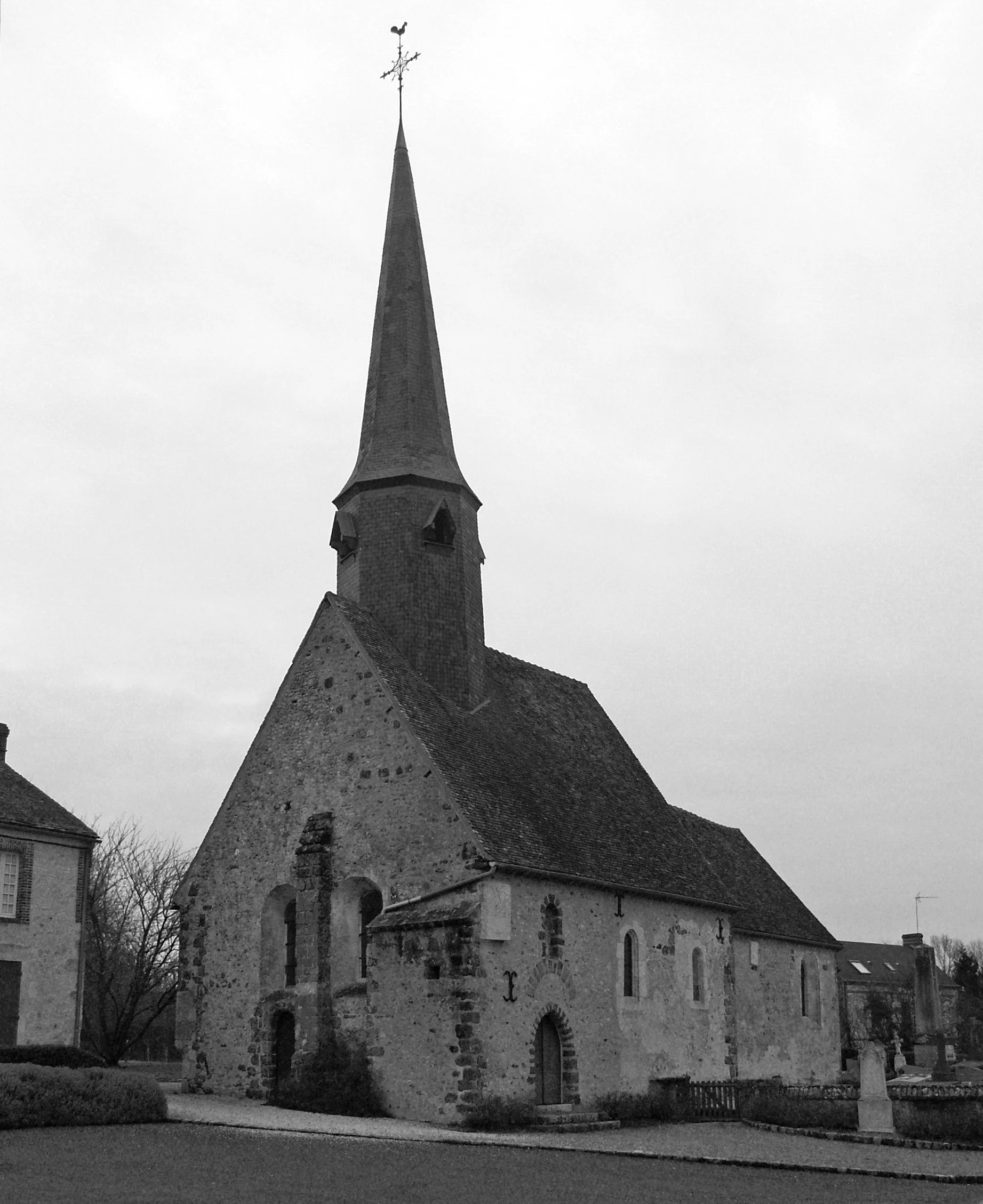
Church of Saint-Pierre in Bivilliers (photo by Unozoe, Wikimedia Commons CC BY-SA 3.0)
Robert and Françoise had two children baptized in France: Jacquine (or Jacqueline), baptized in 1659 in Loisé, and Jean, baptized in 1661 in Coulimer (he died before the family’s crossing to New France).
The couple had at least eleven children:
Jacqueline (1659–1736)
Jean (1661–bef. 1662)
Jacques (1664–1738)
[anonymous] (ca. 1666–ca. 1666)
Jean Baptiste (1667–bef. 1681)
Pierre (1669–1689)
Marie (1670–1670)
Martin (1672–1728)
Marie Françoise (1674–1751)
Paul (1677–1736)
Jean (ca. 1679–aft. 1681)
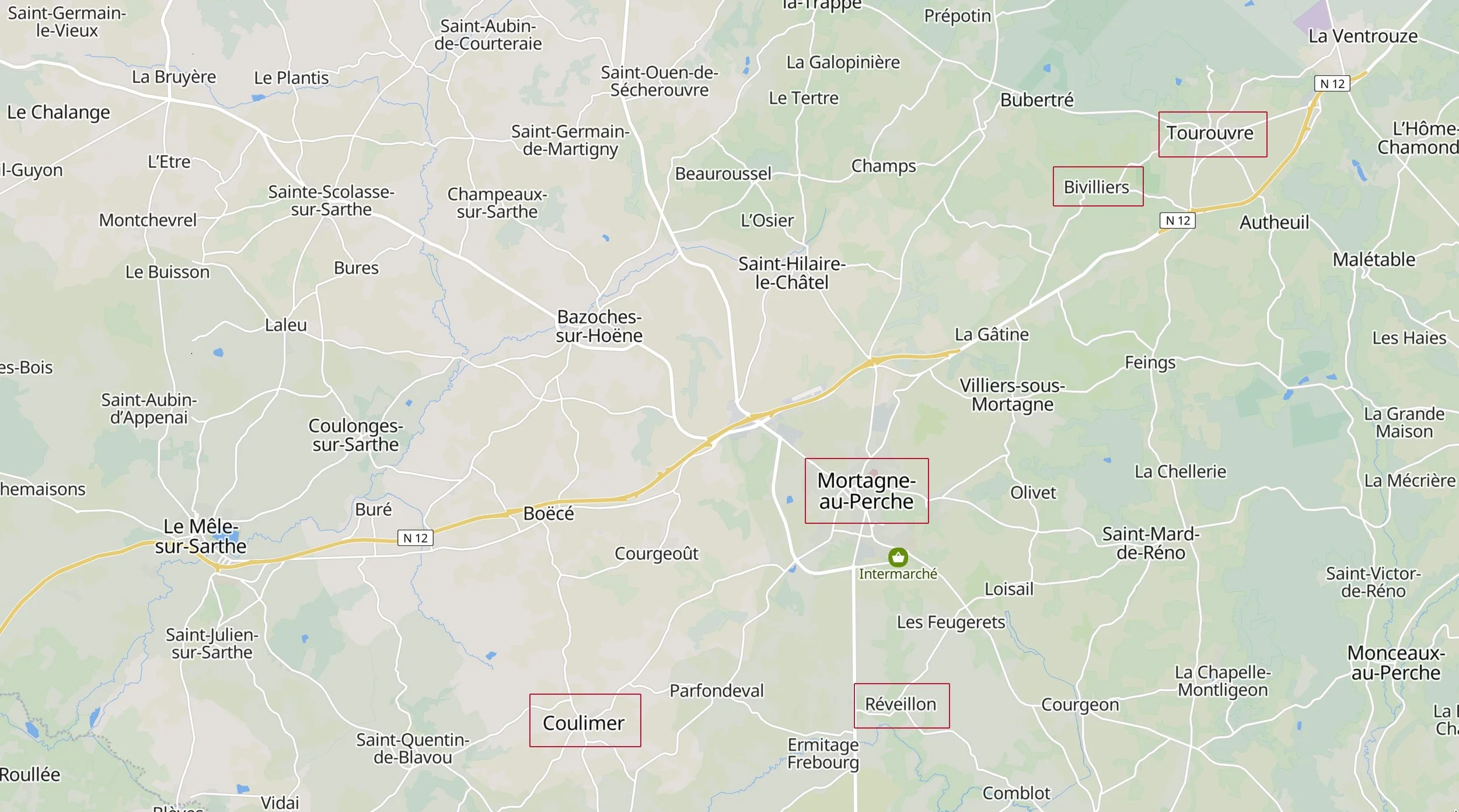
Locations associated with the Boullay family in France (Mapcarta)
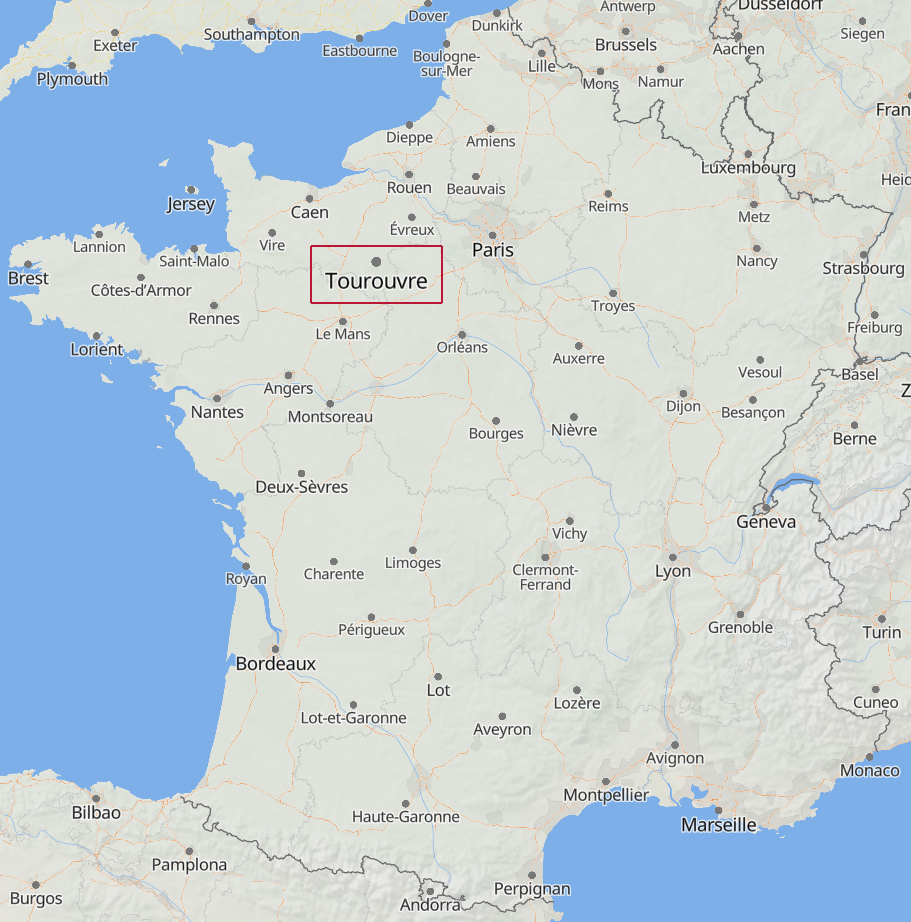
Location of Tourouvre in France (Mapcarta)
Crossing the Atlantic
By June 1662, Robert, Françoise, and their daughter Jacqueline had made their way to the port city of La Rochelle in western France. There, they acknowledged owing 20 livres to Charles Turgeon for travel expenses from Mortagne to La Rochelle, being “near to embark for Canada.” The obligation was recorded by notary Pierre Moreau.
From La Rochelle, the family likely boarded either l’Aigle d’Or or the Saint-Jean-Baptiste, alongside 300 other passengers, arriving at Québec later in the year.
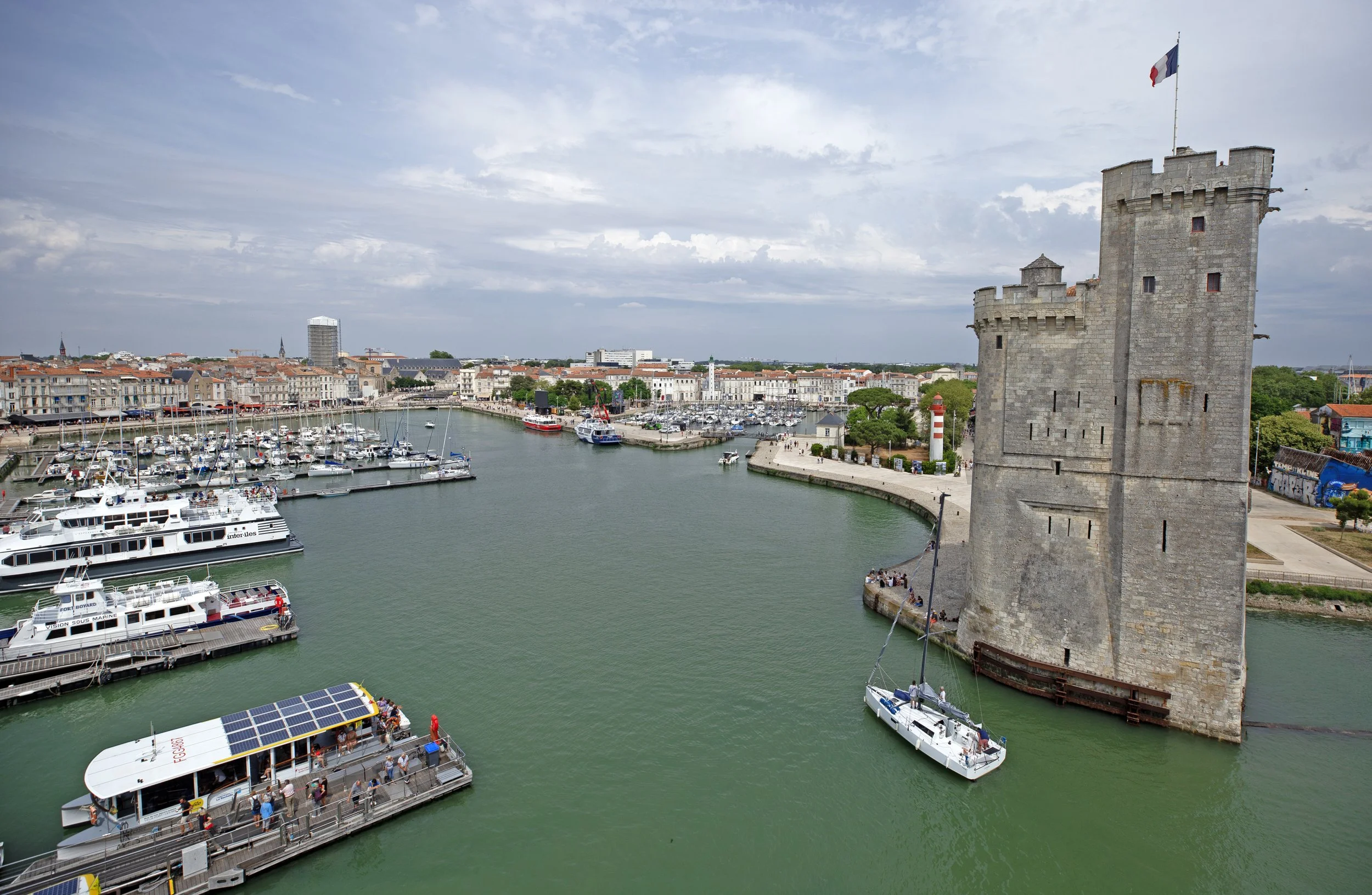
The port of La Rochelle, 2023 (© The French-Canadian Genealogist)
We do not know where the Boullay family settled immediately after their arrival. The first mention of the family in Canada is on February 6, 1664, at the baptism of their son Jacques in Château-Richer.
Settlement on Île-d’Orléans
In 1663, Charles de Lauson, a seigneur and priest, granted Robert a land concession in the seigneurie of Liret, on the north side of Île-d’Orléans, in the parish of Sainte-Famille. The land, measuring three arpents of frontage facing the St. Lawrence River, was located between the lands of the habitant Pierre Boucher and the shoemaker Pierre Roche. Robert promised to pay twenty sols annually per arpent of frontage in seigneurial rente, twelve deniers annually per arpent of frontage in cens, plus two live capons on the feast day of Saint Rémy. A copy of the concession, drawn up by notary Paul Vachon on March 6, 1664, confirms the grant.
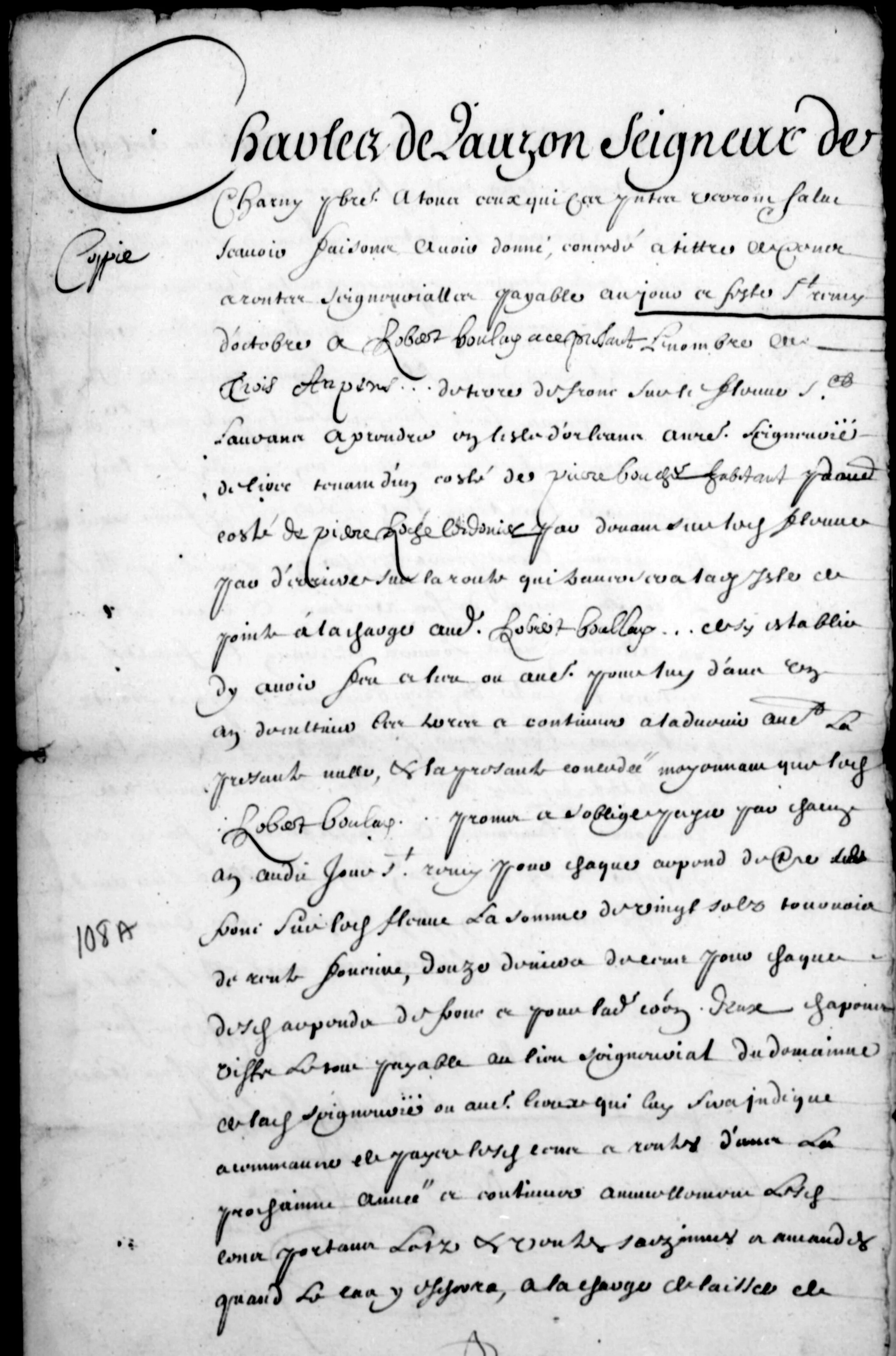
First page of the 1664 land concession to Robert "Boulay" (Bibliothèque et Archives nationales du Québec) [copy]
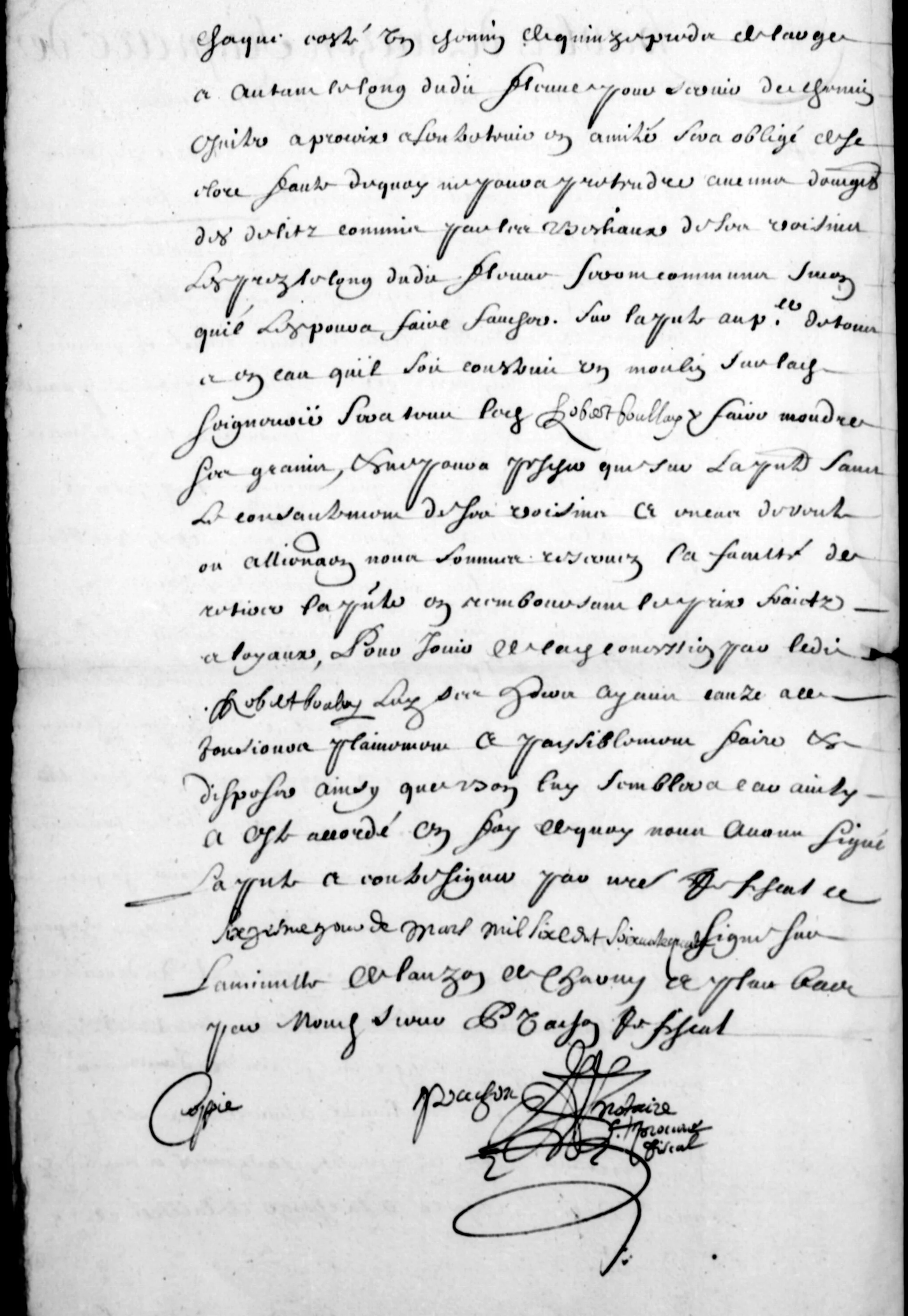
Second page of the 1664 land concession to Robert "Boulay" (Bibliothèque et Archives nationales du Québec) [copy]
In 1666, Robert and Françoise are enumerated in the census of New France, living on Île-d’Orléans with their three children.
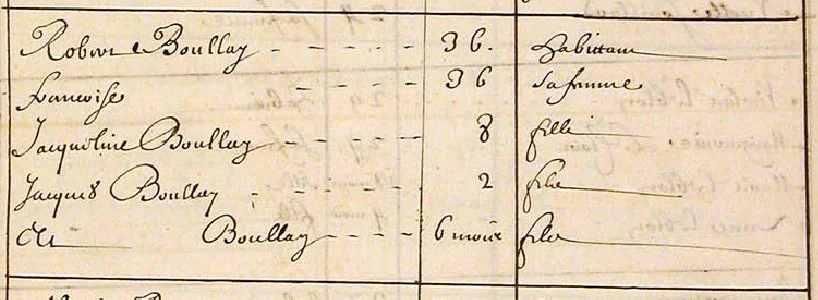
1666 census of New France for the “Boullay” family (Library and Archives Canada)
The family also appears in the 1667 census of New France, still on Île-d’Orléans. They owned six arpents of “valuable” land (cleared or under cultivation) and five head of livestock.
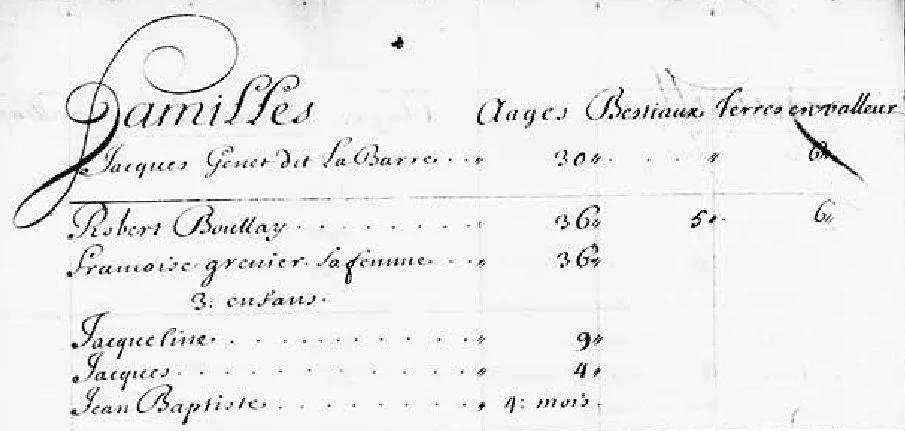
1667 census of New France for the “Boullay” family (Library and Archives Canada)
On February 26, 1669, François de Laval, Bishop of Pétrée, Apostolic Vicar in New France, and seigneur of Beaupré and Île-d’Orléans, granted Robert a land concession in the parish of Saint-Jean on the south side of Île-d’Orléans. The land, measuring three arpents of frontage facing the St. Lawrence River, was located between the lands of Nicolas Audet dit Lapointe and Pierre Michel, and was bounded by “the road that crosses the island from point to point.” Robert promised to pay twenty sols annually per arpent of frontage in seigneurial rente, twelve deniers annually per arpent of frontage in cens, plus two live capons (or thirty sols each) on the feast day of Saint Martin. He also promised to have his grain ground at the seigneurial mill.
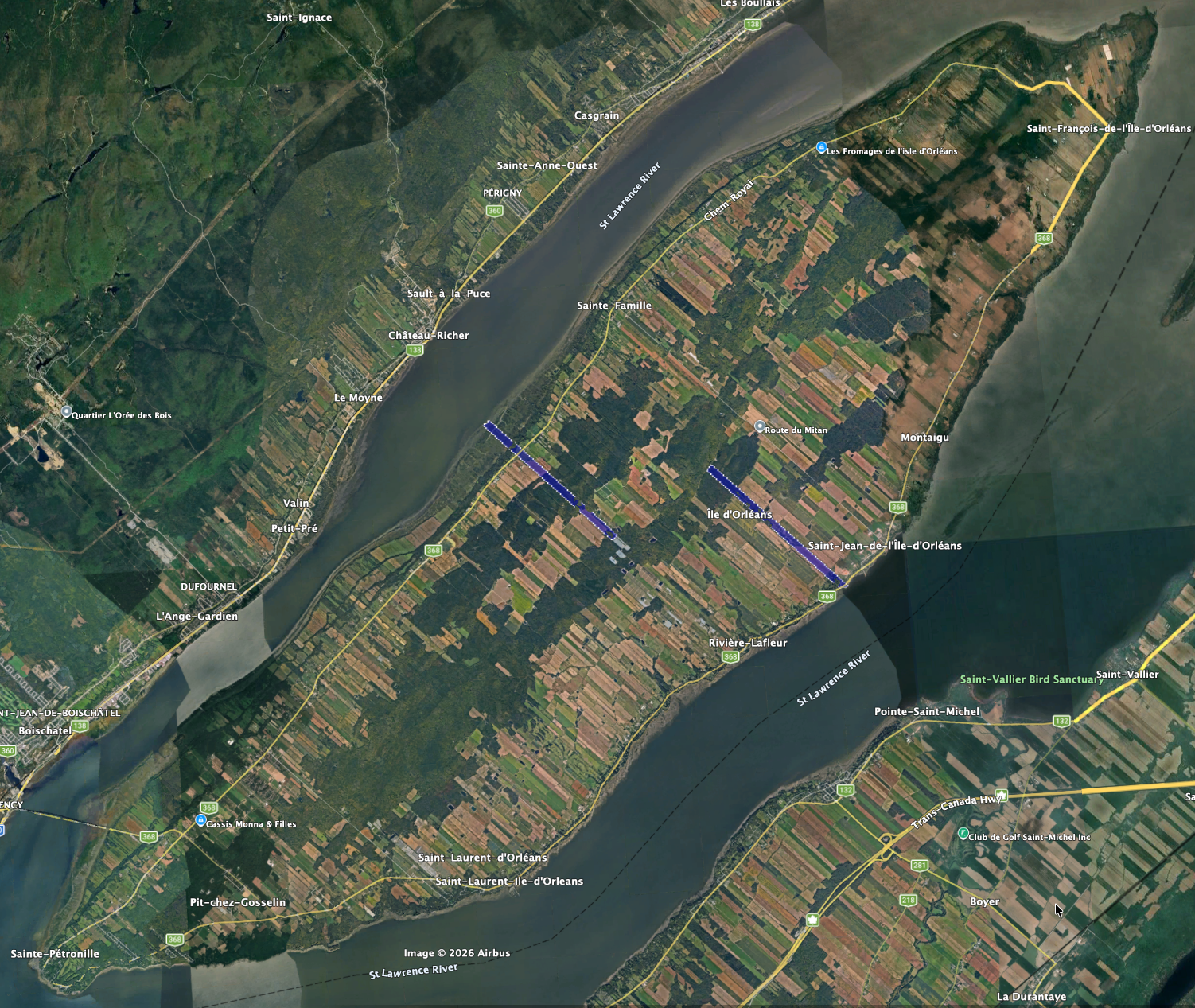
The two land concessions (in blue) owned by Robert Boullay on Île-d’Orléans (Google Earth); exact locations courtesy of Nico Lefrançois for Projet Patrimoine Québec
On November 25, 1670, Robert sold his land in the parish of Sainte-Famille on Île-d’Orléans to Jean Galeran Boucher for 400 livres. Boucher agreed to assume the seigneurial rente and cens payments going forward.
On November 19, 1675, Robert and Françoise sold their land in the parish of Saint-Jean on Île-d’Orléans to their neighbour Pierre Mourier for 165 livres and une paire de Soulliers françois pour ladite garnier, femme dudit vendeur (“a pair of French shoes for the said Garnier, wife of the seller”).
After these two sales, the Boullay family left Île-d’Orléans.
Final Years in Rivière-du-Sud
Robert and his family then settled in the seigneurie of Rivière-du-Sud, though concession documents for any land he may have received have not been located.
In November 1681, another census of New France was conducted. Robert, Françoise, and their six children were enumerated in the seigneurie of Bellechasse [encompassing land that today includes Saint-François-de-la-Rivière-du-Sud and Montmagny]. They lived near their daughter Jacqueline, her husband Pierre Joncas, and their family. Robert owned five arpents of “valuable” land, one gun, and six head of livestock. [The child named “Robert” in this census is likely a mistake; it is most likely Paul.]
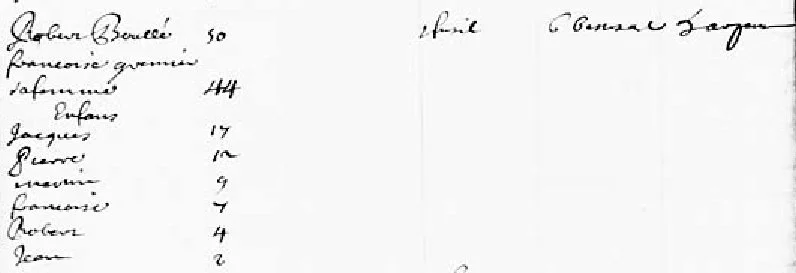
1681 census for the “Boullé” family (Library and Archives Canada)
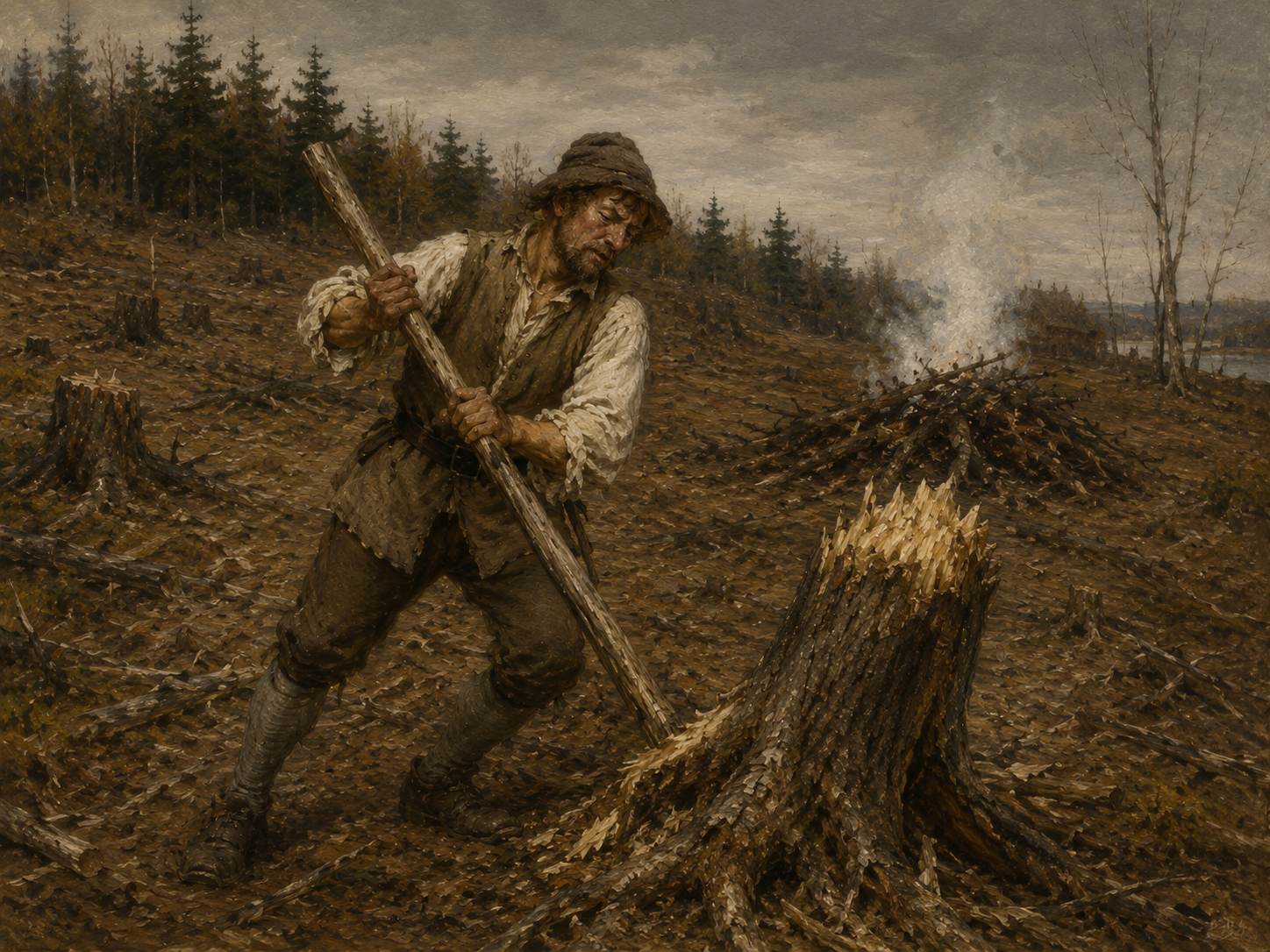
Illustration generated with artificial intelligence by the author, May 2026 (ChatGPT)
On July 10, 1699, notary François Genaple drew up an agreement between Robert and Françoise and their son Martin. “Seeing the frailty, old age, and infirmity in which they find themselves, being unable to continue to live or support themselves through their labour, and having found no other children or sons-in-law willing to take care of them for the rest of their days,” the parents arranged for Martin to take over the operation of their farm in the seigneurie of Rivière-du-Sud. In exchange, Martin agreed to provide them with lifelong care, including food, lodging, heating, clothing, and general maintenance.
The agreement established a financial structure whereby Martin paid an annual rent of 40 écus for the farm, while also assuming a significantly larger annual obligation of 500 livres for his parents’ upkeep. The difference was to be compensated through the value of the parents’ movable property (livestock and goods), with the land itself serving as security if necessary. The contract also stipulated that Martin would construct a barn and maintain the property, and that he renounced any future claims against his siblings arising from this arrangement.
An accompanying preliminary declaration, recorded the same day, clarified Martin’s rights under the agreement. Although the main contract provided that certain parcels of land could serve as security for any excess costs of the pension, Martin explicitly renounced all claims to those lands—particularly the two arpents still held by his parents and the four arpents already given to his brothers, Jacques and Paul Boulet. He affirmed that these properties were to remain with his siblings and be divided among them as previously agreed. This additional act ensured that Martin’s compensation for supporting his parents would come solely from the agreed financial terms and movable assets, thereby preventing any future dispute over the family’s real property.
The agreement is considered unusual because it departs from the customary family support arrangements of New France. Although the couple had several adult sons, none initially agreed to assume responsibility for their care, even when offered the prospect of inheriting their parents’ remaining property. This reluctance is atypical, as it was standard practice for one child—most often a son—to take in aging parents in exchange for land or other assets. The eventual agreement with their son Martin appears cautious and strained, reflecting his concern that the arrangement might later be contested and suggesting possible tension or mistrust within the family.
Furthermore, the financial terms of the contract are imbalanced, requiring significant ongoing support that could exceed the value of the remaining land, which had already been partially divided among the other children. In contrast to more typical and cooperative arrangements seen in similar contexts, including within the next generation of the same family, this agreement points to unusual familial and economic circumstances rather than a routine provision for old-age support.
Deaths of Robert and Françoise
Robert Boullay died at the age of approximately 76, on March 24, 1707, “after receiving the sacraments of the Eucharist, Penance, and Extreme Unction during the course of his illness.” He was buried the following day in the parish cemetery of Saint-Thomas of Pointe à la Caille [Montmagny].
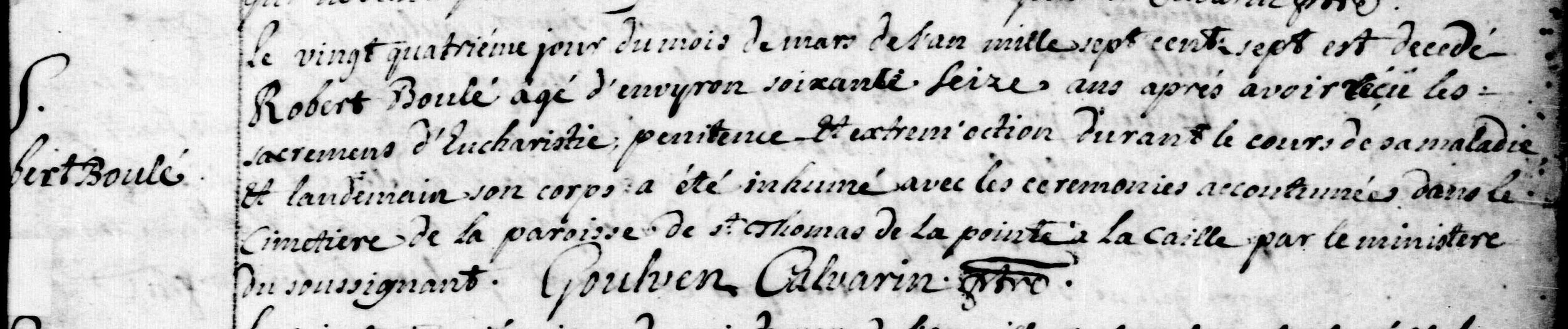
1707 burial of Robert "Boulé" (Généalogie Québec)
Françoise Grenier died at the age of approximately 72, on January 28, 1709, after receiving all the sacraments. She was buried the following day in the parish cemetery of Saint-Thomas of Pointe à la Caille. The priest indicated that “a grand mass was sung for her.”
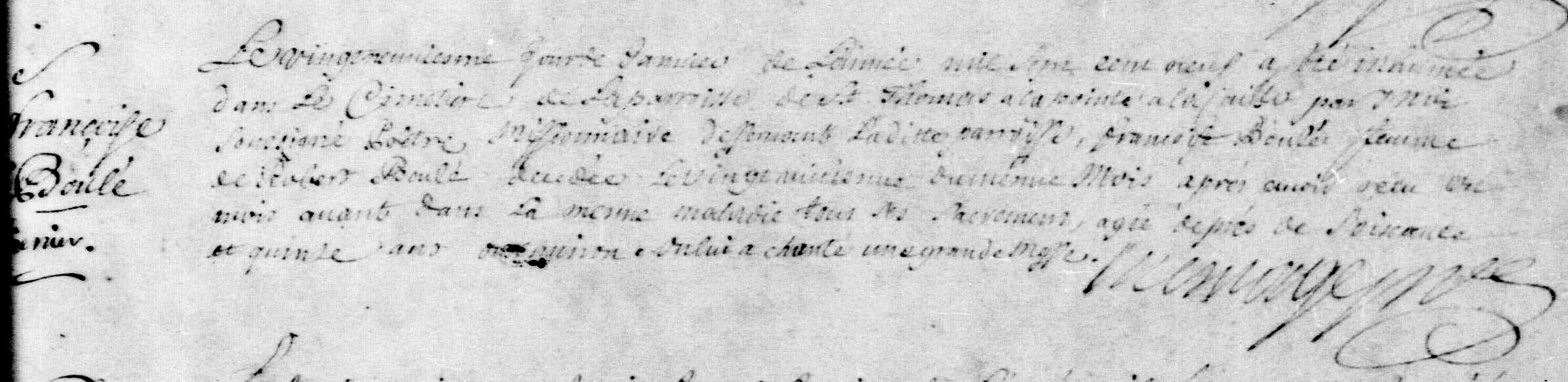
1709 burial of Françoise Grenier (Généalogie Québec)
Settlement and Legacy in New France
From their origins in the Perche region of France, Robert Boullay and Françoise Grenier establish themselves among the early settlers of New France in the 1660s. Along the St. Lawrence and on Île-d’Orléans, they take up land, raise a large family, and participate in the gradual development of the colony. In their later years, arrangements for their care reflect both the demands of aging and the realities of family life in a rural seigneurial setting. By the time of their deaths in the early eighteenth century, their children and grandchildren are established in the region, ensuring the continuation of the Boulay, Boulet, and Boulé lines in Canada.

PDF version of biography located at: https://www.tfcg.ca/robertboullay-and-francoisegrenier.
Are you enjoying our articles and resources? Show your support by making a donation. Every contribution, regardless of its size, goes a long way in covering our website hosting expenses and enables us to create more content related to French-Canadian genealogy and history. Thank you! Merci!
Sources:
"Réveillon, Registre paroissial (B1607-1670, S 1608-1670)," digital images, Direction des archives et du patrimoine culturel de l'Orne (https://gaia.orne.fr/mdr/index.php/docnumViewer/calculHierarchieDocNum/378764/1057:358227:371851:378764/1080/1920 : accessed 5 May 2026), baptism of Robert Boullay, 18 May 1631, Réveillon, image 38 of 128, reference 3NUMECRP348/AC348_1.
"Bivilliers, Registre paroissial (1603–1674)," digital images, Direction des archives et du patrimoine culturel de l'Orne (https://gaia.orne.fr/mdr/index.php/docnumViewer/calculHierarchieDocNum/375685/1057:357863:371503:375685/1080/1920 : accessed 5 May 2026), marriage of Robert Boullay and Françoise Garnier, 11 Jan 1657, Bivilliers, image 69 of 112, reference 3NUMECRP45/EDPT381_4.
"Le LAFRANCE (Baptêmes, mariages et sépultures)," database and digital images, Généalogie Québec (https://www.genealogiequebec.com/Membership/LAFRANCE/acte/28868 : accessed 4 May 2026), baptism of Jacques BOULAY, 6 Feb 1664, Château-Richer (La-Visitation-de-Notre-Dame); citing original data: Institut généalogique Drouin and PRDH.
"Le LAFRANCE (Baptêmes, mariages et sépultures)," database and digital images, Généalogie Québec (https://www.genealogiequebec.com/Membership/LAFRANCE/acte/26355 : accessed 5 May 2026), burial of Robert BOULE, 25 Mar 1707, Montmagny (St-Thomas); citing original data: Institut généalogique Drouin and PRDH.
"Le LAFRANCE (Baptêmes, mariages et sépultures)," database and digital images, Généalogie Québec (https://www.genealogiequebec.com/Membership/LAFRANCE/acte/26383 : accessed 5 May 2026), burial of Francoise BOULE, 29 Jan 1709, Montmagny (St-Thomas); citing original data: Institut généalogique Drouin and PRDH.
“Archives de notaires : Paul Vachon (1655-1693),” digital images, Bibliothèque et Archives nationales du Québec (https://numerique.banq.qc.ca/patrimoine/details/52327/4215634?docref=-X4ML0F-xGAJw2kHKZoO-g : accessed 5 May 2026), land concession by Charles de Lauson to Robert Boulay, 6 Mar 1664, images 370-371 of 1180.
“Archives de notaires : Paul Vachon (1655-1693),” digital images, Bibliothèque et Archives nationales du Québec (https://numerique.banq.qc.ca/patrimoine/details/52327/4215635?docref=iCL_33aQW4EINzkqvtfCgw : accessed 5 May 2026), land concession by François de Laval to Robert Boulay, 26 Feb 1669, images 214-215 of 1169.
“Actes de notaire, 1652-1692 // Claude Auber,” digital images, FamilySearch (https://www.familysearch.org/ark:/61903/3:1:3QHV-53L2-6BG3?cat=koha%3A1175225&i=1014&lang=en : accessed 5 May 2026), sale of land concession by Robert Boulay to Jean Galleran Boucher, 25 Nov 1670, images 1015-1017 of 1368; citing original data: Bibliothèque et Archives nationales du Québec.
“Archives de notaires : Paul Vachon (1655-1693),” digital images, Bibliothèque et Archives nationales du Québec (https://numerique.banq.qc.ca/patrimoine/details/52327/4215636?docref=RQKDn2TgflQdjwraxKsbyQ : accessed 5 May 2026), sale of land by Robert Boullay and Françoise Garnier to Pierre Mourier, 19 Nov 1675, images 438-440 of 1185.
“Actes de notaire, 1682-1709 // François Genaple,” digital images, FamilySearch (https://www.familysearch.org/ark:/61903/3:1:3Q9M-CS56-V31T-D?cat=koha%3A1168969&i=2519&lang=en : accessed 5 May 2026), agreement between Martin Boulet and his parents Robert Boulet and Françoise Grenier, 10 Jul 1699, images 2520-2523 of 3410; citing original data: Bibliothèque et Archives nationales du Québec.
"Recensement du Canada, 1666," digital images, Library and Archives Canada (https://recherche-collection-search.bac-lac.gc.ca/fra/accueil/notice?idnumber=2318856&app=fonandcol : accessed 5 May 2026), household of Robert Boullay, 1666, Île-d’Orléans, page 85 (of PDF), Finding aid no. MSS0446, MIKAN no. 2318856; citing original data: Centre des archives d'outre-mer (France) vol. 460.
"Recensement du Canada, 1667", Library and Archives Canada ((https://www.bac-lac.gc.ca/eng/CollectionSearch/Pages/record.aspx?app=fonandcol&IdNumber=2318857&new=-8585951843764033676 : accessed 5 May 2026), household of Robert Boullay, 1667, Île-d’Orléans, page 110 (of PDF), Finding aid no. MSS0446, Item ID number: 2318857; citing original data: Centre des archives d'outre-mer (France) vol. 460.
"Recensement du Canada fait par l'intendant Du Chesneau," digital images, Library and Archives Canada (https://www.bac-lac.gc.ca/eng/CollectionSearch/Pages/record.aspx?app=fonandcol&IdNumber=2318858&new=-8585855146497784530 : accessed 5 May 2026), household of Robert Boullé, 14 Nov 1681, seigneurie of Bellechasse, page 233 (of PDF), Finding aid no. MSS0446, MIKAN no. 2318858; citing original data: Centre des archives d'outre-mer (France) vol. 460.
Fédération québécoise des sociétés de généalogie, Fichier Origine online database (https://www.fichierorigine.com/fr/repertoire/boulay-2 : accessed 5 May 2026), entry for ROBERT BOULAY (person 240513), updated on 14 Dec 2018.
Université de Montréal, Programme de recherche en démographie historique (PRDH) online database (https://www-prdh-igd.com/Membership/fr/PRDH/Famille/1221 : accessed 5 May 2026), dictionary entry for Robert BOULE BOULAY and Francoise GRENIER, union 1221.
Thomas J. Laforest, Our French-Canadian Ancestors vol. 15 (Palm Harbor, Florida, The LISI Press, 1992), 240-248.
Danielle Boulé, "L’ancêtre Robert Boulay," Les Boulay, Boulet, Boulé et autres familles reliées (https://www.famillesboulaybouletboule.org/lancetre-robert-boulay-1631.html : accessed 7 May 2026).