Pierre Gaudin dit Châtillon & Jeanne Rousselière
Explore the lives of Pierre Gaudin (or Godin) dit Châtillon and Jeanne Rousselière, two seventeenth-century French immigrants whose story is closely tied to the early history of New France. Pierre, a carpenter from Châtillon-sur-Seine, arrived with the Grande Recrue of 1653 and became a skilled craftsman, landholder, habitant, and member of Montréal’s Sainte-Famille militia. Jeanne, originally from Saintonge, came to the colony as a fille à marier. After marrying at Ville-Marie in 1654, the couple raised a large family and lived in several emerging communities, including Montréal, Charlesbourg, Lachine, and later Acadia. Their biography follows their marriage, children, property transactions, carpentry contracts, legal disputes, migration to Beaubassin, and later years in Acadia. Drawing on parish registers, censuses, notarial acts, court records, and other historical sources, this profile reconstructs the lives of a couple whose descendants became part of both French-Canadian and Acadian history.
Cliquez ici pour la version en français
Pierre Gaudin dit Châtillon & Jeanne Rousselière
A Carpenter, a Fille à marier, and a New Life in New France
Pierre Gaudin dit Châtillon, son of Claude Godin and Marie Barden (or Bardin), was baptized on May 17, 1630, in the church of Saint-Vorles in Châtillon-sur-Seine, Burgundy, France [in the present-day department of Côte-d'Or]. His godparents were Salomon Thomas and Marie Camblai. [Although he is sometimes called Godin, Pierre signed his name “Gaudin.” His dit name is often spelled “Chastillon.”]
Pierre’s father, Claude Godin, was also a carpenter. Pierre had at least two older sisters baptized at Saint-Vorles: Jeanne (or Perrine) in 1624 and Marie in 1627.

1630 baptism of Pierre “Godin” (État civil de la Côte-d'Or)
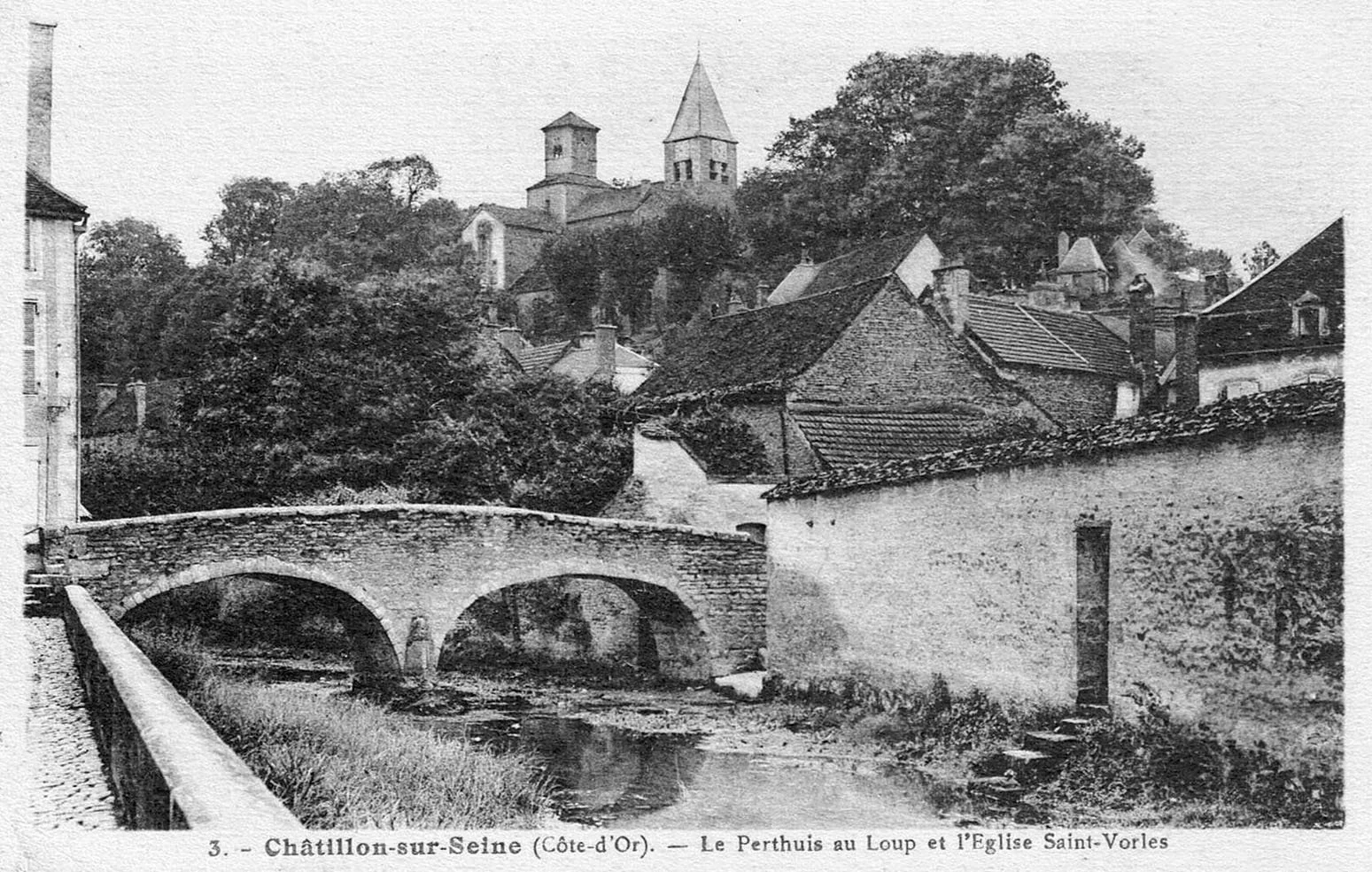
Postcard of Châtillon-sur-Seine and the church of Saint-Vorles, circa 1908 (Geneanet)
The church of Saint-Vorles stands on a rocky promontory above Châtillon-sur-Seine and is one of the town’s oldest surviving religious buildings. It was built around the turn of the 11th century, under Brun de Roucy, bishop of Langres, and retains important Romanesque features. The church is dedicated to Saint Vorles, a 6th-century priest whose relics were once kept there. It has been protected as a French monument historique since 1909.
Located about 200 kilometres southeast of Paris, Châtillon-sur-Seine is a small town in northern Burgundy, with a population of about 5,400 residents, known as Châtillonnais. The surrounding region has been inhabited since antiquity; only six kilometres away, at Vix, archaeologists discovered the celebrated 6th-century BCE Vix burial and its enormous bronze Greek krater, now displayed in the Musée du Pays Châtillonnais in Châtillon-sur-Seine.
Given Pierre’s documented baptism there, his later dit name, Châtillon, likely referred directly to his place of origin.
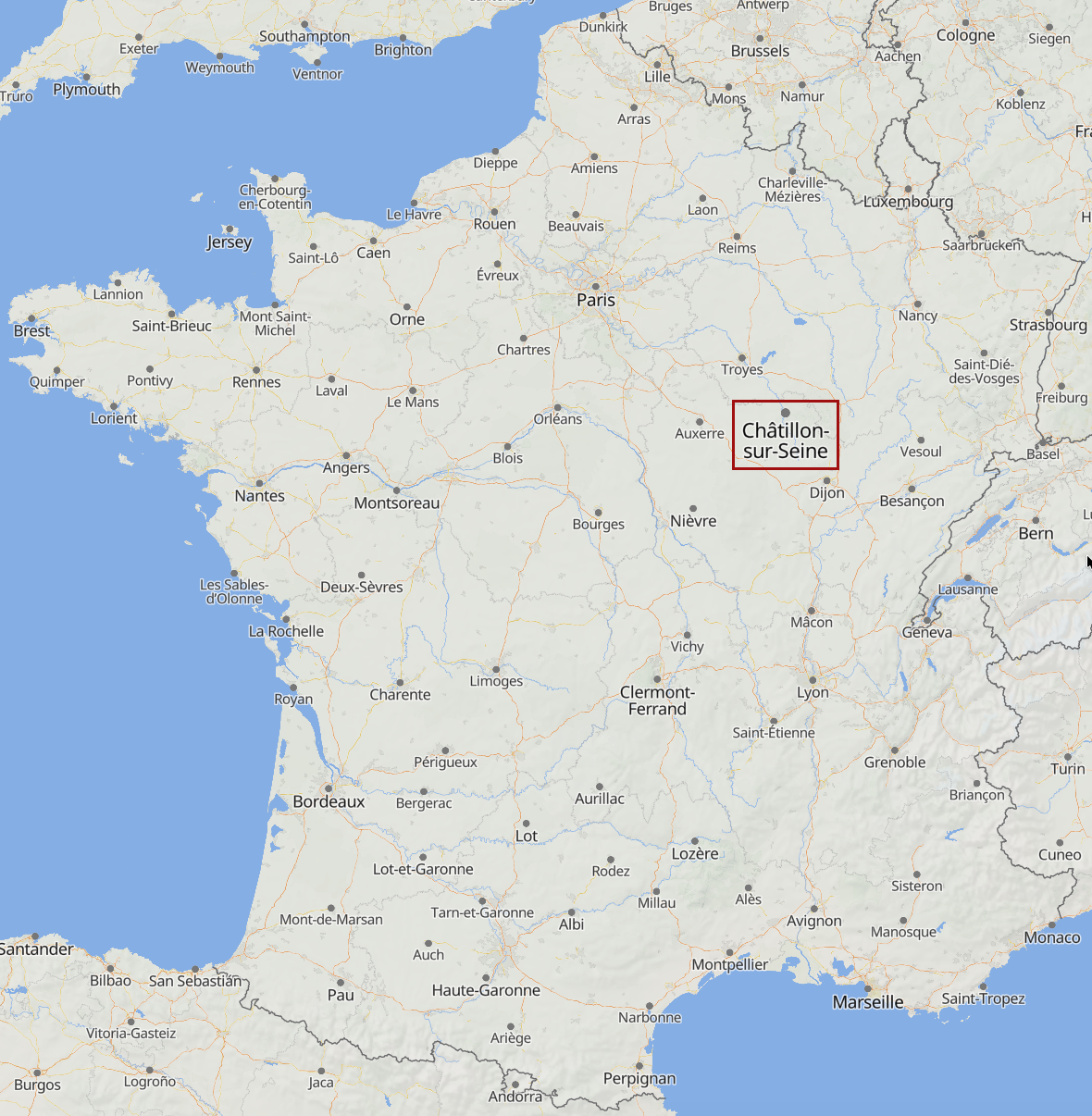
Location of Châtillon-sur-Seine (Mapcarta)
Recruited for New France
On March 23, 1653, Pierre entered into a five-year contract at La Flèche to work in Montréal under the authority of governor Paul de Chomedey de Maisonneuve. He was described as a compagnon charpentier, or journeyman carpenter, from Châtillon-sur-Seine. Pierre and four other craftsmen were required to report to the home of Charles Lecoq, sieur de La Baussonnière, in Nantes no later than April 30, where they were to embark with Maisonneuve for New France. During both the Atlantic crossing and their five years of service, they were to be provided with food, lodging, and sleeping accommodations at no expense to themselves, as well as the tools required for their work. Each man was also to receive a sword and pistol. Pierre was promised wages of 100 livres per year, payable at the end of each year, although advances could be made during the first year for expenses necessary to equip himself. At the completion of the five-year term, the company also agreed to pay the cost of returning him to France if he wished to go back. Pierre declared that he did not know how to sign.
The Grande Recrue of 1653 was organized at a critical moment in the history of Ville-Marie [Montréal]. By 1651, repeated Haudenosaunee (Iroquois) attacks had reduced the settlement to about fifty colonists and forced its inhabitants to take refuge within the fort. Jeanne Mance made 22,000 livres (money originally intended for the Hôtel-Dieu) available to finance reinforcements. Paul de Chomedey de Maisonneuve then returned to France, declaring that if he could not recruit at least 100 men to defend Ville-Marie, the settlement would have to be abandoned.
Recruitment took approximately two years. According to the Dictionary of Canadian Biography, 154 men were engaged in France, of whom 120 reported for departure and boarded the Saint-Nicolas at Saint-Nazaire on June 20, 1653. The voyage was difficult, and illness spread among the passengers; the ship reached Québec on September 22, after which some of the recruits required hospitalization before continuing to Ville-Marie. The contingent, which included men recruited for a variety of skilled trades as well as defence, substantially increased the settlement’s manpower. Marguerite Bourgeoys also travelled with the group and later became a central figure in the development of education in Montréal.
Pierre was among the skilled tradesmen recruited for the Grande Recrue of 1653 and had contracted to serve as a journeyman carpenter in Montréal. He joined the recruits aboard the Saint-Nicolas, which first sailed from Saint-Nazaire on June 20, 1653, but was forced to return because the ship was leaking badly. After several weeks of repairs, it departed again on July 20 and reached Québec on September 22. Pierre and the other members of the Grande Recrue then continued upriver, finally arriving at Ville-Marie on November 16, 1653.
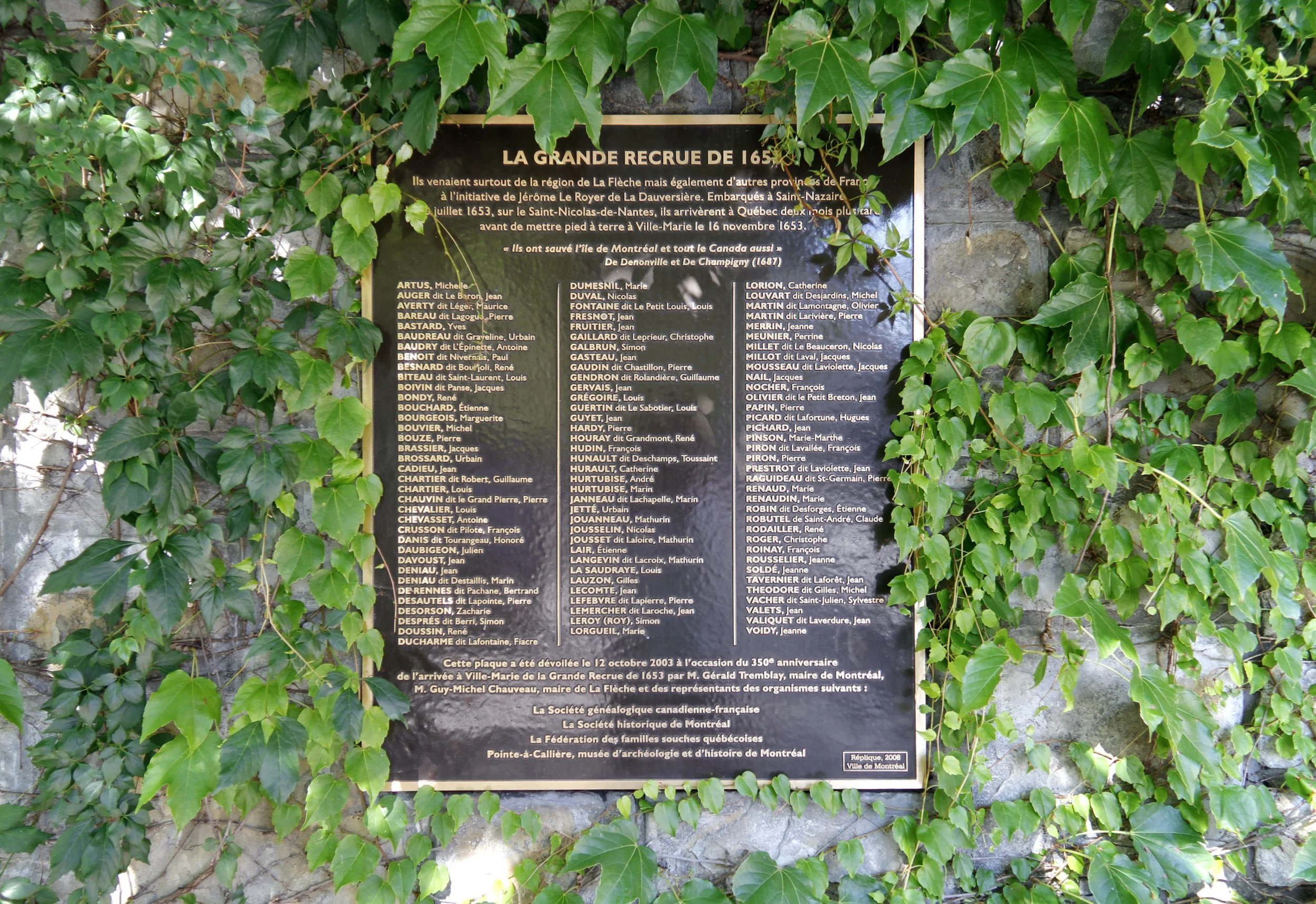
Plaque of the Grande Recrue in Old Montréal, featuring Pierre “Gaudin dit Chastillon” (© The French-Canadian Genealogist)
Jeanne Rousselière, daughter of Louis Rousselière and Isabelle Parisé, was born around 1635 in the parish of Saint-Pierre in Moize, in Saintonge, France [present-day Moëze in the department of Charente-Maritime]. Her baptism record has not been located. [In New France, her surname is often spelled “Rousselier.”]
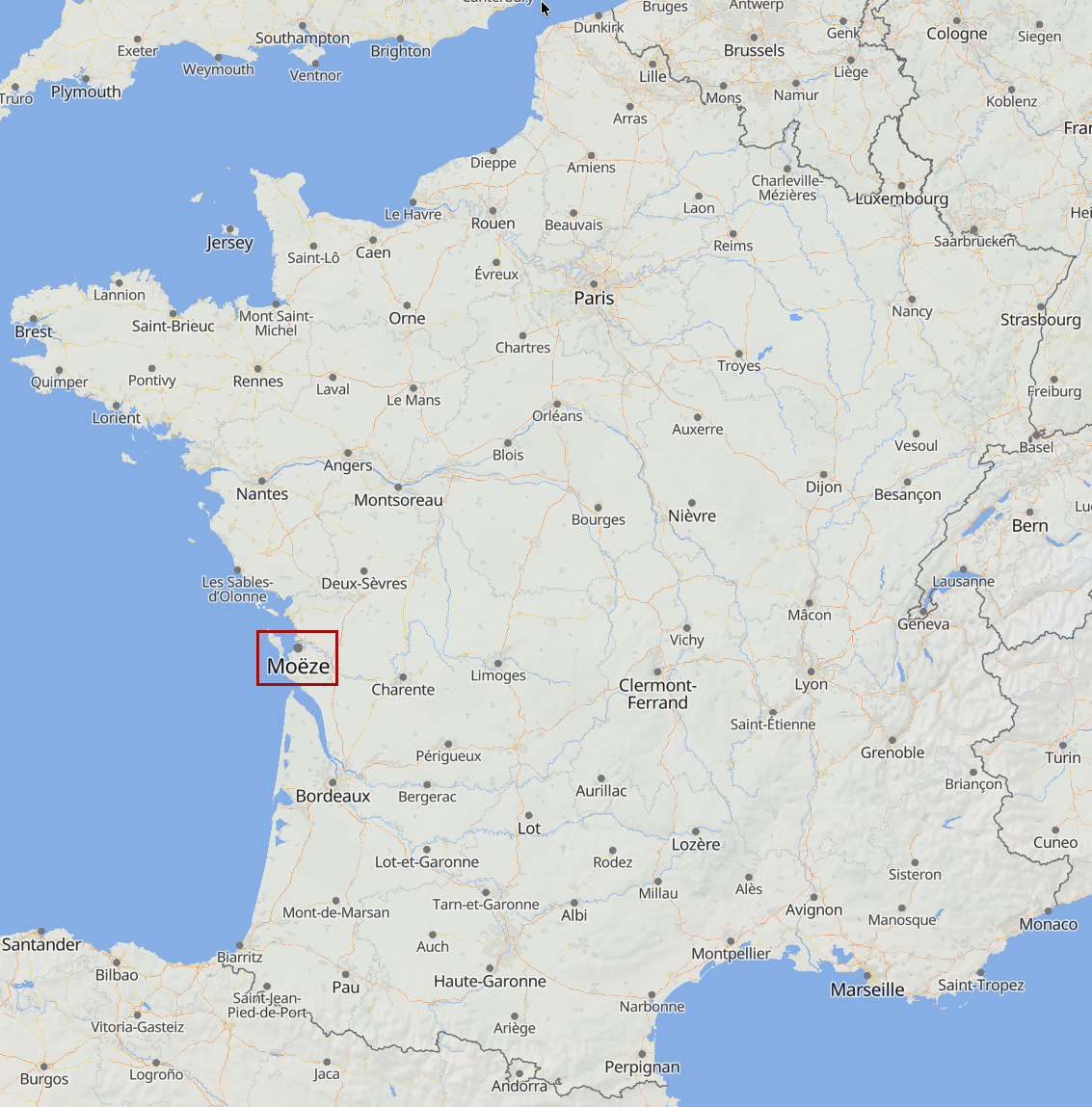
Location of Moëze in France (Mapcarta)
Moëze is located about 10 kilometres south of Rochefort, on the northern edge of the Marais de Brouage. The surrounding marshes were once part of the Gulf of Saintonge, and salt production was an important part of the local economy, particularly during the 16th century. Today the rural commune has only about 620 inhabitants and remains surrounded by the extensive wetlands that characterize this part of the Atlantic coast.
A “fille à marier,” Jeanne arrived in Canada by 1654.
Marriage and Children
On September 27, 1654, notary Raphaël Lambert Closse drew up a marriage contract between Pierre and Jeanne. Pierre was described as a 26-year-old habitant of Ville-Marie (in reality, he was 24), while Jeanne was said to be 19. The future spouses agreed to be bound by the Coutume de Paris (Custom of Paris). The witnesses were Jeanne Mance, Pierre Gadois, Gilbert Barbier, Marin Janot, Jean Lemerche, Henri Perrin, Robert Lecavelier, Honoré Langlois, and Jean Davou. This time, Pierre could sign his name (“Gaudin”), but his new bride could not, so she made her mark.
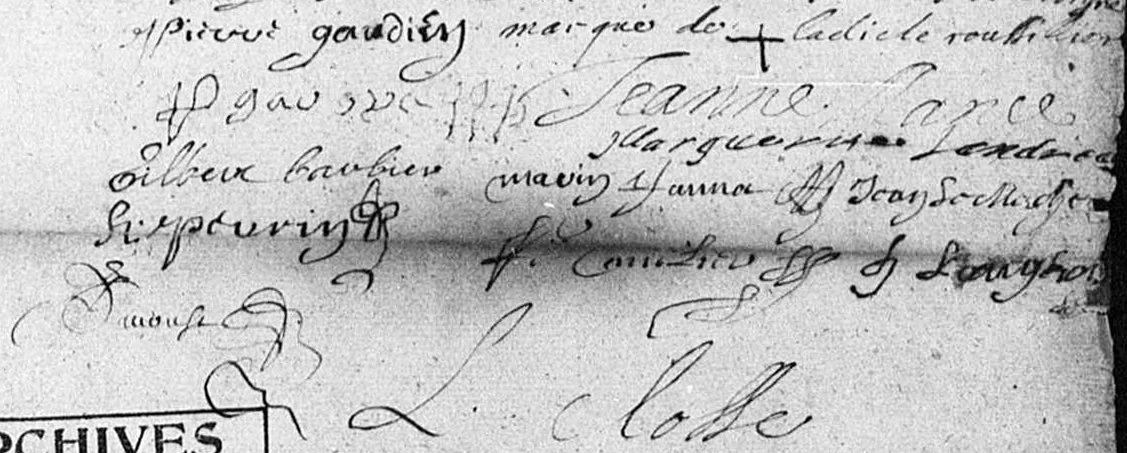
Signatures on the 1654 marriage contract (FamilySearch)
The couple was married on October 13, 1654, in Ville-Marie [Montréal]. Their witnesses were notary Lambert Closse, Pierre Gadois, and Urbain Terssier, all early inhabitants of Ville-Marie.
The couple had at least nine children:
Laurent (1655–1737)
Marie (1657–1687)
Catherine (1659–1746)
Gabriel (1661–bef. 1730)
Madeleine (1664–bef. 1666)
Marie Madeleine (1665– ?)
Pierre (1667–1739)
Jean (1669–?)
Anne (1672–1742)
On March 30, 1655, a kind of community medical-care agreement was concluded between three dozen men residing in Ville-Marie, including Pierre, and master surgeon Étienne Bouchard. Speaking on behalf of their wives and children, the men likely represented most of the settlement’s roughly 150 inhabitants. Bouchard “undertook to treat and prescribe medication for all kinds of illnesses, both natural and accidental, except for the plague, smallpox, leprosy, epilepsy, and lithotomy or stone removal, until complete recovery as far as possible, for the sum of one hundred sols per year for each of the above-named persons, as well as for their wives and children [...].” The agreement, penned by notary Raphaël Lambert Closse at the Fort of Ville-Marie, is considered the first of its kind on the continent.
Later that year, on November 5, 1655, André Dumest [Dumais] ceded Pierre a house and one arpent of land in Ville-Marie, located on the north side of rue Saint-Paul, between rues Saint-Vincent and Saint-Charles. In exchange, Pierre, who was described as a maître charpentier, or master carpenter, agreed to build Dumais a new house and to pay him an additional 100 livres. The new house was to measure 30 feet long by 18 feet wide, with nine-foot posts, and its framing was to be constructed of oak, ash, and elm. Pierre promised to complete the house as soon as possible, while Dumais was to supply the necessary stone once the structure had been raised. The agreement specifically exempted Pierre from a separate 300-livre obligation that Dumais owed to the Messieurs de Montréal should he leave the island.
Nearly six years after acquiring the property from Dumais, on October 3, 1661, Pierre and Jeanne sold the one-arpent Montréal lot to master surgeon Étienne Bouchard for 300 livres. The sale included the house located on the property. Bouchard assumed the cens, rentes, and other seigneurial dues attached to the property, while the purchase price was to be paid to Pierre and Jeanne in instalments.
As an established habitant, Pierre also took on civic responsibilities. In 1663, he was listed as a member of the 19th squadron of the Sainte-Famille Militia.
The Sainte-Famille Militia
In 1663, facing repeated and deadly attacks by the Iroquois, Montréal's residents were left to defend themselves in the absence of formal military support. In response, Paul de Chomedey de Maisonneuve, the town’s founder, established the first Canadian militia. He called upon the men of Montréal to organize themselves into groups of seven, each led by a corporal of their choosing. This local force was placed under the patronage of the Holy Family—Jesus, Mary, and Joseph—and named the Sainte-Famille militia. The final roll listed 139 men, likely representing all able-bodied males in the small settlement, which had a population of around 500 at the time.
In September 1663, Jeanne welcomed her cousin Marie Faucon, a newly arrived Fille du roi, into the household. Marie remained with the family until her marriage two months later; the exact degree of their kinship is unknown.
On the afternoon of June 19, 1664, Pierre and Jeanne sold their 30-arpent land concession to Mathurin Lorion and his wife Jeanne Bizet for 1,800 livres. The agreement confirmed that the property was the concession granted to Pierre by the governor on February 2, 1654. It extended from the bank of the St. Lawrence River to the end of the concession and included the stone house that Pierre and Jeanne had built there, together with its appurtenances and dependencies. Part of the purchase price was to be applied toward debts owed by the sellers. Pierre signed the document, this time with a paraph (flourish).
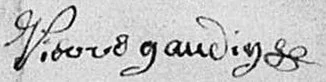
Pierre’s signature in 1664 (FamilySearch)
Move to Charlesbourg
After this sale, the Gaudin family left Montréal for Charlesbourg, near Québec City. On February 28, 1665, Father Claude Dablon, procurator of the Jesuit College in Québec, acting on behalf of the Society of Jesus (the Jesuits), granted Pierre a 40-arpent concession at Charlesbourg in the seigneurie of Notre-Dame-des-Anges. The trapezoidal property measured five perches across at the end adjoining the village and widened to four arpents at its opposite end. Its two side boundaries measured approximately 17 and 18 arpents respectively.
Pierre agreed to pay an annual seigneurial rente of one sol for each arpent of land and woods, or 40 sols in total, together with two deniers of cens for the entire concession and two live capons. These payments were due each year on the winter feast of Saint-Martin, beginning November 11, 1666. He was also required to clear the land and establish a residence by March 1, 1666, and to have his grain ground at the Jesuits’ banal mill. The concession further required him to permit necessary roads across the property and to help his neighbours enclose and maintain the common lands at Charlesbourg.
In Québec, on the morning of September 15, 1666, Pierre granted his wife, Jeanne Rousselière, a power of attorney to act on his behalf in recovering the money still owed by Mathurin Lorion from their 1664 sale of the Montréal property. Jeanne was authorized to receive the outstanding sums, issue receipts and discharges, and pursue the necessary legal remedies if Lorion failed to pay, including seeking to have him surrender the property.
Lorion failed to satisfy the terms of the 1664 purchase. Just 15 days later, on September 30, 1666, in Montréal, he and his wife, Jeanne Bizette, therefore formally surrendered the house and 30-arpent property to Pierre and Jeanne. Acting under Pierre’s power of attorney, Jeanne accepted the property on his behalf. The agreement also dealt with outstanding seigneurial charges and reserved certain rights arising from the original sale; the return of the property did not necessarily extinguish all sums still owed to Pierre and Jeanne. The Lorions also retained rights to standing grain and vegetables then growing on the property.
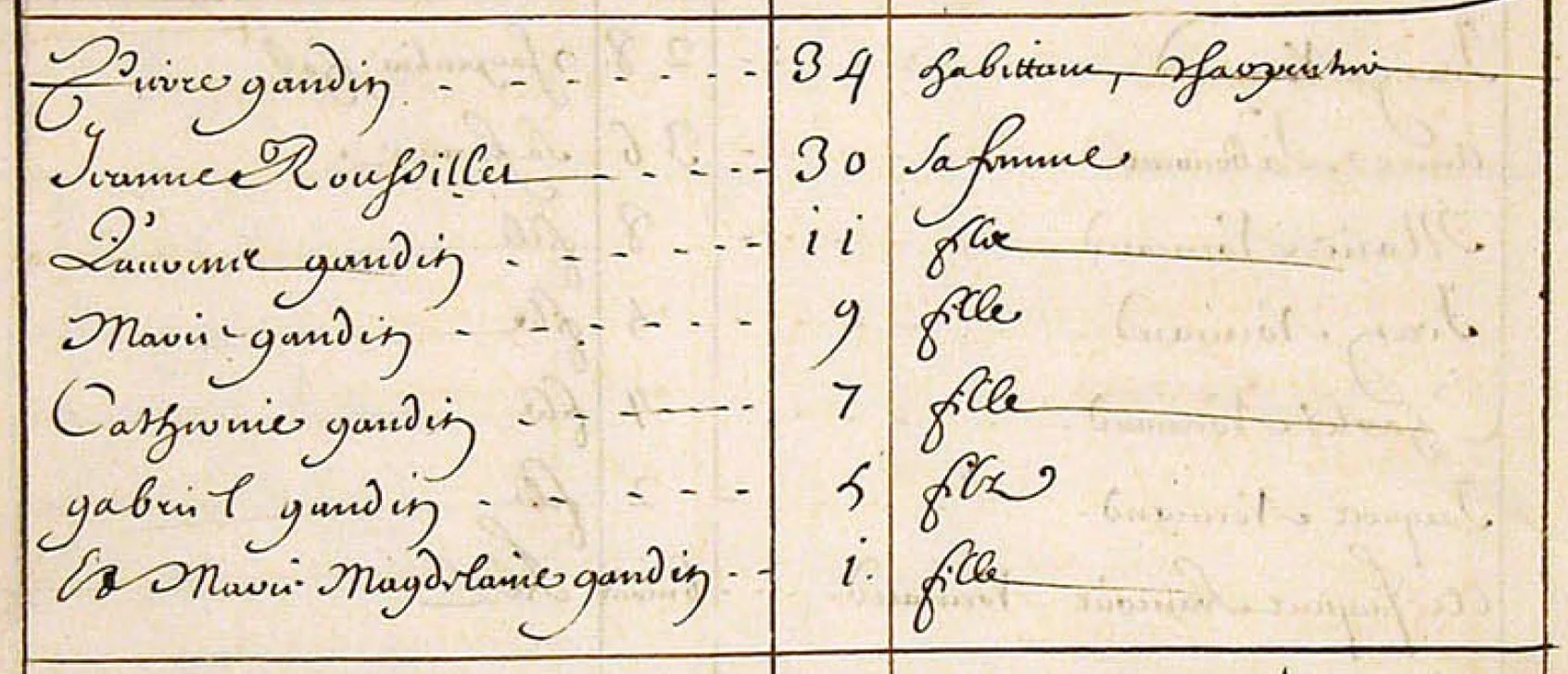
1666 census of New France for the Gaudin household (Library and Archives Canada)
Despite establishing themselves at Charlesbourg, Pierre and Jeanne still retained their property interests in Montréal. By 1667, the family had decided to return to Montréal, where those earlier obligations and transactions remained unresolved.
On July 21, 1667, Pierre and Jeanne sold the 40-arpent Charlesbourg concession to Nicolas Labbé for 450 livres. The property included a house, a small barn, cleared land, and woodland. Labbé assumed the customary cens, rentes, and other seigneurial dues attached to the property. The agreement was drawn up by notary Paul Vachon and signed in his study.
Return to Montréal
On December 1, 1667, notary Bénigne Basset drew up an obligation, or acknowledgement of debt, by Mathurin Lorion to Pierre “Gaudin dit Chastillon.” Both men were described as habitants of the island of Montréal. Lorion acknowledged owing Pierre 60 livres, payable by the following feast of Saint-Michel, September 29, 1668, in wheat, coined money, or pelts, all of good and merchantable quality.
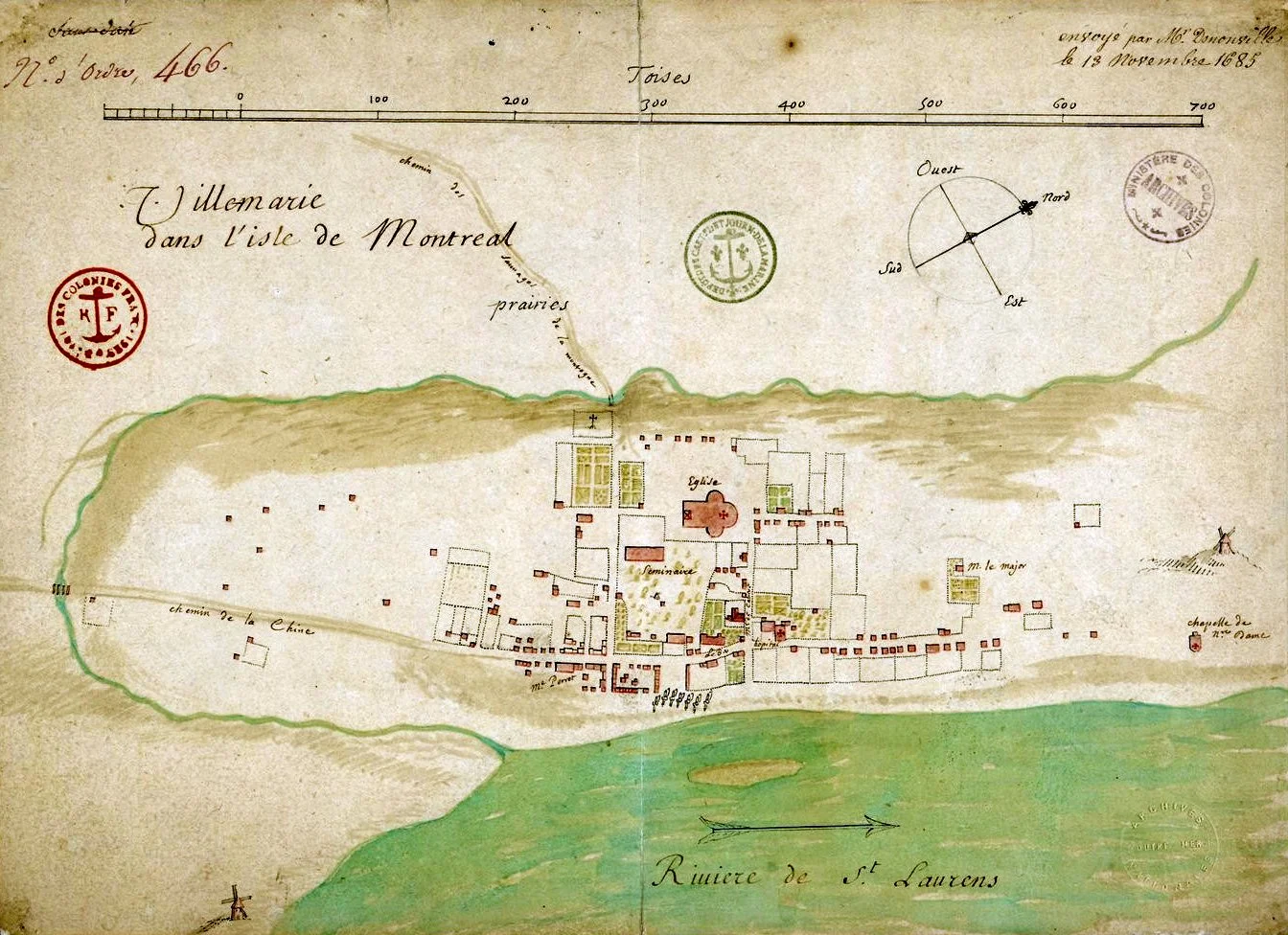
“Villemarie on Montreal Island,” 1685 (Bibliothèque nationale de France)
Land Transactions and Work Contracts
In the 1670s, Pierre and Jeanne’s names appear in several notarial documents drawn up by notary Basset:
June 12, 1670: Pierre rented a milk cow from Suzanne Duverger, widow of Simon Galbrun, for 30 livres annually, for a period of two years. The red-and-brown cow was about three years old, and Pierre agreed to house and feed it for the duration of the agreement. If the cow died through the fault of Pierre or his household, he would owe Duverger 75 livres for its value. If it died naturally, he was instead required to return its hide.
January 14, 1671: Pierre gave a formal declaration concerning a dispute between François Brunet dit Le Bourbonnais and Mathurin Thibaudeau. Pierre stated that he and a man known as Le Limousin had acted as arbitrators between the two men the previous autumn, reaching a settlement under which Thibaudeau was to pay Brunet 100 sous.
March 20, 1672: Pierre sold a plot of land at the foot of the Coteau Saint-Louis to Jean Martinet, sieur de Fonblanche, a surgeon, for 740 livres, together with an additional 12 livres as a pot-de-vin. The property included a house of wood and stone that Pierre had built. Martinet assumed the customary cens, rentes, and other seigneurial charges attached to the property.
December 10, 1673: Pierre entered into an agreement with Marie Frie, widow of Léger Aguenier, acting both in her own name and as mother of her minor son, Paul Aguenier. For 84 livres, Pierre agreed to dismantle a pièce-sur-pièce building situated on the Aguenier concession, on this side of the Petite Rivière du Foudre, and reconstruct it in the form of a barn.
March 5, 1674: Pierre and fellow carpenter Honoré Danis dit Tourangeau were selected as experts to assess the roof framing of Étienne Campeau's barn, work that had been carried out by Pierre Verrier dit Lasolaye.
November 9, 1674: Pierre and Jean Roy dit Lapensée settled their mutual accounts in order to avoid further disputes and “maintain peace and friendship” between them. Roy acknowledged owing Pierre 70 livres, payable in two instalments. The agreement provided that payment could include wheat, coined money, pelts, or merchandise. The men had also grown wheat together that year on Pierre’s concession, and seven minots of wheat were to be deducted for Roy’s share in their farming arrangement. Pierre was described as a charpentier, or carpenter, of the island of Montréal.
June 7, 1676: Pierre and Jeanne sold an 80-arpent concession at Sault Saint-Louis [present-day Lachine] to Mathurin Thibaudeau for 475 livres, plus four livres for épingles. The property measured four arpents across its waterfront by twenty arpents in depth, between the lands of Laramée and Hubert Leroux, and included all buildings standing on the concession. The principal was payable in ten equal annual instalments of 47 livres 10 sols, which could be satisfied in coined money, pelts, or wheat valued at the prevailing market price. Pierre was still described as a charpentier, or carpenter, of the island of Montréal. [The document confirms that the land was received from the Seigneurs of Montréal, with the date left blank, but the original concession was not located.]
June 11, 1676: Pierre entered into an agreement with Mathurin Jousset dit Laloire to construct a wooden building on rue Saint-Paul in Montréal for 110 livres. The structure was to measure 26 feet long by 22 feet wide, with nine-foot posts, and include a chimney. Jousset agreed to supply the necessary wood, while Pierre undertook to complete the work in approximately eight consecutive working days, Sundays excepted. Pierre was described as a charpentier de grosses œuvres, or carpenter specializing in heavy structural work.
The Lachine Chapel
In 1675, Pierre built the first wooden chapel at Lachine. After a missionary's canoe capsized in May 1675, the Seminary decided to establish a chapel at Lachine. It was opened for worship on Holy Thursday in April 1676. The following June, Bishop François de Montmorency de Laval officially announced the establishment of the Saints-Anges-de-la-Chine parish, the third on the Island of Montréal after those of Ville-Marie and Pointe-aux-Trembles.
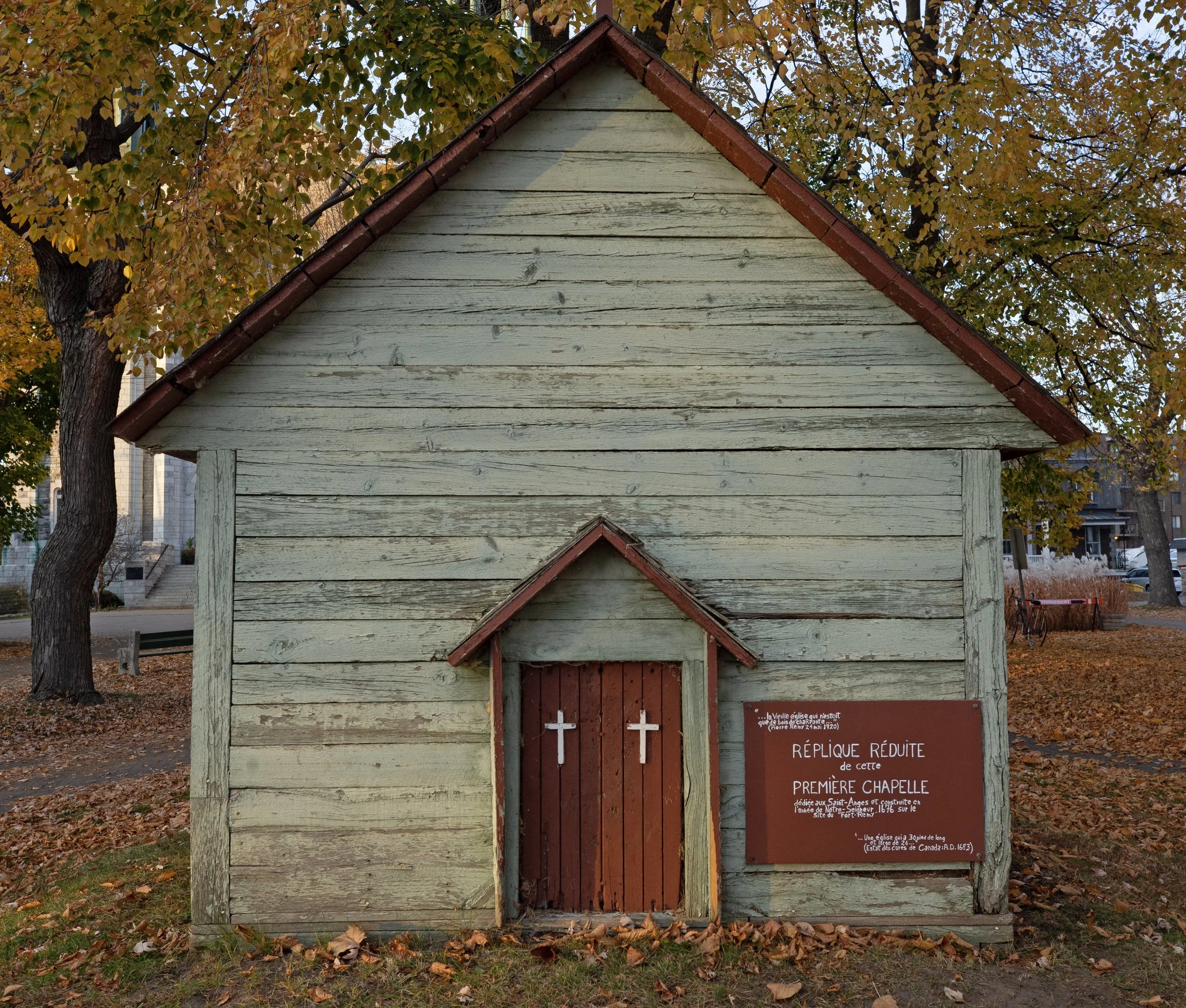
Replica of the first Lachine chapel (© The French-Canadian Genealogist)
Before the Courts
In the early 1670s, members of the Gaudin family appeared several times before the criminal court in Montréal. In the spring of 1672, daughter Catherine was tending livestock near her family’s property at Sault-Saint-Louis when Philippe Portier dit Lafontaine allegedly attempted to assault her. Catherine was questioned and stated that Lafontaine approached her while she was tending cows with her young brother Pierre, seized her after first looking around to see whether anyone was nearby, and attempted to force himself on her. Catherine resisted, cried out, and invoked God and the Virgin for help; according to her testimony, Lafontaine abandoned the attempt when he feared that nearby workers might hear the commotion and fled into the brush.
Catherine’s account formed part of a broader criminal proceeding involving similar allegations by the young daughters of Jean Roy. The Roy girls were questioned again on June 1, and their testimony included references to Lafontaine’s conduct toward Catherine. On June 8, the court concluded that Lafontaine had attempted to rape Jeanne and Marie Roy. He was ordered to make a public amende honorable, appearing in his shirt, bareheaded and carrying a burning torch, to ask forgiveness from God, the king and justice, and the girls’ family. He was also banished from New France for seven years and ordered to leave within eight days, under penalty of hanging if he violated the ban. The court further ordered substantial sums taken from his property to compensate the victims and help provide for their future marriages, as well as payment toward the costs of the proceedings.
Later that year, 13-year-old Catherine married Louis Fortin dit Lagrandeur in Montréal.
In August of 1672, Pierre himself was involved in a separate criminal proceeding. He and his son Laurent were accused of beating Pierre Boutonne dit La Ramée with sticks. Daughter Catherine had accused La Ramée of stealing bread, after which he allegedly slapped her, provoking the Gaudin men. Jeanne also became involved when she apparently went to La Ramée’s cabin carrying a sword, which Laurent took away from her. Laurent began thrusting the sword through gaps in the cabin while both he and his mother called for La Ramée’s death. The outcome of the trial is unknown.
Over two years later, in February 1675, Jeanne and daughter Catherine were involved in yet another incident involving violence with sticks. Catherine, believing that her neighbour Georges Alets intended to steal her wheat, invited him inside, and arranged for her mother Jeanne and two men to hide. Catherine and Jeanne then allegedly struck Alets repeatedly with sticks before he escaped. At Alets’ request, Joseph Serran dit l’Espagnol provided a statement before notary Basset the following month, recounting what Alets had told him just moments after the assault. No other mention of this incident was found in notarial or court records, perhaps indicating that Alets dropped the matter.
Move to Acadia
After Pierre and Jeanne sold their property in Lachine in 1676, they moved to Acadia with their three sons (Laurent, Gabriel, and Pierre) and two daughters (Marie Madeleine and Anne). Both Marie and Catherine were already married and remained in the Montréal area. Pierre and Jeanne’s precise reason for relocating is not recorded, but the move coincided with the establishment of Michel Leneuf de La Vallière’s seigneurie at Beaubassin, where settlers and skilled workers were being recruited from Canada. Pierre’s experience as a carpenter may have played a role in the move; later accounts associate him with construction work at Beaubassin, including the building of the seigneurial mill.
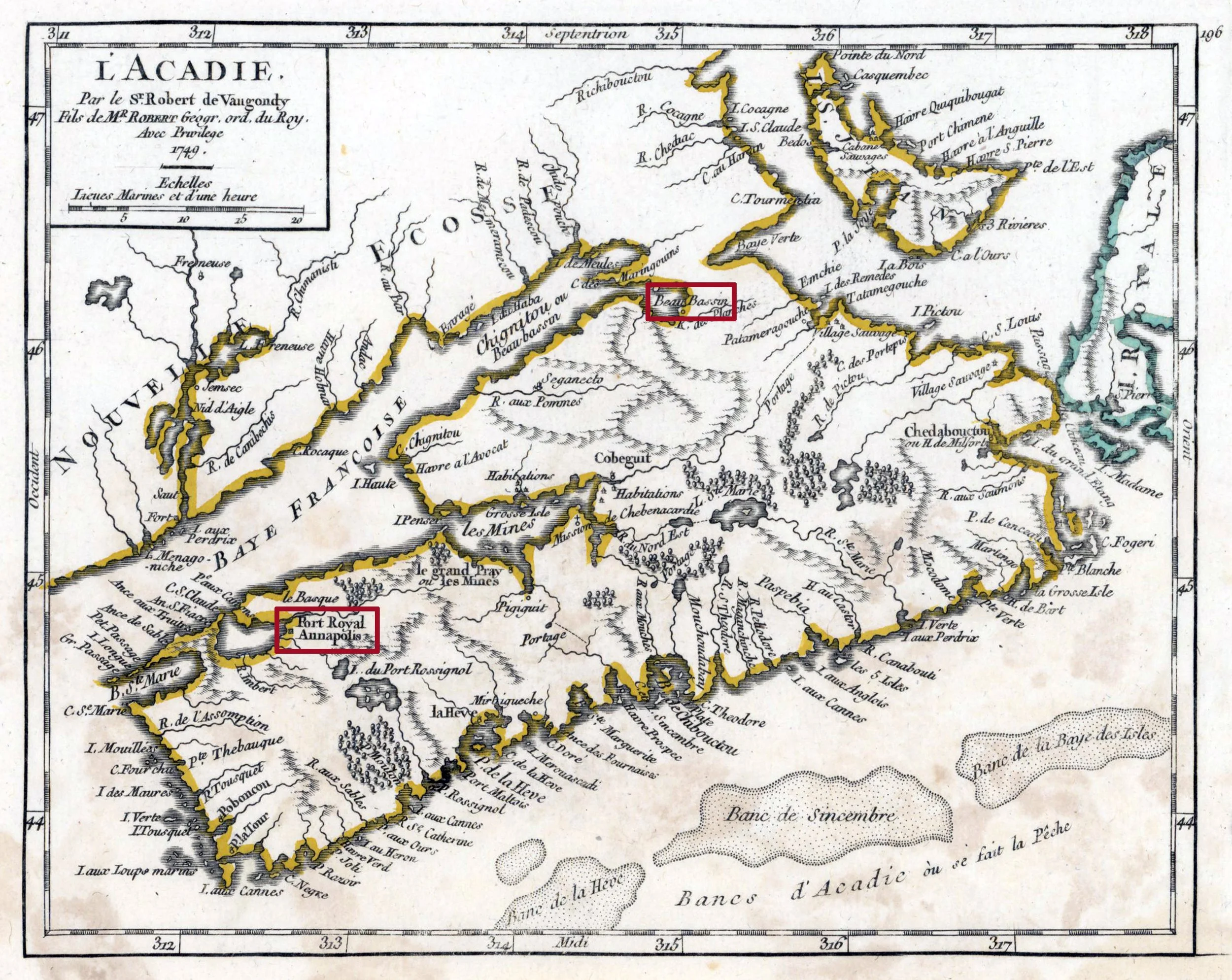
Map of Acadia by Didier Robert de Vaugondy, 1749, showing Beaubassin and Port-Royal in red (Bibliothèque et Archives nationales du Québec)
The Sorcery Trial of Jean Campagna
In September 1684, Jean Campagna, a labourer living at Beaubassin, was arrested on accusations of witchcraft. Campagna had settled at Beaubassin around 1675 and had worked for the local seigneur, Michel Leneuf de La Vallière. Over time, several residents came to attribute illnesses, deaths, and the loss of livestock to his supposed supernatural powers. Among the accusations was an incident involving Pierre Godin that had occurred six years earlier, in 1678.
On November 8, 1684, in Port-Royal, Pierre gave the following testimony:
“in the presence of Germain Bourgeois and his brother Guillaume, stated that while in Beaubassin in the year 1678, as he lay by the fire at the home of a man named Rogel Kessy, Jean Campagnard [Campagna] was nearby and allegedly touched his stomach; the deponent was taken by surprise and believed that the said Campagnard had bewitched him, and an hour later he was seized by a headache, stomach distress, a high fever, and vomiting. When the said deponent was asked by the Reverend Father Claude Moreau what illness he had, the said deponent allegedly replied that it was a forced illness and that he believed the said Campagnard had bewitched him. The Reverend Father reportedly told this to Sieur de La Vallière, who allegedly threatened the said Campagnard that if any harm came to the said deponent, he would thrust his sword a hundred times through his belly, and the said deponent allegedly threatened the said Campagnard and his son. After which, the following night at the same hour, the said Pierre Godin was reportedly relieved and cured. The said deponent stated that he knew nothing more.”
Pierre's testimony became part of a much larger case against Campagna, with residents of Beaubassin giving depositions concerning several alleged instances of witchcraft. Because La Vallière's seigneurial jurisdiction did not extend to imposing the potential capital penalties associated with such an offence, Campagna was eventually transferred to Québec to be tried before the Prévôté. On June 28, 1685, after reviewing the testimony and interrogating Campagna, Judge René-Louis Chartier de Lotbinière ruled that there was no proof of the crime and ordered his release from the royal prison. Campagna was permitted to pursue claims for damages against those responsible for his prosecution, but was forbidden to return to Beaubassin without permission. He was therefore acquitted of the accusations of witchcraft.
Death of Pierre
Pierre Gaudin dit Châtillon died sometime after his 1684 testimony and before the 1686 census. The exact details of his death and burial are unknown.
Jeanne is recorded as his widow in the 1686 census of Acadia, living in Port-Royal with three of her children: Gabriel, Pierre, and Anne. She did not own any plowed land, weapons, or farm animals.
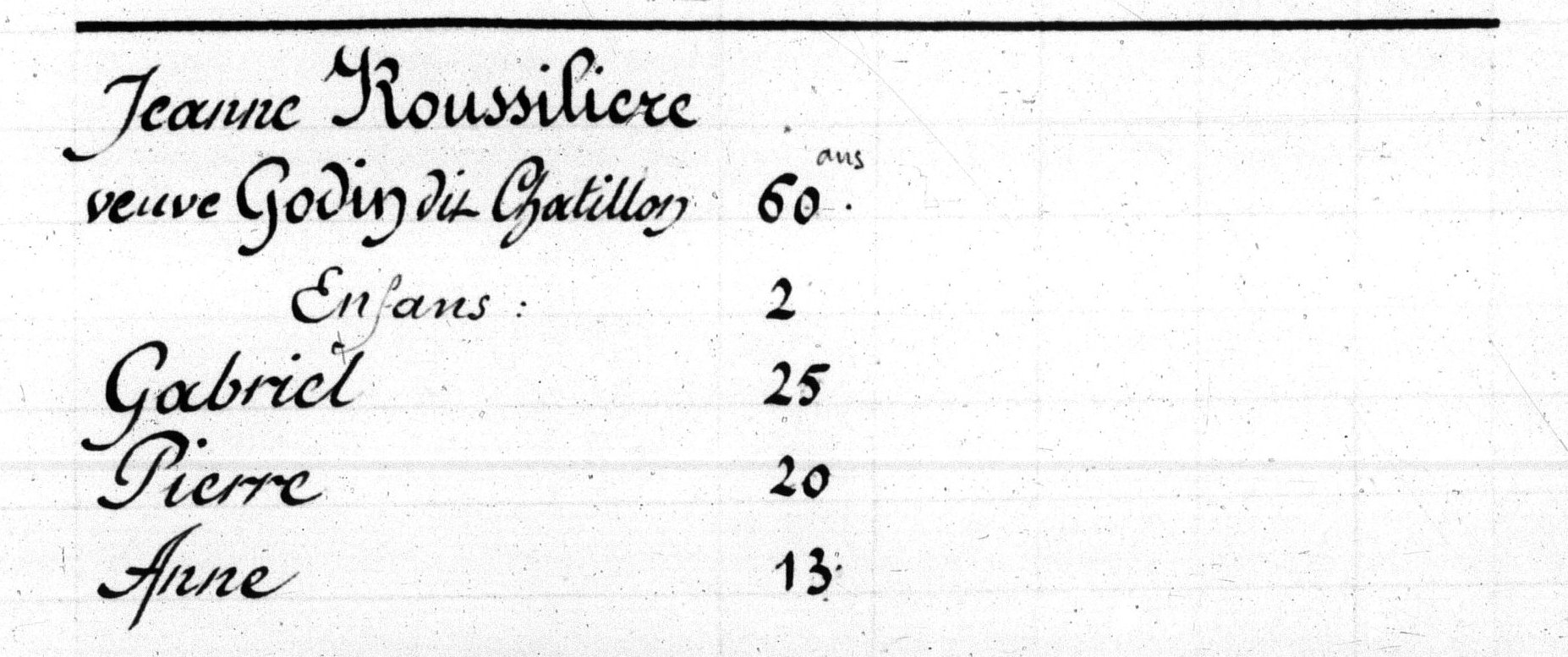
1686 census of Port-Royal, Acadia (Canadiana/Héritage)
Jeanne’s Final Years in Acadia
Jeanne married Pierre Martin sometime between 1686 and 1693. He was the widower of Anne Ouestnorouest dite Petitous, an Indigenous woman. During this same period, Anne Gaudin dite Châtillon married Pierre Martin Jr., son of Pierre Martin and Anne Ouestnorouest dite Petitous.
In 1693, Jeanne and Pierre were enumerated in Port-Royal with Pierre Martin Jr. and his wife Anne Gaudin dite Châtillon and their four children. Pierre owned ten horned animals, eight ewes, ten pigs, twelve arpents of land and one gun.
In 1700, Jeanne and Pierre were still living in Port-Royal with Pierre Martin Jr., Anne Gaudin dite Châtillon, and their nine children. Pierre owned 14 horned animals, 20 ewes, 15 arpents of land and one gun.
In 1701, Jeanne and Pierre were still living in Port-Royal with children Pierre Martin Jr., Anne Gaudin dite Châtillon, and their six children. Pierre Jr. owned nine large horned animals, ten wool-producing animals, eight pigs, six arpents of “valuable” land (cleared or under cultivation) and one firearm.
In 1703, Pierre Martin Sr. was living in Port-Royal with his wife, one boy, and one girl in the household. By 1710, he and his wife were recorded there without children in the household. In 1714, Pierre Martin Sr. was again enumerated with his wife, immediately before Pierre Martin Jr. and his family. These entries suggest that Jeanne Rousselière was still living at Port-Royal as late as 1714. The date and place of her death are unknown.
Founders of a French-Canadian and Acadian Family
Pierre Gaudin dit Châtillon and Jeanne Rousselière belonged to the first generation of French settlers who helped transform Ville-Marie from a precarious outpost into a permanent community. Pierre brought with him the skills of a carpenter and became both a craftsman and landholder, while Jeanne arrived as a young fille à marier and built a family in a colony still in its infancy. Together they raised nine children and moved repeatedly in response to changing opportunities—from Montréal to Charlesbourg, back to Montréal and Lachine, and finally to Acadia.
Their lives were closely intertwined with the development of seventeenth-century New France: Pierre worked on buildings, held and traded land, served in the Sainte-Famille militia, and later took his trade to Beaubassin, while Jeanne managed family affairs, acted in legal transactions, and continued the family’s story in Acadia after Pierre’s death. Their descendants would spread through both Acadia and Québec, making Pierre and Jeanne not only immigrants to New France, but founders of a family whose history became part of the wider French-Canadian and Acadian experience.
PDF version of biography located at: https://www.tfcg.ca/pierregaudinchatillon-and-jeannerousseliere.
Are you enjoying our articles and resources? Show your support by making a donation. Every contribution, regardless of its size, goes a long way in covering our website hosting expenses and enables us to create more content related to French-Canadian genealogy and history. Thank you! Merci!
Sources:
"Châtillon-sur-Seine, Paroisse Saint-Vorles (1576-1667) – Registres paroissiaux et/ou d'état civil : 1576-1632," digital images, État civil de la Côte-d'Or (https://archives.cotedor.fr/v2/ark:/71137/345edd9bc4ee937b4d407e56c4754660 : accessed 21 Sep 2026), baptism of Pierre Godin, 17 May 1630, reference FRAD021EC 161/012, page 582 of 620.
"Le LAFRANCE (Baptêmes, mariages et sépultures)," database and digital images, Généalogie Québec (https://www.genealogiequebec.com/Membership/LAFRANCE/acte/47198 : accessed 21 Sep 2026), marriage of Pierre GODIN and Jeanne ROUSSELIERE, 13 Oct 1654, Montréal (Notre-Dame-de-Montréal); citing original data: Institut généalogique Drouin and PRDH.
"Collection Documents d'administration publique et judiciaire et pièces à conviction rassemblés par les officiers de justice - Archives nationales à Montréal," online database, Bibliothèque et Archives nationales du Québec (https://advitam.banq.qc.ca/notice/1116796 : accessed 21 Sep 2026), "Concession à Pierre Godin, charpentier," 2 Feb 1654, reference TL313,S1,D26, Id 1116796.
"Actes de notaire, 1651-1657 // Raphaël-Lambert Closse," digital images, FamilySearch (https://www.familysearch.org/ark:/61903/3:1:3Q9M-CS5F-5QCR-1?cat=koha%3A481205&view=explore&lang=en&groupId=M9M4-8R5 : accessed 21 Sep 2026), marriage of Pierre Godin and Jeanne Rousselier, 27 Sep 1654, image 293 of 2984; citing original data : Bibliothèque et Archives nationales du Québec.
"Actes de notaire, 1651-1657 // Raphaël-Lambert Closse," digital images, FamilySearch (https://www.familysearch.org/ark:/61903/3:1:3Q9M-CS5F-5QWZ-X?cat=481205&i=2957&lang=en : accessed 22 Sep 2026), agreement between master surgeon Etienne Bouchard and the residents of Montréal, 30 Mar 1655, image 2,598 of 2,984; citing original data: Bibliothèque et Archives nationales du Québec.
"Actes de notaire, 1648-1657 // Jean de Saint-Père," digital images, FamilySearch (https://www.familysearch.org/ark:/61903/3:1:3QHV-P3V7-K49D?cat=koha%3A674697&view=explore&lang=en&groupId=M9DC-QLZ : accessed 22 Sep 2026), agreement between Pierre Godin dit Châtillon and André Dumais, 5 Nov 1655, images 468-470 of 2864; citing original data: Bibliothèque et Archives nationales du Québec.
"Actes de notaire, 1657-1699 // Bénigne Basset," digital images, FamilySearch (https://www.familysearch.org/ark:/61903/3:1:3Q9M-CSV2-RQBP-N?cat=koha%3A426906&view=explore&lang=en&groupId=M9DC-4WX : accessed 21 Sep 2026), land sale by Pierre Gaudin dit Châtillon and Jeanne Rousselière to Étienne Bouchard, 3 Oct 1661, images 1643-1645 of 3055; citing original data: Bibliothèque et Archives nationales du Québec.
"Actes de notaire, 1657-1699 // Bénigne Basset," digital images, FamilySearch (https://www.familysearch.org/ark:/61903/3:1:3Q9M-CSV2-R7S4-K?cat=koha%3A426906&view=explore&lang=en&groupId=M9DC-4WX : accessed 21 Sep 2026), land sale by Pierre Gaudin dit Chastillon and Jeanne Rousseliere, to Mathurin Lorrion and Jeanne Bizette, 19 Jun 1664, image 2171-2173 of 3055; citing original data: Bibliothèque et Archives nationales du Québec.
"Archives de notaires : Paul Vachon (1655-1693)," digital images, Bibliothèque et Archives nationales du Québec (https://numerique.banq.qc.ca/patrimoine/details/52327/4215634?docref=A4VMXLqo3-I_soscmfpm-g : accessed 23 Sep 2026), land concession by the Compagnie de Jésus to Pierre Chatillon, 28 Feb 1665, folder: 10 janvier 1655 - 24 janvier 1668, images 583-586 of 1180.
"Archives de notaires : Romain Becquet (1665-1682)," digital images, Bibliothèque et Archives nationales du Québec (https://numerique.banq.qc.ca/patrimoine/details/52327/4064889?docref=K-8RmQUuurKWQkd1c6Z7tA : accessed 22 Sep 2026), power of attorney by Pierre Godin dit Châtillon to Jeanne Rousselière, 15 Sep 1666, folder: 21 décembre 1665 - 9 février 1670, image 573 of 1081.
"Actes de notaire, 1657-1699 // Bénigne Basset," digital images, FamilySearch (https://www.familysearch.org/ark:/61903/3:1:3Q9M-CSV2-RQ5V-G?cat=koha%3A426906&view=explore&lang=en&groupId=M9DC-4WX : accessed 22 Sep 2026), eviction of Mathurin Lorion and Jeanne Bizette, in favour of Jeanne Rousseliere, 30 Sep 1666, images 2218-2220 of 3055; citing original data: Bibliothèque et Archives nationales du Québec.
"Archives de notaires : Paul Vachon (1655-1693)," digital images, Bibliothèque et Archives nationales du Québec (https://numerique.banq.qc.ca/patrimoine/details/52327/4215634?docref=wDmuNwbWclplFNoCDFUXTQ : accessed 22 Sep 2026), sale of a land concession by Pierre Gaudin dit Chatillon and Jeanne Rousselier to Nicolas Labbé, 21 Jul 1667, folder: 10 janvier 1655 - 24 janvier 1668, images 1106-1108 of 1180.
"Actes de notaire, 1657-1699 // Bénigne Basset," digital images, FamilySearch (https://www.familysearch.org/ark:/61903/3:1:3Q9M-CSV2-RQGB-W?cat=koha%3A426906&view=explore&lang=en&groupId=M9DC-4WX : accessed 23 Sep 2026), obligation of Mathurin Lorion to Pierre Gaudin dit Châtillon, 1 Dec 1667, images 2590-2591 of 3055; citing original data: Bibliothèque et Archives nationales du Québec.
"Actes de notaire, 1657-1699 // Bénigne Basset," digital images, FamilySearch (https://www.familysearch.org/ark:/61903/3:1:3Q9M-CST7-NX67?cat=koha%3A426906&view=explore&lang=en&groupId=TH-909-77566-3928-96 : accessed 23 Sep 2026), lease of a cow by Pierre Gaudin dit Chastillon from Suzanne Duverger, 12 Jun 1670, images 326-327 of 3072; citing original data: Bibliothèque et Archives nationales du Québec.
"Actes de notaire, 1657-1699 // Bénigne Basset," digital images, FamilySearch (https://www.familysearch.org/ark:/61903/3:1:3Q9M-CST7-NFR3?cat=koha%3A426906&view=explore&lang=en&groupId=TH-909-77566-3928-96 : accessed 23 Sep 2026), declaration by Pierre Gaudin dit Chastillon concerning a dispute between François Brunet dit Le Bourbonnais and Mathurin Thibaudeau, 14 Jan 1671, image 593 of 3072; citing original data: Bibliothèque et Archives nationales du Québec.
"Actes de notaire, 1657-1699 // Bénigne Basset," digital images, FamilySearch (https://www.familysearch.org/ark:/61903/3:1:3Q9M-CST7-NQVD?cat=koha%3A426906&view=explore&lang=en&groupId=TH-909-77566-3928-96 : accessed 23 Sep 2026), land sale by Pierre Gaudin dit Chastillon to Jean Martinet, sieur de Fondsblanche, 20 Mar 1672, images 1054-1056 of 3072; citing original data: Bibliothèque et Archives nationales du Québec.
"Actes de notaire, 1657-1699 // Bénigne Basset," digital images, FamilySearch (https://www.familysearch.org/ark:/61903/3:1:3Q9M-CST7-N893?cat=koha%3A426906&view=explore&lang=en&groupId=TH-909-77566-3928-96 : accessed 23 Sep 2026), carpentry work agreement between Pierre Gaudin dit Chastillon and Marie Frie, 10 Dec 1673, images 1852-1853 of 3072; citing original data: Bibliothèque et Archives nationales du Québec.
"Actes de notaire, 1657-1699 // Bénigne Basset," digital images, FamilySearch (https://www.familysearch.org/ark:/61903/3:1:3Q9M-CST7-NZ2F?cat=koha%3A426906&view=explore&lang=en&groupId=TH-909-77566-3928-96 : accessed 23 Sep 2026), nomination of Pierre Gaudin dit Châtillon and Honoré Danis dit Tourangeau as carpentry experts, 5 Mar 1674, image 1923 of 3072; citing original data: Bibliothèque et Archives nationales du Québec.
"Actes de notaire, 1657-1699 // Bénigne Basset," digital images, FamilySearch (https://www.familysearch.org/ark:/61903/3:1:3Q9M-CST7-NXBT?cat=koha%3A426906&view=explore&lang=en&groupId=TH-909-77566-3928-96 : accessed 23 Sep 2026), settling of accounts between Pierre Gaudin dit Châtillon and Jean Roy dit Lapensée, 9 Nov 1674, images 2176-2178 of 3072; citing original data: Bibliothèque et Archives nationales du Québec.
"Actes de notaire, 1657-1699 // Bénigne Basset," digital images, FamilySearch (https://www.familysearch.org/ark:/61903/3:1:3Q9M-CST7-NN2R?cat=koha%3A426906&view=explore&lang=en&groupId=TH-909-77566-3928-96 : accessed 23 Sep 2026), land sale by Pierre Gaudin dit Chastillon and Jeanne Rousseliere to Mathurin Thibaudeau, 7 Jun 1676, images 2950-2952 of 3072; citing original data: Bibliothèque et Archives nationales du Québec.
"Actes de notaire, 1657-1699 // Bénigne Basset," digital images, FamilySearch (https://www.familysearch.org/ark:/61903/3:1:3Q9M-CST7-NNLN?cat=koha%3A426906&view=explore&lang=en&groupId=TH-909-77566-3928-96 : accessed 23 Sep 2026), carpentry work agreement between Pierre Gaudin dit Chastillon and Mathurin Jousset dit Lalouaire, 11 Jun 1676, images 2956-2957 of 3072; citing original data: Bibliothèque et Archives nationales du Québec.
"Actes de notaire, 1657-1699 // Bénigne Basset," digital images, FamilySearch (https://www.familysearch.org/ark:/61903/3:1:3Q9M-CST7-NF32?cat=koha%3A426906&view=explore&lang=en&groupId=TH-909-77566-3928-96 : accessed 23 Sep 2026), declaration by Joseph Seran dit L’Espagnol, 19 Mar 1675, image 2336 of 3072; citing original data: Bibliothèque et Archives nationales du Québec.
"Recensement du Canada, 1666," digital images, Library and Archives Canada (https://recherche-collection-search.bac-lac.gc.ca/fra/accueil/notice?idnumber=2318856&app=fonandcol : accessed 22 Sep 2026), household of Pierre Gaudin, 1666, Notre-Dame des Anges, la Rivière Charles, Charlesbourg, page 113 (of PDF), Finding aid no. MSS0446, MIKAN no. 2318856; citing original data: Centre des archives d'outre-mer (France) vol. 460.
"Dépôt des papiers publics des colonies; état civil et recensements : Série G 1 : Recensements et documents divers : C-2572," digital images, Canadiana (https://heritage.canadiana.ca/view/oocihm.lac_reel_c2572/26 : accessed 23 Sep 2026), 1686 census for Port-Royal, Acadia, household of Jeanne Rousseliere; citing original data: Library and Archives Canada, "Archives des colonies : Série G 1 – 2572," 113152, lac_reel_c2572, MG 1 G 1.
"Dépôt des papiers publics des colonies; état civil et recensements : Série G 1 : Recensements et documents divers : C-2572," digital images, Canadiana (https://heritage.canadiana.ca/view/oocihm.lac_reel_c2572/77 : accessed 23 Sep 2026), 1693 census for Port-Royal, Acadia, household of Pierre Martin; citing original data: Library and Archives Canada, "Archives des colonies : Série G 1 – 2572," 113152, lac_reel_c2572, MG 1 G 1.
"Dépôt des papiers publics des colonies; état civil et recensements : Série G 1 : Recensements et documents divers : C-2572," digital images, Canadiana (https://heritage.canadiana.ca/view/oocihm.lac_reel_c2572/165 : accessed 23 Sep 2026), 1700 census for Port-Royal, Acadia, household of Pierre Martin; citing original data: Library and Archives Canada, "Archives des colonies : Série G 1 – 2572," 113152, lac_reel_c2572, MG 1 G 1.
"Dépôt des papiers publics des colonies; état civil et recensements : Série G 1 : Recensements et documents divers : C-2572," digital images, Canadiana (https://heritage.canadiana.ca/view/oocihm.lac_reel_c2572/182 : accessed 23 Sep 2026), 1701 census for Port-Royal, Acadia, household of Pierre Martin; citing original data: Library and Archives Canada, "Archives des colonies : Série G 1 – 2572," 113152, lac_reel_c2572, MG 1 G 1.
"Dépôt des papiers publics des colonies; état civil et recensements : Série G 1 : Recensements et documents divers : C-2572," digital images, Canadiana (https://heritage.canadiana.ca/view/oocihm.lac_reel_c2572/212 : accessed 23 Sep 2026), 1703 census for Port-Royal, Acadia, household of Pierre Martin; citing original data: Library and Archives Canada, "Archives des colonies : Série G 1 – 2572," 113152, lac_reel_c2572, MG 1 G 1.
"Dépôt des papiers publics des colonies; état civil et recensements : Série G 1 : Recensements et documents divers : C-2572," digital images, Canadiana (https://heritage.canadiana.ca/view/oocihm.lac_reel_c2572/240 : accessed 23 Sep 2026), 1714 census for Port-Royal, Acadia, household of Pierre Martin; citing original data: Library and Archives Canada, "Archives des colonies : Série G 1 – 2572," 113152, lac_reel_c2572, MG 1 G 1.
"Great Britain. Colonial Office : Nova Scotia and Cape Breton, Original Correspondence (CO 217) – 9119," digital images, Canadiana (https://heritage.canadiana.ca/view/oocihm.lac_reel_c9119/1316 : accessed 23 Sep 2026), 1710 census for Port-Royal, Acadia, household of Pierre Martin; citing original data: Library and Archives Canada, C-9119, 104282, lac_reel_c9119.
Fédération québécoise des sociétés de généalogie, Fichier Origine online database (https://www.fichierorigine.com/fr/repertoire/godin/-chatillon : accessed 23 Sep 2026), entry for ODIN / CHÂTILLON, Pierre (reference 241830), updated on 27 Jan 2025.
Université de Montréal, Programme de recherche en démographie historique (PRDH) online database (https://www-prdh-igd-com.res.banq.qc.ca/Membership/en/PRDH/Famille/878 : accessed 17 Sep 2026), dictionary entry for Pierre CHATILLON GODIN and Jeanne ROUSSELIERE, union 878.
Marielle Paiement, “Filles à marier : Jeanne Rousselière,” Le Patrimoine, volume 13, number 1 (fall 2017), 7–15, Société d’Histoire et de Généalogie du Granit.
Stephen A. White, Dictionnaire généalogique des familles acadiennes (Moncton, New Brunswick: Centre d'études acadiennes – Université de Moncton, 1999), page 741-742.
Yvon Sicotte, Base de données – Les Premiers Montréalais (https://lespremiersmontrealais.wordpress.com/wp-content/uploads/2012/04/7-3-1-les-immigrants.pdf : accessed 23 Sep 2026), entry for Pierre GAUDIN (ou GODIN) DIT CHASTILLON, 240.
Peter Gagné, Before the King’s Daughters: Les Filles à Marier, 1634-1662 (Orange Park, Florida : Quintin Publications, 2002), 274.
Mondoux, “Les « Hommes » de Montréal,” Revue d’histoire de l’Amérique française 2, no. 1 (June 1948): 62–63, digitized by Érudit (https://doi.org/10.7202/801429ar : accessed 21 Sep 2026), transcription of engagement contract of Pierre Godin and four other craftsmen, 23 Mar 1653, before Pierre de La Fousse, royal notary at La Flèche.
E.-Z. Massicotte, "La milice de 1663," Le Bulletin des recherches historiques, volume XXXII, number 7, July 1926, 417.
Désiré Girouard, Les anciennes côtes du lac Saint-Louis avec un tableau complet des anciens et nouveaux propriétaires (Montréal : Poirier, Bessette & cie, imprimeurs, 1892), 52, numérisé par Bibliothèque et Archives nationales du Québec (https://collections.banq.qc.ca/ark:/52327/2022735 : consulté le 23 Sep 2026), 7.
"Les Saints-Anges de Lachine, chapelle et église | Montréal – Toute une histoire!," montreal histoire (https://montreal-histoire.com/resource/3852 : accessed 23 Sep 2026).
Benjamin Sulte, Histoire des Canadiens-français, 1608–1880, tome III (Montréal: Wilson & Cie, 1882), 46–47, Wikisource (https://fr.wikisource.org/wiki/Histoire_des_Canadiens-fran%C3%A7ais%2C_Tome_III/Chapitre_3 : accessed 24 Sep 2026).
Robert-Lionel Séguin, La vie libertine en Nouvelle-France au XVIIe siècle (Québec: Septentrion, 2017), 278–283; originally published by Leméac, 1972.
Jacques Gagnon, Un sorcier en Acadie : Transcription annotée des minutes d'un procès et documents contemporains, 1684-1686, présenté par Jean-Pierre-Yves Pépin, collection Notre Patrimoine familial no 44 (Longueuil, Québec : Les Éditions historiques et généalogiques Pepin, 2008).
“Jeanne Mance, Founder of the Hôtel-Dieu,” Musée des Hospitalières de l’Hôtel-Dieu de Montréal (https://stage.museedeshospitalieres.qc.ca/activites/jeanne-mance-fondatrice-de-lhotel-dieu/ : accessed 21 Sep 2026), 19 Sep 2019.
Marie-Claire Daveluy, “CHOMEDEY DE MAISONNEUVE, PAUL DE,” in Dictionary of Canadian Biography (https://www.biographi.ca/en/bio/chomedey_de_maisonneuve_paul_de_1E.html : accessed 21 September 2026), vol. 1 (University of Toronto/Université Laval), revised 2023.