Louis Robert dit Lafontaine & Marie Bourgery
Explore the lives of Louis Robert dit Lafontaine and Marie Bourgery, early French-Canadian ancestors in Boucherville, New France, tracing their origins, migration from France, military service in the Carignan-Salières Regiment, and the growth of their family across North America.
Cliquez ici pour la version en français
Louis Robert dit Lafontaine & Marie Bourgery
A Shoemaker, a Soldier, and a Settler
Louis Robert dit Lafontaine, son of André Robert dit Lafontaine and Catherine Bonin, was baptized on September 12, 1638, in the chapel of Sainte-Marguerite in La Rochelle, Aunis, France. His godparents were Louis Basset and Lumine [Denesert?].
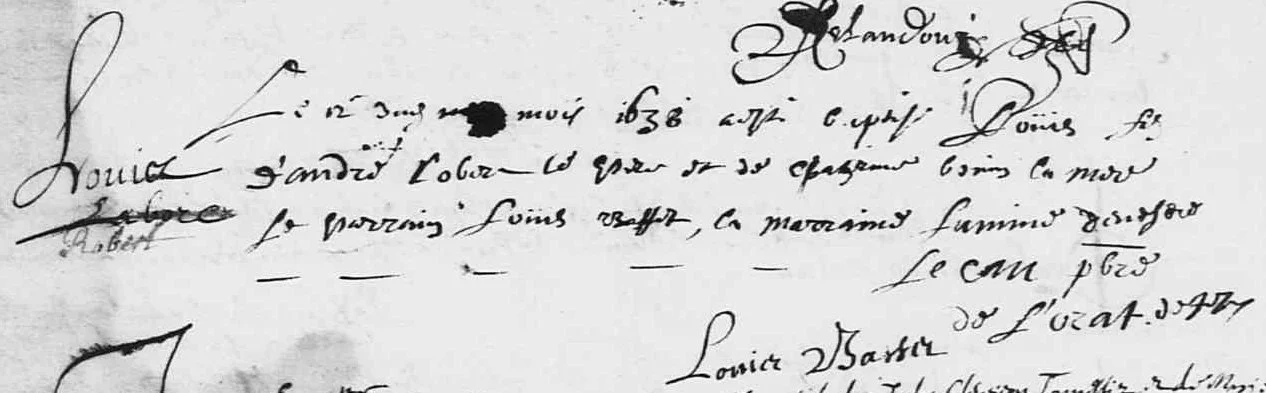
1638 baptism of Louis Robert (Archives de la Charente-Maritime)
Louis’s parents, André Robert dit Lafontaine and Catherine Bonin, were married in the same parish on February 20, 1629. They had at least three other children, all baptized in the chapel of Sainte-Marguerite in La Rochelle: Jeanne (baptized 1630), René (baptized 1633), and Sébastienne (baptized 1637).
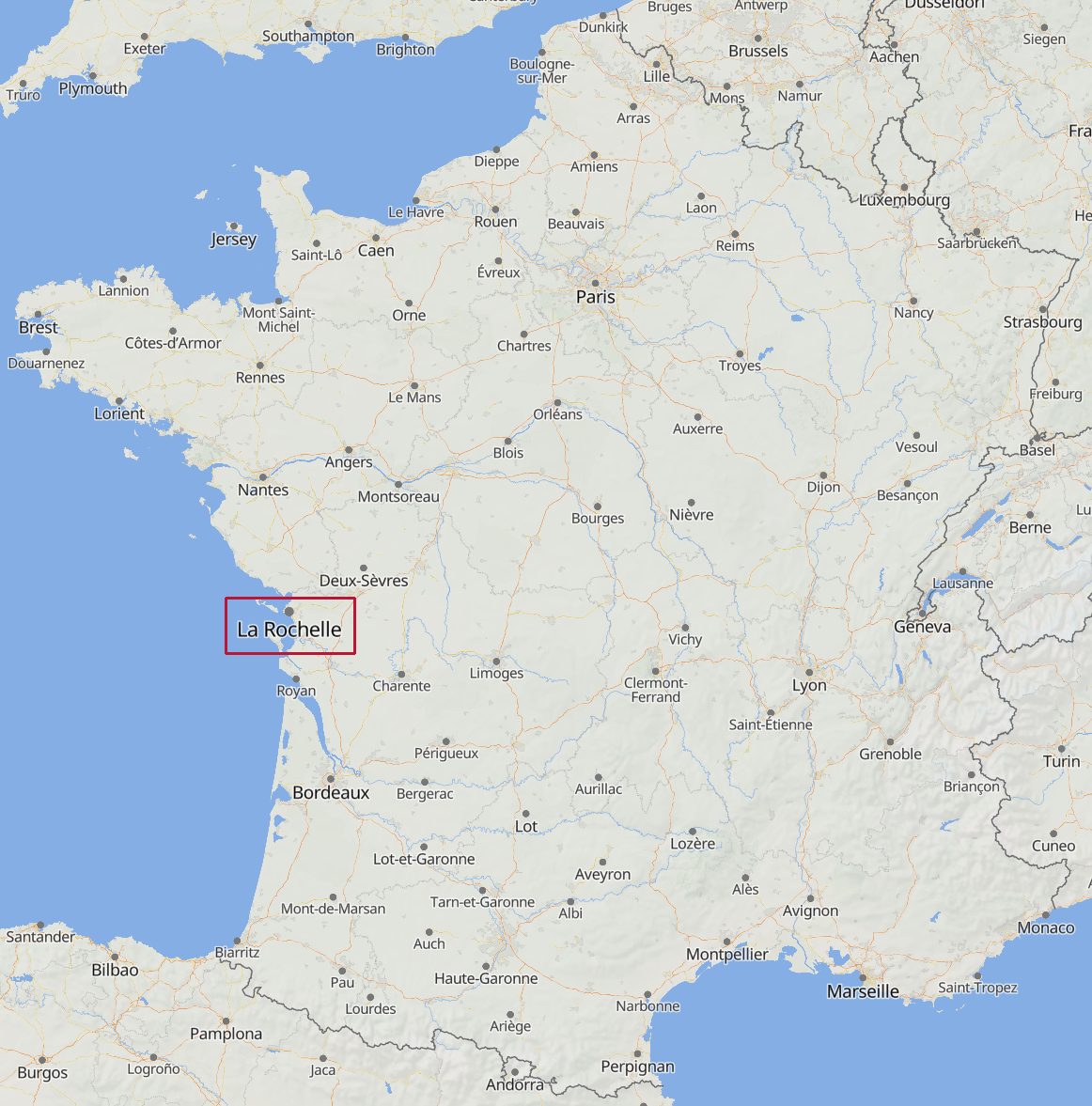
Location of La Rochelle in France (Mapcarta)
After Catherine’s death, André married Gillette Guillet, the widow of Jean Beaumont, on June 22, 1648, in the chapel of Sainte-Marguerite. He died at the age of 56 and was buried in La Rochelle on September 5, 1663. André was recorded as a former cabaretier in the Canton des Forges, the intersection where rue du Minage meets rue Chaudrier, rue Rambaud, and what is now rue Albert 1er. The name reflects the former presence of blacksmiths’ workshops in this part of the city, an area associated with La Rochelle’s artisanal and commercial activity. André’s burial record clearly shows his “dit” name of Lafontaine, confirming that his son Louis was not the first to use it.
Louis’s paternal grandparents were Pierre Robert, a laboureur, or ploughman, and Léonne Rambault. They lived in Breuilaufa, Marche, where André was born.
La Rochelle, located in southwestern France, is now in the department of Charente-Maritime. Today, it has a population of approximately 80,000 residents, called Rochelais and Rochelaises. In the 17th century, La Rochelle was one of France’s principal Atlantic ports and played a central role in transatlantic trade and migration. It was a key point of embarkation for settlers, soldiers, and indentured labourers bound for New France, making it an important gateway between France and its North American colony.
The chapel of Sainte-Marguerite was founded by Premonstratensian nuns in the 12th century and became one of the city’s most important religious buildings during the upheavals of the Wars of Religion. Spared from destruction in 1568, it was used alternately by Catholics and Protestants and even served non-religious functions during periods of conflict. After the Edict of Nantes (1598), it became the principal Catholic place of worship in the city—temporarily replacing parish churches that had been destroyed or were unusable—until the gradual restoration of regular parish life after the siege of 1627–1628. Rebuilt in part around 1610 and further modified in the 17th and 18th centuries, the chapel later became associated with the Oratorians, giving rise to the name “Oratoire.” Although never a formal parish, it played a central role in Rochelais religious life and is notable for the many baptisms recorded there, including those of future emigrants to New France. Today, the building survives as a secular venue known as the Salle de l’Oratoire.
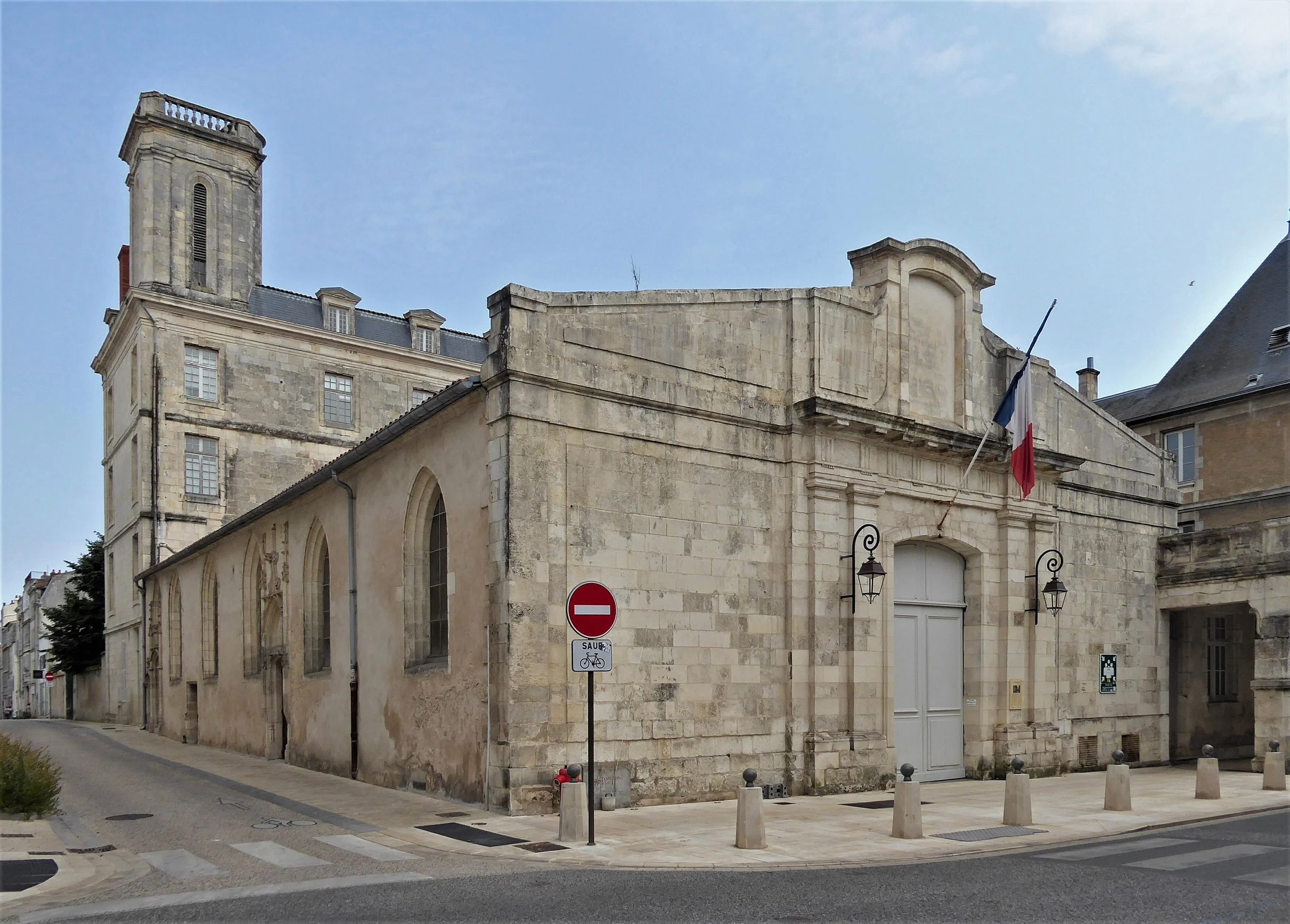
The former Sainte-Marguerite chapel (photo by Chris06, Wikimedia Commons, CC BY-SA 4.0)
A Shoemaker in New France
As a young shoemaker from La Rochelle, Louis likely left France in 1662 in search of more stable and independent economic prospects. Although La Rochelle was a major port, work for artisans could be uneven, and his decision may have been influenced by financial or familial uncertainty. New France offered a setting where a skilled tradesman could find steady demand, particularly in growing settlements that depended on local craftsmen.
His decision to emigrate was also shaped by his environment: as a Rochelais, he would have been well aware of ships departing for Canada and the opportunities they represented. For a young man without clear inheritance prospects, crossing the Atlantic offered the chance to establish himself on his own terms, in a colony where labour was in demand and advancement, both economic and social, was more attainable than in France.
From Shoemaker to Soldier
Around 1665, Louis enlisted in the Carignan-Salières Regiment, serving in the Loubias Company. As a civilian tradesman, he would have faced an uncertain market in a small, developing colony. Enlistment offered steady pay, rations, clothing, and shelter, along with a defined role at a time when employment could fluctuate. The regiment’s arrival created immediate demand for men on the ground, and young local residents were logical recruits. Service also carried longer-term advantages. Soldiers who completed their term were encouraged to remain in the colony, often with access to land.
The Loubias Company likely helped construct and garrison a chain of forts along the Richelieu River—notably Fort Richelieu (rebuilt), Fort Saint-Louis (Chambly), and others—designed to control the main invasion route between New France and Iroquois territory. During the winter of 1665–1666, the troops were dispersed among these posts, where they carried out patrols, maintained supply lines, and secured nearby settlements.
In 1666, elements of the Carignan-Salières Regiment participated in two expeditions into Iroquois territory. These campaigns contributed to forcing a peace in 1667. After the regiment was disbanded in 1668, many soldiers remained in Canada, receiving land grants and integrating into colonial society.
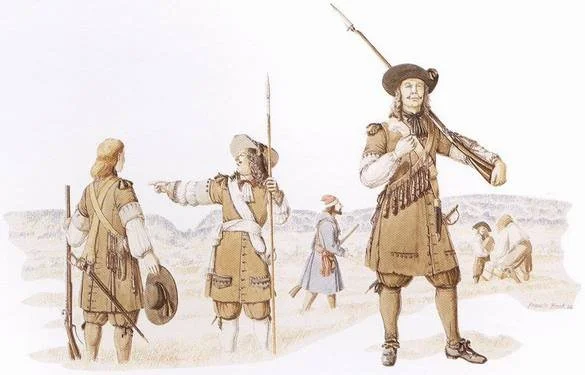
“Officer and soldiers of the régiment de Carignan-Salières, 1665-1668," drawing by Francis Back. “This reconstruction shows an officer and men of the régiment de Carignan-Salières. The common soldiers at left and right carry muskets. Hanging from their shoulder belts are the powder flasks known as 'the Twelve Apostles.' The officer at centre carries a half-pike and wears the white sash of a French officer around his waist.” (Canadian Military History Gateway)
Marie Bourgery
Marie Bourgery, daughter of Jean Baptiste Bourgery and Marie Legendre, was baptized on April 10, 1654, in Trois-Rivières. Her godparents were Briset [given name unknown] and Marie Lafond.
Marie grew up in Trois-Rivières alongside her three siblings: Pierre, Marie Madeleine, and Jean.
Louis and Marie were married on November 25, 1666, in Trois-Rivières. Louis was 28 years old; Marie was 11½. Regional governor Pierre Boucher and Henri de Chastelard de Salières, colonel and commander of the Carignan-Salières Regiment in New France, were among the witnesses. According to historian and archivist Peter J. Gagné, Louis was the only soldier to have Colonel Salières as a witness to his wedding.
A marriage contract was drawn up by notary Séverin Ameau, but it is unfortunately damaged and illegible. We therefore do not know whether any provisions were made for Marie’s age, such as a delay in cohabitation, consummation, or full marital life. Marie had her first child in August 1671.
Legal Age to Marry and Age of Majority
In New France, the legal minimum age for marriage was 14 for boys and 12 for girls. These requirements remained unchanged during the eras of Lower Canada and Canada East. In 1917, the Catholic Church revised its code of canon law, setting the minimum marriage age at 16 for men and 14 for women. The Code civil du Québec later raised this age to 18 for both sexes in 1980. Throughout these periods, minors required parental consent to marry.
The age of majority has also evolved over time. In New France, the age of legal majority was 25, following the Coutume de Paris (Custom of Paris). This was reduced to 21 under the British Regime. Since 1972, the age of majority in Canada has been set at 18 years old, although this age can vary slightly between provinces.
In 1667, a year after their marriage, Louis and Marie were enumerated in the census of New France, living in Trois-Rivières. Louis was closer to 29 years of age, not 26. The couple owned two head of livestock but no land.

1667 census of New France (Library and Archives Canada)
Before the Courts of Trois-Rivières
Louis appears in several court records in the late 1660s.
Louis is mentioned in a court case dated May 11, 1667. In a deposition, Jean Crevier, a 24-year-old inhabitant of Cap-de-la-Madeleine, reported illicit trading of alcohol with Indigenous people along the Trois-Rivières River during the previous winter. He stated that he saw a sergeant, a soldier, and Louis Robert dit Lafontaine each exchange a chopine d’eau-de-vie (a shot of brandy) for meat with Indigenous individuals. Crevier further alleged that such activity was common among soldiers in the area, noting that men from the garrison of Monsieur de Naurois frequently sought out Indigenous people to trade alcohol. While additional incidents involving others were described, Louis Robert’s role is limited to being personally observed engaging in one such exchange.
On January 21, 1668, Jean Godefroy, sieur de Linctôt, filed a legal request before the royal court of Trois-Rivières seeking payment from Louis for agricultural goods owed under a prior agreement. The claim included 12½ minots of wheat due at Christmas and another 12½ due at Easter, along with additional quantities: 8 minots of seed wheat, 1 minot of peas, 1 minot of oats, and 21 bundles of hay. The court ordered Louis to pay the 12½ minots of wheat owed at Christmas. The remainder of the debt was to be settled by agreement between the parties; failing that, they were required to return to court within eight days to resolve the outstanding balance.
On February 16, 1669, Félix Thunay [Tuné], sieur Dufresne, a surgeon, brought a claim before the royal court of Trois-Rivières seeking payment of 12 livres from Louis, based on an agreement between them. Louis failed to appear in court after being summoned, and a default judgment was therefore entered against him. The court ordered that this default be formally notified to Louis and that he be summoned again to appear. If he continued to fail to respond, he would be condemned to pay the full amount claimed.
On the same day, Claude Jutras dit Lavallée brought a claim before the royal court of Trois-Rivières against Pierre Chaperon for the delivery of six cords of firewood. Jutras stated that he had already provided payment in the form of three pots of wine and one pot of eau-de-vie, which had been given to Robert Henry, Louis Robert dit Lafontaine, and Chaperon. The court ruled in favour of Jutras, ordering that the firewood be delivered. It further determined that each of the men who had received the alcohol, including Louis, was responsible for supplying a share of the wood in proportion to what they had received.
A New Start in Boucherville
Louis and Marie then settled in Boucherville, where they had at least eleven children, nine of them boys:
Pierre (1671–?)
Joseph (1674–1748)
François (1678–1756)
Marie (1680–1734)
Marie Marguerite (1683–1766)
Prudent (1686–1742)
Jean Baptiste (1688–1748)
Louis (1691–1693)
Louis (1694–1764)
Jacques (1694–1775)
Antoine (1698–1768)
On November 21, 1671, Louis leased a black-haired cow from Pierre Boucher, seigneur of Boucherville, for one year at the cost of 120 livres.
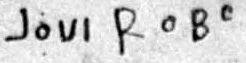
Louis’s signature on the 1671 exchange agreement
Less than a month later, on December 16, 1671, Louis and Gilbert Guillemin, both residents of the seigneurie of Boucherville, exchanged their habitations and agreed that each would be responsible for the seigneurial cens et rentes associated with their new land going forward.
On April 4, 1673, seigneur Pierre Boucher granted land concessions in the seigneurie of Boucherville to 38 men, including Louis. Each concession measured 50 arpents: two arpents of frontage facing the St. Lawrence River by 25 arpents in depth, subject to a seigneurial rente of one sol per arpent of frontage, along with two live capons and six deniers of cens, payable annually on the feast day of St. Remy. His land was located between those of Claude Bourgeault and Prudent Bougret dit Dufort.
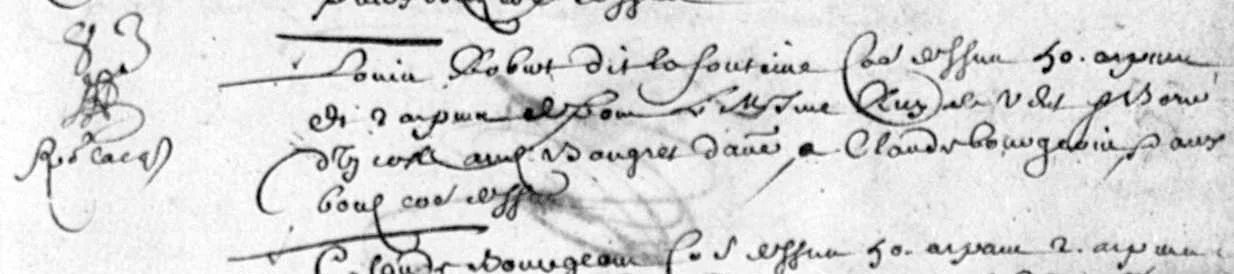
Extract from the 1673 land concession specific to Louis Robert dit Lafontaine (FamilySearch)
Seigneur Boucher grouped his habitations within an enclosure formed by high palisades, which he referred to as the “Bourgade,” in order to protect his tenants from Iroquois attacks. On the same day, April 4, he granted several individuals, including Louis, “a site for building in the Bourgade, measuring one arpent of land, namely half an arpent of frontage along the St. Lawrence River by two arpents in depth.” The seigneurial rente was set at 10 sols, along with one denier of cens annually. Louis’s property was beside that of Léger Baron.
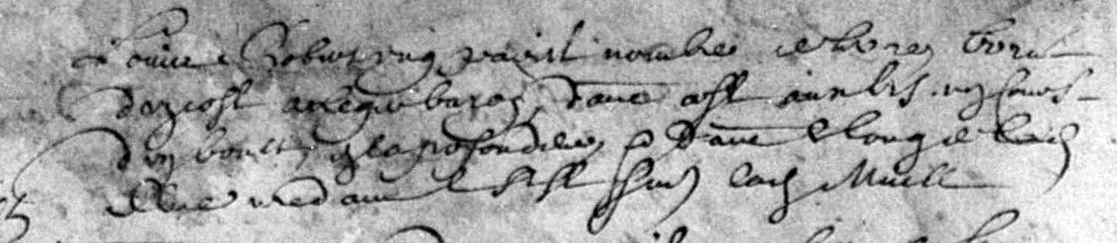
Extract from the 1673 site concession specific to Louis Robert dit Lafontaine (FamilySearch)
Louis set up his shoemaker’s shop on this lot in Boucherville.
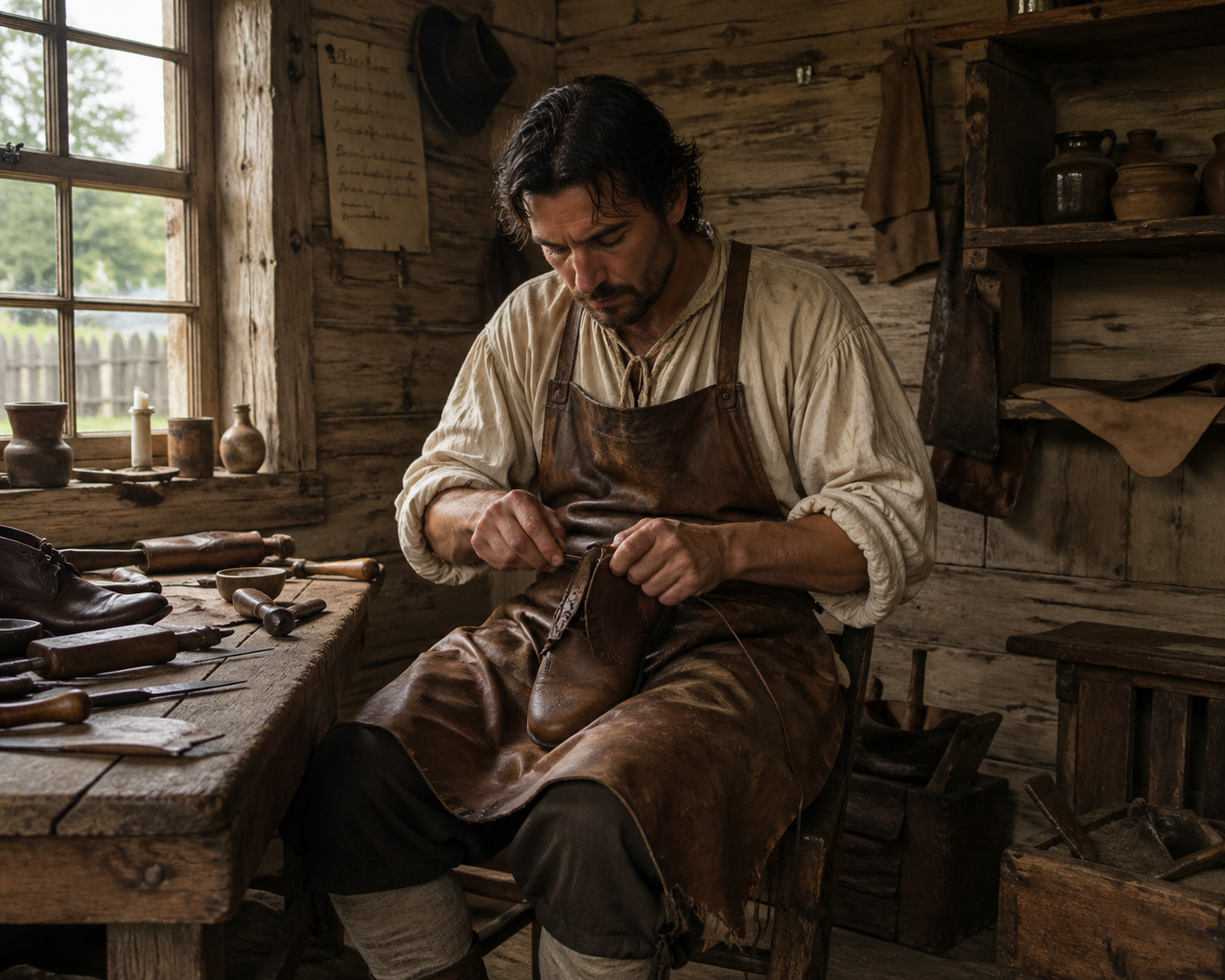
Illustration generated with artificial intelligence by the author, April 2026 (ChatGPT)
On November 4, 1675, Jean de Godefroy, sieur de Linctôt, obtained a default judgment against Louis before the royal court of Trois-Rivières. Louis had been summoned to appear in court but failed to do so, and after the summons was read into the record, the court entered default against him. As a result, Louis was condemned to pay 125 livres to Godefroy, along with court costs.
In 1681, Louis and Marie were enumerated in the census of New France, living in Boucherville with their four children. Louis was recorded as a cordonnier, or shoemaker. They owned two cows.
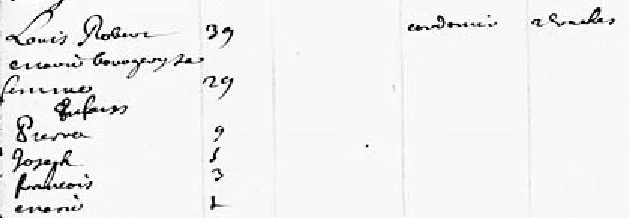
1681 census of New France (Library and Archives Canada)
On June 1, 1693, Jean Leclerc, acting on behalf of his mother Marie Gendre (Legendre), widow of Jean Lamarche, brought a petition before the royal court of Trois-Rivières seeking support for her care due to her advanced age and poverty. The case involved her children, including Florent Leclerc and François Bergeron (husband of one of her daughters), who acknowledged their responsibility but argued that other sons-in-law, including Louis Robert dit Lafontaine, should also contribute. The court ordered that all parties concerned, including Louis, contribute monthly toward Marie Gendre’s maintenance according to their means, with payments to be made to Florent Leclerc, with whom she was living.
Expansion of Landholdings
On March 4, 1701, seigneur Pierre Boucher granted Louis an additional 50 arpents of land adjoining his original concession of 1673. Louis is described as a shoemaker living in Boucherville. He agreed to pay an annual seigneurial rente of 50 sols and six deniers in cens, plus two live capons (or their true value), on the feast day of St-Martin, November 11. He also agreed to have his grain ground at the seigneurial mill and to build and maintain roads on the land as required. Boucher retained the right to cut down and remove trees from the land “for the public good” and for his own manor house. Louis declared not being able to write nor sign.
In 1702, Louis is referred to as a master shoemaker for the first time, in the marriage contract of his daughter Marie to Antoine Daunais.
On June 12, 1704, seigneur Pierre Boucher again granted Louis additional land: a site measuring 72 square feet inside the village of Boucherville. It was bordered by the sites of surveyor Gédéon de Catalogne, Joseph Huet dit Dulude, Jacques Bourdon, and by rue St-Louis. Louis agreed to pay 20 sols in rente and six deniers in cens, due annually on the feast day of St-Martin.
Louis received another land concession from Boucher on April 12, 1707, located on the second row of the seigneurie of Boucherville. This concession also measured 50 arpents: two arpents of frontage by 25 arpents in depth, subject to a seigneurial rente of 50 sols, six deniers of cens, along with two live capons (or their value), payable annually on the feast day of St-Martin. His land bordered those of the late Rochefort, Madame de Varennes, François Viger, and non-conceded lands.
Deaths of Louis and Marie
Louis Robert dit Lafontaine died at the age of 72 on January 1, 1711, “in communion with our Mother, the Holy Roman Catholic and Apostolic Church, after receiving the sacraments of Penance, Viaticum, and Extreme Unction.” He was buried the following day in the Sainte-Famille church cemetery of Boucherville, in the presence of many residents, including royal notary Marien Tailhandier dit LaBeaume.
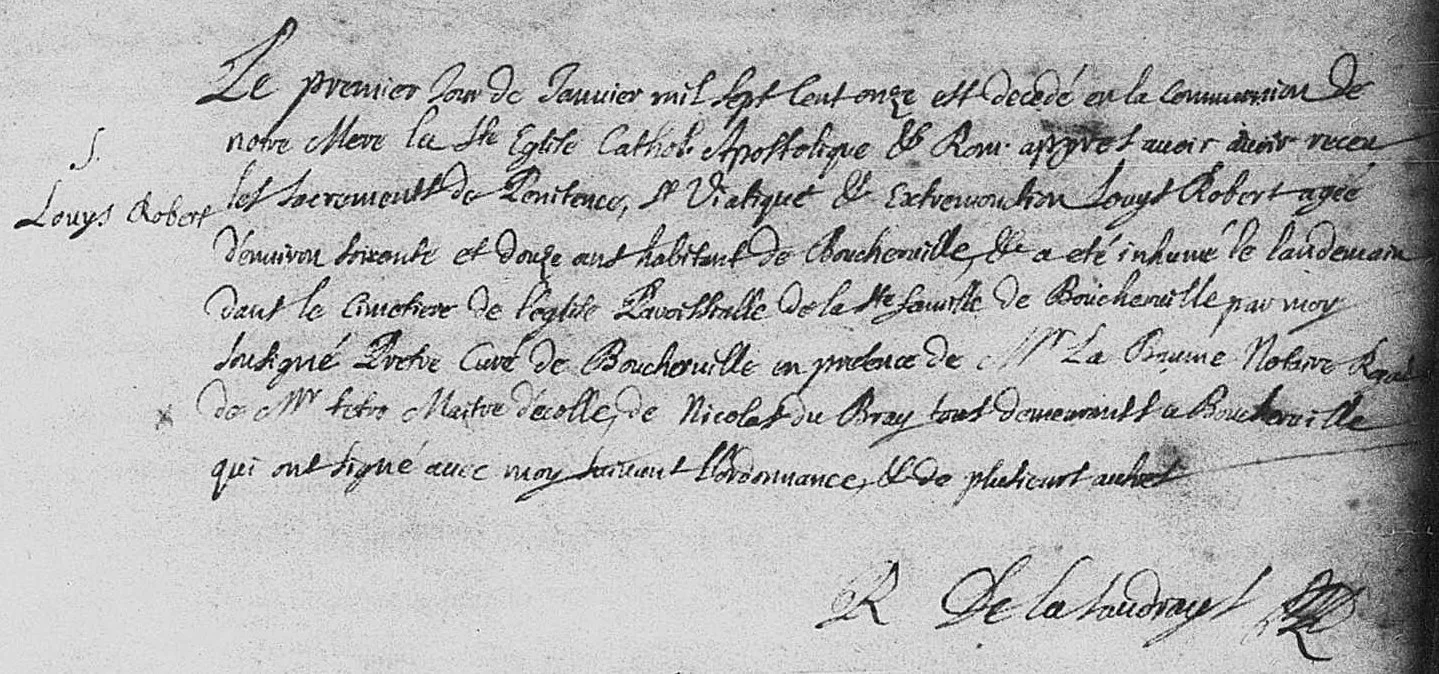
1711 burial of Louis Robert dit Lafontaine (FamilySearch)
On September 10, 1719, Marie dictated her last will and testament to notary Tailhandier dit LaBeaume while sick in bed in a room at her home in Boucherville. “Sound of mind and understanding,” she commended her soul to God and asked that her debts be paid by the executor. She asked to be buried in the Sainte-Famille parish cemetery of Boucherville. She bequeathed:
50 livres to her daughter Marguerite
50 livres in card money to the priest Saladin to celebrate requiem masses for the repose of her soul
Her bed, furnished with a bolster, blanket, and sheets, to granddaughter Angélique Robert, as well as her clothes and linens for her personal use
Marie named her neighbour and “good friend” Joseph Huet dit Dulude as her executor.
Marie Bourgery died two weeks later on September 25, 1719, at the age of 65, “after receiving the sacraments of Penance, the Eucharist, and Extreme Unction.” As she had requested, Marie was buried the following day in the Sainte-Famille parish cemetery in Boucherville. Notary Tailhandier dit LaBeaume attended her burial.
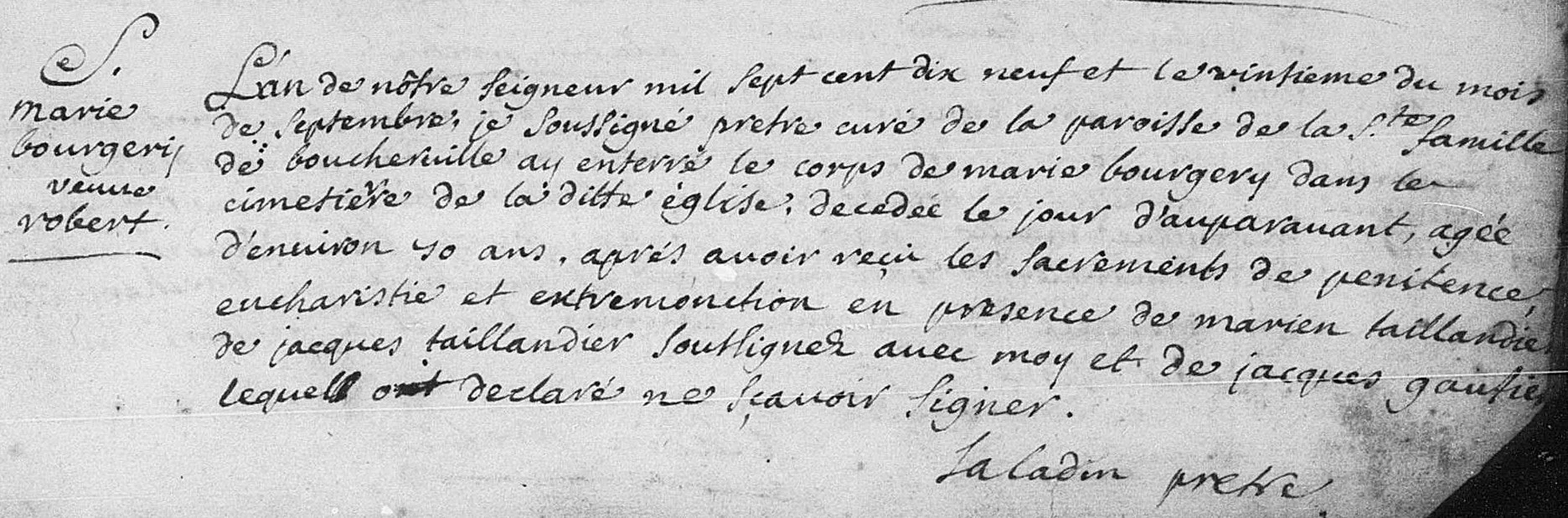
1719 burial of Marie Bourgery (FamilySearch)
From Boucherville to North America
Louis Robert dit Lafontaine and Marie Bourgery built their lives from two different starting points in the early colony: Louis as a young shoemaker from La Rochelle, and Marie as a Canadian-born girl from Trois-Rivières. Their marriage, contracted when Marie was still very young, reflects the social and legal realities of 17th-century New France, where family alliances and community structures often shaped such unions.
Together, they established themselves in Boucherville, where Louis continued his trade, acquired land, and became part of the seigneurial community shaped by Pierre Boucher. Over time, their household grew into a large family whose descendants spread throughout New France and, in later generations, across North America.
PDF version of biography located at: https://www.tfcg.ca/louisrobertlafontaine-and-mariebourgery.
Are you enjoying our articles and resources? Show your support by making a donation. Every contribution, regardless of its size, goes a long way in covering our website hosting expenses and enables us to create more content related to French-Canadian genealogy and history. Thank you! Merci!
Sources:
"Archives en ligne : Registres paroissiaux, pastoraux et d'état civil (La Rochelle)," digital images, Archives de la Charente-Maritime (http://www.archinoe.net/v2/ark:/18812/b8be2bd18eff8b12f5eca4df0034556b : accessed 25 Apr 2026), baptism of Louis Robert, 12 Sep 1638, La Rochelle (Sainte-Marguerite), communal collection, baptisms (1620-1639), image 238 of 267.
"Archives en ligne : Registres paroissiaux, pastoraux et d'état civil (La Rochelle)," digital images, Archives de la Charente-Maritime (http://www.archinoe.net/v2/ark:/18812/d277112c7a75ea70b79c83baab3da442 : accessed 25 Apr 2026), marriage of André Robert and Catherine Bonnin, 20 Feb 1629, La Rochelle (Sainte-Marguerite), communal collection, marriages (1624-1636), image 10 of 89.
"Archives en ligne : Registres paroissiaux, pastoraux et d'état civil (La Rochelle)," digital images, Archives de la Charente-Maritime (http://www.archinoe.net/v2/ark:/18812/549787559f06dbb35cbad9ca90b15784 : accessed 25 Apr 2026), marriage of André Robert and Gilette Guillet, 22 Jun 1848, La Rochelle (Sainte-Marguerite), communal collection, marriages (1636-1666), image 127 of 309.
"Archives en ligne : Registres paroissiaux, pastoraux et d'état civil (La Rochelle)," digital images, Archives de la Charente-Maritime (http://www.archinoe.net/v2/ark:/18812/24b3f93df01f9c9ceee83769a5c84bc1 : accessed 25 Apr 2026), burial of André Robert dit Lafontaine, 5 Sep 1663, La Rochelle (Sainte-Marguerite), communal collection, burials (1636-1665), image 335 of 362.
"Le LAFRANCE (Baptêmes, mariages et sépultures)," database and digital images, Généalogie Québec (https://www.genealogiequebec.com/Membership/LAFRANCE/acte/87364 : accessed 25 Apr 2026), baptism of Marie Bourgerie, 10 Apr 1654, Trois-Rivières (Immaculée-Conception); citing original data: Institut généalogique Drouin and PRDH.
"Le LAFRANCE (Baptêmes, mariages et sépultures)," database and digital images, Généalogie Québec (https://www.genealogiequebec.com/Membership/LAFRANCE/acte/89067 : accessed 25 Apr 2026), marriage of Louis Robert and Marie Bourgeri, 25 Nov 1666, Trois-Rivières (Immaculée-Conception); citing original data: Institut généalogique Drouin and PRDH.
"Canada, Québec, registres paroissiaux catholiques, 1621-1979," digital images, FamilySearch (https://familysearch.org/ark:/61903/3:1:3QS7-899Q-9978-C?cc=1321742&wc=HC3C-7M9%3A13627401%2C13627402%2C19435603 : accessed 26 Apr 2026), burial of Louis Robert, 2 Jan 1711, Boucherville > Sainte-Famille-de-Boucherville > Index 1668-1877 Baptêmes, mariages, sépultures 1668-1717 > image 679 of 749; citing original data: Archives nationales du Québec, Montréal.
"Canada, Québec, registres paroissiaux catholiques, 1621-1979," digital images, FamilySearch (https://familysearch.org/ark:/61903/3:1:3QS7-L993-N943-X?cc=1321742&wc=HC7K-168%3A13627401%2C13627402%2C16005603 : accessed 26 Apr 2026), burial of Marie Bourgeris, 26 Sep 1719, Boucherville > Sainte-Famille-de-Boucherville > Baptêmes, mariages, sépultures 1717-1772 > image 21 of 652; citing original data: Archives nationales du Québec, Montréal.
"Recensement du Canada, 1667," digital images, Library and Archives Canada (https://www.bac-lac.gc.ca/eng/CollectionSearch/Pages/record.aspx?app=fonandcol&IdNumber=2318857&new=-8585951843764033676 : accessed 26 Apr 2026), household of Louis Robert, 1667, Trois-Rivières, page 74 (of PDF), finding aid no. MSS0446, item ID number 2318857; citing original data: Centre des archives d'outre-mer (France) vol. 460.
"Recensement du Canada fait par l'intendant Du Chesneau," digital images, Library and Archives Canada (https://www.bac-lac.gc.ca/eng/CollectionSearch/Pages/record.aspx?app=fonandcol&IdNumber=2318858&new=-8585855146497784530 : accessed 26 Apr 2026), household of Louis Robert, 14 Nov 1681, Boucherville, page 190 (of PDF), finding aid no. MSS0446, MIKAN no. 2318858; citing original data: Centre des archives d'outre-mer (France) vol. 460.
"Fonds Juridiction royale des Trois-Rivières - Archives nationales à Trois-Rivières," digital images, Bibliothèque et Archives nationales du Québec (https://advitam.banq.qc.ca/notice/434163 : accessed 26 Apr 2026), "Déclaration de Jean Crevier, au sujet de la traite de boissons avec les sauvages (Amérindiens), affirmant voir vu, vers la mi-hiver, un sergent avec un soldat et Louis Robert dit la Fontaine (Lafontaine) traiter avec des sauvages...," 11 May 1667, reference TL3,S11,P476, Id 434163.
"Fonds Juridiction royale des Trois-Rivières - Archives nationales à Trois-Rivières," digital images, Bibliothèque et Archives nationales du Québec (https://advitam.banq.qc.ca/notice/434634 : accessed 26 Apr 2026), "Requête faite par Jean Godefroy, sieur de Linctôt (Lintôt), demandeur, pour le paiement par Louis Robert dit Lafontaine, défendeur...," 21 Jan 1668, reference TL3,S11,P947, Id 434634.
"Fonds Juridiction royale des Trois-Rivières - Archives nationales à Trois-Rivières," digital images, Bibliothèque et Archives nationales du Québec (https://advitam.banq.qc.ca/notice/434706 : accessed 26 Apr 2026), "Requête de Félix Thunay (Thunaye, Tune), sieur Dufresne, chirurgien, demandeur, de lui être payé par Louis Robert dit Lafontaine (La Fontaine), la somme de 12 livres suivant le marché fait entre eux. Comme ledit défendeur fait défaut à la suite de son assignation à comparaître en ce jour, il est accordé défaut audit demandeur, ce qui lui sera signifié. Ledit Lafontaine (La Fontaine) est réassigné à comparaître sans quoi il sera condamné à payer ladite somme," 16 Feb 1669, reference TL3,S11,P1019, Id 434706.
"Fonds Juridiction royale des Trois-Rivières - Archives nationales à Trois-Rivières," digital images, Bibliothèque et Archives nationales du Québec (https://advitam.banq.qc.ca/notice/434708 : accessed 26 Apr 2026), "Requête de Claude Jutras (Jutrat) dit Lavallée (La Vallée), demandeur, à l'encontre de Pierre Chaperon (Chapperon) pour qu'il lui livre 6 cordes de bois de chauffage pour lesquelles il avait baillé à Robert Henry et à Louis Robert dit Lafontaine (La Fontaine) et audit défendeur 3 pots de vin et un pot d'eau-de-vie. Ledit Chaperon (Chapperon) est condamné à livrer le bois au demandeur et chacun doit fournir du bois en proportion de la boisson qu'ils ont reçue," 16 Feb 1669, reference TL3,S11,P1021, Id 434708.
"Fonds Juridiction royale des Trois-Rivières - Archives nationales à Trois-Rivières," digital images, Bibliothèque et Archives nationales du Québec (https://advitam.banq.qc.ca/notice/435181 : accessed 26 Apr 2026), "Défaut accordé à Jean de Godefroy, écuyer, sieur de Lintot (Linctôt), demandeur, suivant l'exploit d'assignation du 5 octobre dernier donné à Louis Robert dit la Fontaine (Lafontaine) pour comparaître aujourd'hui, en vertu duquel défaut après que lecture a été faite de l'assignation, signée Adhémar; ledit défaillant est condamné à payer audit sieur de Godefroy la somme de 125 livres avec dépens, signé Boyvinet (Boivinet)," 4 Nov 1675, reference TL3,S11,P1494, Id 435181.
"Fonds Juridiction royale des Trois-Rivières - Archives nationales à Trois-Rivières," digital images, Bibliothèque et Archives nationales du Québec (https://advitam.banq.qc.ca/notice/436045 : accessed 26 Apr 2026), "Requête de Jean Leclerc, faisant pour Marie Gendre (Legendre), comparaissant par Michel Poulain (Poulin), son procureur, demandeur, à l'encontre de Florent Leclerc et François Bergeron, défendeurs...," 1 Jun 1693, reference TL3,S11,P2378, Id 436045.
“Actes de notaire, 1669-1678 // Thomas Frérot,” digital images, FamilySearch (https://www.familysearch.org/ark:/61903/3:1:3Q9M-CSTW-D34F-8?cat=koha%3A644971&i=631&lang=en : accessed 26 Apr 2026), lease of a cow by Pierre Boucher to Louis Robert, 21 Nov 1671, images 632-634 of 3153; citing original data: Bibliothèque et Archives nationales du Québec.
“Actes de notaire, 1669-1678 // Thomas Frérot,” digital images, FamilySearch (https://www.familysearch.org/ark:/61903/3:1:3Q9M-CSTW-D34X-R?cat=koha%3A644971&i=637&lang=en : accessed 26 Apr 2026), land exchange between Louis Robert and Gilbert Guillemant, 16 Dec 1671, images 638-639 of 3153; citing original data: Bibliothèque et Archives nationales du Québec.
“Actes de notaire, 1669-1678 // Thomas Frérot,” digital images, FamilySearch (https://www.familysearch.org/ark:/61903/3:1:3Q9M-CSTW-D38W-1?cat=koha%3A644971&i=699&lang=en : accessed 26 Apr 2026), land concession by Pierre Boucher to Louis Robert dit Lafontaine, 4 Apr 1673, images 700-706 of 3153; citing original data: Bibliothèque et Archives nationales du Québec.
“Actes de notaire, 1669-1678 // Thomas Frérot,” digital images, FamilySearch (https://www.familysearch.org/ark:/61903/3:1:3Q9M-CSTW-D378-Y?cat=koha%3A644971&i=720&lang=en : accessed 26 Apr 2026), concession of plots of land located in the town of Boucherville by Pierre Boucher to Louis Robert, 4 Apr 1673, pages 721-726 of 3153; citing original data: Bibliothèque et Archives nationales du Québec.
“Actes de notaire, 1699-1730 // Marien Tailhandier,” digital images, FamilySearch (https://www.familysearch.org/ark:/61903/3:1:3Q9M-CS5F-49CX-M?cat=koha%3A529348&i=191&lang=en : accessed 26 Apr 2026), land concession by Pierre Boucher to Louis Robert, 4 Mar 1701, images 192-196 of 3203; citing original data: Bibliothèque et Archives nationales du Québec.
“Actes de notaire, 1699-1730 // Marien Tailhandier,” digital images, FamilySearch (https://www.familysearch.org/ark:/61903/3:1:3Q9M-CS5F-499X-N?cat=koha%3A529348&i=714&lang=en : accessed 26 Apr 2026), site concession by Pierre Boucher to Louis Robert, 12 Jun 1704, images 715-717 of 3203; citing original data: Bibliothèque et Archives nationales du Québec.
“Actes de notaire, 1699-1730 // Marien Tailhandier,” digital images, FamilySearch (https://www.familysearch.org/ark:/61903/3:1:3Q9M-CS5F-49ZB-P?cat=koha%3A529348&i=1048&lang=en : accessed 26 Apr 2026), land concession by Pierre Boucher to Louis Robert, 12 Apr 1707, images 1049-1051 of 3203; citing original data: Bibliothèque et Archives nationales du Québec.
“Actes de notaire, 1699-1730 // Marien Tailhandier,” digital images, FamilySearch (https://www.familysearch.org/ark:/61903/3:1:3Q9M-CS5F-C8D9?cat=koha%3A529348&i=384&lang=en : accessed 26 Apr 2026), testament of Marie Bourgerit, 10 Sep 1719, images 385-386 of 2906; citing original data: Bibliothèque et Archives nationales du Québec.
Parchemin, notarial database of ancient Québec (1626-1801), Société de recherche historique Archiv-Histo (https://archiv-histo.com : accessed 26 Apr 2026), "Contrat de mariage entre Antoine Daunay, fils de Antoine Daunay, habitant et de Marie Richard, de Boucherville; et Marie Robert, fille de Louis Robert, maître cordonnier et habitant et de Marie Bourgit, de Boucherville," notary M. Tailhandier dit LaBeaume, 24 Oct 1702.
Fédération québécoise des sociétés de généalogie, Fichier Origine online database (https://www.fichierorigine.com/fr/repertoire/robert/-lafontaine : accessed 25 Apr 2026), entry for ROBERT / LAFONTAINE, Louis (person #243576), updated on 4 Sep 2025.
Université de Montréal, Programme de recherche en démographie historique (PRDH) database (https://www-prdh-igd.com/Membership/fr/PRDH/Famille/2161 : accessed 25 Apr 2026), dictionary entry for Louis ROBERT FONTAINE and Marie BOURGERY BOURGIS (union #2161).
Peter J. Gagné, From Soldiers to Settlers: The Carignan-Salières Regiment in Canada 1665-1668, volume 2 (Woonsocket, Rhode Island, American-French Genealogical Society, 2025), 593-594.
"La chapelle Sainte-Marguerite," Racines Rochelaises (http://racinesrochelaises.free.fr/larochellesm.html : accessed 25 Apr 2026).
Jacqueline Sylvestre, "L’âge de la majorité au Québec de 1608 à nos jours," Le Patrimoine, Feb 2006, volume 1, number 2, page 3, Société d’histoire et de généalogie de Saint-Sébastien-de-Frontenac.