Jérôme Longtin & Marie Catherine Marie dite Ste-Marie
Comprehensive biography of Jérôme Longtin and Marie Catherine Marie dite Ste-Marie, seventeenth-century settlers of Montréal and La Prairie in New France. Explore the life of Jérôme Longtin, master carpenter, landholder, voyageur, and habitant under the French Regime.
Cliquez ici pour la version en français
Jérôme Longtin & Marie Catherine Marie dite Ste-Marie
A Master Carpenter in Early New France
Jérôme Longtin, son of André Longtin and Jeanne Angélique Brière, was born around 1659 in the parish of Saint-Sauveur in Paris, France.
The parish of Saint-Sauveur was located on the Right Bank of the Seine, in a densely populated commercial quarter of central Paris near Les Halles. The church of Saint-Sauveur was an ancient medieval structure that had been rebuilt and modified over centuries. It served a neighbourhood characterized by narrow streets, timber-framed houses, workshops, and small merchants. Parishioners were largely artisans, shopkeepers, labourers, and tradespeople connected to the bustling market economy of the city.
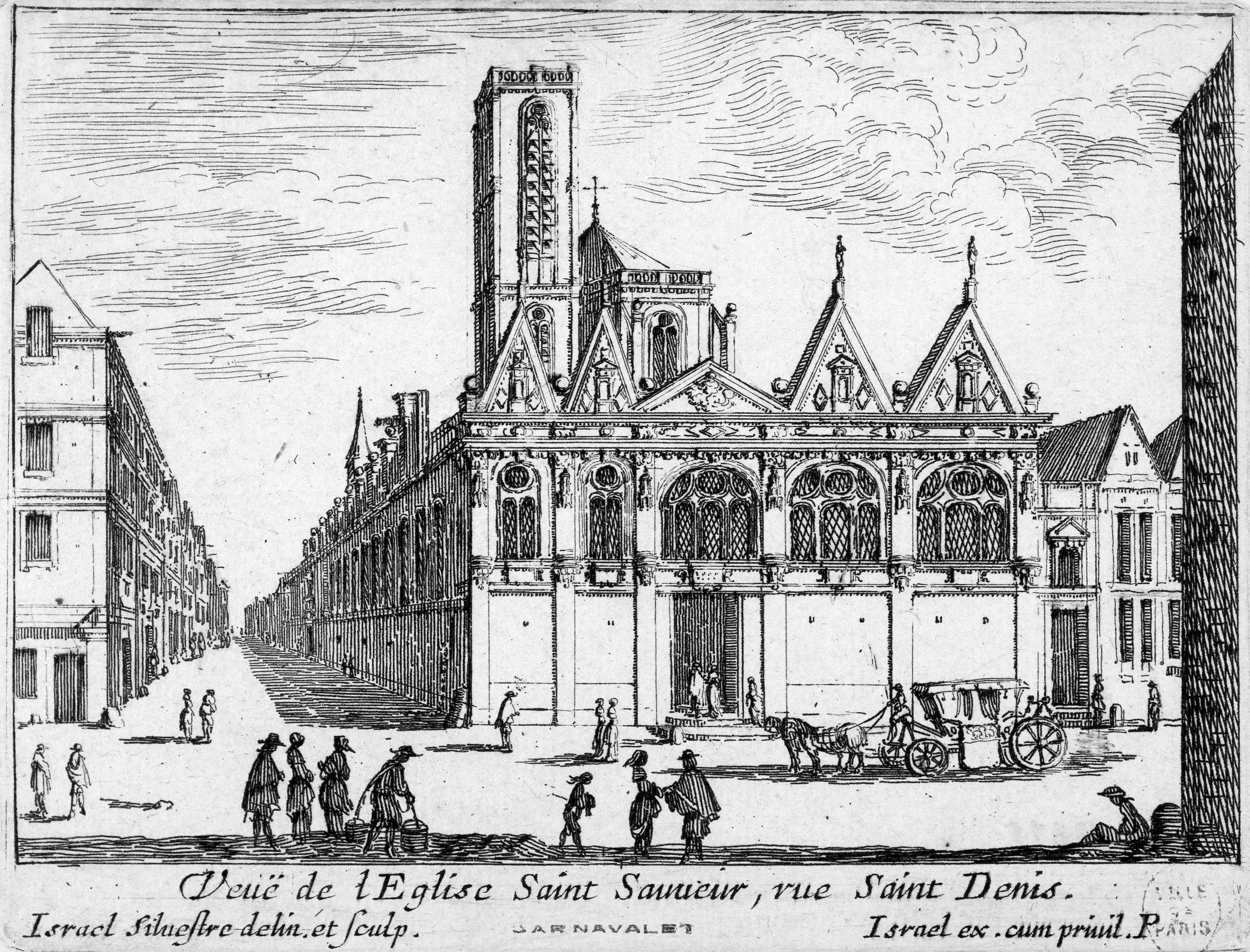
“View of Saint-Sauveur Church, Saint-Denis Street,” engraving by Israël Silvestre, circa 1650 (Wikimedia Commons)
Jérôme’s given name was often spelled Hierosme, Hyerosme, and Hierome in Canadian documents. His surname appears in several phonetic forms, including Longtain, Longtein, Loquetin, Lonquetin, Longuetain, Lontein, and Lonctin.
Before these Canadian records were created, however, Jérôme’s life had already been shaped by a significant transition.
Widowed, Jérôme’s mother, Jeanne Angélique, crossed the Atlantic in 1661 with her young son, arriving in Québec, then part of the colony of Canada in New France. She was a “Fille à marier.”
On September 22, 1661, Jeanne Angélique married Adrien Sédilot, Sieur de Brisval, in the parish of Notre-Dame in Québec. Jeanne Angélique and Adrien do not appear to have had any children together. Adrien became Jérôme Longtin’s adoptive father.
In 1666, the family was recorded in the census of New France living in the Saint-Jean, Saint-François et Saint-Michel district near Québec. Jérôme, listed as “Hierosme Dictain,” age 6, was described as an orphelin (paternal orphan). Adrien was recorded as both an habitant and a charpentier (carpenter). He likely taught Jérôme his trade.
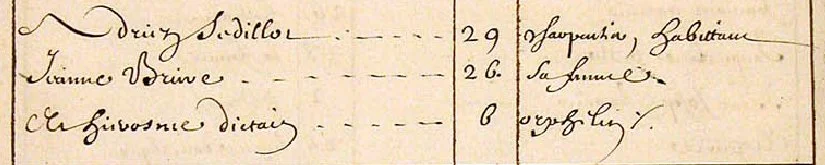
1666 Census of New France (Library and Archives Canada)
Jérôme does not appear in the 1667 census with his mother and adoptive father. It is unclear whether he was omitted from the household or was living elsewhere at the time.
On September 11, 1669, “Jherosme Longtain” of Canada received the sacrament of confirmation.
On the afternoon of August 11, 1680, Jérôme purchased land located on Île-Sainte-Thérèse (north of Saint-Jean-sur-Richelieu) from Nicolas Choquet and Aimée Julien. Jérôme was described as an habitant of Sainte-Thérèse. The plot of land measured two arpents wide by 15 arpents in depth. Jérôme agreed to assume the annual seigneurial rente payments, which included two capons.
Jérôme is likely recorded as “Jerome Limousin,” age 22, in the 1681 census of New France, living on Île-Sainte-Thérèse and working as a domestic servant for Sidrac Dugué. He owned one gun and six arpents of “valuable” land (cleared or under cultivation).

1681 Census of New France (Library and Archives Canada)
Marie Catherine Marie dite Ste-Marie, daughter of Louis Marie dit Ste-Marie and Mathurine Goard, was baptized on February 5, 1670, in the parish of Notre-Dame in Montréal. Her father was recorded as an habitant. Her godparents were Pierre Barreau, habitant, and Catherine Leloup, wife of the master miller Isaac Nafrechou. Only the godmother knew how to sign her name. [The date of birth was omitted from the baptism record.]
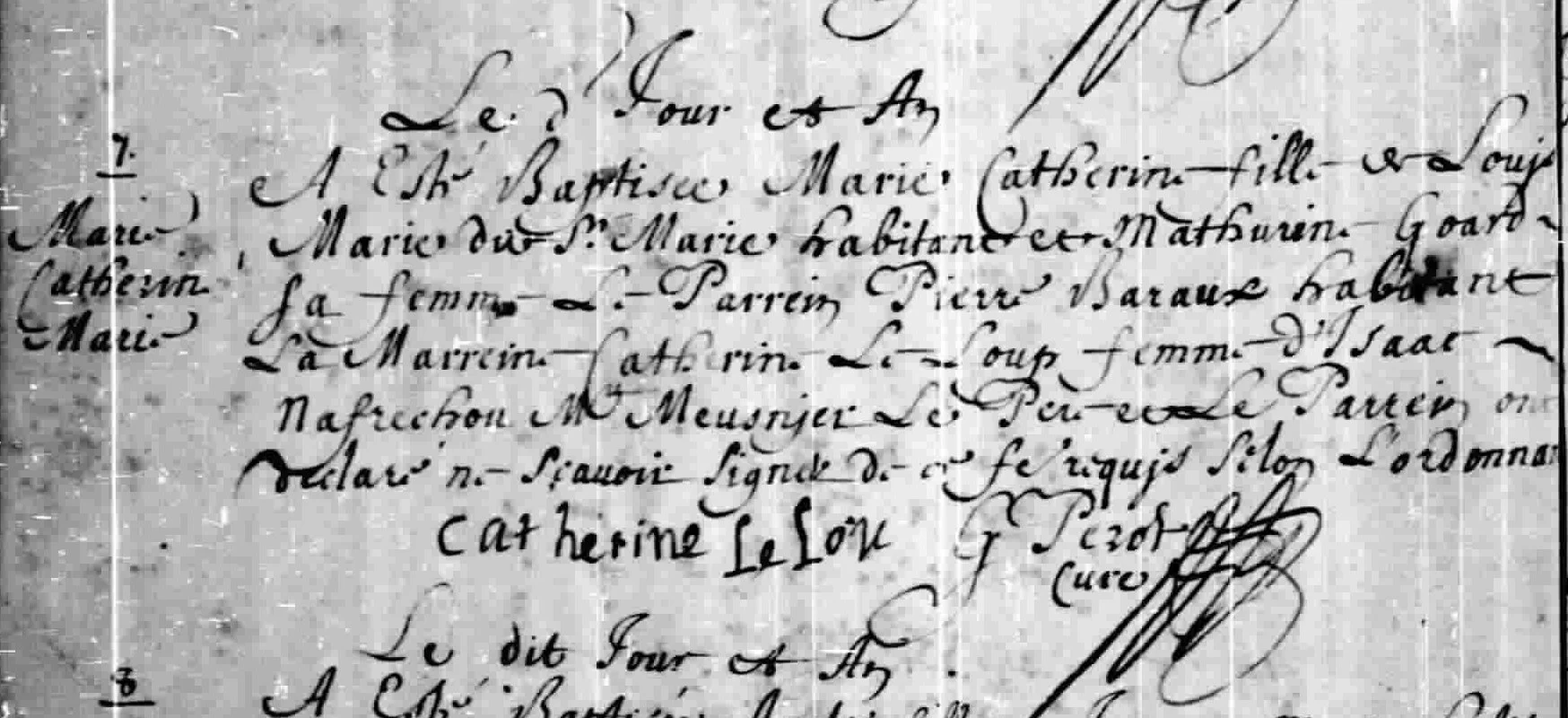
1670 baptism of Marie Catherine Marie dite Ste-Marie (Généalogie Québec)
Marie Catherine was the second of eleven children, although four of her siblings did not survive to adulthood. She grew up in Montréal.
Marriage and Family Life
On October 14, 1684, notary Pierre Cabazié drew up a marriage contract between Jérôme Longtin and Marie Catherine Marie dite Ste-Marie. The groom was a charpentier (carpenter), aged about 25. He could not sign his name. The bride was 14 years old and was able to sign the marriage contract.
Legal Age to Marry and Age of Majority
In New France, the legal minimum age for marriage was 14 for boys and 12 for girls. These requirements remained unchanged during the eras of Lower Canada and Canada East. In 1917, the Catholic Church revised its code of canon law, setting the minimum marriage age at 16 for men and 14 for women. The Code civil du Québec later raised this age to 18 for both sexes in 1980. Throughout these periods, minors required parental consent to marry.
The age of majority has also evolved over time. In New France, the age of legal majority was 25, following the Coutume de Paris (Custom of Paris). This was reduced to 21 under the British regime. Since 1972, the age of majority in Canada has been set at 18 years old, although this age can vary slightly between provinces.
Jérôme and Marie Catherine were married two days later, on October 16, 1684, in the parish of Notre-Dame in Montréal. Their witnesses were Gilbert Barbier and Thomas Dupuis, carpenters, and Jean Deguy, locksmith. Only Barbier and Dupuis were able to sign their names in the marriage record.
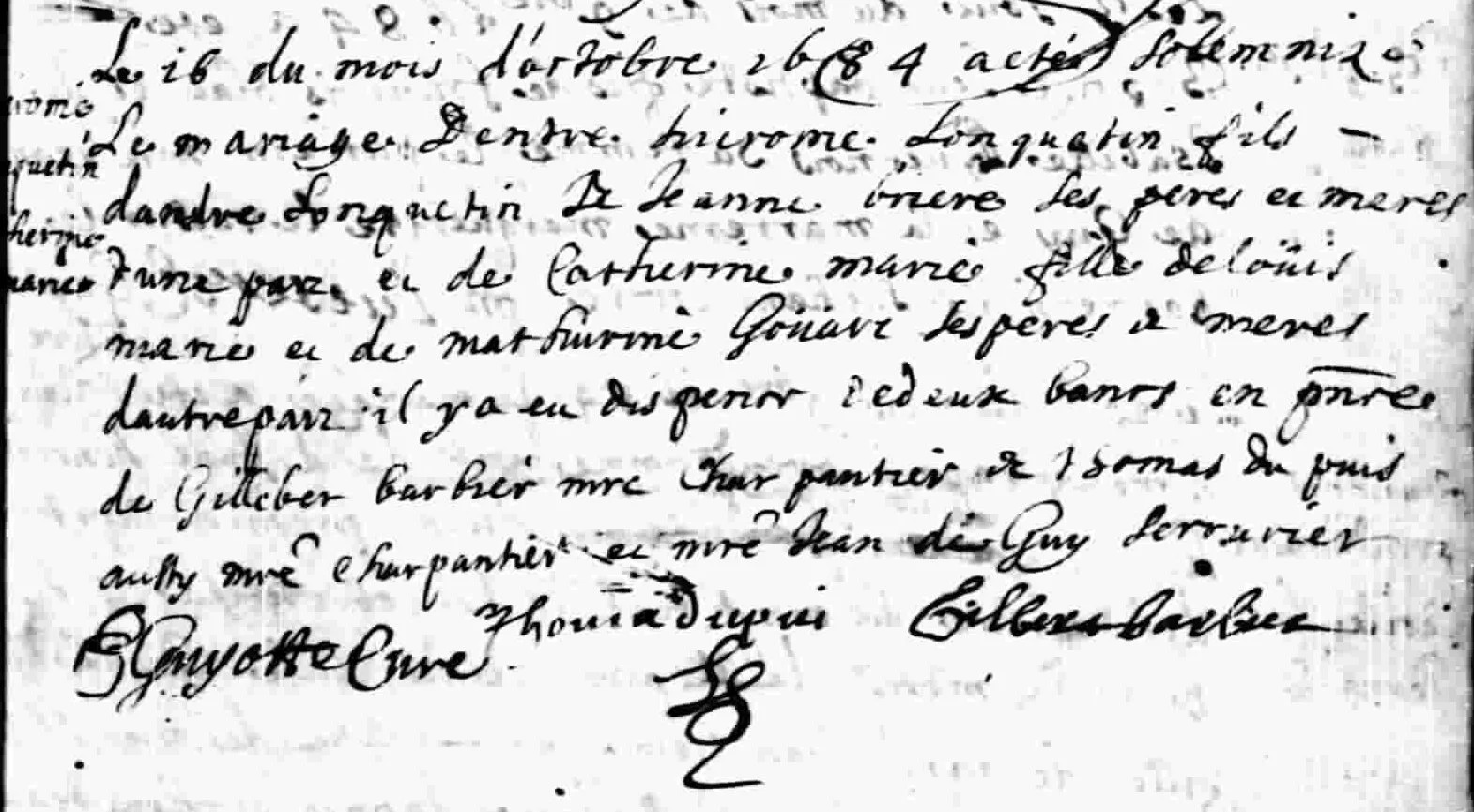
1684 marriage of Jérôme and Marie Catherine (Généalogie Québec)
Jérôme and Marie Catherine eventually settled in La Prairie, where they had ten children:
Marie Catherine (1686–1763)
Jeanne (1688–1688)
André (1689–1776)
Michel (1692–1774)
René (1694–1722)
Jérôme (1696–1696)
François (1697–1767)
Dominique Jérôme (1699–1703)
François Xavier (1702–1733) (twin)
Pierre (1702–1702) (twin)
Master Carpenter
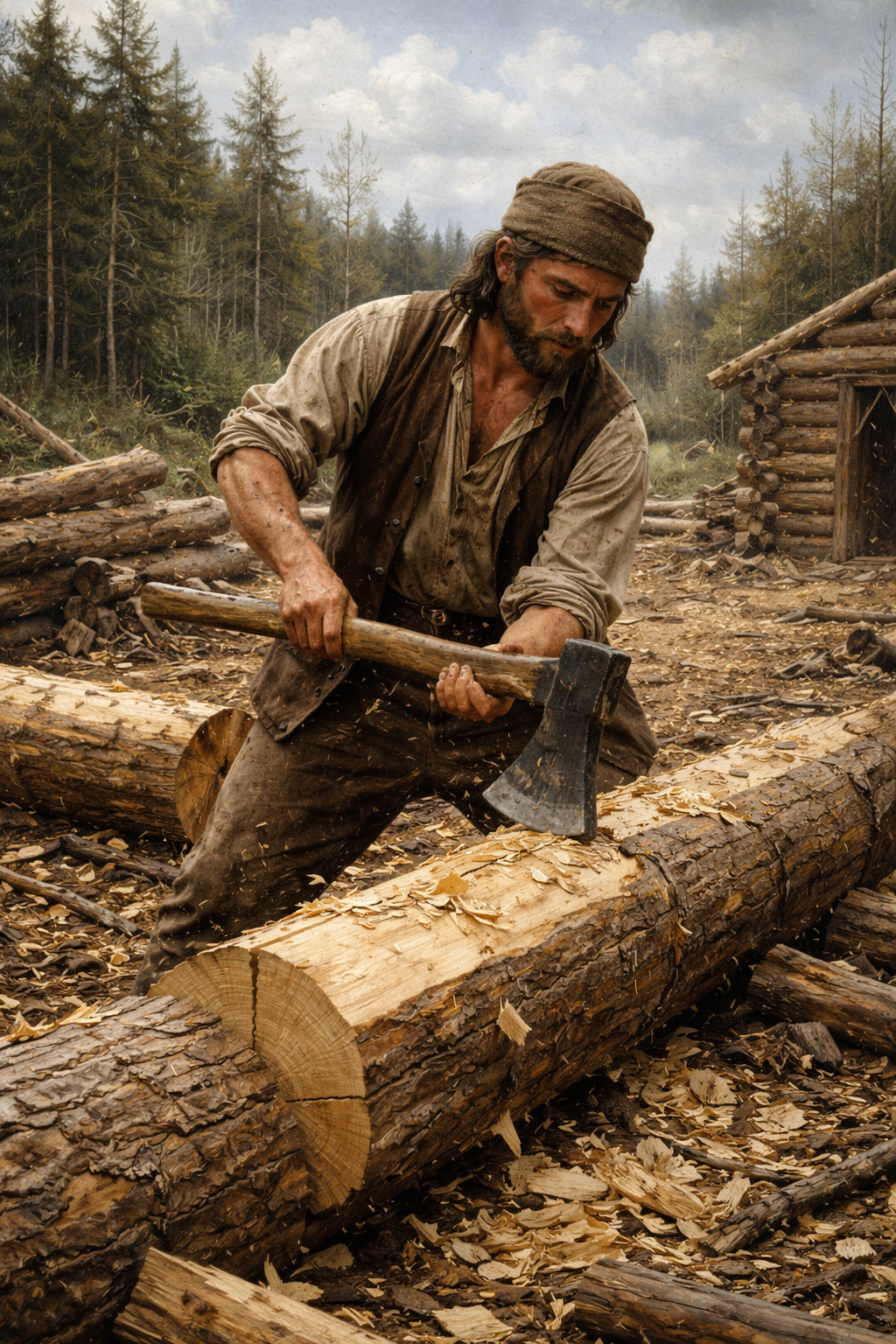
Artificial intelligence image created by the author with ChatGPT (February 2026)
In the 1680s and 1690s, Jérôme entered into numerous contracts as a carpenter. He was referred to as a master carpenter for the first time in 1686, in a land sale document.
December 23, 1684: Jérôme agreed to build a pièce sur pièce (traditional timber-frame) cabin at the northern tip of the island of Montréal for Jacques Lemoyne, for 180 livres. The cabin was to measure 25 feet long by 20 feet wide. Jérôme was recorded as a carpenter from the island of Montréal.
December 26, 1685: Jérôme agreed to construct a timber-framed building on a Villemarie (Montréal) lot for Alexandre Turpin, master-at-arms, for 600 livres, payable in cash and goods. Jérôme was recorded as a carpenter from Montréal.
March 9, 1688: Jérôme agreed to build a two-storey pièce sur pièce (traditional timber-frame) house in Villemarie for Pierre Ganier [Gagné] for 135 livres. The structure was to measure 26 feet long by 21 feet wide. Jérôme was recorded as a resident of La Prairie Saint-Lambert.
November 8, 1691: Jérôme agreed to supply timber for the construction of a house for Jean Magnan and his wife, Marie Moitié, of the town of Villemarie, for 475 livres. Jérôme was recorded as a master carpenter from Côte Saint-Lambert.
December 19, 1691: Jérôme agreed to perform carpentry work on the gable of a house belonging to Jean Fontenelle. Jérôme was recorded as a master carpenter.
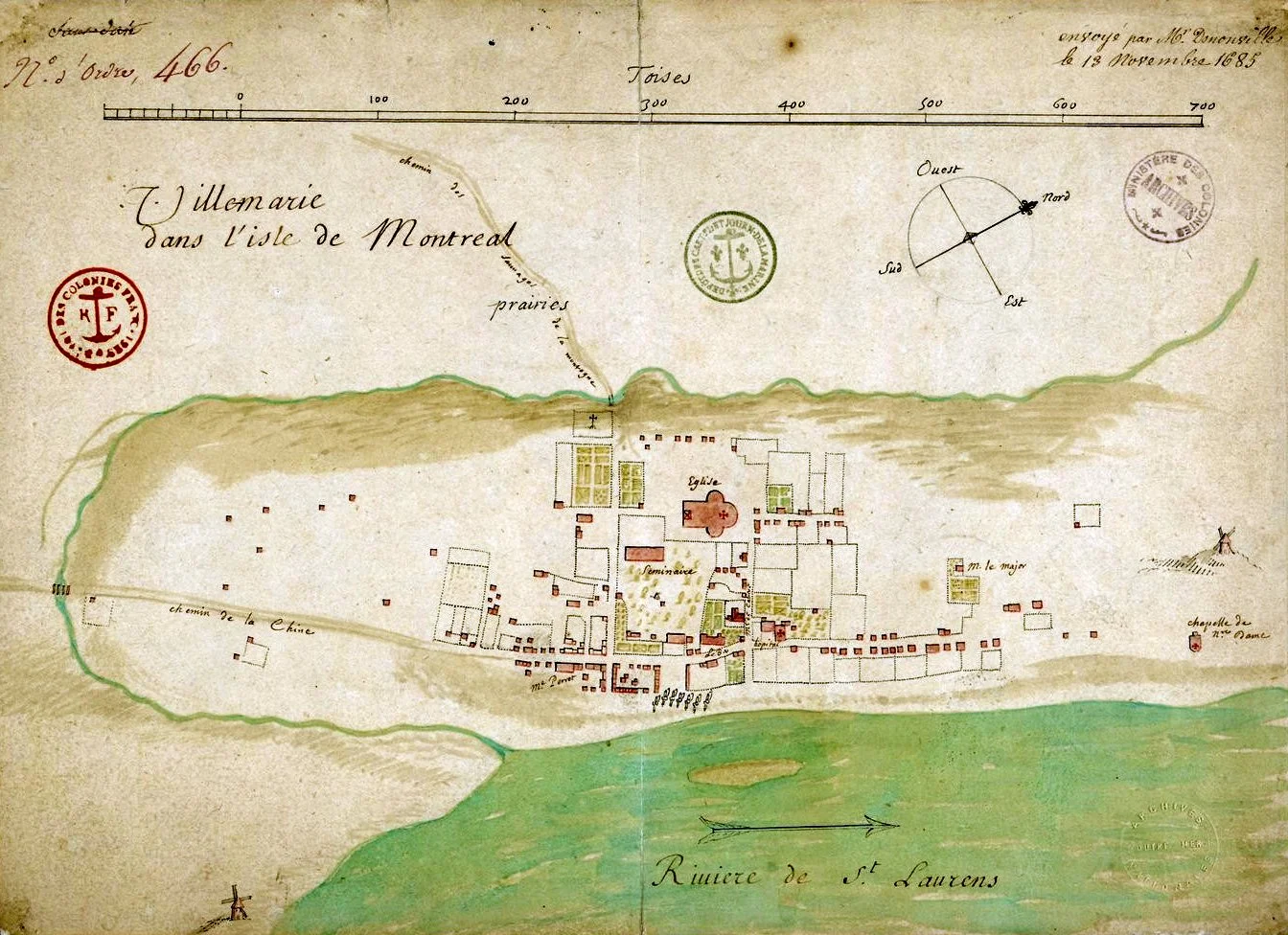
"Villemarie on Montreal Island," 1685 (Bibliothèque nationale de France)
Early Land Acquisitions
Several notarial records involving land transactions were drawn up during this same period, two of which involved Marie Catherine’s father:
October 2, 1685: Jérôme and his father-in-law, Louis Marie dit St-Marie, received a concession of a small plot of land in Villemarie from the Séminaire Saint-Sulpice de Montréal, seigneur and owner of the island of Montréal. The land was situated on the Commune (common land) of the town and measured twenty square feet. It fronted on ȢtaȢoise (Outaouaise) Street on one side, Chagouamigon Street on another, the land of Maximilien Chefdeville on a third, and unceded land on the fourth. The pair committed to building on the land within one year and to paying an annual rente of 30 livres and cens of 5 sols on the feast day of Saint Martin.
October 15, 1685: Jérôme and his father-in-law leased two shops in Villemarie from the Séminaire Saint-Sulpice de Montréal for a term of three years. The shops, measuring about 10 feet each, were located in a building commonly known as Le Hangar. One shop overlooked Outaouaise Street, while the other was along the Commune bordering the Place du marché (market square). They agreed to pay an annual rent of 30 livres.
March 17, 1686: Jérôme purchased land located on Côte Saint-Lambert [La Prairie] from Jacques Perat for 100 livres. The habitation measured two arpents of frontage facing the St. Lawrence River by 20 arpents in depth, bordering the lands of Lacroix and André [illegible] dit L’Espagnol. Jérôme agreed to pay 6 deniers per arpent, plus two live capons in seigneurial rente, payable annually on December 1.
March 9, 1688: Jérôme purchased a land concession located on the côte de la prairie Saint-Lambert [La Prairie] from Pierre Gagné and his wife, Catherine Dobigeon, for 350 livres. The land measured about two arpents of frontage facing the St. Lawrence River by 20 arpents in depth.
June 2, 1697: Jérôme received a concession of a site located partly within the fort and partly outside it, in the seigneurie of La Prairie de la Magdeleine, from the Compagnie de Jésus (Jesuits).
Death of Marie Catherine
Marie Catherine Marie dite Ste-Marie died at the age of 33 on June 9, 1703. She was buried the following day in the parish cemetery of La-Nativité-de-la-Sainte-Vierge in La Prairie.
Given her young age and the proximity of her death to that of her son, Dominique Jérôme, one month earlier, Marie Catherine may have died of a contagious disease. She and her son may have been victims of the smallpox epidemic that devastated Canada in 1702 and 1703, which is believed to have killed between 6% and 10% of the non-Indigenous population in the St. Lawrence Valley.
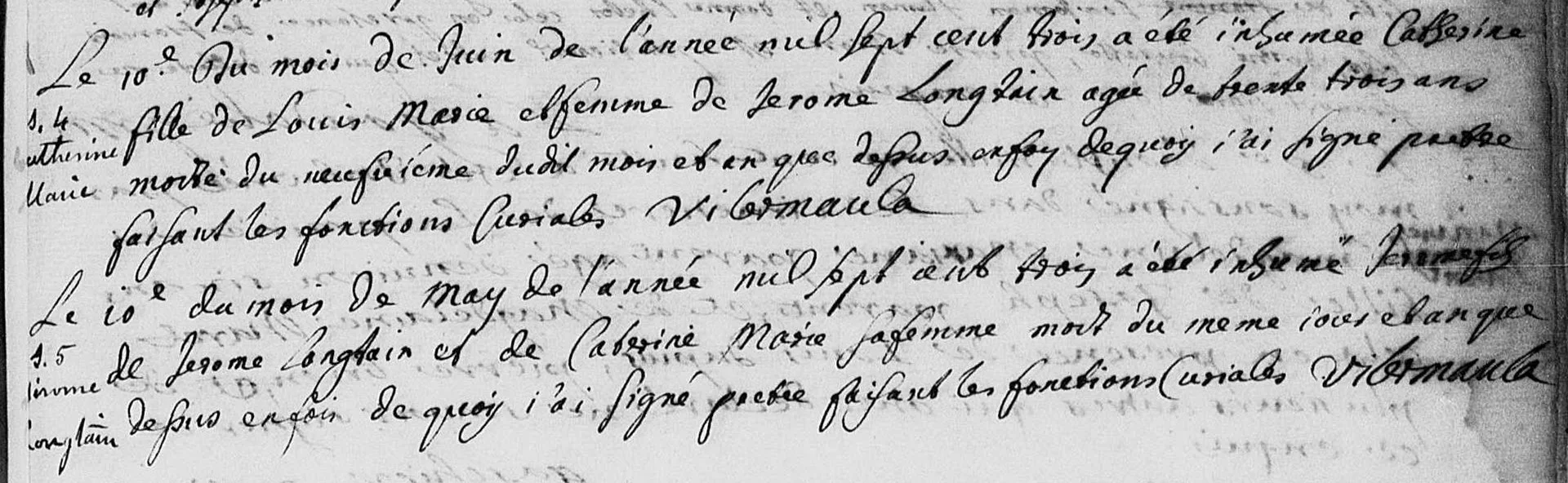
1703 burial records of Catherine Marie and son Dominique Jérôme (FamilySearch)
A Second Marriage
On November 4, 1704, notary Michel Lepailleur de La Ferté drew up a marriage contract between Jérôme Longtin and Marie Louise Dumas dite Rencontre. Jérôme was a 45-year-old widower and habitant of La Prairie Saint-Lambert. Nineteen-year-old Marie Louise was represented by her brother-in-law, François Monet. Jérôme’s witnesses were Michel Marie dit Sainte-Marie (and his wife, Marguerite Brosseau), as well as Angélique, Marie Josèphe, François, and Antoine Marie dite Sainte-Marie, all siblings of his deceased wife, Marie Catherine. The contract followed the standards of the Coutume de Paris. The prefix dower was set at 300 livres, and the preciput at 150 livres.
The Coutume de Paris (Custom of Paris) governed the transmission of family property in New France. Whether or not a couple executed a marriage contract, they were subject to the regime of “community of goods,” meaning that all property acquired during the marriage formed part of the community. Upon the death of the parents, the community property was divided equally among all children, both sons and daughters. If one spouse died, the surviving spouse retained half of the community property, while the other half was divided among the children. Upon the death of the surviving spouse, his or her share was likewise divided equally among the children.
The dower referred to the portion of property reserved by the husband for his wife in the event she outlived him. The preciput, under the regime of community of property, was a benefit conferred by the marriage contract, usually on the surviving spouse, granting that person the right to claim a specified sum of money or property from the community before the remainder was divided.
As was customary before a second marriage, an inventory was drawn up of the community of goods belonging to Jérôme and his late wife, Catherine. Notary Michel Lepailleur de La Ferté drafted the six-page document on November 5, 1704. [Not all items are listed below, as many were illegible.]
Livestock:
One horse and one mare
Three cows
Two young oxen
Two heifers
One two-year-old bull
Three large pigs
Three fattened pigs
Eleven hens and one rooster
Grain stored in the barn :
120 minots of wheat
25 minots of oats
15 minots of peas
Household goods:
A small cooking pot
A copper cauldron
Eight old chairs
One table
A small chest
A pewter basin
Spoons
A small tin lantern
A broken copper candlestick
One plate
Tools and equipment :
One pickaxe
Three old axes
Two horse collars
Several carpentry tools
One hammer
One ploughshare
One new blanket
One old broken firearm
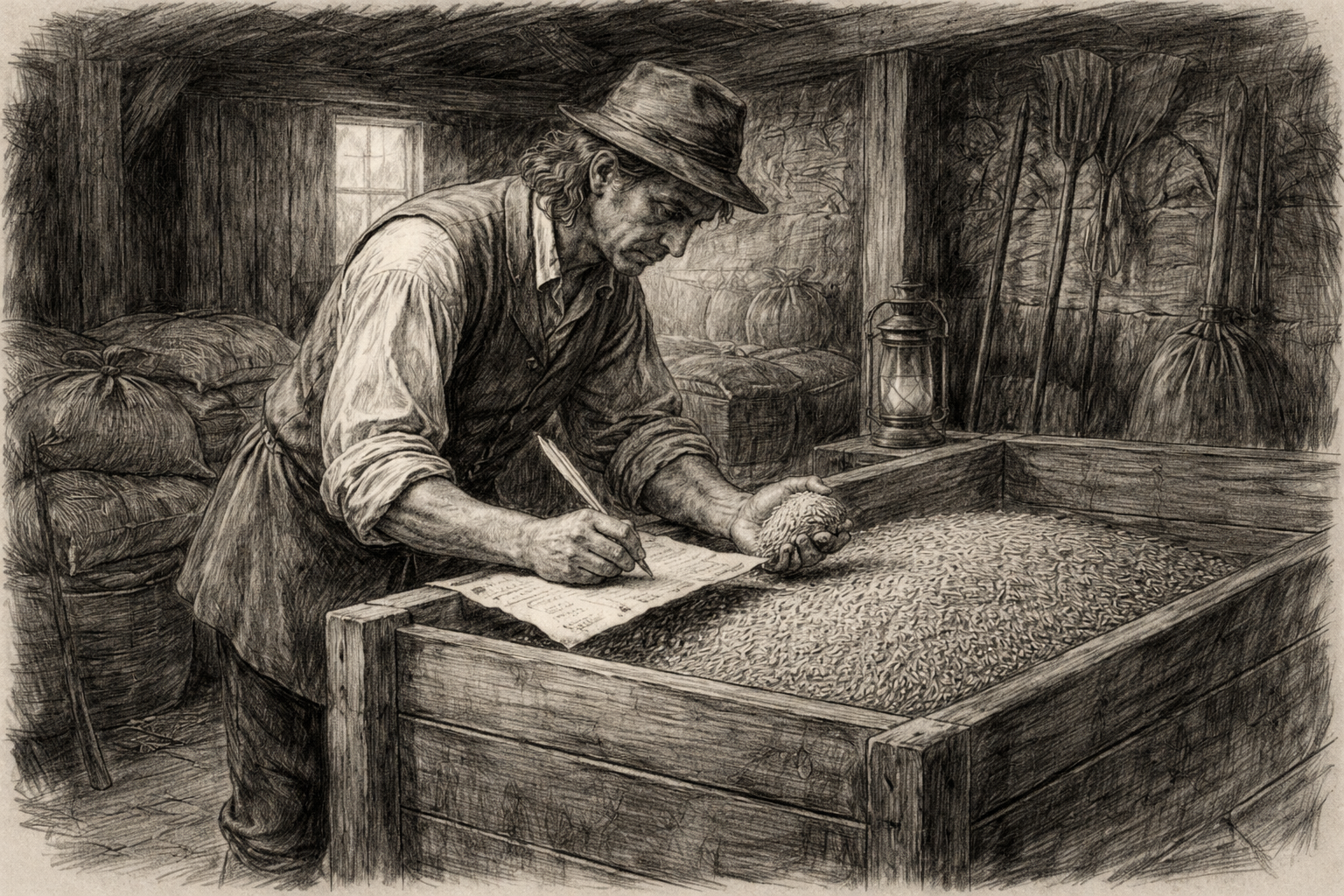
Artificial intelligence image created by the author with ChatGPT (February 2026)
The inventory listed total debts of 49 livres. Jérôme also owned two properties at La Prairie Saint-Lambert.
First Concession
2 arpents of frontage by 20 arpents in depth
A 20 feet by 20 feet pièce sur pièce (traditional timber-frame) house with a thatched roof and an earthen chimney
A 30 feet by 20 feet pièce sur pièce barn, thatched, in poor condition and without a door
A 20 feet by 18 feet pièce sur pièce stable, thatched
Second Concession
3 arpents of frontage by 15 arpents in depth
The inventory suggests a working farm household of moderate means in 1704 New France. It was agriculturally productive and equipped with essential tools, livestock, and grain reserves, but it lacked luxury goods and carried measurable debt. The presence of carpentry tools suggests that Jérôme continued to work as a carpenter in addition to farming.
With the inventory complete, Jérôme and Marie Louise were free to marry. They did so on November 12, 1704, in the parish of La-Nativité-de-la-Sainte-Vierge in La Prairie. Their witnesses were Pierre Caille, Nicolas Cusson, Jean Sansoucy, and Pierre Supernan [Surprenant].
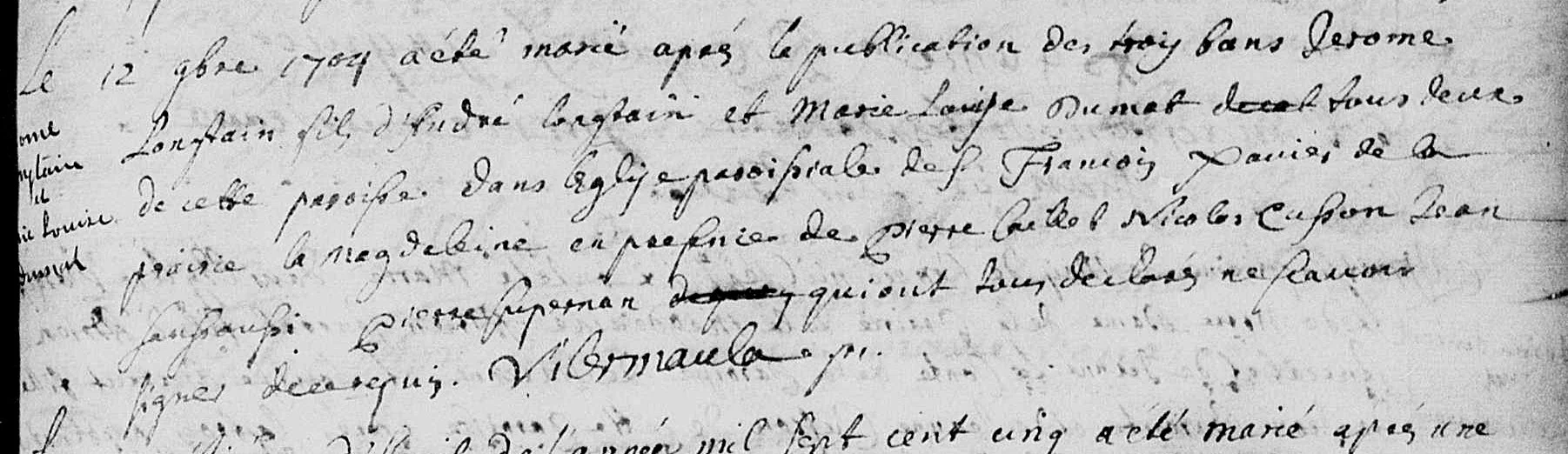
1704 marriage of Jérôme and Marie Louise (FamilySearch)
The couple settled on Jérôme’s land in La Prairie, where they had nine children: Marie Louise, Gabriel, Marie Angélique, Pierre Jérôme, Marie Anne, Joseph, Antoine, Marie Catherine, and François.
On December 3, 1711, Jérôme agreed to build the timber framing of a house on Île aux Hérons belonging to Pierre Trottier dit Desaulniers for 320 livres. The house was to measure 40 feet long by 26 feet wide, and Jérôme was to provide all the required timber.
In a decision that appears somewhat unexpected for a carpenter and farmer in his early fifties, Jérôme was hired as a voyageur alongside Nicolas Gagné on June 7, 1713, by Charles Renaud dit Dubuisson, a lieutenant in the Compagnies franches de la Marine and second officer at Fort Pontchartrain [present-day Detroit]. The pair agreed to travel to the fort by canoe, transporting goods, and to return with furs. Jérôme was to be paid 150 livres upon his return to Montréal. [There were no other men named Jérôme Longtin, or known variants of the name, in New France at this time who could have entered into this contract.]
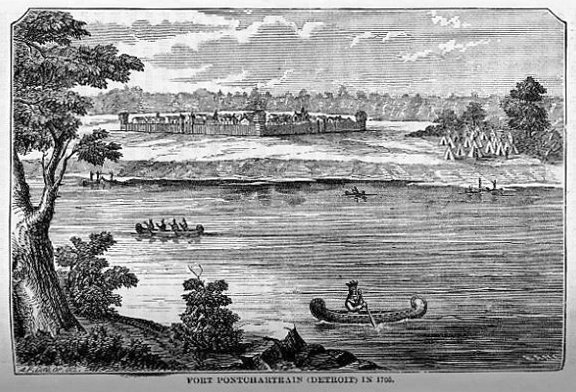
Fort Pontchartrain, 1706 (Wikimedia Commons)
Land and Estate Management
Jérôme was involved in four final land transactions before his death:
September 25, 1716: Jérôme’s first land concession at Saint-Lambert (measuring 2 arpents of frontage by 20 arpents in depth) was divided between him and his children from his marriage to Marie Catherine.
December 20, 1716 : Jérôme purchased a land concession at Rivière de la Tortue from Pierre Favreau dit Lagrandeur and his wife, Marie Jeanne Jouin, for 100 livres. The land measured three arpents of frontage by 30 arpents in depth.
November 13, 1718: Jérôme and Marie Louise exchanged the land at Rivière de la Tortue for land at Saint-Lambert with his son Michel.
February 16, 1723: Jérôme and Marie Louise again exchanged land at Rivière de la Tortue for a portion of land at Saint-Lambert with his son François Jérôme. [This suggests that the previous exchange with Michel may not have been completed.]
Jérôme’s Final Years
At about 60 years of age, on June 25, 1719, Jérôme agreed to one final work contract: to build a pièce sur pièce (traditional timber-frame) building for François Leber for 460 livres.
On November 9, 1721, the parish of La-Nativité-de-la-Bienheureuse-Vierge-Marie-de-Laprairie leased Jérôme a church pew for 15 livres. The Longtin family thereby acquired the right to occupy a designated pew in the parish church on a long-term or potentially perpetual basis.
On June 7, 1723, less than a week before his death, Jérôme dictated his last will and testament to notary Guillaume Barette dit Courville. He requested burial in the parish cemetery of La Prairie, asked that prayers be said for the repose of his soul, and directed that his assets and property be given to his wife.
Death of Jérôme
Jérôme Longtin died at the age of approximately 64 at the Hôtel-Dieu hospital in Montréal. He was buried on June 13, 1723, in the Notre-Dame parish cemetery in Montréal, despite the wishes expressed in his will. The burial record identifies him as an habitant of La Prairie. [The burial record does not include the date of death.]
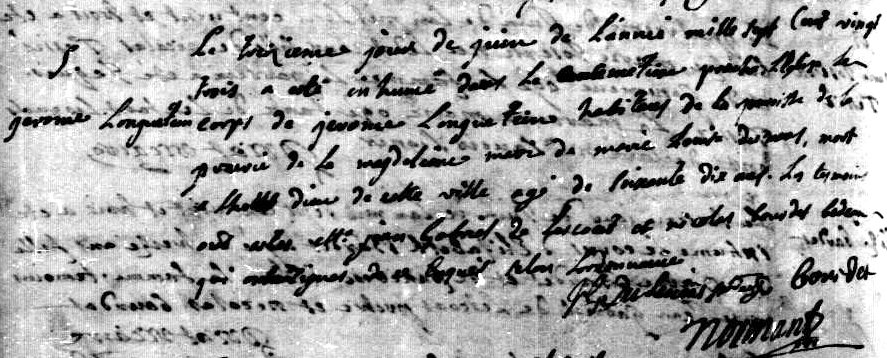
1723 burial of Jérôme Longtin (Généalogie Québec)
From Paris to La Prairie
Jérôme Longtin’s life unfolded during the formative decades of New France. Born in Paris and brought to Canada as a child, he grew up in a colony still clearing farms and establishing parishes. Over the course of his lifetime, he became a carpenter, a master carpenter, a landholder, a voyageur, and a respected habitant of La Prairie.
He married twice, raised a large family, managed land on both Montréal Island and the south shore, and participated in the economic life of the colony, including at least one voyage to Fort Pontchartrain. By the time of his death in 1723, he had secured property, provided for his wife, and left numerous descendants in the region. Through his children and grandchildren, the Longtin family remained rooted in the St. Lawrence Valley for generations.
PDF version of biography located at: https://www.tfcg.ca/jeromelongtin-and-mariecatherinemarie.
Are you enjoying our articles and resources? Show your support by making a donation. Every contribution, regardless of its size, goes a long way in covering our website hosting expenses and enables us to create more content related to French-Canadian genealogy and history. Thank you! Merci!
Sources:
“Le LAFRANCE (Baptêmes, Mariages, Sépultures)," database and digital images, Généalogie Québec (https://www.genealogiequebec.com/Membership/LAFRANCE/acte/66571 : accessed 24 Feb 2026), marriage of Adrien SEDILOT and Jeanne Angelique BRIERE, 22 Sep 1661, Québec (Notre-Dame-de-Québec); citing original data: Drouin Collection, Institut Généalogique Drouin.
“Le LAFRANCE (Baptêmes, Mariages, Sépultures)," database and digital images, Généalogie Québec (https://www.genealogiequebec.com/Membership/LAFRANCE/acte/40028 : accessed 23 Feb 2026), baptism of Marie Catherine MARIE, 5 Feb 1670, Montréal (Notre-Dame-de-Montréal); citing original data: Drouin Collection, Institut Généalogique Drouin.
“Le LAFRANCE (Baptêmes, Mariages, Sépultures)," database and digital images, Généalogie Québec (https://www.genealogiequebec.com/Membership/LAFRANCE/acte/47485 : accessed 23 Feb 2026), marriage of Jerome LONQUETIN and Catherine MARIE, 16 Oct 1684, Montréal (Notre-Dame-de-Montréal); citing original data: Drouin Collection, Institut Généalogique Drouin.
“Le LAFRANCE (Baptêmes, Mariages, Sépultures)," database and digital images, Généalogie Québec (https://www.genealogiequebec.com/Membership/LAFRANCE/acte/52015 : accessed 23 Feb 2026), burial of Jerome LONGTEIN, 13 Jun 1723, Montréal (Notre-Dame-de-Montréal).
"Canada, Québec, registres paroissiaux catholiques, 1621-1979," digital images, FamilySearch (https://www.familysearch.org/ark:/61903/3:1:3QS7-8993-F9WZ-2?lang=en&i=199 : accessed 23 Feb 2026), burial of Catherine Marie, 9 Jun 1703, La Prairie > Nativité-de-la-Prairie-de-la-Magdeleine > Baptêmes, mariages, sépultures 1670-1755 > image 200 of 608; citing original data : Archives nationales du Quebec, Montréal.
"Canada, Québec, registres paroissiaux catholiques, 1621-1979," digital images, FamilySearch (https://www.familysearch.org/ark:/61903/3:1:3QS7-8993-F9WN-C?lang=en&i=167 : accessed 23 Feb 2026), marriage of Jerome Longtain and Marie Louise Dumat, 12 Nov 1704, La Prairie > Nativité-de-la-Prairie-de-la-Magdeleine > Baptêmes, mariages, sépultures 1670-1755 > image 168 of 608; citing original data : Archives nationales du Quebec, Montréal.
"Recensement du Canada, 1666," digital images, Library and Archives Canada (https://recherche-collection-search.bac-lac.gc.ca/fra/accueil/notice?idnumber=2318856&app=fonandcol : accessed 24 Feb 2026), household of Adrien Sedillot, 1666, Saint-Jean Saint-François et Saint Michel, page 99 (of PDF), Finding aid no. MSS0446, MIKAN no. 2318856; citing original data: Centre des archives d'outre-mer (France) vol. 460.
"Recensement du Canada fait par l'intendant Du Chesneau," digital images, Library and Archives Canada (https://www.bac-lac.gc.ca/eng/CollectionSearch/Pages/record.aspx?app=fonandcol&IdNumber=2318858&new=-8585855146497784530 : accessed 24 Feb 2026), household of Sidrach Dugé, 14 Nov 1681, Île-Sainte-Thérèse, page 185 (of PDF), Finding aid no. MSS0446, MIKAN no. 2318858; citing original data: Centre des archives d'outre-mer (France) vol. 460.
"Registre des confirmations 1649-1662," digital images, Généalogie Québec (https://www.genealogiequebec.com/membership/fr/fonds-drouin/REGISTRES : accessed 24 Feb 2026), confirmation of Jherosme Longtain, 11 Sep 1669, route St-Michel; citing original data: Registre des confirmations, Diocèse de Québec, Registres du Fonds Drouin.
"Actes de notaire, 1677-1696 // Claude Maugue," digital images, FamilySearch (https://www.familysearch.org/ark:/61903/3:1:3Q9M-CST7-GS62-B?cat=koha%3A427707&i=1220&lang=en : accessed 24 Feb 2026), land sale by Nicolas Choquet and Aimée Julien to Jérôme Longtain, 11 Aug 1680, images 1221-1223 of 3150; citing original data: Bibliothèque et Archives nationales du Québec.
“Actes de notaire, 1673-1693 // Pierre Cabazié," digital images, FamilySearch (https://www.familysearch.org/ark:/61903/3:1:3Q9M-CST7-G35Q-L?cat=koha%3A481196&i=631&lang=en : accessed 24 Feb 2026), marriage contract of Hierosme Lonctin and Catherine Marie, 14 Oct 1684, images 631-633 of 3195 ; citing original data: Bibliothèque et Archives nationales du Québec.
"Actes de notaire, 1657-1699 // Bénigne Basset," digital images, FamilySearch (https://www.familysearch.org/ark:/61903/3:1:3Q9M-CST7-2WC9-S?cat=koha%3A426906&i=1122&lang=en : accessed 24 Feb 2026), contract for the construction of a pièce sur pièce (traditional timber-frame) cabin between Jérôme Lonctin and Jacques Lemoyne, 23 Dec 1684, images 1123-1124 of 3049; citing original data: Bibliothèque et Archives nationales du Québec.
"Actes de notaire, 1677-1696 // Claude Maugue," digital images, FamilySearch (https://www.familysearch.org/ark:/61903/3:1:3Q9M-CS5F-93ZB-D?cat=koha%3A427707&i=1282&lang=en : accessed 24 Feb 2026), agreement for the construction of a timber-framed building between Jérôme Longtain and Alexandre Turpin, 26 Dec 1685, images 1283-1285 of 3150; citing original data: Bibliothèque et Archives nationales du Québec.
"Actes de notaire, 1668-1714 // Antoine Adhémar," digital images, FamilySearch (https://www.familysearch.org/ark:/61903/3:1:3Q9M-CSTS-63W9-M?cat=koha%3A541271&i=644&lang=en : accessed 24 Feb 2026), agreement for the construction of two-story pièce sur pièce (traditional timber-frame) house between Jérôme Longtain and Pierre Ganier, 9 Mar 1688, images 645-646 of 3102; citing original data: Bibliothèque et Archives nationales du Québec.
"Actes de notaire, 1677-1696 // Claude Maugue," digital images, FamilySearch (https://www.familysearch.org/ark:/61903/3:1:3Q9M-CS5F-SP5G?cat=koha%3A427707&i=215&lang=en : accessed 24 Feb 2026), agreement for the supply of timber between Jérôme Longtin and Jean Magnan, 8 Nov 1691, images 216-217 of 3080; citing original data: Bibliothèque et Archives nationales du Québec.
"Actes de notaire, 1677-1696 // Claude Maugue," digital images, FamilySearch (https://www.familysearch.org/ark:/61903/3:1:3Q9M-CS5F-SPP2?cat=koha%3A427707&i=273&lang=en : accessed 24 Feb 2026), agreement for joinery work between Jérôme Longtin and Jean Fontenelle, 15 Dec 1691, image 274 of 3080; citing original data: Bibliothèque et Archives nationales du Québec.
"Actes de notaire, 1685-1690 // Hilaire Bourgine," digital images, FamilySearch (https://www.familysearch.org/ark:/61903/3:1:3QHV-P3FM-18DL?cat=koha%3A430044&i=3017&lang=en : accessed 25 Feb 2026), land concession granted by the Séminaire de Saint-Sulpice de Montréal to Louis Marie dit St-Marie and Jérôme Longuetin, 2 Oct 1685, images 3018-3019 of 3193; citing original data: Bibliothèque et Archives nationales du Québec.
"Actes de notaire, 1685-1690 // Hilaire Bourgine," digital images, FamilySearch (https://www.familysearch.org/ark:/61903/3:1:3QHV-L3FM-1X3L?cat=koha%3A430044&i=3035&lang=en : accessed 25 Feb 2026), lease for two shops in Villemarie by the Séminaire de Saint-Sulpice de Montréal, to Louis Marie dit Sainte Marie and Jérôme Longuetin, 15 Oct 1685, images 3036-3037 of 3193; citing original data: Bibliothèque et Archives nationales du Québec.
"Actes de notaire, 1677-1696 // Claude Maugue," digital images, FamilySearch (https://www.familysearch.org/ark:/61903/3:1:3Q9M-CS5F-93WD-5?cat=koha%3A427707&i=1331&lang=en : accessed 25 Feb 2026), sale of land located by Jacques Perat to Jérôme Longtain, 17 Mar 1686, images 1332-1334 of 3150; citing original data: Bibliothèque et Archives nationales du Québec.
"Actes de notaire, 1668-1714 // Antoine Adhémar," digital images, FamilySearch (https://www.familysearch.org/ark:/61903/3:1:3Q9M-CSTS-639H-W?cat=koha%3A541271&i=640&lang=en : accessed 25 Feb 2026), sale of land by Pierre Gaigné and Catherine Daubijonx to Jérôme Longtain, 9 Mar 1688, images 641-643 of 3102; citing original data: Bibliothèque et Archives nationales du Québec.
"Actes de notaire, 1701-1732 // Michel-Laferté Lepailleur," digital images, FamilySearch (https://www.familysearch.org/ark:/61903/3:1:3Q9M-CS5F-T359-S?cat=koha%3A538127&i=724&lang=en : accessed 25 Feb 2026), marriage contract of Jérôme Longuetin and Marie-Louise Dumats, 4 Nov 1704, images 725-727 of 3110; citing original data: Bibliothèque et Archives nationales du Québec.
"Actes de notaire, 1701-1732 // Michel-Laferté Lepailleur," digital images, FamilySearch (https://www.familysearch.org/ark:/61903/3:1:3Q9M-CS5F-T3G8-Q?cat=koha%3A538127&i=728&lang=en : accessed 25 Feb 2026), inventory of the property of Jérôme Longuetin, widower of Catherine Marie, 5 Nov 1704, images 729-734 of 3110; citing original data: Bibliothèque et Archives nationales du Québec.
"Actes de notaire, 1701-1732 // Michel-Laferté Lepailleur," digital images, FamilySearch (https://www.familysearch.org/ark:/61903/3:1:3Q9M-CS5V-4SQK-8?cat=koha%3A538127&i=256&lang=en : accessed 26 Feb 2026), contract for carpentry work between Pierre Trottier dit Desauniers and Jérôme Longuetin, 3 Dec 1711, image 257 of 2407; citing original data: Bibliothèque et Archives nationales du Québec.
"Actes de notaire, 1668-1714 // Antoine Adhémar," digital images, FamilySearch (https://www.familysearch.org/ark:/61903/3:1:3Q9M-CS5F-B9KJ-Q?cat=koha%3A541271&i=864&lang=en : accessed 26 Feb 2026), voyageur contract between Nicolas Gaigne and Jérôme Longtain, and Charles Reneau-Dubuisson, 7 Jun 1713, images 865-866 of 3080; citing original data: Bibliothèque et Archives nationales du Québec.
"Actes de notaire, 1709-1744 // Guillaume Barette," digital images, FamilySearch (https://www.familysearch.org/ark:/61903/3:1:3QHV-L3V7-6PW6?cat=koha%3A430015&i=592&lang=en : accessed 26 Feb 2026), division of land located in St Lambert between Jérôme Lonctain and his children, 25 Sep 1716, images 593-595 of 3183; citing original data: Bibliothèque et Archives nationales du Québec.
"Actes de notaire, 1709-1744 // Guillaume Barette," digital images, FamilySearch (https://www.familysearch.org/ark:/61903/3:1:3QHV-L3V7-68F4?cat=koha%3A430015&i=620&lang=en : accessed 26 Feb 2026), sale of a concession at Riviere de la Tortue by Pierre Fauvreau dit Lagrand and Marie-Jeanne Juin to Jérôme Lonctain, 20 Dec 1716, image 621 of 3183; citing original data: Bibliothèque et Archives nationales du Québec.
"Actes de notaire, 1709-1744 // Guillaume Barette," digital images, FamilySearch (https://www.familysearch.org/ark:/61903/3:1:3QHV-P3V7-6ZXL?cat=koha%3A430015&i=770&lang=en : accessed 26 Feb 2026), exchange of land located on the Tortue River in return for land located in St. Lambert between Jérôme Lonctain and Marie-Louise Dumas, and Michel Lonctain, his son, 13 Nov 1718, images 771-772 of 3183; citing original data: Bibliothèque et Archives nationales du Québec.
"Actes de notaire, 1709-1744 // Guillaume Barette," digital images, FamilySearch (https://www.familysearch.org/ark:/61903/3:1:3QHV-L3V7-6CZ9?cat=koha%3A430015&i=1050&lang=en : accessed 26 Feb 2026), exchange of land located on the Tortue River in return for a land portion located in St. Lambert between Jérôme Lonctain and Marie-Louise Dumas, and François Jérôme Lonctain, his son, 16 Feb 1723, images 1051-1052 of 3183; citing original data: Bibliothèque et Archives nationales du Québec.
"Actes de notaire, 1709-1744 // Guillaume Barette," digital images, FamilySearch (https://www.familysearch.org/ark:/61903/3:1:3QHV-L3V7-6J4S?cat=koha%3A430015&i=804&lang=en : accessed 26 Feb 2026), contract for the construction of a timber-framed building between François Leber and Jérôme Lonctain, 25 Jun 1719, images 805-806 of 3183; citing original data: Bibliothèque et Archives nationales du Québec.
"Actes de notaire, 1709-1744 // Guillaume Barette," digital images, FamilySearch (https://www.familysearch.org/ark:/61903/3:1:3QHV-P3V7-6ZJ3?cat=koha%3A430015&i=943&lang=en : accessed 26 Feb 2026), lease of a church pew by the parish council of La-Nativité-de-la-Bienheureuse-Vierge-Marie-de-Laprairie to Jérôme Lonctain, 9 Nov 1721, images 944-945 of 3183; citing original data: Bibliothèque et Archives nationales du Québec.
"Actes de notaire, 1709-1744 // Guillaume Barette," digital images, FamilySearch (https://www.familysearch.org/ark:/61903/3:1:3QHV-L3V7-6GRW?cat=koha%3A430015&i=1113&lang=en : accessed 26 Feb 2026), testament of Jérôme Lonctain, 7 Jun 1723, image 1114 of 3183; citing original data: Bibliothèque et Archives nationales du Québec.
Parchemin, notarial database of ancient Québec (1626-1801), Société de recherche historique Archiv-Histo (https://archiv-histo.com : accessed 25 Feb 2025), " Concession d'un emplacement situé dans le fort et partie dehors, mouvant en la censive de la seigneurie de La Prairie de la Magdeleine; par la Compagnie de Jésus, à Jérôme Longtain, de La Prairie de la Magdaleyne," notary A. Adhémar de Saint-Martin, 2 Jun 1697.
Université de Montréal, Programme de recherche en démographie historique (PRDH) database (https://www-prdh-igd.com/Membership/fr/PRDH/Famille/5468 : accessed 23 Feb 2026), dictionary entry for Jerome LONGTIN and Marie Catherine MARIE STEMARIE (union #5468).
Université de Montréal, Programme de recherche en démographie historique (PRDH) database (https://www-prdh-igd.com/Membership/fr/PRDH/Famille/9493 : accessed 23 Feb 2026), dictionary entry for Jerome LONGTIN and Marie Louise DUMAS RENCONTRE (union #9493).
Peter Gagné, Before the King’s Daughters: Les Filles à Marier, 1634-1662 (Orange Park, Florida : Quintin Publications, 2002), 77.
Jacqueline Sylvestre, "L’âge de la majorité au Québec de 1608 à nos jours," Le Patrimoine, February 2006, volume 1, number 2, page 3, Société d’histoire et de généalogie de Saint-Sébastien-de-Frontenac.