Jean Lefort dit La Prairie & Marguerite Françoise Moreau
Discover the story of Jean Lefort dit La Prairie and Marguerite Françoise Moreau, a Huguenot soldier and a Fille du roi whose lives converged on the south shore of Montréal in the late 17th century. This detailed biography traces their origins in Saint-Jean-d’Angély and Paris, their experiences with the Compagnies franches de la Marine, the 1690 Iroquois raids at La Prairie, their blended family, property holdings, and the legacy they established in early New France.
Cliquez ici pour la version en français
Jean Lefort dit La Prairie & Marguerite Françoise Moreau
A Huguenot Soldier and a Parisian Fille du roi in New France

Location of Saint-Jean-d’Angély in France (Mapcarta)
Jean Lefort dit La Prairie, son of Isaac Lefort and Anne Thibault, was born around 1669 in the parish of Saint-Jean in Saint-Jean-d’Angély, Saintonge, France. The Leforts were a Huguenot family.
Located approximately 40 kilometres east of Rochefort and about 55 kilometres from La Rochelle, in the department of Charente-Maritime, Saint-Jean-d’Angély is a small town of fewer than 7,000 residents, called Angériens.
Jean’s childhood in Saint-Jean-d’Angély would have been shaped not only by the rhythms of a modest market town but also by the increasingly precarious position of Protestants in a region long marked by religious tension. Although Saint-Jean-d’Angély had been a significant Protestant centre earlier in the century, by the 1670s and early 1680s the Crown’s campaign to pressure Huguenots into conversion—through restrictions on worship, curbs on professional advancement, and the presence of royal troops—was intensifying. For a young Huguenot man, opportunities in trades or civic life were narrowing, and daily life carried the constant uncertainty of royal policies that eroded Protestant rights.

Postcard, circa 1900-1910 (Geneanet)

Postcard, circa 1902-1912 (Geneanet)

Postcard, circa 1905-1914 (Geneanet)
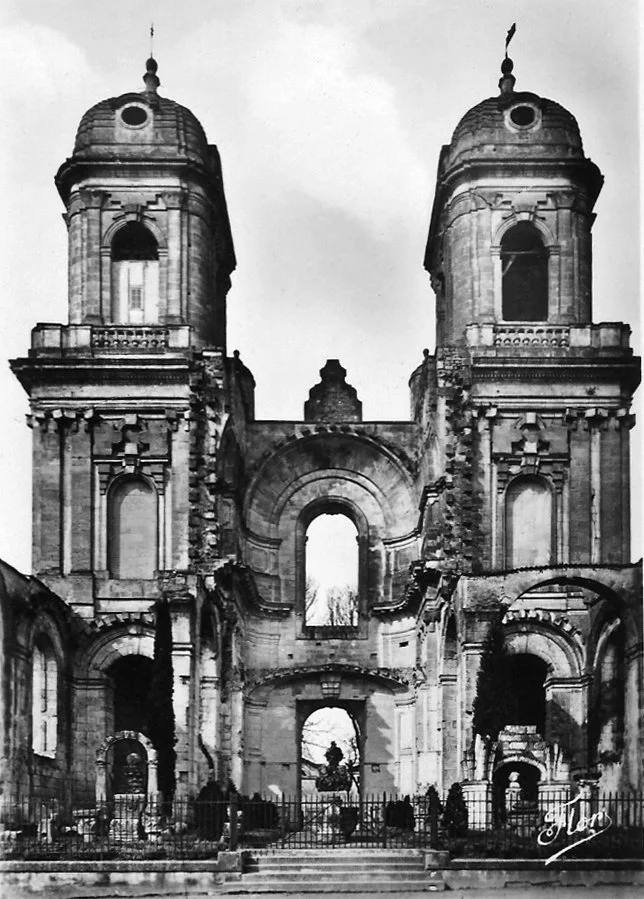
The towers of the Royal Abbey, postcard, 1950 (Geneanet)
A Soldier in New France

Flag of the Compagnies franches de la Marine (Wikimedia Commons)
Against this backdrop, military service in the Compagnies franches de la Marine may have represented one of the few viable paths forward for Jean. Enlistment provided steady provisioning, regular pay, and a way out of an increasingly hostile environment for Protestants in France. Even though Huguenots technically faced obstacles to serving the king, recruitment practices were not always rigidly enforced, especially for overseas service. For someone like Jean—facing shrinking economic prospects, growing religious pressure, and the threat of forced conversion—the decision to enlist and depart for New France would have been both a practical escape and an opportunity for a more stable future, far removed from the tightening restrictions of late-17th-century Saintonge.
According to extensive research by Jocelyne Lefort, Jean likely chose to enlist in the Compagnies franches de la Marine after losing both his parents, while he was still a teenager. He likely sailed from Rochefort for New France on the royal frigate La Tempête on August 29, 1683, as part of a first detachment of Marine companies sent urgently to the colony under Captain Claude Cahouet des Pouraux.
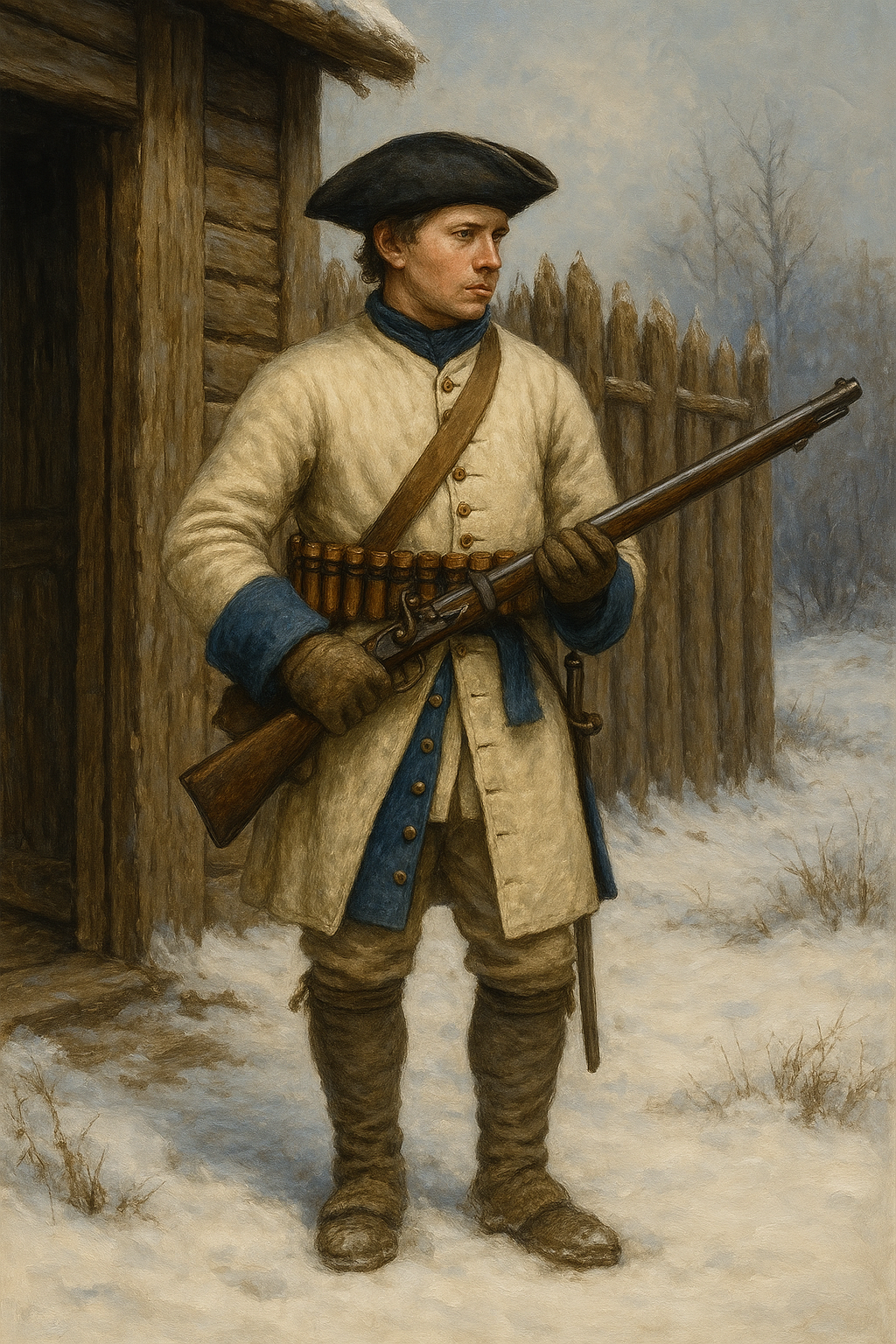
Artificial intelligence image created by the author with ChatGPT (November 2025)
Shortly after landing, the troops were quartered in parishes around Québec, awaiting Governor La Barre’s military plans. In mid-1684, Jean joined La Barre’s expedition against the Tsonnontouans (Seneca). The force consisted of 130 Marine soldiers, 300 militia from Québec, and 200 Indigenous allies. Jean departed Québec on July 9, 1684, reached Montréal on July 16, and then continued upriver as part of a 1,030-man army travelling in 200 canoes and 15 bateaux plats. After a difficult portage, the force arrived at La Galette and then Fort Frontenac on August 9, 1684, prepared for conflict. The campaign ultimately devolved into a military demonstration rather than open combat, as diplomatic overtures led La Barre to negotiate instead of attack.
Following the expedition, Jean likely served in garrison at Montréal and Pointe-aux-Trembles, where soldiers were billeted with local habitants and often hired out for tasks such as cutting wood, clearing land, and threshing grain—an arrangement that provided him both wages and opportunities to acclimatize to the colony.
On April 15, 1685, Jacques Poissant dit La Saline and “Daniel Fore” formally renounced Calvinism in an “abjuration of heresy” in Pointe-aux-Trembles. There is no known record of a Daniel Fore/Fort in Canada at this time, and the parents recorded in the abjuration match those of Jean Lefort. This is most likely a mistake by the writer, or Daniel could be another given name that Jean seldom used.
In later notarial records, Jean was identified as a soldier in the de Noyan Company, serving as part of the royal garrison in Canada under Captain Pierre Payen de Noyan, who arrived in Canada in 1687. Stationed for a time at La Prairie, opposite Montréal, the de Noyan soldiers guarded the south shore corridor, escorted convoys, and helped man small frontier posts. They were also used in offensive operations during the Anglo-French wars of the 1690s, including long winter raids against English settlements. In this role, a soldier of the de Noyan Company would have divided his time among routine garrison duty around Montréal and La Prairie, patrols and escort work, and occasional campaigns into Iroquois and New England territory.
Settlement in La Prairie
On July 27, 1694, Jean received a land concession in La Prairie, in an area called “La Tortue,” from the Compagnie de Jésus (the Jesuits). He was described as a soldier in the de Noyan Company. The plot of land measured two arpents of frontage by fifty arpents deep.
A year later, on the morning of July 16, 1695, Jean purchased the land concession adjoining his property from fellow soldier Louis Bertrand Laramée and his wife Marie Dumas, for 38 livres. The plot of wooded land also measured two arpents of frontage, facing the St. Lawrence River, by fifty arpents deep. Jean declared not knowing how to sign his name.
Marguerite Françoise Moreau
Marguerite Françoise Moreau, daughter of François Moreau and Françoise Gardien, was baptized on August 7, 1654, in the parish of Saint-Sulpice in Paris, France. Her father was a gagne-deniers, or day labourer. Her maternal grandparents were Jean Gardien, an ouvrier à la monnaie, or mint worker, and Marguerite Laurens. [Her baptism record no longer exists, but it was referenced in a 1693 inventory that included important documents.]

1693 reference to Marguerite Françoise Moreau’s baptism
Parish of Saint-Sulpice
Originally a rural chapel linked to the Abbey of Saint-Germain-des-Prés, Saint-Sulpice grew in importance as the Saint-Germain district urbanized in the 17th century. In 1642, Jean-Jacques Olier—a major figure of the Catholic Counter-Reformation—initiated the construction of a new and much larger church to serve the growing population. The foundation stone was laid in 1646 by Queen Regent Anne of Austria and the young Louis XIV. Designed in a restrained yet monumental French classical style, Saint-Sulpice eventually became one of the largest churches in Paris. Despite construction delays and financial challenges, it was consecrated in 1745.
The church played a central role in the religious and intellectual life of the city. It houses one of France’s most renowned pipe organs, a scientific gnomon from the Enlightenment era, and remarkable 19th-century frescoes by Delacroix. Though heavily damaged during the French Revolution, Saint-Sulpice was gradually restored in the 19th century and remains today a prominent symbol of French religious classicism.

Church of Saint-Sulpice, 18th-century drawing by Jean Baptiste Lallemand (Bibliothèque nationale de France)
After the death of her father, Marguerite decided to leave her home country. In 1670, around the age of 15, she arrived in New France as a Fille du roi.
After first docking at Québec, Marguerite travelled further up the St. Lawrence and arrived in Montréal. She was lodged at Maison Saint-Gabriel.
Maison Saint-Gabriel served as temporary housing for many Filles du roi upon their arrival in Ville-Marie (present-day Montréal). Built in 1668, this historic farmhouse in Pointe-Saint-Charles stands as one of the oldest surviving farmsteads in Canada. The Congrégation de Notre-Dame-de-Montréal, founded by Marguerite Bourgeoys, operated the farm for over three centuries.

“The Saint-Gabriel Farmhouse,” 1886 painting by Henry Richard S. Bunnett (McCord Stewart Museum)
Marriage of Marguerite Françoise Moreau and Mathieu Faille dit Lafayette
On September 27, 1670, Father Gilles Perrot drew up a private marriage contract in Montréal between Marguerite and former Carignan-Salières soldier Mathieu Faille dit Lafayette [also called Faye or Delafaye], the son of Claude Faille and Marie Sulière. Mathieu was born around 1641 in Saint-Jean-d’Aubrigoux, Auvergne, France. He was about 29 years old at the time of his marriage; Marguerite was 16.
The couple married three days later in the parish of Notre-Dame in Montréal. Mathieu was described as an habitant of La Prairie. Their witnesses included the king’s storekeeper Sir Jacques Lemoyne, master tailor Sir Pierre Caillé, Antoine Barrois, Pierre Lefebvre, Fille du roi Françoise Gobillon, Antoine Gardien—Françoise’s cousin—“and many other good friends.” Françoise Gobillon acted as “mother of the bride, having come with her from France.” Mathieu and Françoise Gobillon were unable to sign their names, but Marguerite and the remaining witnesses did.
[In her own signatures, Marguerite spelled her surname in several different ways, including Moreau, Moreaux, and Morro. She consistently wrote Margueritte with two Ts and rarely used the given name Françoise.]

1670 marriage of Marguerite Françoise and Mathieu (Généalogie Québec)
Mathieu and Marguerite settled on his land in La Prairie, on the shores of the Saint-Jacques River. They had at least eleven children: Anne, Marie Marguerite, Marie, André, Jean, Marie Angélique, Marie Jeanne, Anne, François, Marie Anne, and Marie Élisabeth.
The couple was enumerated in the 1681 census of New France in La Prairie with their four children. They owned one gun, eight head of cattle, and eight arpents of cleared or cultivated land.

1681 census of New France for the “Faye” household (Library and Archives Canada)
On March 17, 1686, Mathieu and Marguerite sold a plot of land at Prairie Saint-Lambert to Charles Denaux [Denault] and his wife Madeleine Clément for 250 livres, payable in castors (beaver pelts). Mathieu was described as an habitant of La Prairie. The land measured two arpents of frontage, facing the St. Lawrence River, by twenty arpents deep. However, the agreed-upon price was never paid by Denault, and Mathieu and Marguerite retook possession of the land later that year and sold it to their nephew Claude Faille.
Attacks on La Prairie
The events of late summer 1690 at La Prairie unfolded rapidly. In August, John Schuyler’s Albany militia and Indigenous allies carried out a surprise raid near the settlement, burning buildings and supplies before withdrawing. Only a few weeks later, on September 4, 1690, a force made up of Iroquois warriors and Albany militia returned to strike the area again—this time targeting the harvest fields, where habitants and soldiers were working in scattered groups. During this second attack, Mathieu and Marguerite were taken captive. Several men were killed, and others captured, as the raiders moved through the outlying farmland, continuing the larger strategy of weakening south-shore settlements, seizing provisions, and carrying off prisoners to be held in Iroquois territory.
Mathieu and Marguerite were taken to an Oneida village in Iroquois territory, where they remained prisoners for several years.
Conflict with the Iroquois
The 1690 attack on La Prairie occurred during one of the most unstable phases of the long conflict between New France and the Iroquois Confederacy, now intensified by war between France and England. Since the 1680s, Iroquois war parties—sometimes acting in alignment with English interests from New York—had repeatedly struck at French settlements, trade routes, and Indigenous allies. Their goal was to weaken the colony and redirect the fur trade toward Albany. La Prairie, positioned along the Richelieu corridor south of Montréal, stood directly on this frontier and served both as a defensive post and as a base for French and allied Indigenous expeditions. By 1690, the region had endured years of raids, reprisals, and counter-raids. French authorities attempted to secure peace through diplomacy and military pressure, but without lasting success. Schuyler’s raid was part of this larger pattern, in which European rivalries and Iroquois–French tensions turned the Montréal area into a contested borderland where farms, small settlements, and their inhabitants were exposed to sudden and often brutal attacks.

Artificial intelligence image created by the author with ChatGPT (November 2025)
Back in New France, Mathieu and Marguerite were believed to have died in captivity. An inventory of their goods was drawn up by notary Antoine Adhémar de Saint-Martin on October 8, 1693, at the request of Pierre Bourdeau, their son-in-law and the husband of Marie Delafaye. Pierre had taken over the farm in Mathieu’s absence and was managing the family’s affairs. He was also named guardian of the minor Faille children.

Excerpt from the 1693 inventory, which states that Mathieu and Marguerite were “taken by the Irokois on September 4, 1690, and believed dead as there is no certain news of them” (FamilySearch)
Among the clothing and household textiles listed in the inventory were Mathieu’s garments—a coat (justaucorps), a new pair of breeches, an old white work vest (camisole de cresseau), and seven shirts, two of them new—and Marguerite’s clothing: nine shirts, including two new ones, a pair of black bodices, a short chemise, a black mantle, a half-worn apron, and a new red serge skirt. During the family council held the same day, the relatives agreed that, instead of leasing out the property, Pierre would have the use of all goods and lands left by Mathieu and Marguerite, on the condition that he feed and support the children until they reached the age of eighteen, or, for the girls, until marriage. In return, the children were to work for him according to their abilities without wages. Pierre received some compensation for the expenses incurred for the children’s upkeep between 1690 and 1693.
The Return of Mathieu and Marguerite… and the Iroquois
Mathieu and Marguerite were released during renewed peace efforts in the mid-1690s, when Oneida leaders began sending envoys to Montréal to signal their willingness to negotiate and to return French captives. These delegations, part of a broader attempt to re-establish diplomatic dialogue after years of conflict, brought several prisoners back to the colony over the course of 1693 and 1694. Among those freed during this period were Mathieu and Marguerite, who finally returned to La Prairie and reunited with their children after years in captivity.
Tragedy struck the following year. On August 29, 1695, while harvesting wheat with his son André, Mathieu was again attacked by a group of Oneida and Mohawk men. Both were killed in their fields. Mathieu was about 54 years old; André was 17. [The burial record states that Mathieu was about 48 years old.]
Marguerite—newly returned from four years in captivity—was left to bury her husband and teenage son. She was now a widow with four young daughters in her care.
Widowhood and Remarriage
In the challenging environment of New France, marriages lasting more than 20 years were uncommon. Upon the death of a spouse, it was essential for the surviving partner to remarry swiftly. Most families were large, making the task of raising children alone particularly daunting. Widows faced greater difficulties in finding a new husband compared to widowers. They typically had many children and limited financial resources, which made remarriage more challenging. The likelihood of a widow remarrying increased with her youth. On average, widows remarried within three years, whereas widowers typically found new spouses within two years. In the colony's earliest days, circumstances were slightly different. Before 1680, about half of all widows and widowers remarried within a year of their spouse's death.
On October 9, 1695, Marguerite was granted the lease of a bench in the parish church of La Prairie for twelve livres, with an annual rente of two livres ten sols.

Artificial intelligence image created by the author with ChatGPT (November 2025)
Marriage of Jean Lefort dit La Prairie and Marguerite Françoise Moreau
Before she could remarry, Marguerite had to resolve her legal affairs. On November 5, 1696, she requested that a guardian and substitute guardian be appointed for her minor children. The following day, she was elected the legal guardian, and Nicolas Boyer was appointed substitute guardian.
On November 7, 1696, notary Antoine Adhémar de Saint-Martin prepared the final inventory of the community property of Marguerite and her late husband, Mathieu. This allowed her to settle the estate and allocate each child’s inheritance before her upcoming marriage.
The 1696 inventory depicts a modest household. The furnishings consisted mainly of worn kitchenware, a rough table, an old kneading trough, and two old chests, together valued at 87 livres 10 sols. The real value lay in agricultural assets. In the barn were about 150 minots of wheat, divided among Marguerite’s daughters, household needs, seed for the next year, and the costs of the inventory and the support of her four minor daughters. The titles confirmed two 50-arpent concessions on both sides of the Rivière Saint-Jacques, with a house, barn, and stable, all noted as being in poor condition. The family also owned a village lot with a small timber-frame house and outbuildings.
Livestock represented a substantial portion of the estate: two oxen, two cows, three bulls, two heifers, and poultry, along with a cart and plough. The cattle were valued at 450 livres and the equipment at 76 livres. Marguerite also held 400 livres in savings with the Montréal merchant Soumande, and Pierre Bourdeau owed the community 138 livres for a land purchase made on his behalf. Altogether, the movable goods, livestock, tools, and savings totalled 1,155 livres in argent du pays (local currency).
That same day, notary Adhémar drew up the marriage contract between Jean and Marguerite at her home in La Prairie. Jean was about 28 years old; Marguerite was about 42. The contract identifies Jean as a resident of La Prairie, originally from Saint-Jean-d’Angély, and the son of the late Isaac Lefort and Anne Thibaud. Marguerite was also a resident of La Prairie and the widow of Mathieu Faille dit Lafayette. Jean’s witnesses were Pierre Billeron dit La Fatigue and Jean Cusson. Marguerite’s witnesses were her daughters Marguerite and Marie, Nicolas Boyer, and Jean Cailloud dit Baron. As a soldier, Jean had obtained permission from Frontenac to marry.
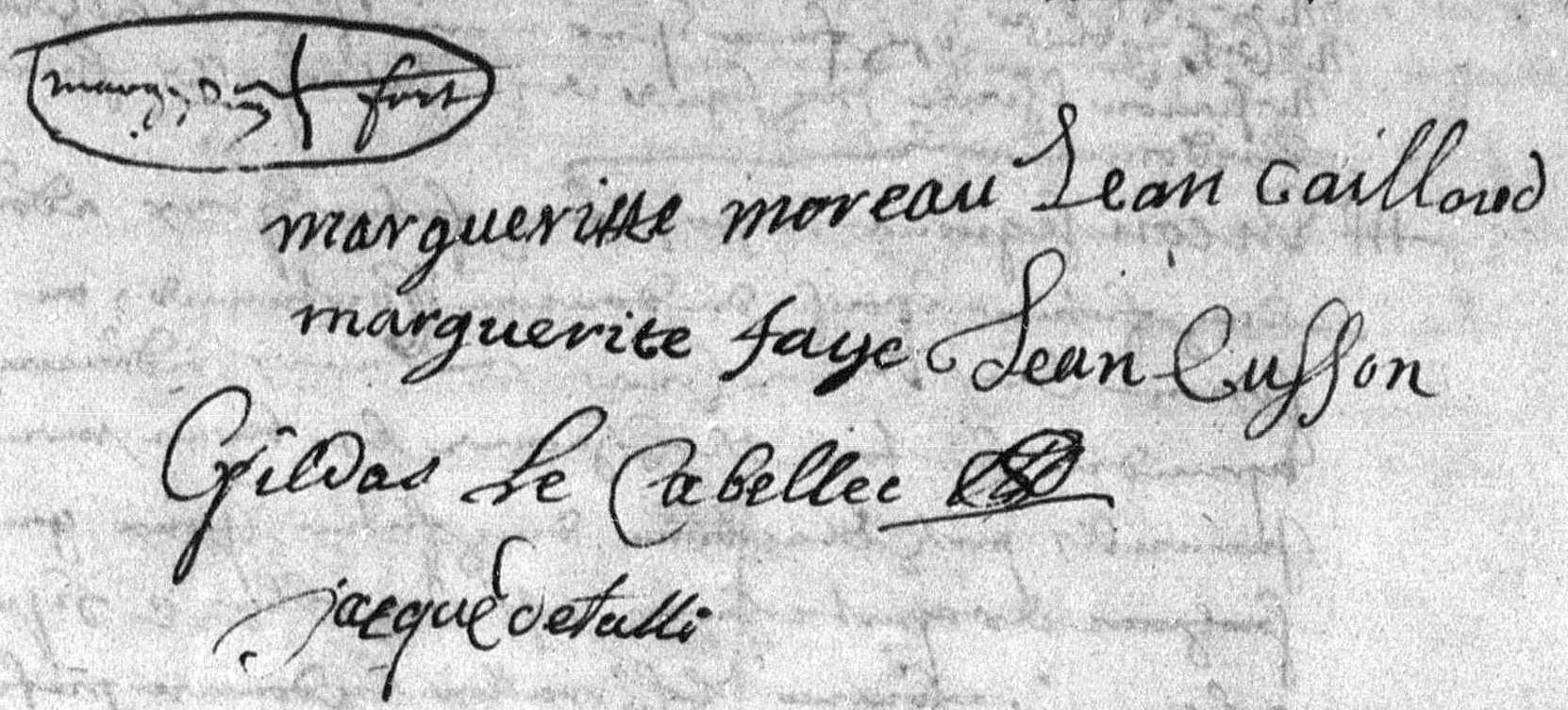
Signature portion of the 1696 marriage contract, including Marguerite’s signature and Jean’s mark
Marguerite declared that all her movable goods—valued at 577 livres 10 sols—would enter the new marital community, while her immovable property remained her own and that of her children from her first marriage. In accordance with the édit des secondes noces, she granted Jean a single child’s share of her future succession, the maximum she was permitted to give a second husband, to protect the rights of her Faille children. Her daughters were to work according to their abilities for the new household without wages while minors. Jean agreed to provide for the four young girls, whose ages ranged from one to thirteen. The contract followed the norms of the Coutume de Paris. The dower was set at 200 livres, and the préciput at 150 livres.
The Coutume de Paris (Custom of Paris) governed the transmission of family property in New France. Whether or not a couple had a marriage contract, they were subject to the “community of goods,” meaning all property acquired during the marriage became part of the community. Upon the death of the parents, the community property was divided equally among all children, both sons and daughters. If one spouse died, the surviving spouse retained half of the community property, while the other half was shared among the children. When the surviving spouse passed away, their share was also divided equally among the children.
The dower referred to the portion of property reserved by the husband for his wife in the event she outlived him. The preciput, under the regime of community of property, was a benefit conferred by the marriage contract, usually on the surviving spouse, granting them the right to claim a specified sum of money or property from the community before the rest was divided.
Jean and Marguerite married on November 21, 1696, in the parish church of La Prairie, in the presence of Pierre Gangnier [Gagné] “and many other parishioners who did not sign.”
The couple settled on Marguerite’s property in La Prairie, where they had two sons:
Jean (1697–1760)
Pierre (1699–1723)
On August 14, 1701, Jean and Marguerite sold a land concession in La Prairie to their son-in-law Pierre Bourdeau for 15 livres. The land measured two arpents of frontage by twenty-five arpents deep. Marguerite’s late son André had been granted this concession in 1695.
Jean and Marguerite appear only occasionally in the records over the next decade and a half, primarily as parents during their daughters’ marriages and as godparents.
Death of Marguerite Françoise Moreau
On September 8, 1718, Marguerite dictated her last will and testament to notary Guillaume Barette dit Courville. She was described as a resident of La Tortue in La Prairie, “lying sick in bed, yet sound in mind, memory and understanding.” She opened her testament in the customary manner, commending her soul to God and invoking the Virgin Mary and her patron saint for comfort in her illness. She then set out her burial wishes and the masses to be performed for the repose of her soul.
Marguerite expressed a strong desire to reward her two sons, Jean and Pierre Lefort, for the support they had given her throughout her life, particularly during her final illness, and for the labour they had contributed to improving the family farm. She left each of them 225 livres and insisted that her executor carry out this provision of the will even if others opposed it. She specified that all funeral expenses, masses, and the special legacies to her sons were to be paid from her movable property; the remainder of her movable and immovable goods was to be divided equally among all her children with inheritance rights. She appointed her neighbour René Dupuy as executor. Too weak to sign, she declared that she could not write her name. Despite her insistence that Jean and Pierre receive their 225-livre legacies, the will was not honoured: the sons ultimately never received them because of objections raised by their half-sisters and the limitations imposed by the Coutume de Paris.
Marguerite Françoise Moreau died “after a long illness” at the age of 64 on October 16, 1718, in La Prairie. She was buried the following day inside the parish church, in accordance with her testament.

1718 burial of Marguerite (FamilySearch)
On February 18, 1719, Jean was elected guardian of his minor children, and René Bourassa was appointed substitute guardian.
On February 23, 1719, notary Michel Lepailleur de La Ferté drew up an inventory of the community of goods belonging to Jean and Marguerite. The eleven-page document enumerated all of the couple’s possessions: kitchen utensils and tools, linens and clothing, furniture, a substantial quantity of harvested grain, farm animals, debts owed, and important papers. The inventory also described the buildings on the Lefort property: a log house measuring twenty-five feet long by twenty feet wide with two chimneys, as well as a barn, a bakery, and a stable.
The following month, on March 7 and 8, 1719, notary Pierre Raimbault drafted an agreement between Jean, his sons, and his stepchildren (and their spouses) in order “to avoid any legal proceedings or disputes” concerning the successions of the late Marguerite Moreau, of Mathieu Faille dit Lafayette, and of Jean and Marguerite’s community of property.
Marriage of Jean Lefort dit La Prairie and Marguerite Bourgis
Notary Marien Tailhandier dit La Beaume drew up a marriage contract between Jean and Marguerite Bourgis (or Bourgery) on August 7, 1719, at the home of Gilles Papin in Boucherville. Jean was about 51 years old; Marguerite was 38, the daughter of Pierre Bourgis (or Bourgery) and Marguerite Boutard. His witnesses were his friends Joseph Bénard and Gilles Papin. Her witnesses were her brothers Léger and Denis, and her cousin Joseph Robert. The contract followed the norms of the Coutume de Paris. Jean was still unable to sign his name, but his future wife could.

Artificial intelligence image created by the author with ChatGPT (November 2025)
The couple married a week later, on August 14, 1719, in the parish church of Sainte-Famille in Boucherville, the bride’s place of residence. Their witnesses were Gilles Papin, René Alexandre Lemoine, René Dupuy, Pierre Roy, Isaac Brien dit Desrochers, and Jacques Gauthier.
Jean and Marguerite settled on his land in La Prairie and had at least three children between 1720 and 1723: an anonymous female child, Marie Marguerite, and Marie Josèphe.
Years of Litigation
Between 1722 and 1726, Jean was involved in several court cases. After the death of Marguerite Moreau, he became responsible for managing the estate from her first marriage to Mathieu Faille. This included land, debts owed to the family, and the rights of the surviving Faille/Delafaye children. Because the estate had never been fully settled, disputes arose among the married daughters, their husbands, and Jean. The 1719 agreement drafted to “avoid any legal proceedings or disputes” had clearly not resolved the underlying issues.
April 10, 1722 – Élisabeth Delafaye vs. Jean Lefort dit Laprairie
Élisabeth, wife of Pierre de St-Cosme, sued Jean, described as a resident of the Côte de la Tortue in La Prairie, alleging that he owed her money. As part of the proceedings, the court assembled a detailed statement of everything the innkeeper Raphaël Beauvais owed to Jean Lefort, likely to help determine the true balance of accounts and whether Lefort’s claims or counterclaims could reduce the amount Élisabeth sought to recover.
July 27, 1722 to July 24, 1724 – Pierre Roy & Marie Angélique Delafaye vs. Jean Lefort dit Laprairie
This larger case concerned the division of the Faille family inheritance. Pierre Roy, acting for his wife Marie Angélique, initiated legal action against Jean, the stepfather of the Faille children. The dispute centred on the proper partition of the estate of Mathieu Faille and Marguerite Moreau. The case expanded to include several heirs: Joseph Bénard dit Carignan (widower of Marguerite Faille/Delafaye), Pierre Bourdeau (husband of Marie Delafaye), Pierre Roy, Angélique Delafaye, and Jeanne Delafaye, widow of Antoine Rougier dit Lafrance. It also contained documentation from a related suit filed by Jean Lefort (father and son) against the Faille heirs. This proceeding was essentially the first major attempt to compel a full accounting of the succession.
July 20 to August 4, 1724 – Jean Lefort (father and son) vs. Joseph Bénard dit Carignan
In this case, brought by Jean Senior and his son Jean, the Leforts sought a formal settlement of the succession of Marguerite Moreau, widow of Mathieu Faille. The file includes depositions and supporting documents submitted to justify their claims, along with an attestation stating that Mathieu Faille had settled on his land in La Prairie before marrying Marguerite Moreau—a detail relevant to distinguishing assets belonging to Mathieu’s estate from Marguerite’s property.
April 16, 1726 — Jean Lefort (father and son) vs. Joseph Bénard dit Carignan and all Faille/Delafaye–Moreau heirs
This final case brought together nearly all remaining heirs to the Faille–Moreau estate. Again, Jean Senior and his son Jean sued Joseph Bénard dit Carignan and the heirs of Mathieu Faille and Marguerite Moreau. The file contains the final judgment (dictum de sentence) setting out how the estate was to be divided.
Death of Jean Lefort dit La Prairie
Jean Lefort dit La Prairie died at the age of approximately 58 on November 1, 1726. His burial record has not been located, but his death date is confirmed in an inventory drawn up later that month.
On November 19, 1726, a gathering of family and friends elected Marguerite Bourgis as guardian of the minor Lefort children, and René Dupuy, their neighbour, as substitute guardian.
Four days later, on November 23, notary Barette dit Courville completed an inventory of the community of goods belonging to Jean and Marguerite. The ten-page document included the couple’s land and buildings, furniture, weapons, farm animals and tools, household items, harvested grain, clothing, and linens.
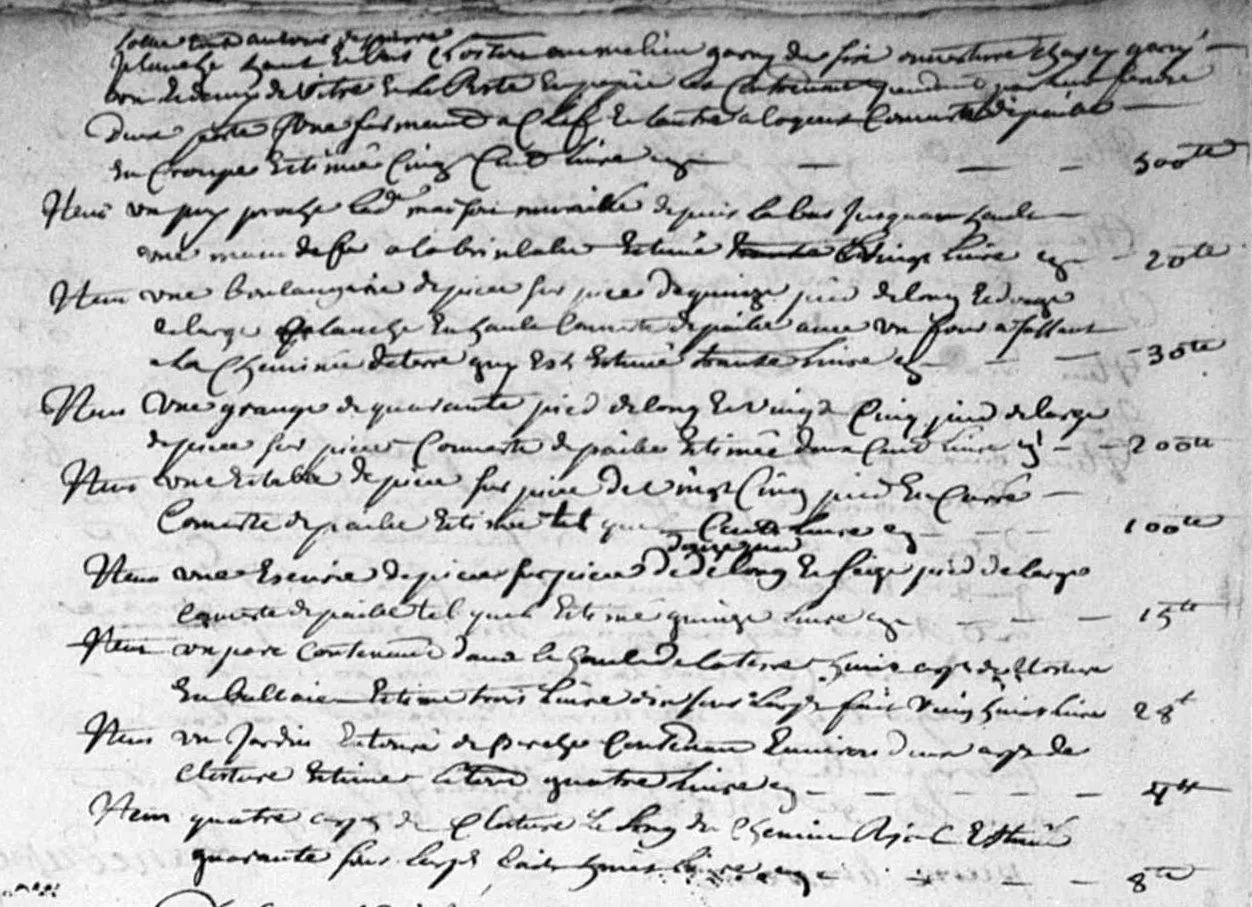
Excerpt of the 1726 inventory, showing Jean’s property and buildings (FamilySearch)
A Life Built on the La Prairie Frontier
From their distant beginnings in Saintonge and Paris, Jean Lefort dit La Prairie and Marguerite Françoise Moreau built a shared life shaped by military service, frontier hardship, and the complex realities of family in early La Prairie. Their union brought together two distinct migration stories—Jean’s enlistment as a young Huguenot soldier and Marguerite’s arrival as a Fille du roi—and anchored them in a community marked by war, settlement, and resilience. Through landholdings, marriages, and the raising of a blended family, they left a durable imprint on the south shore of Montréal. The records that survive—from concessions and marriage contracts to inventories and court cases—trace not only their challenges but also the enduring legacy of the Lefort and Faille–Moreau descendants who continued to shape the region in the generations that followed.
PDF version of article located at: https://www.tfcg.ca/jeanlefortditlaprairie-and-margueritefrancoisemoreau.
Are you enjoying our articles and resources? Show your support by making a donation. Every contribution, regardless of its size, goes a long way in covering our website hosting expenses and enables us to create more content related to French-Canadian genealogy and history. Thank you! Merci!
Sources:
Jocelyne Lefort, “L’audacieuse et courageuse Margueritte-Françoise Moreau, ma première ancêtre paternelle en Nouvelle-France," L’Ancêtre, volume 46, number 328, fall 2019, pages 25-38.
Jocelyne Lefort, “Margueritte-Françoise Moreau, ma première ancêtre paternelle en Nouvelle-France, une femme résiliente (1re partie), L’Ancêtre, volume 49, number 340, fall 2022, pages 33-44.
Jocelyne Lefort, “Margueritte-Françoise Moreau, ma première ancêtre paternelle en Nouvelle-France, une femme résiliente (2e partie), L’Ancêtre, volume 49, number 341, winter 2023, pages 111-121.
"Fonds Drouin, Pointe-aux-Trembles (Registre des Marguilliers), 1674-1803," digital images, Généalogie Québec (https://www.genealogiequebec.com/membership/fr/fonds-drouin/REGISTRES : accessed 20 Nov 2025), abjuration of heresy by Daniel Fore, 4 Mar 1685 ; citing original data : Institut généalogique Drouin, année, Collection Drouin.
“Le LAFRANCE (Baptêmes, Mariages, Sépultures)," database and digital images, Généalogie Québec (https://www.genealogiequebec.com/Membership/LAFRANCE/acte/47344 : accessed 18 Nov 2025), marriage of Mathieu Faille and Marguerite Françoise Maureaux, 30 Sep 1670, Montréal (Notre-Dame-de-Montréal); citing original data: Institut généalogique Drouin.
"Canada, Québec, registres paroissiaux catholiques, 1621-1979," digital images, FamilySearch (https://www.familysearch.org/ark:/61903/3:1:3QSQ-G993-F9WP-2?lang=en&i=88 : accessed 19 Nov 2025), burial of Mathieu and André Faye, 29 Aug 1695, La Prairie > Nativité-de-la-Prairie-de-la-Magdeleine > Baptêmes, mariages, sépultures 1670-1755 > image 89 of 608; citing original data : Archives nationales du Québec, Montréal.
"Canada, Québec, registres paroissiaux catholiques, 1621-1979," digital images, FamilySearch (https://www.familysearch.org/ark:/61903/3:1:3QS7-L993-F97G-C?lang=en&i=82 : accessed 19 Nov 2025), marriage of Jean Lefort dit Laprairie and Françoise Moreau, 21 Nov 1696, La Prairie > Nativité-de-la-Prairie-de-la-Magdeleine > Baptêmes, mariages, sépultures 1670-1755 > image 83 of 608; citing original : Archives Nationales du Quebec, Montréal.
"Canada, Québec, registres paroissiaux catholiques, 1621-1979," digital images, FamilySearch (https://www.familysearch.org/ark:/61903/3:1:3QS7-L993-F97Q-G?lang=en&i=207 : accessed 19 Nov 2025), burial of Marguerite Moreau, 17 Oct 1718, La Prairie > Nativité-de-la-Prairie-de-la-Magdeleine > Baptêmes, mariages, sépultures 1670-1755 > image 208 of 608; citing original data : Archives nationales du Québec, Montréal.
"Canada, Québec, registres paroissiaux catholiques, 1621-1979," digital images, FamilySearch (https://www.familysearch.org/ark:/61903/3:1:3QS7-L993-N943-X?lang=en&i=20 : accessed 19 Nov 2025), marriage of Jean Lefort and Marguerite Bourgeris, 14 Aug 1719, Boucherville > Sainte-Famille-de-Boucherville > Baptêmes, mariages, sépultures 1717-1772 > image 21 of 652; citing original data : Archives nationales du Québec, Montréal.
"Recensement du Canada fait par l'intendant Du Chesneau," digital images, Library and Archives Canada (https://www.bac-lac.gc.ca/eng/CollectionSearch/Pages/record.aspx?app=fonandcol&IdNumber=2318858&new=-8585855146497784530 : accessed 18 Nov 2025), household of Mathieu Fave, 14 Nov 1681, La Prairie de la Magdelaine, page 177 (of PDF), Finding aid no. MSS0446, MIKAN no. 2318858; citing original data: Centre des archives d'outre-mer (France) vol. 460.
"Fonds Cour supérieure. District judiciaire de Montréal. Tutelles et curatelles - Archives nationales à Montréal," digital images, Bibliothèque et Archives nationales du Québec (https://advitam.banq.qc.ca/notice/472407 : accessed 19 Nov 2025), "Tutelle des enfants mineurs de feu Mathieu Faye Lafayette [Mathieu Faille Faye] et de Marguerite Françoise Moreau," 5-6 Nov 1696, reference CC601,S1,SS1,D71, Id 472407.
"Fonds Cour supérieure. District judiciaire de Montréal. Tutelles et curatelles - Archives nationales à Montréal," digital images, Bibliothèque et Archives nationales du Québec (https://advitam.banq.qc.ca/notice/473089 : accessed 19 Nov 2025), "Tutelle des enfants mineurs de Jean Lefort Laprairie et de feu Marguerite Moreau," 18 Feb 1719, reference CC601,S1,SS1,D411, Id 473089.
“Fonds Juridiction royale de Montréal - Archives nationales à Montréal," digital images, Bibliothèque et Archives nationales du Québec (https://advitam.banq.qc.ca/notice/700769 : accessed 20 Nov 2025), "Procès entre Élisabeth Faye, épouse de Cosme, demanderesse, et Jean Lefort dit Laprairie, habitant de la côte de la tortue à Laprairie, défendeur, pour dettes," 10 Apr 1722, reference TL4,S1,D2718, Id 700769.
“Fonds Juridiction royale de Montréal - Archives nationales à Montréal," digital images, Bibliothèque et Archives nationales du Québec (https://advitam.banq.qc.ca/notice/700829 : accessed 20 Nov 2025), "Procès entre Pierre Roy, époux de Marie-Angélique Faye, habitant de Laprairie, demandeur, et Jean Lefort dit Laprairie, veuf de Marguerite Moreau, veuve de Mathieu Faye, pour le partage d'un héritage," 27 Jul 1722 to 24 Jul 1724, reference TL4,S1,D2778, Id 700829.
“Fonds Juridiction royale de Montréal - Archives nationales à Montréal," digital images, Bibliothèque et Archives nationales du Québec (https://advitam.banq.qc.ca/notice/701136 : accessed 20 Nov 2025), "Procès entre Jean Lefort dit Laprairie, père et fils, le premier étant veuf de Marguerite Moreau, demandeurs, et Joseph Bénard dit Carignan, veuf de Marguerite Faye, défendeur, pour le règlement d'une succession," 20 Jul 1724 to 4 Aug 1724, reference TL4,S1,D3085, Id 701136.
“Fonds Juridiction royale de Montréal - Archives nationales à Montréal," digital images, Bibliothèque et Archives nationales du Québec (https://advitam.banq.qc.ca/notice/701310 : accessed 20 Nov 2025), "Procès entre Jean Lefort dit Laprairie, père, veuf de Marguerite Moreau, et son fils du même nom, demandeurs, et Joseph Bénard dit Carignan, veuf de Margueritte Faye, et les héritiers des défunts Mathieu Faye et de son épouse Marguerite Moreau, défendeurs, pour un partage d'héritage," 16 Apr 1726, reference TL4,S1,D3259, Id 701310.
“Fonds Cour supérieure. District judiciaire de Montréal. Tutelles et curatelles - Archives nationales à Montréal," digital images, Bibliothèque et Archives nationales du Québec (https://advitam.banq.qc.ca/notice/473477 : accessed 20 Nov 2025), "Tutelle des enfants mineurs de feu Jean Lefort [Laprairie] et de Marguerite Bourgis [Marguerite Bourgery Bourgis]," 19 Nov 1726, reference CC601,S1,SS1,D605, Id 473477.
“Actes de notaire, 1677-1696 // Claude Maugue," digital images, FamilySearch (https://www.familysearch.org/ark:/61903/3:1:3Q9M-CS5F-SG7H?cat=koha%3A427707&i=1629&lang=en : accessed 17 Nov 2025), land sale by Louis Bertrand dit Larammée and Marie Dumas to Jean Lefort dit Laprairie, 16 Jul 1695, images 1630-1632 of 3080; citing original data: Bibliothèque et Archives nationales du Québec.
“Actes de notaire, 1668-1714 // Antoine Adhémar," digital images, FamilySearch (https://www.familysearch.org/ark:/61903/3:1:3Q9M-CSTH-57QD-9?cat=koha%3A541271&i=882&lang=en : accessed 19 Nov 2025), inventory of the community of goods of Mathieu Faye dit Lafayette and Marguerite Moreau, 8 Oct 1693, images 883-899 of 3065; citing original data: Bibliothèque et Archives nationales du Québec.
“Actes de notaire, 1677-1696 // Claude Maugue," digital images, FamilySearch (https://www.familysearch.org/ark:/61903/3:1:3Q9M-CS5F-93CY-B?cat=koha%3A427707&i=1337&lang=en : accessed 18 Nov 2025), land sale by Mathieu Faye and Marguerite Moreau to Charles Denaux and Madeleine Clément, 17 Mar 1686, images 1338-1342 of 3150; citing original data: Bibliothèque et Archives nationales du Québec.
“Actes de notaire, 1668-1714 // Antoine Adhémar," digital images, FamilySearch (https://www.familysearch.org/ark:/61903/3:1:3Q9M-CSTH-57QD-9?cat=koha%3A541271&i=882&lang=en : accessed 19 Nov 2025), inventory of the community of goods of Mathieu Faye dit Lafayette and Marguerite Moreau, 8 Oct 1693, images 883-899 of 3065; citing original data: Bibliothèque et Archives nationales du Québec.
“Actes de notaire, 1709-1744 // Guillaume Barette," digital images, FamilySearch (https://www.familysearch.org/en/search/catalog/koha:430015 : accessed 19 Nov 2025, collation of a lease for a bench by the Fabrique de la paroisse St-François-Xavier-de-La-Prairie-de-la-Madeleine to Marguerite Moreau, 9 May 1723 (drawn up 9 Oct 1695), images 1093-1095 of 3183; citing original data: Bibliothèque et Archives nationales du Québec.
“Actes de notaire, 1668-1714 // Antoine Adhémar," digital images, FamilySearch (https://www.familysearch.org/ark:/61903/3:1:3Q9M-CSTC-MWDT-C?cat=koha%3A541271&i=1326&lang=en : accessed 19 Nov 2025), inventory of the community of goods of Mathieu Faye dit Lafayette and Marguerite Moreau, 7 Nov 1696, images 1327-1334 of 2856; citing original data: Bibliothèque et Archives nationales du Québec.
“Actes de notaire, 1668-1714 // Antoine Adhémar," digital images, FamilySearch (https://www.familysearch.org/ark:/61903/3:1:3Q9M-CSTC-MWJD-J?cat=koha%3A541271&i=1334&lang=en : accessed 19 Nov 2025), marriage contract of Jean Lefort dit Laprairie and Marguerite Moreau, 7 Nov 1696, images 1335-1340 of 2856; citing original data: Bibliothèque et Archives nationales du Québec.
“Actes de notaire, 1668-1714 // Antoine Adhémar," digital images, FamilySearch (https://www.familysearch.org/ark:/61903/3:1:3Q9M-CSTH-538J-D?cat=koha%3A541271&i=2607&lang=en : accessed 19 Nov 2025), sale of a land concession by Jean Lefort dit Laprairie and Marguerite Moreau to Pierre Bourdeaux, 14 Nov 1701, images 2608-2609 of 3103; citing original data: Bibliothèque et Archives nationales du Québec.
“Actes de notaire, 1709-1744 // Guillaume Barette," digital images, FamilySearch (https://www.familysearch.org/ark:/61903/3:1:3QHV-P3V7-6PDZ?cat=koha%3A430015&i=759&lang=en : accessed 19 Nov 2025, testament of Marguerite Moreau, 8 Sep 1718, images 760-761 of 3183; citing original data: Bibliothèque et Archives nationales du Québec.
“Actes de notaire, 1701-1732 // Michel-Laferté Lepailleur," digital images, FamilySearch (https://www.familysearch.org/ark:/61903/3:1:3Q9M-C344-9SRD-H?cat=koha%3A538127&i=486&lang=en : accessed 19 Nov 2025, inventory of the community of goods of Jean Lefort and Marguerite Moreau, 23 Feb 1719, images 487-497 of 3129; citing original data: Bibliothèque et Archives nationales du Québec.
“Actes de notaire, 1697-1727 // Pierre Raimbault," digital images, FamilySearch (https://www.familysearch.org/ark:/61903/3:1:3Q9M-CS5V-W7NQ-7?cat=koha%3A675517&i=19&lang=en : accessed 19 Nov 2025, agreement between Jean Lefort, his children and step-children, 7 Mar 1719, images 20-29 of 3089; citing original data: Bibliothèque et Archives nationales du Québec.
“Actes de notaire, 1699-1730 // Marien Tailhandier," digital images, FamilySearch (https://www.familysearch.org/ark:/61903/3:1:3Q9M-CS5F-CFCC?cat=koha%3A529348&i=374&lang=en : accessed 19 Nov 2025, marriage contract of Jean Lefort dit Laprerye and Marguerite Bourgit, 7 Aug 1719, images 375-377 of 2906; citing original data: Bibliothèque et Archives nationales du Québec.
“Actes de notaire, 1709-1744 // Guillaume Barette," digital images, FamilySearch (https://www.familysearch.org/ark:/61903/3:1:3QHV-L3V7-6VGC?cat=koha%3A430015&i=1526&lang=en : accessed 20 Nov 2025, inventory of the community of goods of Jean Lefort dit Laprairie and Marguerite Bourgis, 23 Nov 1726, images 1527-1536 of 3183; citing original data: Bibliothèque et Archives nationales du Québec.
Parchemin, notarial database of ancient Québec (1626-1801), Société de recherche historique Archiv-Histo (https://archiv-histo.com : accessed 17 Nov 2025), "Concession d'une terre située à La Prairie de la Magdelayne lieudit à la Tortue; par la Compagnie de Jésus, à Jean Lefort dit Laprairie, soldat de la compagnie de Monsieur de Noyan, de La Prairie de la Magdelayne," notary A. Adhémar de Saint-Martin, 27 Jul 1694.
Fédération québécoise des sociétés de généalogie, Fichier Origine online database (https://www.fichierorigine.com/fr/repertoire/maureau/-moreau : accessed 18 Nov 2025), entry for MAUREAU / MOREAU, Marguerite-Françoise (person #250069), updated on 12 Jul 2012.
Université de Montréal, Programme de recherche en démographie historique (PRDH) database (https://www-prdh-igd.com/Membership/fr/PRDH/Famille/3356 : accessed 14 Nov 2025), dictionary entry for Mathieu DELAFAYE FAILLE and Marguerite MOREAU, union 3356.
Université de Montréal, Programme de recherche en démographie historique (PRDH) database (https://www-prdh-igd.com/Membership/fr/PRDH/Famille/7731 : accessed 19 Nov 2025), dictionary entry for Jean LEFORT PRAIRIE and Marguerite MOREAU, union 7731.
Université de Montréal, Programme de recherche en démographie historique (PRDH) database (https://www-prdh-igd.com/Membership/fr/PRDH/Famille/13213 : accessed 19 Nov 2025), dictionary entry for Jean LEFORT PRAIRIE and Marguerite BOURGERY BOURGIS, union 13213.
Peter Gagné, Kings Daughters & Founding Mothers: the Filles du Roi, 1663-1673, Volume Two (Orange Park, Florida : Quintin Publications, 2001), 422.
Réal Houde, "Mathieu Faye et Marguerite Françoise Moreau, pionniers de La Prairie," Société d’histoire de La Prairie-de-la-Magdeleine (https://shlm.info/articles/mathieu-faye-et-marguerite-francoise-moreau-pionniers-de-la-prairie/ : accessed 18 Nov 2025).
M. Michel Rougé, "La paroisse Saint-Sulpice," Compagnie des Prêtres de Saint-Sulpice (https://www.saintsulpicefrance.fr/missions/la-paroisse-saint-sulpice : accessed 27 Jun 2025).
John H. G. Pell, “SCHUYLER, JOHANNES (John),” in Dictionary of Canadian Biography (https://www.biographi.ca/en/bio/schuyler_johannes_3E.html. : accessed 18 Nov 2025), vol. 3, University of Toronto/Université Laval, 2003–.
André Lachance, Vivre, aimer et mourir en Nouvelle-France; Juger et punir en Nouvelle-France: la vie quotidienne aux XVIIe et XVIIIe siècles (Montréal, Québec: Éditions Libre Expression, 2004), 38-40.