Jean Gagnon & Marguerite Cochon
Jean Gagnon and Marguerite Cochon were among the early French settlers who helped establish permanent communities along the St. Lawrence. This article traces their origins in Perche and Dieppe, their marriage and family life on the Côte de Beaupré, and their roles as merchants, landowners and members of the developing society of New France.
Cliquez ici pour la version en français
Jean Gagnon & Marguerite Cochon
Merchants, Landowners and Pioneers of New France
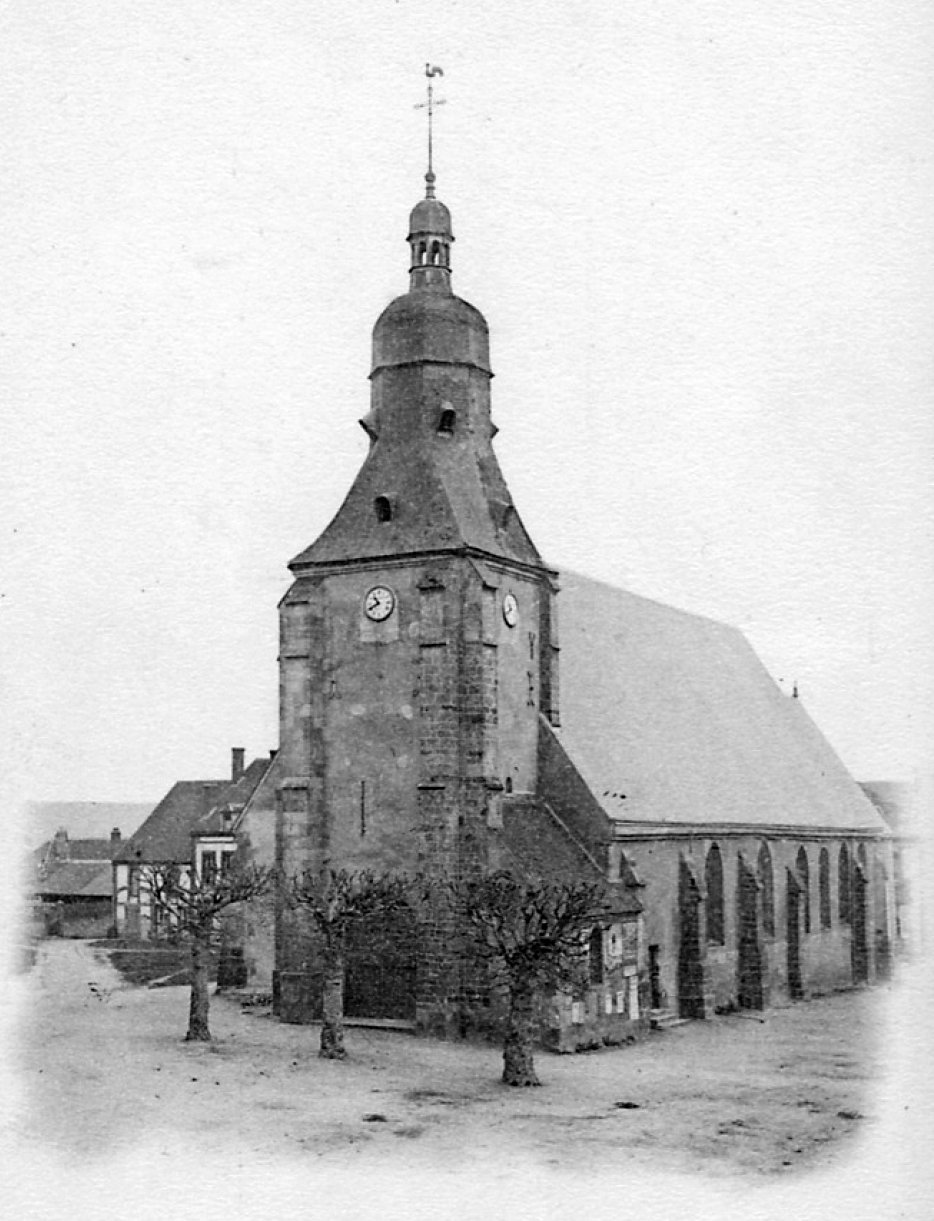
The church of Saint-Aubin in Tourouvre, where Jean Gagnon was baptized, dates back to the 15th century. Dozens of emigrants to Canada were baptized in this church (Archives du Département de l’Orne).
Jean Gagnon, son of Pierre Gagnon and Renée (or Magdeleine) Roger, was born in the village of La Gagnonnière, located between Tourouvre and Ventrouze in the old French province of Perche. He was baptized “Jehan Gaignon” on August 13, 1610, in the parish of Saint-Aubin in Tourouvre. His godparents were Jehan Creste and Jehanne Gaignon. His paternal grandparents were Barnabé Gagnon and Françoise Creste, while his maternal grandparents were Gervais Roger and Marion Aubert. Jean’s family name appeared in a variety of phonetic ways on documents, including Gaignon, Gasgnon, and Gangnon.
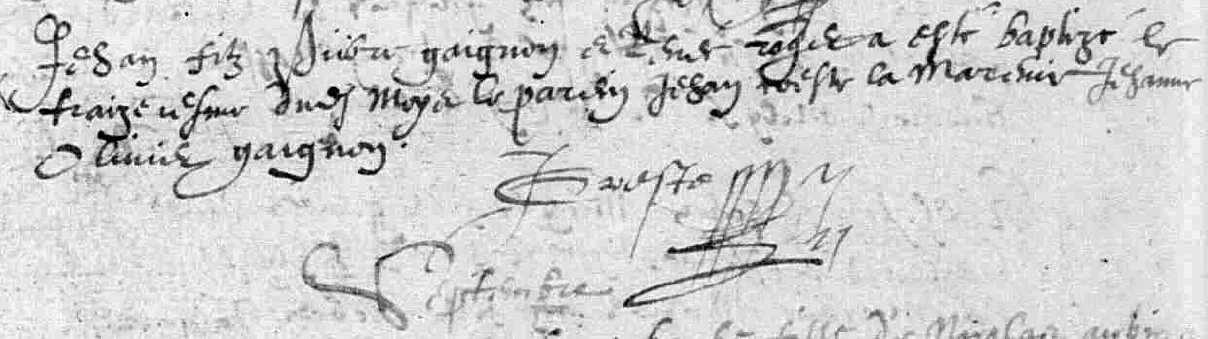
1610 baptism of Jean Gagnon (Archives du Département de l’Orne)
The Gagnon family owned a farm and an inn in La Gagnonnière. Jean had six siblings: Noël, Louis, Mathurine, Marguerite, Mathurin, and Pierre. The latter three would also become pioneers in New France.
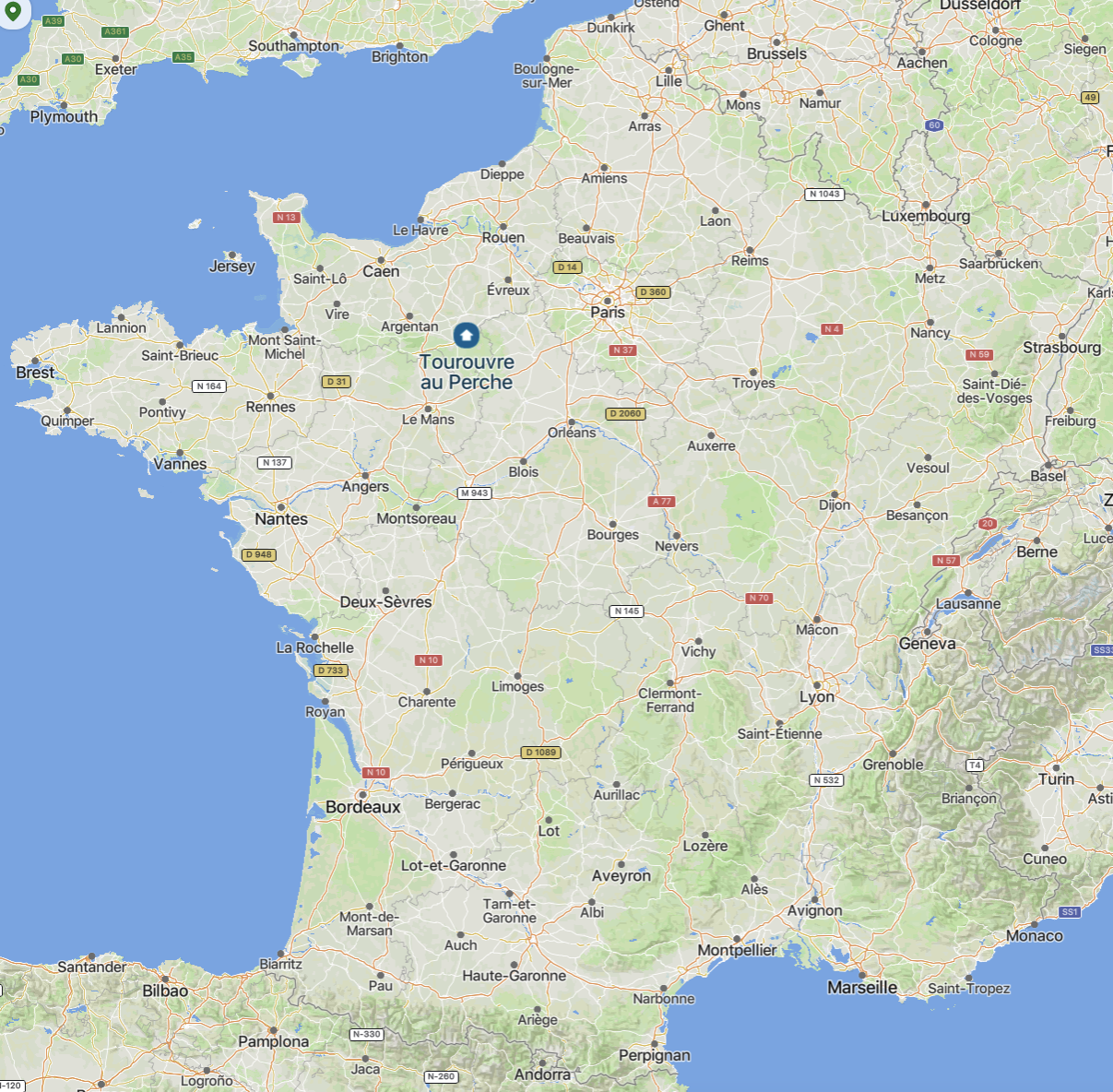
Location of Tourouvre (present-day Tourouvre-au-Perche) in France (Mapcarta)
Jean’s departure for Canada formed part of a much larger migration from Perche that played an important role in the early settlement of New France.
The Percheron Emigration: From France to the Shores of Canada
Tourouvre and the surrounding Perche region became an important centre of seventeenth-century emigration to New France. Many of the colony’s early settlers came from this area, often departing for Canada through the port of La Rochelle. The church of Saint-Aubin houses two remarkable stained-glass windows: one dedicated to those who emigrated to Canada, and another commemorating the 1891 visit of Honoré Mercier, a notable descendant of Julien Mercier.
Key figures in this migration included Robert Giffard, a seigneur and surgeon, and the Juchereau brothers, merchants Jean and Noël, who had been granted large land concessions in Canada. They needed men who could clear their lands, build homes and other buildings, and start cultivation. Their primary aim was to bring as many colonists and families to Canada as possible. The Compagnie des Cent-Associés partly funded the migration of these colonists, including Zacharie Cloutier, Jean Guyon, Noël Langlois, and many others. The Museum of French Emigration to Canada in Tourouvre-au-Perche celebrates these pioneers and their stories.
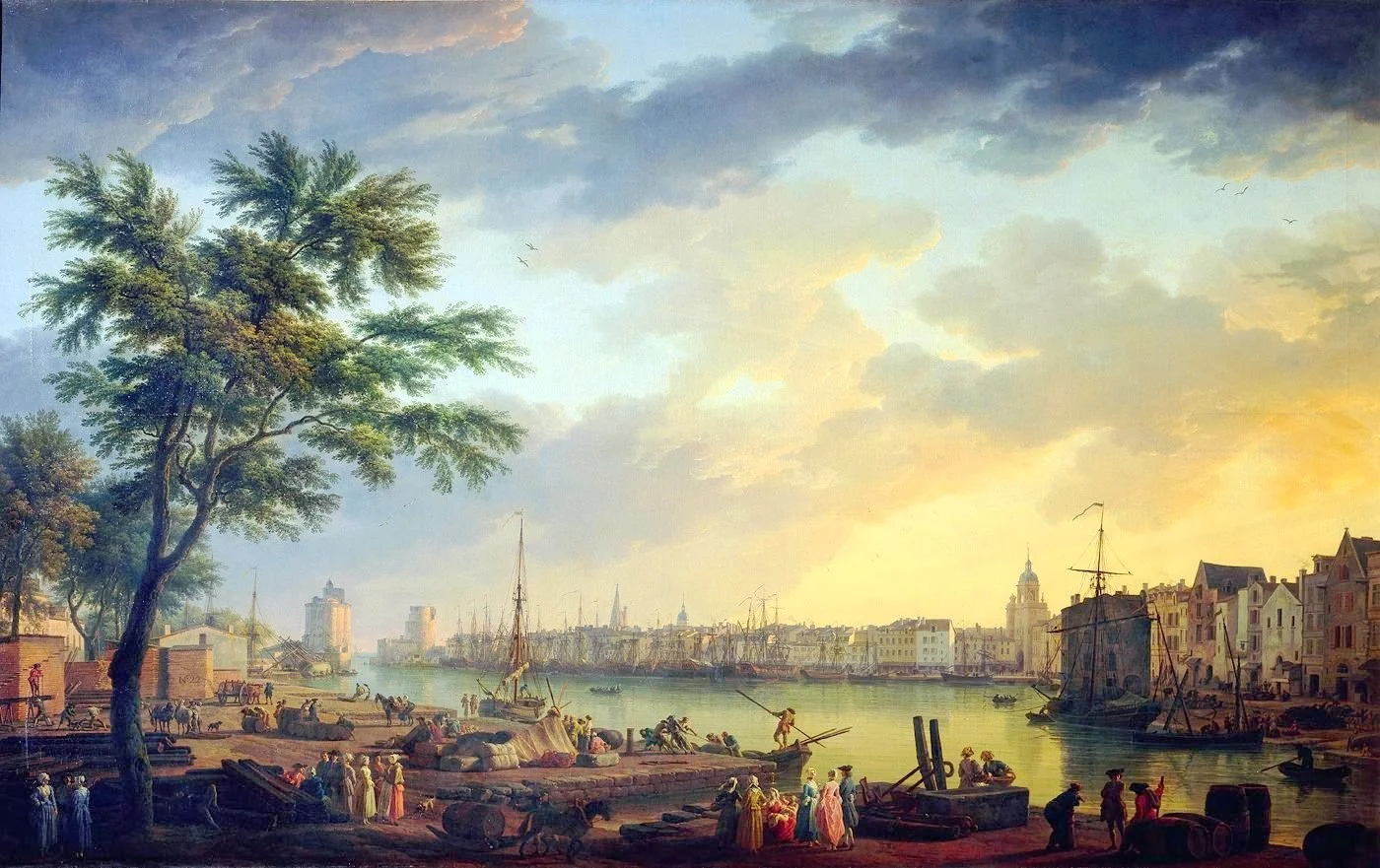
“View of the Port of La Rochelle,” a 1762 painting by Joseph Vernet (Wikimedia Commons)
Arrival in New France
Jean sailed to New France with his brothers Mathurin and Pierre sometime between 1635 and 1640. The three brothers were merchants who operated a store on rue Saint-Pierre in Québec’s lower town. The property measured approximately 24 feet wide by 60 feet deep. Joseph Massé Gravel dit Brindelière was a co-proprietor; he would later marry Marguerite Tavernier, the Gagnon brothers’ niece (daughter of Marguerite Gagnon and Éloi Tavernier).
By 1640, Jean was established on a tract of land on the Beaupré coast at Château-Richer. The property measured seven arpents of frontage on the St. Lawrence River by 126 arpents in depth; formal title to the concession was issued on July 20, 1652. Between 1640 and 1652, Jean bought and sold land in Château-Richer but held onto his original concession.
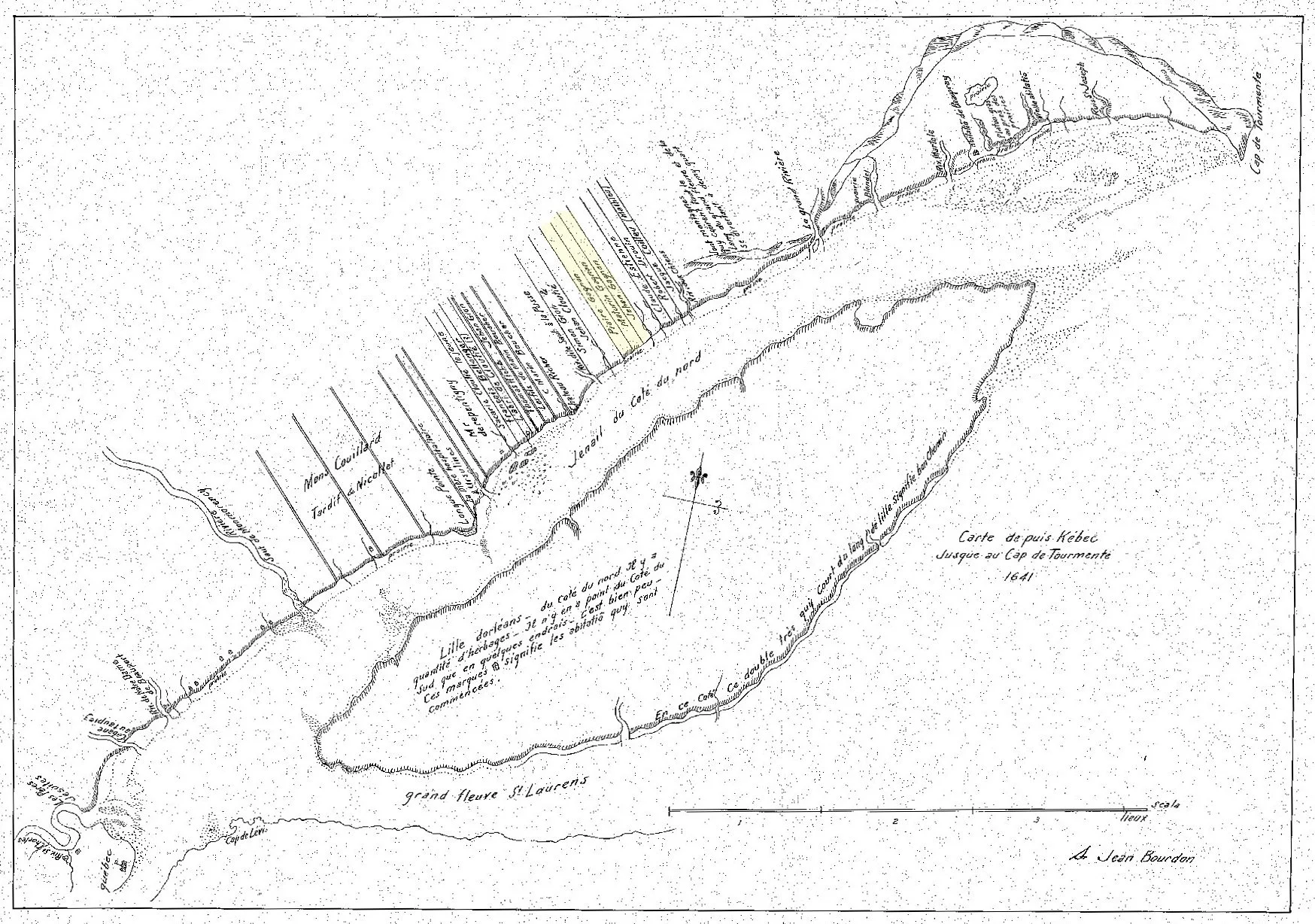
“Map from Kébec to Cap Tourmente, 1641,” drawn by Jean Bourdon, showing the Gagnon concessions in yellow (Bibliothèque et Archives nationales du Québec)
In 1642, Mathurin returned to France to attend to family and business affairs. The following year, he returned to Canada with his daughter Marie Marthe. Around the same period, his sister Marguerite Gagnon and her husband, Éloi Tavernier, also settled in New France with their daughters Marguerite and Marie. Their mother, Renée (or Magdeleine) Roger, likewise emigrated to Canada, although sources differ as to the exact year of her arrival.
Marguerite Cochon (or Cauchon), daughter of Jean Cauchon and Marguerite Cointel (or Cointerel), was born around 1620 in the parish of Saint-Jacques in Dieppe, Normandy, France.
Dieppe sits in northern France, in the Seine-Maritime department. Today, the city has approximately 30,000 inhabitants, known as Dieppois. As a major port, it distinguished itself in the 16th century for its contribution to the French school of cartography.
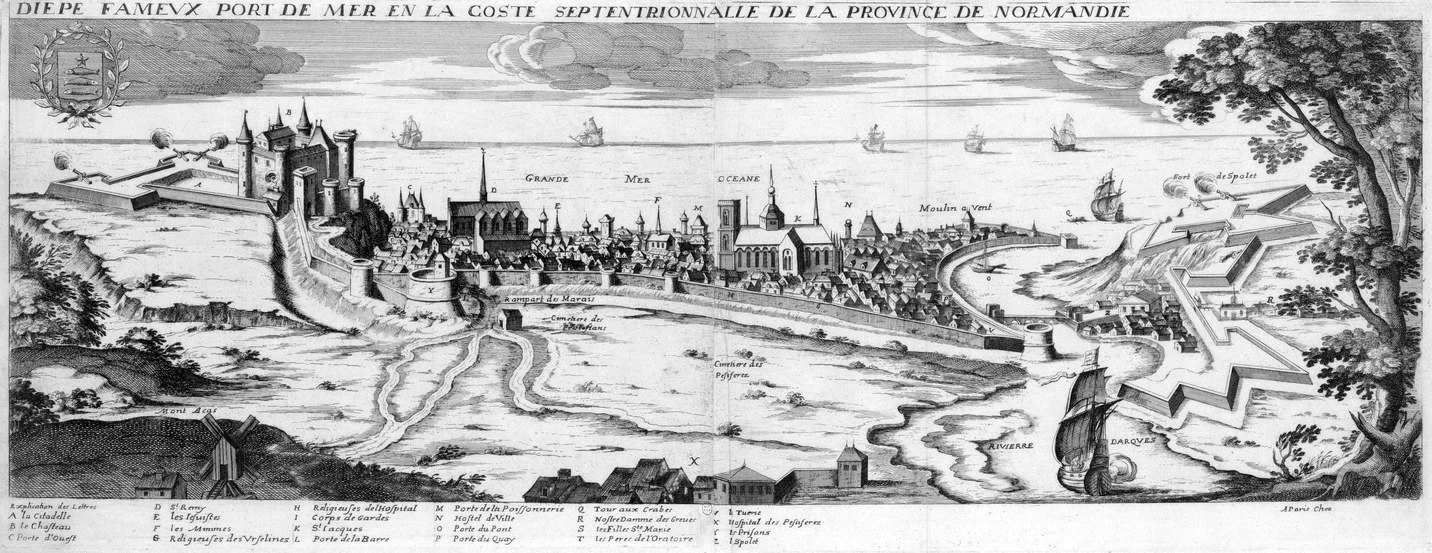
“Diepe, a famous seaport on the northern coast of the province of Normandy,” 1650 (Bibliothèque nationale de France)
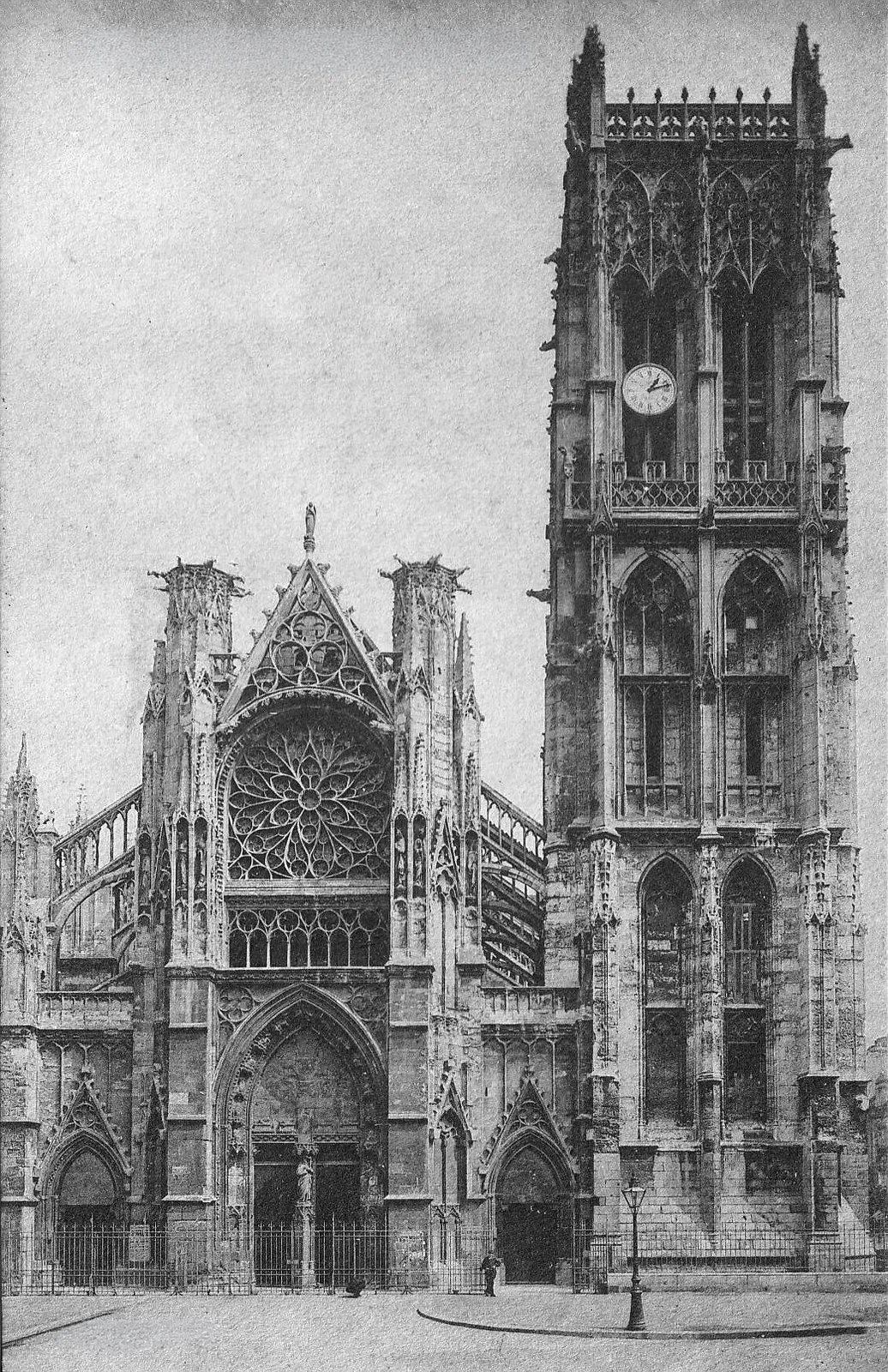
Church of Saint-Jacques in Dieppe, undated postcard (Geneanet)
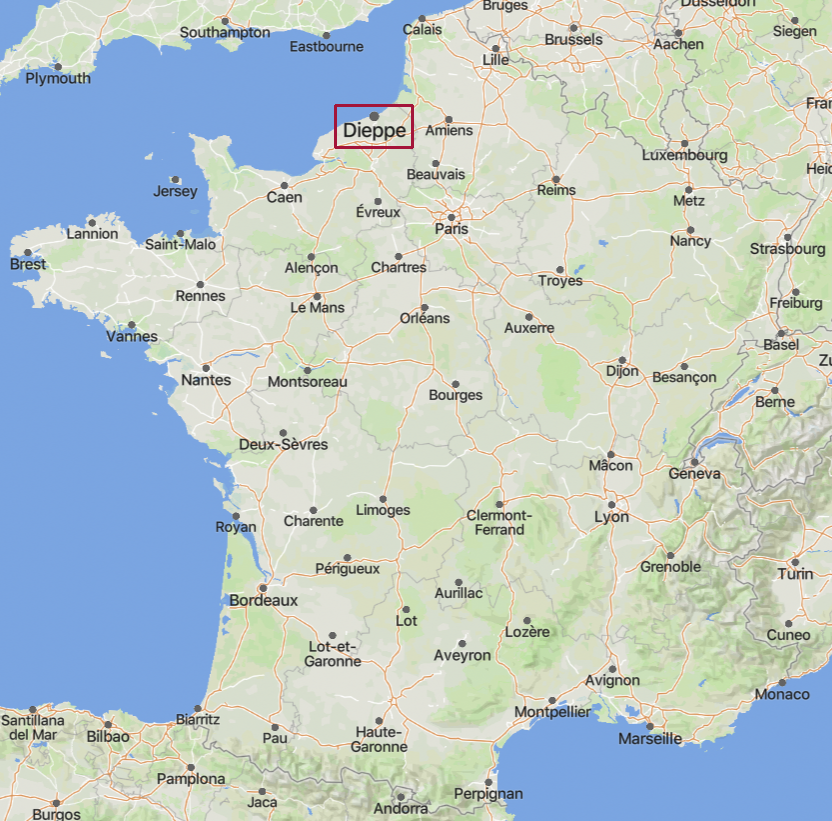
Location of Dieppe in France (Mapcarta)
Marguerite grew up in Dieppe with four brothers: Guillaume, born in January 1624; Jean, born around 1627; Pierre, baptized on July 17, 1631; and Nicolas, born and baptized on January 9, 1633. Their mother, Marguerite Cointel, died that same day at about 40 years of age, and the infant Nicolas died three days later. Their father, Jean Cauchon, remarried Jeanne Abraham in early April 1633. Marguerite subsequently gained at least three half-siblings: Françoise, baptized in Dieppe on December 7, 1633; Jacques, baptized there on February 6, 1635; and an unnamed child born and buried in Québec on March 27, 1642. The family appears to have migrated to New France during the latter half of the 1630s, and Marguerite was established there by 1640, when she married Jean Gagnon.
On Canadian documents, the family name was spelled both Cochon and Cauchon. Marguerite signed her name Cochon.
Marriage and Children
Jean “Gangnon” and Marguerite “Cochon” were married on July 29, 1640, in Beaupré. [The record is preserved in the Québec register now catalogued under Notre-Dame-de-Québec.] He was 29 years old; she was about 20. The witnesses were Pierre Legardeur d’Arpentigny; Noël Juchereau, sieur des Châtelets; and Jean Bourdon. [The marriage record incorrectly describes both of Jean’s parents as deceased; his mother was still living.]
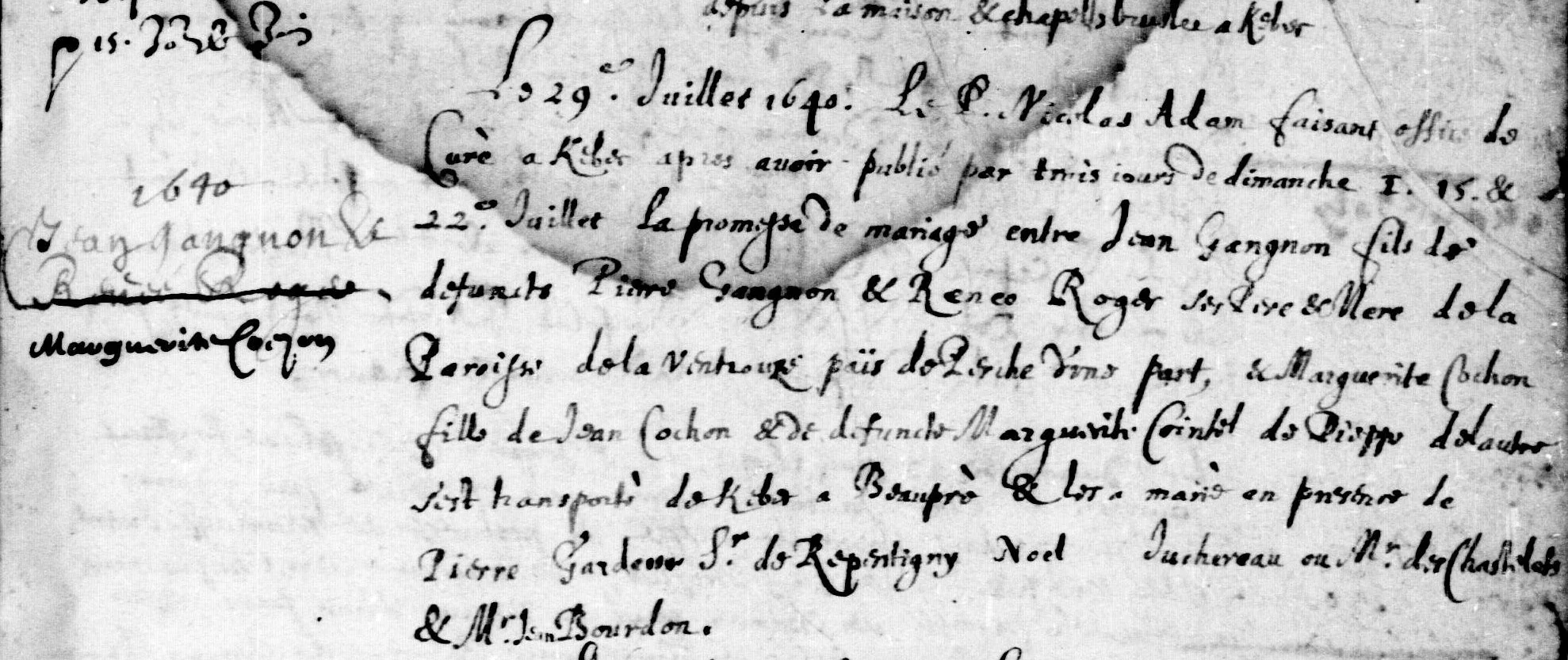
1640 marriage of Jean and Marguerite (Généalogie Québec)
Jean and Marguerite settled on the côte de Beaupré, where they had at least eight children:
Jeanne (1641–1699)
Renée (1643–bef. 1702)
Marguerite (1645–bef. 1705)
Jean (1648–1687)
Étienne (1650–bef. 1666)
Germain (1653–1708)
Raphaël (1656–1687)
Marie (1659–1722)
Business and Property in Québec
On August 14, 1651, the three Gagnon brothers received a land concession from Louis d'Ailleboust, which was ratified by Jean de Lauson on December 1, 1652. The concession involved three-quarters of a site located on rue Saint-Pierre, in the lower town of Québec, measuring four toises wide by ten toises long, on which there was a main building consisting of three rooms with chimneys, three bedrooms, and three attics. [The toise was an old measure of length equal to six feet.]
On October 6, 1653, Jean was involved in two notarial transactions recorded by notary Guillaume Audouart dit Saint-Germain:
Six-month lease agreement for one half of the cellar of a shop and house located on the port of Québec by Pierre, Jean, and Mathurin Gagnon, brothers, and Massé Gravel dit Brindelière, to merchant Jean Garos of La Rochelle, for 90 livres.
Contract for the carpentry and flooring of the same house located in the port of Québec by Michel Bourdet and Pierre Biron, carpenters, for Jean, Pierre and Mathurin Gagnon, brothers, and Massé Gravel dit Brindelière, for 135 livres.
Before the same notary, four years later on September 9, 1657, Jean recognized that he owed Robert Tauvé the sum of 152 livres, 9 sols, 6 deniers, for a cash loan. Jean incurred the debt to finance the transportation from France of an engagé, or hired servant, who was to work for him in New France.
Family and Community Life
On February 2, 1660, Jean and Marguerite, as well as their children Renée, Jean, Jeanne, and Marguerite, received the sacrament of confirmation from François de Montmorency-Laval, “Monsignor the Illustrious and Most Reverend Bishop of Petrée, Vicar Apostolic in the whole of New France,” in Château-Richer, alongside 169 other people.
The following month, on March 7, 1660, notary Claude Auber penned an agreement between Jean and his son-in-law Jean Chapeleau, the husband of Jeanne Gagnon. The pair formally settled their outstanding mutual accounts, which included money, work performed, provisions, and apparently matters involving livestock. After the accounts were reconciled, Jean owed his son-in-law 160 livres.
The Gagnon Family in the Census
In 1666, Jean and Marguerite were recorded in the census of New France living on the côte de Beaupré (in Château-Richer) with their five children and one domestic servant, Étienne Mesny.
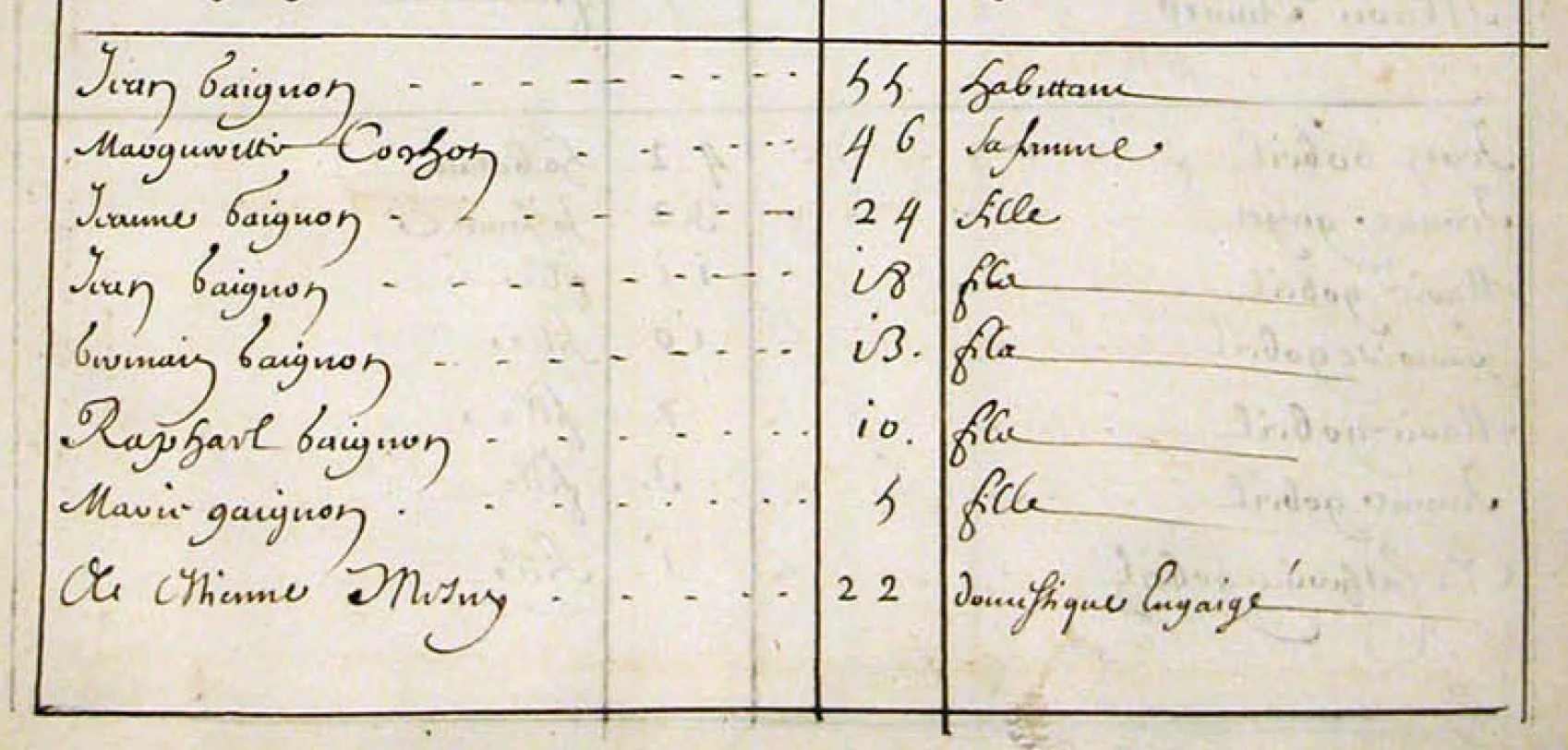
1666 census for the “Gaignon” family (Library and Archives Canada)
The following year, another census was taken. Jean and Marguerite were still living in Beaupré with their four children and a different domestic servant, Noël Viard. They owned 8 head of cattle and 30 arpents of cleared or cultivated land.
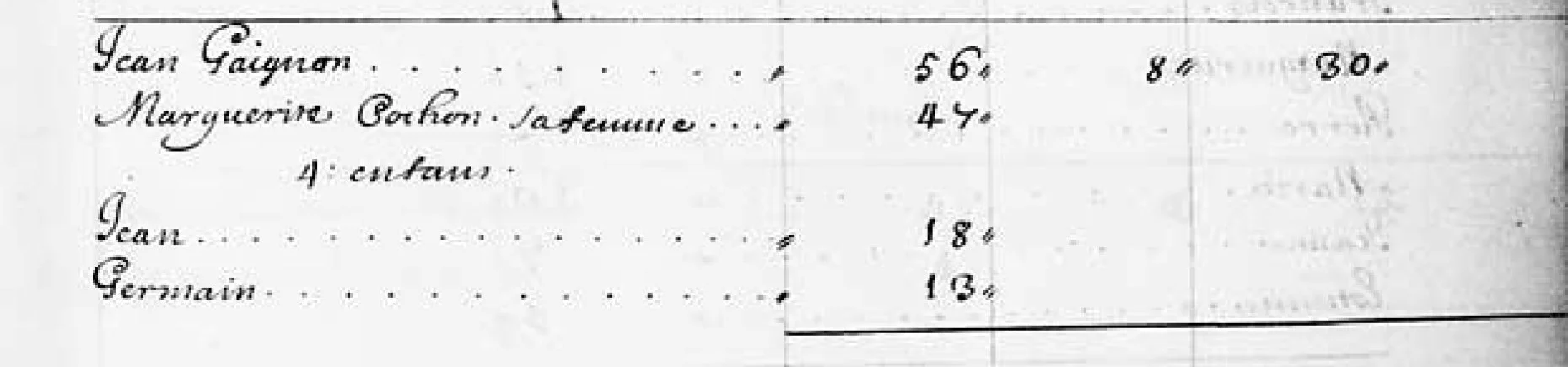

1667 census for the “Gaignon” family (Library and Archives Canada)
Final Property Transactions
Jean appeared in two last notarial documents before his death.
On February 21, 1667, Jean and his brother Pierre purchased a plot of land located on the côte and seigneurie of Beaupré from Nicolas Quentin [Cantin] and Madeleine Roulloy [Roulois] for 1,800 livres. The land measured four arpents of frontage facing the St. Lawrence River, bordering Jean’s own land and that of Martin Guérard. It was subject to a seigneurial rente of 20 sols for each arpent of frontage, plus two live capons for the entire property, due annually on the feast day of Saint Martin, November 11. On this document, we see Jean’s signature for the first time, where previously he had only left his mark.
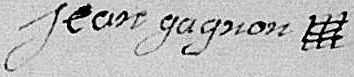
Signature of Jean Gagnon in 1667 (FamilySearch)
On October 9, 1668, Jean sold his interest in the Québec property to bourgeois Pierre Pellerin de St-Amand and Louise de Monceaux for 300 livres. Located on “the street running from the Place d’Armes to the Company’s warehouse,” the house had a cellar, kitchen and attic, and neighboured that of Noël Jérémie dit Lamontagne and Jacques Leber. Curiously, Jean now declared not knowing how to write or sign.
Death of Jean
Jean Gagnon died at the age of 59 on April 2, 1670. He was buried the same day inside the parish church of Notre-Dame in Château-Richer. He was recorded as a marguillier, or church warden. [Although the burial record gives Jean’s age as 70, his 1610 baptism establishes that he was 59.]
The burial record reads:
“In the year of our Lord Jesus Christ, one thousand six hundred and seventy, on the second of April, Jean Gagnon, husband of Marguerite Cochon, aged seventy, died in the communion of the Holy Church, having received penance and the sacrament of the extreme unction on the second of April; being a churchwarden and a resident of Notre-Dame du Château-Richer, he was buried in the same church.”
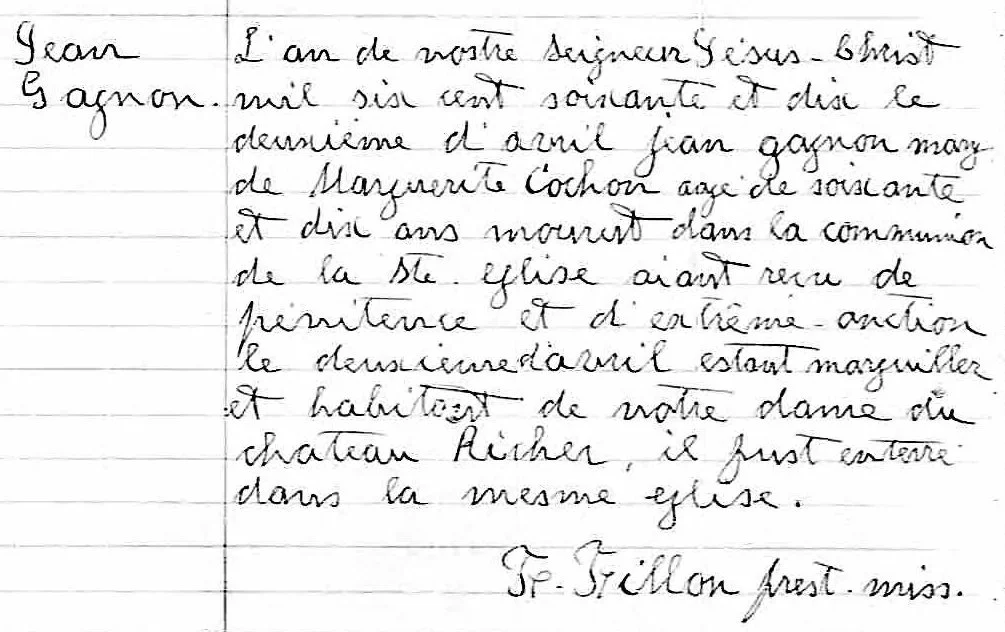
1670 burial of Jean Gagnon (Ancestry) [copy]
Buried inside the Church?
Intramural church burial was an ancient Christian tradition that early colonists brought from France. In France, this privilege was primarily reserved for clergy and nobles. However, in New France, burials within church walls were not limited to these elite groups. They were performed for those belonging to the most powerful social classes (which could include farmers), successful tradespeople, and those devoted to their church and community.
Bodies were typically placed in crypts located under the church floor or in graves dug after raising the floor or moving a church bench.
The funeral rites for such burials were generally more elaborate and expensive than those for cemetery burials. These rites often included special masses, processions, and other ceremonies that underscored the social status and community contributions of the deceased.
The practice of intramural church burials began to decline by the mid-nineteenth century, primarily due to public hygiene concerns, lack of space, and changing attitudes toward burial practices. By this time, many communities began to favour dedicated cemeteries located away from populated areas.
The Inventory
Marguerite would outlive her husband by almost three decades. During those years, she appears repeatedly in the notarial record, managing property, settling family inheritances and disputes, and gradually transferring portions of her land through a series of sales, divisions, and agreements.
On January 19, 1674, notary Paul Vachon drew up an inventory of the community of goods belonging to Marguerite and her late husband. The document enumerated their possessions, which included:
Hearth and kitchen equipment
a pot/fireplace crane
cooking pots with their lids and ladles
a grill/gridiron
a shovel
five kettles
a strainer
16 pounds of pewter
an old basin
Weapons and tools
a large gun
another gun
two sickles
two scythes
a carpenter’s chisel
a hammer
Farm equipment and livestock
a fully equipped plow with its fittings
four oxen
two dairy cows
two other cows
three heifers
four pigs
Grain and food stores
50 minots of wheat
25 minots of barley
4 minots of peas
Furniture
two chests with locks
The inventory also listed a few outstanding debts and obligations, as well as the land concession document for Marguerite’s property. It measured seven arpents of frontage on the St. Lawrence River by one and a half leagues in depth and bordered the lands of Jacques David and Jean Gagnon, son of Pierre. It was subject to a cens of 7 sols, plus 7 livres and two live capons in seigneurial rente. The document also includes Marguerite’s signature.
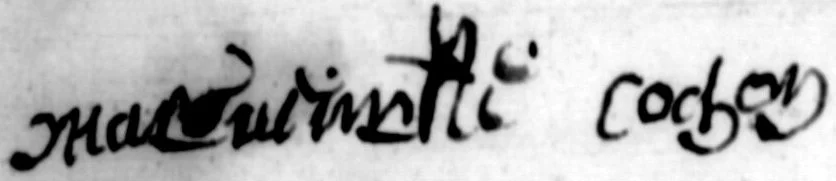
Marguerite’s signature in 1674 (Bibliothèque et Archives nationales du Québec)
The After-Death Inventory
The Coutume de Paris (Custom of Paris) governed the transmission of family property in New France. When a couple married, with or without a contract, they were subject to the “community of goods.” All property acquired during the union by the spouses was part of this community. After the death of the parents (assuming the couple had children), the property of the community was divided equally among all the children, sons and daughters. When the community was dissolved by the death of one spouse, the survivor was entitled to half, and the other half was divided equally among the children. When the surviving spouse died, the children divided the remaining share of the community. Inventories were drawn up after a death to itemize all the goods within a community.
Dividing the Cochon Inheritance
Six months later, on the afternoon of July 2, 1674, Marguerite and her brothers Jean and Jacques appeared before notary Vachon to divide a land concession located in Château Richer, in the seigneurie of Beaupré, inherited from their father Jean, who died in 1673. The land measured six arpents of frontage facing the St. Lawrence by one league and a half deep. On the property was a house with two lower rooms, a cellar and an attic, as well as a barn, a stable, a courtyard and a garden. It was subject to a cens of 6 sols, plus 6 livres and two live capons in seigneurial rente, payable to the seigneurs annually on November 11, the feast day of Saint Martin.
Jean and Marguerite relinquished their rights in the three-arpent portion on one side to Jacques, while Jacques relinquished his rights in the other three-arpent portion to them. Jacques's portion was the improved half with the house, buildings and cultivated land. The other three arpents fell to Jean and Marguerite. The agreement also contains provisions intended to equalize the partition; Jacques was to assist with grain associated with the other three arpents so that Jean and Marguerite could develop their portion.
Why Capons?
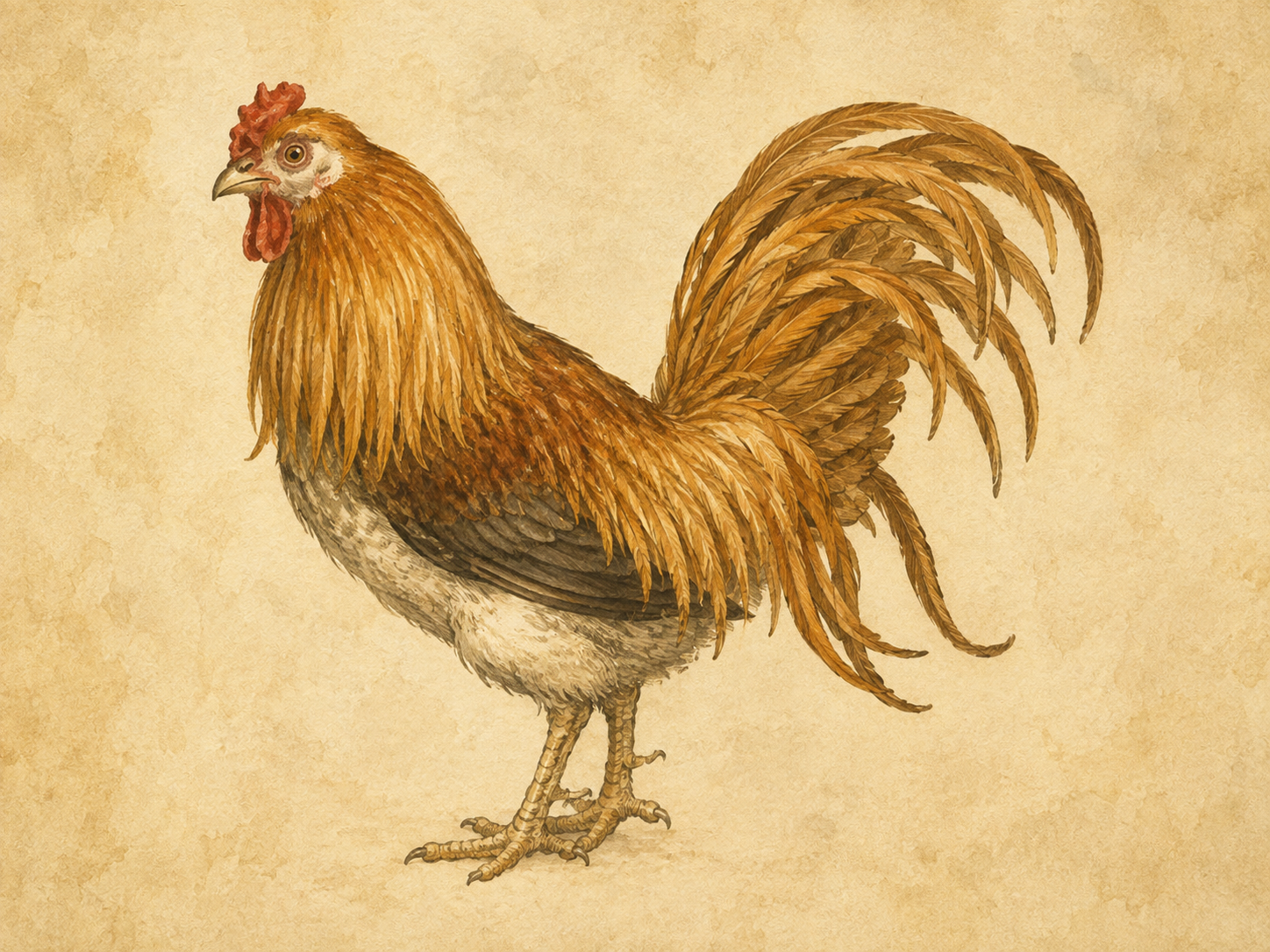
Illustration generated with artificial intelligence by the author, August 2026 (ChatGPT)
A capon was a castrated rooster that was then fattened for the table. Caponizing produced a less active bird that accumulated more fat and retained tender meat longer than an ordinary mature rooster, making capons a particularly desirable form of poultry.
In New France, capons became a common form of seigneurial rent paid in kind, often assessed at one fat capon per arpent of frontage. The bird had a recognized monetary equivalent—frequently 20 sols—so the obligation could sometimes be satisfied in cash instead. Wheat could sometimes be substituted as well. In effect, the capon functioned as both food and a convenient standardized unit of value in an economy where annual obligations were not always paid entirely in cash.
The timing was also practical. Seigneurial rents were frequently due on St. Martin’s Day, November 11, after the agricultural season. Caponizing was practiced toward the end of summer, which meant the birds could be fattened and ready when autumn rents fell due.
In 1681, Marguerite was recorded in the census of New France still living on the côte de Beaupré (in Château-Richer) with her two sons, Germain and Raphaël. The family owned one gun, nine head of cattle, and 14 arpents of cleared or cultivated land. The household listed before hers in the census was that of her nephew Jean Gagnon, and the one after was that of her son Jean.

1681 census for Marguerite Cochon’s household (Library and Archives Canada)
Inheritance Disputes with Son Jean
The disputes over Jean Gagnon’s estate had begun several years earlier. On February 24, 1676, notary Gilles Rageot drew up an arbitration agreement between Marguerite, acting on her own behalf and as mother and guardian of her three minor children, Germain, Raphaël and Marie, together with their paternal uncle and curator Pierre Gagnon, and Marguerite’s adult son Jean. A dispute had arisen over what Jean was entitled to receive from his late father’s estate, as well as other claims between the parties. They agreed to submit their differences to arbitrators and to abide by their decision.
On August 9, 1682, Marguerite and her children entered into another partition concerning the division of the family’s land in Château-Richer. Disputes nevertheless continued, particularly between Marguerite and her eldest son Jean over their respective rights and financial obligations arising from his father’s estate. On March 15, 1684, the family again agreed to submit the outstanding issues to arbitration.
The arbitrators issued their decision the following day. After reviewing the family’s earlier contracts, estate inventory, accounts, land divisions and previous court decisions, they balanced the various claims between Marguerite and Jean and determined that Jean ultimately owed his mother only 19 livres and 1 sol, which Marguerite agreed to forgive.
More importantly, they rearranged their adjoining landholdings: Jean received his inherited share of four perches and three feet of frontage beside land he already owned and transferred an equivalent area to his mother. The fence between their properties was to be moved accordingly, and all other outstanding claims between the parties were dismissed. On March 20, 1684, the Conseil souverain formally confirmed the arbitration award.
Settling the Family Property
After the inheritance disputes had largely been settled, Marguerite continued to manage and gradually redistribute the family’s property. Between 1688 and 1696, she appears in a series of notarial transactions involving her children, in-laws and other relatives. These agreements included sales and donations of land, the settlement of inheritance shares, compensation for services rendered by her son Germain, and ultimately arrangements for her own support in old age.
January 23, 1688 — Property transferred to Germain: Marguerite’s sons-in-law Jean Caron and Louis Gagnier acknowledged that she had fully satisfied the shares of movable property due to their wives, Marguerite and Marie Gagnon. They then sold their wives’ inherited land shares to their brother-in-law Germain Gagnon. Each parcel measured four perches of frontage on the St. Lawrence River by one and a half leagues in depth, and Germain paid 150 livres for each. In a separate transaction that same day, Marguerite sold Germain a one-arpent portion of her own Beaupré property for 600 livres.
April 3, 1689 — A donation to Barbe Delphine Tardif: Marguerite and her brother Jean Cochon donated two arpents of land at Château-Richer to their sister-in-law, Barbe Delphine Tardif, widow of Jacques Cochon. The property extended one and a half leagues inland and lay between land belonging to the donors and Barbe’s own property. The donation was made in recognition of the “good and faithful services and friendship” Barbe had shown them.
May 11, 1692 — Sale to Jacques Cochon and Geneviève Plante: Marguerite sold a portion of her property in the seigneurie of Beaupré to her nephew Jacques Cochon, son of Jacques Cochon and Barbe Delphine Tardif, and his wife Geneviève Plante. The land measured one arpent of frontage on the St. Lawrence River by one and a half leagues in depth and included cultivated land, meadows and woodland. It bordered the property of Barbe Delphine Tardif, and the purchasers assumed the seigneurial obligations attached to the land.
June 3, 1692 — Compensation for Germain’s years of service: Marguerite formally acknowledged owing her son Germain 1,000 livres for the many years of service he had rendered her following his father’s death. In satisfaction of this debt, she transferred to him a parcel measuring one and a half arpents of frontage on the St. Lawrence River by one and a half leagues in depth. The agreement also protected Germain’s investment: if Marguerite’s heirs later attempted to reclaim the property, they would first have to reimburse both the 1,000 livres and the value of any improvements he had made.
June 3, 1692 — Property in exchange for lifetime support: In a separate act executed the same day, Marguerite transferred another parcel to Germain, this one measuring one arpent of frontage by one and a half leagues in depth and valued at 800 livres. Instead of paying the price in cash, Germain undertook to support his mother for the remainder of her life. His obligations included food, lodging, and heat, care during illness, clothing, and, after her death, responsibility for her burial and prayers for her soul.
January 12, 1693 — Sale to surgeon Jean Navers: Marguerite next sold an habitation at Château-Richer to Jean Navers, a surgeon, for 1,300 livres. The property measured two and a half arpents of frontage on the St. Lawrence River by one and a half leagues in depth and included cultivated land, meadows and woodland. It bordered land belonging to the heirs of Jean Gagnon and property then held by Germain Gagnon. On March 11, Marguerite formally acknowledged receiving the purchase price and released Navers from any further obligation.
November 5, 1696 — New arrangements for Marguerite’s care: In the last known notarial act concerning Marguerite before her death, she, Germain and her son-in-law Jean Caron reorganized the arrangements for her support. Marguerite was to live with Caron and her daughter Marguerite Gagnon, who would provide her with food and lodging whether she was healthy or ill. Germain agreed to contribute 25 livres per month toward her upkeep and remained responsible for supplying her clothing, including a new robe de chambre and a chemisette. Although Marguerite had signed earlier notarial acts, on this occasion she declared that she did not know how to write or sign.
Death of Marguerite
Marguerite Cauchon died at the age of about 79 on June 24, 1699, at the Hôtel-Dieu in Québec. She was buried in the hospital cemetery. [Though the patient register records her only as “Madame Gagnon,” the PRDH, Fichier Origine, and René Jetté have all attributed this record to Marguerite Cauchon.]
Gagnon Heritage
Several plaques honour the history of the Gagnon family. In 1960, a commemorative plaque was affixed to the church of Saint-Aubin in Tourouvre in honour of the Gagnon brothers.
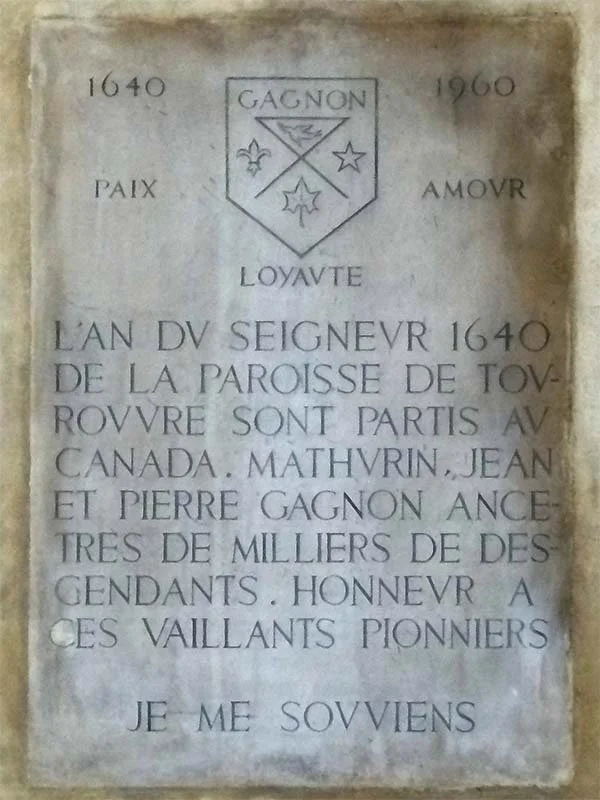
(© Association Perche-Canada; photo used with permission)
In Canada, a plaque marks the place where the Gagnon brothers operated a store in Québec City's Lower Town in 1651. It is located in UNESCO Park.
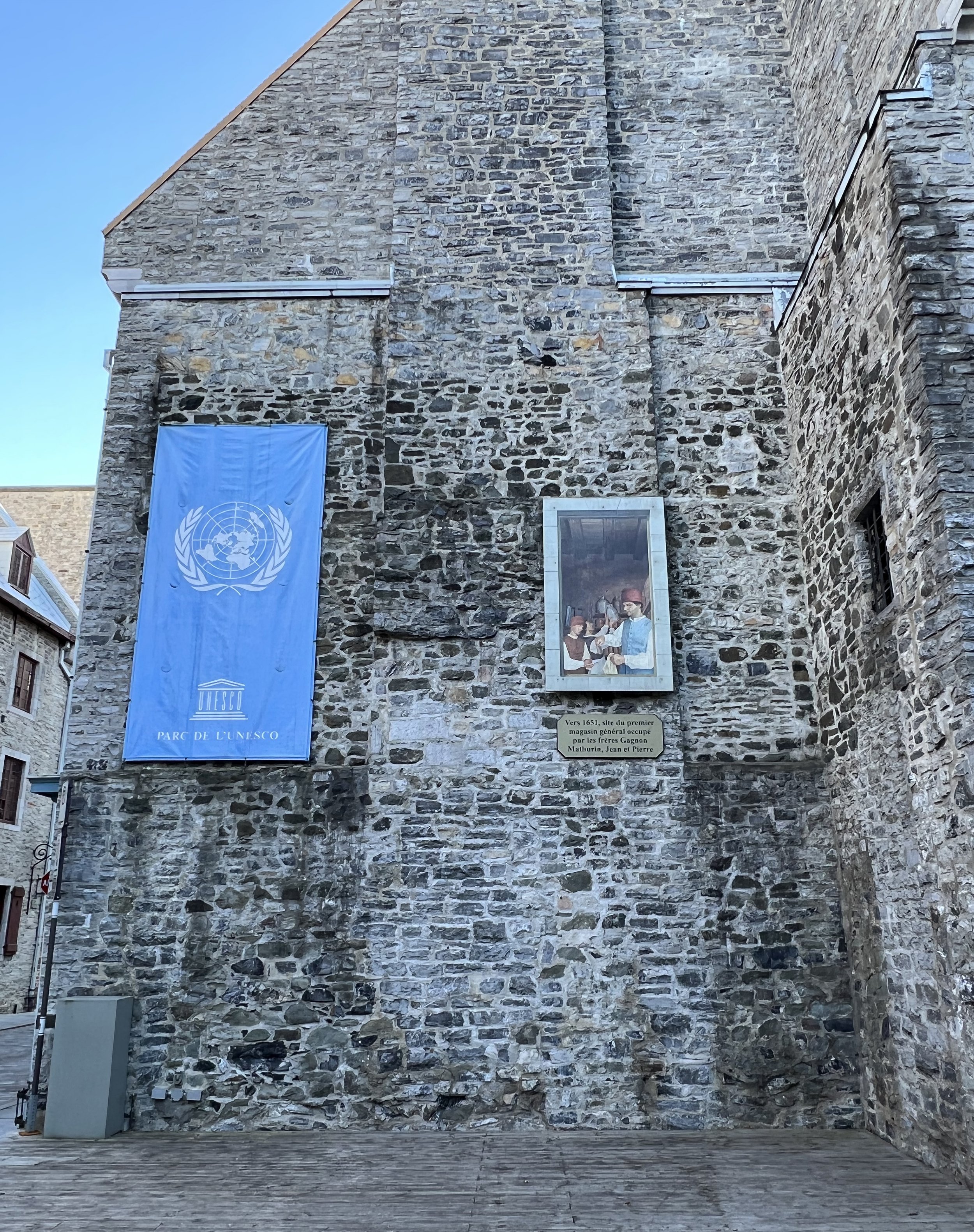
Gagnon brothers’ commemorative plaque in Québec (© The French-Canadian Genealogist)
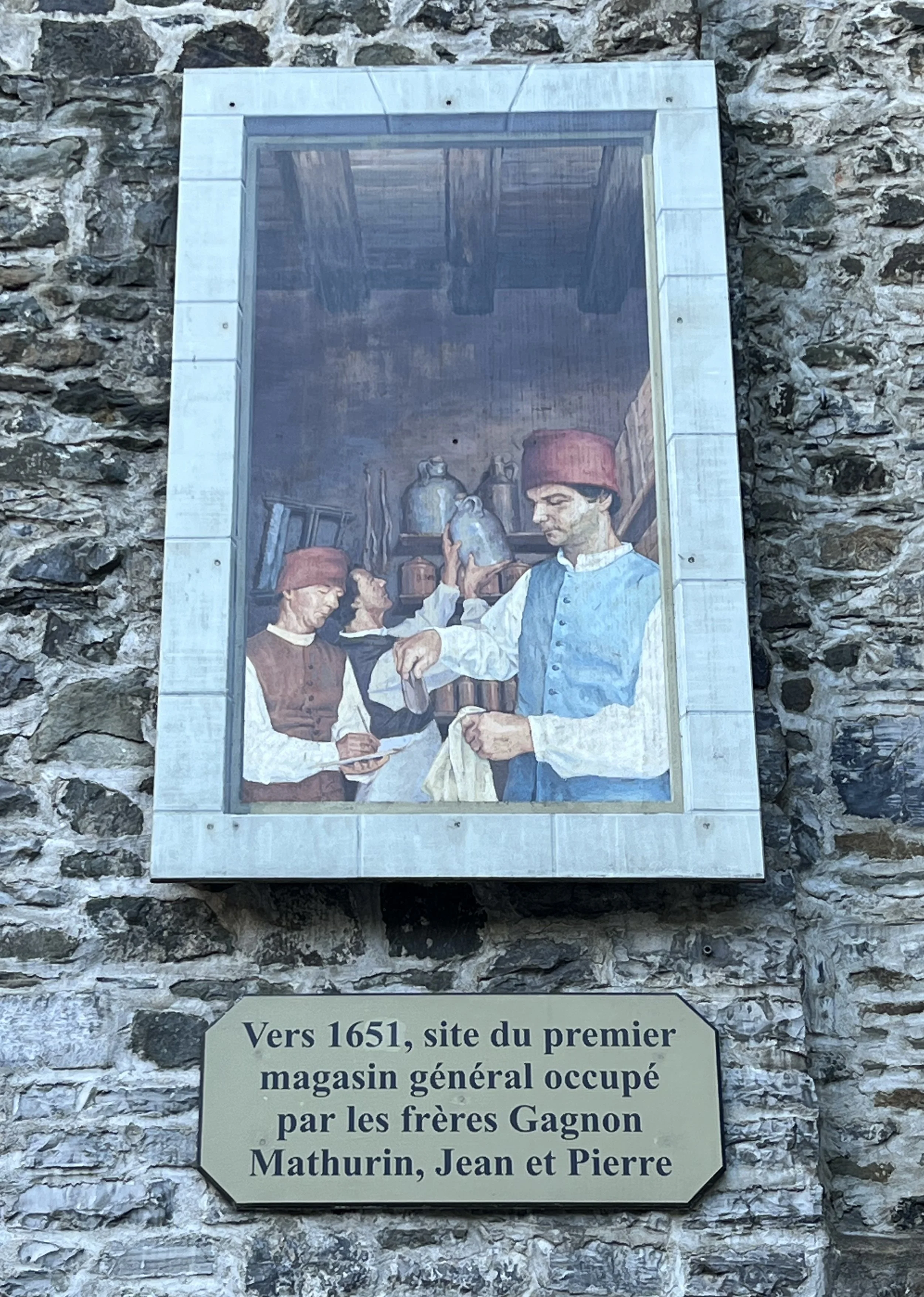
Gagnon brothers’ commemorative plaque in Québec (© The French-Canadian Genealogist)
Another plaque was erected in Château-Richer in 1940, located at 8754 avenue Royale.
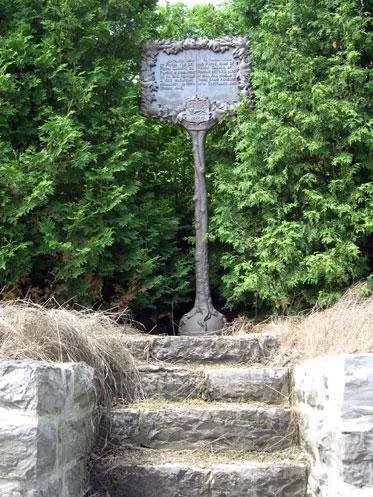
Gagnon brothers’ commemorative plaque in Château-Richer (Marie-Claude Côté, 2003, © Ministère de la Culture et des Communications)
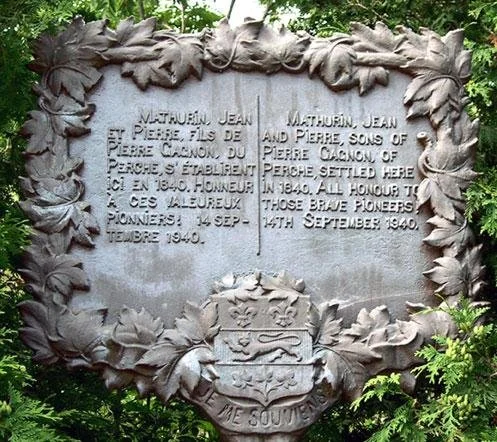
Gagnon brothers’ commemorative plaque in Château-Richer (Marie-Claude Côté, 2003, © Ministère de la Culture et des Communications)
A short French-language film also explores the history of the Gagnon name in Canada:
The Beginnings of a Canadian Family
Jean Gagnon and Marguerite Cochon belonged to the first generation of French settlers who transformed the shores of the St. Lawrence into permanent communities. Coming from different regions of France—Jean from Perche and Marguerite from Dieppe—they married at Beaupré in 1640 and built their life at Château-Richer. Jean combined farming with commercial activity in Québec, while together they raised a large family whose lives became firmly rooted in the growing colony.
Jean’s death in 1670 left Marguerite a widow for nearly thirty years, during which she continued to manage family property, navigate inheritance matters and provide for her children and her own later years. By the time of her death in 1699, the family they had founded had been established in Canada for almost sixty years. Their story reflects the experience of New France’s pioneer generation: migration, settlement, hard work, family alliances and the gradual creation of a society that their descendants would call home for centuries.
PDF version of biography located at: https://www.tfcg.ca/jeangagnon-and-margueritecochon.
Are you enjoying our articles and resources? Show your support by making a donation. Every contribution, regardless of its size, goes a long way in covering our website hosting expenses and enables us to create more content related to French-Canadian genealogy and history. Thank you! Merci!
Sources:
État civil, Tourouvre, registre paroissial, "B 1588-mars 1615, 22 fév. 1615-mars 1615, M 1589-1600," digital images, Direction des archives et du patrimoine culturel de l'Orne (https://gaia.orne.fr/mdr/index.php/docnumViewer/calculHierarchieDocNum/378648/1057:358411:372026:378648/1440/3440 : accessed 14 Aug 2026), baptism of Jehan Gaignon, 13 Aug 1610, image 129 of 187.
Madame Pierre Montagne [Françoise Lamarche], Tourouvre et les Juchereau : Un chapitre de l’émigration percheronne au Canada (Québec, Société Canadienne de Généalogie, 1965).
“Le LAFRANCE (Baptêmes, Mariages, Sépultures)," database and digital images, Généalogie Québec. (https://www.genealogiequebec.com/Membership/LAFRANCE/acte/66341 : accessed 14 Aug 2026), marriage of Jean GANGNON and Marguerite COCHON, 29 Jul 1640, Québec (Notre-Dame-de-Québec); citing original data: Institut généalogique Drouin.
“Quebec, Canada, Vital and Church Records (Drouin Collection), 1621-1968,” digital images, Ancestry.ca (https://www.ancestry.ca/imageviewer/collections/1091/images/d13p_16510517?usePUB=true&_phsrc=Tap9544&pId=63920424 : accessed 17 Aug 2026), burial of Jean Gagnon [copy], 2 Apr 1670, Château-Richer > ALL > 1661-1702, image 362 of 727; citing original data: Drouin Collection, Institut Généalogique Drouin, Montréal.
“Quebec, Canada, Vital and Church Records (Drouin Collection), 1621-1968,” digital images, Ancestry.ca (https://www.ancestry.ca/imageviewer/collections/1091/images/d13p_31480202?usePUB=true&_phsrc=Tap9683 : accessed 18 Aug 2026), patient register, "Madame Gagnon," died 24 Jun 1699, Québec (Hôtel-Dieu); citing original data: Drouin Collection, Institut Généalogique Drouin, Montréal.
"Fonds Intendants - Archives nationales à Québec," digital images, Bibliothèque et Archives nationales du Québec (https://advitam.banq.qc.ca/notice/91315 : accessed 17 Aug 2026), "Déclaration faite au papier terrier de la Compagnie des Indes occidentales par Joseph Gagnon, en son nom et pour Pierre Gagnon, son père, ainsi que Mathurin Gagnon et Jean Gagnon, ses oncles, laquelle déclaration étant relative aux trois quarts d'un emplacement sis rue Saint-Pierre, en la Basse-Ville de Québec, contenant quatre toises de large sur dix de long, sur lequel il y a un corps de logis consistant en trois chambres à feu, trois chambres et trois greniers," 14 Jan 1668, reference E1,S4,SS2,P146, Id 91315.
“Fonds Conseil souverain - Archives nationales à Québec,” digital images, Bibliothèque et Archives nationales du Québec (https://advitam.banq.qc.ca/notice/403401 : accessed 17 Aug 2026), "Arrêt qui homologue une sentence arbitraire rendue sur un compromis entre Marguerite Cochon, veuve du défunt Jean Gagnon pour elle et ses enfants, et Jean Gagnon, son fils," 20 Mar 1684, reference TP1,S28,P3312, Id 403401.
"Registre des confirmations 1649-1662," digital images, Généalogie Québec (https://www.genealogiequebec.com/membership/fr/fonds-drouin/REGISTRES : accessed 17 Aug 2026), confirmation of Jean Gagnon and family, 2 Feb 1660, Château-Richer; citing original data: Registre des confirmations, Diocèse de Québec, Registres du Fonds Drouin.
"Actes de notaire, 1634, 1649-1663 // Guillaume Audouart," digital images, FamilySearch (https://www.familysearch.org/ark:/61903/3:1:3Q9M-CSVN-32J3?cat=1171569&i=812&lang=en : accessed 23 Apr 2025), lease agreement by Pierre, Jean and Mathurin Gagnon, and Massé Gravel dit Brindelière, to Jean Garos, 6 Oct 1653, image 813 of 2642; citing original data : Bibliothèque et Archives nationales du Québec.
"Actes de notaire, 1634, 1649-1663 // Guillaume Audouart," digital images, FamilySearch (https://www.familysearch.org/ark:/61903/3:1:3Q9M-CSVN-3JGK?cat=1171569&i=814&lang=en : accessed 23 Apr 2025), contract for the carpentry of a same house in Québec by Michel Bourdet and Pierre Biron for Jean, Pierre and Mathurin Gagnon, and Massé Gravel dit Brindelière, 6 Oct 1653, image 815 of 2642; citing original data : Bibliothèque et Archives nationales du Québec.
"Actes de notaire, 1634, 1649-1663 // Guillaume Audouart," digital images, FamilySearch (https://www.familysearch.org/ark:/61903/3:1:3Q9M-CSVN-3VY8?cat=koha%3A1171569&view=explore&lang=en&groupId=TH-909-70683-15391-81 : accessed 17 Aug 2026), obligation (debt) of Jean Gagnon to Robert Tauvé, 9 Sep 1657, image 1870 of 2642; citing original data : Bibliothèque et Archives nationales du Québec.
"Actes de notaire, 1652-1692 // Claude Auber," digital images, FamilySearch (https://www.familysearch.org/ark:/61903/3:1:3QHV-53L2-69S3-8?cat=koha%3A1175225&view=explore&lang=en&groupId=TH-7765-100513-27662-88 : accessed 17 Aug 2026), agreement between Jean Gasgnon and Jean Chappelleau, 7 Mar 1660, image 201 of 1368; citing original data : Bibliothèque et Archives nationales du Québec.
"Actes de notaire, 1652-1692 // Claude Auber," digital images, FamilySearch (https://www.familysearch.org/ark:/61903/3:1:3QHV-53L2-61SX?cat=koha%3A1175225&view=explore&lang=en&groupId=TH-7765-100513-27662-88 : accessed 17 Aug 2026), land sale by Nicolas Quentin dit Lafontayne and Madeleine Roulloys to Jean and Pierre Gasgnon, 21 Feb 1667, images 761-763 of 1368; citing original data : Bibliothèque et Archives nationales du Québec.
"Actes de notaire : Romain Becquet," digital images, Bibliothèque et Archives nationales du Québec (https://numerique.banq.qc.ca/patrimoine/details/52327/4064889?docref=a9zlGjqkTMl7MZIEtcUYkQ : accessed 17 Aug 2026), house sale by Jean Gaignon to Pierre Pelerin de St Amand and Louise de Monceaux, 9 Oct 1668, folder 21 décembre 1665 - 9 février 1670, image 818-1081.
"Actes de notaire : Paul Vachon," digital images, Bibliothèque et Archives nationales du Québec (https://numerique.banq.qc.ca/patrimoine/details/52327/4215636?docref=tL04hhmDOdF_gp2myRZRjg : accessed 17 Aug 2026), inventory of the community of goods of Marguerite Cochon, widow of Jean Gangnon, 19 Jan 1674, folder 1 septembre 1673 - 27 novembre 1680, images 100-106 of 1185.
"Actes de notaire : Paul Vachon," digital images, Bibliothèque et Archives nationales du Québec (https://numerique.banq.qc.ca/patrimoine/details/52327/4215636?docref=a2ITM6tod3m3VrcIISDhjA : accessed 17 Aug 2026), division of a land concession between Marguerite, Jean and Jacques Cochons, 2 Jul 1674, folder 1 septembre 1673 - 27 novembre 1680, images 168-171 of 1185.
"Actes de notaire, 1652-1692 // Claude Auber," digital images, FamilySearch (https://www.familysearch.org/ark:/61903/3:1:3QHV-J3DQ-J7P7?cat=koha%3A1171570&view=explore&lang=en&groupId=TH-7758-91937-3642-72 : accessed 17 Aug 2026), agreement between Marguerite Cochon (on her behalf and that of her three minor children, Germain, Raphaël, and Marie) and Pierre Gagnon, her brother-in-law and the children’s curator, on the one hand, and Jean Gagnon Jr. on the other, 24 Feb 1676, images 997-998 of 3381; citing original data : Bibliothèque et Archives nationales du Québec.
"Actes de notaire, 1680-1726 // Etienne Jacob," digital images, FamilySearch (https://www.familysearch.org/ark:/61903/3:1:3QHV-L3NX-WQN8?cat=koha%3A678814&view=explore&lang=en&groupId=M9DC-S3J : accessed 18 Aug 2026), agreement between Marguerite Cochon and her sons-in-law Jean Carron and Louis Gasgnier; sale of land from Carron and Gasgnier to Germain Gagnon; sale of land by Marguerite Cochon to Germain Gagnon, 23 Jan 1688, images 533-539 of 3044; citing original data : Bibliothèque et Archives nationales du Québec.
"Actes de notaire, 1680-1726 // Etienne Jacob," digital images, FamilySearch (https://www.familysearch.org/ark:/61903/3:1:3QHV-P3NX-W8Z6?cat=koha%3A678814&view=explore&lang=en&groupId=M9DC-S3J : accessed 18 Aug 2026), land donation by Marguerite Cochon and brother Jean Cochon to Barbe Delphine Letardif, 3 Apr 1689, images 641-642 of 3044; citing original data : Bibliothèque et Archives nationales du Québec.
"Actes de notaire, 1680-1726 // Etienne Jacob," digital images, FamilySearch (https://www.familysearch.org/ark:/61903/3:1:3QHV-L3NX-WW62?cat=koha%3A678814&view=explore&lang=en&groupId=M9DC-S3J : accessed 18 Aug 2026), land sale by Marguerite Cochon to Jacques Cochon and Geneviève Plante, 11 May 1692, images 1172-1173 of 3044; citing original data : Bibliothèque et Archives nationales du Québec.
"Actes de notaire, 1680-1726 // Etienne Jacob," digital images, FamilySearch (https://www.familysearch.org/ark:/61903/3:1:3QHV-P3NX-7S36-M?cat=koha%3A678814&view=explore&lang=en&groupId=M9DC-S3J : accessed 18 Aug 2026), land sale by Marguerite Cochon to son Germain Gagnon, 3 Jun 1692, images 1182-1184 of 3044; citing original data : Bibliothèque et Archives nationales du Québec.
"Actes de notaire, 1680-1726 // Etienne Jacob," digital images, FamilySearch (https://www.familysearch.org/ark:/61903/3:1:3QHV-L3NX-79YR-4?cat=koha%3A678814&view=explore&lang=en&groupId=M9DC-S3J : accessed 18 Aug 2026), sale of a portion of land by Marguerite Cochon to son Germain Gagnon, 3 Jun 1692, images 1185-1186 of 3044; citing original data : Bibliothèque et Archives nationales du Québec.
"Actes de notaire, 1680-1726 // Etienne Jacob," digital images, FamilySearch (https://www.familysearch.org/ark:/61903/3:1:3QHV-P3NX-WDRW?cat=koha%3A678814&view=explore&lang=en&groupId=M9DC-S3J : accessed 18 Aug 2026), sale of an habitation by Marguerite Cochon to Jean Navers, 12 Jan 1693, images 1268-1271 of 3044; citing original data : Bibliothèque et Archives nationales du Québec.
"Actes de notaire, 1680-1726 // Etienne Jacob," digital images, FamilySearch (https://www.familysearch.org/ark:/61903/3:1:3QHV-P3NX-W67D?cat=koha%3A678814&view=explore&lang=en&groupId=M9DC-S3J : accessed 18 Aug 2026), agreement between Marguerite Cochon, Jean Caron and Germain Gasgnon, 5 Nov 1696, images 1975-1976 of 3044; citing original data : Bibliothèque et Archives nationales du Québec.
Parchemin, notarial database of ancient Québec (1626-1801), Société de recherche historique Archiv-Histo (https://archiv-histo.com : accessed 17 Aug 2026), "Partage d'une concession située dans la paroisse du Chateau Richer entre Marguerite Cochon, veuve de Jean Gaingnon, de la paroisse de Nostre Dame du Chateau Richer; et Jean Gaingnon, de la seigneurie de Beaupré en la paroisse du Chateau Richer, son fils aîné Germain Gaingnon, de la seigneurie de Beaupré en la paroisse du Chateau Richer, Raphaël Gaingnon, de la seigneurie de Beaupré en la paroisse du Chateau Richer, Jean Caron et Marguerite Gaingnon, son épouse, de la seigneurie de Beaupré en la paroisse du Chateau Richer, Jean Houimet et Renée Gaingnon, son épouse, de la paroisse de la Scaincte Famille en l'île et comté Scainct Laurens, et Louis Gaingner et Marie Gaingnon, son épouse, de Scaincte Anne du Petit Cap au lieudit la Grande Riviere, ses enfants et gendres," notary Paul Vachon, 9 Aug 1682.
Parchemin, notarial database of ancient Québec (1626-1801), Société de recherche historique Archiv-Histo (https://archiv-histo.com : accessed 17 Aug 2026), "Compromis entre Marguerite Cochon, veuve de Jean Gagnon, de la côte de Beaupré, tant pour elle que se faisant et portant fort de Germain Gagnon et Raphaël Gagnon, ses fils, et Jean Ouymet et Marie-Renée Gagnon, son épouse, son gendre, Jean Caron et Marguerite Gagnon, son épouse, et Louis Gagner et Marie Gagnon, son épouse; et Jean Gagnon, du Chasteau Richer," notary Gilles Rageot, 15 Mar 1684.
"Recensement du Canada, 1666," digital images, Library and Archives Canada (https://recherche-collection-search.bac-lac.gc.ca/fra/accueil/notice?idnumber=2318856&app=fonandcol : accessed 17 Aug 2026), household of Jean Gaignon, 1666, côte de Beaupré, page 61 (of PDF), Finding aid no. MSS0446, MIKAN no. 2318856; citing original data: Centre des archives d'outre-mer (France) vol. 460.
"Recensement du Canada, 1667," digital images, Library and Archives Canada (https://www.bac-lac.gc.ca/eng/CollectionSearch/Pages/record.aspx?app=fonandcol&IdNumber=2318857&new=-8585951843764033676 : accessed 17 Aug 2026), household of jean Gaignon, 1667, Beaupré, pages 145-146 (of PDF), Finding aid no. MSS0446, Item ID number: 2318857; citing original data: Centre des archives d'outre-mer (France) vol. 460.
"Recensement du Canada fait par l'intendant Du Chesneau," digital images, Library and Archives Canada (https://www.bac-lac.gc.ca/eng/CollectionSearch/Pages/record.aspx?app=fonandcol&IdNumber=2318858&new=-8585855146497784530 : accessed 17 Aug 2026), household of Marguerite Cochon, 14 Nov 1681, Beaupré, page 250 (of PDF), Finding aid no. MSS0446, MIKAN no. 2318858; citing original data: Centre des archives d'outre-mer (France) vol. 460.
Gérard Lebel, Nos Ancêtres 1 (Ste-Anne-de-Beaupré, Revue Sainte Anne de Beaupré, 1981), 53-54.
Fédération québécoise des sociétés de généalogie, Fichier Origine online database (https://www.fichierorigine.com/fr/repertoire/gagnon-3 : accessed 14 Aug 2026), entry for Jean Gagnon (person 241622), updated on 11 Dec 2016.
Fédération québécoise des sociétés de généalogie, Fichier Origine online database (https://www.fichierorigine.com/fr/repertoire/cauchon-2 : accessed 14 Aug 2026), entry for Marguerite Cauchon (person 240747), updated on 30 Nov 2025.
Université de Montréal, Programme de recherche en démographie historique (PRDH) online database (https://www-prdh-igd-com.res.banq.qc.ca/Membership/en/PRDH/Famille/352 : accessed 16 Aug 2026), dictionary entry for Jean GAGNON and Marguerite CAUCHON, union 352.
Jean-François Loiseau, “Les Gagnon, une famille pionnière originaire de Tourouvre et de La Ventrouze," l'Association Perche-Canada (https://www.perche-quebec.com/perche/individus/gagnon.htm#2 : accessed 25 Apr 2025).
“Plaque de Mathurin, Jean et Pierre Gagnon,” Répertoire du patrimoine culturel du Québec (https://www.patrimoine-culturel.gouv.qc.ca/rpcq/detail.do?methode=consulter&id=99293&type=bien : accessed 25 Apr 2025), Ministère de la Culture et des Communications, Gouvernement du Québec
Thuot, Jean-René, "La pratique de l’inhumation dans l’église dans Lanaudière entre 1810 et 1860 : entre privilège, reconnaissance et concours de circonstances," 2006, Études d'histoire religieuse, 72, 75–96, digitized by Érudit (https://doi.org/10.7202/1006589ar).
Robert-Lionel Séguin, “La basse-cour en Nouvelle-France," Les Cahiers des dix, number 38, 1973, digitized by Érudit (https://www.erudit.org/fr/revues/cdd/1973-n38-cdd01427/1025312ar.pdf : accessed 8 Aug 2026).
Marcel Trudel, "Les obligations du censitaire, à l’époque des Cent-Associés," Revue d'histoire de l'Amérique française, volume 27, number 1, June 1973, digitized by Érudit (https://www.erudit.org/fr/revues/haf/1973-v27-n1-haf1997/303230ar.pdf : accessed 8 Aug 2026).