Jean Bougran (or Beaugrand) dit Champagne & Marguerite Samson
Discover the story of Jean Bougran (or Beaugrand) dit Champagne and Marguerite Samson, two early settlers of New France. Follow the journey of a Carignan-Salières Regiment soldier and a Fille du roi as they built a family in seventeenth-century Canada and helped shape the colony's future.
Cliquez ici pour la version en français
Jean Bougran (or Beaugrand) dit Champagne & Marguerite Samson
A Soldier, a Fille du roi, and the Beginnings of the Champagne Family
Jean Bougran (or Beaugrand) dit Champagne was born around 1641 in France. His exact origins and his parents’ names are unknown. [No marriage contract or record has been located for the couple, which would normally provide their origins and their parents’ names.] Although his origins remain unknown, his “dit” name suggests a possible connection to the Champagne region of France.
Jean was a soldier in the Carignan-Salières Regiment, serving in the company of Saurel. The company was among the last large group to land in New France. It sailed from La Rochelle on May 13 aboard La Paix and reached Quebec on August 19, 1665.
Just six days after landing, Saurel was tasked with rebuilding Fort Richelieu at the confluence of the Richelieu and St. Lawrence rivers, one of five forts the regiment threw up along the Mohawk raiding route. It was later renamed Fort Sorel; Saurel and his men wintered there, and he had them clear a large stretch of the surrounding forest in anticipation of settlement. Jean almost certainly spent that first hard winter garrisoning and clearing at the mouth of the Richelieu.
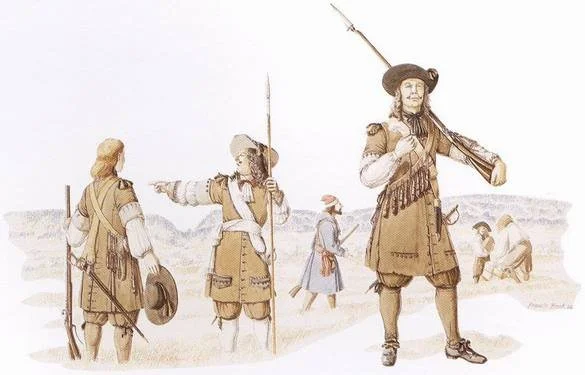
“Officer and soldiers of the régiment de Carignan-Salières, 1665-1668," drawing by Francis Back (Canadian Military History Gateway)
In July 1666, after a Mohawk attack on Isle La Motte killed seven soldiers and captured four (including Tracy's cousin), Tracy ordered Saurel to lead a punitive expedition. Two days short of the nearest Mohawk village, Saurel met a delegation already returning the four prisoners unharmed, refused his Algonquin allies' demand to hand the Mohawk over, and escorted the delegation back to Quebec instead. Later that year the company took part in Tracy's large-scale expedition, which razed four hastily abandoned Mohawk villages and destroyed their food stores; a peace settlement followed in 1667.
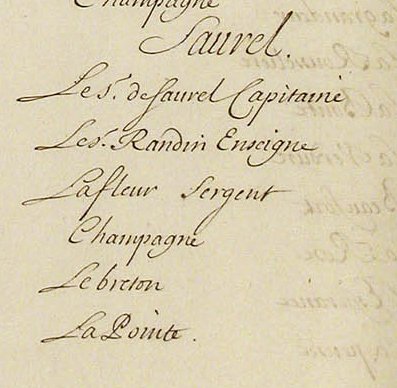
Extract from the list of the Soldiers of the Carignan-Salières Regiment who became inhabitants of New France in 1668 (Library and Archives Canada)
When the regiment was recalled to France in 1668, the men were offered land to stay. Saurel, as an officer, received a seigneurie centred on Fort Richelieu, and 29 of his own men settled there, joined by four others whose officers had gone home, 33 in all.
Marguerite Samson was born around 1649 in France. Her exact origins and her parents’ names are also unknown. She was a Fille du roi, arriving in Canada in 1670.
Jean and Marguerite were married in New France, likely in Saint-Pierre-de-Saurel, sometime before 1671. [No marriage contract or record has been found.]
The couple settled in the seigneurie of Dautray. They had at least three children:
Jean Baptiste (ca. 1671–1730)
Charles (1673–aft. 1681)
Marie (1675–aft. 1681)
In 1676, Jean’s signature appeared on a document for the first time. He signed “gean bougeren.”

Jean’s signature in 1676
On December 31, 1676, Marguerite is named the godmother of Marguerite Delbec, daughter of Pierre Delbec and Geneviève Terion, in Saint-Pierre-de-Saurel. She could not sign her name.
In 1678, Jean and Marguerite moved their family to the seigneurie of Villemur, although they still kept ties with Saint-Pierre-de-Saurel. On October 13, 1680, Marguerite was named the godmother of Marguerite Piette, daughter of Jean Piette dit Trempe (Jean’s fellow soldier in the Saurel company) and Marguerite Chamereau, in Saint-Pierre-de-Saurel.
Jean (40 years old) and Marguerite (32 years old) were recorded in the 1681 census living in the seigneurie of Villemur, with their three children. They owned three arpents of “valuable” land (cleared or under cultivation), two cows, and no guns.
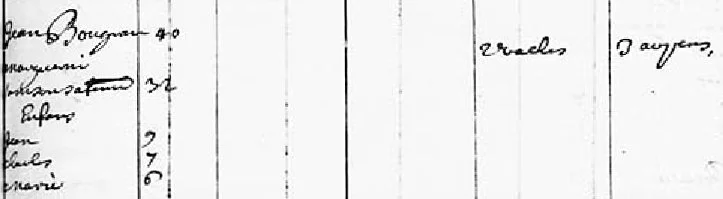
1681 census of New France for the “Bougrant” family (Library and Archives Canada)
The Seigneurie of Villemur
The seigneurie listed as "Villemur" in the 1681 census is the fief known today as Berthier-en-Haut, now the town of Berthierville, on the north shore of the St. Lawrence in the Lanaudière region (MRC d'Autray), opposite present-day Sorel-Tracy. It was granted to the sieur Randin in 1672 and sold the following year to Isaac-Alexandre de Berthier, an officer of the Carignan-Salières regiment, who renamed it after himself. The census label "Villemur" derives from this seigneur's own title, sieur de Villemur, before the name "Berthier" came into common use. Berthier held two seigneuries bearing his name: this one and Berthier-en-Bas (today Berthier-sur-Mer) on the south shore near Bellechasse. The families enumerated under Villemur in 1681 belong to the north-shore seigneurie, the Berthierville of today.
On May 28, 1687, Jean “Bougran” served as a witness at the wedding of soldier Antoine Moran dit Lagrandeur and Marie Madeleine Poutret dite Lavigne in Saint-Pierre-de-Saurel.
After this wedding, Jean is largely absent from the public record and not much is known about his life until his death.
Death of Jean and Marguerite’s Final Years
Jean Bougran (or Beaugrand) dit Champagne died at the age of about 58. He was buried on December 5, 1699, in the parish cemetery of Saint-Pierre-de-Saurel. [The date of death was omitted from the burial record, which no longer exists.]
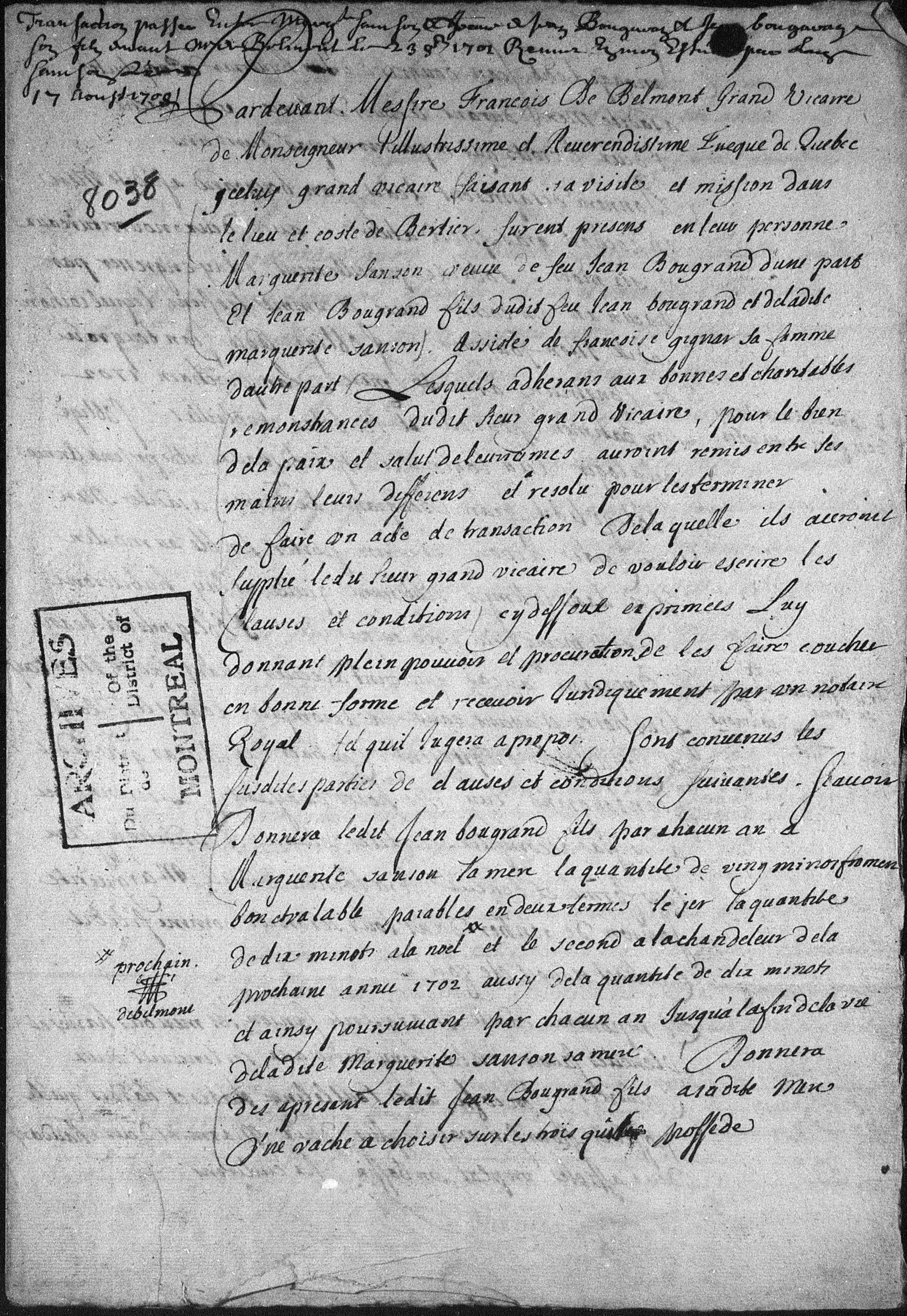
First page of the 1701 agreement between Marguerite and her son (FamilySearch)
On October 23, 1701, grand vicar François de Belmont penned an agreement between Marguerite and her son Jean Baptiste and his wife Françoise. Jean Baptiste agreed to house his mother and provide her with twenty minots of wheat annually until her death, as well as one cow among the three that he possessed, one fat pig ready for butchering, and two piglets aged six months. He also promised to fatten one pig annually for Marguerite, which she would provide, and build her a building to house her animals and poultry in 1702. He promised to provide her with ten cords of wood, and to bring her wheat to the seigneurial mill for grinding, so long as they were living in the same place, côte, or parish.
Marguerite promised to bring her furniture, clothing and utensils, namely her “bed, draped with curtains, sheets, two blankets, her trunk containing all the linen and clothes she owns for her personal use, plus two saucepans, two pots, two plates, a dish, a basin and six spoons.” Jean Baptiste also agreed to set aside a portion of his garden for his mother’s use, and to provide her with one year’s supply of vegetables and herbs.
In exchange, Marguerite ceded to Jean Baptiste her rights to the inheritance of her late husband, including all the land he owned. This agreement was registered on October 17, 1708, by notary Antoine Adhémar.
Death of Marguerite
Marguerite Samson died at the age of about 72. She was buried on July 24, 1721, in the parish cemetery of Saint-Pierre-de-Saurel. [The date of death was omitted from the burial record.]
The burial record reads:
“On the twenty-fourth of July, in the year one thousand seven hundred and twenty-one, by me the undersigned [priest], was buried in the cemetery of this parish, Margueritte Samsom, wife of the late Jean Bougran. She died having received all the sacraments; the witnesses were Pierre Ratel and Nicolas Baillargeon, who declared that they were unable to sign this record.”
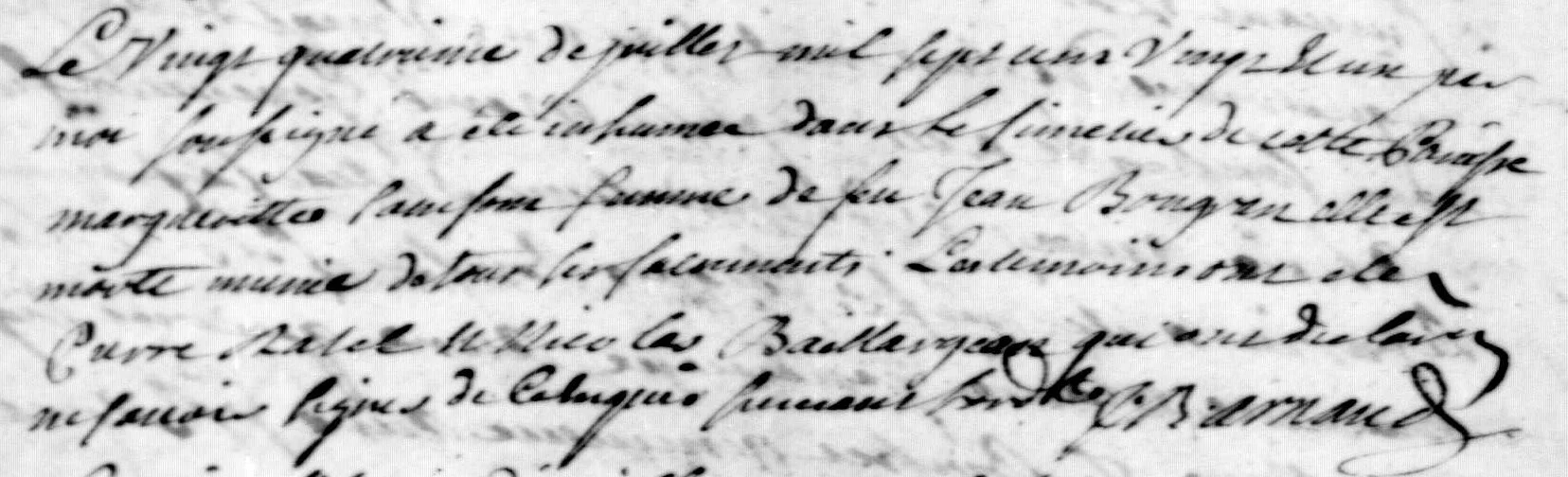
1721 burial of Marguerite "Samsom" (Généalogie Québec)
Pioneers of New France
Jean Bougran dit Champagne and Marguerite Samson were among the early settlers who helped transform New France from a fragile colony into a permanent society along the St. Lawrence River. He arrived as a soldier with the Carignan-Salières Regiment; she crossed the Atlantic as one of the Filles du roi. Together, they built a life in a young colony that was still taking shape, raising a family and establishing roots that would endure long after their deaths. Though many details of their origins remain unknown, their lives reflect the courage, resilience, and determination of the men and women who helped build French Canada.
PDF version of biography located at: https://www.tfcg.ca/jeanbeaugrandchampagne-and-margueritesamson.
Are you enjoying our articles and resources? Show your support by making a donation. Every contribution, regardless of its size, goes a long way in covering our website hosting expenses and enables us to create more content related to French-Canadian genealogy and history. Thank you! Merci!
Sources:
"Le LAFRANCE (Baptêmes, mariages et sépultures)," database and digital images, Généalogie Québec (https://www.genealogiequebec.com/Membership/LAFRANCE/acte/83202 : accessed 11 Jun 2026), baptism of Marguerite DOLLEBEC, 31 Dec 1676, Sorel (St-Pierre); citing original data: Institut généalogique Drouin and PRDH.
"Le LAFRANCE (Baptêmes, mariages et sépultures)," database and digital images, Généalogie Québec (https://www.genealogiequebec.com/Membership/LAFRANCE/acte/83284 : accessed 11 Jun 2026), baptism of Marguerite PIET, 13 Oct 1680, Sorel (St-Pierre); citing original data: Institut généalogique Drouin and PRDH.
"Le LAFRANCE (Baptêmes, mariages et sépultures)," database and digital images, Généalogie Québec (https://www.genealogiequebec.com/Membership/LAFRANCE/acte/83995 : accessed 11 Jun 2026), marriage of Antoine MORAN and Madeleine POUTRET, 28 May 1687, Sorel (St-Pierre); citing original data: Institut généalogique Drouin and PRDH.
"Le LAFRANCE (Baptêmes, mariages et sépultures)," database and digital images, Généalogie Québec (https://www.genealogiequebec.com/Membership/LAFRANCE/acte/84128 : accessed 11 Jun 2026), burial of Jean BOUGRAN CHAMPAGNE, 5 Dec 1699, Sorel (St-Pierre); citing original data: Institut généalogique Drouin and PRDH.
"Le LAFRANCE (Baptêmes, mariages et sépultures)," database and digital images, Généalogie Québec (https://www.genealogiequebec.com/Membership/LAFRANCE/acte/84226 : accessed 11 Jun 2026), burial of Marguerite SAMSOM, 24 Jul 1721, Sorel (St-Pierre); citing original data: Institut généalogique Drouin and PRDH.
"Recensement du Canada fait par l'intendant Du Chesneau," digital images, Library and Archives Canada (https://www.bac-lac.gc.ca/eng/CollectionSearch/Pages/record.aspx?app=fonandcol&IdNumber=2318858&new=-8585855146497784530 : 10 Jun 2026), household of Jean Bougrant, 14 Nov 1681, Seigneurie of Villemur, page 117 (of PDF), Finding aid no. MSS0446, MIKAN no. 2318858; citing original data: Centre des archives d'outre-mer (France) vol. 460.
“Archives de notaires : Antoine Adhémar (1668-1714),” digital images, Bibliothèque et Archives nationales du Québec (https://numerique.banq.qc.ca/patrimoine/details/52327/4495467?docref=vYGFKgNyTBKT7Jhox-gjQw : accessed 11 Jun 2026), obligation of Guillaume David to Jacques Babie, 25 Jun 1676, page 464 of 516.
“Actes de notaire, 1668-1714 // Antoine Adhémar,” digital images, FamilySearch (https://www.familysearch.org/ark:/61903/3:1:3Q9M-CSTC-21MP?cat=koha%3A541271&view=explore&grid=on&i=507&lang=en : accessed 11 Jun 2026), agreement between Marguerite Sanson and Jean Bougrand and Françoise Gignat, 23 Oct 1701, registered 17 Aug 1708, pages 508-510 of 3055; citing original data: Bibliothèque et Archives nationales du Québec.
Université de Montréal, Programme de recherche en démographie historique (PRDH) online database (https://www-prdh-igd-com.res.banq.qc.ca/Membership/en/PRDH/Famille/3509 : accessed 10 Jun 2026), dictionary entry for Jean BEAUGRAND CHAMPAGNE and Marguerite SAMSON, union 3509.
Peter J. Gagné, From Soldiers to Settlers: The Carignan-Salières Regiment in Canada 1665-1668, volume 1 (Woonsocket, Rhode Island, American-French Genealogical Society, 2025), 94.
Jack Verney, The Good Regiment: The Carignan-Salières Regiment in Canada, 1665–1668 (Montréal : McGill-Queen’s University Press, 1991).