Jacques Beauchamp & Marie Dardenne
Jacques Beauchamp, a young hatter from La Rochelle, and Marie Dardenne left France for New France in the years following their 1656 marriage, settling on the island of Montréal and building a life as habitants at Pointe-aux-Trembles. Drawing on parish registers, notarial acts, and censuses spanning more than three decades, this biography traces their journey from a French port city to the founding generation of a Quebec family.
Cliquez ici pour la version en français
Jacques Beauchamp & Marie Dardenne
A Hatter, a Servant, and the Making of a Québec Family
Jacques Beauchamp, son of Michel Beauchamps (or Deschamps) and Marie Roullet, was baptized on July 8, 1635, in the parish of Notre-Dame-de-Cougnes in La Rochelle, Aunis, France [although the record is included in the register of the parish of Sainte-Marguerite]. His godparents were Jacques Beauchamps and Marie Marillet. [The date of birth was omitted from the baptism record.] Jacques’s surname has been recorded in a variety of phonetic ways: Beauchamps, Bauchamp, Beauchan, Bauchan, Baucham, Bauchamps, Beaucham, and Beauchans.

1635 baptism of Jacques "Beauchamps" (Archives de la Charente-Maritime)
La Rochelle, located in southwestern France, is now in the department of Charente-Maritime. Today, it has a population of approximately 80,000 residents, called Rochelais and Rochelaises.
Located in the historic Cougnes district, the Church of Notre-Dame-de-Cougnes stands on the site of one of La Rochelle’s earliest parishes, documented as early as 1077. The present building dates largely from the 17th century, rebuilt after the Wars of Religion and the devastating Siege of La Rochelle (1627–1628), which left the medieval structure in ruins. Its plain stone façade and robust square bell tower reflect the restrained architectural style of a city focused on recovery rather than ornamentation.
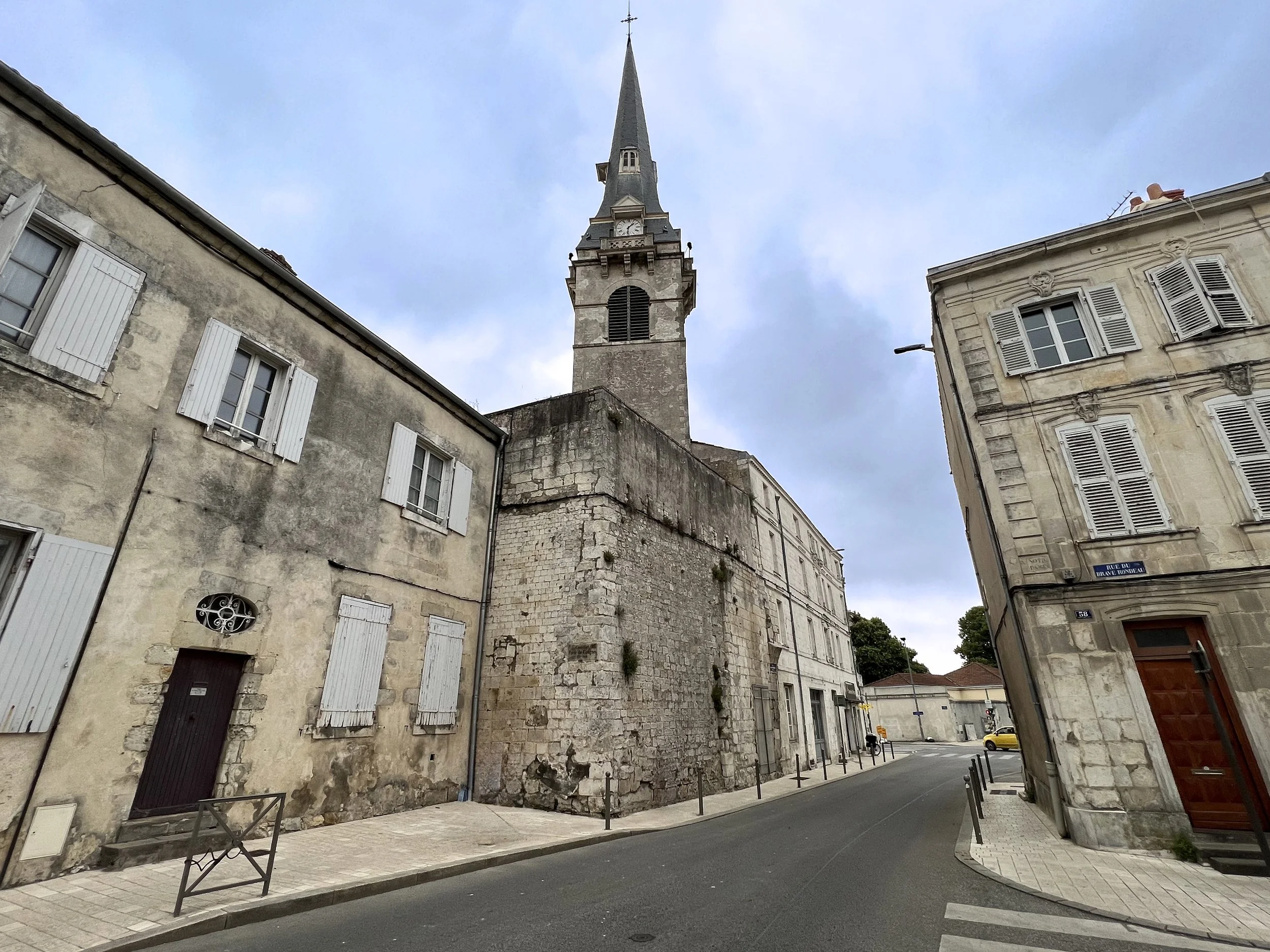
The Church of Notre-Dame-de-Cougnes in La Rochelle (© The French-Canadian Genealogist)
Jacques's father, Michel Beauchamps (or Deschamps), was born in Nanteuil-Auriac-de-Bourzac, in the Périgord region (present-day Dordogne). He married Marie Roullet in the chapel of Sainte-Marguerite in La Rochelle on May 12, 1630. They had at least four other children, all baptized in the chapel of Sainte-Marguerite in La Rochelle: Pierre (baptized 1633), Marie (baptized 1638), Jean (baptized 1644), and Guillaume (born 1646). Michel worked as a gardener, then a carpenter.
Jacques's paternal grandparents were Jean Deschamps and Louise de Lanterna, while his maternal grandparents were Elie Roullet and Marie Bardonneau.
Marie Dardenne (or Dardaine), daughter of Pierre Dardaine and Gillette Chaigne, was baptized in the parish of Saint-Jean-du-Perrot in La Rochelle, Aunis, France on April 11, 1638. Her godparents were Estienne Duchesne and Marie Marin. [The date of birth was omitted from the baptism record.] Marie’s surname has also been recorded as Dardene and Dardennes.
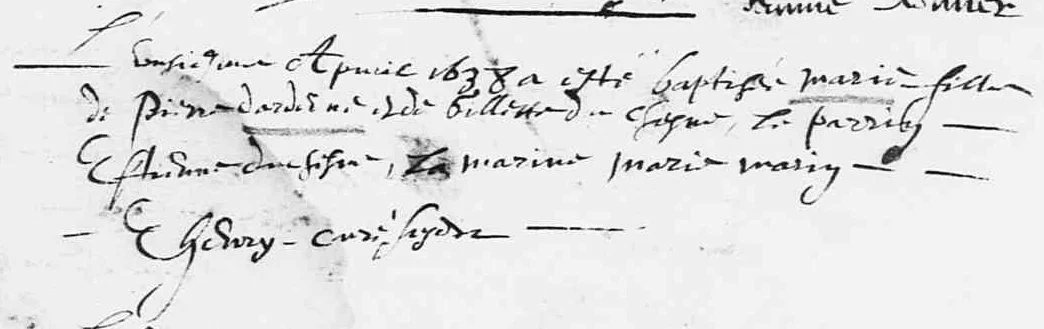
1638 baptism of Marie Dardenne (Archives de la Charente-Maritime)
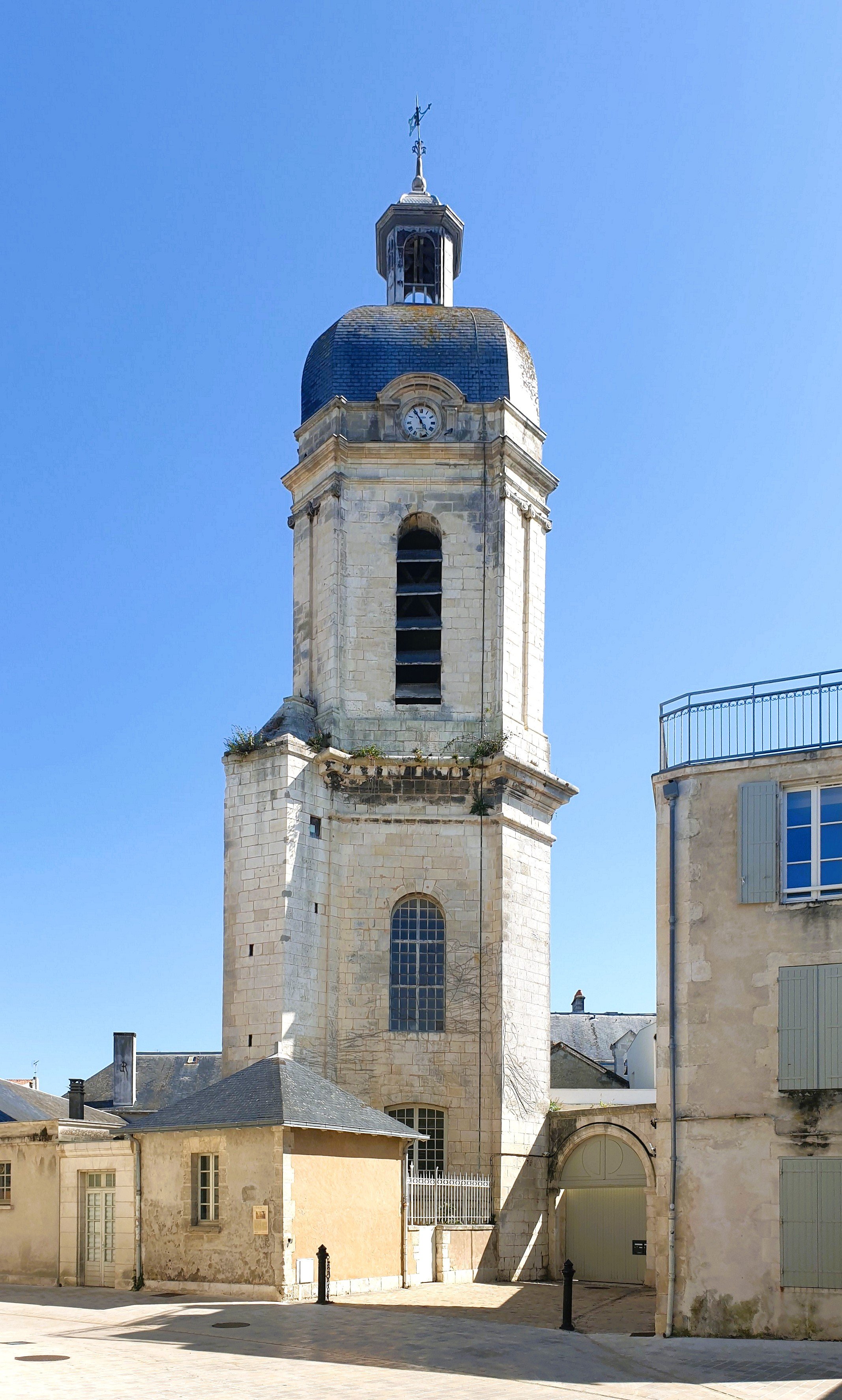
Saint-Jean Bell Tower (photo by Chris06, Wikimedia Commons, CC BY-SA 4.0)
A parish with medieval origins, the church of Saint-Jean-du-Perrot was largely destroyed in the 16th century and then reconstructed between 1672 and 1699. Decommissioned in 1887 and in danger of falling into ruin, the church was demolished that same year, with the exception of the bell tower, which still stands today.
Marie’s parents, Pierre Dardaine and Gillette Chaigne, were married in the chapel of Sainte-Marguerite in La Rochelle on June 22, 1637. Pierre was recorded as a voiturier, or coachman/carter. They had at least four other children, all baptized in La Rochelle: René (baptized 1642), Jeanne (born circa 1643), Louise (died 1646), and Pierre (baptized 1650).
Marie's paternal grandparents were François Dardenne, a ploughman, and Marie Petit, while her maternal grandparents were Pierre Dardaine and Louise Chenu.
Marriage
Jacques Beauchamp and Marie Dardenne were married on October 29, 1656, in the chapel of Sainte-Marguerite in La Rochelle. The groom was a 21-year-old chapelier, or hatter; the bride was 18.
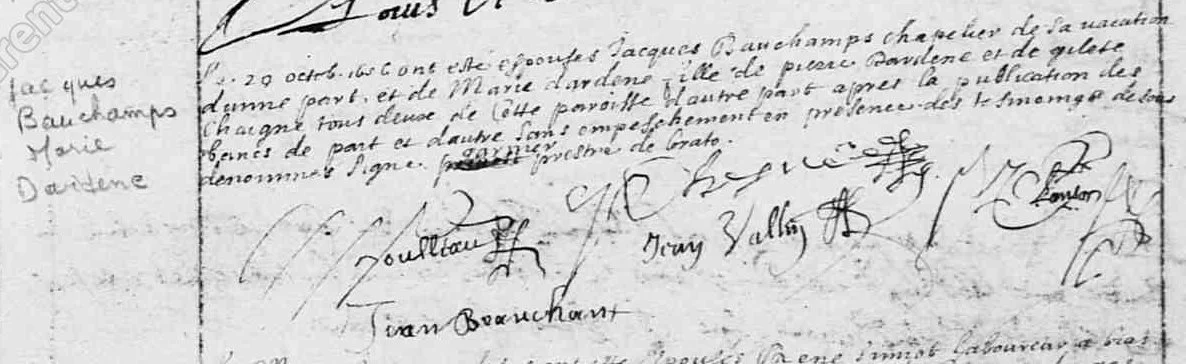
1656 marriage of Jacques “Bauchamps” and Marie “Dardene” (Archives de la Charente-Maritime)
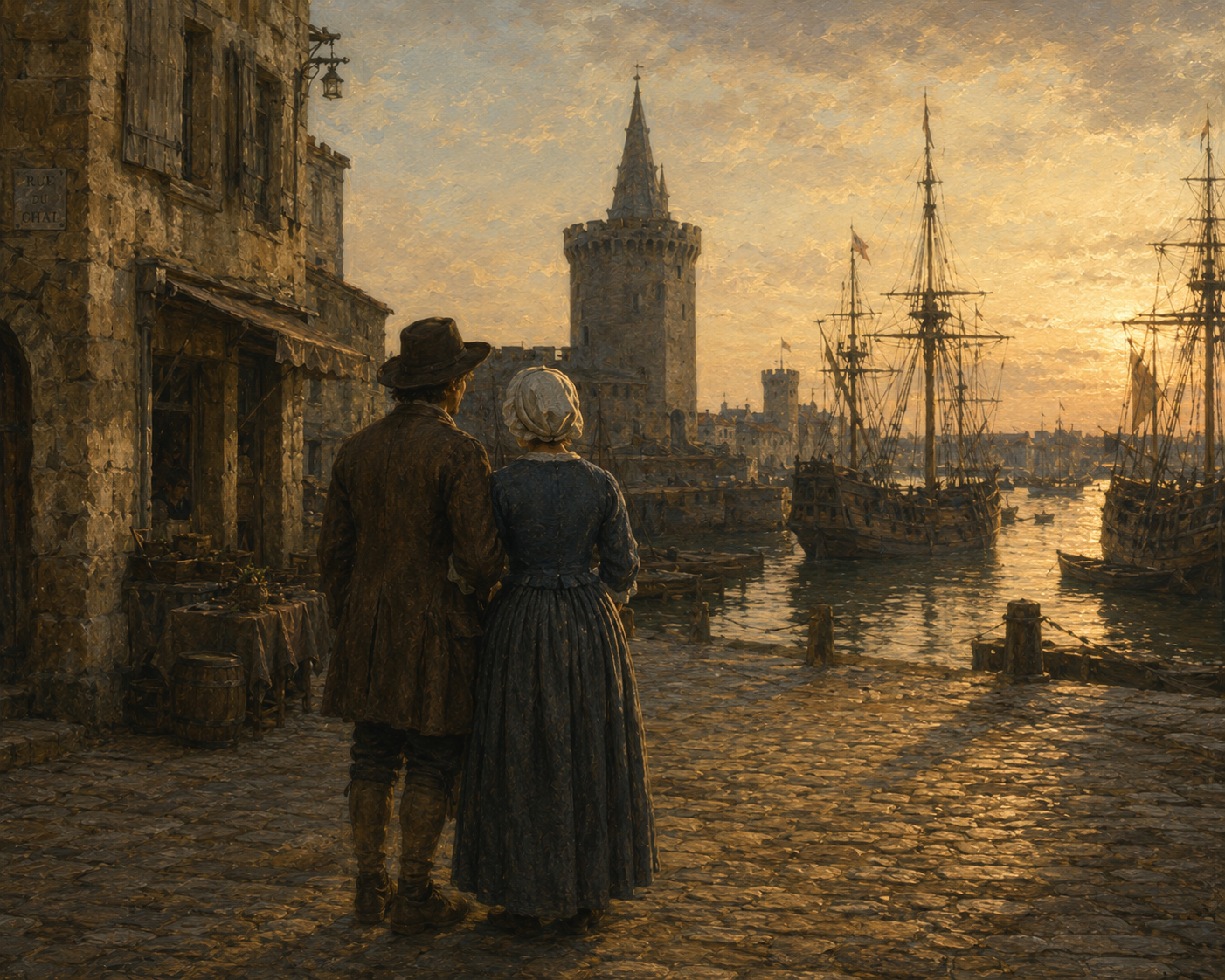
Illustration generated with artificial intelligence by the author, July 2026 (ChatGPT)
The chapel of Sainte-Marguerite was founded by Premonstratensian nuns in the 12th century and became one of the city’s most important religious buildings during the upheavals of the Wars of Religion. Spared from destruction in 1568, it was used alternately by Catholics and Protestants and even served non-religious functions during periods of conflict. After the Edict of Nantes (1598), it became the principal Catholic place of worship in the city, temporarily replacing parish churches that had been destroyed or were unusable. Rebuilt in part around 1610, it continued to serve this role until the gradual restoration of regular parish life following the Siege of La Rochelle (1627–1628). Further modified in the 17th and 18th centuries, the chapel later became associated with the Oratorians, giving rise to the name "Oratoire." Although never a formal parish, it played a central role in Rochelais religious life and is notable for the many baptisms recorded there, including those of future emigrants to New France. Today, the building survives as a secular venue known as the Salle de l’Oratoire.
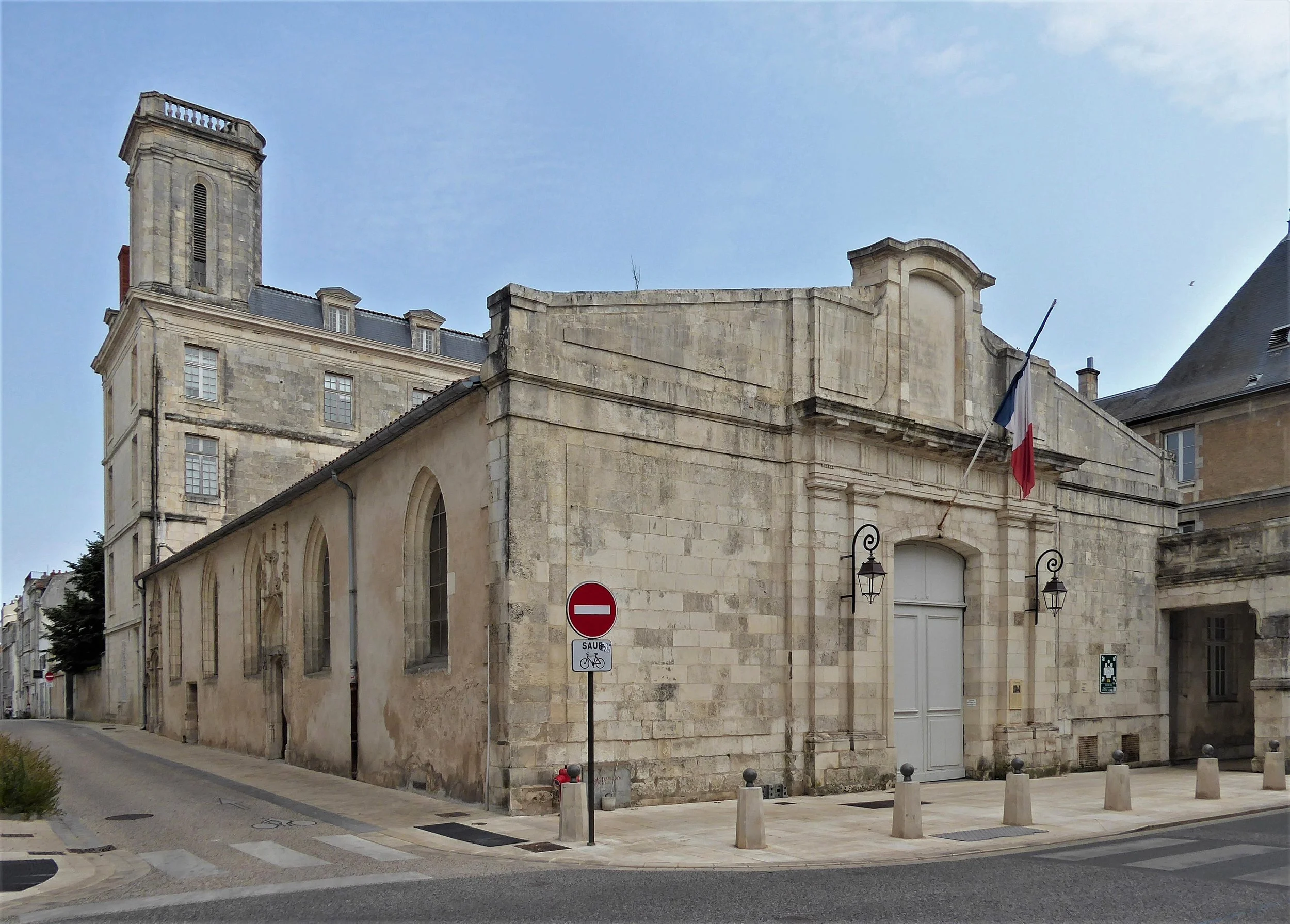
The former Sainte-Marguerite chapel (photo by Chris06, Wikimedia Commons, CC BY-SA 4.0)
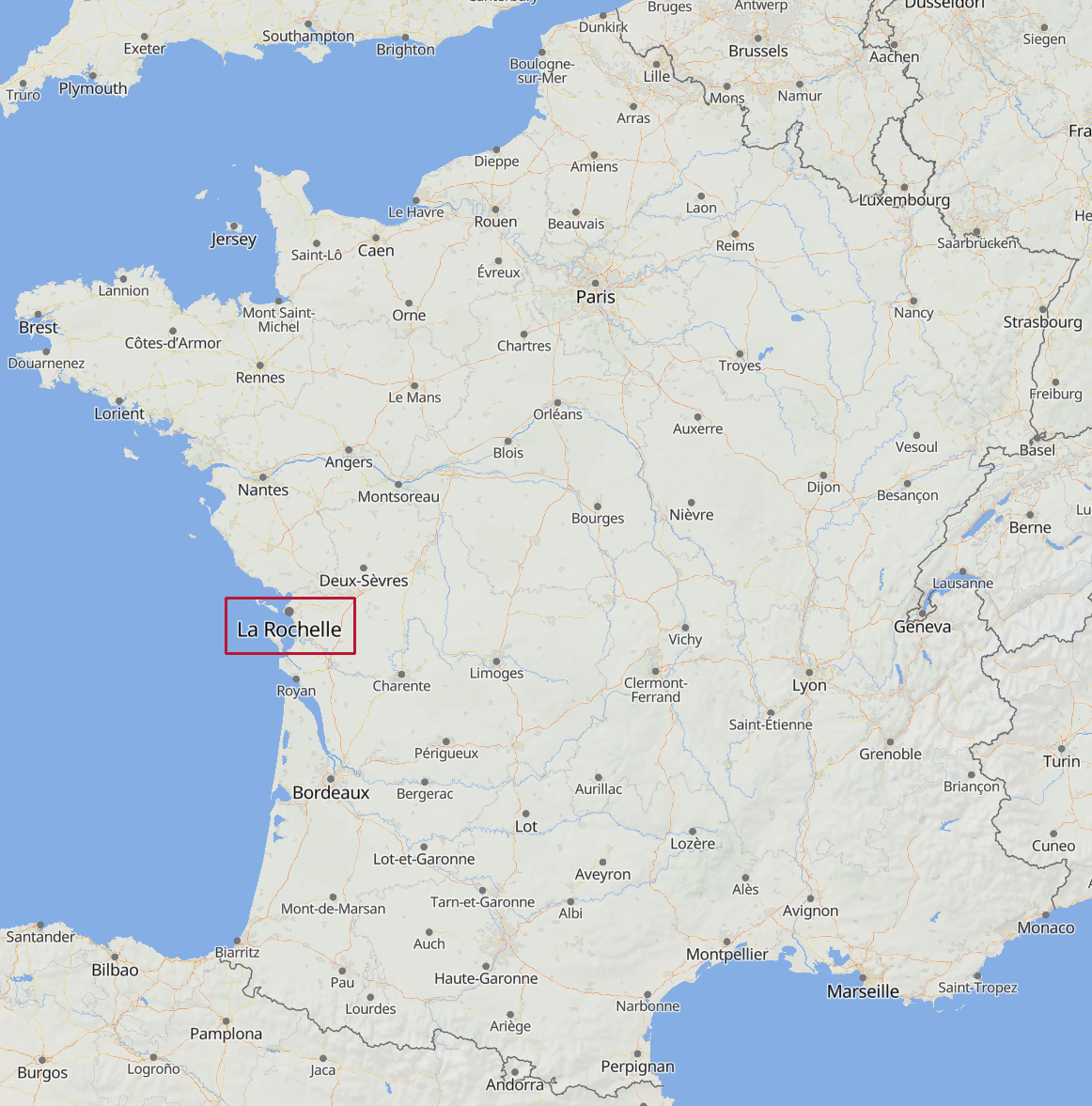
Location of La Rochelle in France (Mapcarta)
Jacques and Marie continued to live in La Rochelle. They had one daughter, Marthe, baptized on February 2, 1658, in the chapel of Sainte-Marguerite. She does not reappear in the public record, implying that she likely died before her parents’ departure for Canada.
The city they left behind was, in the 17th century, one of France's principal Atlantic ports and played a central role in transatlantic trade and migration. It was a key point of embarkation for settlers, soldiers, and indentured labourers bound for New France, making it an important gateway between France and its North American colony.
A New Start in New France
Around 1658, Jacques and Marie decided to leave their home city and country for Canada, then in New France. Several factors may have drawn Jacques and Marie across the Atlantic. La Rochelle was, by the 1650s, the principal port of embarkation for New France, and its merchants and shipowners actively recruited engagés, artisans, and young families through contracts offering passage, land, and the promise of a fresh start in exchange for several years of labour. As a hatter, Jacques possessed a portable trade that would have been in demand in the fledgling colony, where skilled craftsmen were scarce and often commanded better terms than they could expect in an oversaturated urban market like La Rochelle. The Aunis region had also suffered economically in the wake of the Siege of La Rochelle (1627–1628) and subsequent religious and fiscal pressures, and many Rochelais of modest means saw emigration as a route to landownership and social advancement unavailable to them at home. The death of infant Marthe, if it did indeed occur before the family's departure, may have further loosened whatever ties bound them to La Rochelle, leaving the couple freer to pursue the colonial opportunity without the complication of resettling a young child. Whether motivated primarily by economic ambition, recruitment incentives, or personal loss, the Beauchamp-Dardenne couple's decision reflected a pattern common to thousands of La Rochelle emigrants of their generation.
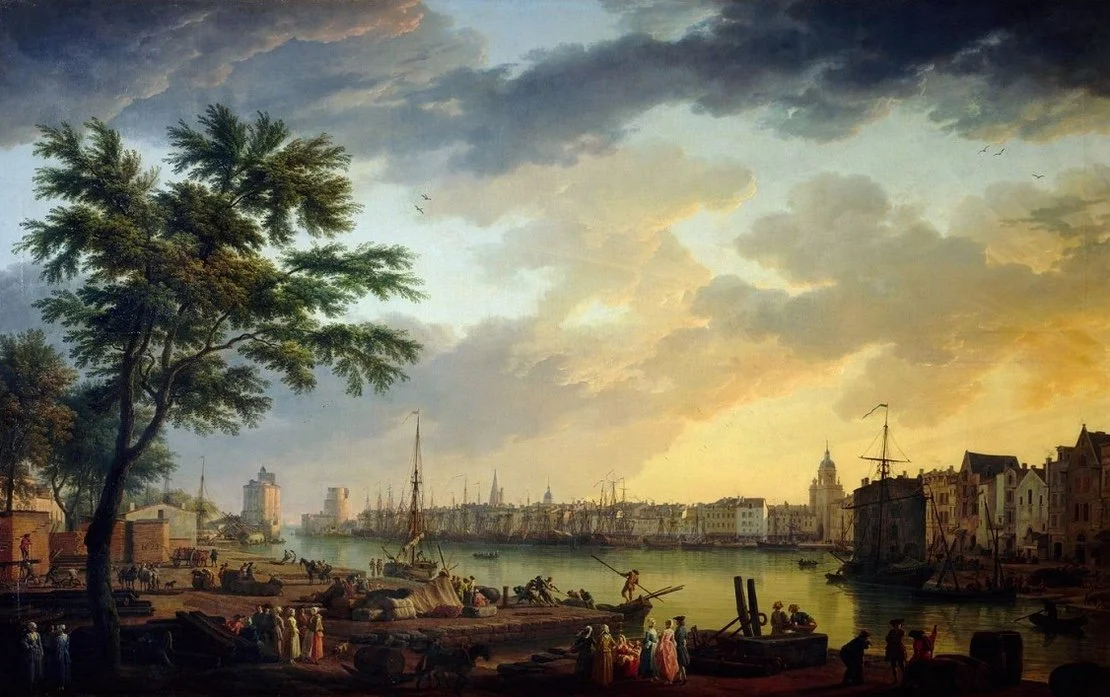
View of the port of La Rochelle, 1762 painting by Joseph Vernet (Wikimedia Commons)
An Extended Family on the Island of Montréal
Jacques likely arrived at Québec in the summer or fall of 1658. He is first mentioned in a notarial record in March of 1659. As ships did not arrive from France in the winter, he was likely aboard the fleet that arrived the previous year. Marie followed her husband a year later. She is recorded on Jeanne Mance’s passenger list for the Saint-André, a ship of recruits destined for Montréal. Marie is listed as “la femme de jaques beauchamps” under “For Mr. Souart,” implying that she was likely hired as a servant for his household.
Several of Marie’s relatives also arrived in Canada by 1659: her father Pierre and her brothers René and Pierre Dardenne. Jean Beauchamp, Jacques’s brother, also emigrated to Canada, arriving around 1666.
Jacques and Marie had at least eight children:
Marthe (1658–1658, in France)
Denise (1661–1721)
Jeanne (1663–1711)
Catherine (1666–1719)
Françoise (1669–1723)
Marie (1672–1754)
Pierre (1676–1722)
Jacques (1678–ca. 1719)
Establishing a Foothold at Pointe-Saint-Charles
Alongside starting a family, Jacques began building a foothold on the island. On March 19, 1659, he received a plot of land at Pointe-Saint-Charles from Simon Grenet. Jacques's name also appears that autumn in a related pair of transactions: Jacques Morin, who held a leasehold on six arpents of land at Pointe-Saint-Charles from Jean Pichaud, ceded half of it to Simon Grenet on October 5; two weeks later, on October 19, Grenet passed this same parcel along to Jacques [Beauchamp], on the same terms under which Morin had held it. Grenet thus appears twice within the year as an intermediary in land dealings that ultimately benefited the young couple, helping Jacques and Marie establish themselves at Pointe-Saint-Charles early in their time in Canada. Jacques was unable to sign his name on the document.
On July 3, 1662, Jacques leased a further three arpents of land on the seigneurial domain of the island of Montréal, this time from Robert Lecavelier dit Desaulniers [Cavelier dit Deslauriers], acting on behalf of his son Jean-Baptiste, the land's owner. This addition brought more farmland under Jacques's management as he continued to build up his holdings in and around Montréal in the years following his arrival.
A short time later, on August 25, 1662, Jacques received a 15-arpent land concession in Pointe-Saint-Charles from the sieur de Maisonneuve, governor of the island. On the same day, he received another land concession from the Société de Notre-Dame de Montréal, the seigneur of the island of Montréal. The land was located on the edge of the Saint-Pierre meadow. Jacques was described as a resident of Villemarie.
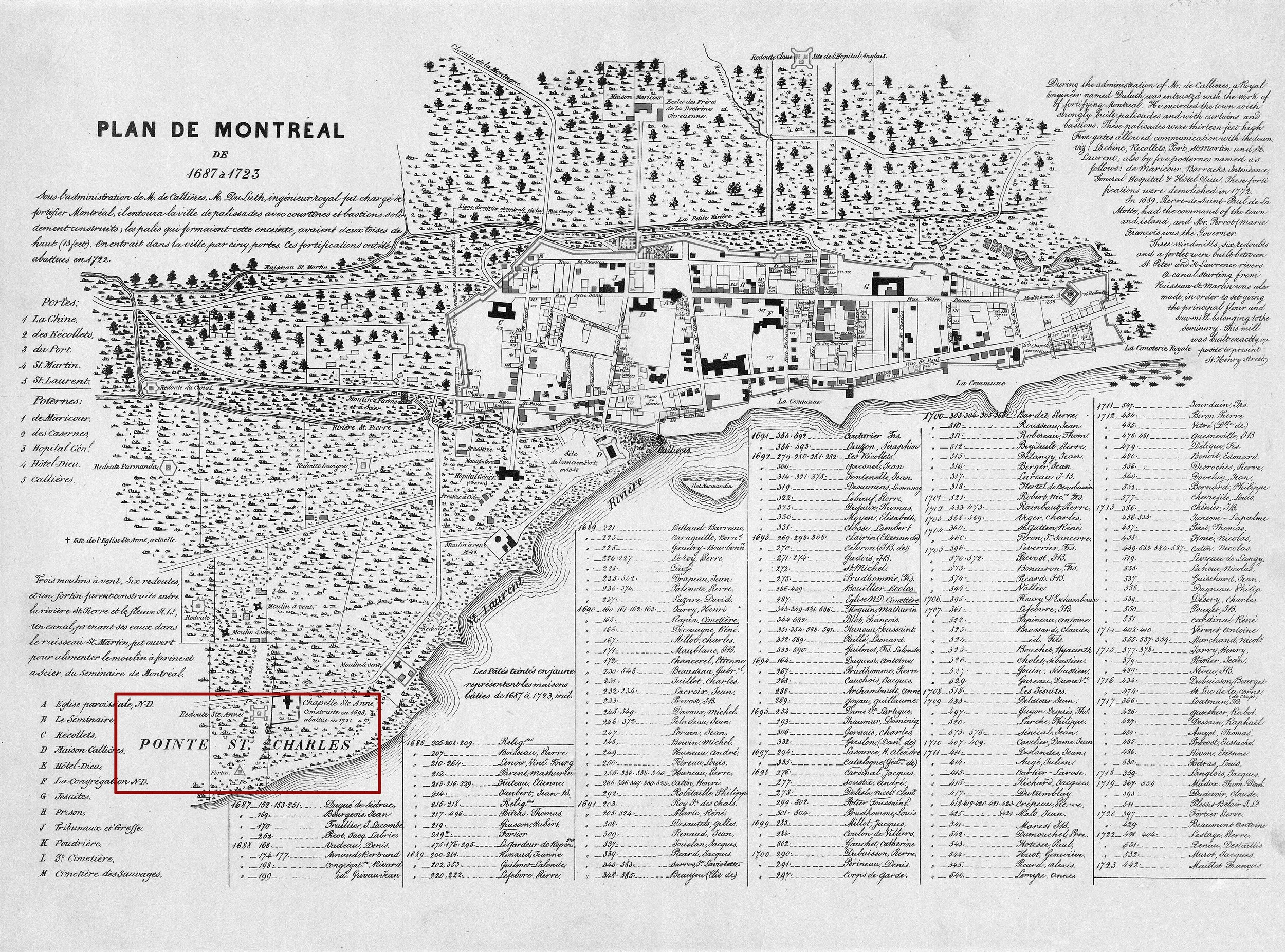
Map of Montréal from 1687 to 1723, showing Pointe-Saint-Charles in red, drawn by P.-L. Morin in 1884 and published by H. Beaugrand (Archives de Montréal)
Ville-Marie or Montréal?
In seventeenth-century records, Ville-Marie (or Villemarie) and Montréal refer to the same place: the fortified settlement founded by Paul de Chomedey de Maisonneuve and Jeanne Mance on the site of present-day Old Montréal. Maisonneuve himself referred to the colony as "Villemarie on the Island of Montréal in New France." The name Ville-Marie first appears in printed sources in 1643, including Les véritables motifs de messieurs et dames de la Société de Nostre Dame de Montreal pour la conversion des sauvages de la Nouvelle-France and that year's Relations des Jésuites. Throughout the seventeenth century, both names coexisted and were often used to refer to the same settlement.
Originally, Montréal referred to the mountain—named Mont Royal by Jacques Cartier—and later to the island itself. Over time, the name also came to designate the settlement, particularly in civil and ecclesiastical records. This usage became increasingly common after the Sulpicians became seigneurs of the island in 1663 and the parish was named Notre-Dame de Montréal. By the late seventeenth century, and even more so in the early eighteenth, official records increasingly favoured Montréal, although Ville-Marie continued to appear, especially when referring to the original missionary settlement or its fortifications.
On July 15, 1663, Jacques sub-leased his three arpents of land belonging to Cavelier to Charles Thoulomé and Mathurin Lelièvre. The agreement was subject to the same clauses and conditions as the original 1662 contract with Cavelier. The lessees also agreed to provide Jacques with six minots of wheat, one minot of peas annually. Jacques was described as an “habitant of Villemarie on the Island of Montréal.”
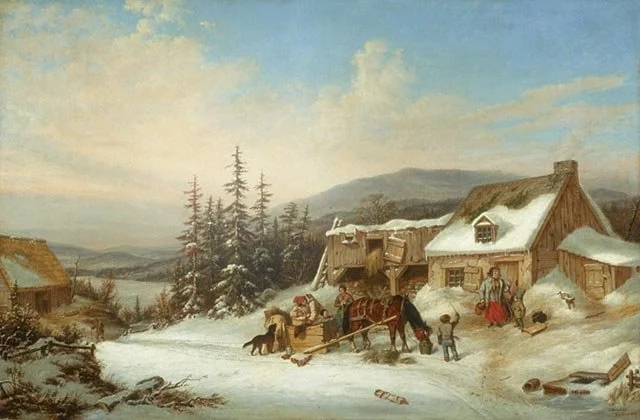
"Habitant Farm," circa 1850 oil painting by Cornelius Krieghoff (Wikimedia Commons)
As an established habitant, Jacques also took on civic responsibilities. In 1663, Jacques was listed as a member of the 18th squadron of the Sainte-Famille Militia.
The Sainte-Famille Militia
In 1663, facing repeated and deadly attacks by the Iroquois, Montréal's residents were left to defend themselves in the absence of formal military support. In response, Paul de Chomedey de Maisonneuve, the town’s founder, established the first Canadian militia. He called upon the men of Montréal to organize themselves into groups of seven, each led by a corporal of their choosing. This local force was placed under the patronage of the Holy Family—Jesus, Mary, and Joseph—and named the Sainte-Famille militia. The final roll listed 139 men, likely representing all able-bodied males in the small settlement, which had a population of around 500 at the time.
The Beauchamp Family in the Census
Jacques and Marie were recorded in the 1666 census living in Montréal with their two daughters, Denise and Jeanne. Jacques was listed as chapelier, or hatter.
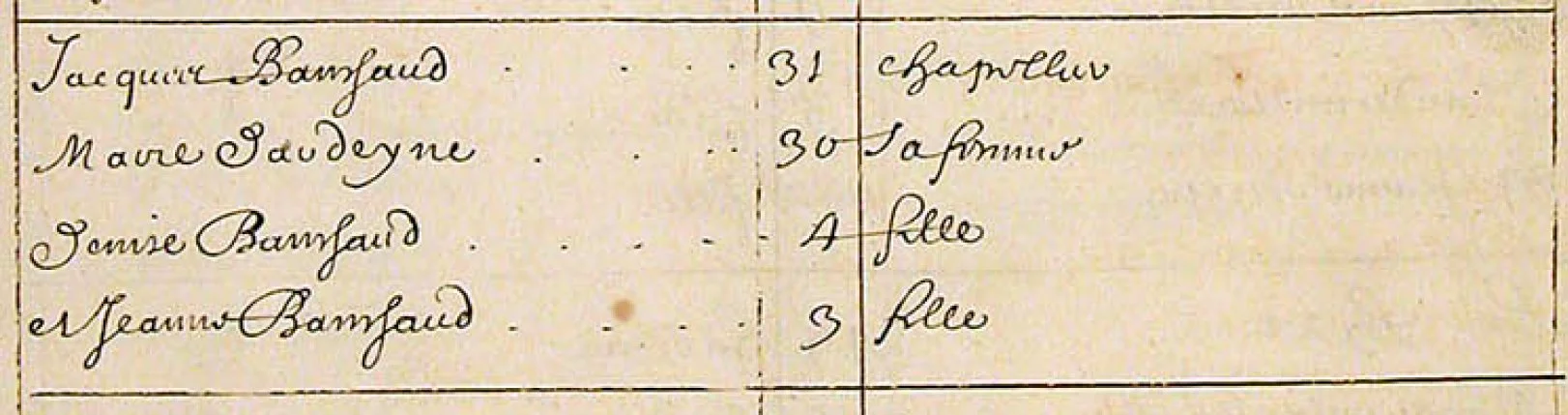
1666 census for the “Bauchaud” family (Library and Archives Canada)
Another census, taken in 1667, found the Beauchamp family still living in Montréal, now with six arpents of cleared land and two head of livestock.
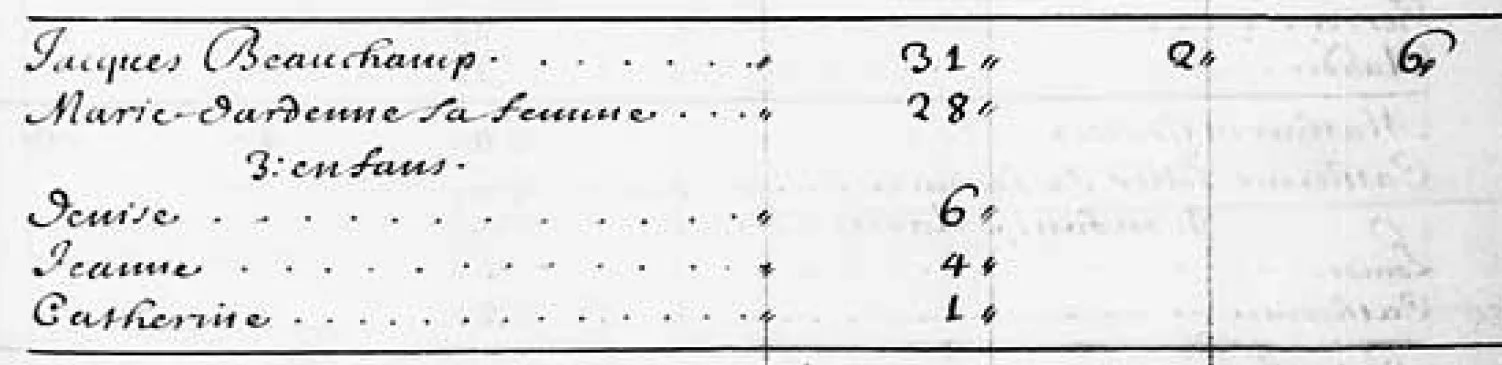
1667 census for the Beauchamp family (Library and Archives Canada)
On November 25, 1668, Jacques and Marie, residents of the island of Montréal, sold the Pointe-Saint-Charles concession they had received from de Maisonneuve to Pierre Perras dit Lafontaine and his wife Denise Lemaistre. The land included a pièce sur pièce (log) house. The buyers agreed to pay 250 minots of wheat, payable in two equal payments.
On September 29, 1671, Marie’s father, Pierre Dardenne, sold land on the island of Montréal below and near “Bois Brûlé” to François Sabatier for 400 livres, on his behalf and on that of his son René and daughter Marie (and her husband Jacques). The land measured three arpents wide facing the St. Lawrence River by twenty arpents deep, and included all buildings constructed upon it. Pierre had acquired the land two years earlier in 1669.
On November 17, 1675, Jacques acknowledged having received 213 livres from Nicolas Boyer, per an agreement they had reached the December prior. Jacques is recorded as an habitant of the island of Montréal. On this notarial document, Jacques’s signature appears for the first time.
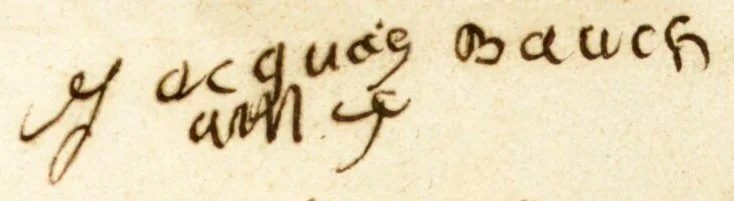
Signature of Jacques Beauchamp in 1675
It was around this time that Jacques and Marie moved to Pointe-aux-Trembles on the northeastern tip of the island of Montréal, settling in the parish of Saint-Enfant-Jésus.
On June 25, 1680, Marie's father, Pierre Dardenne, again sold land on his own behalf and on that of his son René and daughter Marie (and her husband Jacques) — this time at côte Sainte-Anne, to Jean Chaumont, for 150 livres. The land measured three arpents wide facing the St. Lawrence River by twenty arpents deep, and included all buildings constructed upon it. Only René was able to sign the document.
In November of 1681, another census was conducted in New France. Jacques and Marie were again enumerated in Montréal, living with their five children. They owned 16 arpents of cleared land, one gun and eight head of livestock. The family lived near Jacques’s brother Jean and his family, recorded two families down on the census. For the first time, Jacques is recorded as a charpentier, or carpenter.
This implies that either Jacques had changed his occupation from chapelier to charpentier, or the enumerator misheard his profession. Regardless, there are no notarial or legal documents referring to Jacques’s work, other than him being recorded as an habitant.
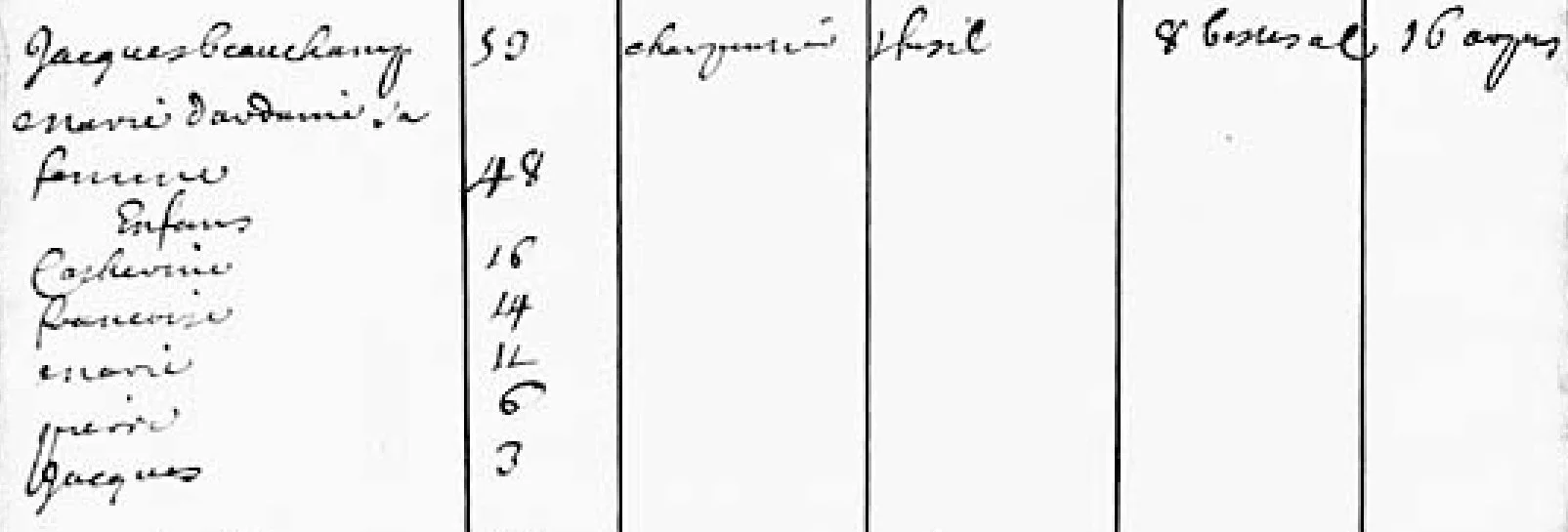
1681 census for the Beauchamp family (Library and Archives Canada)
On February 16, 1687, Jacques sold a plot of land located on côte Saint-Sulpice near the seigneurie of Mr. Lavaltrie to Urbain Girard dit Langevin, both in his own name and in that of his father-in-law Pierre Dardenne. The land measured six arpents wide facing the St. Lawrence River by twenty arpents deep, and bordered Pierre’s land. The land included a stone cabin and a stone shed. The sale price was 100 livres, plus a “capot à usage d’homme vallant dix livres” (a man’s winter coat with a hood, worth 10 livres).
Death of Jacques
Jacques Beauchamp died at the age of 57. He was buried on February 8, 1693, inside the parish church of Saint-Enfant-Jésus in Pointe-aux-Trembles. The date of death was omitted from the burial record, but he died sometime before January 27, 1693, when Marie is described as a widow in a notarial document.
The burial record reads:
“On February 8, 1693, Jacques Baucham, a former habitant of the parish, was buried in our church near the confessional, after paying ten sols for the parish council’s fee to open the grave [...]”
[Note: The entry's title reads "Burial of the grand Baucham" — the only instance in which Jacques is called "grand." While several online genealogy databases credit him with the dit name "Legrand," this article does not adopt it, since the record shows no consistent, repeated use of the name.]
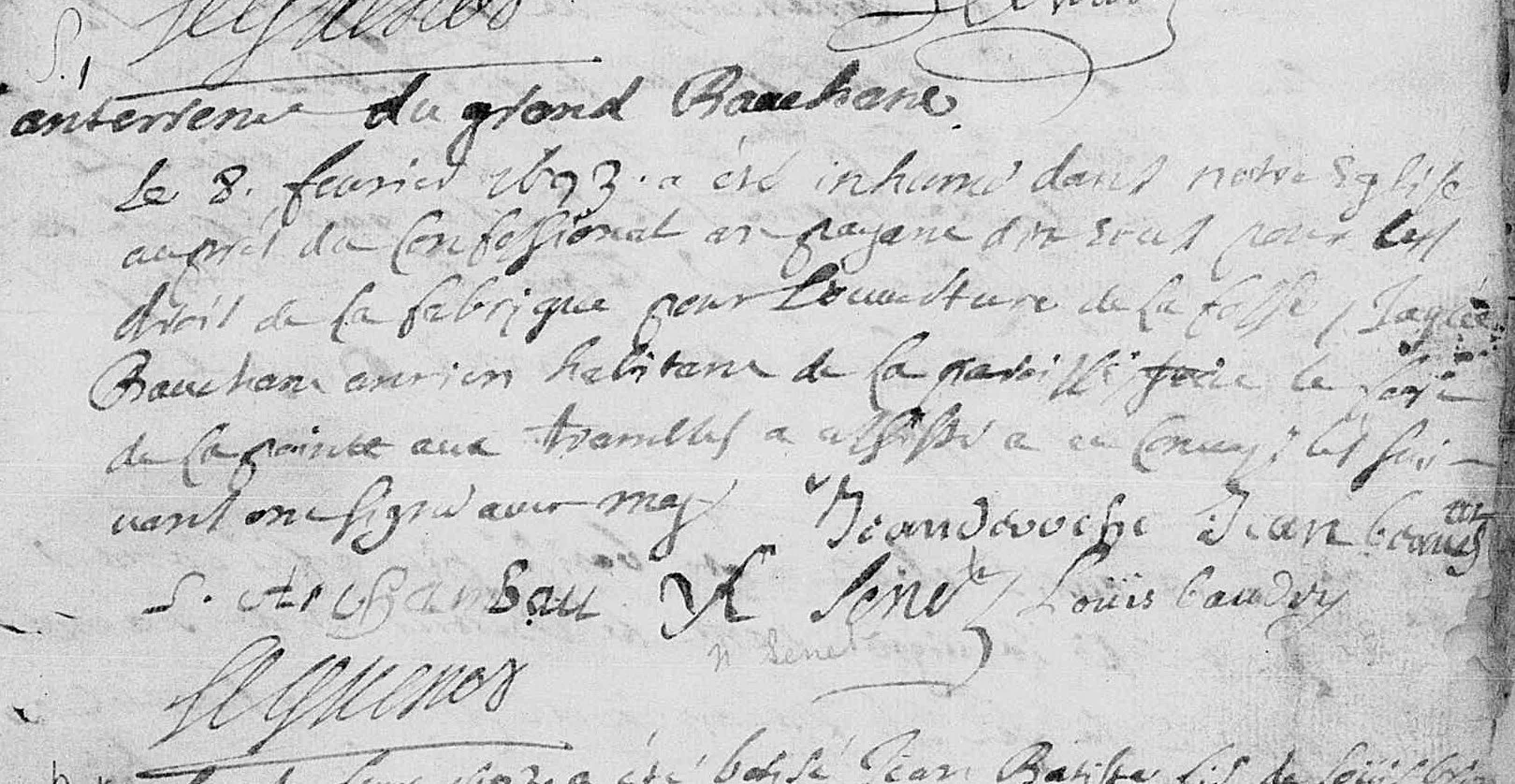
1693 burial of Jacques Beauchamp (FamilySearch)
Buried inside the church?
Intramural church burials are an ancient Christian tradition that early colonists brought from France. In France, this privilege was primarily reserved for clergy and nobles. However, in New France, burials within church walls were not limited to these elite groups. They were performed for those belonging to the most powerful social groups (which could even include farmers), successful tradespeople, and those devoted to their church and community. Bodies were typically placed in crypts located under the church floor or in graves dug after raising the floor or moving a church bench.
The funeral rites for such burials were generally more elaborate and expensive than those for cemetery burials. These rites often included special masses, processions, and other ceremonies that underscored the social status and community contributions of the deceased. The practice of intramural church burials began to decline by the mid-nineteenth century, primarily due to public hygiene concerns, a lack of space, and changing attitudes towards burial practices. By this time, many communities started to favour dedicated cemeteries away from populated areas.
Marie’s Final Years
Marie’s name appears in several notarial documents after the death of her husband, mostly related to his succession and additional land transactions.
In early 1693, the Fabrique (council) of the parish of L'Enfant-Jésus-de-la-Pointe-aux-Trembles granted dozens of land concessions in the bourg, or village, of Pointe-aux-Trembles, in an effort to rebuild and repopulate the village following a series of devastating Iroquois raids in 1690 and 1691, which had killed several residents and burned some thirty homes. Concentrating settlers within the fortified bourg, near the fort built to defend the settlement, offered a measure of protection that outlying farms could not.
On January 27, 1693, Marie received a concession measuring 35 feet wide on Saint-Jean street by 70 feet deep, which included a barn and a stable. On March 4, 1693, she received another concession measuring 30 feet wide on Saint-François street. She agreed to pay 27 deniers in cens annually for the entire concession.
As was customary after the death of a spouse, an inventory was taken of the community of goods belonging to Jacques and Marie. Notary Antoine Adhémar de Saint-Martin penned the 13-page document on April 8, 1693. It enumerated all of the couple’s possessions and their estimated values, including kitchen tools, utensils and equipment; furniture; clothing, bedding and linens; tobacco; stores of wheat, peas and oats; farm animals including oxen, cows, pigs; farm tools and equipment. The document also listed the couple’s land, their debts totalling 109 livres, and important documents. The total value of their assets was estimated at 1,418 livres.
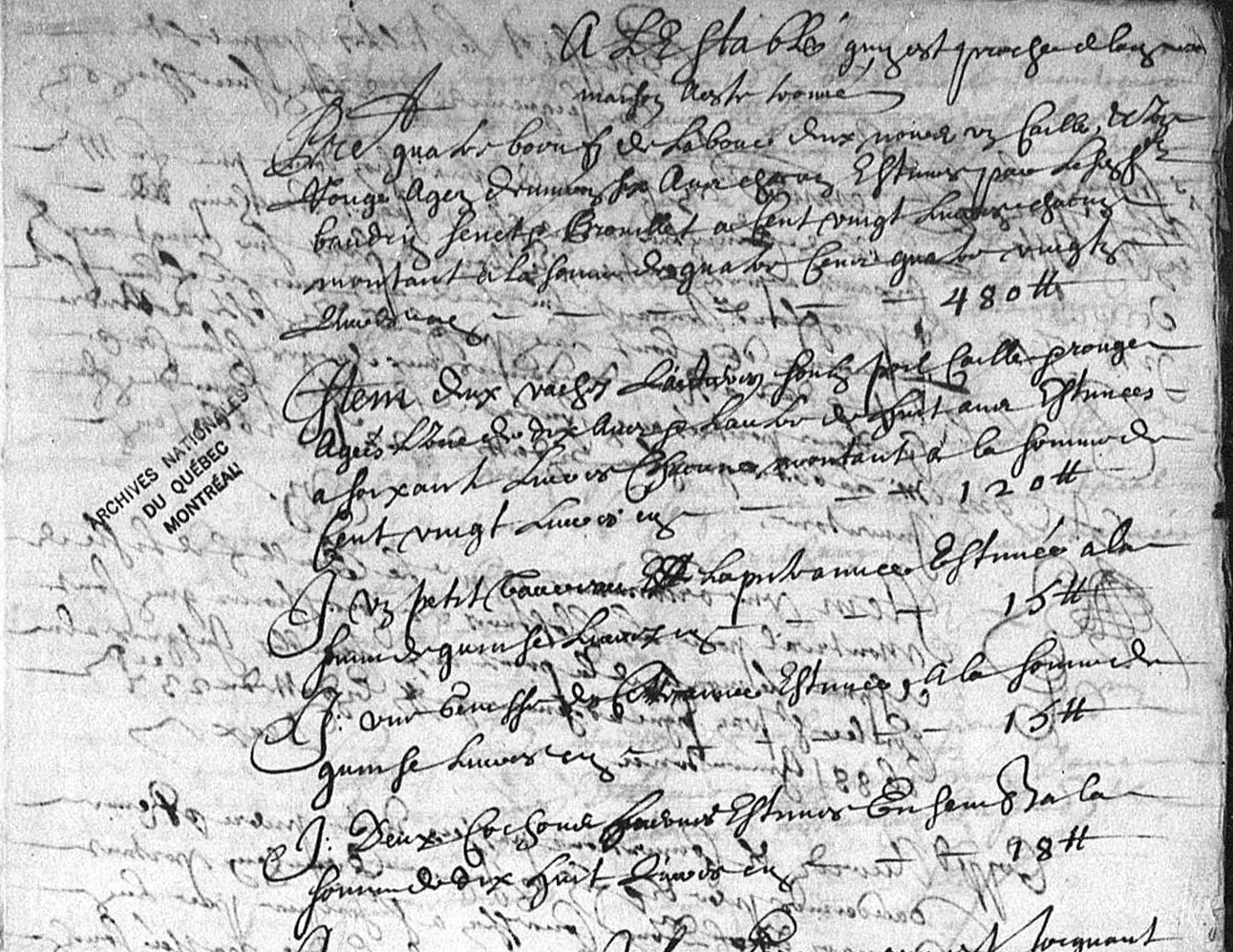
Extract of the 1693 inventory, showing the couple’s farm animals (FamilySearch)
The day following the inventory, Jacques’s succession was divided between his wife, his children and their spouses. Marie was assisted by Villemarie merchant Pierre Perthuys, her representative and advisor, and her brother-in-law Jean Beauchamp.
On June 11, 1693, Marie leased an island “near the Grande-Isle called La Trinité” from Marie Boucher, the widow of René Gaultier, the seigneur of Varennes, on behalf of herself and her children. The farm lease was for five years.
Despite the inventory having been deemed “clos” (finalized) on May 19, 1693, Jacques’s heirs (Marie and her children and spouses) continued to negotiate the succession after this date.
On February 28, 1694, an agreement was penned by notary Adhémar regarding the division of 1) a parcel of land located on côte Saint-Jean in Pointe-aux-Trembles; 2) a parcel of land located along the St. Lawrence River; 3) a parcel of land located on the island of Sainte-Thérèse; 4) two lots located in the village of Pointe-aux-Trembles, on Saint-Jean street and Saint-François street.
From March 23 to December 7, 1694, Marie and her children appear before the courts in Montréal to settle amicably the division of the property bequeathed to them through inheritance.
On November 30, 1695, Marie sold the land located on the island of Sainte-Thérèse to Jean Baptiste Pilon dit Lafortune and Élisabeth Bertault for 650 livres. The land measured four arpents of frontage facing the St. Lawrence River by fifteen arpents deep, on which there was “about four days’ [worth] of ploughing, ” with the other parts cleared by pickaxe and the remainder being wooded. The sale document indicates that Jacques had acquired the land in two parts: the first two arpents sold to him via private contract by Pierre Gour dit Lavigne in 1689, and the last two arpents obtained through an exchange with Pierre Ango in 1690, again via private contract. The land was subject to three livres in cens and four capons in rente annually.
On February 1, 1696, Marie appeared before notary Adhémar for the last time. On this date, she gives all of her movable and immovable property to her son Jacques. In exchange, he promised to feed and take care of his mother, in sickness and in health.
Donations
In Québec, the practice of making donations "entre vifs" (between living persons) was quite common, especially as individuals aged or experienced a decline in health. This type of donation involved transferring control of one's possessions to another person, typically one of their children, who would then take on the responsibility of caring for them. The donation process was formalized through a notary, who documented the agreement in detail. This notarized document specified the rights and responsibilities of both parties, outlining exactly what the parent was giving to the child and what the child was expected to provide in return. The assets included in these donations often comprised land, a house or farm, and livestock. In exchange for receiving these assets, the child might be required to pay off any outstanding debts and ensure that the parent was properly housed, fed, clothed, and otherwise cared for until their death.
Death of Marie
Marie Dardenne died at the age of 61 on August 7, 1699, in Boucherville. She was buried the following day in the parish cemetery of Sainte-Famille. The burial record mistakenly states that she was “about 72 years old.” The seigneur of Boucherville, Pierre Boucher, “and many others" attended the burial.
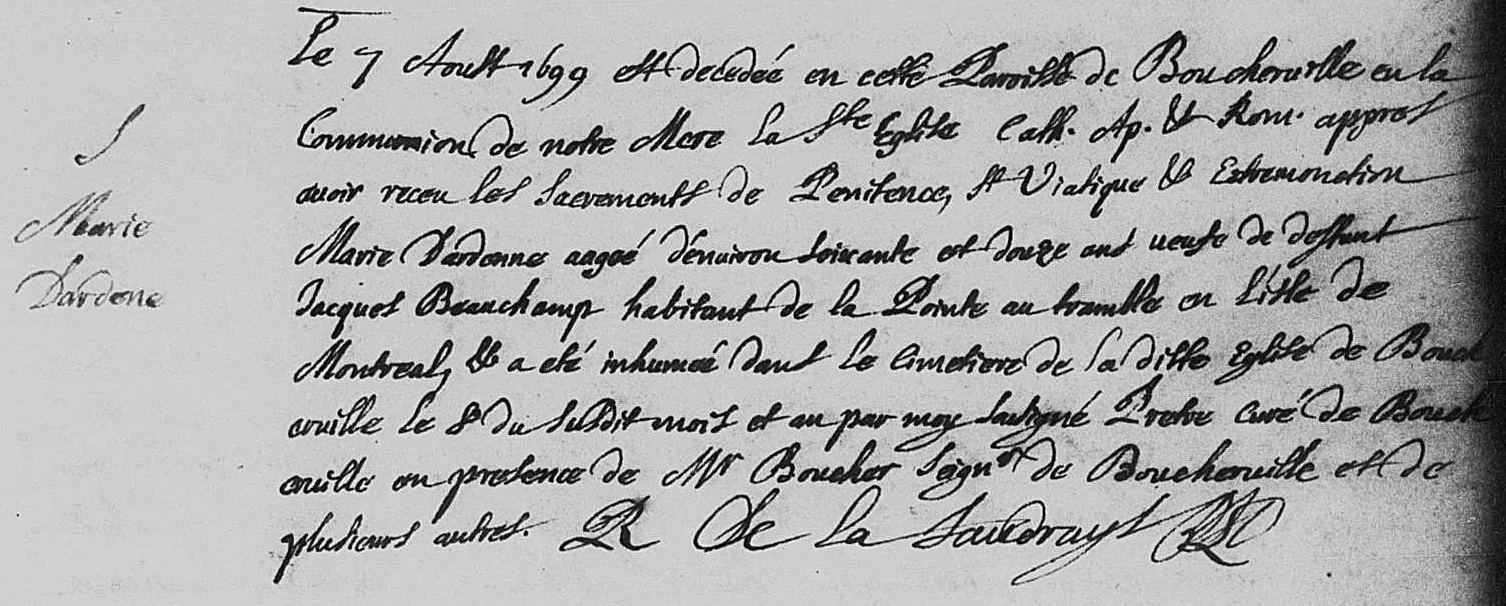
1699 burial of Marie Dardenne (FamilySearch)
From La Rochelle to Pointe-aux-Trembles
Jacques Beauchamp and Marie Dardenne married in the autumn of 1656, in a chapel that had carried the city's Catholic worship through decades of religious war. Within two years, they had left La Rochelle behind, drawn like thousands of other Rochelais by the promise of land and a fresh start across the Atlantic. In New France, the young hatter became, in time, an habitant with cleared fields of his own. Marie followed a year later, arriving as a hired servant for the Souart household before becoming the anchor of a growing farm and family at Pointe-Saint-Charles and, later, Pointe-aux-Trembles. The couple steadily built a modest estate through land grants, leases, and sales recorded across dozens of notarial documents.
When Jacques died in 1693, he was buried inside the church itself, a mark of standing reserved for the community's more established residents, and a measure of the place he and Marie had made for themselves in Pointe-aux-Trembles. Marie outlived him by six years, closing out his affairs, securing land for her children, and finally handing over everything she owned to her son in exchange for care in her old age. Theirs is not a story of dramatic fortune, but of two ordinary emigrants whose steady, unglamorous work planted roots that would take hold in Quebec for generations.
PDF version of biography located at: https://www.tfcg.ca/jacquesbeauchamp-and-mariedardenne.
Are you enjoying our articles and resources? Show your support by making a donation. Every contribution, regardless of its size, goes a long way in covering our website hosting expenses and enables us to create more content related to French-Canadian genealogy and history. Thank you! Merci!
Sources:
"Archives en ligne : Registres paroissiaux, pastoraux et d'état civil (La Rochelle)," digital images, Archives de la Charente-Maritime (http://www.archinoe.net/v2/ark:/18812/aaf4414a3b165c5ed5f4f97f82041917 : accessed 12 Jul 2026), baptism of Jacques Beauchamps, 8 Jul 1635, La Rochelle (Sainte-Marguerite), communal collection, baptisms (1620-1639), image 172 of 267.
"Archives en ligne : Registres paroissiaux, pastoraux et d'état civil (La Rochelle)," digital images, Archives de la Charente-Maritime (http://www.archinoe.net/v2/ark:/18812/f820cb0ab735ca2f751c32eb3f39774c : accessed 12 Jul 2026), marriage of Michel Beauchamps and Marie Roullet, 12 May 1630, La Rochelle (Sainte-Marguerite), communal collection, marriages (1624-1636), image 37 of 89.
"Archives en ligne : Registres paroissiaux, pastoraux et d'état civil (La Rochelle)," digital images, Archives de la Charente-Maritime (http://www.archinoe.net/v2/ark:/18812/7bf1ebb148ab4ecc1fff20a310745dd5 : accessed 13 Jul 2026), baptism of Marie Dardenne, 11 Apr 1638, La Rochelle (Saint-Jean-du-Pérot), communal collection, baptisms (1632-1638), image 41 of 135, reference G G 352.
"Archives en ligne : Registres paroissiaux, pastoraux et d'état civil (La Rochelle)," digital images, Archives de la Charente-Maritime (http://www.archinoe.net/v2/ark:/18812/65bb35406196f081bcd8ed86b3f8ea0f : accessed 13 Jul 2026), marriage of Pierre Dardaine and Gilette Chaisgne, 22 Jun 1637, La Rochelle (Sainte-Marguerite), communal collection, marriages (1636-1666), image 12 of 309, reference G G 376.
"Archives en ligne : Registres paroissiaux, pastoraux et d'état civil (La Rochelle)," digital images, Archives de la Charente-Maritime (http://www.archinoe.net/v2/ark:/18812/01a9ccb324007c7540d5e824f12f97e4 : accessed 13 Jul 2026), marriage of Jacques Bauchamp and Marie Dardene, 29 Oct 1656, La Rochelle (Sainte-Marguerite), communal collection, marriages (1636-1666), image 191 of 309, reference G G 376.
"Archives en ligne : Registres paroissiaux, pastoraux et d'état civil (La Rochelle)," digital images, Archives de la Charente-Maritime (http://www.archinoe.net/v2/ark:/18812/5903e2b0176e6da78ade4b6465c75c9d : accessed 13 Jul 2026), baptism of Marthe Beauchamps, 2 Feb 1658, La Rochelle (Sainte-Marguerite), communal collection, baptisms (1654-1662), image 69 of 179.
"La chapelle Sainte-Marguerite," Racines Rochelaises (http://racinesrochelaises.free.fr/larochellesm.html : accessed 13 Jul 2026).
"Pointe-aux-Trembles. Religious Records 1674–1876, 1674, 1727," digital images, FamilySearch (https://www.familysearch.org/ark:/61903/3:1:3QSQ-G993-W65G?cat=240130&view=explore&lang=en&groupId=TH-1971-27996-10138-87 : accessed 15 Jul 2026), burial of Jacques BAUCHAM, 8 Feb 1693, Montréal, Pointe-aux-Trembles (St-Enfant-Jésus), Image Group Number: 005468882, image 290 of 665.
"Canada, Québec, registres paroissiaux catholiques, 1621-1979," digital images, FamilySearch (https://www.familysearch.org/ark:/61903/3:1:3QS7-L99Q-99WM-8?lang=en&i=593&groupId=1321742 : accessed 15 Jul 2026), burial of Marie Dardene, 8 Aug 1699, Boucherville > Sainte-Famille-de-Boucherville > Index 1668-1877 Baptêmes, mariages, sépultures 1668-1717 > image 594 of 749; citing original data : Archives nationales du Québec, Montréal.
“Archives de notaires : Bénigne Basset dit Deslauriers (1657-1699)," digital images, Bibliothèque et Archives nationales du Québec (https://numerique.banq.qc.ca/patrimoine/details/52327/4143984?docref=UmuGJSAMzpP0Dvt4ffweJA : accessed 13 Jul 2026), land lease by Jacques Morin to Jacques Beauchamp, 19 Oct 1659, images 384-385 of 702, reference CN601,S17.
“Archives de notaires : Bénigne Basset dit Deslauriers (1657-1699)," digital images, Bibliothèque et Archives nationales du Québec (https://numerique.banq.qc.ca/patrimoine/details/52327/4143985?docref=74tNar91ngUolqrLRPxRjw : accessed 13 Jul 2026), land lease agreement for a parcel of land between Robert Lecavelier-Desaulniers and Jacques Beauchamps, 3 Jul 1662, images 170-171 of 840, reference CN601,S17.
“Archives de notaires : Bénigne Basset dit Deslauriers (1657-1699)," digital images, Bibliothèque et Archives nationales du Québec (https://numerique.banq.qc.ca/patrimoine/details/52327/4143986?docref=TQ-oSj30zrP-1NlbtY0JXg : accessed 13 Jul 2026), land sale by Jacques Beauchamps and Marie Dardainne to Pierre Perras dit Lafontaine and Denise Lemaistre, 25 Nov 1668, images 355-357 of 801, reference CN601,S17.
“Archives de notaires : Bénigne Basset dit Deslauriers (1657-1699)," digital images, Bibliothèque et Archives nationales du Québec (https://numerique.banq.qc.ca/patrimoine/details/52327/4143985?docref=_YKqevVYG9kVgXPtlD_h4A : accessed 13 Jul 2026), land lease agreement between Jacques Beauchamp, and Charles Thoulomés and Mathurin Lelievres, 15 Jul 1663, images 349-351 of 840, reference CN601,S17.
“Archives de notaires : Bénigne Basset dit Deslauriers (1657-1699)," digital images, Bibliothèque et Archives nationales du Québec (https://numerique.banq.qc.ca/patrimoine/details/52327/4143987?docref=PU4DdJnoO0zpC28jxfCAnQ : accessed 13 Jul 2026), land sale by Pierre Dardaine, both in his own name and acting as agent and guarantor for René Dardaine, and Jacques Bauchamps and Marie Dardaine, to François Sabaltier, 29 Sep 1671, images 432-434 of 815, reference CN601,S17.
“Archives de notaires : Bénigne Basset dit Deslauriers (1657-1699)," digital images, Bibliothèque et Archives nationales du Québec (https://numerique.banq.qc.ca/patrimoine/details/52327/4143989?docref=b_KgU1sEE9IAwwxMXtGk1A : accessed 13 Jul 2026), agreement between Jacques Bauchamp and Nicolas Boyer, 26 Dec 1674, images 314-315 of 715, reference CN601,S17.
"Actes de notaire, 1677-1696 // Claude Maugue," digital images, FamilySearch (https://www.familysearch.org/ark:/61903/3:1:3Q9M-CST7-GS6K-N?cat=koha%3A427707&view=explore&lang=en&groupId=TH-909-77572-65110-33 : accessed 15 Jul 2026), land sale by Pierre Dardaine, both in his own name and acting as and on behalf of René Dardaine and Jacques Beauchamp, to Jean Chaumont, 25 Jun 1680, images 1090-1091 of 2531; citing original data: Bibliothèque et Archives nationales du Québec.
“Archives de notaires : Bénigne Basset dit Deslauriers (1657-1699)," digital images, Bibliothèque et Archives nationales du Québec (https://numerique.banq.qc.ca/patrimoine/details/52327/4143992?docref=YdHfH3QFTfgm29FW_zDBUw : accessed 13 Jul 2026), land sale by Jacques Beauchamp, both in his own name and acting as agent and guarantor for Pierre Dardaine, to Urbain Girard dit Langevin, 16 Feb 1687, images 735-737 of 933, reference CN601,S17.
"Actes de notaire, 1668-1714 // Antoine Adhémar," digital images, FamilySearch (https://www.familysearch.org/ark:/61903/3:1:3Q9M-CS5F-Y3CF-T?cat=koha%3A541271&view=explore&lang=en&groupId=TH-909-76077-85012-42 : accessed 15 Jul 2026), lot concession by the Parish Council of L'Enfant-Jésus-de-la-Pointe-aux-Trembles to Marie Dardenne, 27 Jan 1693, images 2795-2796 of 3048; citing original data: Bibliothèque et Archives nationales du Québec.
"Actes de notaire, 1668-1714 // Antoine Adhémar," digital images, FamilySearch (https://www.familysearch.org/ark:/61903/3:1:3Q9M-CS5F-Y34Y-D?cat=koha%3A541271&view=explore&lang=en&groupId=TH-909-76077-85012-42 : accessed 15 Jul 2026), lot concession by the St. Sulpice Seminary of Montreal to Marie Dardenne, 4 Mar 1693, images 2862-2863 of 3048; citing original data: Bibliothèque et Archives nationales du Québec.
"Actes de notaire, 1668-1714 // Antoine Adhémar," digital images, FamilySearch (https://www.familysearch.org/ark:/61903/3:1:3Q9M-CS5F-Y3QL-J?cat=koha%3A541271&view=explore&lang=en&groupId=TH-909-76077-85012-42 : accessed 15 Jul 2026), inventory of the community property of Marie Dardennes, widow of Jacques Beauchamp, 8 Apr 1693, images 2954-2966 of 3048; citing original data: Bibliothèque et Archives nationales du Québec.
"Actes de notaire, 1668-1714 // Antoine Adhémar," digital images, FamilySearch (https://www.familysearch.org/ark:/61903/3:1:3Q9M-CS5F-Y3H9-L?cat=koha%3A541271&view=explore&lang=en&groupId=TH-909-76077-85012-42 : accessed 15 Jul 2026), agreement between Marie Dardennes and the children (and their spouses) of Jacques Beauchamp, 9 Apr 1693, images 2968-2976 of 3048; citing original data: Bibliothèque et Archives nationales du Québec.
"Actes de notaire, 1668-1714 // Antoine Adhémar," digital images, FamilySearch (https://www.familysearch.org/ark:/61903/3:1:3Q9M-CSTH-579J-8?cat=koha%3A541271&view=explore&lang=en&groupId=TH-909-77664-136049-63 : accessed 15 Jul 2026), lease and rent agreement for an island from Marie Boucher to Marie Dardennes and her children, 11 Jun 1693, image 106 of 3065; citing original data: Bibliothèque et Archives nationales du Québec.
"Actes de notaire, 1668-1714 // Antoine Adhémar," digital images, FamilySearch (https://www.familysearch.org/ark:/61903/3:1:3Q9M-CSTH-57WS-L?cat=koha%3A541271&view=explore&lang=en&groupId=TH-909-77664-136049-63 : accessed 15 Jul 2026), agreement between Marie Dardennes and the children (and their spouses) of Jacques Beauchamp, 28 Feb 1694, images 1371-1379 of 3065; citing original data: Bibliothèque et Archives nationales du Québec.
"Actes de notaire, 1668-1714 // Antoine Adhémar," digital images, FamilySearch (https://www.familysearch.org/ark:/61903/3:1:3Q9M-CSTC-MWVD-W?cat=koha%3A541271&view=explore&lang=en&groupId=TH-909-77670-168229-49 : accessed 15 Jul 2026), land sale by Marie Dardennes to Jean-Baptiste Pilon dit Lafortune and Elisabeth Bertault, 30 Nov 1694, images 545-554 of 3065; citing original data: Bibliothèque et Archives nationales du Québec.
"Actes de notaire, 1668-1714 // Antoine Adhémar," digital images, FamilySearch (https://www.familysearch.org/ark:/61903/3:1:3Q9M-CSTC-MW6F-N?cat=koha%3A541271&view=explore&lang=en&groupId=TH-909-77670-168229-49 : accessed 15 Jul 2026), donation of personal property and real estate by Marie Dardennes to her son Jacques Beaucham, 1 Feb 1696, images 658-659 of 2856; citing original data: Bibliothèque et Archives nationales du Québec.
Parchemin, notarial database of ancient Québec (1626-1801), Société de recherche historique Archiv-Histo (https://archiv-histo.com : accessed 14 Jul 2026), "Cession d'une terre située en l'île de Montréal au lieu de la pointe St Charles; par Simon Grenet, à Jacques Beauchamps," notary B. Basset dit Deslauriers, 19 Mar 1659.
Parchemin, notarial database of ancient Québec (1626-1801), Société de recherche historique Archiv-Histo (https://archiv-histo.com : accessed 14 Jul 2026), "Collation d'une concession de terre située sur le bord de la prairie Sainct Pierre; par la Société de Notre-Dame de Montréal, seigneur de l'île de Montréal, à Jacques Beauchamp, de Villemarie," private contract, 30 Jan 1667 (original dated 25 Aug 1662).
“Fonds Juridiction royale de Montréal - Archives nationales à Montréal," digital images, Bibliothèque et Archives nationales du Québec (https://advitam.banq.qc.ca/notice/696921 : accessed 15 Jul 2026), "Licitation par les cohéritiers de défunt Jacques Beauchamp et Marie Dardenne, sa veuve, pour régler à l'amiable le partage des biens qui leurs ont été transmis par succession," 23 Mar 1694-7 Dec 1694, reference TL4,S1,D34, Id 696921.
"Recensement du Canada, 1666," digital images, Library and Archives Canada (https://recherche-collection-search.bac-lac.gc.ca/fra/accueil/notice?idnumber=2318856&app=fonandcol : accessed 14 Jul 2026), household of Jacques Bauchaud, 1666, Montréal, page 132 (of PDF), Finding aid no. MSS0446, MIKAN no. 2318856; citing original data: Centre des archives d'outre-mer (France) vol. 460.
"Recensement du Canada, 1667," Library and Archives Canada (https://collectionscanada.gc.ca/ : accessed 14 Jul 2026), household of Jacques Beauchamp, 1667, Montréal, page 157, Finding aid no. MSS0446, Item ID number: 2318857; citing original data: Centre des archives d'outre-mer (France) vol. 460.
"Recensement du Canada fait par l'intendant Du Chesneau," Library and Archives Canada (https://collectionscanada.gc.ca/ : accessed 14 Jul 2026), household of Jacques Beauchamp, 14 Nov 1681, Montréal, page 136 (of PDF), Finding aid no. MSS0446, MIKAN no. 2318858; citing original data: Centre des archives d'outre-mer (France) vol. 460.
Fédération québécoise des sociétés de généalogie, Fichier Origine online database (https://www.fichierorigine.com/fr/repertoire/beauchamp-1 : accessed 12 Jul 2026), entry for BEAUCHAMP, Jacques (person #240238), updated on 11 Dec 2024.
Fédération québécoise des sociétés de généalogie, Fichier Origine online database (https://www.fichierorigine.com/fr/repertoire/dardenne/-dardaine : accessed 13 Jul 2026), entry for DARDENNE / DARDAINE, Marie (person #241125), updated on 25 Feb 2023.
Archange Godbout, Les passagers du Saint-André : la recrue de 1659 (Montréal, Société généalogique canadienne-française, 1964), 10, 25.
Université de Montréal, Programme de recherche en démographie historique (PRDH) online database (https://www-prdh-igd-com.res.banq.qc.ca/Membership/en/PRDH/Famille/83900 : accessed 13 Jul 2026), dictionary entry for Jacques BEAUCHAMP LEGRAND and Marie DARDENNE, union 83900.
Yvon Sicotte, Base de données – Les Premiers Montréalais (https://lespremiersmontrealais.wordpress.com/wp-content/uploads/2012/04/7-3-1-les-immigrants.pdf : accessed 13 Jul 2026), entry for Jacques Beauchamp, page 38.
E.-Z. Massicotte, "La milice de 1663," Le Bulletin des recherches historiques, volume XXXII, number 7, July 1926, 417.
Thuot, Jean-René, "La pratique de l’inhumation dans l’église dans Lanaudière entre 1810 et 1860 : entre privilège, reconnaissance et concours de circonstances," 2006, Études d'histoire religieuse, 72, 75–96, digitized by Érudit (https://doi.org/10.7202/1006589ar).
André Lachance, Vivre, aimer et mourir en Nouvelle-France; Juger et punir en Nouvelle-France: la vie quotidienne aux XVIIe et XVIIIe siècles (Montréal, Québec: Éditions Libre Expression, 2004), 167-172.