Guillaume Falardeau & Marie Ambroise Bergevin
Discover the story of Guillaume Falardeau and Marie Ambroise Bergevin, the ancestral couple of the Falardeau family in North America. Follow Guillaume’s journey from Saintonge, France, to New France as a soldier in the Compagnies franches de la Marine, and learn how he and Marie Ambroise established their family in Beauport and Charlesbourg. Based on parish records, notarial archives, and historical research, this biography explores the origins of the Falardeau family in Canada and life in colonial Québec during the late 17th and first half of the 18th century.
Cliquez ici pour la version en français
Guillaume Falardeau & Marie Ambroise Bergevin
The Origins of the Falardeau Family in New France
Guillaume Falardeau (or Folardeau), son of Pierre Folardeau and Jeanne Cousteau, was born in the parish of Saint-Sauveur in Bignay, Saintonge, France. He grew up in Bignay alongside at least three siblings: Élie, Jeanne, and Jean, the latter of whom also emigrated to Canada.
Guillaume’s estimated year of birth varies based on surviving historic records, only two of which provide an age:
Circa 1656 (70 years old in 1726 on his burial record)
Circa 1669 (25 years old in 1694, when he was a patient at l’Hôtel-Dieu)
Located about 60 kilometres southeast of the port city of La Rochelle, Bignay is a rural commune in the present-day department of Charente-Maritime. It has a current population of about 350 residents, known as Bignaysiens.
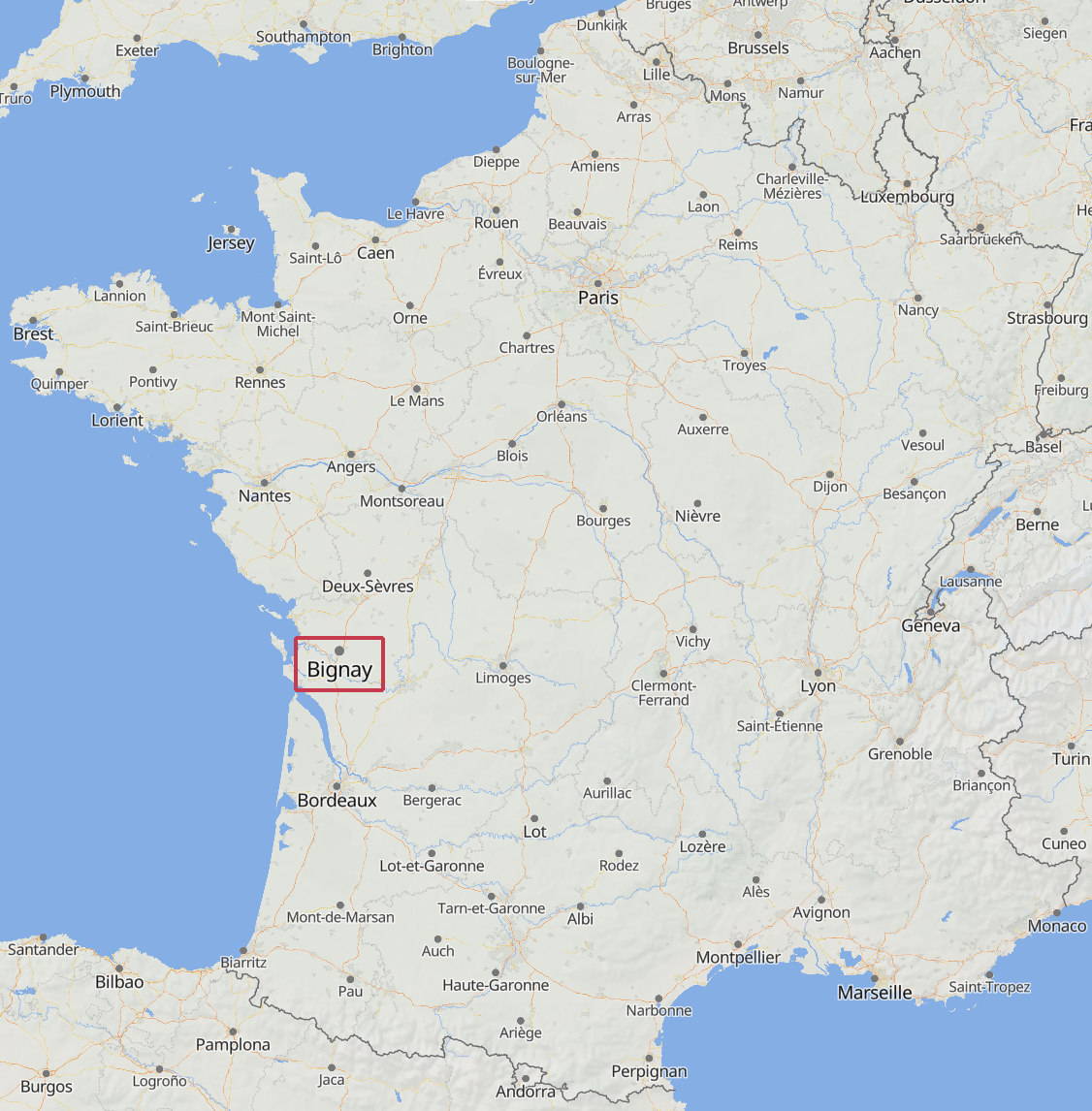
Location of Bignay in France (Mapcarta)
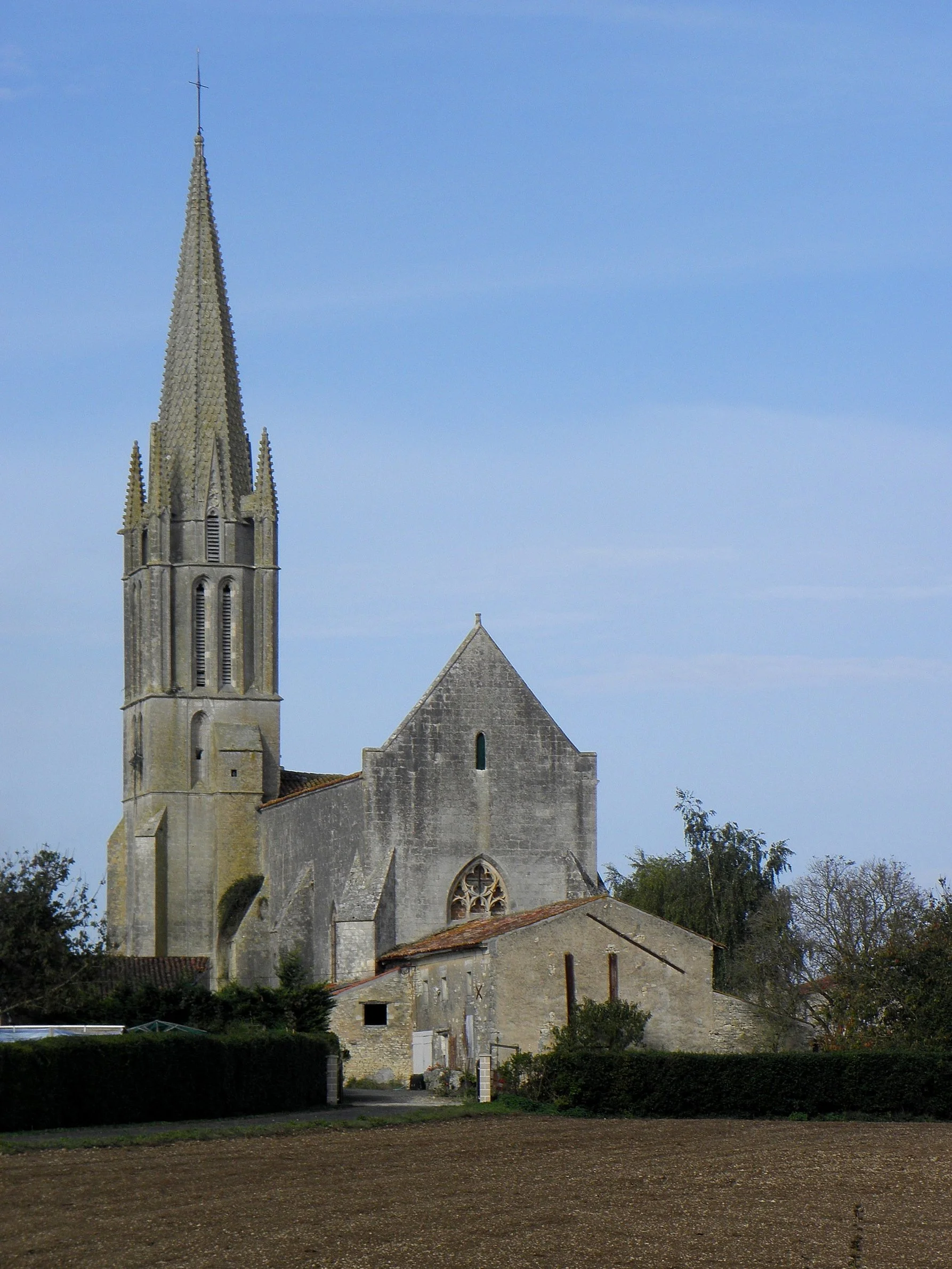
Church of Saint-Sauveur in Bignay (photo by GO69, Wikimedia Commons, CC BY-SA 4.0)
The Church of Saint-Sauveur (also called the Church of Sainte-Trinité) in Bignay, where the Folardeau family worshipped, originated as part of a 12th-century priory belonging to the Order of Sainte-Geneviève. Its early history was turbulent. Around 1430, armed brigands occupied the church and used it as a base from which to terrorize the surrounding countryside until local nobles and villagers besieged the building. During the assault, the church was accidentally destroyed by fire. The present church was rebuilt shortly afterward, around 1434, although the original Romanesque west façade and portal from the 12th century survived.
Additional work continued over the centuries, including the completion of the vaulted ceilings in the 17th century under the patronage of the Chaumont family. The Gothic spire, notable for faithfully following medieval Gothic design principles, was restored in the 19th century after repeated lightning strikes. The church has been protected as a historic monument since 1907 and retains several notable historic features, including a bell cast in 1666, a 16th-century baptismal font, and restored historic altars.
A Soldier in the Compagnies franches de la Marine
At some point before his arrival in New France, Guillaume enlisted, or was recruited, as a soldier in the Saint-Jean Company of the Compagnies franches de la Marine. For a young man from Bignay, military service may have offered opportunities that were difficult to find in rural Saintonge, particularly for younger sons with limited prospects of inheriting land. Service in the colonial troops provided steady pay, food, clothing, and the possibility of establishing a new life in Canada after completing one’s term.
The region’s proximity to major Atlantic ports such as La Rochelle and Rochefort also exposed local men to colonial recruitment and stories of New France, making enlistment both accessible and familiar. Unfortunately, very little is known about the Saint-Jean Company itself or Guillaume’s specific activities as a soldier, although he appears to have arrived in New France around 1687.
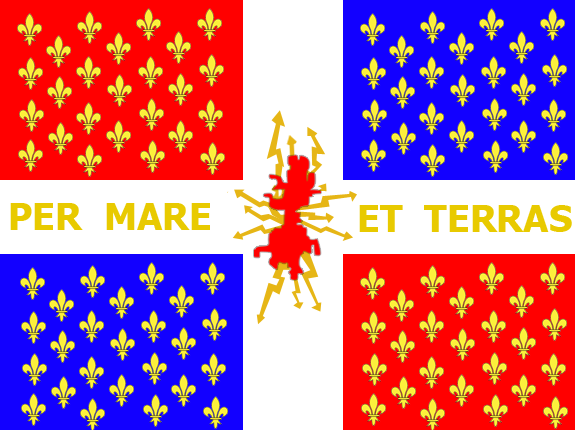
Flag of the Compagnies franches de la Marine (Wikimedia Commons)
Settlement in Beauport
On December 9, 1693, Guillaume received his first land concession in New France. Before notary Jean-Robert Duprac in Beauport, seigneur Joseph Giffard granted him land measuring three arpents of frontage by 25 arpents deep in the village of Saint-Ignace of Beauport. His land neighboured that of René Siret dit Lafleur and Georges Dumast.
Guillaume agreed to pay a seigneurial rente of 20 sols and a cens of one sol per arpent of frontage annually on the feast day of Saint Martin, November 11, plus three live capons for the entire concession. He also agreed to have his grain ground at the seigneurial mill.
Marie Ambroise Bergevin
Marie Ambroise Bergevin, daughter of Jean Bergevin dit Langevin and Marie Anne Piton, was baptized on May 8, 1676, in the “bourg-royal” (Charlesbourg). Her godparents were Étienne Proteau and Ambroise Doigt. [The date of birth was omitted from the baptism record, which is included in the register of the parish of Notre-Dame in Québec.]
On historical documents, Marie Ambroise’s surname appears in a variety of forms, including Brechevin, Brenevin, Bergemin, and Bergemint.
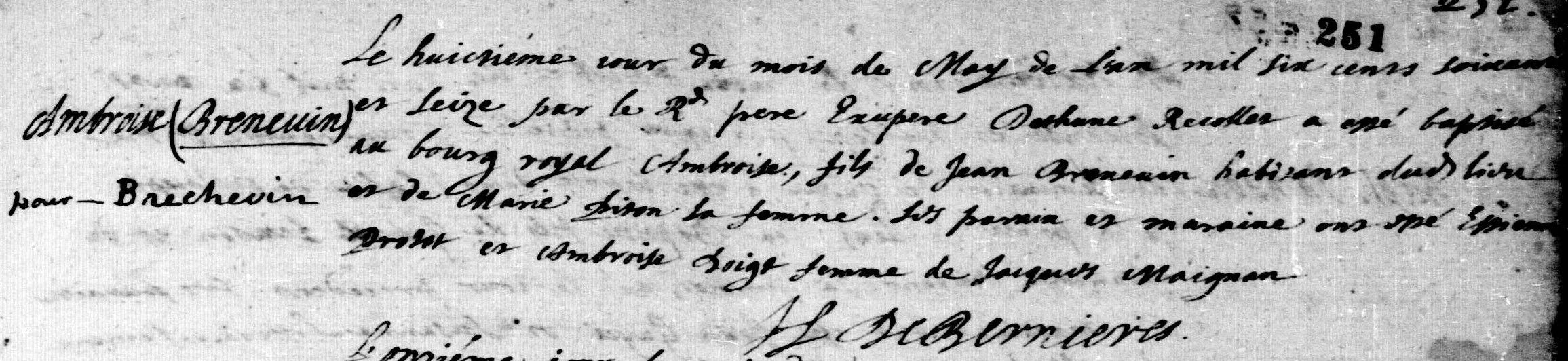
1676 baptism of Marie Ambroise “Brenevin” (Généalogie Québec)
Ambroise had ten siblings, although three died in infancy. The Bergevin family initially lived in Québec before settling first in Bourg-Royal and later in the village of Saint-Michel in Beauport.
The family was recorded in the 1681 census living just outside Bourg-Royal. They owned seven arpents of “valuable” land (cleared or under cultivation), one gun, and no livestock.


1681 census of New France for the “Berianin” family (Library and Archives Canada)
Marriage and Children
On January 13, 1694, notary Louis Chambalon drew up a marriage contract between Guillaume “Follardeau” and Marie Ambroise Bergevin. The groom was identified as a soldier in the Saint-Jean Company residing in Québec and the son of a ploughman. The bride was 17 years old; her parents were present and stipulated on her behalf, as she was still a minor. Their witnesses were pewter maker Sébastien Hervé, roofer Pierre Gatien, joiner Joseph Vandandaigue, master tailor Claude Phillipeau, and roofer Charles Normand. The official witnesses were arquebusier Jean Soulard and Charles Hazeur.
“In anticipation of and in preparation for said future marriage,” Ambroise’s parents promised to give the couple a plot of land measuring three arpents of frontage in the village of Saint-Ignace in Beauport. They also agreed to provide two minots of wheat seed from the Bergevin land for cultivation, a trousseau for Ambroise, housing and food for the newlywed couple for one year, and assistance in building an habitation on their land. Within two years, the Bergevins also promised the couple a one-year-old calf, two young pigs, six chickens, as well as kitchen utensils and household items. The remainder of the contract followed the standards of the Coutume de Paris. The prefixed dower was set at 500 livres.
The Coutume de Paris (Custom of Paris) governed the transmission of family property in New France. Whether or not a couple had a marriage contract, they were subject to the “community of goods,” meaning that all property acquired during the marriage became part of the community. Upon the death of the parents, the community property was divided equally among all children, both sons and daughters. If one spouse died, the surviving spouse retained half of the community property, while the other half was shared among the children. When the surviving spouse later died, their share was also divided equally among the children. Inventories were drawn up following a death in order to list the assets of the estate. The dower referred to the portion of property reserved by the husband for his wife in the event that she outlived him.
The couple was married on January 25, 1694, in the parish of Nativité-de-Notre-Dame in Beauport. Guillaume’s brother Jean served as a witness, as did Marie Ambroise’s father Jean, along with Pierre Conil [Conille] and notary Nicolas Metru. Only Metru was able to sign the marriage record.
The couple had at least nine children:
Jean Baptiste (1694–1762)
Guillaume (1696–1740)
René (1698–1756)
Louis (1704–1756)
Marie Françoise (1707–1789)
Charles (1709–?)
Marie Marguerite (1712–1760)
Marie Françoise (1715–1776)
François (1719–1754)
Just a few months later, Guillaume was hospitalized at the Hôtel-Dieu in Québec for three days, from March 17 to 20. He was recorded as being 25 years old and from Saintonge. The hospital register does not indicate the reason for his stay.

1694 patient register at Hôtel-Dieu (Ancestry)
Guillaume and Ambroise had been living in the village of Saint-Michel in Beauport since their marriage. On December 19, 1699, Guillaume received another land concession from the Compagnie de Jésus (the Jesuits), “to reside on the second road of Saint Claude in the seigneurie of Notre-Dame-des-Anges, which consists of two arpents of frontage.” He promised to pay annually one sol for each arpent in area in seigneurial rente, two live capons, and one sol in cens, on the feast day of Saint Martin. Guillaume also agreed to clear and develop the land.
It remains unclear whether Guillaume or his family ever worked or lived on this land. Given the absence of children between 1698 and 1704, it is possible that Guillaume temporarily left the family home to work his new concession in Notre-Dame-des-Anges, located about five kilometres west of Beauport.
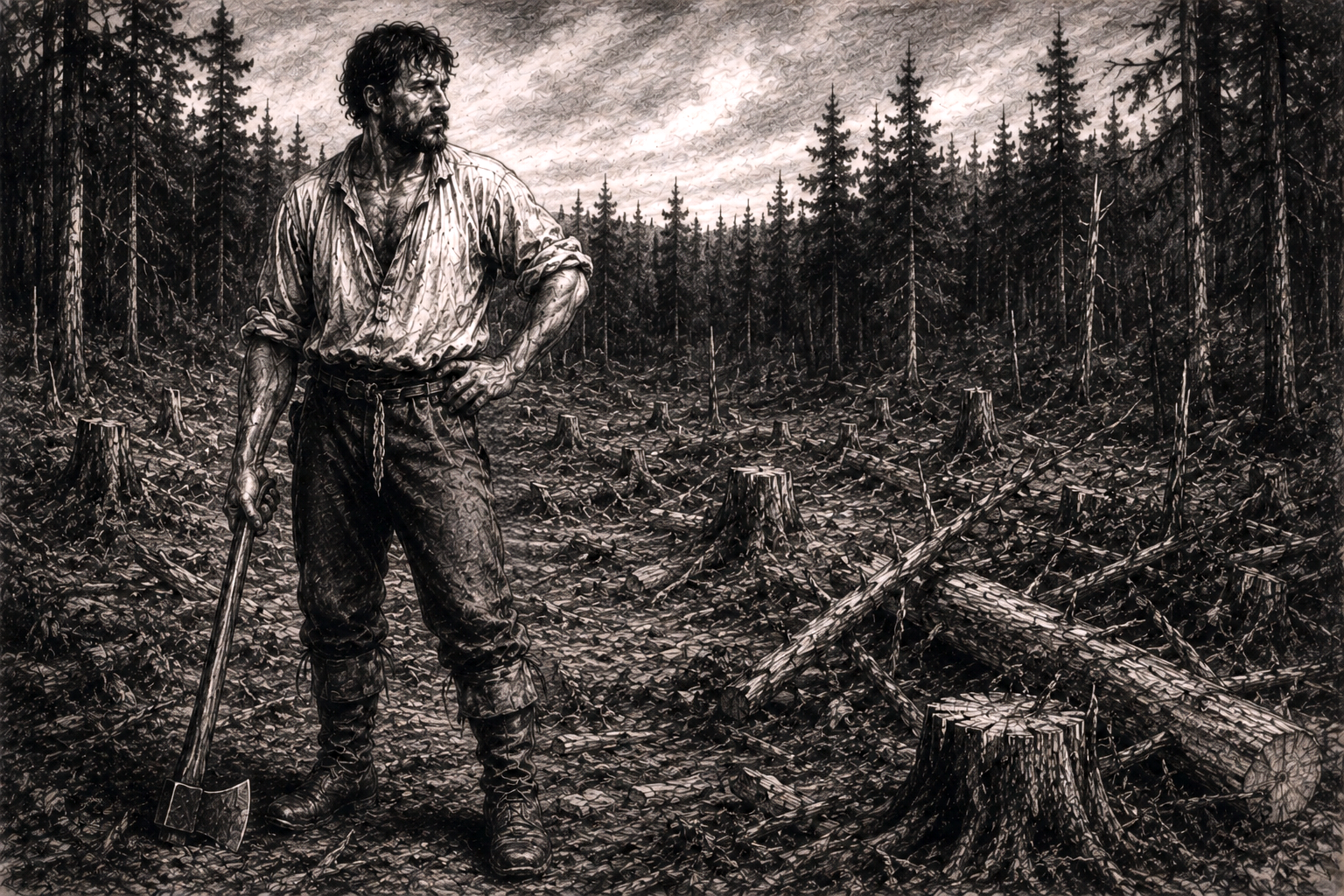
Illustration generated with artificial intelligence by the author, May 2026 (ChatGPT)
According to their children’s baptism records in Charlesbourg, the Falardeau family lived in the Bourg-Royal area of Charlesbourg in 1704, then in the Saint-Antoine area of Charlesbourg from 1707 until at least 1715. Guillaume returned the Beauport land concession to seigneur Ignace Juchereau on March 7, 1712.
On April 10, 1714, Guillaume received a concession on “route Sainct Anthoine” in the côte and seigneurie of Saint-Gabriel (of which Saint-Antoine formed part). Guillaume was recorded as a resident of Saint-Antoine. The land measured six arpents of frontage by twenty arpents deep. He agreed to pay an annual rente of six livres, plus three sols in cens and four “good live capons,” on the feast day of Saint Martin.
According to the concession document, Guillaume had already occupied and cleared this land for several years. The contract formalized a verbal agreement made years earlier.
Death of Guillaume
Guillaume Falardeau (or Folardeau) died “suddenly” on November 30, 1726. He was buried the following day in the parish cemetery of Saint-Charles-Borromée in Charlesbourg.
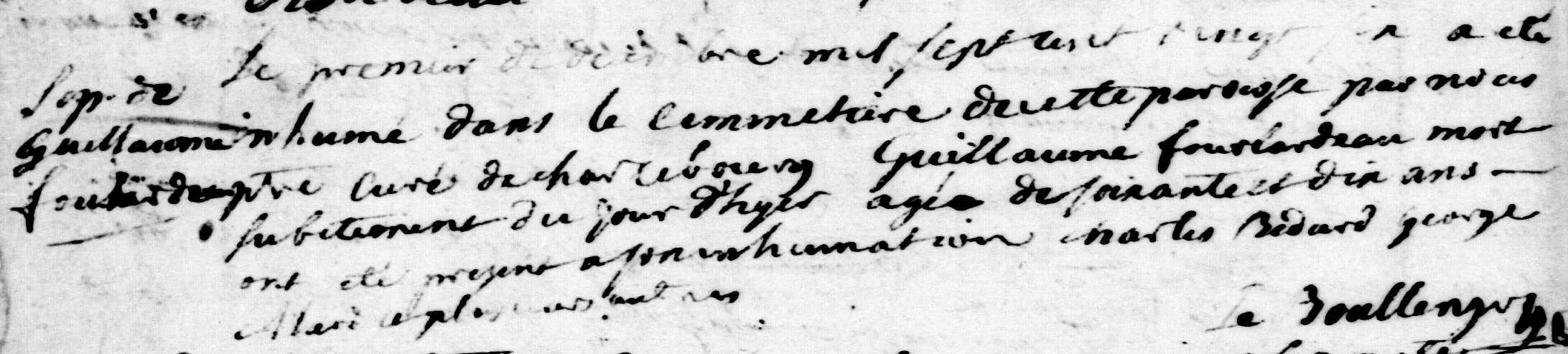
1726 burial of Guillaume “Fourlardeau” (Généalogie Québec)
Marie Ambroise’s Final Years
On the afternoon of May 16, 1733, Ambroise donated her movable and immovable property located in the village of Saint-Antoine to her son Charles. Her late husband was described as an habitant of “Petit-Saint-Antoine” in the seigneurie of Saint-Gabriel. The donated land in Saint-Antoine bordered that of her brother François Bergevin, the land of his heirs, that of Jean Allard, and non-ceded land, and included a house and barn.
In return, Charles agreed to pay the future cens and rente payments on the property and to provide housing, heating, food, care, and medication for his mother. Ambroise also requested that Charles provide her annually with specific goods, including one pair of shoes, one pair of stockings, three shirts, one skirt, one corset, and one cotton handkerchief.
Upon her death, Ambroise requested that twenty masses be said for the repose of her soul. She also requested that ten masses be said annually for two years following her death.
Donations entre vifs
In Québec, the practice of making donations entre vifs (“between living persons”) was common, especially as individuals aged or experienced declining health. This type of donation involved transferring control of one’s possessions to another person, typically one of their children, who then assumed responsibility for their care.
The donation process was formalized before a notary, who documented the agreement in detail. The notarized document specified the rights and responsibilities of both parties, outlining exactly what the parent was giving to the child and what the child was expected to provide in return.
The assets included in these donations often comprised land, a house or farm, and livestock. In exchange for receiving these assets, the child might be required to pay outstanding debts and ensure that the parent was properly housed, fed, clothed, and otherwise cared for until death.
The Inventory
On March 1, 1735, an inventory of the community of goods belonging to Ambroise and her late husband was drawn up by notary Noël Duprac at the request of Guillaume Falardeau Jr. This six-page inventory enumerated all the goods and property located at their home in Saint-Antoine.
Although some items are difficult to read, the inventory includes the following:
Kitchenware and Tableware
one iron cooking pot with its lid
one yellow copper kettle
15 pounds of pewter
10 earthenware plates
one strainer with a tin cup
one roasting spit
12 earthenware bowls
three jugs
one glass bottle
one chamber pot
six forks
Tools and Implements
one branding iron
one sieve
one axe
three old hoes
three old sickles
26 pounds of thread
Furniture and Storage
one bread chest with a quintin
one pine chest without a lock
Bedding and Household Linens
one feather bed with a straw mattress, two sheets, and two blankets, one woollen and one de ville (referred to a high-quality woven blanket or bedspread, often imported from France)
two sheets
two homespun tablecloths
one bed with a straw mattress, two blankets, one woollen and the other de ville, with its bedstead
three old sacks
Livestock and Farming Equipment
four pigs
one horse harness
three cows
two oxen
17 hens
Provisions and Foodstuffs
one half-minot of salt
120 pounds of lard
wheat and other un-appraised grains (all divided among the heirs before the inventory)
Lands
one concession measuring three arpents in frontage by twenty arpents in depth in the village of Saint-Antoine, of which approximately 25 arpents were under cultivation, including:
one pièce-sur-pièce house measuring 35 feet long by 16 feet wide, covered with planks and equipped with a chimney
one shed measuring 30 feet long by 20 feet wide, roofed with straw
one pièce-sur-pièce stable measuring 20 feet long by 16 feet wide, roofed with straw, with a stake floor
one concession at the place called Antoine measuring three arpents in frontage by twenty arpents in depth
The inventory also includes several minor debts, along with important documents: the marriage contract, land concessions, and receipts for seigneurial rents.
Based on this inventory, the widow and heirs of Guillaume Falardeau divided the goods and property among themselves on April 3, 1735, before notary Noël Duprac.
Death of Marie Ambroise
Marie Ambroise Bergevin died at the age of 82 on October 1, 1758. She was buried the following day in Saint-Charles-Borromée parish cemetery in Charlesbourg.

1758 burial of Marie Ambroise Bergevin (Généalogie Québec)
From Saintonge to Canada
Guillaume Falardeau and Marie Ambroise Bergevin lived lives shaped by opportunity, hard work, and perseverance. Guillaume crossed the Atlantic as a soldier in the service of the king, arriving in a colony that was still young and growing. Marie Ambroise was born in New France and came from a family that helped establish the agricultural communities surrounding Québec. Together, they built a life in Beauport and Charlesbourg, raising a large family while clearing land, cultivating crops, and contributing to the development of the colony.
Their descendants witnessed the transformation of New France into British North America, spread throughout Québec and beyond, and eventually crossed borders in search of new opportunities. Today, every Falardeau family in North America traces its origins in Canada to Guillaume and Marie Ambroise. Through their children and grandchildren, the name endured, linking a small village in Saintonge to generations of descendants across Canada and the United States.
PDF version of biography located at: https://www.tfcg.ca/guillaumefalardeau-and-marieambroisebergevin.
Are you enjoying our articles and resources? Show your support by making a donation. Every contribution, regardless of its size, goes a long way in covering our website hosting expenses and enables us to create more content related to French-Canadian genealogy and history. Thank you! Merci!
Sources:
"Église de la Sainte-Trinité de Bignay," Vals de Saintonge (https://www.valsdesaintonge.fr/blog/point-d-interet/eglise-de-la-sainte-trinite-de-bignay/ : accessed 18 May 2026).
"Le LAFRANCE (Baptêmes, mariages et sépultures)," database and digital images, Généalogie Québec (https://www.genealogiequebec.com/Membership/LAFRANCE/acte/59371 : accessed 18 May 2026), baptism of Ambroise Brenevin, 8 May 1676, Québec (Notre-Dame-de-Québec); citing original data: Institut généalogique Drouin and PRDH.
"Le LAFRANCE (Baptêmes, mariages et sépultures)," database and digital images, Généalogie Québec (https://www.genealogiequebec.com/Membership/LAFRANCE/acte/77329 : accessed 18 May 2026), marriage of Guillaume FOLLARDEAU and Ambroise BERGEVIN, 25 Jan 1694, Beauport (Nativité-de-Notre-Dame); citing original data: Institut généalogique Drouin and PRDH.
"Le LAFRANCE (Baptêmes, mariages et sépultures)," database and digital images, Généalogie Québec (https://www.genealogiequebec.com/Membership/LAFRANCE/acte/82222 : accessed 19 May 2026), burial of Guillaume FOURLARDEAU, 1 Dec 1726, Charlesbourg (St-Charles-Borromée); citing original data: Institut généalogique Drouin and PRDH.
"Le LAFRANCE (Baptêmes, mariages et sépultures)," database and digital images, Généalogie Québec (https://www.genealogiequebec.com/Membership/LAFRANCE/acte/261908 : accessed 19 May 2026), burial of Ambroise BERGEVIN, 2 Oct 1758, Charlesbourg (St-Charles-Borromée); citing original data: Institut généalogique Drouin and PRDH.
"Recensement du Canada fait par l'intendant Du Chesneau," digital images, Library and Archives Canada (https://www.bac-lac.gc.ca/eng/CollectionSearch/Pages/record.aspx?app=fonandcol&IdNumber=2318858&new=-8585855146497784530 : 18 May 2026), household of Jean Berianin (Bergevin), 14 Nov 1681, Beauport, page 275-276 (of PDF), Finding aid no. MSS0446, MIKAN no. 2318858; citing original data: Centre des archives d'outre-mer (France) vol. 460.
"Actes de notaire, 1693-1723 // Jean-Robert Duprac," digital images, FamilySearch (https://www.familysearch.org/ark:/61903/3:1:3QHV-P3NX-89PZ-W?cat=koha%3A754273&i=1038&lang=en : accessed 19 May 2026), land concession by Joseph Giffard to Guillaume Foulourdeau, 9 Dec 1693, images 1039-1041 of 2804 ; citing original data: Bibliothèque et Archives nationales du Québec.
"Actes de notaire, 1692-1716 // Louis Chambalon," digital images, FamilySearch (https://www.familysearch.org/ark:/61903/3:1:3Q9M-CS56-LC4B?cat=koha%3A1170051&i=1348&lang=en : accessed 19 May 2026), marriage contract of Guillaume Follardeau and Ambroise Bergevin, 13 Jan 1694, images 1349-1351 of 3409; citing original data: Bibliothèque et Archives nationales du Québec.
"Actes de notaire, 1693-1723 // Jean-Robert Duprac," digital images, FamilySearch (https://www.familysearch.org/ark:/61903/3:1:3QHV-L3NX-DYL?cat=koha%3A754273&i=1530&lang=en : accessed 19 May 2026), land concession by the Compagnie de Jésus to Guillaume Falerdeau, 19 Dec 1699, images 1531-1533 of 2804 ; citing original data: Bibliothèque et Archives nationales du Québec.
"Actes de notaire, 1693-1723 // Jean-Robert Duprac," digital images, FamilySearch (https://www.familysearch.org/ark:/61903/3:1:3Q9M-CS56-GPG1?cat=koha%3A754273&i=614&lang=en : accessed 19 May 2026), land concession by the Compagnie de Jésus to Guillaume Falerdeau, 10 Apr 1714, images 615-617 of 2777 ; citing original data: Bibliothèque et Archives nationales du Québec.
"Actes de notaire, 1723-1748 // Noël Duprac," digital images, FamilySearch (https://www.familysearch.org/ark:/61903/3:1:3QHV-P3NX-DS96-4?cat=koha%3A754344&i=2263&lang=en : accessed 19 May 2026), donation by Ambroise Bergevin to Charles Falardaux, 16 May 1733, images 2264-2266 of 2771 ; citing original data: Bibliothèque et Archives nationales du Québec.
"Actes de notaire, 1723-1748 // Noël Duprac," digital images, FamilySearch (https://www.familysearch.org/ark:/61903/3:1:3QHV-P3NX-D9PM-5?cat=koha%3A754344&i=2624&lang=en : accessed 19 May 2026), inventory of the goods of Ambroise Bergevin, 1 Mar 1735, images 2625-2630 of 2771 ; citing original data: Bibliothèque et Archives nationales du Québec.
"Actes de notaire, 1723-1748 // Noël Duprac," digital images, FamilySearch (https://www.familysearch.org/ark:/61903/3:1:3QHV-P3NX-69WN?cat=koha%3A754344&i=2661&lang=en : accessed 19 May 2026), inheritance division between Ambroise Bergevin and heirs of Guillaume Falardeau, 3 Apr 1735, images 2262-2263 of 2771 ; citing original data: Bibliothèque et Archives nationales du Québec.
“Quebec, Canada, Vital and Church Records (Drouin Collection), 1621-1968,” digital images, Ancestry.ca (https://www.ancestry.ca/imageviewer/collections/1091/images/d13p_31480098?pId=14867038 : accessed 19 May 2026), patient register, Hôtel-Dieu (Québec), March 1694, entry for Guillaume Faulardaux ; citing original data: Institut Généalogique Drouin; Montreal, Quebec, Canada; Drouin Collection.
Fédération québécoise des sociétés de généalogie, Fichier Origine online database (http://www.fichierorigine.com : accessed 18 May 2026), entry for FALARDEAU / FOLARDEAU, Guillaume (person 241475), updated on 4 Jan 2020.
Université de Montréal, Programme de recherche en démographie historique (PRDH) online database (https://www-prdh-igd-com.res.banq.qc.ca/Membership/fr/PRDH/Famille/7177 : accessed 19 May 2026), dictionary entry for Guillaume FALARDEAU and Marie Ambroise BERGEVIN LANGEVIN, union 7177.
Thomas J. Laforest, Our French-Canadian Ancestors vol. 21 (Palm Harbor, Florida, The LISI Press, 1995), 113.
André Lachance, Vivre, aimer et mourir en Nouvelle-France; Juger et punir en Nouvelle-France: la vie quotidienne aux XVIIe et XVIIIe siècles (Montréal, Québec: Éditions Libre Expression, 2004), 167-172.