Guillaume Cousture & Anne Émard
Discover the remarkable lives of Guillaume Cousture (1618–1701) and Anne Émard (1627–1700), two pioneers who helped shape the early history of New France. Born in Rouen, Normandy, Guillaume arrived in the colony around 1640 as a Jesuit donné. Captured by Iroquois warriors in 1642, he endured nearly three years in captivity before becoming an important interpreter and intermediary in peace negotiations between the French and Indigenous nations. His extraordinary life also included expeditions into northern territories, diplomatic missions, and service as a militia captain and judge. In 1649, he married Anne Émard, an immigrant from Niort, France, and together they established a family at Pointe-Lévy, across the St. Lawrence River from Québec. Explore their fascinating story through historical accounts, parish registers, notarial records, and other archival sources that reveal both Guillaume’s remarkable adventures and the everyday lives of this pioneering couple.
Cliquez ici pour la version en français
Guillaume Cousture & Anne Émard
Captivity, Diplomacy, and Family Life in New France
Guillaume Cousture (or Couture), son of Guillaume Cousture and Madeleine Malet (or Mallet), was baptized on January 14, 1618, in the parish of Saint-Godard in Rouen, Normandy, France.
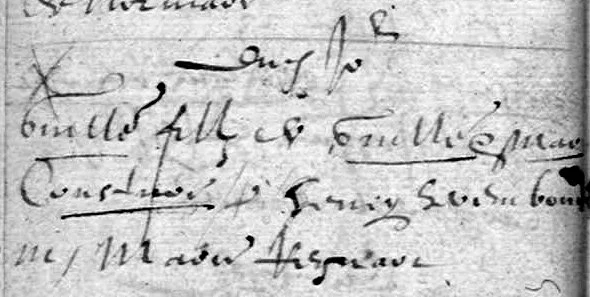
1618 baptism of Guillaume Cousture (Archives de la Seine-Maritime)
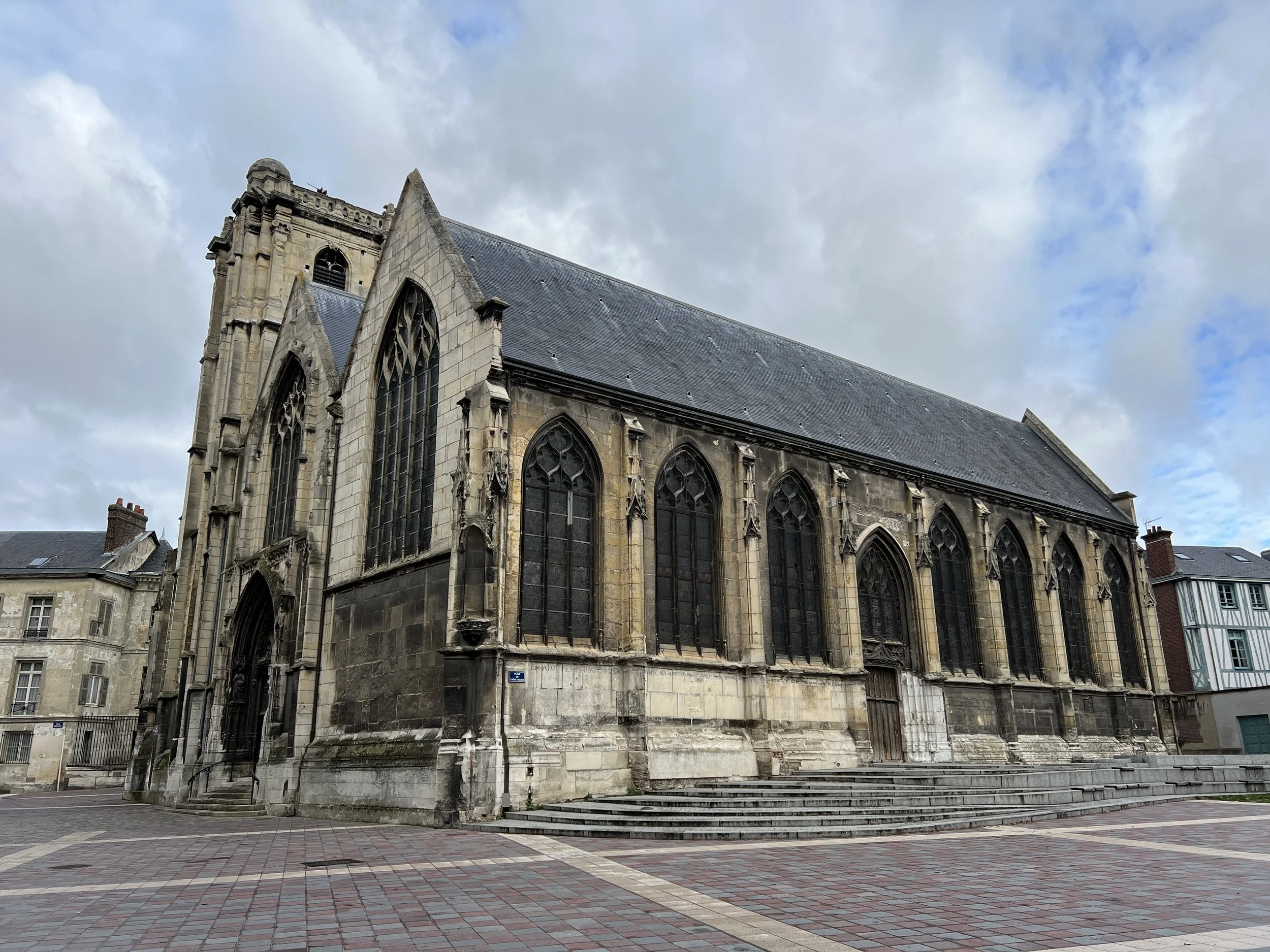
Church of Saint-Godard in Rouen, 2021 photo by Chabe01 (Wikimedia Commons, CC BY-SA 4.0)
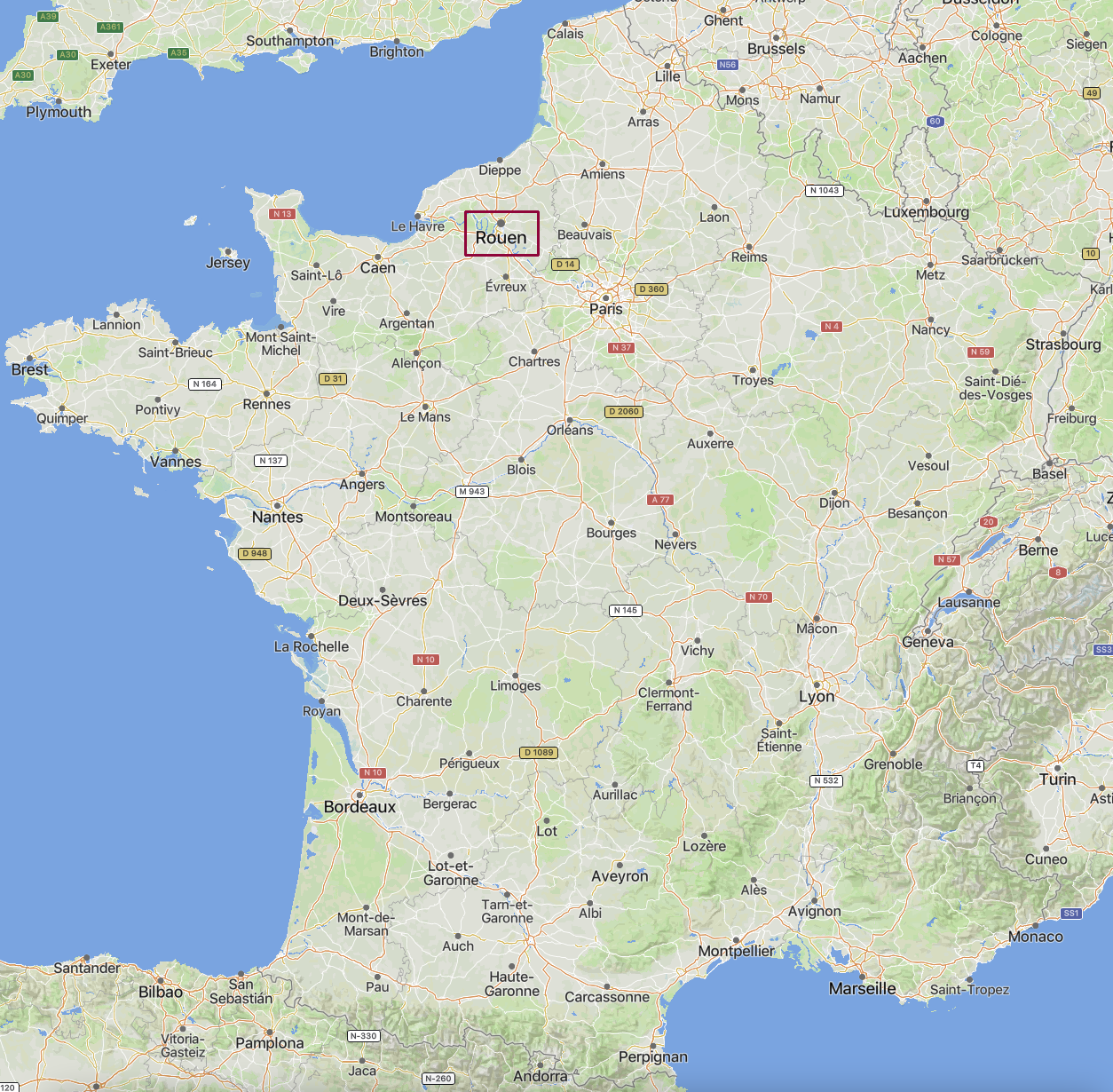
Location of Rouen in France (Mapcarta)
Guillaume grew up in Rouen alongside at least four siblings, all baptized at Saint-Godard: Geneviève, Marie, Alexandre, and Anne. His father was a master carpenter and likely taught Guillaume his trade. His paternal grandparents were master carpenter Robert Cousture and Ysabeau (or Isabeau) Dorée. Their fathers were François Cousture and Robert Dorée.
Rouen, now home to approximately 114,000 residents, is located in the department of Seine-Maritime. The city lies 120 kilometres northwest of Paris and about 50 kilometres south of Dieppe.
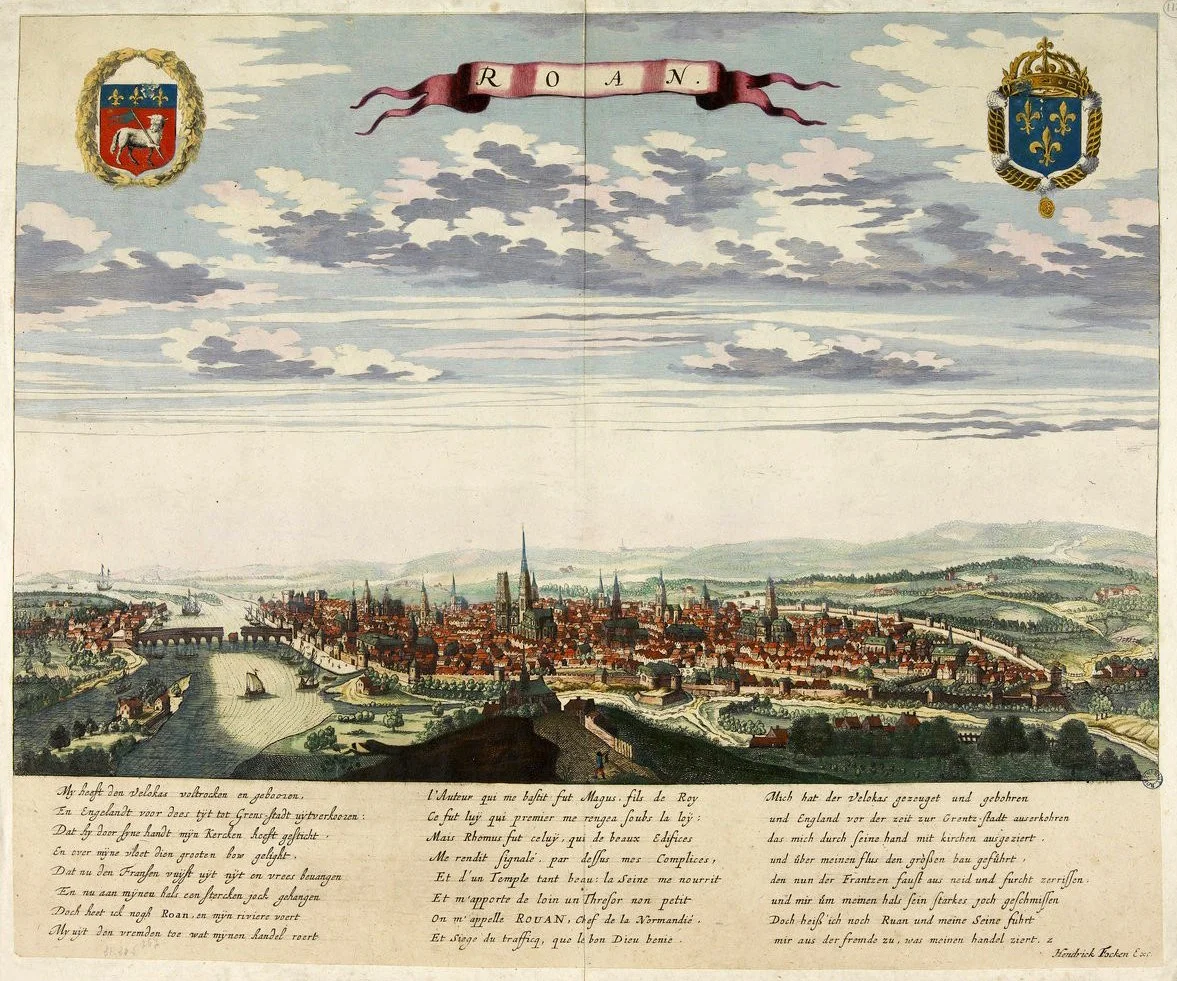
Rouen in 1660 ("Roan" in Dutch), engraving by Hendrick Focken (Bibliothèque nationale de France)
A Missionary’s Life in New France
Guillaume sailed to New France around 1640, although his exact arrival date is unknown. A carpenter by trade, he opted to serve the Jesuit missionaries as a donné. His duties would have involved practical work in support of the missions, in exchange for food, clothing, and care instead of wages.
As a donné, Guillaume was expected to renounce his possessions. The earliest known mention of his presence in New France is a donation executed before notary Martial Piraube on June 26, 1641, relating to property he had inherited from his late father in Normandy. Guillaume was described as a menuisier, or joiner. The record states that he was a domestic servant for the “Reverend Fathers of the Society of Jesus at the Huron Mission in New France.”
Guillaume donated two-thirds of his inheritance to his mother, Madeleine Malet, and granted her the usufruct of the remaining third during her lifetime. He stipulated that, upon their mother's death, his sister Marie would be the sole heir to the two-thirds given to Madeleine and would receive the income from the remaining third for the rest of her life. The inheritance consisted of movable and immovable property in La Haye Aubrée, Normandy. Guillaume also authorized his mother, or his sister Marie if their mother was deceased, to obtain an accounting from his uncle and former guardian, Victor Cousture, who had administered the inherited property. The donation “was made out of the deep friendship” that Guillaume felt for his mother and his sister.
The transaction was subsequently mentioned in a Jesuit memorandum of 1642, which raised questions about the legal validity of property donations made by donnés.
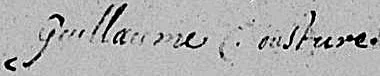
Guillaume’s signature in 1641
Life Among the Hurons
Shortly after the donation to his mother, Guillaume travelled to Huron country carrying supplies for the Jesuits. He returned to Québec in the summer of 1642 with Fathers Isaac Jogues and Charles Raymbaut and several others. Their group consisted of 25 men in four canoes and included several Indigenous leaders. Approximately two weeks later, Guillaume left again for Huron country, accompanied by Jogues, René Goupil, and a larger group of Frenchmen and Hurons. The Hurons had been on an official mission to Québec and were returning home, having been promised the protection of their fellow French travellers from their enemies, the Iroquois [now called the Haudenosaunee]. Unbeknownst to the group, Iroquois sentries were closely tracking their movements.
On August 1, 1642, approximately 40 French and Huron men departed Trois-Rivières in twelve canoes. The following morning, they were ambushed by Iroquois warriors near Lac Saint-Pierre.
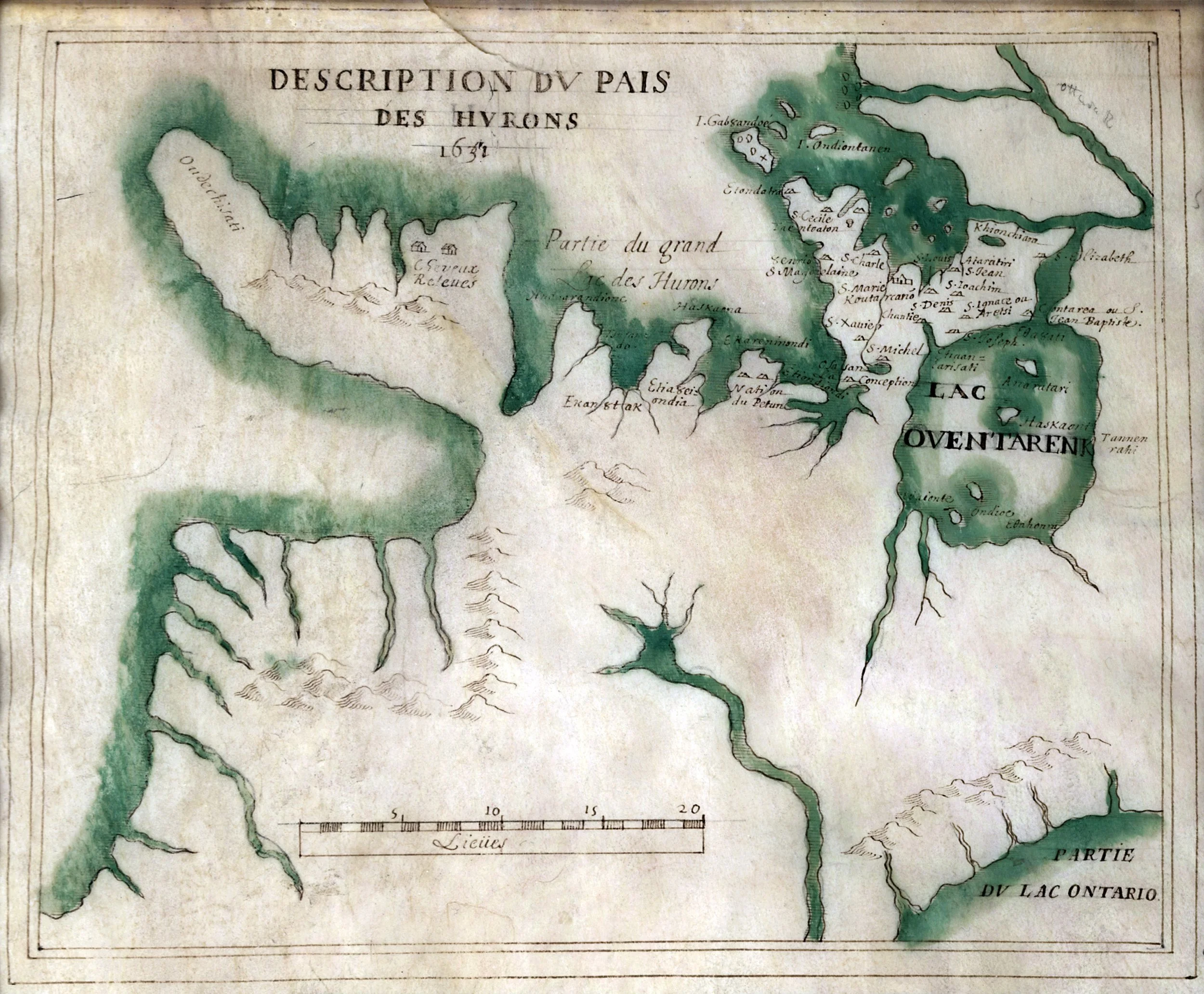
Description du pais des Hurons, map depicting the Huron-Wendat homeland and Jesuit missions in present-day Ontario. Attributed to Jesuit missionary Jean de Brébeuf, circa 1639–1648 (Library of Congress).
Three Years in Captivity
On August 2, 1642, Guillaume was captured by the Iroquois alongside Father Isaac Jogues and fellow donné René Goupil. According to the Jesuit Relations, Guillaume initially escaped into the forest with several of the Hurons but turned back when he realized that Jogues and Goupil had been left behind. On his return, he encountered five Iroquois. When one man’s arquebus misfired, Guillaume shot his own weapon and killed him. The other four immediately seized Guillaume, stripped him, beat him with clubs, tore out his fingernails with their teeth, crushed the bleeding ends of his fingers, and pierced one of his hands with a javelin.
The prisoners were then marched to Iroquois territory on a journey that lasted thirteen days. Jogues later stated, “It is true that, during thirteen days that we spent on that journey, I suffered in the body torments almost unendurable, and, in the soul, mortal anguish; hunger, the fiercely burning heat, the threats and hatred of those Leopards, the pain of our wounds,—which, for not being dressed, became putrid even to the extent of breeding worms,—caused us, in truth, much distress.”
Eight days into the journey, the captives and their kidnappers encountered another group of approximately 200 Iroquois. The prisoners were stripped and forced between two lines of men armed with sticks and thorns, who struck them repeatedly as they passed.
Running the gauntlet
Among the seventeenth-century Haudenosaunee, returning war parties commonly brought captives into their communities through a ritualized ordeal later described by Europeans as “running the gauntlet.” Captives were forced between two lines of villagers who struck them with sticks, clubs or other objects. The practice formed part of a broader system of mourning warfare in which captives could help a community respond to deaths suffered in war. The violence allowed members of the community to express grief and vengeance and could also test a captive’s endurance. Afterward, captives might be adopted into a bereaved family to replace a deceased relative, retained as prisoners, or subjected to further torture and death.
The violence continued after they reached the Iroquois villages. In one location, a man attempted to cut off one of Guillaume’s forefingers with a dull knife. When he was unable to sever it, he twisted and tore the finger, pulling a sinew from Guillaume’s arm and causing the arm to swell. Guillaume and the other prisoners were subjected to further beatings and abuse before they were eventually spared. Several of their Huron companions were killed, while others were held captive. Guillaume spent the following winter among the Iroquois, during which he also suffered from a frozen foot.
The Jesuit Relations particularly praised Guillaume's courage and loyalty to Jogues. The author wrote that the conduct of the Frenchmen accompanying the priest was astonishing, especially that of Guillaume, who reportedly had an opportunity to escape but refused to abandon him. According to the account, Guillaume declared: “I cannot abandon him. I will willingly endure fire and the fury of these tigers for the love of Jesus Christ, in the company of my good Father.” Although these words were reported by the Jesuit chronicler rather than written by Guillaume himself, they provide a contemporary account of his determination to remain with Jogues, even at the risk of his own life.
News of the captives was difficult to obtain, but in a letter dated June 30, 1643, Jogues confirmed that he and Guillaume were still alive. The letter also described the continuing dangers in the region and Jogues's determination to stay among the Iroquois, despite the real possibility of further violence. French authorities attempted to communicate with the prisoners, but these efforts were complicated by the dangers of travelling through Iroquois territory.
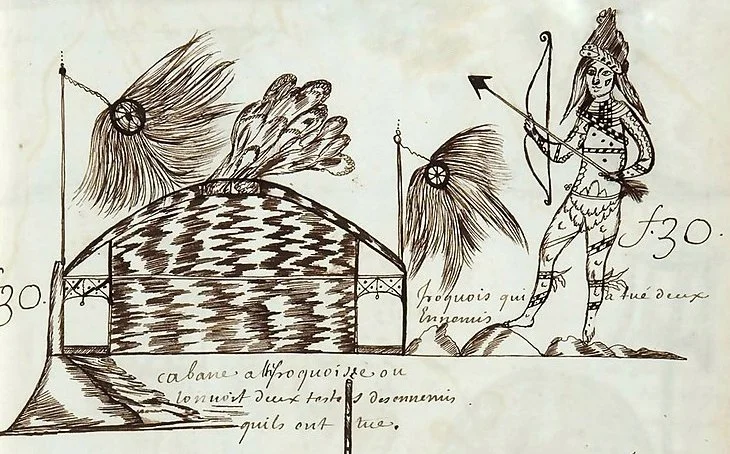
An Iroquois warrior and dwelling, attributed to Jesuit missionary Louis Nicolas, circa 1675–1682 (Wikimedia Commons)
Guillaume and Father Jogues were eventually separated, with Guillaume sent to an Iroquois village far from where the priest was being held. Jogues later said that he could see little possibility of helping Guillaume under these circumstances. Nevertheless, Guillaume had previously encouraged Jogues to escape if an opportunity arose, promising that he would then seek his own freedom. According to Jogues, Guillaume told him, “You know well that I remain in this captivity only for your sake. Make every effort to save yourself, for I cannot think of my own freedom or my life until I know that you are safe.”
Fellow captive René Goupil was killed on September 29, 1642, and Father Jogues managed to escape back to France aboard a Dutch ship. Guillaume, however, remained in Iroquois territory.
As was customary, he was handed over to the family of the man he had killed for his fate to be decided. Guillaume was adopted by a Mohawk widow, who dressed his wounds and cared for him. [The Mohawk are an Iroquois nation.] During this time, he learned Mohawk customs and their language, slowly earning the confidence of the chiefs. He was given the Indigenous name Ihandich.
From Prisoner to Peacemaker
In the spring of 1645, Governor Charles Huault de Montmagny released an Iroquois prisoner and sent him back to his people with a message proposing peace between the Iroquois, the French, and their Indigenous allies. The proposal was received favourably, and the Mohawks selected two delegates to travel to Trois-Rivières for negotiations. Guillaume, who by then had spent nearly three years among the Iroquois, accompanied them.
In July 1645, the returning messenger, the two Mohawk delegates, and Guillaume arrived at Trois-Rivières. According to the Jesuit Relations, Guillaume’s appearance caused considerable excitement: “As soon as he was recognized, everyone threw their arms round him; they regarded him as a man who had risen from the dead, bringing joy to all those who had believed him dead, or at least in danger of spending the rest of his days in a most bitter and barbaric captivity.”
During the peace negotiations, Mohawk spokesman Kiotsaeton placed a ceremonial wampum collar on Guillaume’s arm, symbolizing his safe return. Kiotsaeton explained that he had chosen to escort Guillaume personally rather than allow him to undertake the dangerous journey alone, declaring that he had brought him home at the risk of his own life. The negotiations continued with the exchange of ceremonial gifts and laid the groundwork for a peace agreement between the French and the Iroquois.

Wampum belt, 18th century (McCord Stewart Museum)
After these first peace negotiations, Guillaume returned to Mohawk territory, where he spent the winter helping to maintain the newly established peace. By March 1646, he was back in Trois-Rivières with seven Mohawk representatives to continue the negotiations.
“At Trois-Rivières, Cousture was given a new Indigenous name during a feast held in his honour by Father Le Buteux. In place of his former name, Ihandich, which sounds unpleasant in the Iroquois language, he was given the name Achirra, the name of the late Mr. Nicolet, to the delight of all the Huron, Algonquin, and Annieronon people.”
The following month, Guillaume travelled to Sillery with Jesuit Father Claude Pijart.
It was around this time that Guillaume decided to leave his missionary life behind. He sought permission from the Jesuits to be released from his commitments as a donné so that he could marry. His request was approved on April 26, 1646. Despite this, he continued to work as an interpreter with Indigenous nations throughout his life. He would marry more than three years later.
Father Pijart departed Sillery on April 28, 1646, apparently accompanied by Guillaume, who returned to the Huron country. Guillaume's return to the Québec region is not clearly documented until the autumn of 1647. Meanwhile, the fragile peace with the Mohawks deteriorated. Father Jogues, who had returned to New France in the summer of 1644, was killed in Mohawk territory on October 18, 1646, followed by Jean de La Lande on October 18 or 19, bringing the peace efforts to an end.
Settlement at Pointe-Lévy
On May 15, 1647, Guillaume received the first land concession at Pointe-Lévy, on the south shore of the St. Lawrence River, from Governor Charles Huault de Montmagny. It contained approximately 200 arpents of land, with five arpents of frontage, facing the river. Guillaume was required to clear and cultivate the land, allow for the establishment of roads through the property, and obtain a formal concession from the Compagnie de la Nouvelle-France. On October 15, 1648, he obtained an official concession title from the seigneur, Jean de Lauzon.
Pointe-Lévy formed part of the larger seigneurie de Lauzon, established in 1636 and named after its proprietor, Jean de Lauzon. The inhabited shoreline was also known as the côte de Lauzon, a designation frequently used in contemporary records.
Guillaume’s first neighbour at Pointe-Lévy was François Bissot. On November 4, 1647, notary Claude Lecoustre penned an agreement between Guillaume and Bissot in Québec, in which Bissot agreed to pay him 200 livres for a small house already constructed at Pointe-Lévy and for timber cleared from the surrounding land. Guillaume was permitted to continue occupying the house without charge until September 29, 1648.
Anne Émard
Anne Émard, daughter of Jean Émard and Marie Bineau, was born on October 22, 1627. She was given an emergency baptism shortly after birth by the midwife, Marthe Coupry, “in case of necessity.” She was then baptized the same day in the parish of Saint-André in Niort, Poitou, France. Her father was described as a maître tailleur d’habits, or master tailor. Her godparents were the master surgeon Jehan Filleul and Anne Jouslard. The father and godparents all signed the baptism record. [Anne’s name is often spelled Esmard, Aymart, and Aymard.]
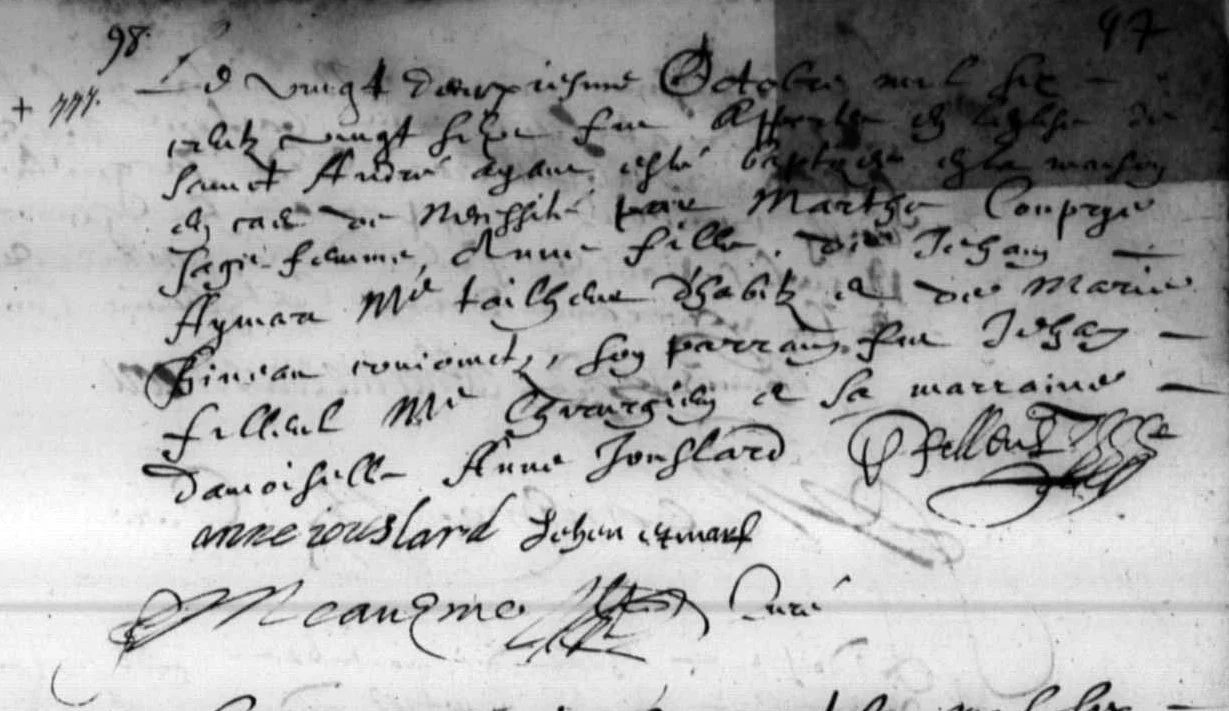
1627 baptism of Anne Émard (Archives Départementales des Deux-Sèvres)
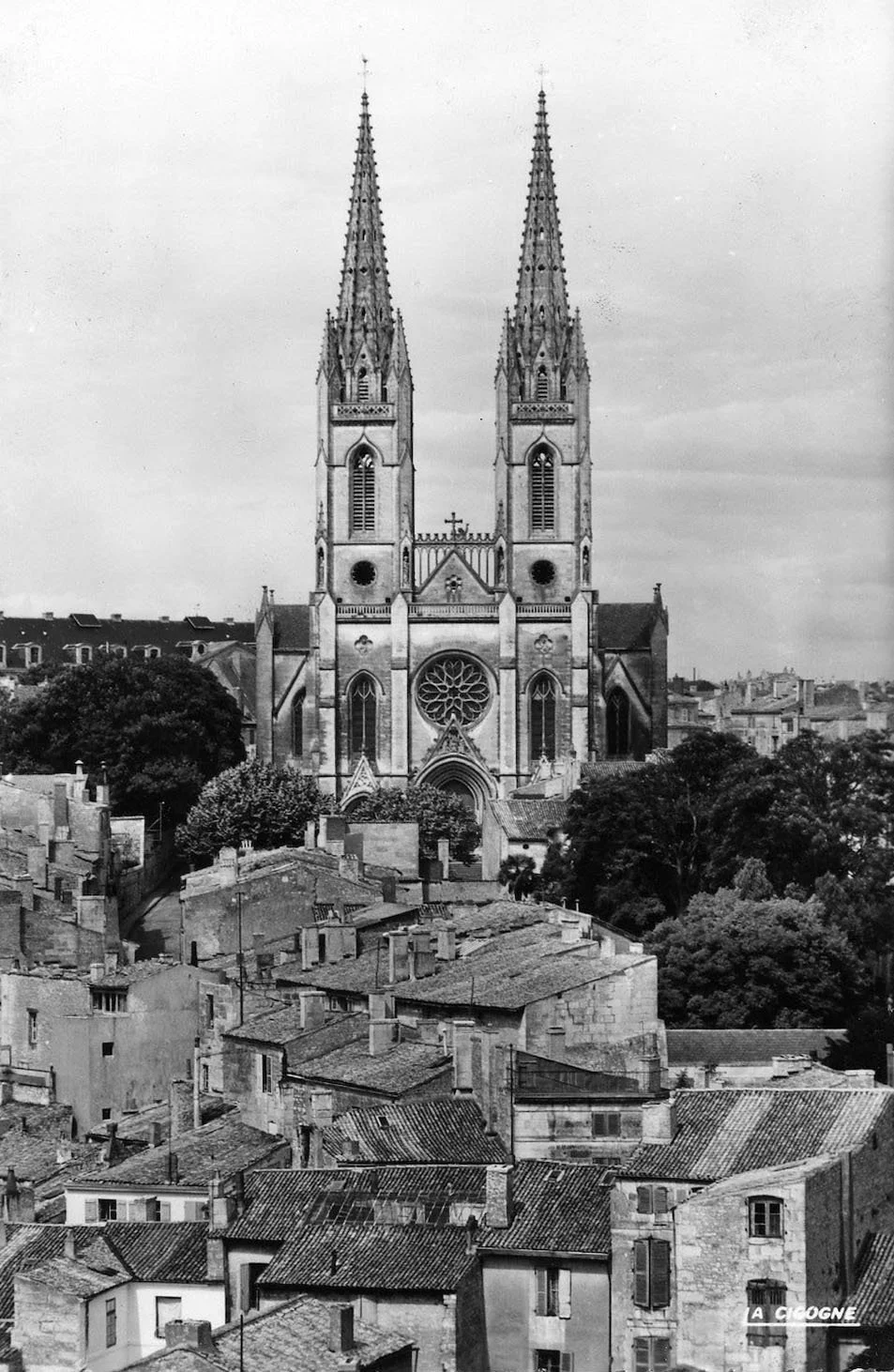
Church of Saint-André in Niort (Geneanet)
Anne grew up in Niort; she had at least 10 siblings: Marie, Barbe, Jean, Pierre, Françoise, Jeanne, Madeleine, Jean, Philippe, and Jean. After her father Jean’s death, her mother Marie married the widower Antoine Lurinq on November 15, 1632, in Niort. The couple had two daughters: Marie and Hélène. Anne’s maternal grandparents were Daniel Bineau, a master scribe, and Marie Hay.
Located in western France, Niort lies about 350 kilometres southwest of Paris, in the present-day department of Deux-Sèvres. It has a current population of about 60,000 residents, called Niortais. Niort is less than 60 kilometres away from La Rochelle, an important port city for 17th-century emigration to New France.
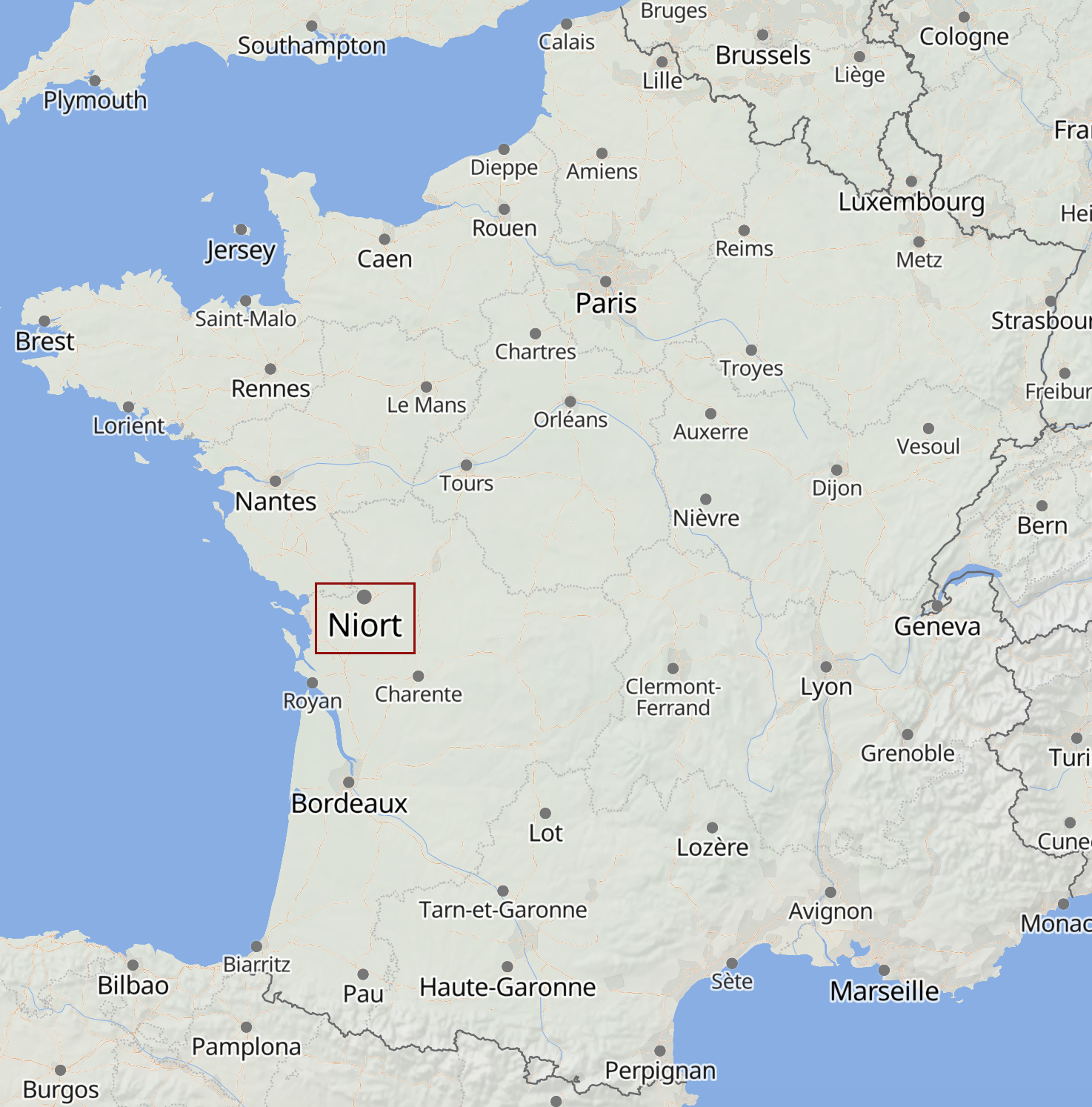
Location of Niort in France (Mapcarta)
Two of Anne’s sisters would also become pioneers in New France. Barbe, born around 1619, married Gilles Michel dit Taillon. After his death, she married Olivier Letardif in 1648. Madeleine, born in 1626, married Zacharie Cloutier that same year.
By March 1648, Anne was in La Rochelle, where she attended the signing of Madeleine’s marriage contract with Zacharie Cloutier on March 29. She was also present on May 16 when Barbe signed her marriage contract with Olivier Letardif. Both agreements were concluded at Barbe’s home in La Rochelle.
The three Émard sisters probably arrived in Québec on September 20, 1648, accompanied by Olivier Letardif, Barbe’s husband, and Zacharie Cloutier, Madeleine’s husband. They may have travelled aboard La Notre-Dame, a ship commanded by Letardif the previous year.
Marriage and Children
On November 18, 1649, notary Guillaume Audouart drafted a traité de mariage, or marriage treaty, between honnête homme (honest man) Guillaume Cousture and Anne Émard. Guillaume was assisted by François Cousture, Antoine Baudouin, Martin Grouvel, and Charles Cadieux. Anne was assisted by her brothers-in-law Olivier Letardif and Zacharie Cloutier. The contract followed the norms of the Coutume de Paris (Custom of Paris). Letardif, “for the friendship and good affection” he had for Anne, gave her a furnished feather bed and a dairy cow. Guillaume and several witnesses were able to sign their names, but Anne could not.
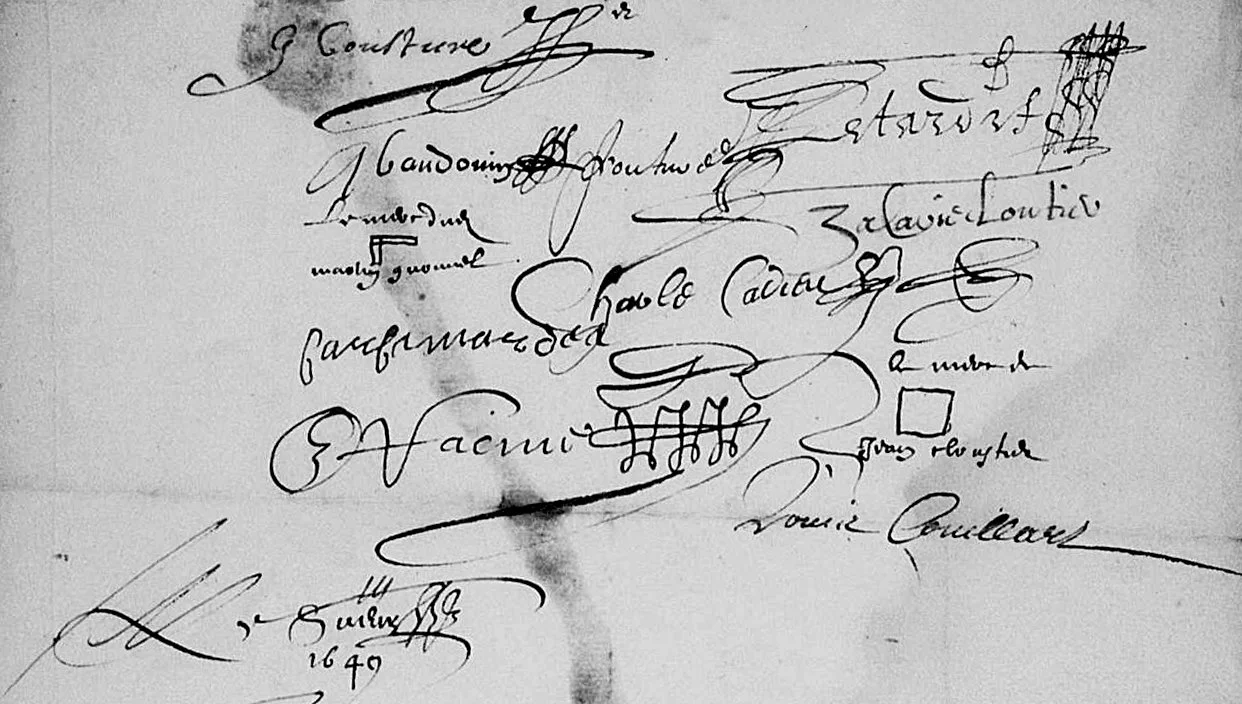
The signature portion of Guillaume and Anne’s marriage contract (FamilySearch)
Guillaume and Anne were married the same day at his home at Pointe-Lévy. He was 31 years old; she was 22. Their witnesses were Olivier Letardif, Martin Grouvel, Zacharie Cloutier and Charles Cadieux. Theirs was likely the first marriage celebrated at Pointe-Lévy.
The couple settled on Guillaume’s land at Pointe-Lévy, where they had at least ten children:
Jean Baptiste (1650–1698)
Anne (1652–1684)
Louis (1654–after 1683)
Marguerite (1656–1690)
Marie (1658–1702)
Charles (1659–1709)
Guillaume (1662–1738)
Louise (1665–1751)
Eustache (1667–1745)
Joseph Auger (1670–1733)
Commercial, Property, and Legal Affairs
In addition to his work as a carpenter and settler, Guillaume was involved in various commercial transactions, property dealings, and legal matters. Notarial and court records from the 1650s reveal his involvement in shipping, construction, land ownership, and the settlement of financial disputes.
August 20, 1651: notary Guillaume Audouart penned an agreement in which several persons, namely Guillaume, Zacharie Cloutier, Abraham Martin, Nicholas Juchereau de St-Denis, Geneviève Juchereau (wife of Charles Legardeur de Tilly), and Anne Convent (wife of Jacques Maheut), gave a power of attorney to Jean Juchereau de Laferté, authorizing him to act as their representative in a matter concerning a boat named L'Espérance. Juchereau would demand an account from the vessel's captain for equipment entrusted to him and any transactions conducted on their behalf. If the captain refused to cooperate, Juchereau could pursue legal action, including the seizure and sale of his property. The agreement suggests that Guillaume had a financial interest in the boat, although the specifics are unknown.
On September 16, 1653, notary Audouart wrote up an agreement between honorable homme (honourable man) Guillaume, described as an habitant of Pointe de Lévy, and Guillaume Durand, a travaillant, or worker. Durand, having worked on the Couture property during its owner’s frequent absences, had initiated legal proceedings to recover 225 livres in unpaid wages and services. To settle the debt, Guillaume agreed to pay half the amount in peas and the other half in eels.
On September 7, 1658, Guillaume entered into an agreement with master carpenters Charles Pouliot and Nicolas Huot dit St-Laurent, before notary Audouart, for the construction of the timber frame of a house in Lower Town, Québec. The house was to measure 24 feet long by 17 feet wide, and the agreed construction price was 180 livres. Guillaume agreed to provide the necessary lumber and the carpenters agreed to complete the work by the following May.
On May 15, 1659, Guillaume purchased a parcel of land in Québec’s Lower Town from Pierre Denis, sieur de La Ronde. The lot, measuring 20 feet along one side, bordered the property of Martin Prévost and Pierre Le Petit on one side, and a road separating it from the brewery on the other. As part of the transaction, Guillaume assumed responsibility for an annual payment of 60 sols associated with the property, payable to representatives of the Compagnie de la Nouvelle-France.
On August 26, 1659, Guillaume entered into an agreement before notary Audouart with Catherine Françoise Desnaguets, acting on her own behalf and that of her husband, Pierre Le Petit. A dispute had arisen over a building Guillaume had constructed near the brewery, which apparently encroached upon the couple's land. The parties reached an amicable settlement intended to preserve “the future friendship between them.”
On July 20, 1660, Guillaume and Bertrand Fafard dit Laframboise gave testimony concerning a shipment of goods supplied by the Compagnie for transport to the Huron country in 1656. Guillaume, who had served as captain of the expedition, maintained that all the goods listed in an inventory dated August 26, 1656, had been delivered. Following an investigation, Fafard agreed that the shipment had been delivered in full.
Diplomatic Missions and Exploration
Although Guillaume had established himself at Pointe-Lévy, his knowledge of Indigenous languages and his experience among the Haudenosaunee continued to be valuable to the colonial authorities. He was frequently asked to assist in negotiations and undertake expeditions on behalf of the government. In 1657, he was involved in negotiations concerning the proposed establishment of a French settlement and Jesuit mission among the Onondaga, one of the Haudenosaunee nations.
In May 1661, Guillaume joined an expedition organized by Governor Pierre de Voyer d'Argenson to search for a route to the Northern Sea, or Hudson Bay. The party included Jesuit Fathers Gabriel Druillettes and Claude Dablon, several other Frenchmen, and Indigenous guides. They travelled north along the Saguenay River but were forced to abandon their journey before reaching their destination. Guillaume returned to Québec in July.
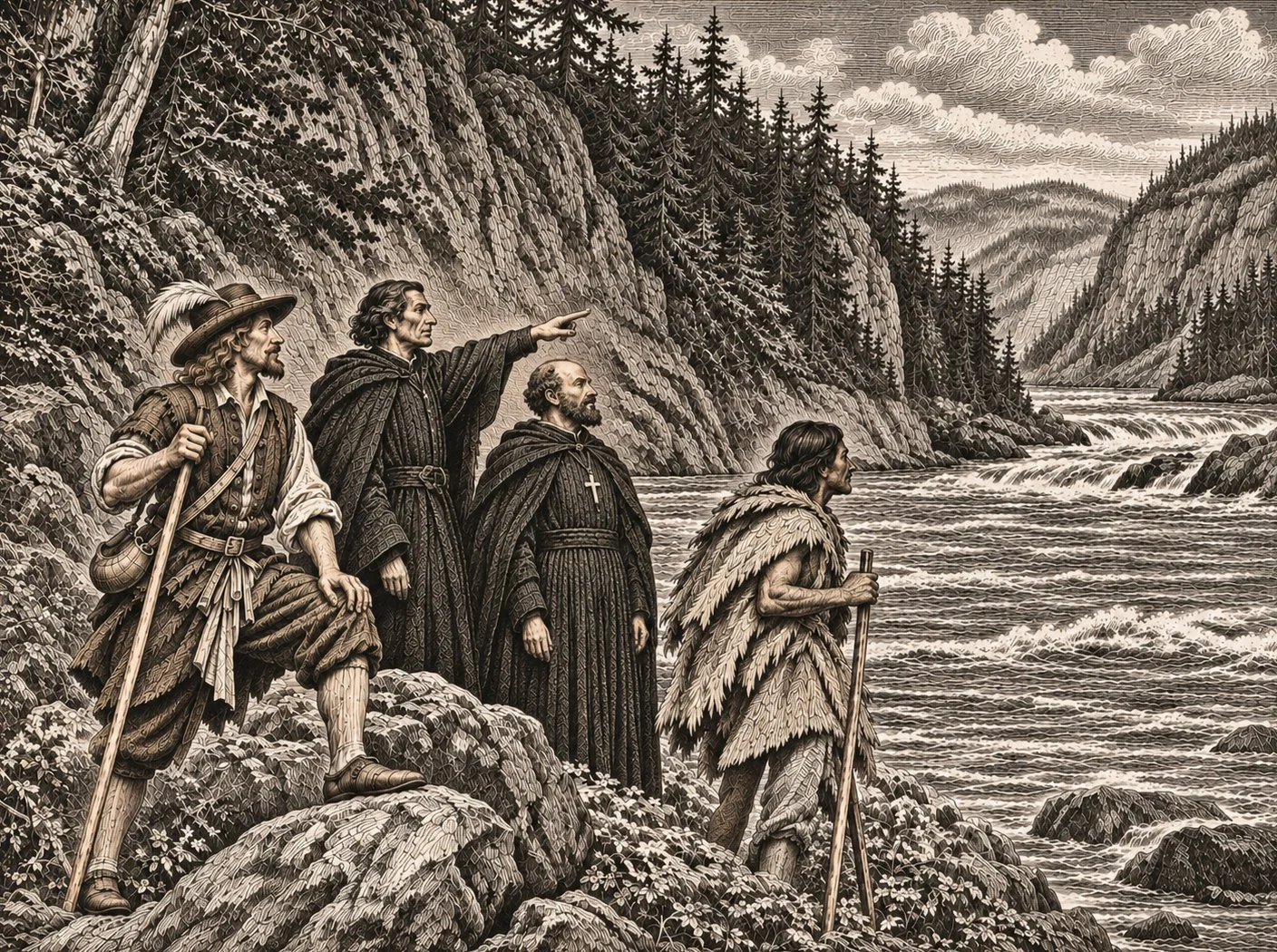
Illustration generated with artificial intelligence by the author, November 2026 (ChatGPT)
Two years later, Governor Pierre Dubois Davaugour appointed Guillaume to lead another expedition northward. Departing in May 1663, the party included Frenchmen Pierre Duquet and Jean Langlois, along with Indigenous travellers in a fleet of 44 canoes. They explored the interior north of the St. Lawrence, travelling through the Saguenay and Lac Saint-Jean regions toward Lac Mistassini. Although some later historical accounts claimed that Guillaume reached Hudson Bay and formally claimed the territory for France, he himself acknowledged in 1688 that the expedition had failed to reach the Northern Sea.
On May 28, 1665, Guillaume entered into a partnership with Charles Amiot, Sébastien Prouvereau, and Noël Jérémie, who was represented by Charles Aubert, sieur de La Chesnaye. The agreement related to a journey with Father Henri Nouvel to “the nations called Papinachois,” an Innu people living along the north shore of the St. Lawrence River. The associates agreed to share equally in the profits from trading merchandise and were prohibited from conducting private trade for their own benefit. In the event of illness or death, the partner’s share would be given to his heirs.
Guillaume's last diplomatic mission occurred in July 1666, following the killing of French officers by Mohawk warriors near Lake Champlain, including the nephew of the Governor of Trois-Rivières. Guillaume was sent to Albany to protest the attacks, which had occurred despite earlier assurances of peace. He subsequently travelled into Mohawk territory to demand that those responsible be surrendered, warning that the French would take military action if they refused. According to historical accounts, he returned to Québec on September 6, accompanied by two Mohawks, one of whom was implicated in the attack.
A Prominent Figure at Pointe-Lévy
In 1667, Guillaume and Anne were enumerated in the census of New France, living on the côte de Lauzon (Pointe-Lévy) with their nine children. Guillaume was identified as captain of the côte de Lauzon. The family owned six head of livestock and had twenty arpents of land under cultivation.
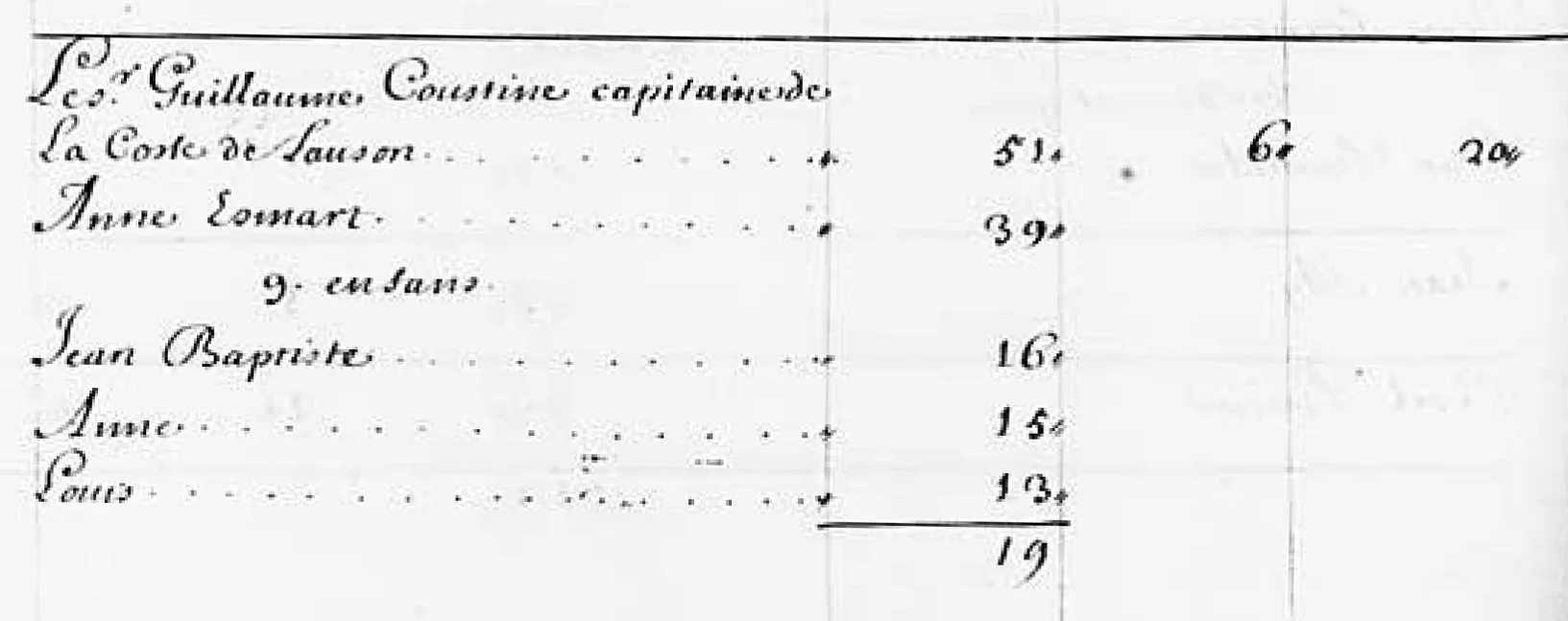
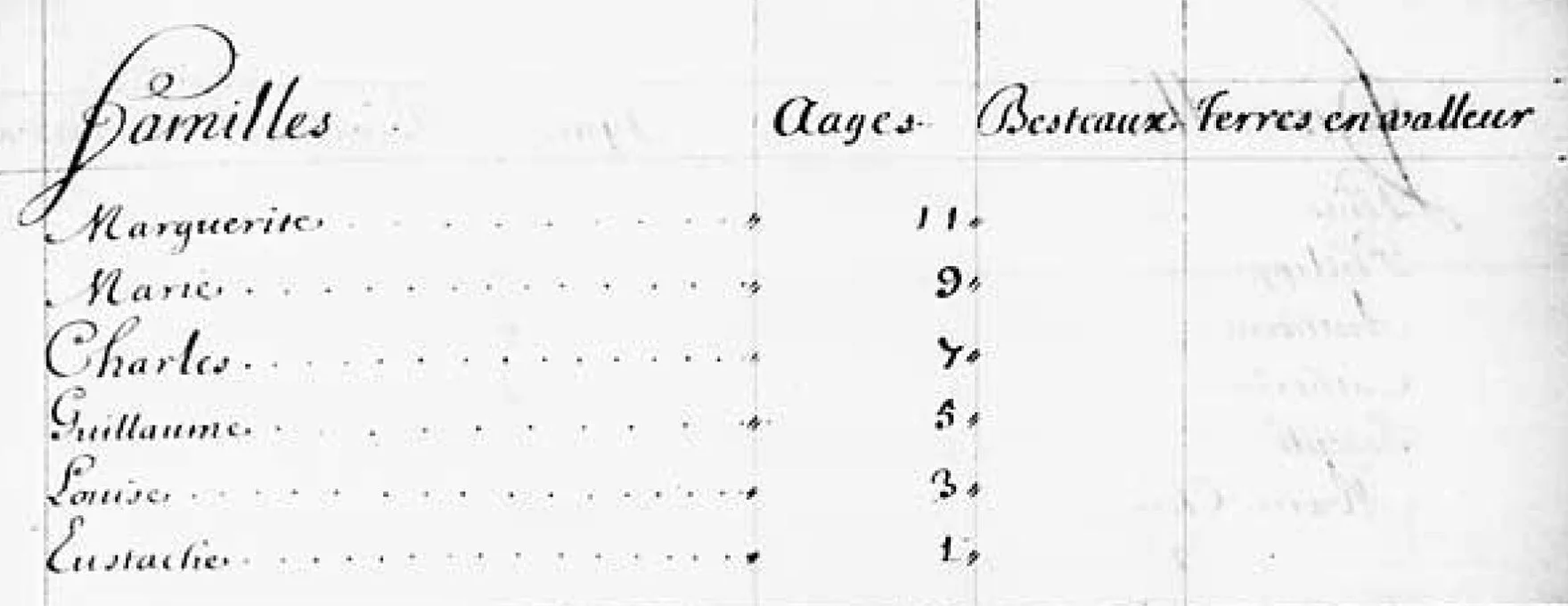
1667 census of New France for the Cousture family (Library and Archives Canada)
Guillaume had reportedly been appointed militia captain in 1666, and notarial records continued to identify him as captain of the habitants of the côte de Lauzon through at least 1678. His responsibilities extended beyond military defence. As captain, he communicated and enforced government proclamations, organized compulsory community labour, oversaw road maintenance, and convened meetings of local inhabitants. The position made him an important intermediary between the colonial authorities and the settlers of Pointe-Lévy.
Guillaume also maintained property interests in Québec. On April 22, 1668, he sold his lot and the timber frame of a house in Québec’s Lower Town to master armourer Nicolas Gauvereau for 150 livres. This was the same parcel of land he had purchased in 1659.
On July 14, 1672, Guillaume, acting on his own behalf and that of Laurent Poirée, entered into an agreement with notary Romain Becquet and his wife, Romaine Boudet, to resolve an ongoing legal dispute. A judgment had previously been issued by the lieutenant general, but Becquet had appealed to the Sovereign Council. The parties agreed to submit their differences to two councillors of the Sovereign Council, Charles Le Gardeur de Tilly and Mathieu Damours de Chauffours, and to abide by their decision. The councillors subsequently ordered Becquet to pay Guillaume twenty livres in damages, reimburse his legal expenses, and reconcile with him publicly: “In our presence, he shall embrace the said Mr. Cousture, asking him to forget what has transpired between them, with a promise from both parties to live as good friends in future.”
Guillaume also served in a judicial capacity. In documents dated 1673 to 1700, he was described as the juge sénéchal de la côte et seigneurie de Lauzon, or judge of the Lauzon seigneurie. From 1682 until his death, he was also occasionally asked to participate in Sovereign Council meetings when its regular members were absent.
In 1681, Guillaume and Anne were enumerated in the census of New France, living in the seigneurie of Lauzon with their seven children. Guillaume was identified as a carpenter. The family owned seven head of cattle, four guns, and twenty arpents of cleared or cultivated land.
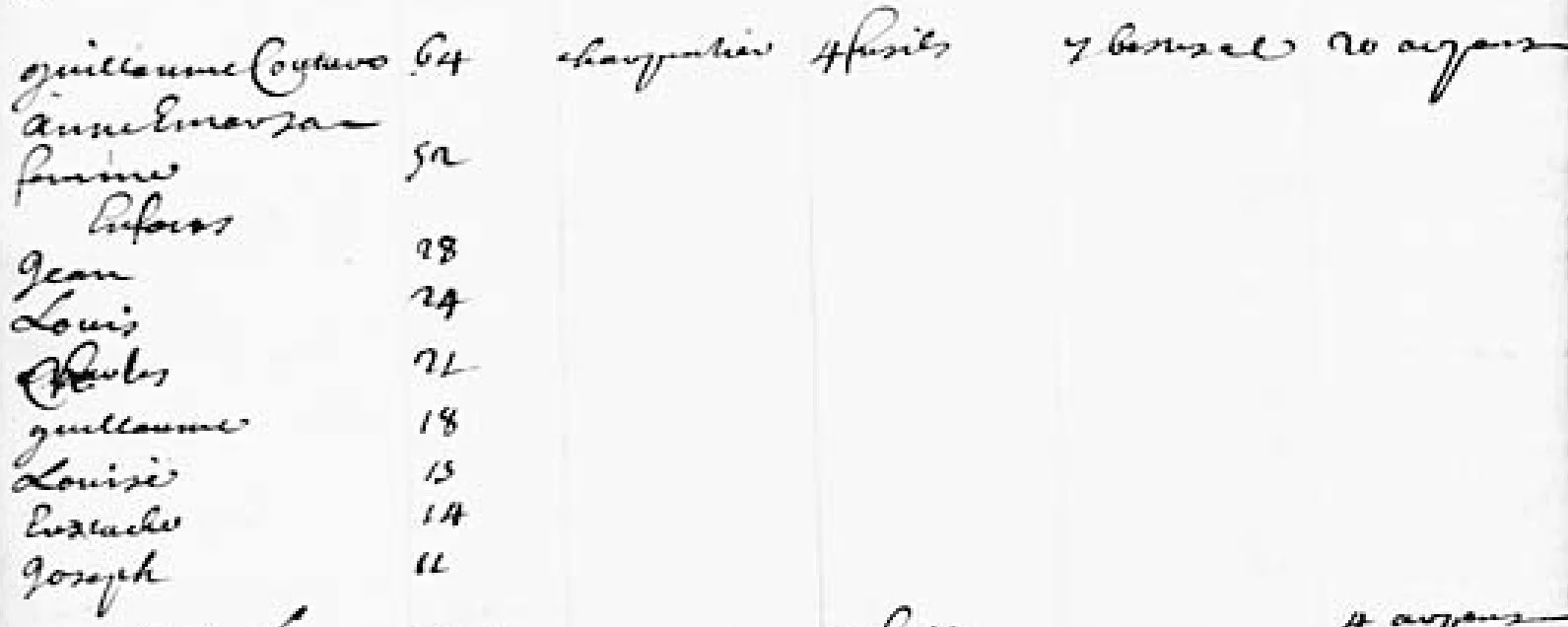
1681 census of New France for the “Couture” family (Library and Archives Canada)
Guillaume and Anne’s Final Years
On June 13, 1695, Guillaume and Anne signed an agreement before notary Nicolas Métru, promising their son Joseph Auger 600 livres, payable after Guillaume’s death and to be drawn from the land and habitation where they lived. The payment was in recognition of the “good and friendly services” Joseph Auger had provided his parents and continued to provide daily.
Anne Émard died at the age of 72 on January 17, 1700. She was buried the following day in the Saint-Joseph parish cemetery at Pointe-Lévy.
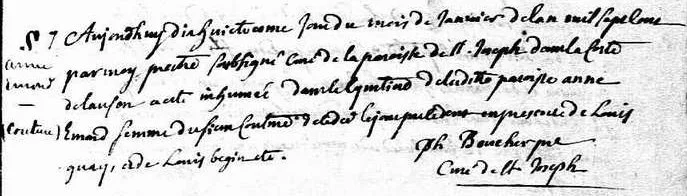
1700 burial of Anne Émard (Généalogie Québec)
Following Anne’s death, Guillaume formally acknowledged the debt owed to their son Joseph Auger. On June 28, 1700, notary François Genaple de Bellefonds recorded Guillaume’s obligation to pay Joseph 600 livres in recognition of his years of service to his parents, particularly his work on the family farm. The agreement noted that, unlike his brothers, Joseph had devoted himself to his parents’ property rather than developing land for his own benefit.
Guillaume Cousture died at the age of 83 on April 4, 1701, at the Hôtel-Dieu hospital in Québec. He was likely buried in the hospital cemetery.

1701 death of Guillaume Cousture in the Hôtel-Dieu register (Ancestry)
The Estate of Guillaume and Anne
On November 14, 1701, notary Michel Lepailleur de LaFerté drew up an inventory of the community of goods of Guillaume and Anne, at the request of their children.
The After-Death Inventory
The Coutume de Paris (custom of Paris) governed the transmission of family property in New France. Under this legal system, married couples were generally subject to the community of goods, unless their marriage contract provided otherwise. The community included movable property and property acquired during the marriage, although certain assets, particularly inherited real estate, remained separate.
When one spouse died, the community was dissolved. The surviving spouse was entitled to half of the community property, while the deceased spouse's half passed to the heirs, generally the children, who inherited in equal shares regardless of sex. When the surviving spouse died, his or her share also passed to the heirs, subject to any applicable debts, agreements or earlier transfers. After-death inventories were drawn up to identify and value the property, possessions and debts of the deceased, providing a basis for settling the estate.
The five-page document provides a glimpse into the everyday life of Guillaume and Anne. Their household possessions included a fireplace crane, a pair of damaged andirons, a grill, a frying pan, two cooking pots, a brass colander, two worn kettles, a fire shovel, a roasting spit, a small mortar and pestle, a brass candlestick, and 36 pounds of old pewter dishes, basins, plates, pots, and sauce spoons.
The family's furnishings and linens were relatively modest. They included two small feather beds covered in worn ticking, a bolster, three nearly worn-out Normandy blankets, five old shirts that were no longer usable, three worn tablecloths, and three old pine chests.
Among the tools and equipment were a musket, a large axe, a two-man saw with worn fittings, an old ploughshare, three logging chains, a winnowing basket, a small compass, a pair of scales, and other implements. The livestock consisted of three oxen, a cow, and two one-year-old pigs.
The inventory also listed several important documents, including Guillaume's original land concession of May 15, 1647, and two court judgments. The family's principal property at Pointe-Lévy measured five arpents of frontage by forty arpents deep, with approximately fifty arpents of cleared land. Other documents concerned land in the seigneurie de Vincennes, including a concession associated with Marie Couillard, widow of François Bissot.
The inventory also records arrangements made among the heirs. Eustache and Charles transferred their interests in the family property to their brother Joseph, on condition that they would not be responsible for the community's debts. Joseph also claimed the 600 livres that Guillaume had promised him in recognition of his years of service to the family. He also agreed to take two oxen and the two pigs as part of his share, while the remaining ox and cow were to be slaughtered and divided equally among the heirs. Their sister Marie relinquished her share of the household furnishings in Joseph's favour. The family's possessions and legal papers were left in Joseph's custody, to be produced when required.
An Enduring Legacy
Few settlers in New France experienced a life as extraordinary as Guillaume Cousture. From his beginnings in Rouen to his years among the Jesuit missionaries, his brutal captivity among the Iroquois, and his subsequent role in diplomatic negotiations, his journey was marked by remarkable challenges and transformations. Yet his lasting legacy was also built at Pointe-Lévy, where he and Anne Émard, herself an immigrant from Niort, established a home and raised ten children. Together, they witnessed the growth of a fledgling French colony while contributing to the establishment of a community on the south shore of the St. Lawrence River. More than three centuries later, their descendants continue to carry the family name, a lasting testament to the lives they built in New France.
PDF version of biography located at: https://www.tfcg.ca/guillaumecousture-and-anneemard.
Are you enjoying our articles and resources? Show your support by making a donation. Every contribution, regardless of its size, goes a long way in covering our website hosting expenses and enables us to create more content related to French-Canadian genealogy and history. Thank you! Merci!
Sources:
"Rouen (paroisse Saint-Godard) - 01/01/1615-31/12/1621," digital images, Archives de la Seine-Maritime (https://www.archivesdepartementales76.net/ark:/50278/76ec9f3672609745f72932201026ab44/img:AD76_EC_4E02038_09_0022 : accessed 13 Nov 2026), baptism of Guillaume Cousture, 14 Jan 1618, Rouen (St-Godard), image 22 of 43.
"Niort (Deux-Sèvres, France) - Baptêmes - (1620-1635)," digital images, Archives Départementales des Deux-Sèvres (https://archives-deux-sevres-vienne.fr/ark:/58825/vtae6c4e6676781d847/daogrp/0/103 : accessed 19 Nov 2026), baptism of Anne Aymart, 22 Oct 1627, Niort (St-André), image 103 of 244.
“Le LAFRANCE (Baptêmes, Mariages, Sépultures)," database and digital images, Généalogie Québec (https://www.genealogiequebec.com/Membership/LAFRANCE/acte/66392 : accessed 21 Nov 2026), marriage of Guillaume COUTURE and Anne EMART, 18 Nov 1649, Québec (Notre-Dame-de-Québec); citing original data: Institut généalogique Drouin.
“Le LAFRANCE (Baptêmes, Mariages, Sépultures)," database and digital images, Généalogie Québec (https://www.genealogiequebec.com/Membership/LAFRANCE/acte/23401 : accessed 21 Nov 2026), burial of Anne EMARD, 18 Jan 1700, Lauzon (St-Joseph-de-la-Pointe-Lévy); citing original data: Institut généalogique Drouin.
“Quebec, Canada, Vital and Church Records (Drouin Collection), 1621-1968,” digital images, Ancestry.ca (https://www.ancestry.ca/imageviewer/collections/1091/images/d13p_31480221?pId=15043512 : accessed 21 Nov 2026), death of Guillaume Couture, 4 Apr 1701, Hôtel-Dieu, Québec; citing original data: Drouin Collection, Institut Généalogique Drouin, Montréal, Quebec, Canada.
"Collection Centre d'archives de Québec - Archives nationales à Québec," digital images, Bibliothèque et Archives nationales du Québec (https://advitam.banq.qc.ca/notice/366877 : accessed 21 Nov 2026), "Documents concernant Guillaume Couture," 26 Jun 1641–23 Mar 1923, reference P1000,S3,D453, Id 366877.
"Fonds Intendants - Archives nationales à Québec," digital images, Bibliothèque et Archives nationales du Québec (https://advitam.banq.qc.ca/notice/93774 : accessed 22 Nov 2026), "Contrat de vente par Pierre Denis, écuyer, seigneur de la Ronde (LaRonde), à Guillaume Cousture (Couture), habitant, d'un emplacement sis en la Basse-Ville de Québec, joignant d'un côté la maison de Martin Prevost (Provost) et Pierre LePetit (Petit), de l'autre côté le chemin touchant la Brasserie (Notaire Guillaume Audouart dit Saint-Germain)," 15 May 1659, reference E1,S4,SS1,D345,P3, Id 93774.
"Fonds Juridiction royale des Trois-Rivières," digital images, Bibliothèque et Archives nationales du Québec (https://advitam.banq.qc.ca/notice/433909 : accessed 22 Nov 2026), deposition of Guillaume Cousture and Bertrand Fafard dit Laframboise concerning a shipment of goods intended for the Huron country, 20 Jul 1660, reference TL3,S11,P222, Id 433909.
Rapport de l'archiviste de la province de Québec pour 1923–1924 (Québec: Imprimeur du Roi, 1924), facsimile of the concession granted by Charles Huault de Montmagny to Guillaume Couture, 15 May 1647, p. 73, digitized by Patrimoine Québec (https://patrimoinequebec.ca/bibliotheque/livre.php?id=69 : accessed 18 Nov 2026).
"Recensement du Canada, 1667," digital images, Library and Archives Canada (https://www.bac-lac.gc.ca/eng/CollectionSearch/Pages/record.aspx?app=fonandcol&IdNumber=2318857&new=-8585951843764033676 : accessed 22 Nov 2026), household of Guillaume Cousture, 1667, côte de Lauzon, pages 96-97 (of PDF), Finding aid no. MSS0446, Item ID number: 2318857; citing original data: Centre des archives d'outre-mer (France) vol. 460.
"Recensement du Canada fait par l'intendant Du Chesneau," digital images, Library and Archives Canada (https://www.bac-lac.gc.ca/eng/CollectionSearch/Pages/record.aspx?app=fonandcol&IdNumber=2318858&new=-8585855146497784530 : accessed 22 Nov 2026), household of Guillaume Couture, 14 Nov 1681, seigneurie de Lauzon, page 225 (of PDF), Finding aid no. MSS0446, MIKAN no. 2318858; citing original data: Centre des archives d'outre-mer (France) vol. 460.
"Actes de notaire, 1626-1645 // Martial Piraube," digital images, FamilySearch (https://www.familysearch.org/ark:/61903/3:1:3Q9M-CSVN-Q66M?cat=koha%3A1176010&view=explore&lang=en&groupId=M9DC-CWC : accessed 13 Nov 2026), donation by Guillaume Cousture, 26 Jun 1641, images 1114-1116 of 2056 ; citing original data : Bibliothèque et Archives nationales du Québec.
"Archives de notaires : Lecoustre, Claude (1647-1648)," digital images, Bibliothèque et Archives nationales du Québec (https://numerique.banq.qc.ca/patrimoine/details/52327/5124961?docref=erNy79aLMLBJBu9cFr1siA : accessed 12 Nov 2026), agreement between François Bissot and Guillaume Couture, 4 Nov 1647, image 42 of 98.
"Actes de notaire, 1634, 1649-1663 // Guillaume Audouart," digital images, FamilySearch (https://www.familysearch.org/ark:/61903/3:1:3Q9M-CSVN-3J4G?cat=koha%3A1171569&view=explore&lang=en&groupId=TH-909-70683-15391-81 : accessed 12 Nov 2026), marriage treaty between Guillaume Cousture and Anne Emard, 18 Nov 1649, image 96 of 2642 ; citing original data : Bibliothèque et Archives nationales du Québec.
"Actes de notaire, 1634, 1649-1663 // Guillaume Audouart," digital images, FamilySearch (https://www.familysearch.org/ark:/61903/3:1:3Q9M-CSVN-32ZY?cat=koha%3A1171569&view=explore&lang=en&groupId=TH-909-70683-15391-81 : accessed 12 Nov 2026), power of attorney by Guillaume Cousture (and several others) to Jean Juchereau de Laferté, 20 Aug 1651, image 455 of 2642 ; citing original data : Bibliothèque et Archives nationales du Québec.
"Actes de notaire, 1634, 1649-1663 // Guillaume Audouart," digital images, FamilySearch (https://www.familysearch.org/ark:/61903/3:1:3Q9M-CSVN-3LC1?cat=koha%3A1171569&view=explore&lang=en&groupId=TH-909-70683-15391-81 : accessed 12 Nov 2026), agreement between Guillaume Cousture and Guillaume Durand, 16 Sep 1653, image 804 of 2642 ; citing original data : Bibliothèque et Archives nationales du Québec.
"Actes de notaire, 1634, 1649-1663 // Guillaume Audouart," digital images, FamilySearch (https://www.familysearch.org/ark:/61903/3:1:3Q9M-CSVN-32NC?cat=koha%3A1171569&view=explore&lang=en&groupId=TH-909-70683-15391-81 : accessed 12 Nov 2026), carpentry agreement between Charles Pouliot and Nicolas Huot dit St Laurent, and Guillaume Cousture, 7 Sep 1658, images 2139–2140 of 2642 ; citing original data : Bibliothèque et Archives nationales du Québec.
"Actes de notaire, 1634, 1649-1663 // Guillaume Audouart," digital images, FamilySearch (https://www.familysearch.org/ark:/61903/3:1:3Q9M-CSVN-3L9T?cat=koha%3A1171569&view=explore&lang=en&groupId=TH-909-70683-15391-81 : accessed 12 Nov 2026), transaction between Guillaume Cousture and Catherine Françoise Desnaguets and her husband Pierre Lepetit, 26 Aug 1659, images 2535–2536 of 2642 ; citing original data : Bibliothèque et Archives nationales du Québec.
"Actes de notaire, 1663-1687 // Pierre Duquet," digital images, FamilySearch (https://www.familysearch.org/ark:/61903/3:1:3Q9M-CSTC-Y9CL-K?cat=koha%3A1175224&view=explore&lang=en&groupId=TH-909-77697-24515-66 : accessed 22 Nov 2026), partnership between Guillaume Cousture, Charles Amiot, Noël Jérémie, and Sébastien Prouvereau, 28 May 1665, images 393–394 of 2541; citing original data : Bibliothèque et Archives nationales du Québec.
"Actes de notaire, 1663-1687 // Pierre Duquet," digital images, FamilySearch (https://www.familysearch.org/ark:/61903/3:1:3Q9M-CSTC-Y9CP-D?cat=koha%3A1175224&view=explore&lang=en&groupId=TH-909-77697-24515-66 : accessed 21 Nov 2026), lot sale in Quebecq by Guillaume Cousture to Nicolas Gauvereau, 22 Apr 1668, images 665–666 of 2541; citing original data : Bibliothèque et Archives nationales du Québec.
"Actes de notaire, 1663-1687 // Pierre Duquet," digital images, FamilySearch (https://www.familysearch.org/ark:/61903/3:1:3Q9M-CSTC-Y9C2-P?cat=koha%3A1175224&view=explore&lang=en&groupId=TH-909-77697-24515-66 : accessed 21 Nov 2026), transaction between Guillaume Cousture, Laurent Poirée, and Romain Becquet and Romaine Boudet, 14 Jul 1672, images 1529-1530 of 2541; citing original data : Bibliothèque et Archives nationales du Québec.
"Archives de notaires : Romain Becquet (1665-1682)," digital images, Bibliothèque et Archives nationales du Québec (https://numerique.banq.qc.ca/patrimoine/details/52327/4064891?docref=asZh3atJEUUCji83ihxZkw : accessed 22 Nov 2026), agreement between Romain Becquet and Guillaume Cousture, 14 Jul 1672, image 696 of 881.
"Actes de notaire, 1678-1700 // Nicolas Metru," digital images, FamilySearch (https://www.familysearch.org/ark:/61903/3:1:3QHV-R3LX-P9Z5-3?cat=koha%3A964091&view=explore&lang=en&groupId=M9DC-M2F : accessed 21 Nov 2026), promise of a monetary donation by Guillaume Cousture and Anne Esmard to their son Joseph Auger Cousture de Lacressonniere, 13 Jun 1695, image 1291 of 3347; citing original data : Bibliothèque et Archives nationales du Québec.
"Actes de notaire, 1682-1709 // François Genaple," digital images, FamilySearch (https://www.familysearch.org/ark:/61903/3:1:3Q9M-CS56-VQM7-H?cat=koha%3A1168969&view=explore&lang=en&groupId=TH-909-76008-102518-49 : accessed 21 Nov 2026), obligation (debt) by Guillaume Cousture to his son Joseph Auger Cousture de Lacressonniere, 28 Jun 1700, image 3000 of 3410; citing original data : Bibliothèque et Archives nationales du Québec.
"Actes de notaire, 1700-1714 // Michel-Laferté Lepailleur," digital images, FamilySearch (https://www.familysearch.org/ark:/61903/3:1:3QHV-R3LZ-G9CS-W?cat=koha%3A730550&view=explore&lang=en&groupId=M9DC-WFK : accessed 21 Nov 2026), inventory of the community of goods of the late Guillaume Couture and Anne Hemard, 14 Nov 1701, images 1971–1975 of 2467; citing original data : Bibliothèque et Archives nationales du Québec.
Fédération québécoise des sociétés de généalogie, Fichier Origine online database (https://www.fichierorigine.com/fr/repertoire/couture/-cousture : accessed 13 Nov 2026), entry for COUTURE / COUSTURE, Guillaume (reference 241058), updated on 10 Mar 2021.
Fédération québécoise des sociétés de généalogie, Fichier Origine online database (https://www.fichierorigine.com/fr/repertoire/emard/-aymart/-aymard : accessed 13 Nov 2026), entry for EMARD / AYMART / AYMARD, Anne (reference 241452), updated on 19 Feb 2019.
Université de Montréal, Programme de recherche en démographie historique (PRDH) database (https://www-prdh-igd-com.res.banq.qc.ca/Membership/en/PRDH/Famille/627 : accessed 21 Nov 2026), dictionary entry for Guillaume COUTURE and Anne EMARD, union 627.
Roland-Yves Gagné and Marc J. Coûture, “Les origines de Guillaume Cousture,” Mémoires de la Société généalogique canadienne-française, vol. 56, no. 1, booklet 243 (spring 2005), pages 11–30.
Joseph-Edmond Roy, Guillaume Couture, premier colon de la Pointe-Lévy (Lévis: Mercier et Cie, 1884), Appendix B, “Accord entre Frs. Bissot et Gme Cousture” (https://fr.wikisource.org/wiki/Guillaume_Couture,_premier_colon_de_la_Pointe-L%C3%A9vy/10 : accessed 18 Nov 2026).
Guy Perron, “427 – Départ des sœurs Émard pour Québec en 1648,” Le blogue de Guy Perron (https://lebloguedeguyperron.wordpress.com/2025/09/14/427-depart-des-soeurs-emard-pour-quebec-en-1648/ : accessed 22 Nov 2026), 14 Sep 2025.
Peter Gagné, Before the King’s Daughters: Les Filles à Marier, 1634-1662 (Orange Park, Florida : Quintin Publications, 2002), 132.
“Guillaume Couture,” Au fil des ans, Société historique de Bellechasse (https://shbellechasse.com/aufildesans/19_03_a.pdf : accessed 22 Nov 2026), 70th issue (summer 2007), 10–13.
Raymond Douville, “COUTURE (Cousture), GUILLAUME (d. 1701),” in Dictionary of Canadian Biography, vol. 2 (https://www.biographi.ca/en/bio/couture_guillaume_1701_2E.html : accessed 16 Nov 2026), University of Toronto/Université Laval, 2003–.
Léon Pouliot, “LA LANDE, JEAN DE,” in Dictionary of Canadian Biography, vol. 1 (https://www.biographi.ca/en/bio/la_lande_jean_de_1E.html : accessed 17 Nov 2026), University of Toronto/Université Laval, 2003–.
Georges-Émile Giguère, “JOGUES, ISAAC,” in Dictionary of Canadian Biography, vol. 1 (https://www.biographi.ca/en/bio/jogues_isaac_1E.html : accessed 17 Nov 2026), University of Toronto/Université Laval, 2003–.
The Jesuit Relations and Allied Documents, vol. XXXI, edited by Reuben Gold Thwaites, pages 25–32; 48-51. Uploaded by Wikimedia Commons (https://upload.wikimedia.org/wikipedia/commons/8/8b/The_Jesuit_relations_and_allied_documents_%28microform%29_-_travels_and_explorations_of_the_Jesuit_missionaries_in_New_France%2C_1610-1791_%28IA_cihm_07565%29.pdf : accessed 16 Nov 2026).
Relations des Jésuites, volume II (Québec, Augustin Coté Éditeur Imprimeur, 1858), 1643 chapter (pages 66-69 ; 76-77), 1645 chapter (pages 23-27).
Journal des Jésuites (Québec, Léger Brousseau Imprimeur-Éditeur, 1871), 42-43.
Michel Lavoie, Souveraineté, contrôle, mainmise, propriété, possession, exploitation. Le colonialisme d’exploitation sur le Domaine seigneurial du roi, 1652–1859 (https://www.raceshifting.com/wp-content/uploads/2019/06/2.1-090709_Metis3_Expertise_Lavoie.pdf : accessed 22 Nov 2026), June 2009.
Daniel K. Richter, “War and Culture: The Iroquois Experience,” The William and Mary Quarterly, 3rd ser., vol. 40, no. 4 (October 1983), pages 528–559, digitized by JSTOR (https://cooperative-individualism.org/richter-daniel_war-and-culture-the-iroquois-experience-1983-oct.pdf : accessed 16 Nov 2026).