Abraham Martin dit l’Écossais & Marguerite Langlois
Discover the lives of Abraham Martin dit l’Écossais and Marguerite Langlois, early settlers of Québec, ancestors of thousands of French-Canadians, whose land gave its name to the Plains of Abraham.
Cliquez ici pour la version française
Abraham Martin dit l’Écossais & Marguerite Langlois
The Family Behind the Plains of Abraham
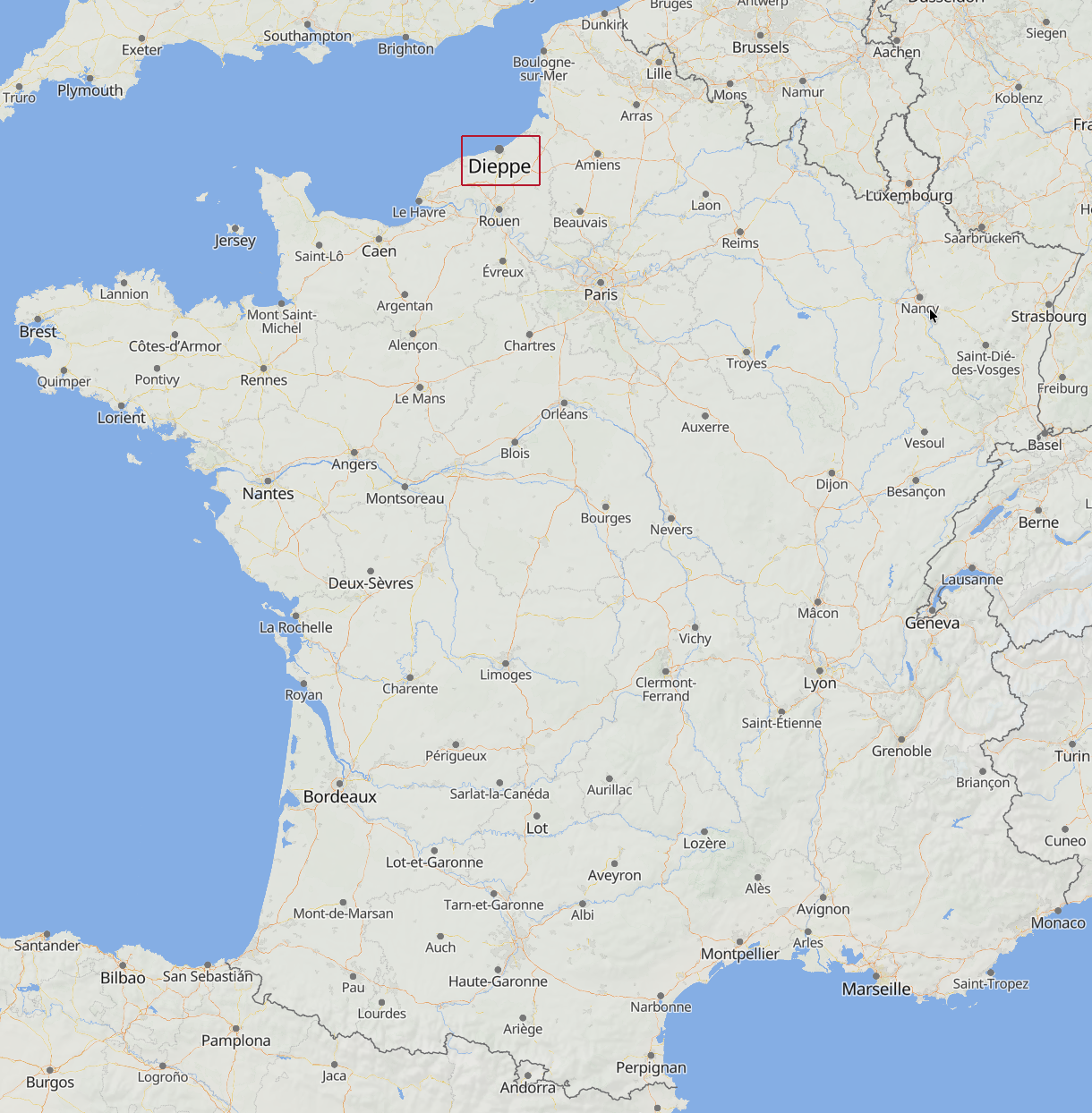
Location of Dieppe in France (Mapcarta)
Abraham Martin was born around 1589. This estimated year of birth is derived from the age of seventy-five recorded at his burial in 1664. His exact place of birth is unknown, although he was living in Dieppe, Normandy, by at least 1616.
Nicknamed the “City of Four Ports,” Dieppe lies in northwestern France along the English Channel, in what is today the department of Seine-Maritime. With a present-day population of roughly 30,000 residents, known as Dieppois, the town has long been defined by its maritime identity. In the 16th century, Dieppe distinguished itself as an important centre of navigation and cartography, contributing significantly to the French school of mapmaking.
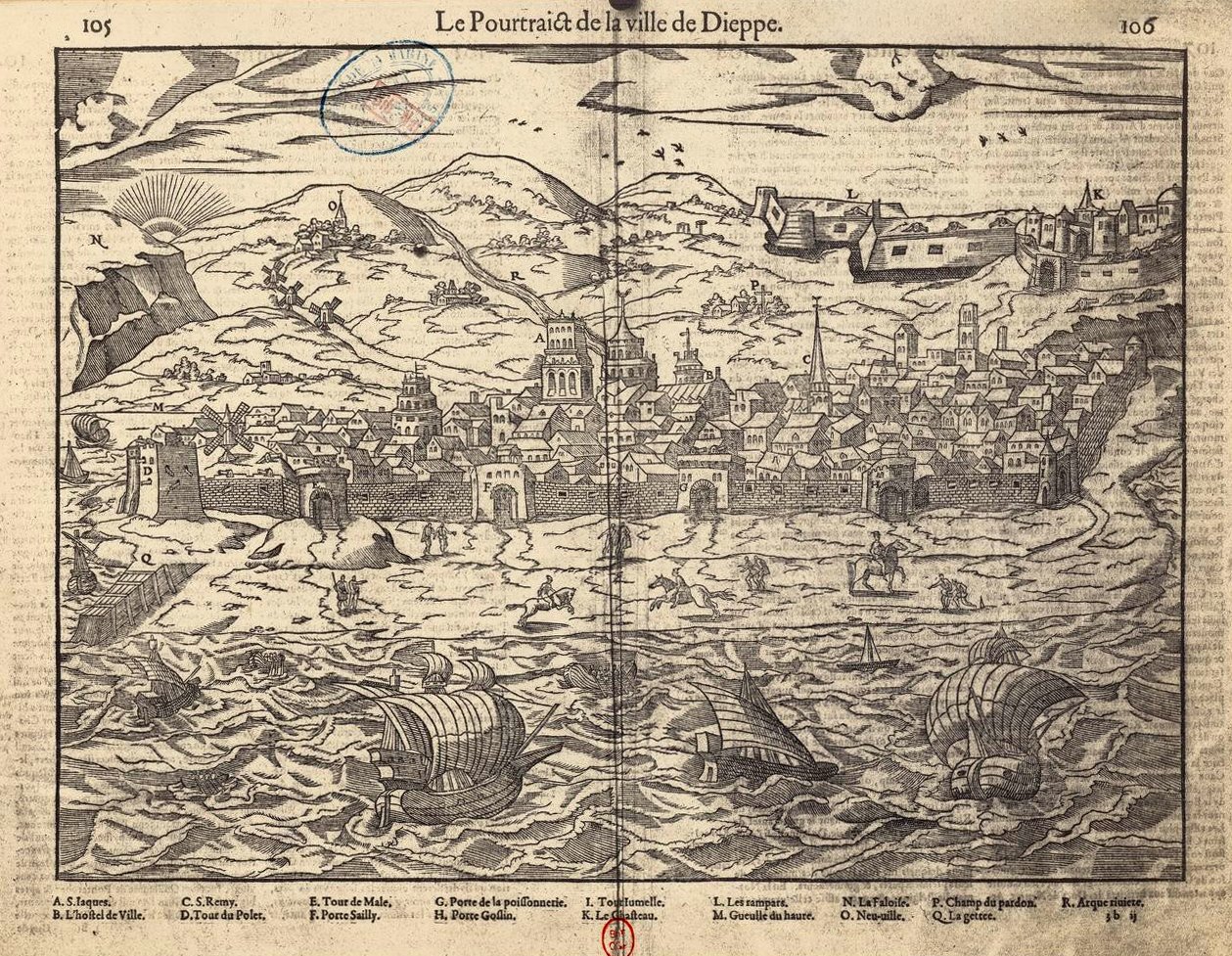
“A portrait of the city of Dieppe,” 1575 drawing by cartographer François de Belleforest (Bibliothèque nationale de France)
Around the age of twenty-six, Abraham married Marguerite Langlois in France, likely in Dieppe. Marguerite may also have been from the town, although her year of birth and the identities of both their parents remain unknown. No marriage record has yet been found.
Abraham and Marguerite’s first known child, Jehan, was baptized in the parish of Saint-Jacques in Dieppe on September 23, 1616. His godparents were Jehan Filie and Colette Chignart. This baptism record is the earliest confirmed document we have for Abraham and Marguerite.

1616 baptism of son Jehan Martin in Dieppe (Archives départementales de la Seine-Maritime)
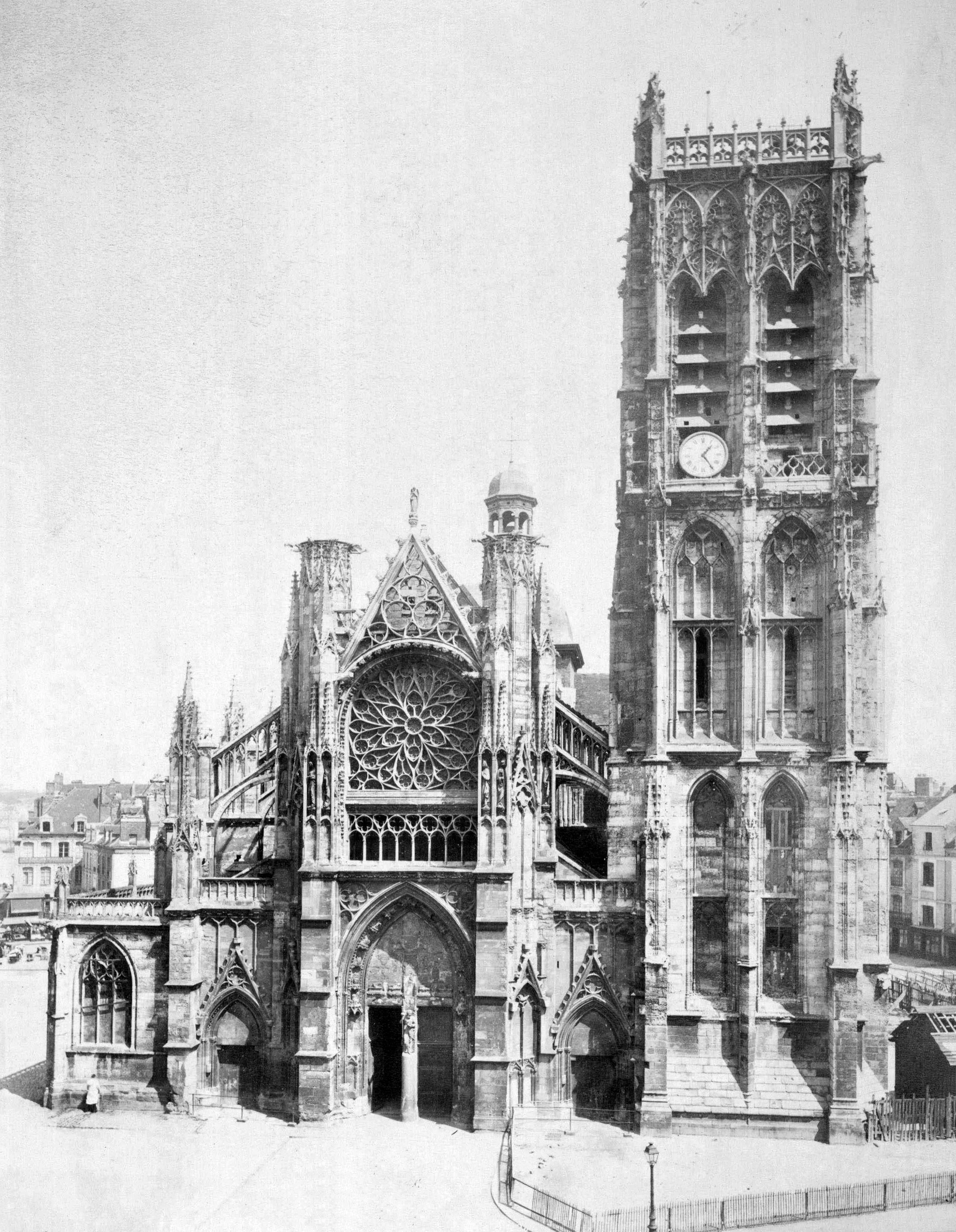
The Church of Saint-Jacques, a striking Gothic structure dating to the 13th century, still stands in Dieppe today. 19th-century photo by Étienne and Louis Antonin Neurdein (Institut national d'histoire de l'art).
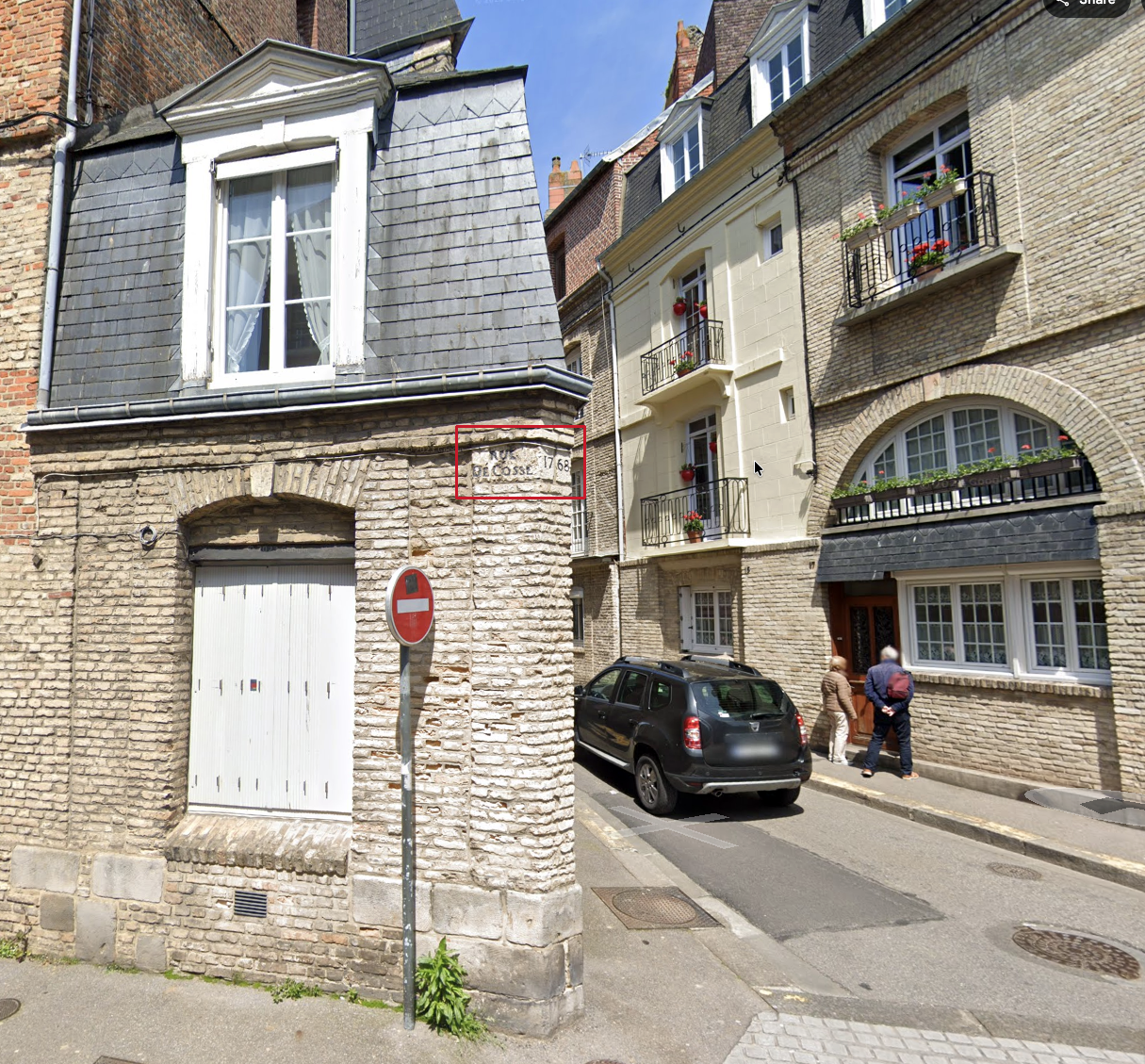
Rue d’Écosse in Dieppe, France (© Google Street View)
Abraham’s dit name, “l’Écossais” (the Scot), has prompted several theories about his origins. According to Fichier Origine, he resided on rue d’Écosse (Scotland Street) in Dieppe, a street that still exists today near the church of Saint-Jacques. Some have suggested that he may have had Scottish ancestry or spent time in Scotland during his youth. Others have proposed that the name may have been adopted for unrelated reasons, including military service. So far, no records have been found to support any of these theories.
Early Pioneers
Abraham Martin and Marguerite Langlois were among the earliest permanent French settlers in Québec. They were established in the colony by 1621, at roughly the same time as Françoise Langlois, likely her sister, and her husband Pierre Desportes.
What would lead a young couple to leave Dieppe for the uncertainties of New France around 1620? As an active Atlantic port, Dieppe was closely connected to the fishing and trading networks that linked Normandy to the St. Lawrence Valley. By this time, Québec was slowly evolving from a seasonal trading post into a permanent settlement, and colonial promoters were encouraging families to establish themselves there. For a man in his early thirties with a growing family, the promise of land and long-term opportunity in Canada may have offered possibilities that were difficult to secure in France.
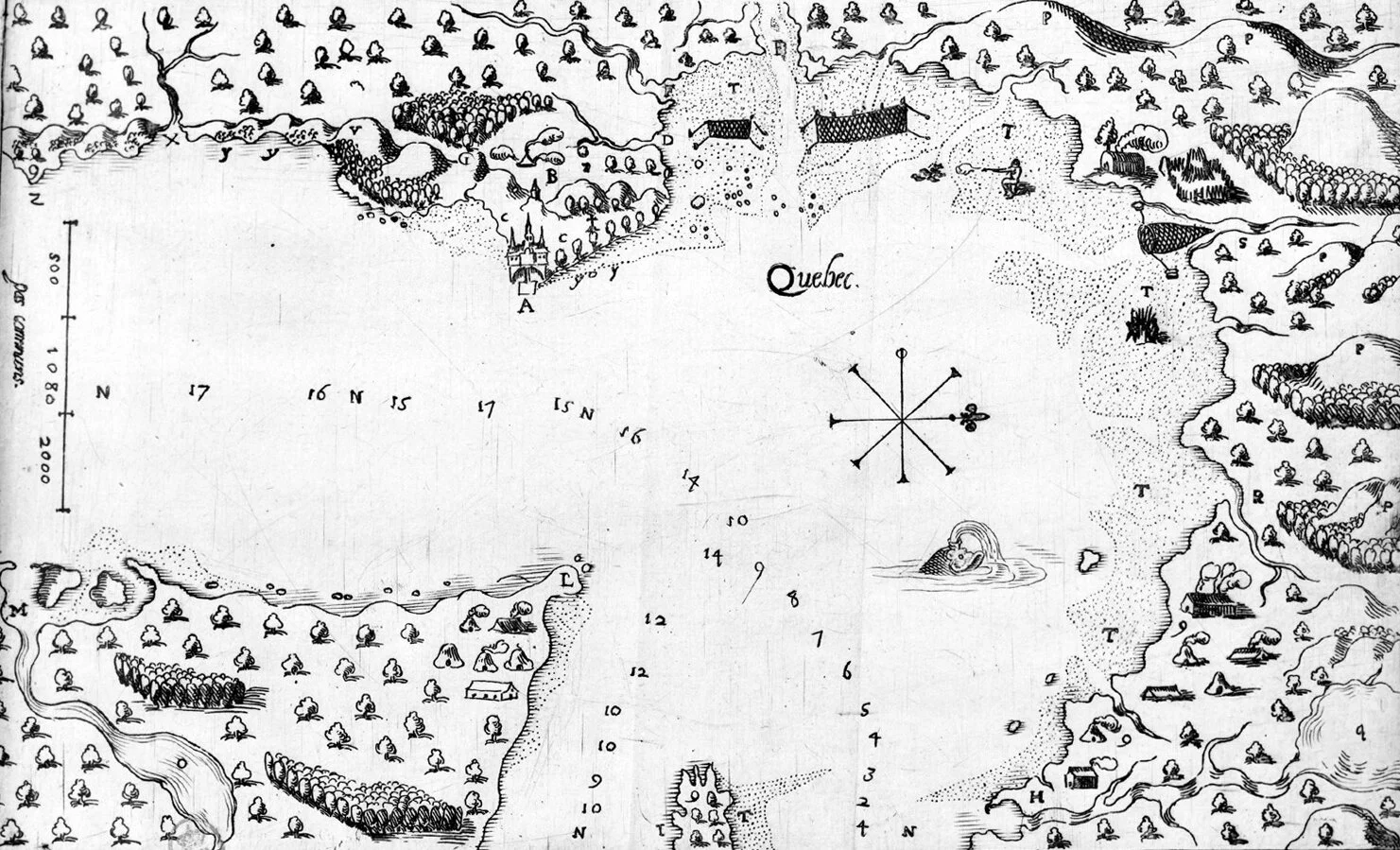
Drawing of Québec by Samuel de Champlain, published in 1613 (Bibliothèque et Archives nationales du Québec)
Over the next several years, Marguerite gave birth to three more children in Québec: Eustache, Marguerite, and Hélène. All were baptized at Notre-Dame de Québec, the colony’s first parish.
Eustache Martin is traditionally regarded as one of the earliest children of European parentage born in Québec. His baptism is the first entry preserved in the surviving parish register of Notre-Dame; his sister Marguerite’s baptism follows immediately after. At the baptism of their daughter Hélène in 1627, Samuel de Champlain, often called the “Father of New France,” is recorded as her godfather, a reflection of the small, close-knit nature of the early settlement.
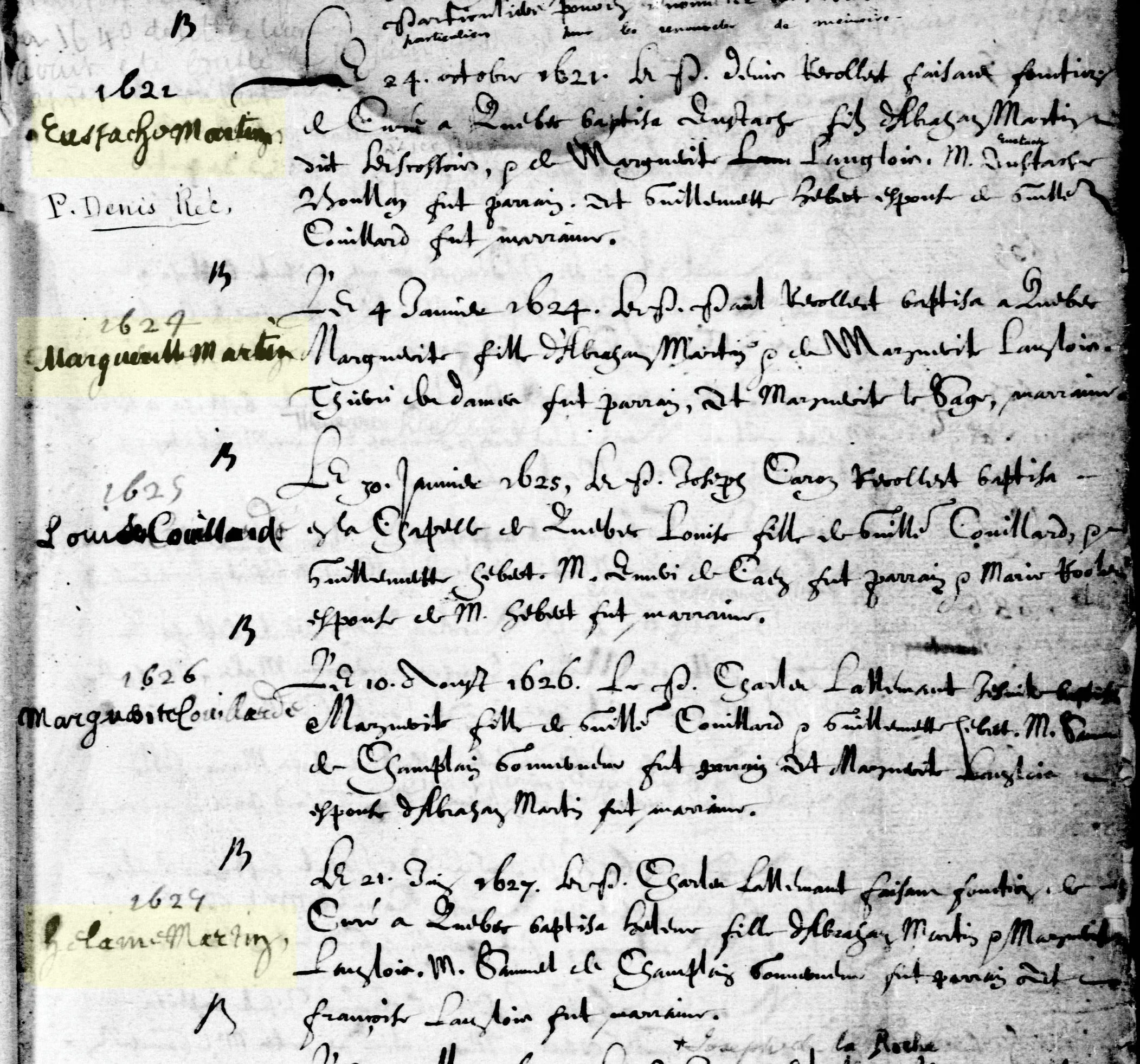
The baptisms of Eustache, Marguerite, and Hélène Martin in Québec (Généalogie Québec)
The Kirke Brothers and the Fall of Québec
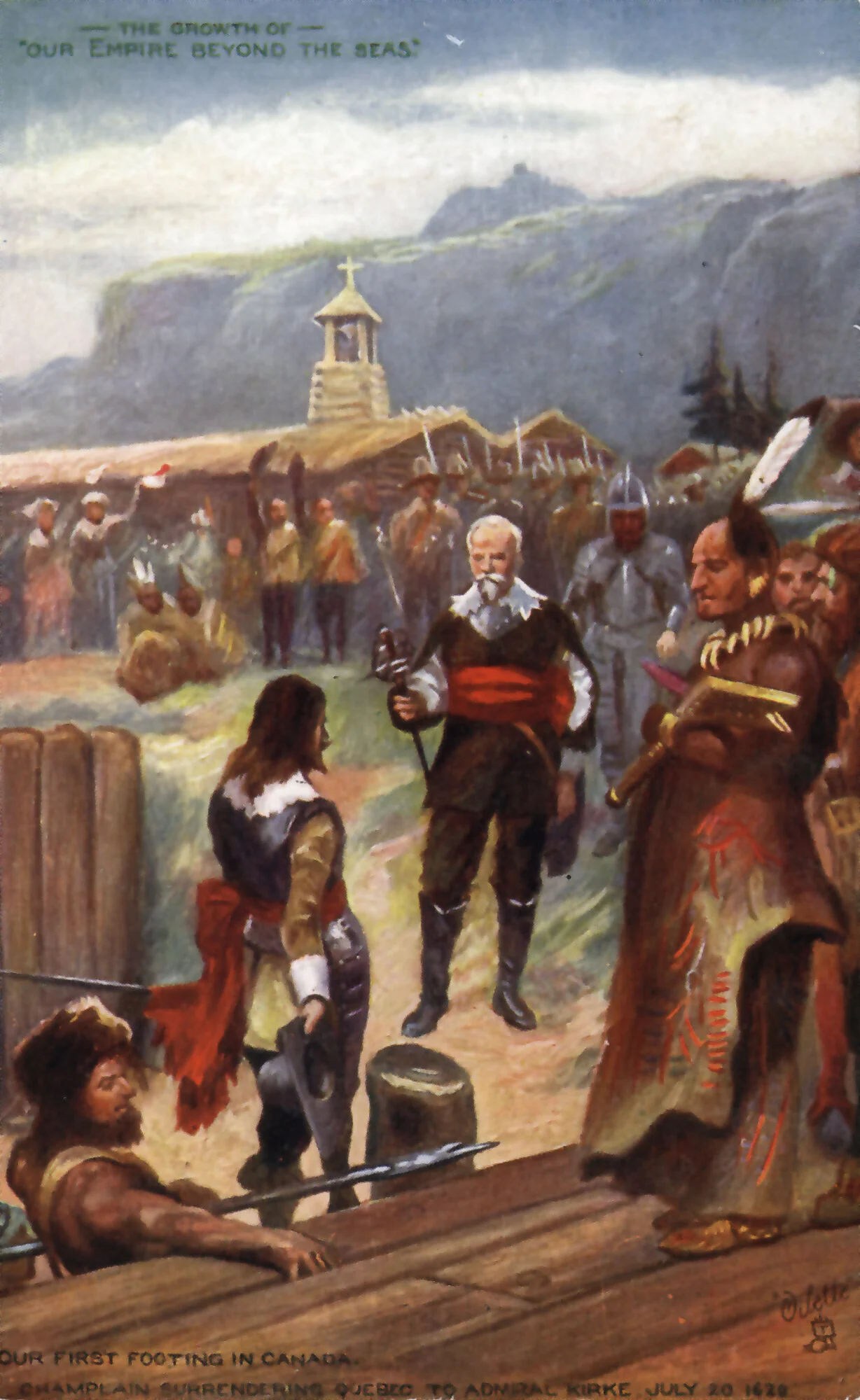
“Champlain surrendering Québec to Admiral Kirke, July 20 1628", 1911 postcard (Wikimedia Commons)
In 1629, the fragile French settlement at Québec was abruptly disrupted by the English. The attack was led by the Kirke brothers, David, Louis, and Thomas, privateers operating under an English commission during the Anglo-French War (1627–1629). The brothers had already intercepted several French supply ships bound for Québec, leaving the colony dangerously short of food and supplies. When their fleet arrived at Québec in July 1629, Samuel de Champlain and the small garrison had little choice but to surrender the starving settlement.
Like many of the colony’s earliest inhabitants, Abraham Martin and his family soon returned to France. During this period of exile, Marguerite gave birth to their fifth child in Dieppe. Pierre Martin was baptized in the parish of Saint-Jacques on August 1, 1630. The English occupation of Québec lasted three years. Under the Treaty of Saint-Germain-en-Laye in 1632, England agreed to restore Québec and the rest of New France to France, allowing former settlers to return.
Abraham and his family were among those who came back to Québec in 1633, the same year that Samuel de Champlain returned to resume his role as commander of the colony. Champlain’s health soon began to decline, however, and he suffered a severe stroke in October 1635. On November 17 of that year, he drafted his final will and testament. In recognition of their role in helping establish the young colony, Champlain gave 600 livres to Abraham and his wife Marguerite on the condition that the money be used to clear land in New France. He also gave their daughter Marguerite 600 livres “to help her marry in this country of New France a man who would be a resident of the said country and not otherwise,” along with an additional 300 francs to his goddaughter Hélène.
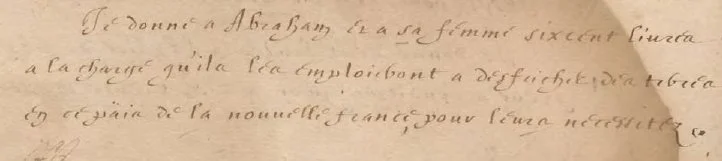
Extract from Samuel de Champlain’s last will and testament mentioning the bequest to “Abraham and his wife” (Bibliothèque et Archives nationales du Québec)
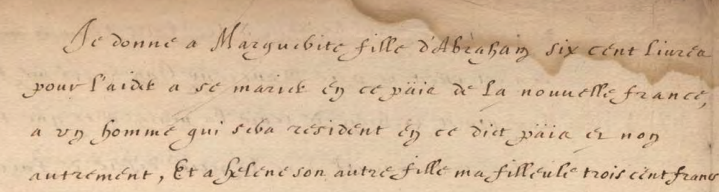
Excerpt from Champlain’s will showing donations to Marguerite and Hélène Martin (Bibliothèque et Archives nationales du Québec)
Abraham Martin’s Landholdings
On December 4, 1635, a report recorded the measurement and demarcation of the 12 arpents of land granted to Abraham by the Compagnie de la Nouvelle-France. The property was located on the northern slope of Cap-aux-Diamants and represents the earliest known reference to his landholding. In 1643, he purchased a property known as the “jardin du Père Denis” (the garden of Father Denis) from Guillaume Hubou. Two years later, Abraham received another 20 arpents of land from Adrien Duchesne, a surgeon and interpreter also from Dieppe.
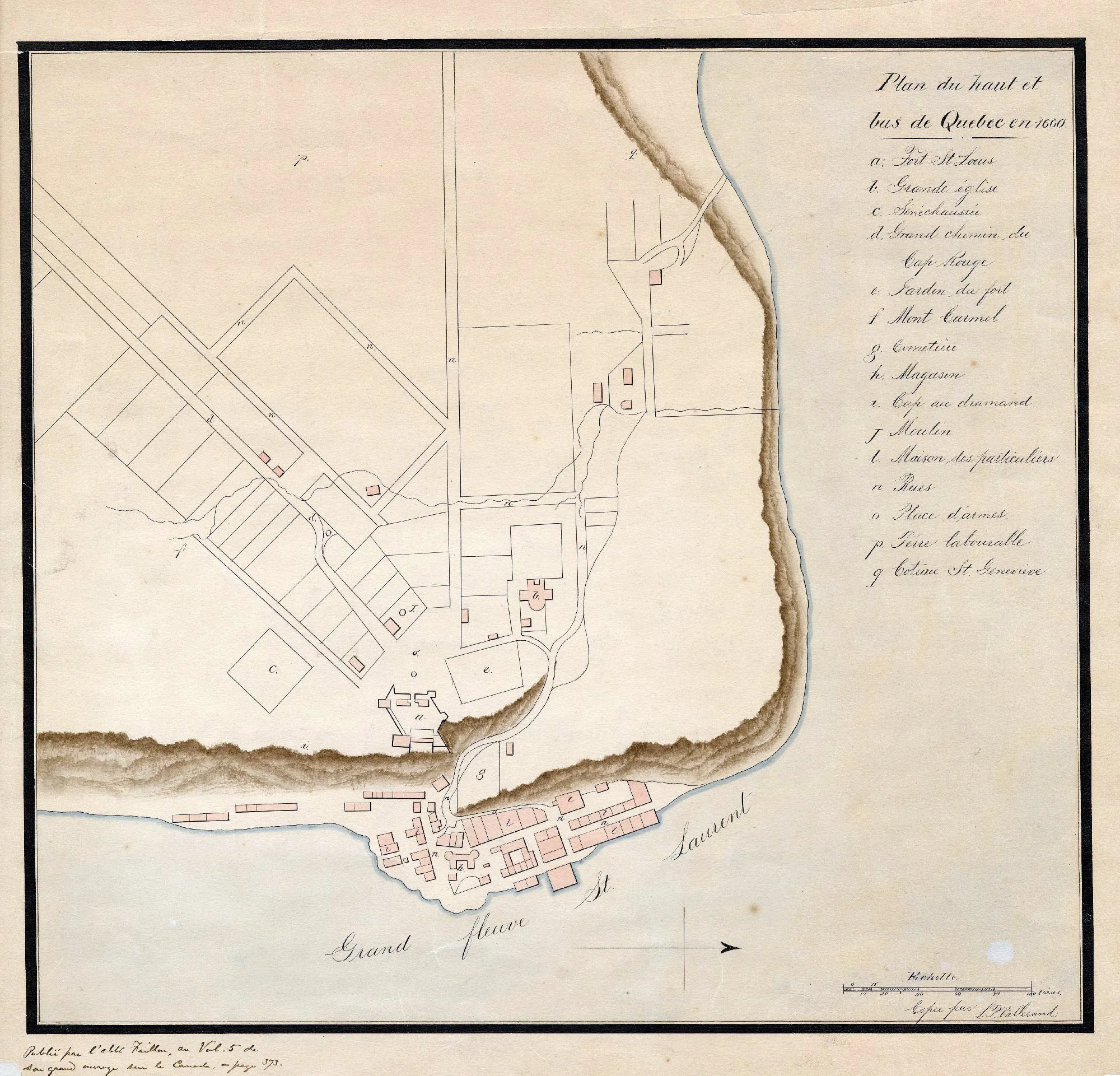
"Map of upper and lower Québec in 1660," copied by Louis-Philippe Vallerand from the original by Jean Bourdon (Bibliothèque et Archives nationales du Québec)
In October 1648, Abraham obtained an adjoining property, giving him a substantial tract of land on the plateau west of Québec. At the time, this area remained largely open countryside outside the fortified town. As the colony grew, his property and the routes leading up the slope became familiar landmarks for residents, and his name gradually became attached to nearby geographic features.
Although Abraham Martin himself could never have imagined it, the land that bore his name would later give its name to one of the most famous battlefields in North American history.
From Abraham Martin to the Plains of Abraham
The name “Plains of Abraham” ultimately derives from Abraham Martin himself, although it did not appear during his lifetime. By 1663 he owned a tract of land known as Claire-Fontaine, located on the edge of the coteau Sainte-Geneviève in the upper part of the town. This property had been assembled in stages through concessions granted in 1635 and 1645. After Abraham’s death, the land was sold in 1675 by his son, the priest Charles-Amador Martin, to the Ursuline nuns. Although the property lay roughly 500 metres from the area now associated with the Plains of Abraham, Abraham’s land and the routes leading to it helped anchor his name in the surrounding landscape.
The earliest known place name connected to him appears in 1734 with the mention of “Rüs d’abrahan”, a road linking his former land to the route that later became Grande Allée. During the Siege of Québec in 1759, military reports began referring to the nearby plateau as the “hauteurs d’Abraham” (heights of Abraham). The now familiar expression “Plains of Abraham” appears the same year in an account by the British officer John Knox, describing the ground where the opposing armies met on September 13, 1759.
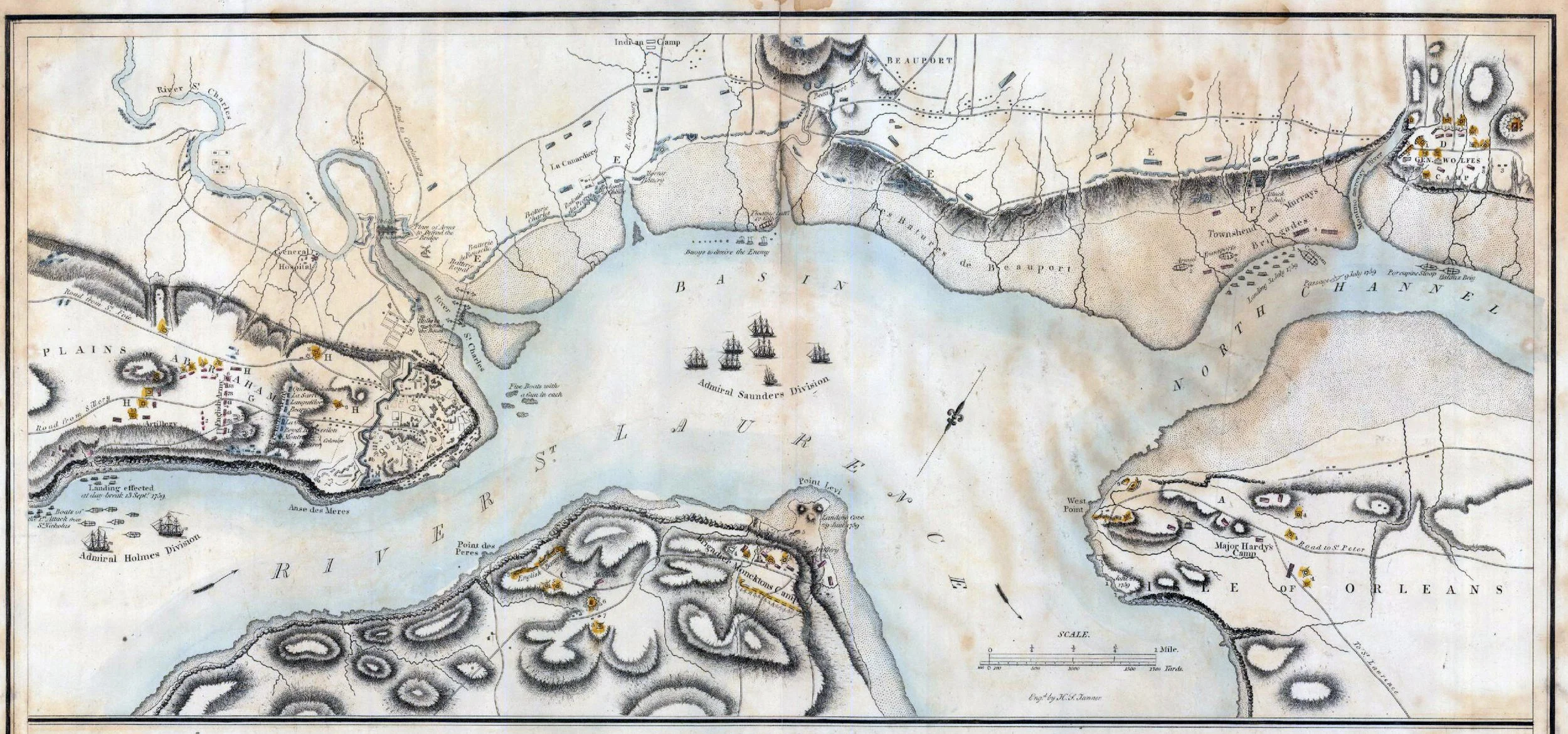
“Plan of Quebec and adjacent country shewing the principal emcampments & works of the British & French armies during the Siege by General Wolfe in 1759,” showing the “Plains of Abraham,” 1759 map by J. B. Glegg and John Melish (Bibliothèque et Archives nationales du Québec)
Over time the name became firmly established in maps and historical writing. The English form appears on a map by Jean-Baptiste Duberger in 1808, while the French Plaines d’Abraham is used by Joseph Bouchette in 1815. Today the name is often associated with the parc des Champs-de-Bataille, created in 1908, but historically it referred more broadly to the plateau southwest of Québec’s fortifications where the famous battle was fought.
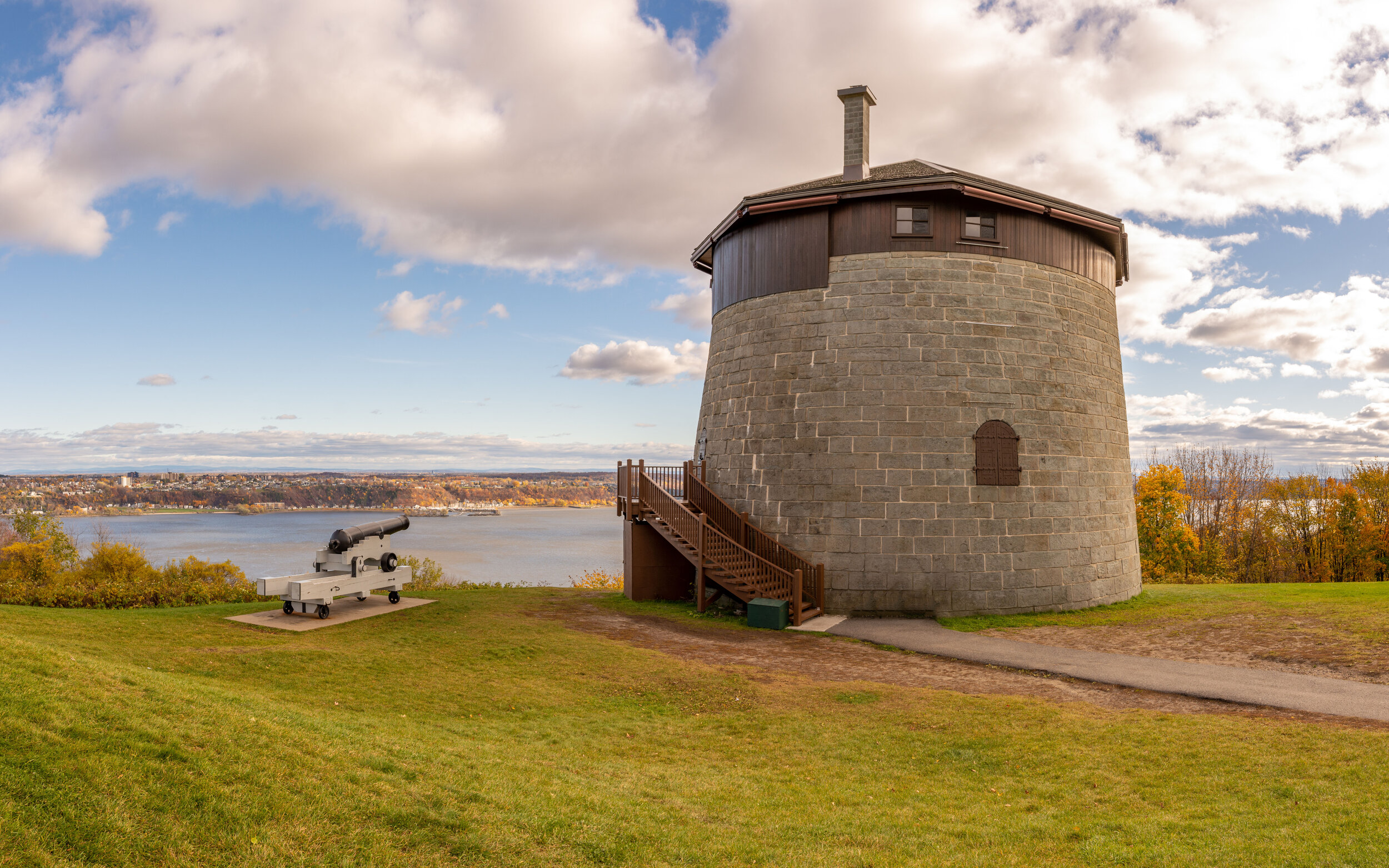
Martello Tower 1 on the plains of Abraham in Québec City, at the top of Cap Diamant overlooking the St. Lawrence River (Wikimedia Commons)
Life on the River
Abraham was described as a maître pilote des rivières (a master river pilot). He may, in fact, have been the colony’s first pilot, or even a “royal pilot,” although no official proof of the latter designation exists. In a marriage contract dated December 27, 1647, between Abraham’s daughter Marie and Jean Cloutier, Abraham refers to himself, or is identified, as a “royal pilot.”
Mentions in the Journal des Jésuites shed some light on Abraham’s life on the St. Lawrence in the 1640s and 1650s.
June 1648: “master” Abraham and two of his sons-in-law went seal hunting for the first time. On the eve of Saint-Jean-Baptiste Day, they caught 42 seals at Île-Rouge near Tadoussac, from which they made six barrels of oil.
August 3, 1653: “master” Abraham’s boat brought news of Father Lyonne’s arrival in Tadoussac aboard the Capitaine Poulet.
The Boat L’Espérance
On December 22, 1649, Abraham sold half of his share of a boat (presumably L’Espérance) to Jacques Maheu. Abraham could not sign his name, so he made his mark on the agreement penned by Guillaume Audouart.
On August 20, 1651, Abraham and the other part owners of the boat L’Espérance (Zacharie Cloutier, Guillaume Couture, Nicolas Juchereau, Geneviève Juchereau, and Anne Couvent, wife of Jacques Maheu) gave a power of attorney to Jean Juchereau to require an explanation from the unnamed captain of the boat and to have him render an account of all tackle or ship’s gear (agrès) entrusted to him, as well as of all goods he may have traded in the name of the above-named persons. In case of refusal, the parties authorized Juchereau to pursue the matter in court, by seizure and sale of property, against the captain.
Conflicts with the Law
On January 19, 1649, the first public execution took place in Québec. An unnamed young girl of about 15 was executed for theft. Less than a month later, on February 15, 1649, Abraham Martin was accused of raping the girl and was sent to prison. His trial was postponed until the arrival of the next fleet from France. However, a trial never took place, and the legal records are largely missing. Was he guilty? Unless additional legal documents are discovered, we may never know. To learn more, read this detailed analysis by Robert Bérubé.
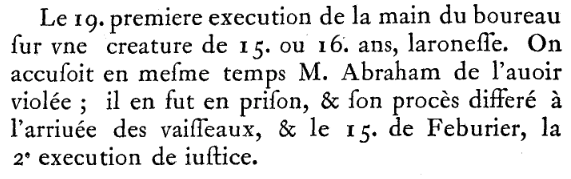
January 19, 1649, entry in Le journal des Jésuites (published from the original manuscript in the archives of the Séminaire de Québec, Bibliothèque et Archives nationales du Québec)
On April 3, 1664, Abraham again appeared before the courts, this time because of the actions of his domestic servant, a man named Saint-Martin. Abraham was ordered to pay the equivalent of 20 livres in foodstuffs and medication to Pierre Hudon, the domestic servant of the sieur Marsolet, for the "excesses committed on him" by Saint-Martin.
Abraham and Marguerite in the Records
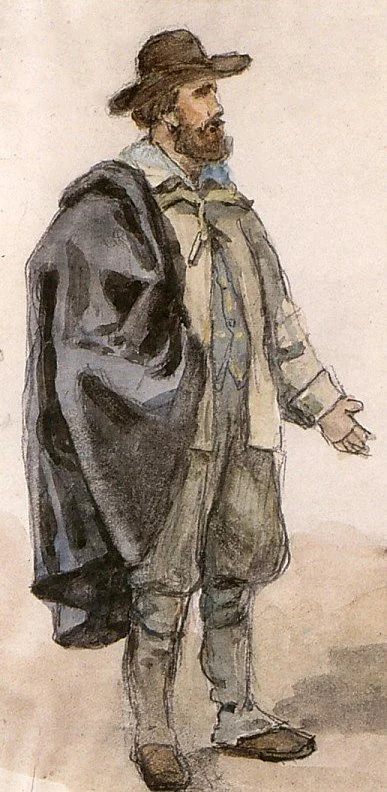
Abraham Martin, portrayed by artist Charles Huot in 1908 (Wikimedia Commons)
Beyond the occasional appearance before colonial courts, numerous surviving notarial records provide glimpses into the everyday lives of Abraham and Marguerite.
January 3, 1650: Abraham and Marguerite hired Nicolas Causinier, approximately 12 years old, as a servant, in exchange for five minots of wheat, or the equivalent in cash.
February 12, 1651: Abraham acknowledged owing René Maheu, general clerk for the stores of New France, 275 livres 13 sols for goods purchased on credit. Abraham is described as an habitant, living on the outskirts of Québec.
September 22, 1657: Abraham acknowledged owing merchants Simon Hillereau and Benjamin Anceau a debt of 41 livres for goods delivered. Abraham is described as an habitant of Québec.
August 3, 1660: Abraham leased farmland “in the place commonly called Claire Fontayne” to Jacques Lemarié for three years. Although the agreement was later rescinded at an unknown date, it provides details about Abraham’s property, which included a house, barn, stable, yard, garden, ploughable land, and wooded land. He also owned two ploughing oxen and two red-haired cows.
January 15, 1663: Pierre Millet gave all his movable and immovable property to Abraham. In return, Abraham agreed to assume all of Millet’s debts. He also promised to have Millet buried after his death “in accordance with the custom of our Holy Catholic and Apostolic Church and at a place he deems appropriate.”
August 3, 1664: At Abraham’s request, the royal bailiff summoned a man named Julien to appear before the Council the following Saturday at 10 a.m. Julien was ordered to answer for failing to return a crosscut saw that Abraham had lent him. Julien was declared in default on August 9, 1664.
Together, these scattered records provide a rare glimpse into the economic life of a 17th-century habitant family in Québec.
Death of Abraham Martin
On September 6, 1664, Abraham dictated his last will and testament to notary Pierre Duquet in his home. Although “sick in bed,” he was of sound mind. As was customary, he commended his soul to God and requested that his debts be paid. Abraham bequeathed 20 livres to the poor of the Hôtel-Dieu and 10 livres to the Chapelle de madame Sainte-Anne in Québec. He gave his remaining movable and immovable property to his wife, Marguerite. Noël Morin was named executor. Among the witnesses were Jean Bourdon and Jacques Ratté.
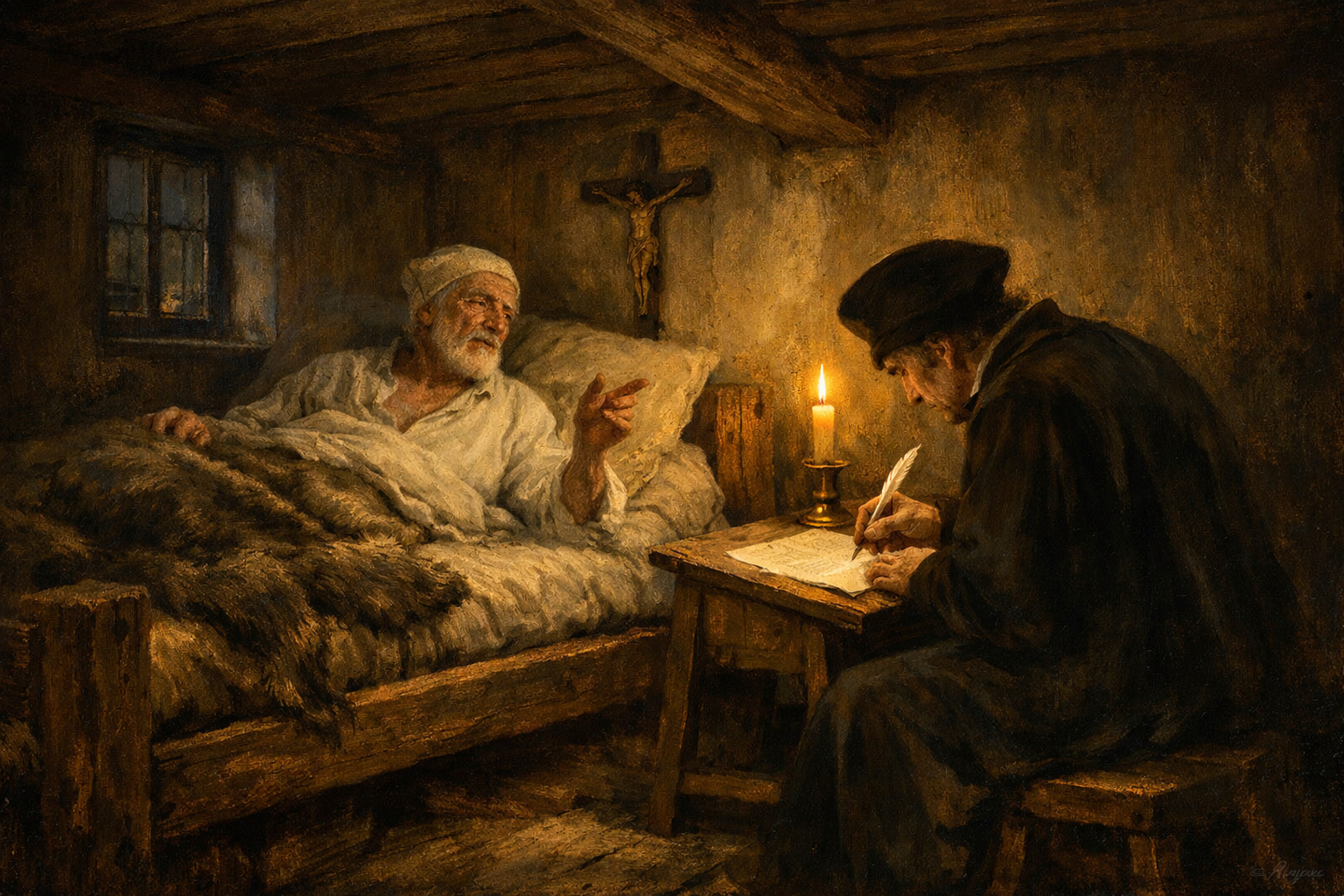
Illustration generated with artificial intelligence by the author, March 2026 (ChatGPT)
Abraham was buried two days later, on September 8, 1664. The burial record indicates that he was about 75 years old, an “ancien habitant de ce pays” (an early habitant of this country).

1664 burial of Abraham Martin (Généalogie Québec)
A month later, on October 7, 1664, notary Duquet drew up the inventory of the community of goods of Abraham and Marguerite. The 11-page document lists all of their assets and belongings, with their value estimated by Jean Bourdon, royal bailiff, and Jacques de la Rüe, master joiner. Although some pages are torn and not all items are legible, the inventory includes the following items:
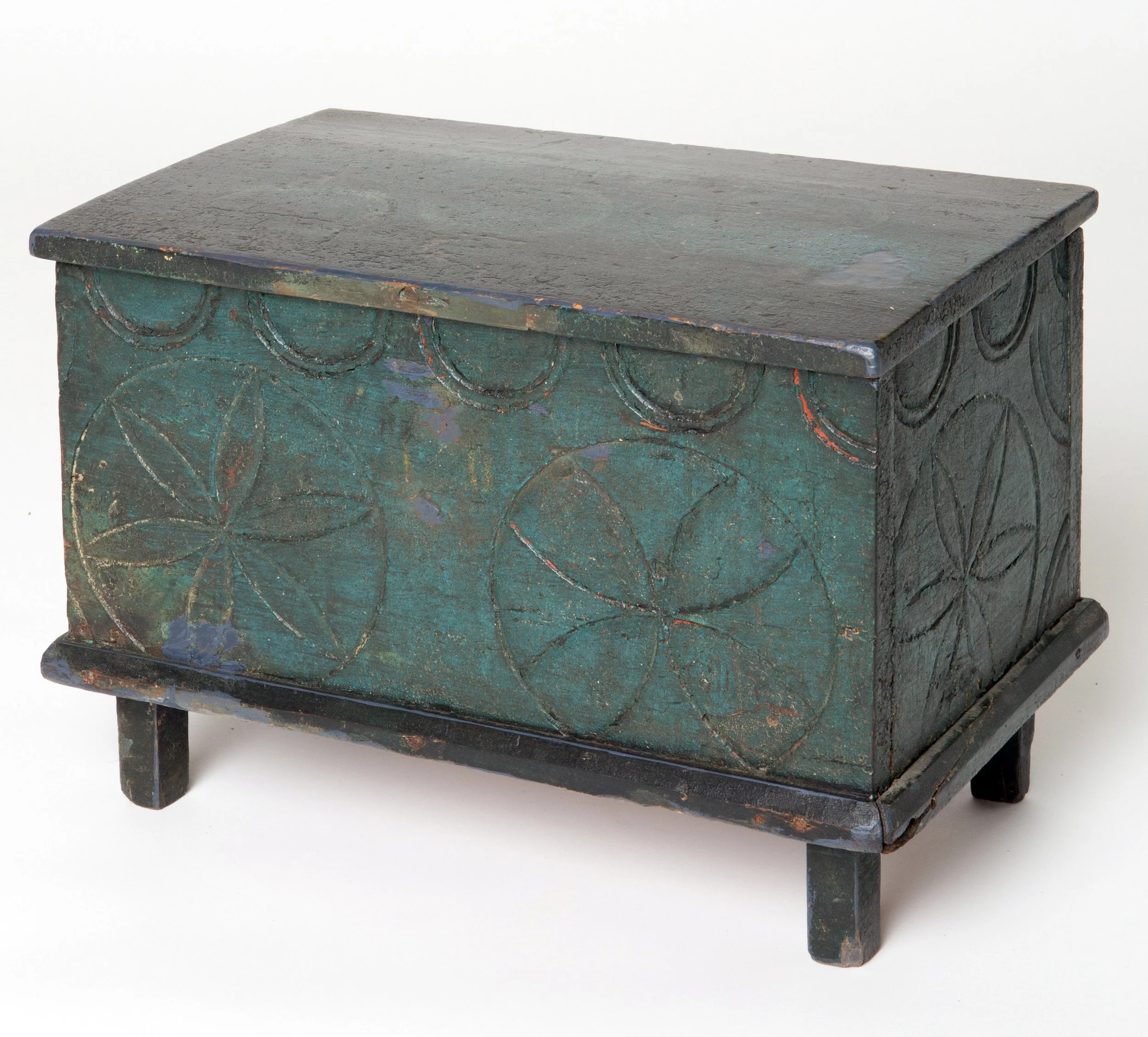
Chest, 18th century (McCord Stewart Museum Montreal)
Kitchen Utensils and Hearth Equipment
two pairs of andirons
a fire shovel
a pair of fire tongs
a grill
two pot hooks (crémaillères)
two iron pots
a roasting drip pan
a roasting spit
a frying pan
two ladles
five kettles
a strainer
two small frying pans, one of copper
an iron fork for turning roasted fish with a frying pan
a lamp with its candlestick
a bucket fitted with iron bands
a brazier
Tableware
two faience plates
two earthenware plates
a silver cup
twenty-two pounds of pewter
Furniture and Household Objects
a kneading chest with its two supports
a wooden tub
a wooden chest with its key
an armchair
an old table
three paintings
a faience holy water font
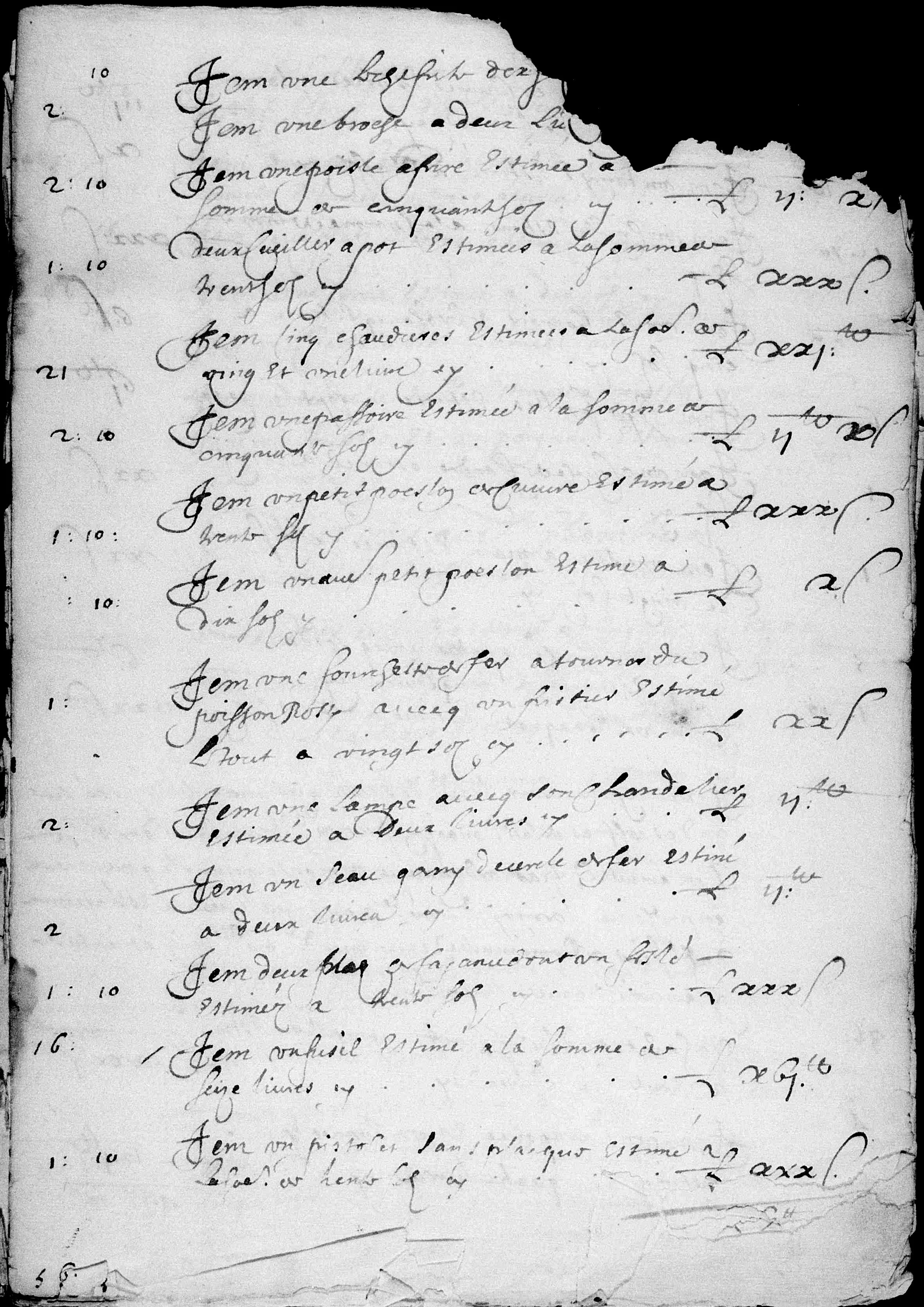
Page 3 of Abraham and Marguerite’s inventory (Bibliothèque et Archives nationales du Québec)
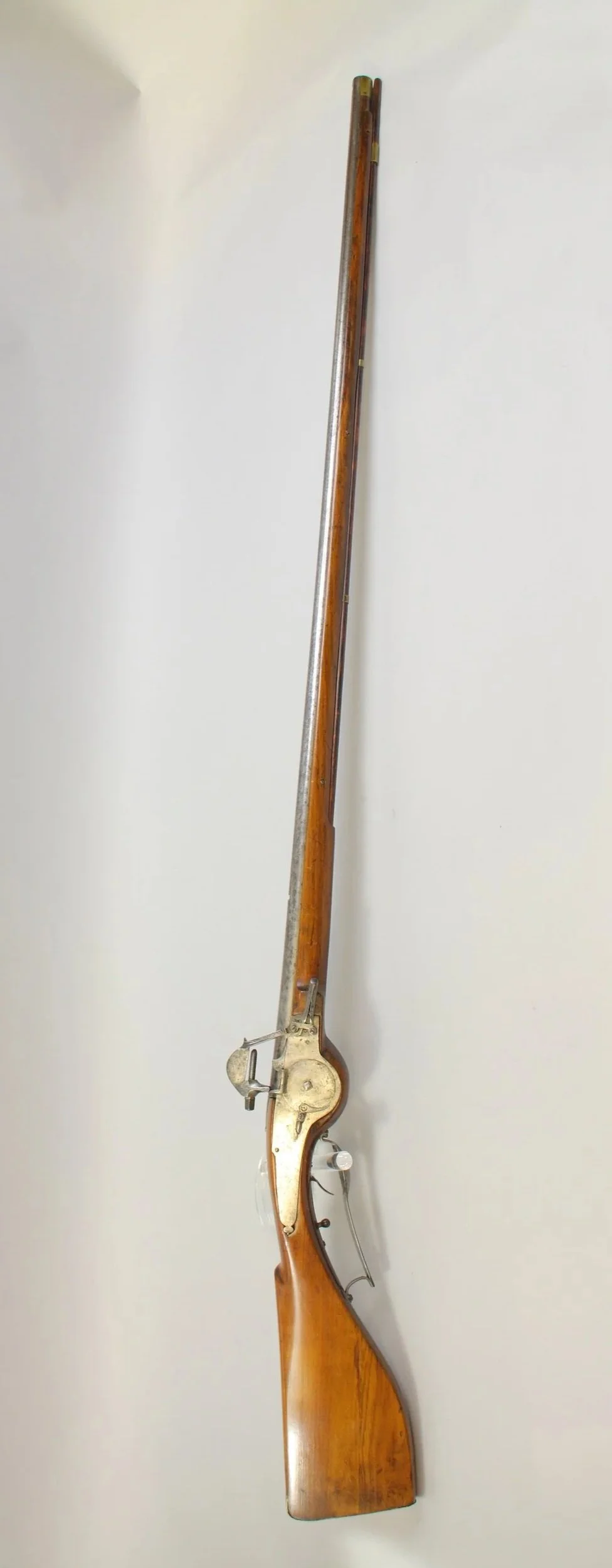
Wheetlock musket, about 1625 (McCord Stewart Museum Montreal)
Weapons and Equipment
a musket
a pistol [without its plates?]
a cutlass and a dagger
a baldric and buff leather gear
a staff with a sword
Tools and Domestic Equipment
a hand saw
a pruning hook
three axes
three poor-quality hoes
an auger
a hand plane
four iron wedges
two small chisels
two iron gouges
Clothing and Personal Effects
a complete suit belonging to the deceased
a cap
a double wool cap
Household Linens
three sheets
nine napkins
three tablecloths
four hand towels
Miscellaneous Objects
a pair of snowshoes
a sieve
a funnel
a Flemish [jug?]
three empty barrels
Agriculture and Food Storage
a winnowing fan
three minots of corn
a meat chest for storing salted pork
Livestock and Agricultural Equipment
five large pigs
two cows
four oxen
a cart fitted with iron-rimmed wheels
a farm wagon
a plow
Documents
a concession contract granted by Monsieur de Montmagny to Adrien Duchesne for twenty arpents of woodland, dated April 5, 1639
a donation made to Abraham Martin by Monsieur de Montmagny and Monsieur Duchesne of the said land, dated December 1635 (sic, should read 1645)
a ratification by the gentlemen of the Company for twelve arpents, dated May [1650?]
a transfer and donation of the said land by the said Sieur Duchesne to Abraham Martin with ratification noted at the bottom, dated February 1, 1652
four receipts
The inventory provides a revealing snapshot of the household of Abraham Martin and Marguerite Langlois in 1664. It records the tools, household goods, clothing, livestock, and agricultural equipment that supported daily life in early Québec. Together, these items point to a well-established household engaged in both farming and practical trades typical of inhabitants of the colony.
On November 7, 1664, Marguerite and her children (and their spouses) divided the movable and immovable property before notary Duquet.
The Coutume de Paris (Custom of Paris) governed the transmission of family property in New France. Whether or not a couple had a marriage contract, they were subject to the “community of goods,” meaning that all property acquired during the marriage formed part of the community. Upon the death of one spouse, the surviving spouse retained half of the community property, while the other half was divided equally among the children, both sons and daughters. Upon the death of the surviving spouse, their share was likewise divided among the children. Inventories were drawn up following a death to record all assets of the estate.
Marguerite’s Final Years
Marguerite remarried less than four months after her husband’s death. On January 11, 1665, notary Duquet drew up a contract between her and René Branche, following the standards of the Coutume de Paris. The couple married a month later, on February 17, 1665, in the parish church of Notre-Dame in Québec. Among their witnesses were Noël Morin, Pierre Biron, and Jacques Ratté.
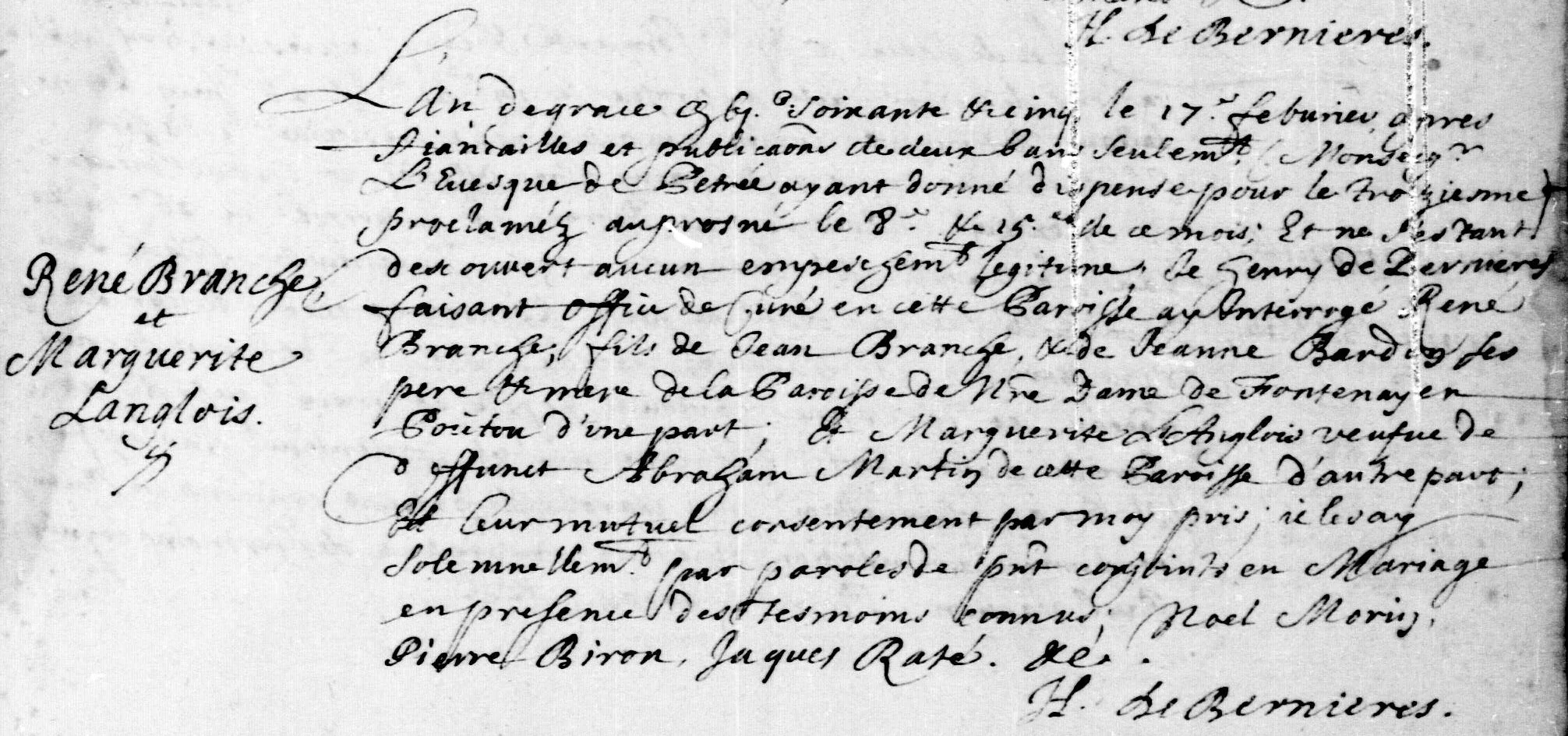
1665 marriage of Marguerite Langlois and René Branche (Généalogie Québec)
Marguerite Langlois died on the evening of December 17, 1665, just ten months after her marriage. She was buried two days later “in the cemetery for the poor of the hospital where she died, by the clergy of this parish.”
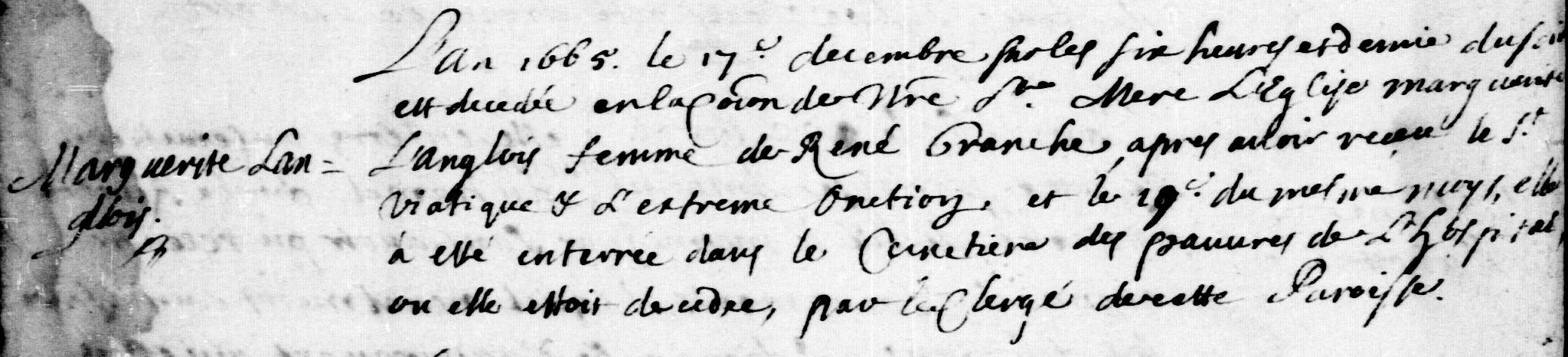
1665 burial of Marguerite Langlois (Généalogie Québec)
Children and Descendants
Abraham and Marguerite had at least 11 children:
Jean (1616–?)
Eustache (1621–?)
Marguerite (1624–1679)
Hélène (1627–before 1653)
Pierre (1630–?)
Marie (1635–1699)
Adrien (1638–?)
Madeleine (1640–1688)
Barbe (1643–1660)
Anne (1645–1717)
Charles Amador (1648–1711) (priest)
As of 1800, the couple of Abraham Martin and Marguerite Langlois ranked sixth in Québec for the number of married descendants, with 7,765.
Note: There is no evidence that the Anne Martin who married Jean Côté on November 17, 1635, was the daughter of Abraham Martin and Marguerite Langlois.
Monuments and Commemoration
In 1926, a monument was erected in Québec City in honour of Abraham Martin. It was created by sculptor Henri Hébert and donated by the Canadian Pacific Railway. In addition, three streets bear his name: côte d’Abraham and rue Abraham-Martin in Québec, and avenue de l’Abraham-Martin in Rimouski. The latter refers to two pilot boats named after Abraham Martin. A commemorative plaque has also been installed on the Plains of Abraham themselves.
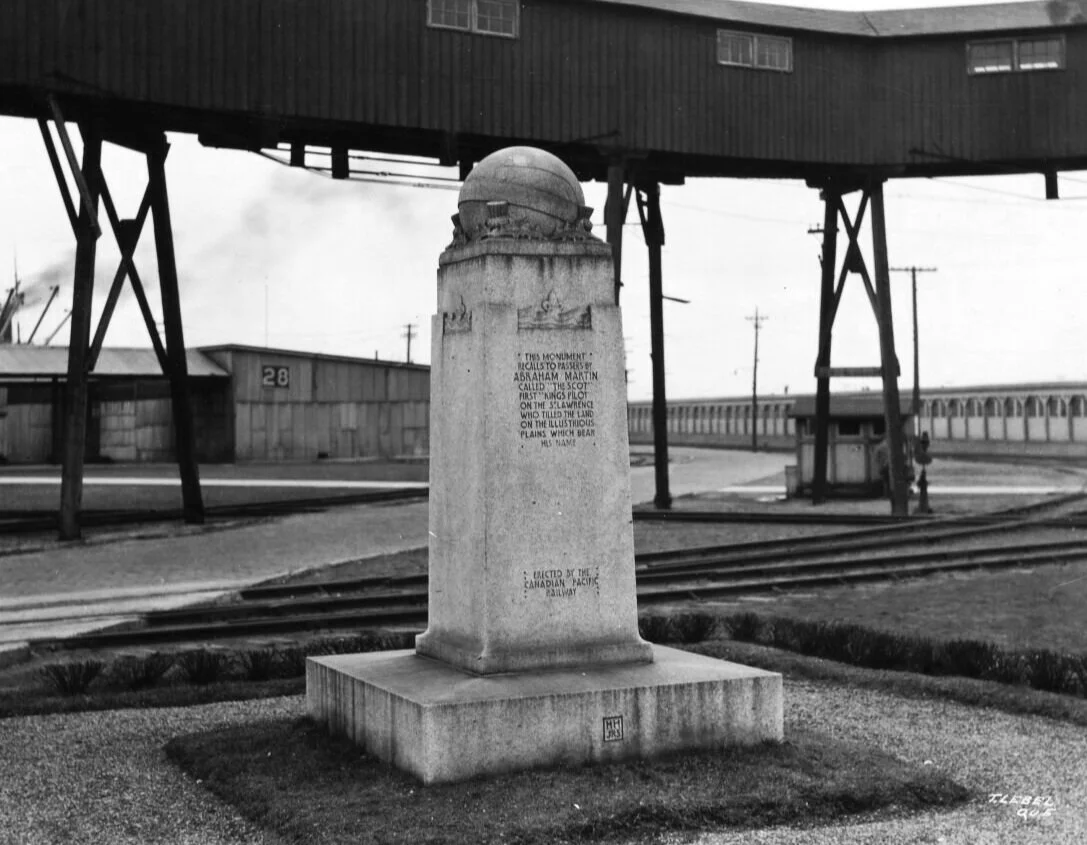
Abraham Martin monument in Québec City, 1930 (Bibliothèque et Archives nationales du Québec)
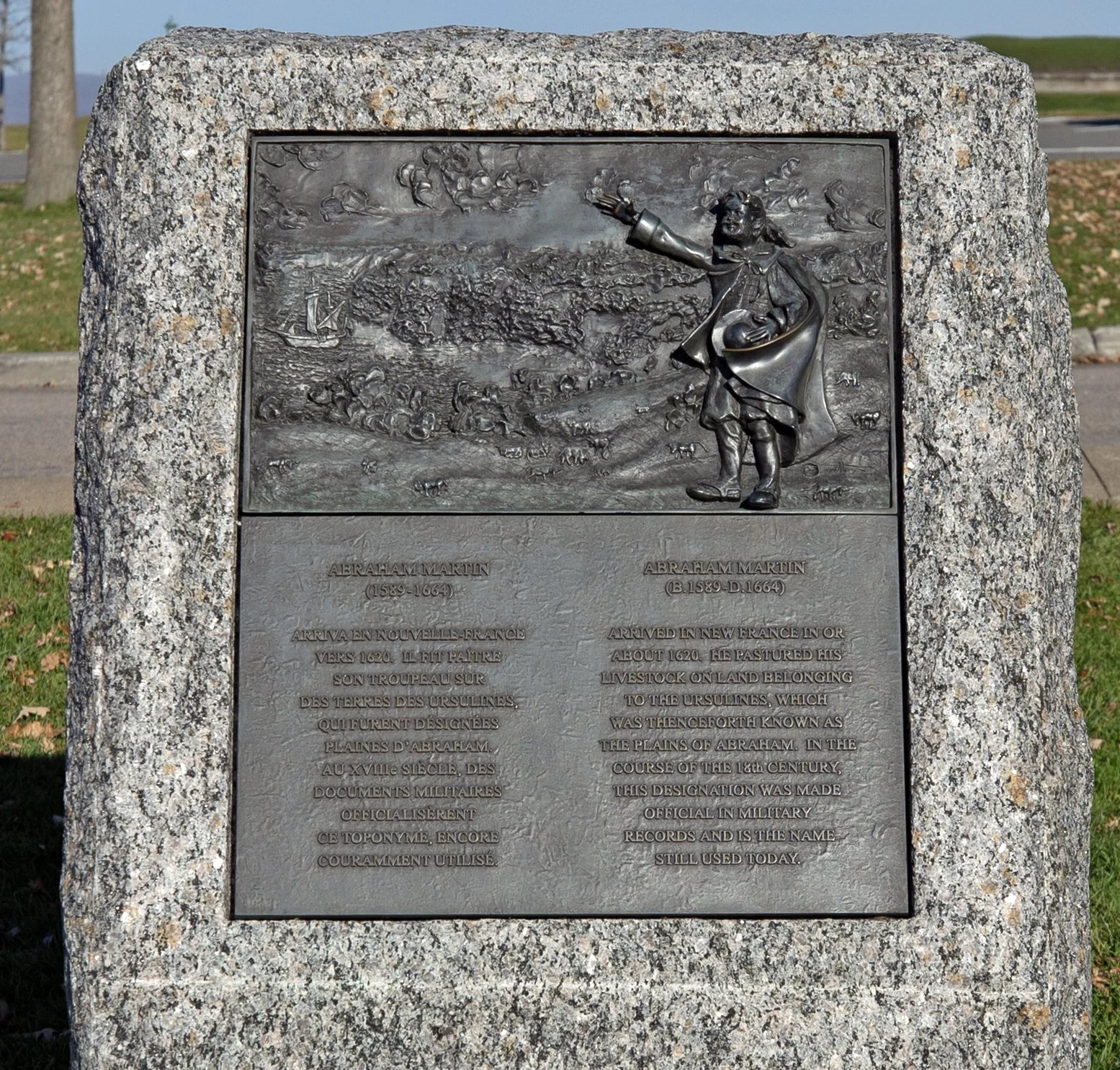
Commemorative plaque for Abraham Martin on the Plains of Abraham (© The French-Canadian Genealogist)
A Lasting Legacy
Abraham Martin and Marguerite Langlois lived through the formative decades of the colony as early settlers of Québec. Established on the heights west of the town, they built a life tied to the river and the land, raising a large family whose descendants spread widely throughout New France. Like many inhabitants of their time, their lives were shaped by the demands of work, land, and community. The land Abraham once held would later give its name to the Plains of Abraham, linking their story to one of the most significant sites in Canadian history.
PDF version of biography located at: https://www.tfcg.ca/abrahammartin-and-margueritelanglois.
Are you enjoying our articles and resources? Show your support by making a donation. Every contribution, regardless of its size, goes a long way in covering our website hosting expenses and enables us to create more content related to French-Canadian genealogy and history. Thank you! Merci!
Sources:
“État civil : Dieppe - 01/01/1613-31/12/1616," digital images, Archives départementales de la Seine-Maritime (https://www.archivesdepartementales76.net/ark:/50278/249236bdbd0fe124b93069ca1d1013f8/dao/0/31 : accessed 2 Mar 2026), baptism of Jehan Martin, 23 Sep 1616, Dieppe (paroisse Saint-Jacques), image 31 of 35.
“État civil : Dieppe - 01/01/1629-31/12/1634," digital images, Archives départementales de la Seine-Maritime (https://www.archivesdepartementales76.net/ark:/50278/e210c7d9f930977f39d352725b6054dd/dao/0/21 : accessed 9 Mar 2026), baptism of Pierre Martin, 1 Aug 1630, Dieppe (paroisse Saint-Jacques), image 21 of 68.
"Le LAFRANCE (Baptêmes, mariages et sépultures)," database and digital images, Généalogie Québec (https://www.genealogiequebec.com/Membership/LAFRANCE/acte/57096 : accessed 2 Mar 2026), baptism of Eustache Martin, 24 Oct 1621, Québec (Notre-Dame-de-Québec) ; citing original data : Institut généalogique Drouin and PRDH.
"Le LAFRANCE (Baptêmes, mariages et sépultures)," database and digital images, Généalogie Québec (https://www.genealogiequebec.com/Membership/LAFRANCE/acte/57097 : accessed 2 Mar 2026), baptism of Marguerite Martin, 4 Jan 1624, Québec (Notre-Dame-de-Québec) ; citing original data : Institut généalogique Drouin and PRDH.
"Le LAFRANCE (Baptêmes, mariages et sépultures)," database and digital images, Généalogie Québec (https://www.genealogiequebec.com/Membership/LAFRANCE/acte/57100 : accessed 2 Mar 2026), baptism of Helene Martin, 21 Jun 1627, Québec (Notre-Dame-de-Québec) ; citing original data : Institut généalogique Drouin and PRDH.
"Le LAFRANCE (Baptêmes, mariages et sépultures)," database and digital images, Généalogie Québec (https://www.genealogiequebec.com/Membership/LAFRANCE/acte/68966 : accessed 13 Mar 2026), burial of Abraham Martin, 8 Sep 1664, Québec (Notre-Dame-de-Québec) ; citing original data : Institut généalogique Drouin and PRDH.
"Le LAFRANCE (Baptêmes, mariages et sépultures)," database and digital images, Généalogie Québec (https://www.genealogiequebec.com/Membership/LAFRANCE/acte/66657 : accessed 16 Mar 2026), marriage of Rene Branche and Marguerite Langlois, 17 Feb 1665, Québec (Notre-Dame-de-Québec) ; citing original data : Institut généalogique Drouin and PRDH.
"Le LAFRANCE (Baptêmes, mariages et sépultures)," database and digital images, Généalogie Québec (https://www.genealogiequebec.com/Membership/LAFRANCE/acte/68988 : accessed 16 Mar 2026), burial of Marguerite Langlois, 19 Dec 1665, Québec (Notre-Dame-de-Québec) ; citing original data : Institut généalogique Drouin and PRDH.
“Collection Centre d'archives de Québec - Archives nationales à Québec," digital images, Bibliothèque et Archives nationales du Québec (https://advitam.banq.qc.ca/notice/366789 : accessed 9 Mar 2026), "Documents concernant Samuel de Champlain (1619-1635)," reference P1000,S3,D362, Id 366789.
"Collection Centre d'archives de Québec - Archives nationales à Québec," digital images, Bibliothèque et Archives nationales du Québec (https://advitam.banq.qc.ca/notice/367808 : accessed 9 Mar 2026), "Procès-verbal de mesurage et de bornage de 12 arpents de terre données à Abraham Martin," reference P1000,S3,D1399, Id 367808.
"Archives de notaires : Claude Lecoustre (1647-1648)," digital images, Bibliothèque et Archives nationales du Québec (https://numerique.banq.qc.ca/patrimoine/details/52327/5124961?docref=nyQ-gfSasKL_59-sjDSz-g : accessed 12 Mar 2026), marriage contract of Jean Cloutier and Marie Martin, 27 Dec 1647, images 49-51 of 98.
"Actes de notaire, 1634, 1649-1663 // Guillaume Audouart," digital images, FamilySearch (https://www.familysearch.org/ark:/61903/3:1:3Q9M-CSVN-32YJ?cat=koha%3A1171569&i=106&lang=en : accessed 11 Mar 2026), sale of part of a boat by Abraham Martin to Jacques Maheult, 22 Dec 1649, image 107 of 2642; citing original data: Bibliothèque et Archives nationales du Québec.
"Actes de notaire, 1634, 1649-1663 // Guillaume Audouart," digital images, FamilySearch (https://www.familysearch.org/ark:/61903/3:1:3Q9M-CSVN-32ZY?cat=koha%3A1171569&i=454&lang=en : accessed 12 Mar 2026), power of attorney to Jean Juchereau de Laferté by Abraham Martin and others, 20 Aug 1651, image 455 of 2642; citing original data: Bibliothèque et Archives nationales du Québec.
"Actes de notaire, 1634, 1649-1663 // Guillaume Audouart," digital images, FamilySearch (https://www.familysearch.org/ark:/61903/3:1:3Q9M-CSVN-3297?cat=koha%3A1171569&i=116&lang=en : accessed 12 Mar 2026), engagement contract by Pierre Misselet and Perrine Baudry of Nicolas Causinier to Abraham Martin and Marguerite Lescossoisse, 3 Jan 1650, images 117-118 of 2642; citing original data: Bibliothèque et Archives nationales du Québec.
"Actes de notaire, 1634, 1649-1663 // Guillaume Audouart," digital images, FamilySearch (https://www.familysearch.org/ark:/61903/3:1:3Q9M-CSVN-3KYW?cat=koha%3A1171569&i=364&lang=en : accessed 12 Mar 2026), obligation (debt) of Abraham Martin to René Maheut, 12 Feb 1651, image 365 of 2642; citing original data: Bibliothèque et Archives nationales du Québec.
"Actes de notaire, 1634, 1649-1663 // Guillaume Audouart," digital images, FamilySearch (https://www.familysearch.org/ark:/61903/3:1:3Q9M-CSVN-3KFQ?cat=koha%3A1171569&i=1908&lang=en : accessed 12 Mar 2026), obligation (debt) of Abraham Martin to Simon Hillereau and Benjamin
Anseau, 22 Sep 1657, image 1909 of 2642; citing original data: Bibliothèque et Archives nationales du Québec.
"Actes de notaire, 1634, 1649-1663 // Guillaume Audouart," digital images, FamilySearch (https://www.familysearch.org/ark:/61903/3:1:3QHV-V3DQ-J9QG-Y?cat=koha%3A1171569&i=235&lang=en : accessed 12 Mar 2026), lease of land by Abraham Martin to Jacques Lemarié, 3 Aug 1660, images 236-240 of 1431; citing original data: Bibliothèque et Archives nationales du Québec.
"Actes de notaire, 1634, 1649-1663 // Guillaume Audouart," digital images, FamilySearch (https://www.familysearch.org/ark:/61903/3:1:3QHV-V3DQ-J93G-X?cat=koha%3A1171569&i=1216&lang=en : accessed 13 Mar 2026), donation by Pierre Millet to Abraham Martin, 15 Jan 1663, images 1217-1218 of 1431; citing original data: Bibliothèque et Archives nationales du Québec.
"Actes de notaire, 1663-1687 // Pierre Duquet," digital images, FamilySearch (https://www.familysearch.org/ark:/61903/3:1:3Q9M-CSTC-Y99S-D?cat=koha%3A1175224&i=228&lang=en : accessed 13 Mar 2026), testament of Abraham Martin, 6 Sep 1664, images 229-332 of 2541; citing original data: Bibliothèque et Archives nationales du Québec.
"Actes de notaire, 1663-1687 // Pierre Duquet," digital images, FamilySearch (https://www.familysearch.org/ark:/61903/3:1:3Q9M-CSTC-Y9CX-J?cat=koha%3A1175224&i=249&lang=en : accessed 13 Mar 2026), inventory of the community of goods of the late Abraham Martin and Marguerite Langlois, 7 Oct 1664, images 250-260 of 2541; citing original data: Bibliothèque et Archives nationales du Québec.
"Actes de notaire, 1663-1687 // Pierre Duquet," digital images, FamilySearch (https://www.familysearch.org/ark:/61903/3:1:3Q9M-CSTC-Y9CV-8?cat=koha%3A1175224&i=296&lang=en : accessed 13 Mar 2026), transaction between Marguerite Langlois and her children (and their spouses), 7 Nov 1664, images 297-300 of 2541; citing original data: Bibliothèque et Archives nationales du Québec.
"Actes de notaire, 1663-1687 // Pierre Duquet," digital images, FamilySearch (https://www.familysearch.org/ark:/61903/3:1:3Q9M-CSTC-Y9WX-D?cat=koha%3A1175224&i=332&lang=en : accessed 13 Mar 2026), marriage contract of René Branches and Marguerite Langlois, 11 Jan 1665, images 333-335 of 2541; citing original data: Bibliothèque et Archives nationales du Québec.
Parchemin, notarial database of ancient Québec (1626-1801), Société de recherche historique Archiv-Histo (https://archiv-histo.com : accessed 11 Mar 2026), " Vente d'une pièce de terre située au lieu appelé le Jardin du Pere Denis; par Guillaume Hubou, habitant, de Quebeq, à Abraham Martin, de Quebeq.," notary M. Piraube, 1643.
"Fonds Conseil souverain - Archives nationales à Québec," digital images, Bibliothèque et Archives nationales du Québec (https://advitam.banq.qc.ca/notice/401718 : accessed 12 Mar 2026), "Jugement condamnant Abraham Martin à payer l'équivalent de 20 livres tournois en aliments et médicaments à Pierre Hudon, serviteur domestique du sieur Marsolet, pour les excès commis sur lui par le nommé Saint-Martin, serviteur domestique du sieur Martin et que ce serviteur soit contraint par toutes voies et rigueurs de justice, même par corps," 3 Apr 1664, reference TP1,S28,P1629, ID 401718; citing original data: Pièce provenant du Registre plumitif no 1 Bis des arrêts, jugements et délibérations du Conseil souverain de la Nouvelle-France (26 septembre 1663 au 23 août 1664), f. 33v.
" Fonds Conseil souverain - Archives nationales à Québec," digital images, Bibliothèque et Archives nationales du Québec (https://advitam.banq.qc.ca/notice/401869 : accessed 12 Mar 2026), " Exploit d'assignation à comparaître faite par Levasseur, huissier, à la demande d'Abraham Martin au nommé Julien, pour qu'il soit condamné à lui rendre un objet qu'il lui a prêté," 3 Aug 1664, reference TP1,S28,P1780, Id 401869 ; citing original data: Pièce provenant du Registre plumitif no 1 Bis des arrêts, jugements et délibérations du Conseil souverain de la Nouvelle-France (26 septembre 1663 au 23 août 1664), se trouvant entre le f. 13v et 14 bis.
Fédération québécoise des sociétés de généalogie, Fichier Origine online database (https://www.fichierorigine.com/fr/repertoire/martin/-lecossais : accessed 2 Mar 2026), entry for Abraham MARTIN / L'ÉCOSSAIS (reference #290146).
“Plaines d'Abraham,” Commission de toponymie, Gouvernement du Québec (https://toponymie.gouv.qc.ca/ct/ToposWeb/Fiche.aspx?no_seq=141 : accessed 9 Mar 2026).
Gouvernement du Québec, Commission de toponymie (https://toponymie.gouv.qc.ca/ct/ToposWeb/recherche.aspx?s=Abraham-Martin : accessed 16 Mar 2026).
Journal des Jésuites (Québec, Léger Brousseau Imprimeur-Éditeur, 1871), 111.
Journal des Jésuites (Québec, Léger Brousseau Imprimeur-Éditeur, 1871), 184.
John S. Moir, “KIRKE (Kertk, Quer(que), Guer), Sir DAVID,” in Dictionary of Canadian Biography, vol. 1–(https://www.biographi.ca/en/bio/kirke_david_1E.html : accessed 9 Mar 2026), University of Toronto/Université Laval, 2003.
Antonio Drolet, “DU CHESNE, ADRIEN,” in Dictionary of Canadian Biography, vol. 1 (http://www.biographi.ca/en/bio/du_chesne_adrien_1E.html : accessed 9 Mar 2026 ), University of Toronto/Université Laval, 2003.
A.G. Doughty and N.E. Dionne, Quebec Under Two Flags: A Brief History of the City from its Foundation Until the Present Time (Quebec, The Quebec News Company, 1903), XXVII.