Gillette Banne
Explore the story of Gillette Banne and the 1672 murder of her son-in-law, Julien Latouche, in Trois-Rivières. Drawing on original court records, this article examines the roles of Jacques Bertault and Isabelle Bertault, revealing family conflict, violence, and justice in 17th-century New France.
Cliquez ici pour la version en français
Content Advisory:
This article contains descriptions of violence and judicial punishment that some readers may find disturbing. It may not be suitable for all audiences. My aim is to present the lives of our early pioneers in all their realities, including their strengths, their hardships, and their darker aspects, drawing on the historical record to better understand the world in which they lived.
Gillette Banne
A Mother, a Murder, and the Law in Seventeenth-Century New France
On the evening of May 17, 1672, a man’s cries echoed across the river at Trois-Rivières. He called out that he was being killed and warned that his attacker would be hanged. By the following day, Julien Latouche had vanished, and suspicion had already begun to settle on those closest to him.
At the centre of what followed was Gillette Banne. Within months of her daughter’s marriage, her household had become a place of violence and fear. What began as conflict within the family soon led to one of the most unusual criminal cases in New France, preserved today in the colony’s judicial records.
Gillette Banne, the daughter of Marin Banne and Isabeau Boire, was born in Argences, Normandy, France. Located approximately 185 kilometres west-northwest of Paris and 17 kilometres from the English Channel, Argences lies in the present-day department of Calvados. The small town has a population of roughly 4,000 inhabitants, known as Argençais.
Gillette's exact year of birth is uncertain. Only three known contemporary records provide her age, and they do not agree:
At her 1664 confirmation, she is recorded as 38 years old, suggesting a birth around 1626.
In the 1666 census of New France, she is recorded as 30 years old, suggesting a birth around 1636.
During her interrogation of June 2, 1672, she is described as "about forty-five years old," suggesting a birth around 1627.
Two of these records point to a birth around 1626–1627, while the 1666 census suggests 1636. At present, the available evidence does not permit these conflicting ages to be reconciled with certainty.
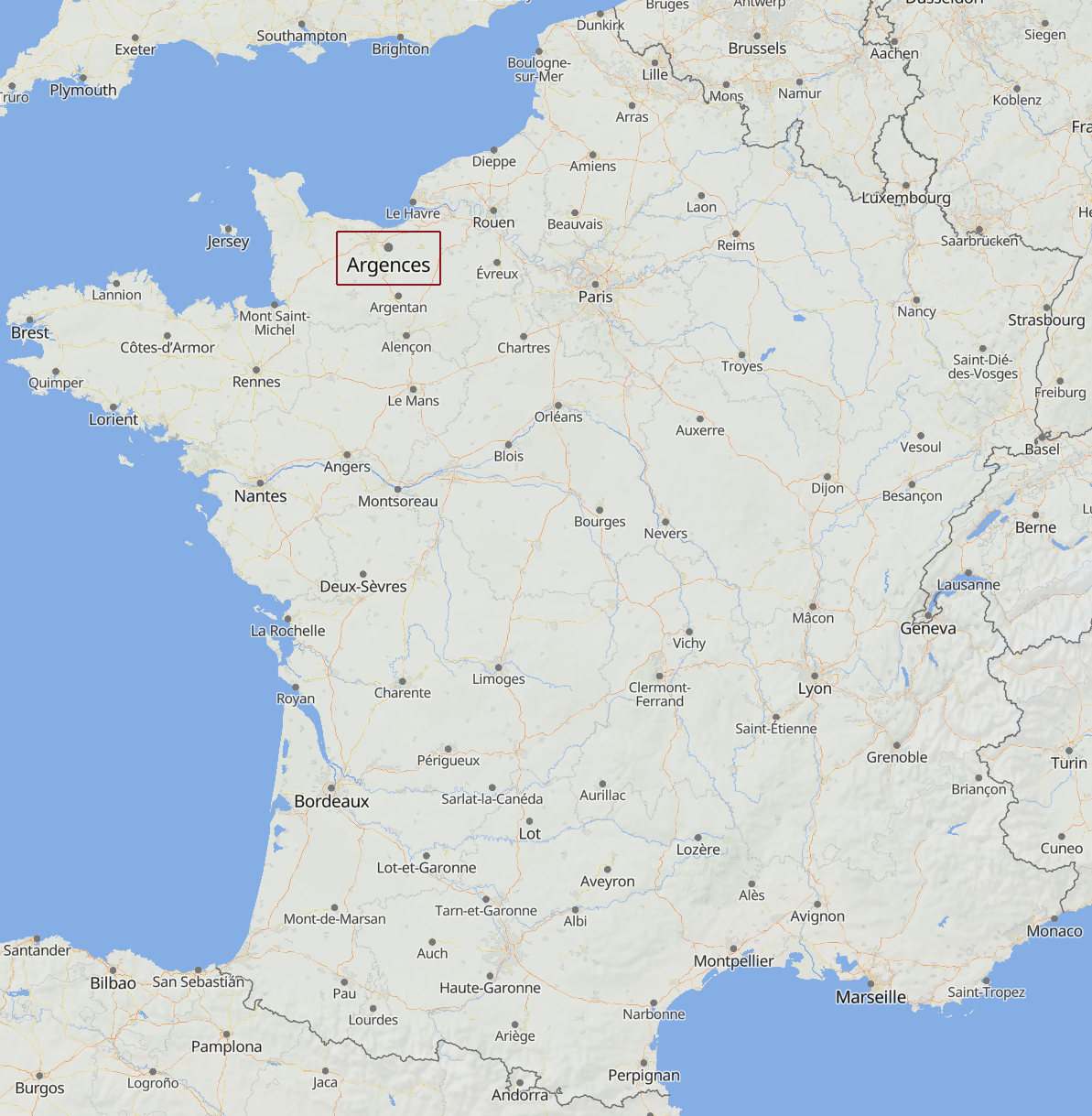
Location of Argences in France (Mapcarta)
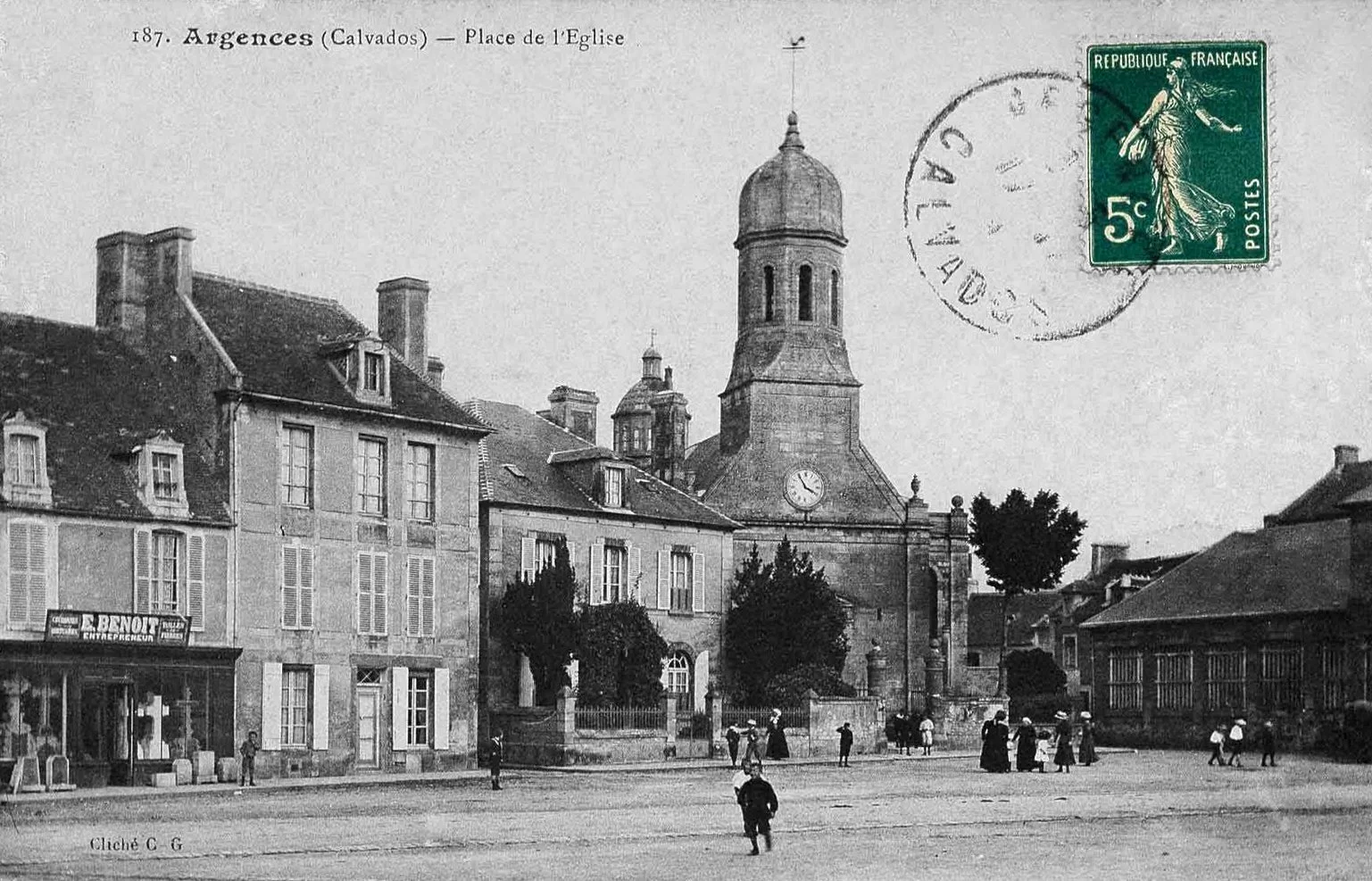
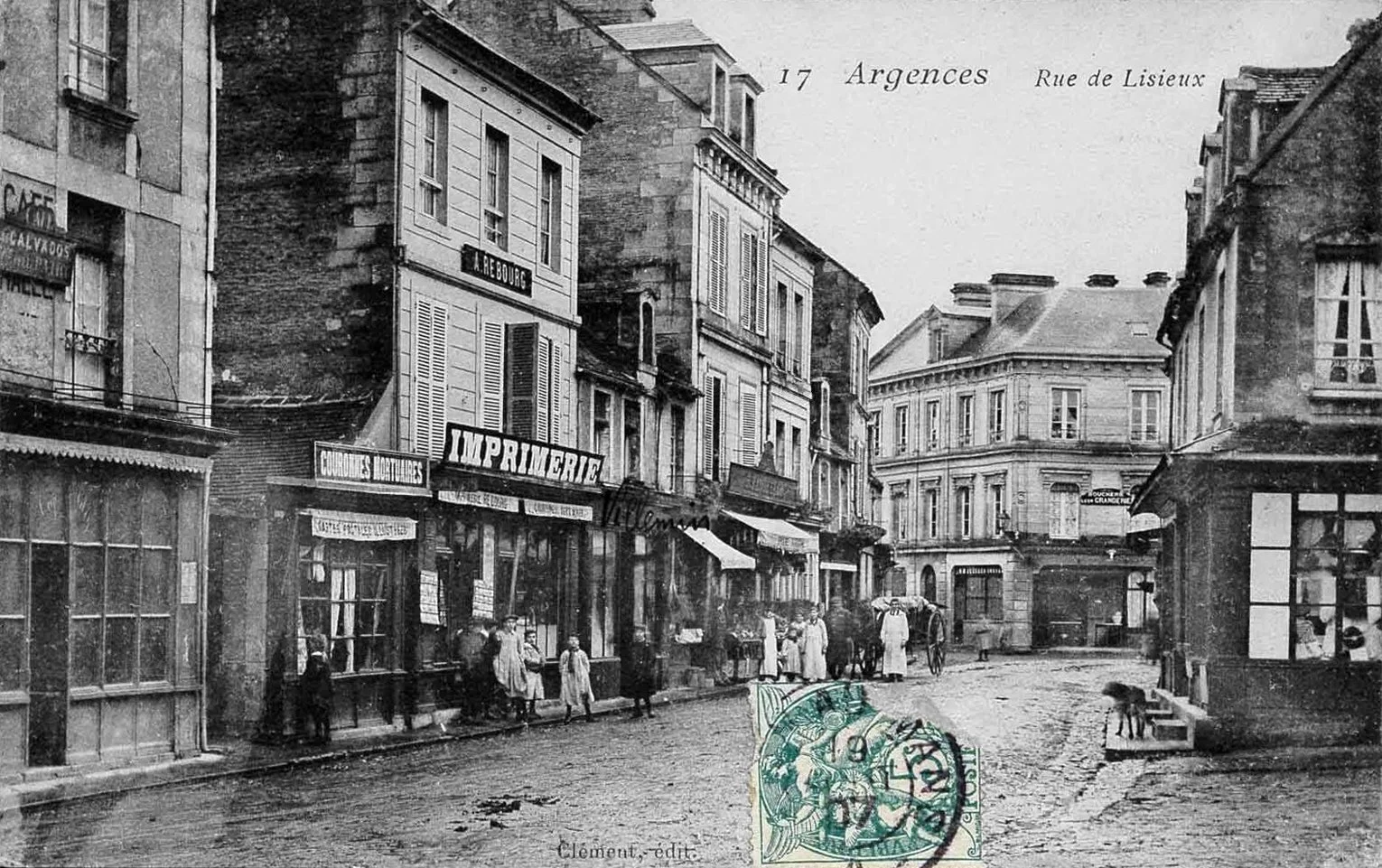
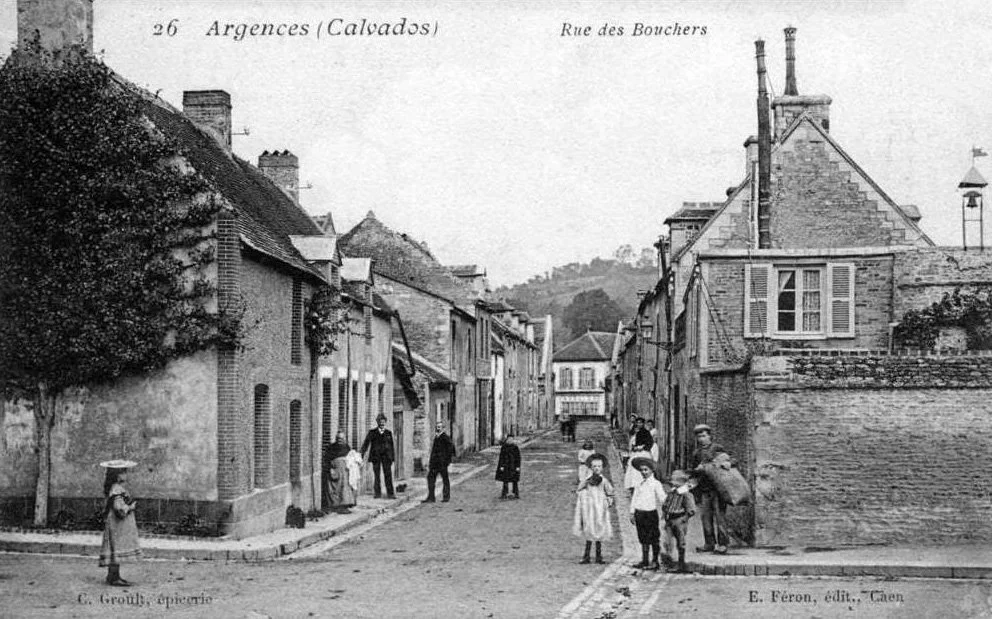
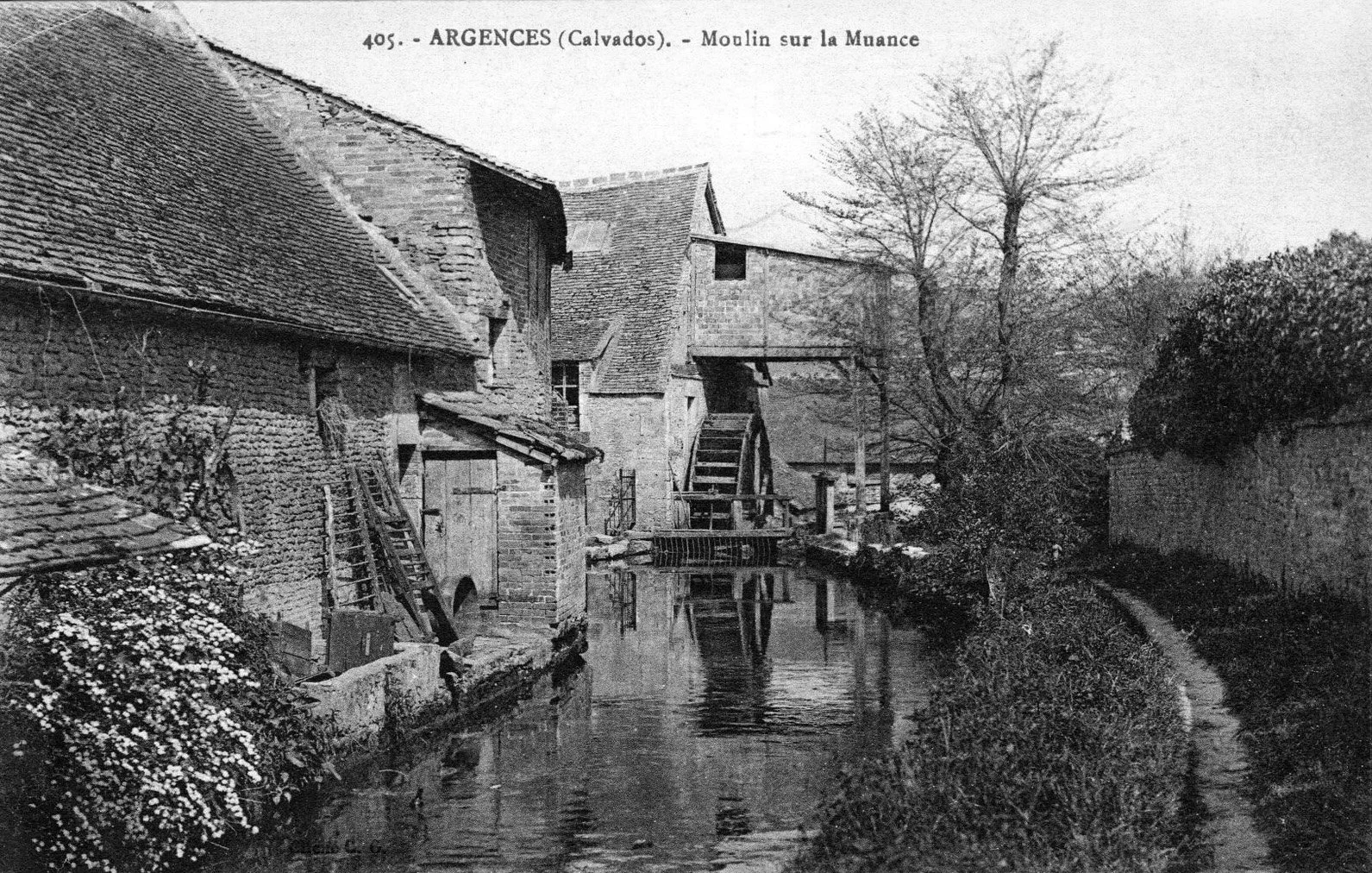
Postcard of Argences (Geneanet)
A peasant girl in France (artificial intelligence image created by the author with ChatGPT, February 2026)
Few details of Gillette's early life in Argences have emerged. She likely grew up in a rural world shaped by farming and religion. Fields, rivers, mills, and scattered dwellings defined the landscape, and most inhabitants belonged to the peasant majority. Families typically farmed small plots or worked land owned by seigneurs or ecclesiastical institutions.
Like most children growing up in rural Normandy, Gillette likely helped with household tasks from an early age, tending animals, collecting firewood, minding younger siblings, and assisting with food preparation. Formal schooling was rare and literacy uncommon, although religious instruction was nearly universal. As she grew older, she would have learned the domestic skills expected of women, including spinning, sewing, cooking, and household management.
Crossing the Atlantic: Gillette's Journey to New France
How did Gillette come to be a world away in New France? For a girl whose world had likely seldom extended beyond neighbouring parishes, it was an extraordinary leap. She had been recruited as a fille à marier, arriving in Canada around 1649.
The circumstances surrounding Gillette's immigration are unknown. Her parents or guardians may have arranged her emigration, perhaps entrusting her to a recruiter or religious intermediary who promised marriage opportunities and a more secure future in New France. Poverty or limited prospects at home may have driven that decision. Alternatively, she may have been orphaned or semi-orphaned and placed in the care of a parish, convent, or charitable organization that facilitated her emigration as part of broader efforts to populate the colony with marriageable women.
From Young Bride to Young Widow
The details of Gillette's earliest days in New France are unknown. Sometime before 1650, she married Marin Chauvin dit Lafortune; no marriage contract or record has been found for the couple. Gillette’s age at the time is uncertain. Depending on which contemporary age record is accepted, she may have been in her early teens or her early twenties. Marin was about 24 or 25.
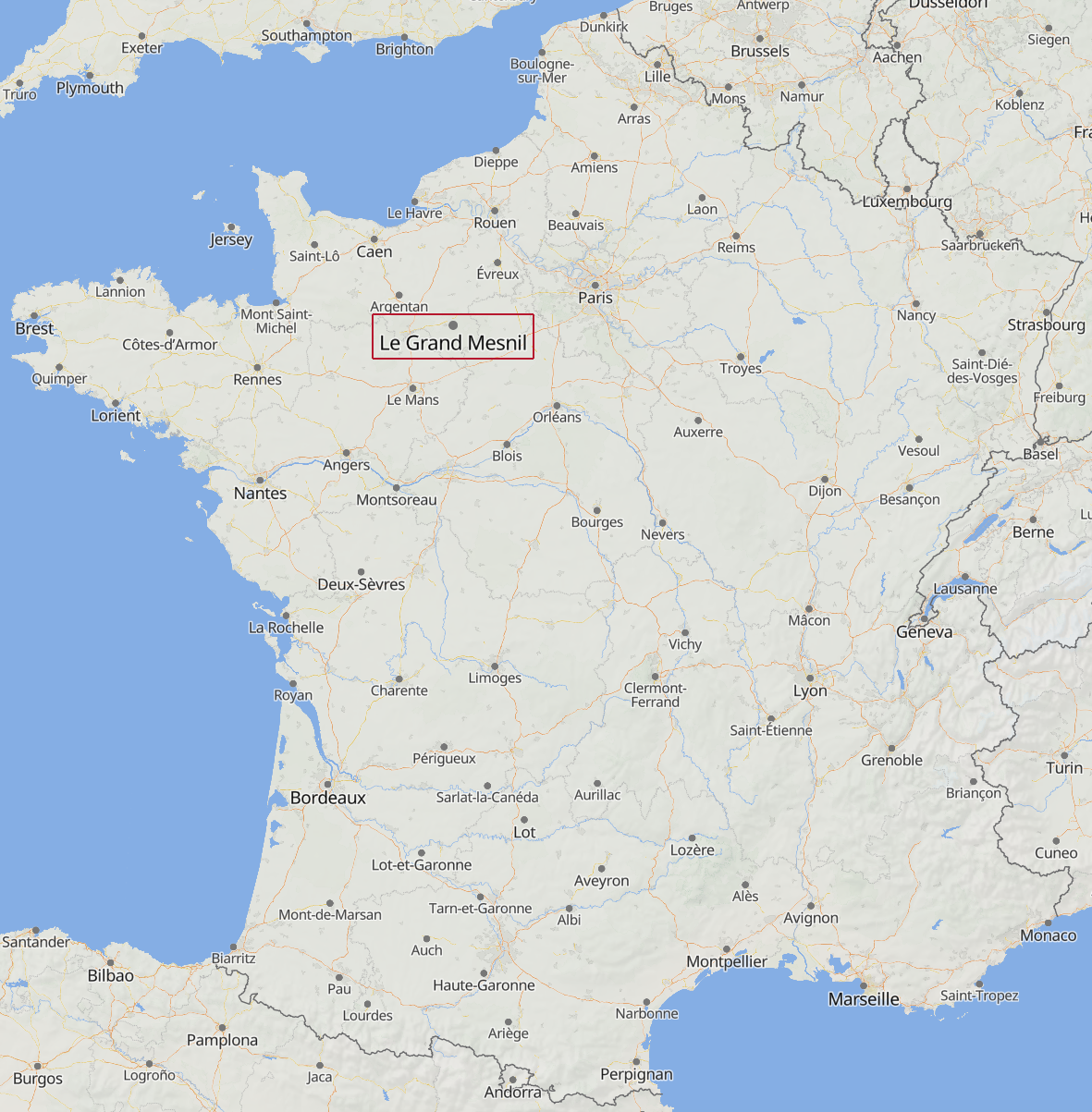
Location of Le Grand Mesnil in France (Mapcarta)
Gillette’s new husband, Marin, was from the hamlet of Le Grand Mesnil in Perche, France. He was baptized on March 16, 1625, in nearby Saint-Mard-de-Réno. On March 8, 1648, he signed a three-year contract in Tourouvre to work for Noël Juchereau in New France. The contract was to take effect when Marin boarded a ship at La Rochelle later that year and expire upon his return to France three years later. Under its terms, Juchereau would provide return passage, food, and a salary of 40 livres per year; Marin received 10 livres in advance. He was described in the contract as a manoeuvre, or manual labourer.
The couple's time together was short. On September 8, 1650, Gillette and Marin's only child, a daughter named Marie, was baptized in Trois-Rivières. Marin Chauvin dit Lafortune died sometime before June 7, 1651; his burial record has not been found.
As a young widow with an infant daughter, Gillette nonetheless secured a foothold in the colony. On June 7, 1651, Governor Charles d'Ailleboust granted her a plot of land in Trois-Rivières, on the condition that she build upon and enclose it within one year, failing which the concession would be void. The lot measured about one-third of an arpent and was bordered by the land of the Sieur de Normanville, that of the heirs of Sébastien Dodier, and the town palisade on the northeast and northwest. The concession was subsequently ratified by Governor Lauzon on June 18, 1652, and later confirmed under Governor Boujonnier.
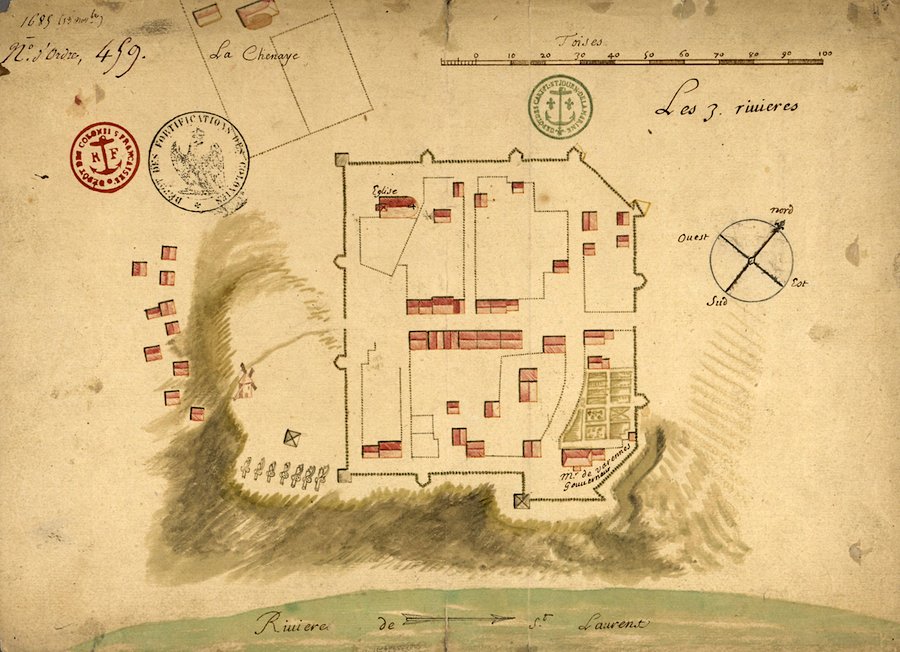
Map of Trois-Rivières in 1685; Gillette’s property would have been located in the upper-right corner of the fortified town (Wikimedia Commons)
Building a Family in Trois-Rivières
On the afternoon of July 27, 1653, notary Sévérin Ameau drew up a marriage contract between Gillette and locksmith Jacques Bertault, the son of Thomas Bertault and Catherine Colonne. He was about 27, from Les Essarts in the Poitou province of France. Gillette’s age is uncertain; the surviving records suggest that she may have been approximately 17 or approximately 27 years old. The contract stipulated that Jacques would feed and care for Marie Chauvin, Gillette's daughter from her first marriage, until she reached the age of 12. Neither bride nor groom could sign the contract. The date of their wedding is unknown, as the marriage record has not been located. Couples typically married within three weeks of signing a marriage contract.
Gillette and Jacques settled in Trois-Rivières, where they had six children:
Jacques (1654–before 1666)
Marguerite (1655–1687)
Suzanne (1657–1739)
Élisabeth “Isabelle” (1659–1736)
Marie Jeanne (1660–1698)
Nicolas (1662–after 1683)
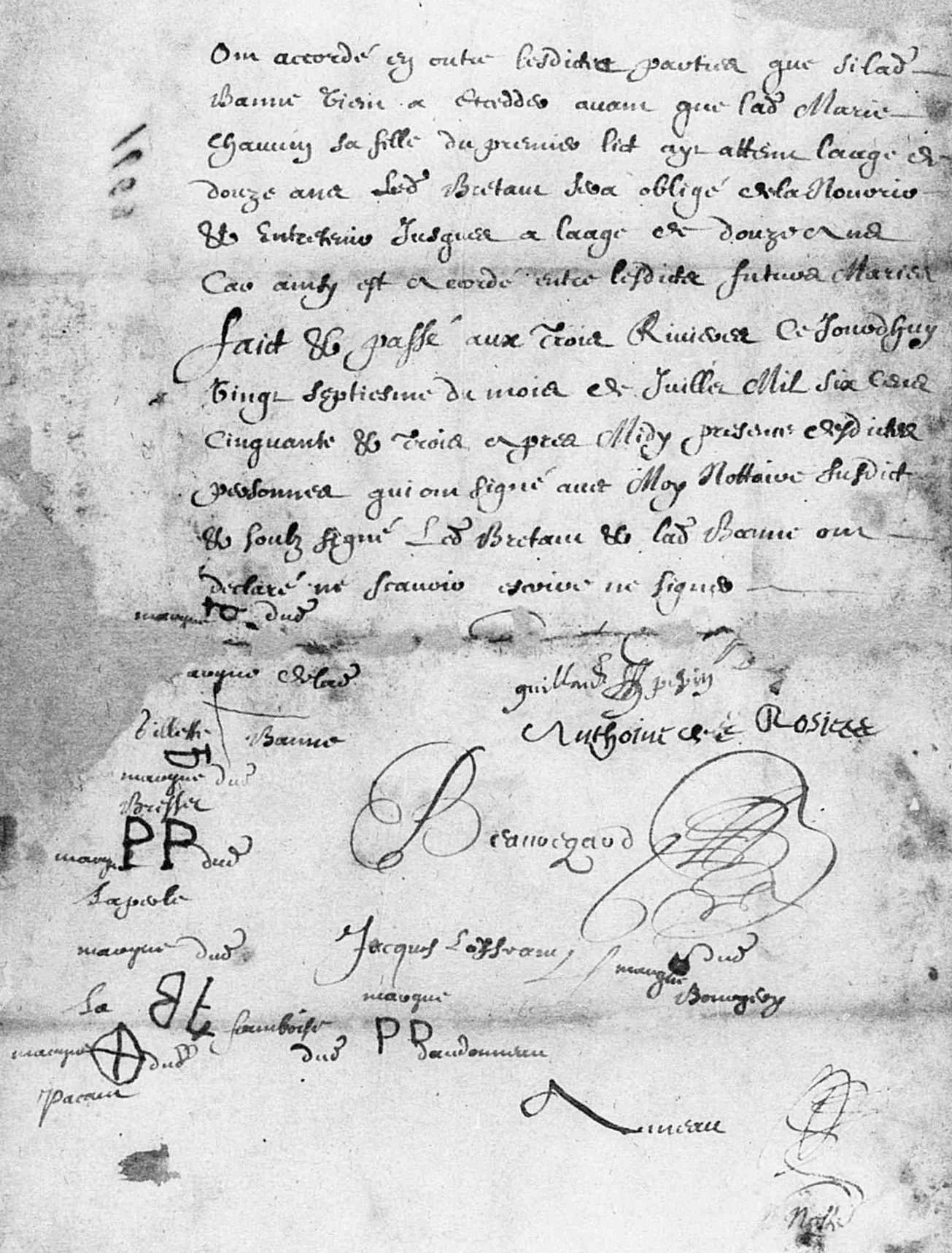
Last page of Gillette and Jacques’s marriage contract (FamilySearch)
On March 9, 1655, Jacques received a land concession from the Compagnie de Jésus (the Jesuits), jointly with Christophe Crevier dit Lameslée, Jacques Brisset, Jean Pacault, Pierre Dandonneau dit Lajeunesse, and Michel Lemay, all residents of Trois-Rivières. The concession was an island called Saint-Christophe, with a seigneurial payment of rente — half a bushel of wheat — due annually on the feast day of Saint-Martin. Whether Jacques ever lived or worked on the island is unknown.
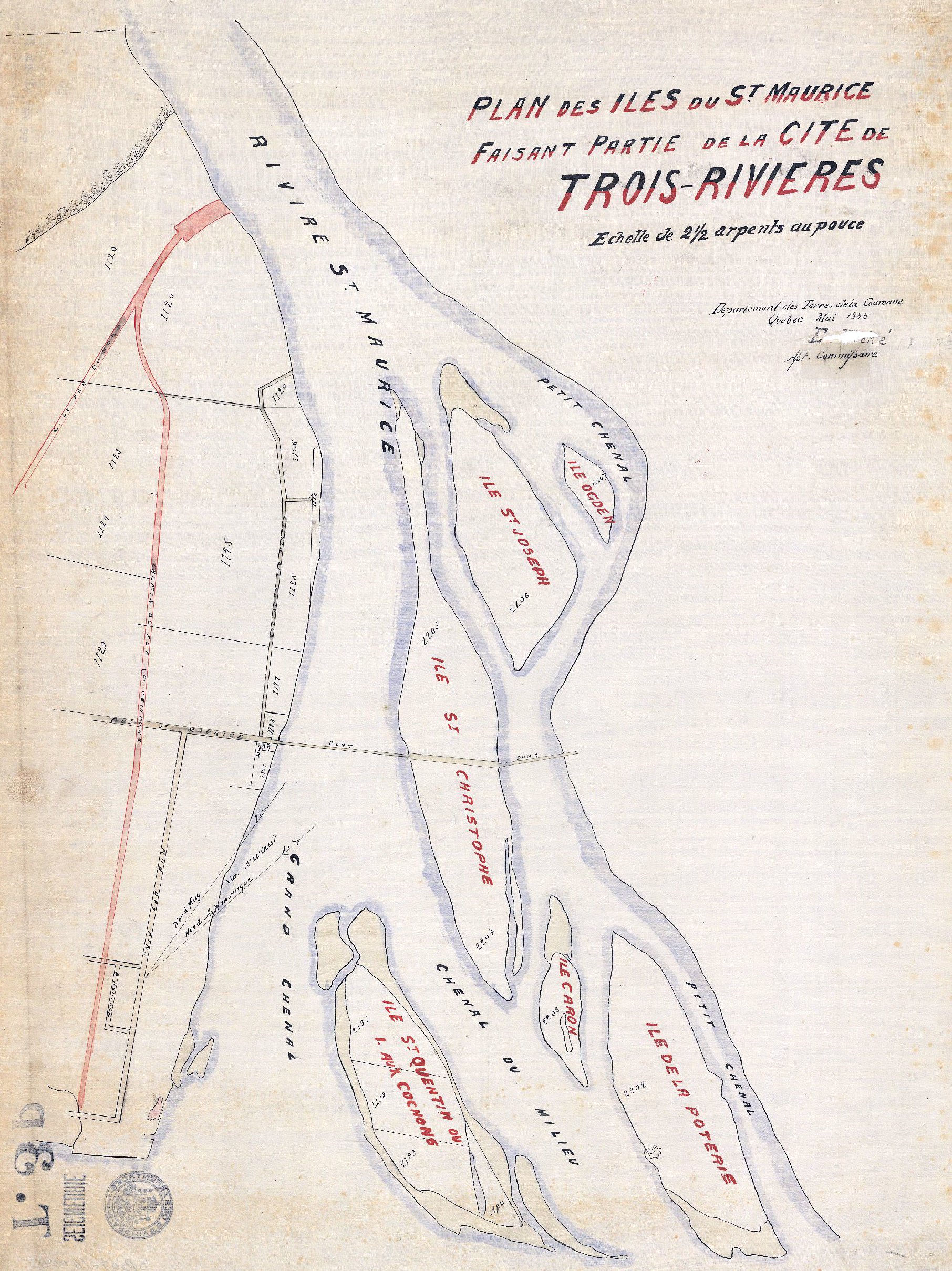
"Map of the city of Trois-Rivières showing islands and the St. Maurice River," May 1885 (Bibliothèque et Archives nationales du Québec)
On May 22, 1664, Gillette received the sacrament of confirmation at Trois-Rivières, alongside 38 others. [Gillette’s age was recorded inconsistently in contemporary records: 38 at her 1664 confirmation, 30 in the 1666 census, and “about forty-five” during her 1672 interrogation. Her exact year of birth remains uncertain.]
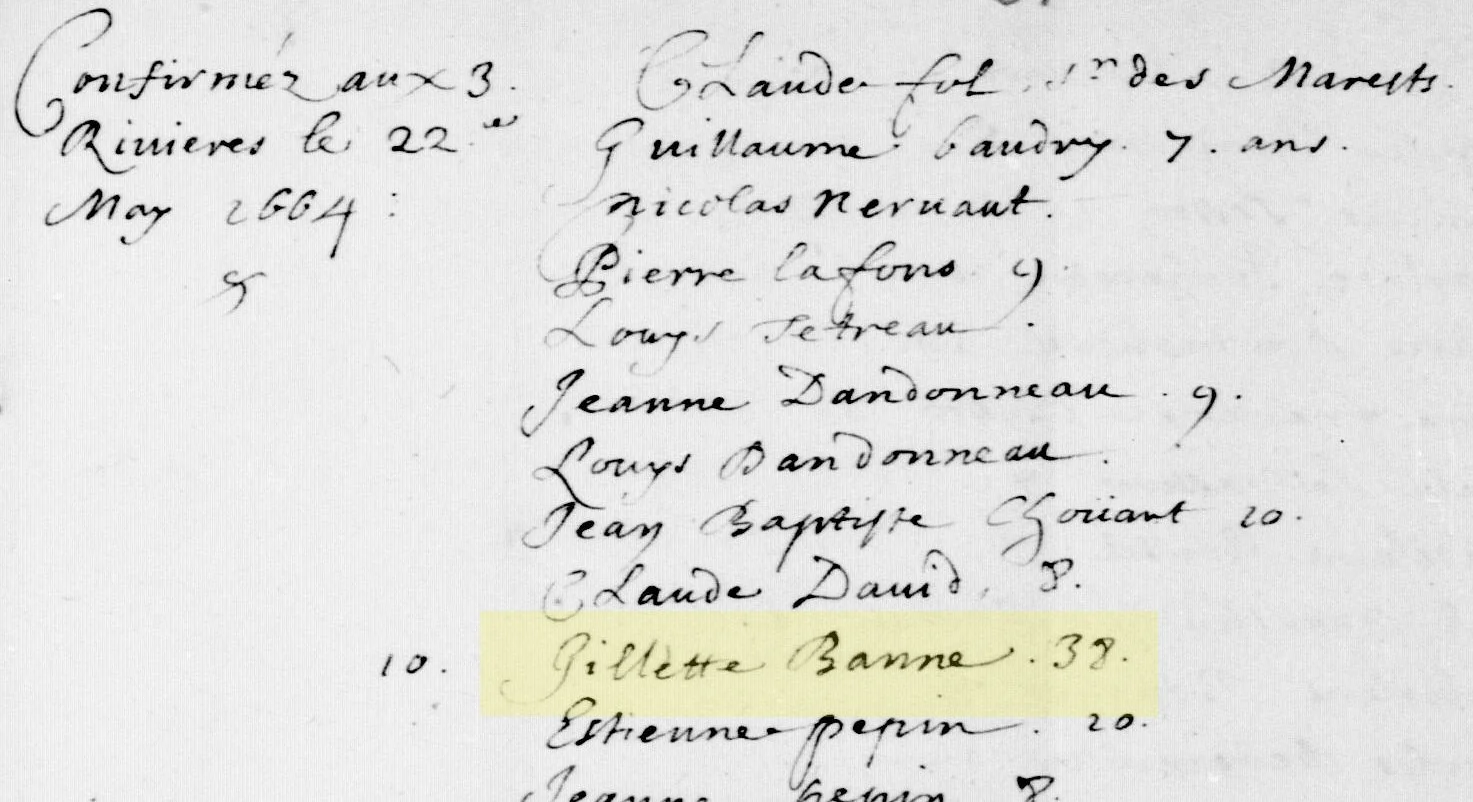
1664 Confirmation of Gillette Banne (Généalogie Québec)
Gillette and Jacques appeared in the 1666 census of New France, recorded as living in Trois-Rivières with their five surviving children. Their son Jacques had died before the census was taken, and daughter Marie Chauvin had married and left the household. Jacques was recorded as an habitant.
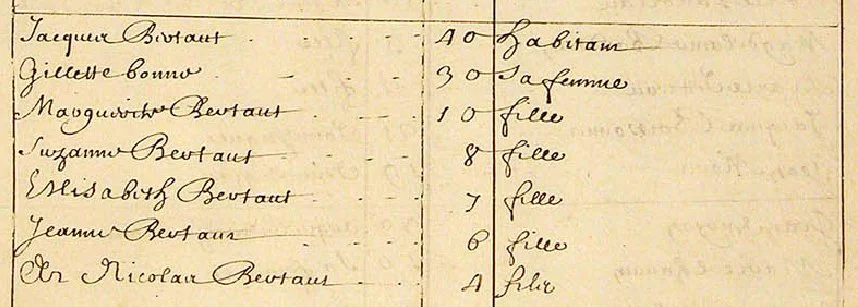
1666 Census of New France for the “Bertaut” family (Library and Archives Canada)
Young Brides: The Bertault Daughters
As was customary at the time, Jacques would have sought suitable husbands for his daughters. Though the average age at first marriage for women in seventeenth-century New France was closer to 20 to 22, the legal minimum for girls was 12. Two of the Bertault daughters, Marguerite and Isabelle, were married at 12, Suzanne at 13, and Marie Jeanne at 20. Although canon law permitted marriage at such young ages, early unions were rarely contracted without deliberate parental pressure.
Several factors may explain Jacques's decisions. With men significantly outnumbering women in the colony, Jacques likely had no shortage of prospective suitors for his daughters. Economic pressures may also have played a role, as marriage transferred the financial responsibility of a daughter to her husband. In a frontier setting like Trois-Rivières, it could also provide a young woman with immediate security and protection, though this was not always guaranteed, as Isabelle's marriage to Julien Latouche would later demonstrate.
An Unhappy Union
On August 12, 1671, 12-year-old Isabelle Bertault married Julien Latouche in the parish church of the Immaculate Conception at Trois-Rivières. Latouche, identified in the record as a native of La Rochelle, was likely in his late twenties or early thirties. Quentin Moral and François Roussel stood as witnesses. Latouche had arrived in New France on August 18, 1665, as a soldier in the Carignan-Salières regiment, part of the Grandfontaine Company.
From the outset, the marriage was troubled. Isabelle later stated that she had been forced into the union by her father for economic reasons. Julien had steady work on a farm belonging to Madame de La Fontaine, and Jacques believed he could earn a good income and eventually purchase a farm of his own. Isabelle’s mother, Gillette Banne, had not consented to the marriage. While she was away assisting at a childbirth, Jacques proceeded with the arrangement regardless. Despite the objections of both his wife and daughter, he insisted on his authority: as father and head of the household, the marriage would go forward.
Latouche did little to secure the confidence of his new family. He appears to have been a marginal figure in Trois-Rivières, little known, according to Isabelle, who even believed he might be English or Flemish. Both Isabelle and her parents described him as idle and unreliable. Isabelle also indicated that she was often forced to turn to her mother for food, as her husband failed to provide for her. Jacques later claimed that his son-in-law had “ruined himself” through drink.
The marriage deteriorated rapidly. Isabelle stated plainly that her husband “beat and mistreated her,” and that this violence was known beyond the household. She noted that a rumour had circulated within the community that her husband had beaten her. In moments of abuse, she admitted saying, “I wish you were dead.” She also conceded that she “did not much love her husband.”
Even Jacques, who had imposed the marriage, soon expressed regret. He acknowledged that “the situation quickly changed” and that he had been “deceived in this marriage.” He claimed to have reproached Latouche for the mistreatment of his daughter—an assertion that sits uneasily alongside his own admitted violence toward his wife and child. Indeed, according to one witness, Jacques had already spoken in far harsher terms: Jean Héroux dit Bourguinville reported hearing him say that his son-in-law would die “by no hand but his own.”
Gillette, for her part, intervened when her daughter was beaten and attempted to support her. Yet her hostility toward her son-in-law deepened. According to testimony, she spoke openly of wanting him dead and, on several occasions, urged her husband to act. Jacques later stated that his wife “often urged him to kill” Latouche, and that Isabelle herself spoke with her mother about getting rid of her husband.
By the months following the marriage, the household was marked by tension, resentment, and recurring violence. What had begun as a coerced union had become something far more volatile. The idea of Latouche’s death was no longer unthinkable.
Things soon escalated. Gillette appears to have taken matters into her own hands in an effort to rid the household of her son-in-law. According to later testimony, she went into the nearby forest to gather herbs believed to poison and kill pigs. She then prepared a soup and, seemingly with her husband’s and daughter’s knowledge, served it to Latouche at the table. The attempt failed. The herbs had no effect. Jacques later stated that, when this did not succeed, they proceeded to something else.
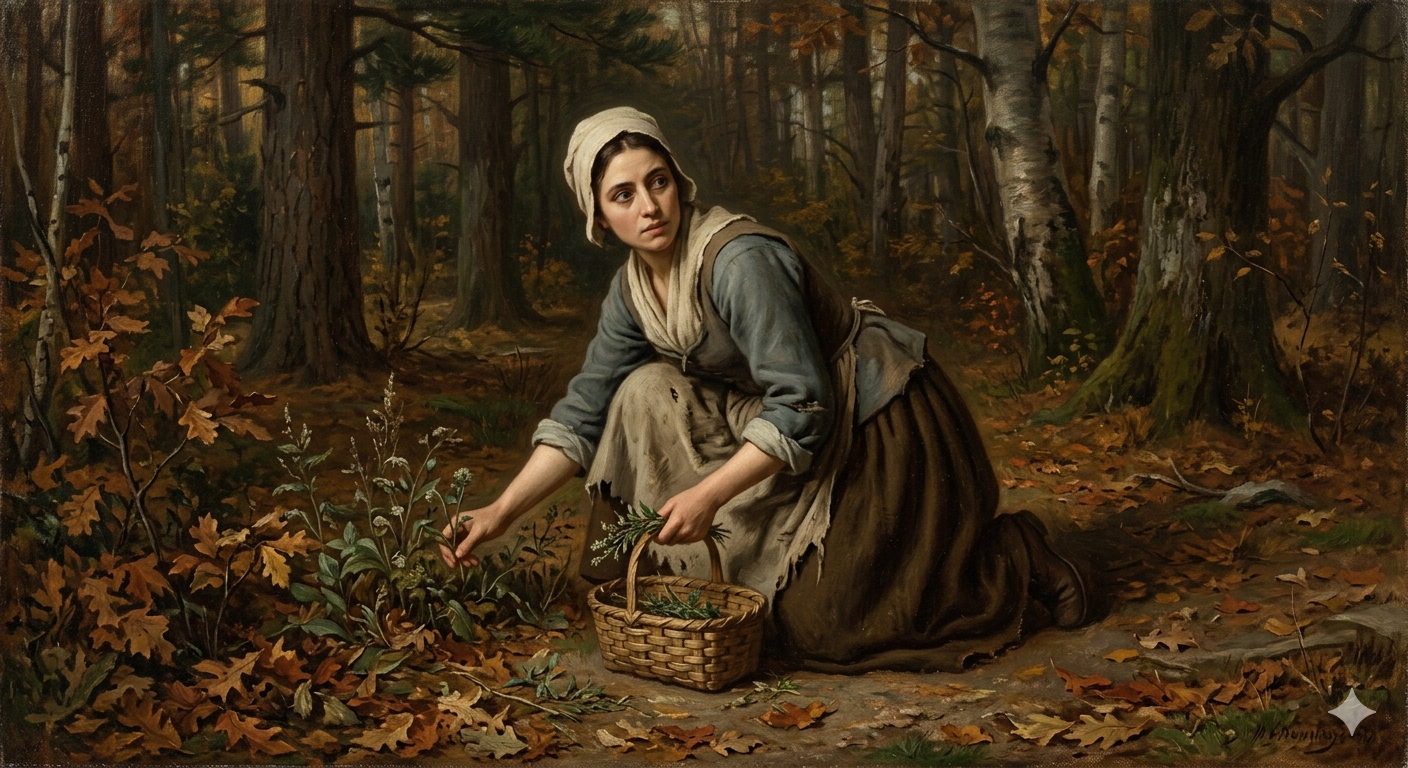
Gillette picking herbs (artificial intelligence image created by the author with Gemini, April 2026)
The Events of May 17: the Bertaults’ Version
The Bertault family would later present their own account of the events of May 17—one that differs in important respects from other testimony.
On Sunday, May 15, 1672, Julien Latouche crossed the river with his wife to the home of his in-laws, Jacques Bertault and Gillette Banne, to work at their habitation on the opposite shore of Trois-Rivières. Isabelle and her husband began clearing land to plant blé d’Inde, or corn. According to Isabelle, Latouche quickly proved unwilling to work, standing about and whistling instead. Frustrated, she threatened to leave. It was then, she said, that he began to beat and mistreat her. Her parents intervened, and a quarrel ensued.
Two days later, on May 17, the conflict resumed with greater violence. Isabelle was again beaten by her husband, this time so severely that, according to Gillette, she was left “completely covered in blood.” Jacques attempted to reprimand his son-in-law for the assault, but the confrontation escalated into a physical struggle.
The accounts place the decisive events in the family’s barn. Watching from a crack in the wall, Isabelle described how her father struck Latouche with a slap. Latouche responded with threats, declaring that he intended to kill him. He then threw himself upon Jacques, seized him by the hair, and forced him to the ground, placing his feet on his stomach while pulling at his hair as Jacques cried out for help.
Gillette rushed in to intervene, but Latouche turned on her as well, seizing her by the collar and threatening to kill them both. Unable to separate the two men, she called to her daughter: “my daughter, come in, your husband is trying to kill your father,” hoping her presence would calm him. Instead, the violence intensified. Latouche struck her parents even more forcefully and bit Gillette’s fingers, drawing blood.
In desperation, Gillette broke free and seized a hoe that was leaning nearby. She struck Latouche twice on the head. He collapsed to the ground. Jacques later acknowledged that, in the confusion that followed, he also struck both his wife and daughter, though he offered no clear explanation for doing so.
Believing, or claiming, that Latouche had only been stunned, the three left the barn and returned to their nearby cabin. About half an hour later, they went back. There, they found him “stiff dead.” They then dragged the body to the river and threw it in. The trio returned to their house at Trois-Rivières that night.
Later, when questioned as to why he did not seek assistance, Jacques replied that no help was available and that the river, difficult to cross, prevented him from reaching the authorities. Gillette later stated that she reported the matter to Sieur de Labadie, explaining that they had killed their son-in-law and attributing the act to the abuse suffered by her daughter and the tensions that had arisen since the marriage.
The Events of May 17: the Witnesses’ Version
Three local witnesses—Jean Gauthier, aged 22, Jean Héroux dit Bourguinville, 18, and Louis Petit, 14—offered an account that differs in important respects from that of the Bertault family.
On the evening of May 17, Gauthier and Petit stated that they were on the opposite side of the river when they heard a voice resembling that of Julien Latouche crying out from Jacques Bertault’s barn. According to their testimony, the voice repeatedly declared that he was being killed and that his attacker would be hanged. They reported that these cries continued for approximately an hour and a half and were accompanied by the sound of blows. They further stated that Gillette Banne was heard urging on the violence, repeating words to the effect of “kill him.”
From across the river, Gauthier shouted toward the barn: “Go on, you wretch—if you kill your son-in-law, you’ll be hanged! There are enough witnesses.”
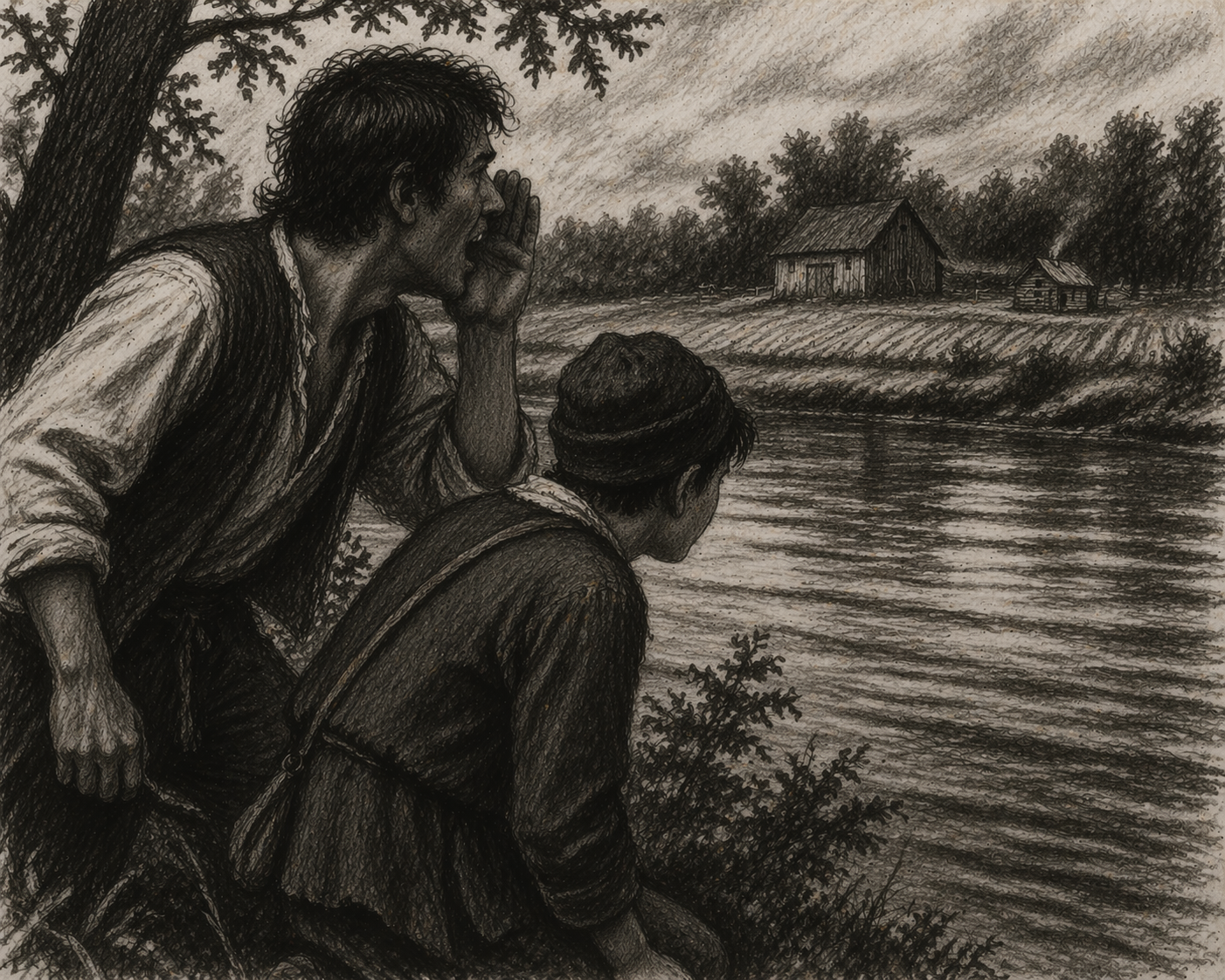
Gauthier shouting from across the river (artificial intelligence image created by the author with ChatGPT, April 2026)
The following day, Gauthier and Petit, joined by Héroux dit Bourguinville and Pierre Pépin, crossed the river and went to the Bertault habitation in search of Latouche. There they encountered Jacques Bertault, who entered his cabin and emerged with a firearm. Drawing back the mechanism and placing his hand on the trigger, he warned them that they would not find his son-in-law. When asked directly whether he had killed him, Bertault gave no answer.
Gauthier and Pépin then entered the barn. Inside, they reported finding blood, bloodstained objects, a flail covered in blood, and what they identified as human teeth.
What followed was the intervention of colonial justice.
Murder and Justice in New France
Before turning to the investigation that followed, it is useful to understand how criminal justice operated in New France. Homicide, murder, and assassination did occur in New France, though they remained relatively rare. Known as “simple voluntary homicides,” there were 23 recorded murders, alongside 8 duels and 5 cases of infanticide over the entire period of French rule. Approximately 80% of crimes were committed by men, making cases involving women—such as that of Gillette Banne—comparatively rare.
Even so, most killings did not lead to formal prosecution. Only about 7% of those accused of murder were ultimately charged and brought before the royal courts—a proportion comparable to that of England and Normandy at the time. In most cases, such acts were viewed as spontaneous and unpremeditated, arising from provocation rather than intent.
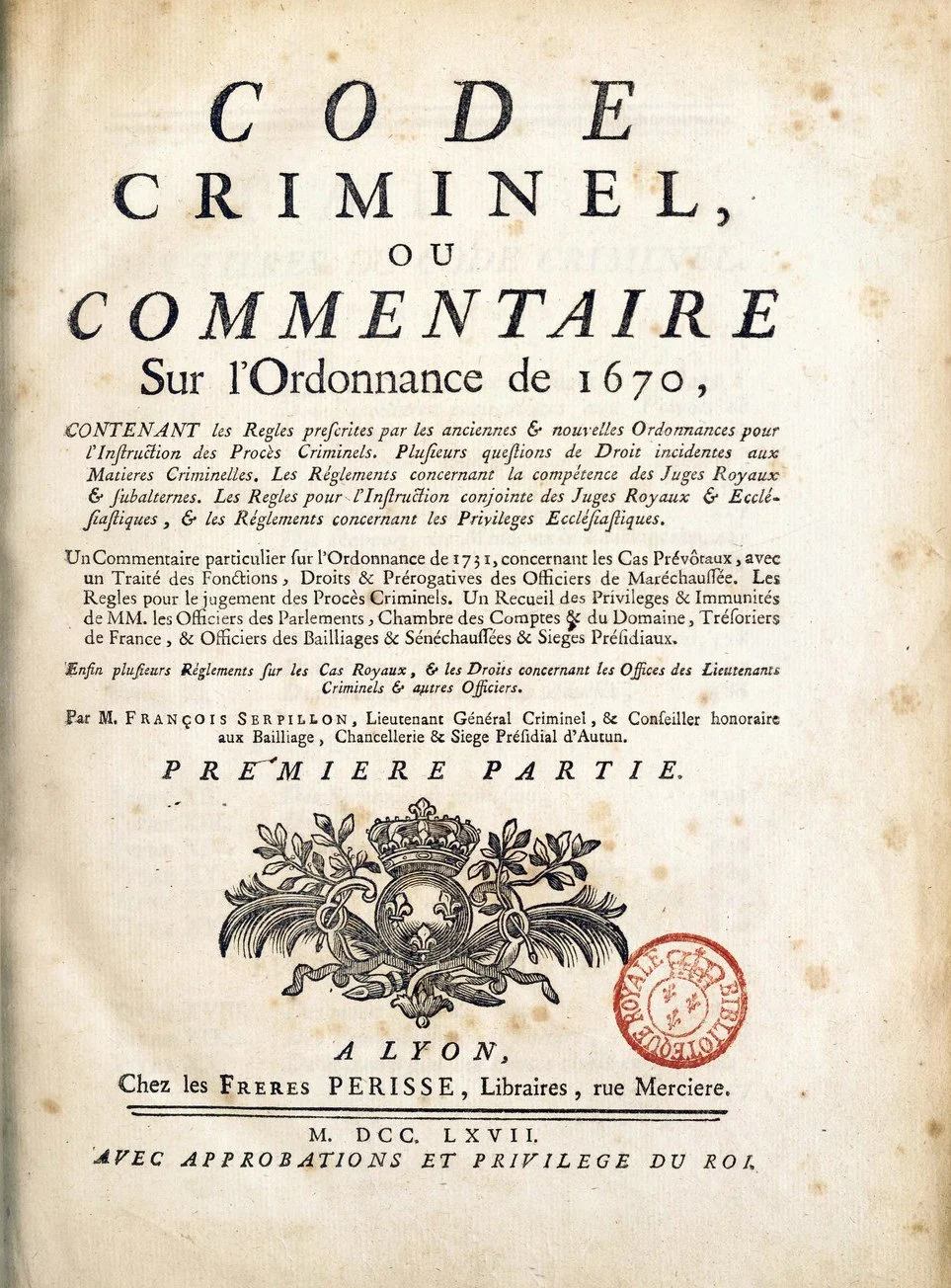
The Grande ordonnance of 1670 (Bibliothèque nationale de France)
As a French colony, New France operated under the Grande ordonnance criminelle of 1670, one of the first comprehensive frameworks governing criminal procedure. While the Ordonnance did not define crimes themselves, it established how they were to be investigated and prosecuted, according to their severity. Once a crime was reported to the lieutenant general for civil and criminal affairs, proceedings were initiated in accordance with its rules.
Unlike modern legal systems, the process effectively presumed guilt rather than innocence. Proceedings were conducted in writing and largely in secret, in contrast to English colonies, where trials tended to be oral and public.
The process began with a plainte, or formal complaint. No inquiry could proceed without it, unless the king’s prosecutor intervened after learning of a crime through public outcry. This was followed by les informations, a preliminary inquiry during which witnesses were examined in secret and their statements recorded by a clerk. The prosecutor could summon as many witnesses as necessary, and once their depositions were gathered, he determined whether the accused should be arrested or summoned to appear.
The accused was then brought in for interrogation. Before questioning, they swore an oath to tell the truth and provided their name, age, residence, and occupation. They were not represented by counsel, nor were they given access to the evidence against them or the names of those who had denounced them. Questioning was directed toward a single objective: quickly obtaining a confession. The clerk recorded every exchange, and the resulting document was submitted to the prosecutor for review.
In more serious cases—particularly those involving the possibility of capital punishment—the process advanced to le règlement à l’extraordinaire, or Extraordinary Questioning. Witnesses were recalled, their previous statements read aloud, and they were asked to confirm them. The accused was then confronted with these witnesses and permitted to respond. This confrontation, along with the interrogation itself, constituted one of the few opportunities for the accused to challenge the evidence. The prosecutor then presented his conclusions, recommending acquittal or conviction.
Where the evidence remained insufficient, but suspicion persisted, the court could resort to la question. A confession was considered essential in capital cases; without it, a death sentence could not be carried out. Such a confession might be obtained voluntarily—or extracted under torture. In this context, la Question referred specifically to the use of torture to compel admission of guilt. Following this, the accused was treated and subjected to yet another interrogation.
Finally, the lieutenant general for civil and criminal affairs, assisted by two magistrates called juges assesseurs, or associate judges, interrogated the accused one final time before rendering sentence. In the event of an appeal, the case was decided by the Conseil Souverain. Once the sentence had been pronounced, the conseiller rapporteur (reporting councillor), accompanied by the clerk, went to the place where the accused was being held. There, the accused heard the sentence while kneeling before the two officials. The execution of the sentence normally followed the same day.
It is within this procedural framework that the case of Gillette Banne and her family unfolded.
Opening of the Criminal Investigation into the Murder of Julien Latouche
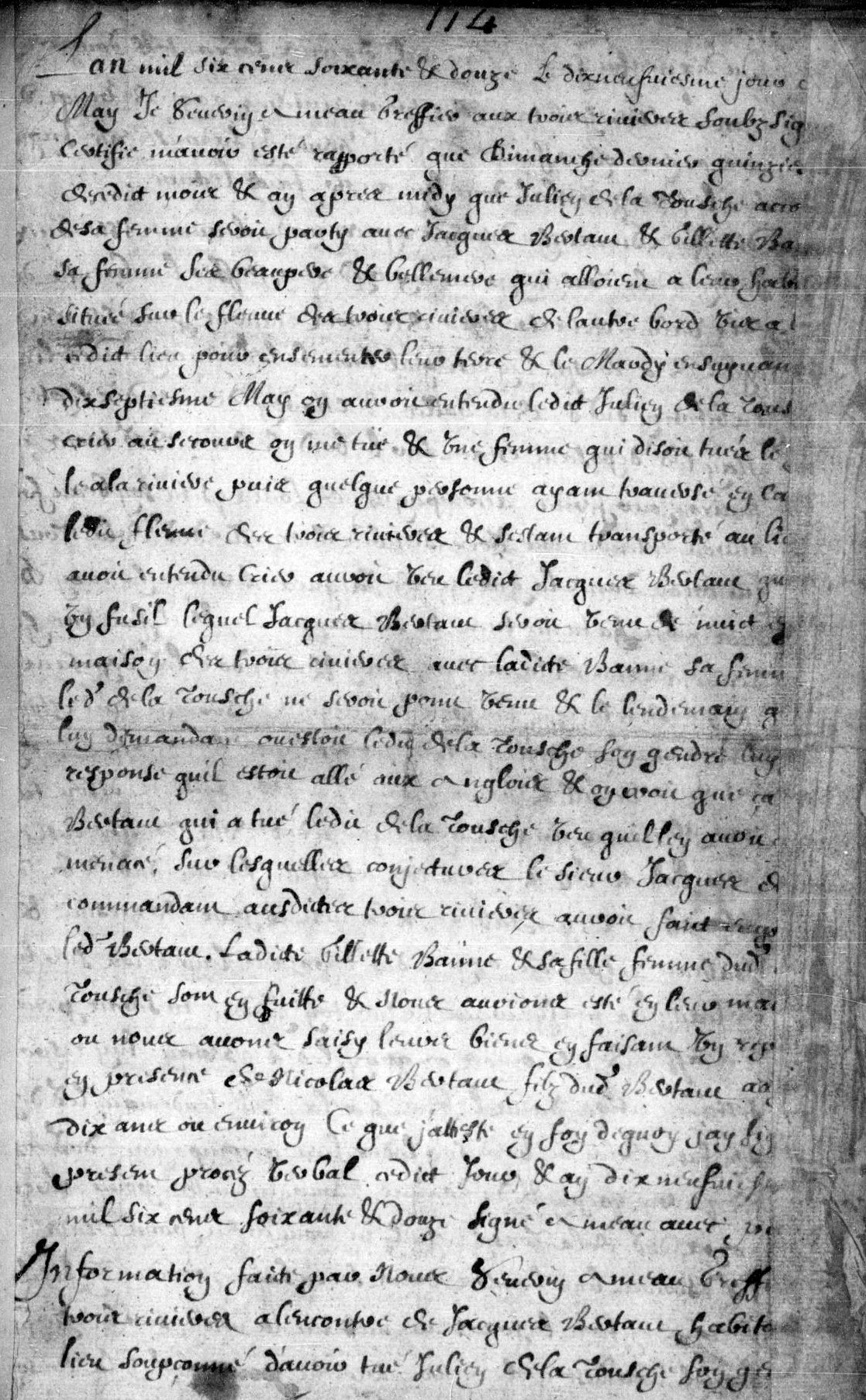
Ameau’s memorandum, dated May 19, 1672 (Bibliothèque et Archives nationales du Québec)
The day after Latouche’s disappearance, suspicion quickly fell on his in-laws. Jacques Bertault was arrested by soldiers at his home in Trois-Rivières and taken to the guardhouse. Gillette and Isabelle fled into the surrounding woods but were apprehended a few days later.
Authorities then proceeded to the Bertault residence, where they seized the family’s property in the presence of their 10-year-old son, Nicolas. On May 19, the principal witnesses—Jean Gauthier, Louis Petit, and Jean Héroux dit Bourguinville—were formally interrogated, and the clerk Séverin Ameau recorded the initial findings in a memorandum.
On the basis of this testimony, a formal judicial investigation was opened against Jacques Bertault, suspected of having killed his son-in-law, Julien Latouche. The inquiry was overseen by the fiscal prosecutor at Trois-Rivières, Louis de Godefroy de Normanville, who acted as the local representative of the Crown in criminal matters. In this capacity, he directed the proceedings, intervening on behalf of judicial authority to initiate procedural acts and ensure the prosecution of the case. He presided over the interrogations, assisted by the clerk Séverin Ameau.
The Accused Under Interrogation
Following their arrest, Jacques Bertault, Gillette Banne, and Isabelle Bertault were interrogated on multiple occasions. Their statements, given under oath, offer differing and at times contradictory accounts of the events surrounding Latouche’s death.
Jacques Bertault
In his interrogations, Jacques Bertault offered shifting and at times contradictory accounts of the events. He initially denied any knowledge of the killing, claiming he had neither heard cries nor struck his son-in-law, and stating that the blood in the barn came from sturgeon he had caught. As questioning progressed, he acknowledged a violent altercation but minimized his role, asserting that it was his wife who delivered the fatal blow with a hoe while he acted only in response to Latouche’s aggression. In later testimony, however, he altered his account again, alleging that his wife had long sought to poison Latouche and had urged him to kill him, ultimately claiming that both he and Gillette struck the victim. Throughout, Jacques attempted to portray that he was reacting to an immediate threat, while deflecting primary responsibility onto his wife.
Gillette Banne
Gillette Banne consistently framed the killing as a desperate act undertaken to defend her husband and daughter. She stated that Latouche had violently assaulted Isabelle, leaving her severely injured, and that when Jacques intervened, Latouche turned on him, attempting to kill him. According to her account, she entered the barn to separate them, but, unable to do so and fearing for their lives, seized a hoe and struck Latouche. While she denied having encouraged her husband to kill their son-in-law, she admitted to delivering the blow that caused his death and later acknowledged that an earlier attempt had been made to poison him using herbs. Her testimony emphasized self-defence rather than premeditation.
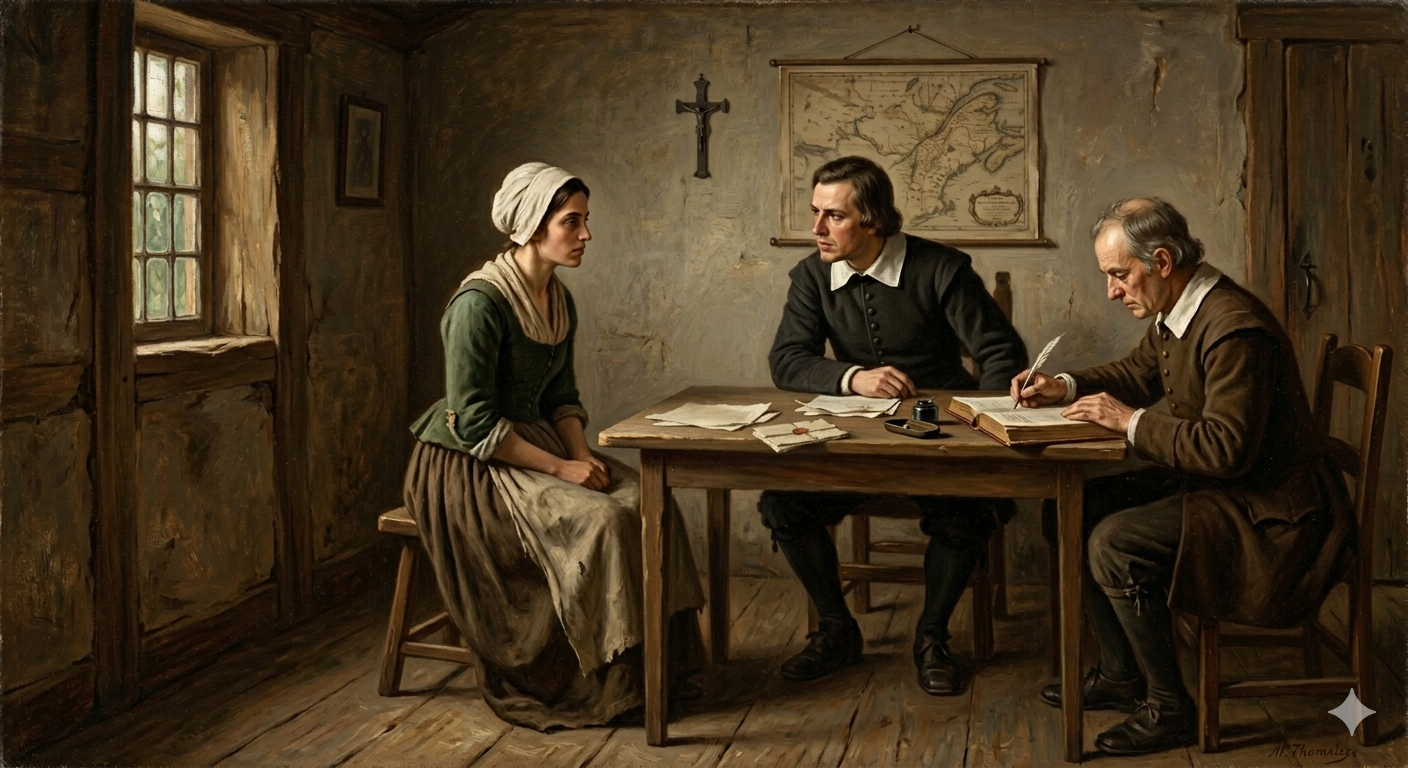
Gillette’s interrogation (artificial intelligence image created by the author with Gemini, April 2026)
Isabelle Bertault
Isabelle Bertault’s statements portray her as both victim and reluctant witness. She described a marriage marked by violence. She maintained that the fatal confrontation arose when her father reproached Latouche for this abuse, leading to a violent struggle in which Latouche attempted to kill her father. Isabelle consistently denied striking her husband, and that it was her mother who delivered the decisive blow. While she initially denied any prior intent to harm her husband, she later admitted that discussions had taken place within the family about getting rid of him and ultimately acknowledged her presence during the events and involvement in disposing of the body.
Imprisoned at Québec
After the first series of interrogations, Jacques, Gillette, and Isabelle were transported to Québec, likely by canoe, under guard of two soldiers, and imprisoned. There, the accused were ordered to be interrogated for a final time on May 8, 1672. The investigation was then transferred to Louis-Théandre Chartier de Lotbinière, lieutenant general for civil and criminal affairs at the provost’s court at Québec. This court was to “deal in the first instance with cases of all kinds, whether civil, criminal, or concerning police, trade and navigation”; appeals were a matter for the Conseil Souverain.
In 1672, imprisonment at Québec did not mean confinement in a purpose-built jail, but rather temporary detention in a space associated with the colony’s judicial or military authority. Individuals were typically held under guard in a room within an administrative building, a guardhouse, or another secure space within the fortified settlement. These makeshift places were small, sparsely furnished, and intended for short-term use while authorities conducted interrogations or awaited judgment. Imprisonment itself was not the punishment; it functioned as a procedural step within the legal process, which remained focused on confession, sentencing, and the swift execution of sentences.
The Bertault Family’s Fate
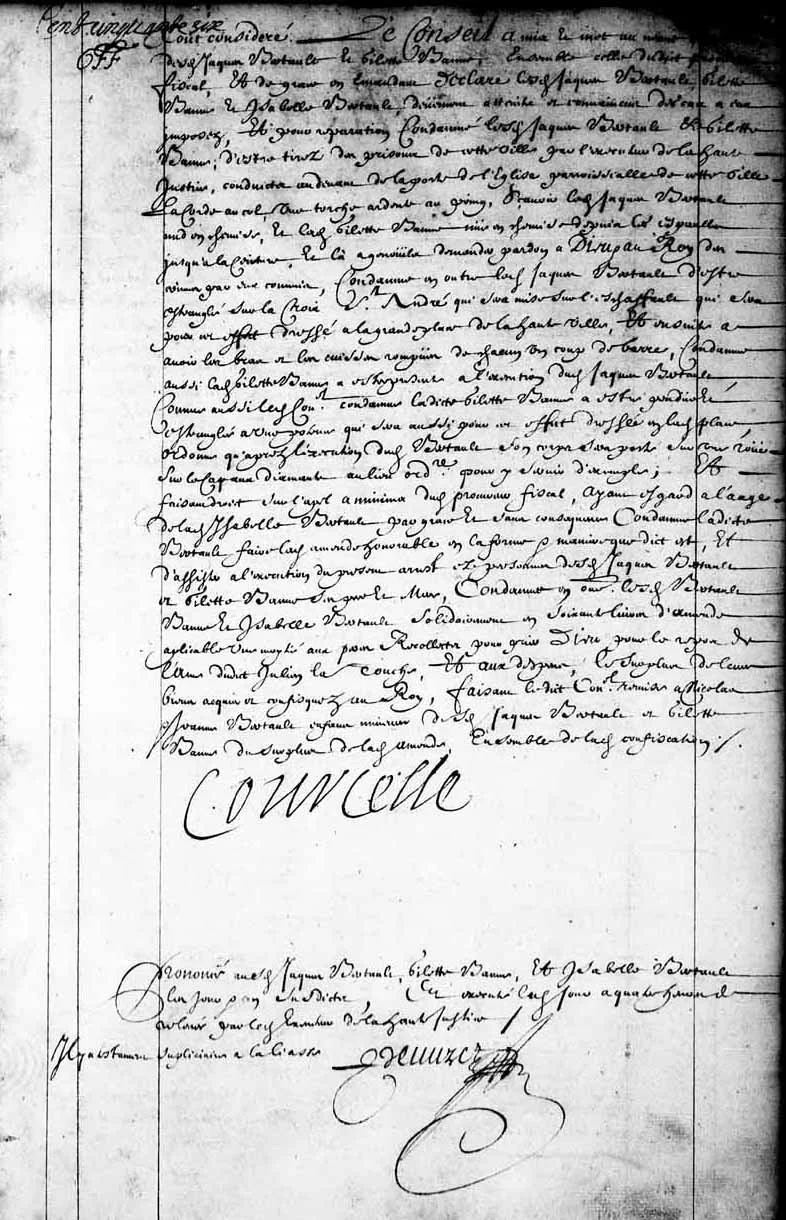
On the same day as their final interrogation, May 8, 1672, proceedings were brought against Jacques Bertault, Gillette Banne, and Isabelle Bertault, accused of having attempted to poison and of having, by ambush, killed Julien Latouche. After examination of the extraordinary proceedings and deliberation with six assessors, the judges declared the three accused convicted of the crimes of poisoning and murder.
The sentence was delivered: Jacques, Gillette, and Isabelle were to be taken from prison and led, with a rope around their necks and a torch in hand, before the door of the parish church, where Jacques, bareheaded and in his shirt, and the two women, in their shifts (undergarments) to the waist, must, on their knees, ask forgiveness of God and the King for the crimes committed.
They were to be led to a scaffold erected in the Grande Place (public square) of the Upper Town, furnished with a Saint Andrew’s cross, upon which Jacques Bertault was to be laid out to receive a blow to the right arm, then be strangled, and, after his death, receive further blows, including one to the left arm and one to each thigh. Gillette Banne was sentenced to be hanged and strangled at a gallows erected for that purpose in the same place. Isabelle Bertault was sentenced to attend the executions, with a rope around her neck. After the executions, the body of Jacques Bertault was to be placed on a wheel at Cap-aux-Diamants to serve as an example. In addition, the accused were sentenced to a fine of one hundred livres to the seigneurs of the country, to costs, and the remainder of their property is declared confiscated.
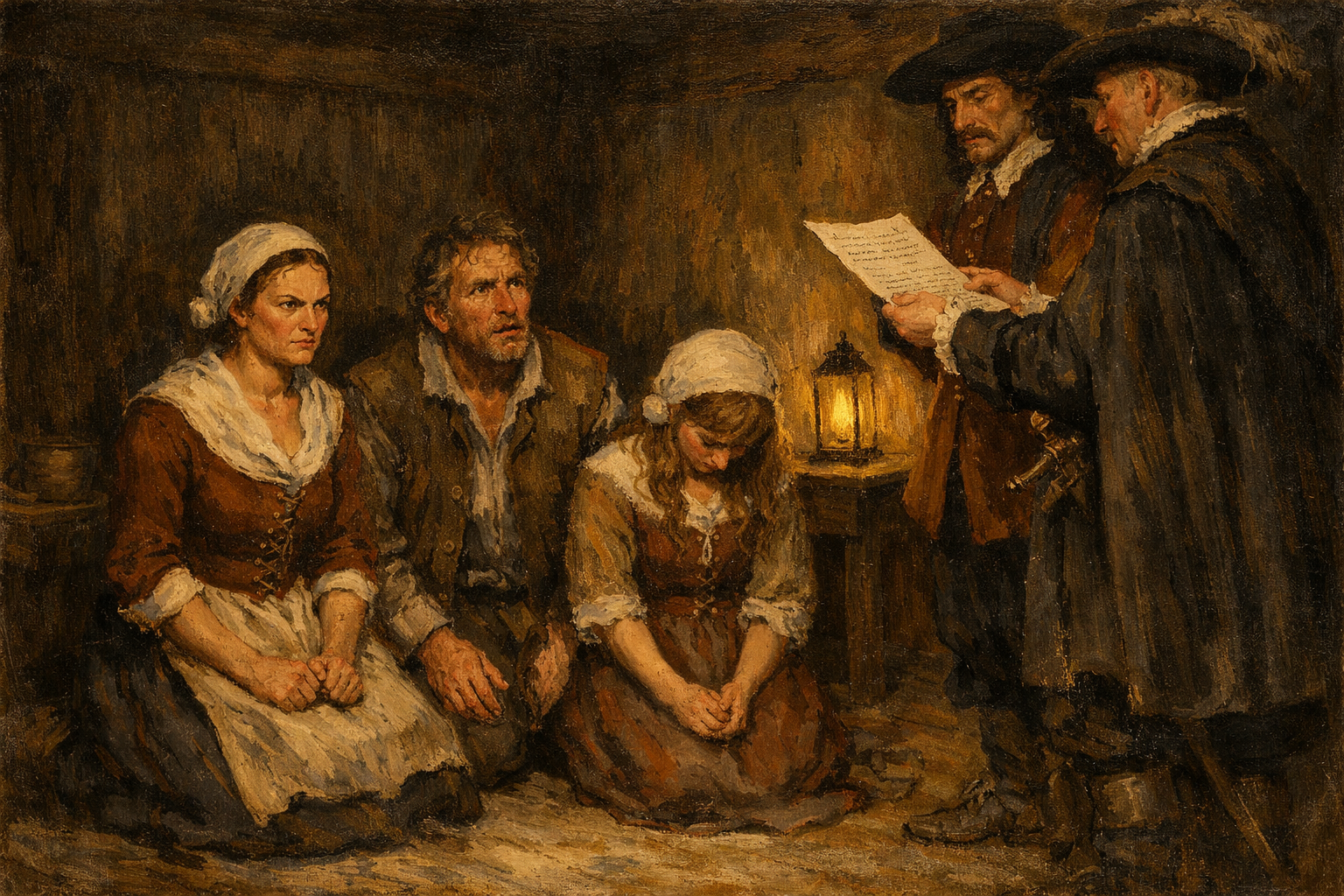
The reading of the sentence (artificial intelligence image created by the author with ChatGPT, April 2026)
A Last Appeal
Jacques and Gillette appealed the decision of the court, but Isabelle did not. After reviewing the case and hearing the parties, the Conseil Souverain dismissed the appeals and upheld the guilt of all three accused, while modifying certain aspects of the sentences.
Jacques was sentenced to perform an amende honorable before the parish church, then to be strangled on a Saint Andrew’s cross on the scaffold, after which his limbs were to be broken. His body was then to be displayed on a wheel at Cap-aux-Diamants as an example.
Gillette Banne was sentenced to witness her husband’s execution and then to be hanged and strangled.
Isabelle Bertault, due to her age, received a mitigated sentence: she was required to perform an amende honorable and attend the executions of her parents.
All three were also jointly fined sixty livres, part of which was allocated to the Récollet priests for prayers for the soul of the victim, and were ordered to pay costs, with their remaining property confiscated to the Crown. A partial remission was granted in favour of their minor children.
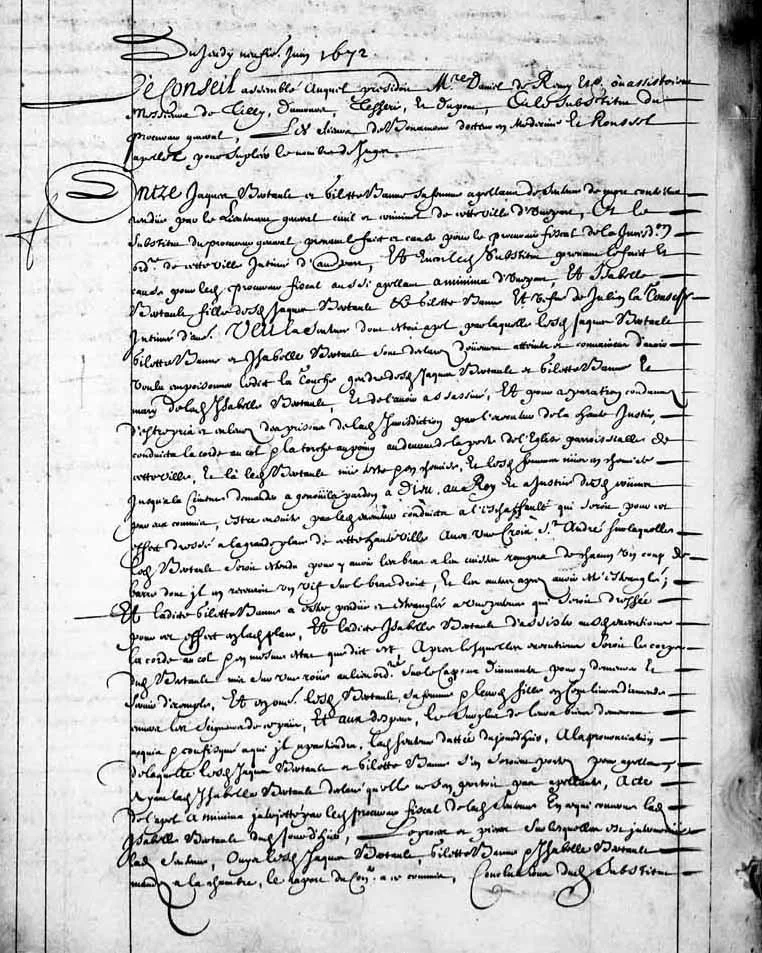
The appeal and final sentence of May 9, 1672 (Bibliothèque et Archives nationales du Québec)
Understanding the Sentences
Before turning to Jacques and Gillette’s final moments, it is useful to examine the punishments included in their sentence, as each formed a distinct stage in the execution that followed.
The amende honorable, which literally translates to “honourable amends,” was intended to repair the public scandal caused by a crime. The offender, usually barefoot and stripped to his shirt, was led to a church with a wax torch in his hand and a rope around his neck, held by the public executioner, to beg pardon on his knees of God, the King, and the community. It was sometimes used as an alternative to execution, but more often served as a prelude to capital punishment or the galleys. Despite its name, the amende honorable was fundamentally a ritual of public humiliation.
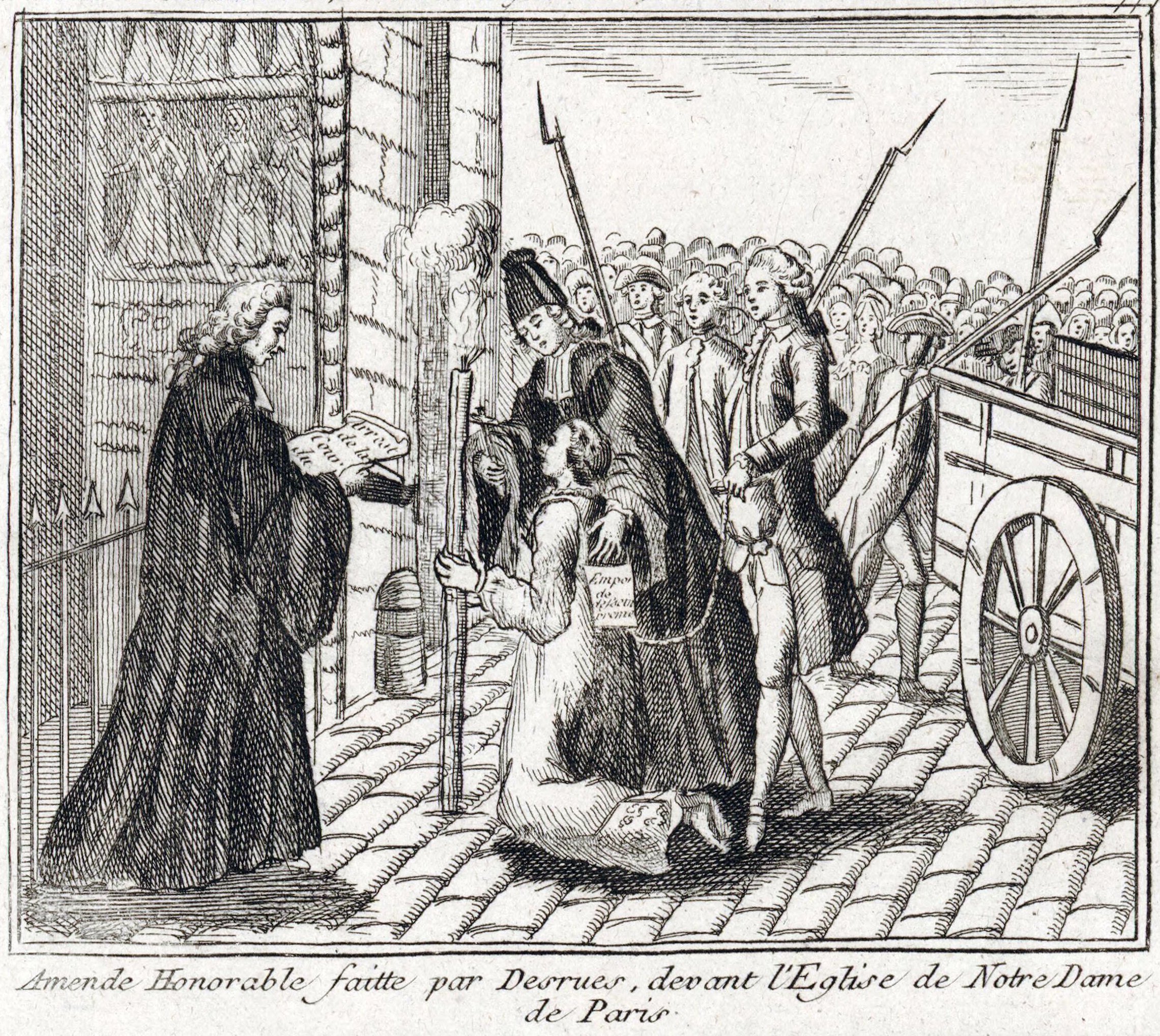
Depiction of an amende honorable (portion of the 1777 engraving "Tableau des principaux événements de la vie d'Antoine-François Desrues, né à Chartres en l'année 1745," Bibliothèque nationale de France)
Jacques Bertault’s sentence then proceeded to one of the most severe forms of execution, though in a mitigated form. He was to be strangled on a Saint Andrew’s cross before his limbs were broken. In such cases, the execution began with strangulation rather than the immediate breaking of the limbs. The condemned was positioned beneath the scaffold so that the head aligned with a device known as a moulinet, around which a rope had been fastened and placed tightly about the neck. Operated by two men using levers, the mechanism gradually tightened the rope until the condemned was strangled to death. Only after death did the executioner proceed to break the bones on the cross, distinguishing this method from the more brutal form in which the victim was broken while still alive.
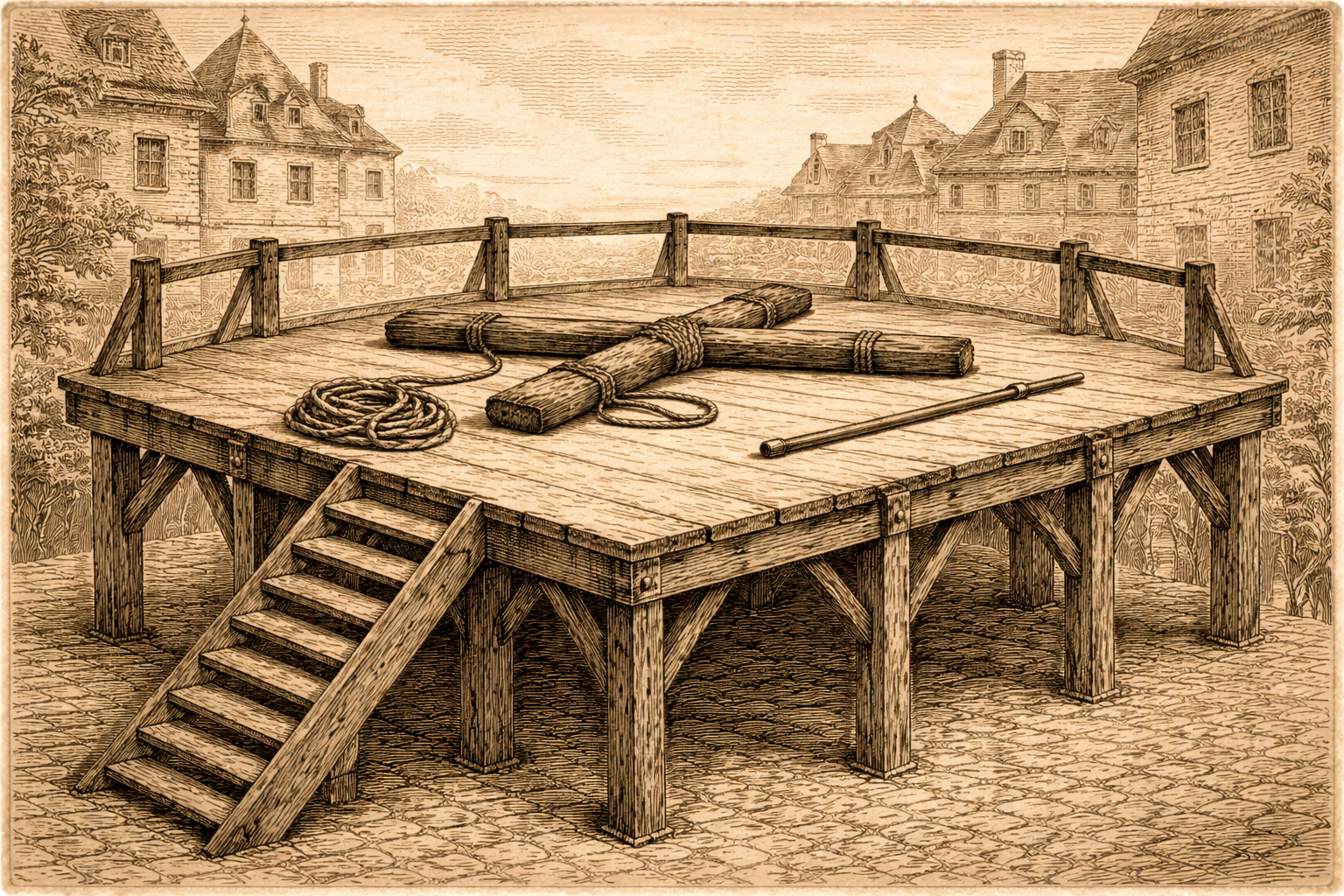
Saint Andrew’s cross on a scaffold (artificial intelligence image created by the author with ChatGPT, April 2026)
Following this, the treatment of Jacques’s body formed part of the sentence itself. The body was removed and arranged in a contorted position, with the legs bent so that the heels approached the back of the head. It was then placed upon a wagon wheel mounted horizontally and exposed to the public for a period of time. In his case, this display was ordered at Cap-aux-Diamants, where the body was left exposed as a warning and example.
Gillette Banne’s sentence followed a different but equally public form of execution. Death by hanging was the most common method in New France, and it was the punishment imposed upon her. The executioner would tie the offender by the neck to an elevated structure, such as a gallows, leaving them without any foothold and causing death by strangulation. As with Jacques, the execution was not only punitive but demonstrative, carried out before the public.
In addition to these corporal punishments, the sentence imposed financial penalties on all three accused. In the context of criminal justice in New France, the fine and confiscation of property reflected both punitive and symbolic objectives. The fine served, in part, a spiritual function: a portion was allocated to the Récollets to fund prayers for the soul of the victim, formally acknowledging the harm done. The remainder of the fine, along with court costs (dépens), functioned as a financial penalty imposed by the state.
The confiscation of goods (confiscation des biens) further extended the punishment beyond the individuals themselves. Upon conviction, the condemned’s property was seized by the Crown. This acted as an additional sanction and reinforced royal authority by asserting the Crown’s ultimate claim over the property of those who had committed grave offences. In practice, this could leave surviving family members in a precarious financial position.
In this case, however, the sentence also included a partial remission in favour of the Bertault children. While confiscation was the rule, colonial authorities could exercise discretion to mitigate its effects, particularly where innocent dependents were concerned. Some portion of the seized property was therefore likely preserved or returned for the benefit of the minor children, Nicolas and Jacques Bertault. This reflects a pragmatic dimension of justice in New France: although punishment was severe and highly public, there remained limited scope to protect those who bore no responsibility for the crime.
These sentences were carried out on June 9, 1672.
The Execution of Jacques Bertault and Gillette Banne
Public executions in New France, though relatively rare, drew significant attention. Over the course of the colony’s history, approximately 80 individuals were executed for a wide range of offences, including murder, duelling, counterfeiting, robbery committed at night, burglary, arson, concealment of pregnancy, infanticide, rape, indecent assault, desertion, treason, homosexuality, and bestiality.
In Québec City, such events were eagerly anticipated. Word spread quickly through the small settlement, and residents could observe preparations firsthand as the king’s carpenter erected the scaffold. These executions were not merely punitive acts but public demonstrations of royal authority, intended to set an example, instill fear, and deter others from committing similar crimes.
On June 9, 1672, at approximately four o’clock in the afternoon, Jacques Bertault and Gillette Banne were brought to execution. The crowd, likely numbering in the hundreds, gathered in the Upper Town, among them their young daughter Isabelle. The proceedings may have been accompanied by the sound of drums, marking the solemnity of the occasion.
The execution took place in the principal public square of Québec’s Upper Town (Haute-Ville), referred to in the records as the Grande Place or place publique. While its exact modern equivalent remains uncertain, it would have been located near the colony’s administrative and religious centre, in the area of today’s Upper Town.
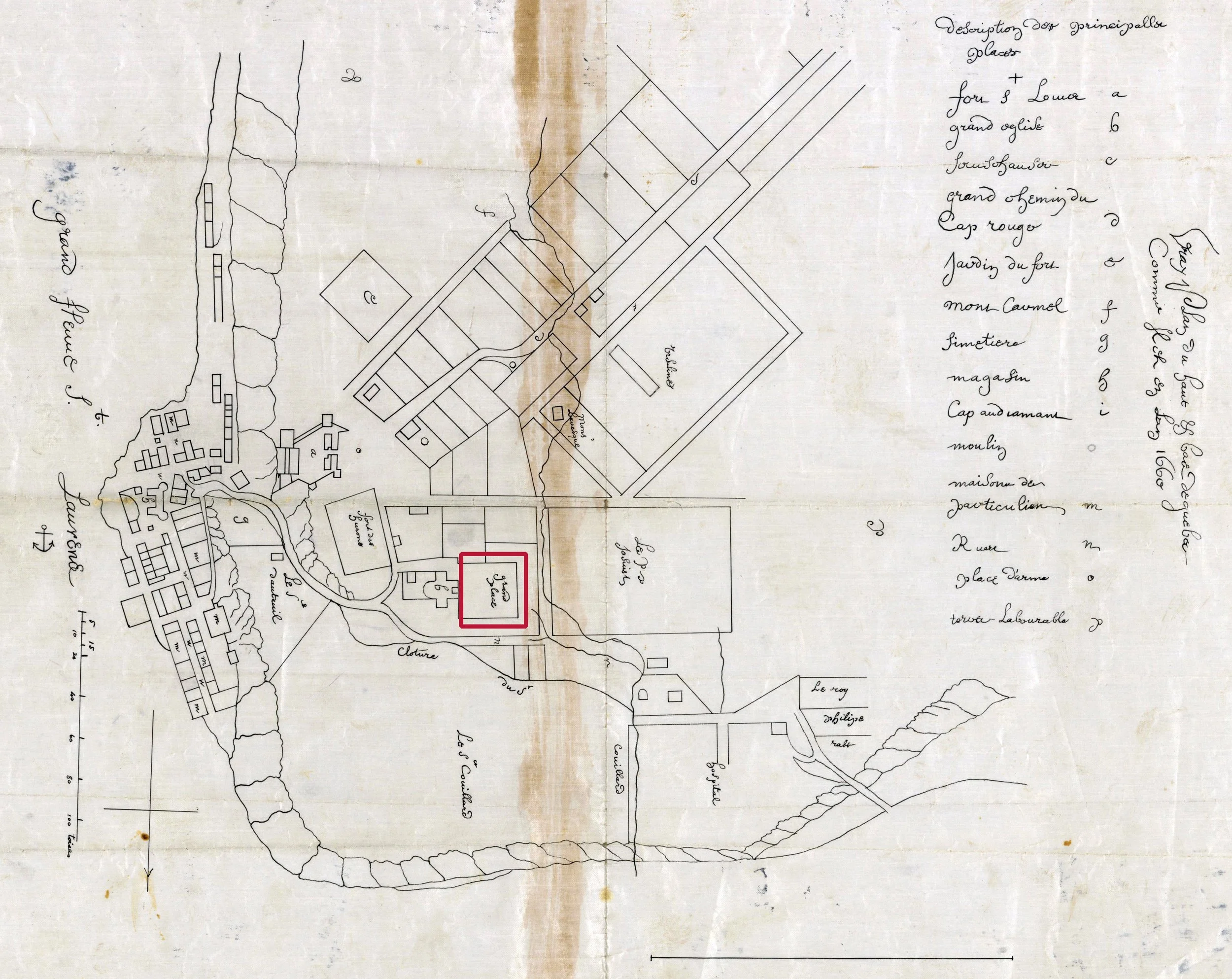
1660 map of Québec by Jean Bourdon, with the Grande Place in red (Bibliothèque et Archives nationales du Québec)
Aftermath
The execution of Jacques Bertault and Gillette Banne left five children behind, including two minors. Isabelle, who had endured an abusive marriage, the death of her husband, and the execution of her parents, ultimately rebuilt her life away from Trois-Rivières.
All of the Bertault daughters settled in Boucherville, where they married and established families of their own. Nicolas Bertault appears in the records until 1683, after which his fate is unknown.
Isabelle married twice more: first to Noël Laurence on November 6, 1673, in Boucherville, and later to Jean Baptiste Pilon dit Lafortune on March 1, 1688, in Repentigny. Over the course of her life, she had eleven children.
Élisabeth “Isabelle” Bertault died at the age of 77 and was buried on March 18, 1736, in Repentigny.
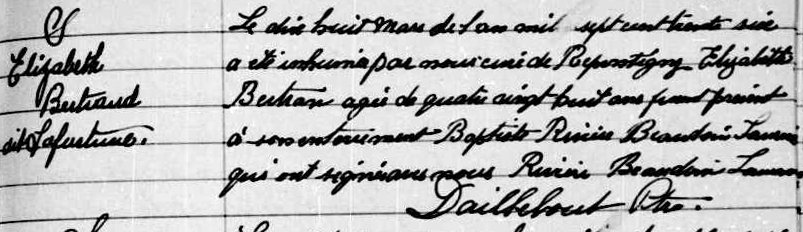
1736 burial of Élisabeth “Isabelle” Bertault (Généalogie Québec)
Beyond the Sentence
The case of Gillette Banne reveals both the violence that could exist within households and the limits of justice in seventeenth-century New France. While her actions were judged within a rigid legal framework, little weight appears to have been given to the circumstances in which they occurred. Concepts such as self-defence, particularly in the context of domestic violence, were not understood or applied in the way they are today.
Testimony in the case makes clear that Isabelle’s mistreatment was known within the community, yet this did not alter the course of proceedings. Violence within marriage, though not accepted, was more commonplace and often treated as a private matter unless it resulted in serious injury or death. When such cases came before the courts, the focus remained on the act itself rather than the conditions that produced it.
The case also draws attention to the position of very young brides in New France. Although canon law permitted marriage at the age of twelve, such unions placed girls like Isabelle in profoundly unequal relationships, often with significantly older men. In practice, their ability to refuse a marriage or to leave a violent household was extremely limited. This legal and social framework helps explain how situations of abuse could persist, and why conflicts within the family could escalate before coming to the attention of the courts.
Seen in this light, the fate of Gillette Banne and her family reflects not only the severity of colonial justice, but also the social realities of the time. Their story stands as a rare and revealing example of how conflict within the household could escalate into a matter of public justice, with consequences that extended far beyond the individuals involved.

PDF version of biography located at: https://www.tfcg.ca/gillettebanne-en. Updated 12 Jul 2026.
Are you enjoying our articles and resources? Show your support by making a donation. Every contribution, regardless of its size, goes a long way in covering our website hosting expenses and enables us to create more content related to French-Canadian genealogy and history. Thank you! Merci!
Sources:
"Le LAFRANCE (Baptêmes, mariages et sépultures)," database and digital images, Généalogie Québec (https://www.genealogiequebec.com/Membership/LAFRANCE/acte/87232 : accessed 19 Feb 2026), baptism of Marie Chauvin, 8 Sep 1650, Trois-Rivières (Immaculée-Conception); citing original data: Institut généalogique Drouin and PRDH.
"Le LAFRANCE (Baptêmes, mariages et sépultures)," database and digital images, Généalogie Québec (https://www.genealogiequebec.com/Membership/LAFRANCE/acte/89081 : accessed 16 Apr 2026), marriage of Julien DELATOUCHE and Elisabeth Therese BERTAULT, 12 Aug 1671, Trois-Rivières (Immaculée-Conception); citing original data: Institut généalogique Drouin and PRDH.
"Le LAFRANCE (Baptêmes, mariages et sépultures)," database and digital images, Généalogie Québec (https://www.genealogiequebec.com/Membership/LAFRANCE/acte/125825 : accessed 18 Apr 2026), burial of Elisabeth BERTEAU, 18 Mar 1736, Repentigny (La-Purification-de-la-Bienheureuse-Vierge-Marie); citing original data: Institut généalogique Drouin and PRDH.
"Registre des confirmations 1649-1662," digital images, Généalogie Québec (https://www.genealogiequebec.com/membership/fr/fonds-drouin/REGISTRES : accessed 23 Feb 2026), confirmation of Gillette Banne, 22 May 1664, Trois-Rivières; citing original data: Registre des confirmations, Diocèse de Québec, Registres du Fonds Drouin.
"Recensement du Canada, 1666," digital images, Library and Archives Canada (https://recherche-collection-search.bac-lac.gc.ca/fra/accueil/notice?idnumber=2318856&app=fonandcol : accessed 23 Feb 2026), household of Jacques Bertaut, 1666, Trois-Rivières, page 145 (of PDF), finding aid no. MSS0446, MIKAN no. 2318856; citing original data: Centre des archives d'outre-mer (France) vol. 460.
“Fonds Intendants - Archives nationales à Québec," digital images, Bibliothèque et Archives nationales du Québec (https://advitam.banq.qc.ca/notice/91782 : accessed 20 Feb 2026), "Déclaration faite au papier terrier de la Compagnie des Indes occidentales par Jacques Bertault, laquelle déclaration étant relative à une place pour bâtir située en la ville des Trois-Rivières et contenant un tiers d'arpent," 23 Jun 1668, reference E1,S4,SS2,P238, Id 91782 ; citing original data: Papier terrier de la Compagnie des Indes occidentales, cahier I (26 Jul 1667 to 30 Sep 1668), f. 120-120v.
« Fonds Conseil souverain - Archives nationales à Québec », images numérisées, Bibliothèque et Archives nationales du Québec (https://advitam.banq.qc.ca/notice/398771 : consulté le 16 avr. 2026), « Procès de Jacques Bertault, âgé d'environ 50 ans, laboureur, maçon, natif du bourg et de la paroisse des Essarts en Poitou, habitant de Trois-Rivières, de son épouse Gillette Banne, âgée d'environ 45 ans, native du bourg d'Argences, à trois lieues de Caen, et de leur fille Élisabeth (Isabelle), native de Trois-Rivières, âgée de 12-13 ans, accusés du meurtre, après avoir essayé de l'empoisonner, de Julien Latouche, gendre et mari des accusés », 19 mai 1672-8 juin 1672, cote TP1,S777,D110, Id 398771.
“Actes de notaire, 1651-1702 // Ameau Séverin,” digital images, FamilySearch (https://www.familysearch.org/ark:/61903/3:1:3Q9M-CS5F-73VC-W?cat=koha%3A615650&i=102&lang=en : accessed 20 Feb 2026), marriage contract of Jacques Bertaut and Gillette Banne, 27 Jul 1653, images 103-109 of 2436; citing original data: Bibliothèque et Archives nationales du Québec.
“Actes de notaire, 1651-1702 // Ameau Séverin,” digital images, FamilySearch (https://www.familysearch.org/ark:/61903/3:1:3Q9M-CS5F-73NT-T?cat=koha%3A615650&i=148&lang=en : accessed 23 Feb 2026), concession of an island called St-Christophle by the Compagnie de Jésus to Christophe Crevier de Lameslée, Jacques Bertaut, Jacques Brisset, Jean Pacault, Pierre Dandonneau dit Lajeunesse and Michel May, 9 Mar 1655, images 149-150 of 2436; citing original data: Bibliothèque et Archives nationales du Québec.
Fédération québécoise des sociétés de généalogie, Fichier Origine online database (https://www.fichierorigine.com/fr/repertoire/chauvin/-lafortune : accessed 20 Feb 2026), entry for CHAUVIN / LAFORTUNE, Marin (reference 250030), updated on 8 Sep 2016.
Université de Montréal, Programme de recherche en démographie historique (PRDH) database (https://www-prdh-igd.com/Membership/fr/PRDH/Famille/780 : accessed 23 Feb 2026), dictionary entry for Jacques BERTAULT and Marie Gillette BANNE (union #780).
Université de Montréal, Programme de recherche en démographie historique (PRDH) database (https://www-prdh-igd.com/Membership/fr/PRDH/Individu/11150 : accessed 18 Apr 2026), dictionary entry for Elisabeth Isabelle BERTAULT (person #11150).
Peter Gagné, Before the King’s Daughters: Les Filles à Marier, 1634-1662 (Orange Park, Florida : Quintin Publications, 2002), 327.
Peter J. Gagné, From Soldiers to Settlers: The Carignan-Salières Regiment in Canada 1665-1668, volume 2 (Woonsocket, Rhode Island, American-French Genealogical Society, 2025), 425.
André Lachance, Délinquants, juges et bourreaux en Nouvelle-France (Montréal, Les Éditions Libre Expression, 2011).
Eric Wenzel, La justice criminelle en Nouvelle-France (1670–1760): Le Grand Arrangement (Dijon, France: Éditions Universitaires de Dijon, 2012).
Jean Badreux, Tom Nulty sur l’Echafaud : les supplices à travers les âges (Montréal, Leprohon & Leprohon, 1898), 20-21.
André Vachon, “CHARTIER DE LOTBINIÈRE, LOUIS-THÉANDRE,” in Dictionary of Canadian Biography, vol. 1 (https://www.biographi.ca/en/bio/chartier_de_lotbiniere_louis_theandre_1E.html : accessed 16 Apr 2026), University of Toronto/Université Laval, 2003–.
Louis XIV, Code criminel, ou Commentaire sur l'ordonnance de 1670, digital images, Bibliothèque nationale de France (https://gallica.bnf.fr/ark:/12148/bpt6k9740763j/ : accessed 17 Apr 2026).
“Amende honorable,” Encyclopedia of Diderot and d'Alembert (https://encyclopediaofdiderot.org/s/diderot/item/157650 : accessed 18 Apr 2026).