Charles Giroux & Marguerite Bruneau
Discover the story of Charles Giroux, a shoemaker from Mortagne, France, who settled in Quebec City in the late 17th century, and his wife, Marguerite Bruneau, born in New France in 1681. Married in 1699, they raised a family and acquired a modest property on Rue Saint-Nicolas in Quebec City.
Drawing on parish registers, notarial contracts, and a detailed household inventory from 1714, this biography explores their family history, living conditions, and the hardships they endured. It also offers a fascinating glimpse into everyday life for an ordinary family in the capital of New France during the early 18th century.
Cliquez ici pour la version en français
Charles Giroux & Marguerite Bruneau
A Shoemaker from the Perche Region and His Family in New France
Charles Giroux, son of Pierre Giroux and Magdelaine Delaunay, was born in the parish of Saint-Jean in Mortagne, in the former province of Perche, France [now Mortagne-au-Perche, in the Orne department].
Located about 125 kilometres southwest of Paris as the crow flies, Mortagne-au-Perche is now classified as a rural town and has a population of approximately 4,000, known as Mortagnais.
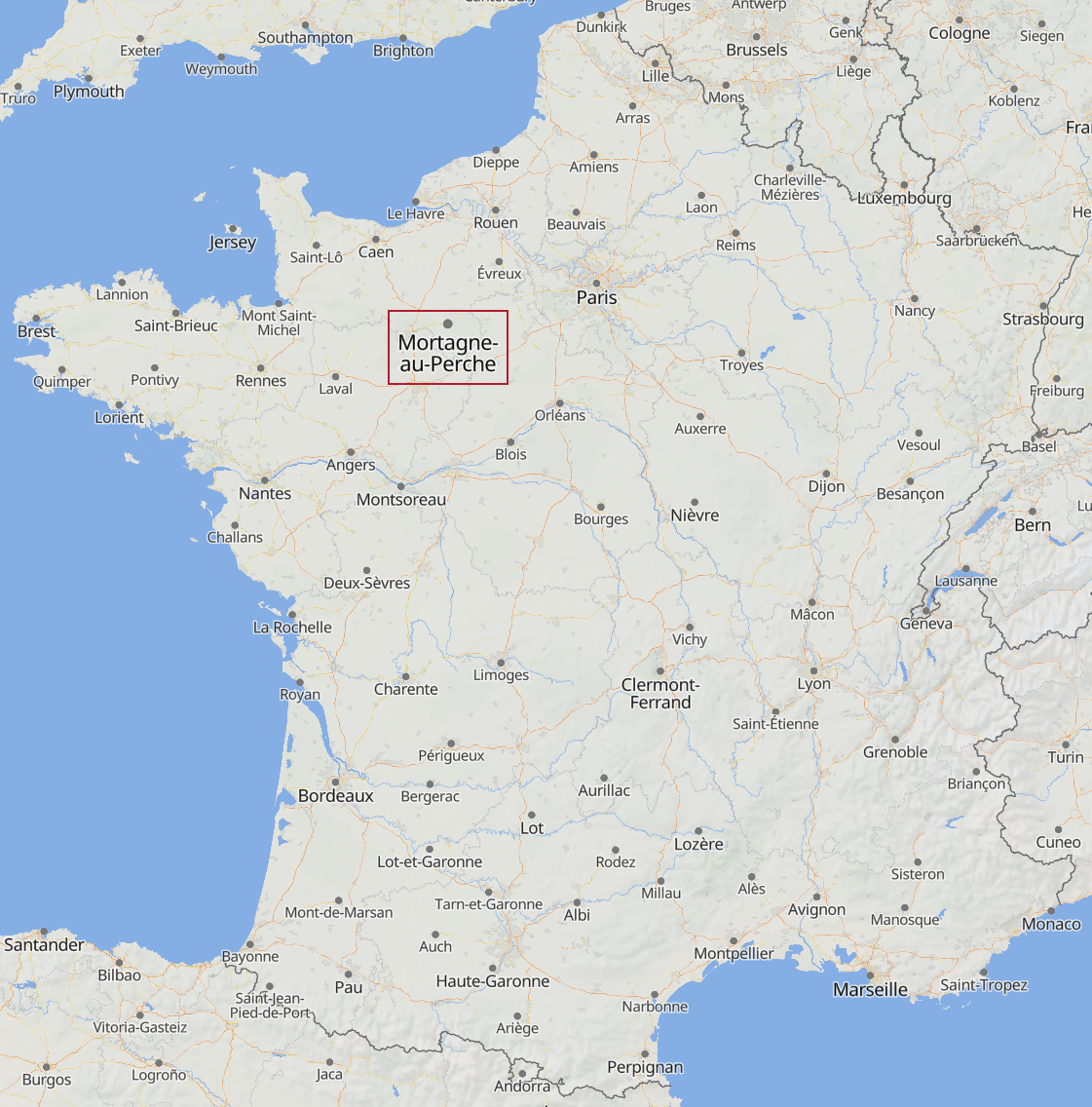
Location of Mortagne-au-Perche in France (Mapcarta)
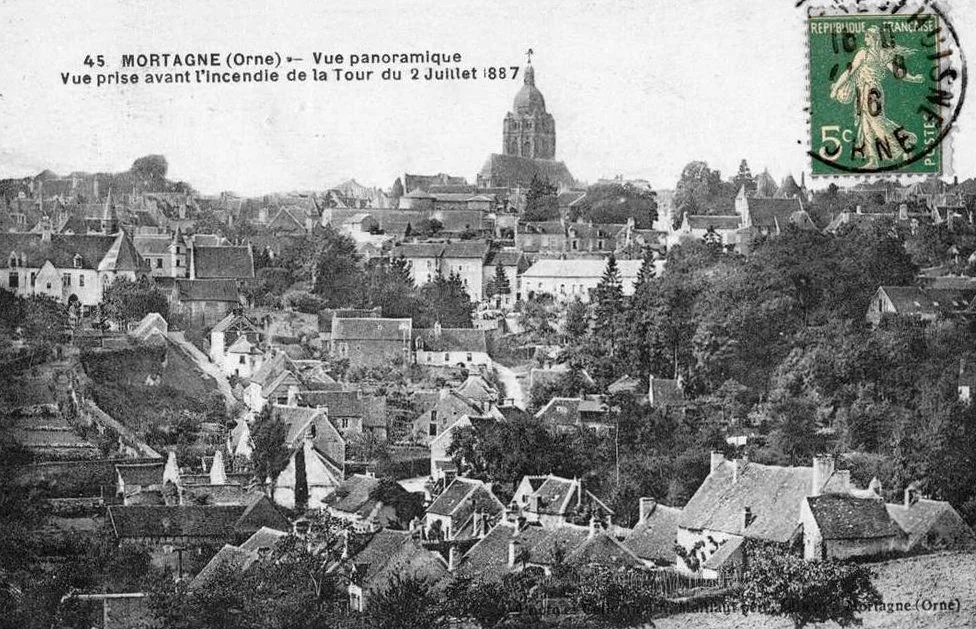
Postcard, 1887 (Geneanet)
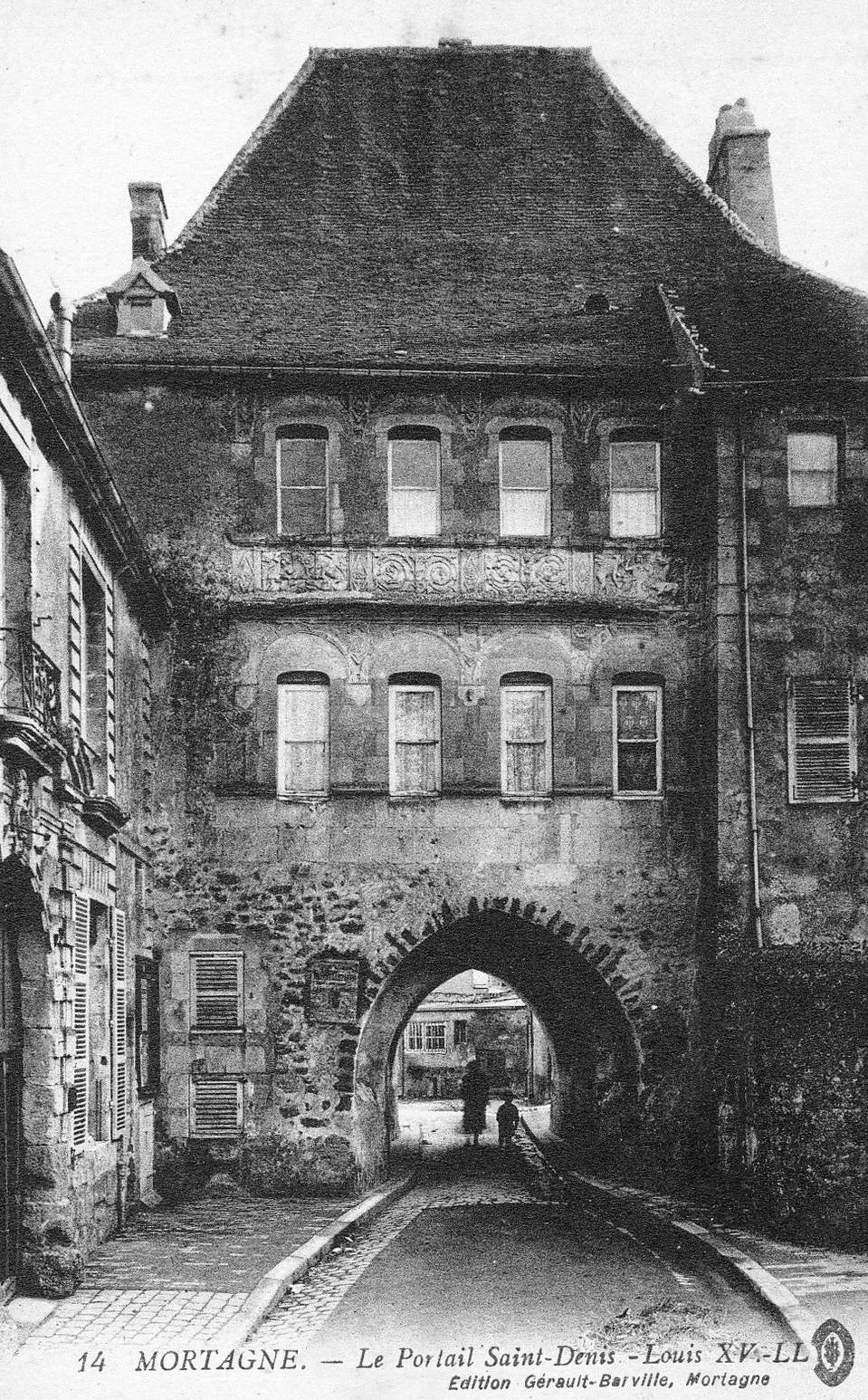
Postcard, circa 1910 (Geneanet)
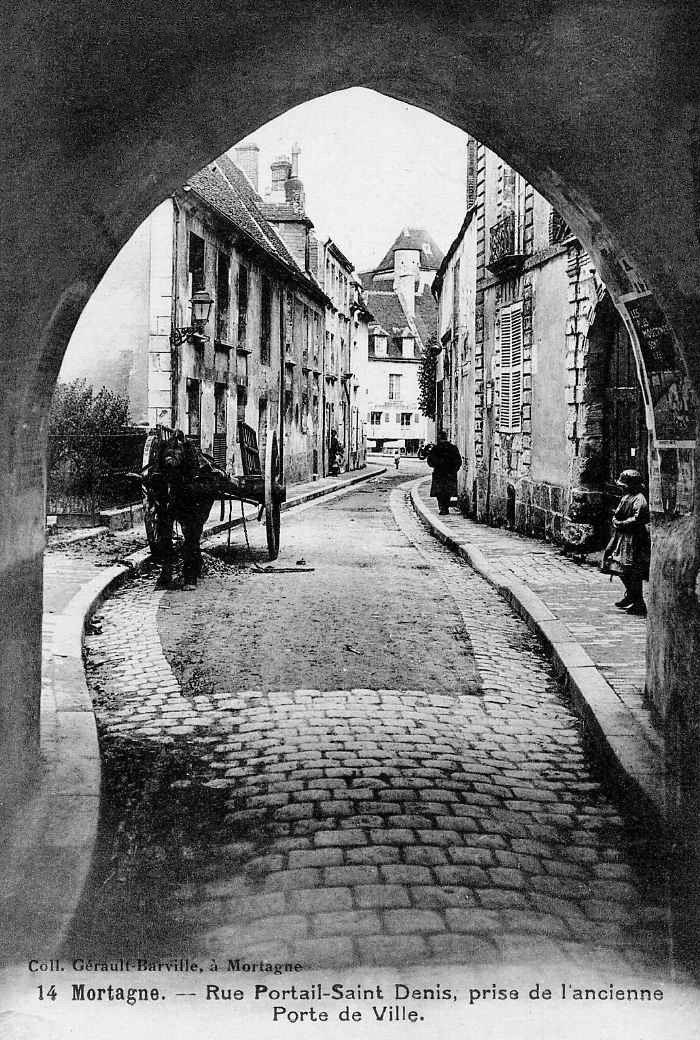
Postcard, circa 1910 (Geneanet)
The Percheron Emigration: From France to the Shores of Canada
Tourouvre and the former province of Perche were closely connected to the history of French emigration to Canada in the 17th century. The region became an important centre of emigration. Many emigrants from Perche travelled to New France through the port of La Rochelle. Key figures in this migration included Robert Giffard, a seigneur and surgeon, and the Juchereau brothers, merchants Jean and Noël, who had been granted large land concessions in Canada. They recruited men who could clear the land, build houses and other buildings, and begin cultivating the land. Their primary aim was to bring as many colonists and families to Canada as possible. The Compagnie des Cent-Associés partly funded the migration of these colonists, including Zacharie Cloutier, Jean Guyon, Noël Langlois, and many others. The Museum of French Emigration to Canada in Tourouvre-au-Perche celebrates these pioneers and their stories.
The exact date of Charles’s arrival in New France is unknown, but he was first mentioned there on October 29, 1698, as a witness to the marriage of Nicolas Foulon and Barbe Boyer in Québec City. He was unable to sign his name. Charles settled in nearby Charlesbourg and worked as a shoemaker.
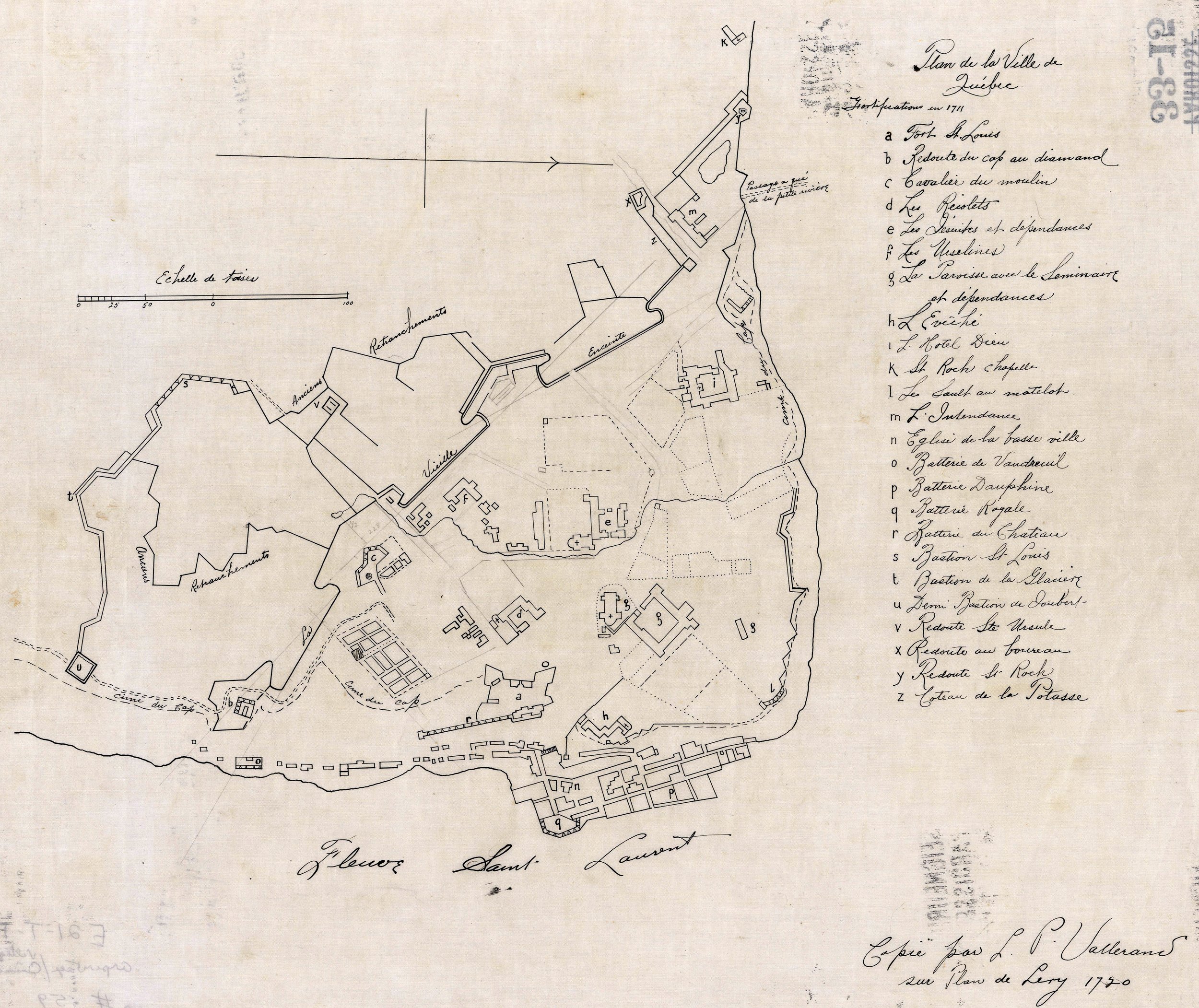
“Map of the City of Québec, Capital of New France,” copied in 1720 by L. P. Vallerand from Robert de Villeneuve's original dated September 1693 (Bibliothèque et Archives nationales du Québec)
Marguerite Bruneau, daughter of René Bruneau dit Jolicoeur and Marie Anne Petro, was born on November 21, 1681. She was baptized four days later in Québec City. Her parents lived in Petite-Auvergne, located south of the Trait-Carré in Charlesbourg. Her godparents were Guillaume [Feri?] and Marguerite Boissel. Her father and godparents declared that they could not sign their names. [Marguerite’s mother’s surname appears in various spellings, including Petro, Poitreau, and Proteau.]
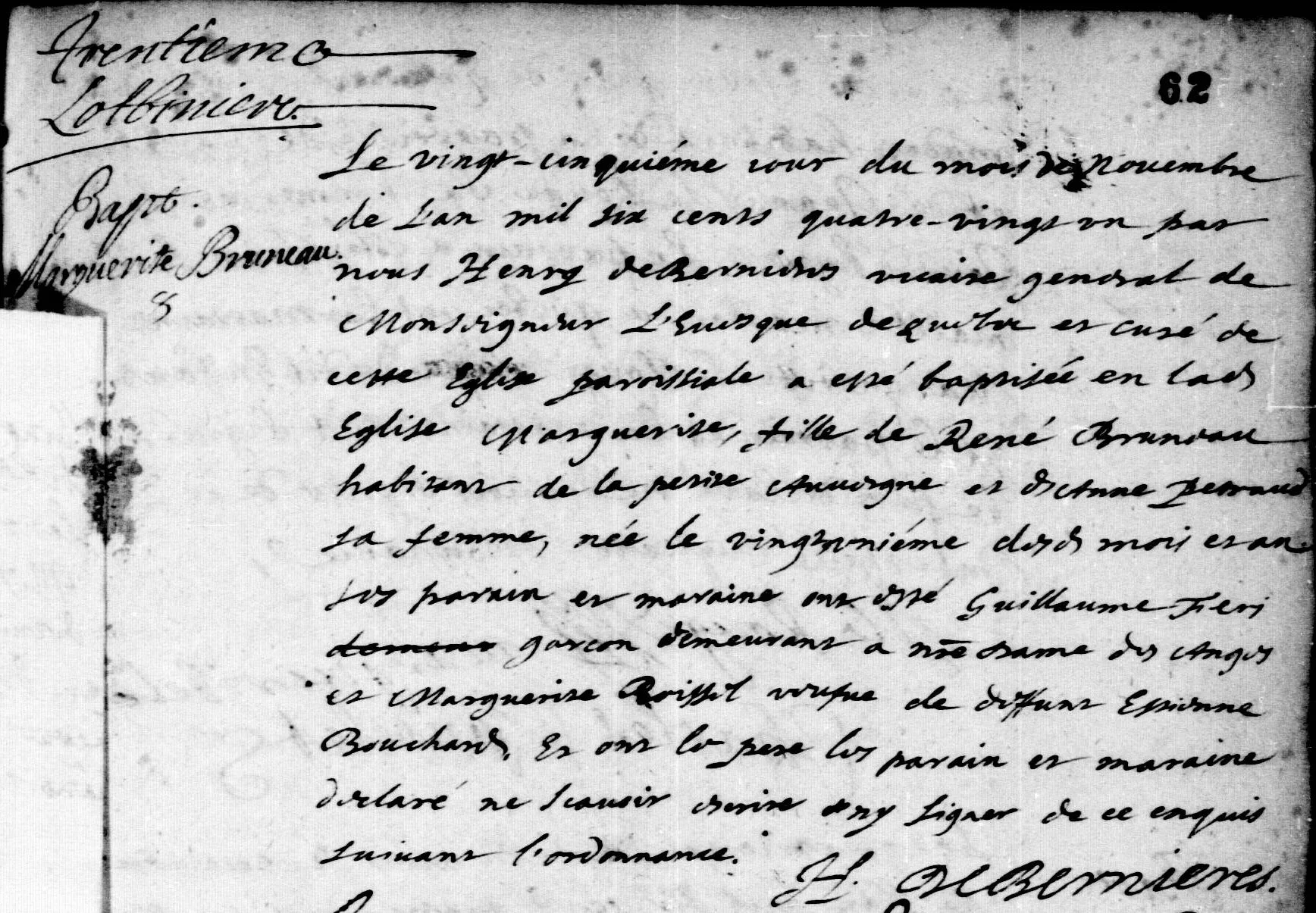
Baptism of Marguerite Bruneau (Généalogie Québec)
Marguerite grew up in Petite-Auvergne. She had nine brothers and sisters, five of whom died in early childhood.
Marriage and Children
On the afternoon of February 15, 1699, notary François Genaple de Bellefonds drew up the marriage contract for Charles Giroux and Marguerite Bruneau in Québec City. Charles was described as a shoemaker residing in Charlesbourg, son of “the late Pierre Girou, formerly a linen bleacher residing in the town of Mortagne in the Perche region, and Magdelaine de Launay.” Marguerite, aged 17, was the “daughter of René Bruneau and Anne Proteau, her father and mother, formerly residents of Petite Auvergne, in the parish of the aforementioned Charlebourg.” She was accompanied by her godfather, Guillaume [Fery?].
Charles was assisted by Pierre Moreau de La Topine. On Marguerite’s side were Guillaume [Fery?], her godfather, as well as her brothers-in-law Jean Lamothe, husband of Anne Bruneau, and François Duclos, husband of Jeanne Bruneau.
Guillaume promised his goddaughter a milk cow to be given to her on the following All Saints’ Day. Charles granted his future wife a fixed dower (douaire préfix) of 300 livres, and the préciput was set at 100 livres. The contract also stipulated that debts incurred before the marriage would remain the responsibility of the person who incurred them. If Marguerite became a widow, she could renounce the community of property and reclaim the assets that had come to her during the marriage through inheritance, donation, or otherwise, as well as her dower, her préciput, and her clothing, garments, and linens for her personal use, without being liable for the debts of the community. The future spouses declared that they did not know how to sign their names.
Charles and Marguerite were married eight days later, on February 23, 1699, in Québec City. Their witnesses were Pierre Moreau de La Topine, Jean Guillot, and Jean Dubreuil.
An order dated September 22, 1772, corrected an error in the marriage record of Charles and Marguerite. At the request of Jacques Laissard, acting on behalf of Charles’s heirs, the ecclesiastical authority noted that Charles’s mother had been listed under the name “Delome” in the marriage register, whereas her correct name was “Delaunay,” as indicated, among other sources, in the marriage contract dated February 15, 1699. The order directed that “Delome” be replaced with “Delaunay” in the register and that the order be attached in the margin of the record.
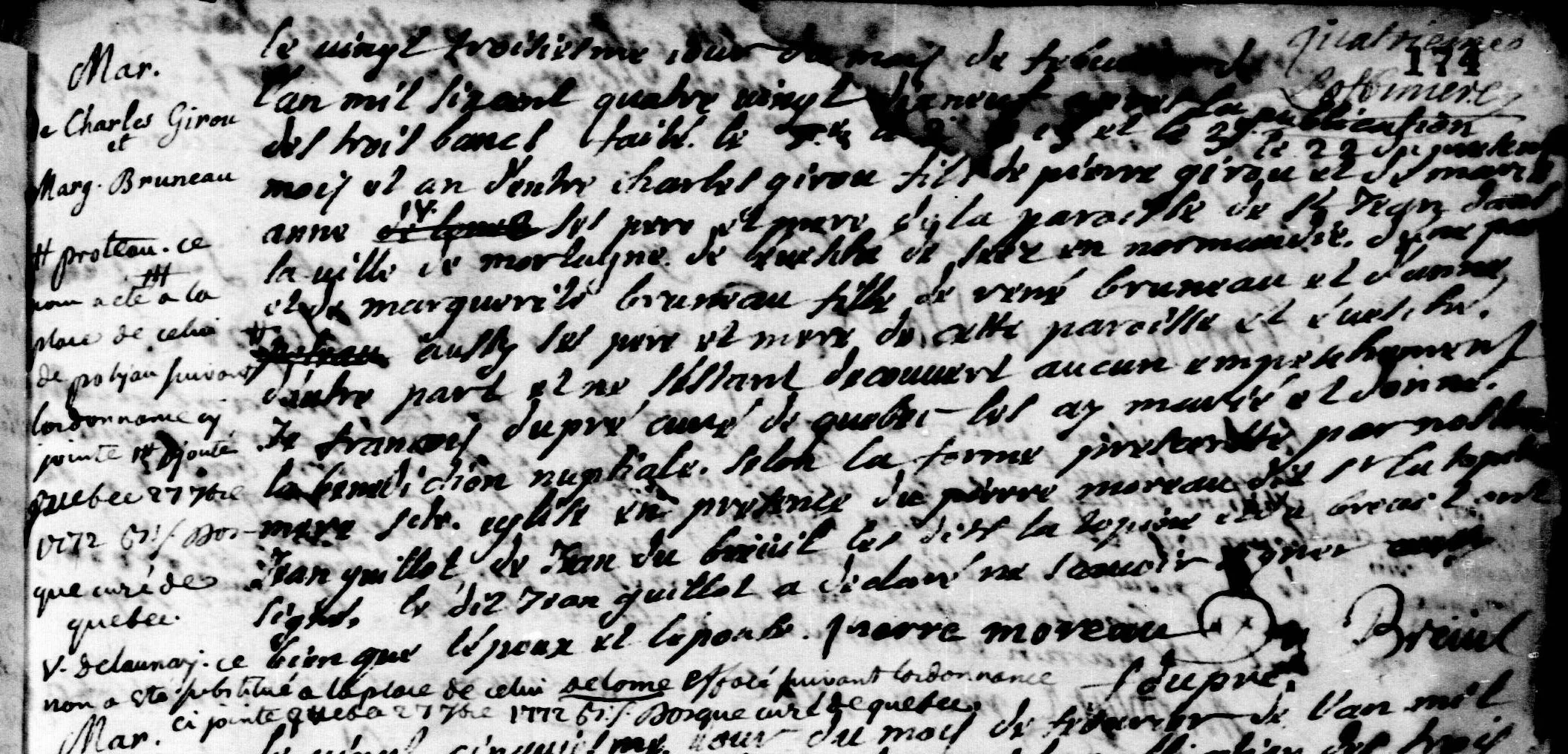
Marriage of Charles Giroux and Marguerite Bruneau (Généalogie Québec)
The couple settled in Québec City, where they had six children:
Marie Marguerite (1700–1774)
Jacques (1702–1703)
Marie Charlotte (1705–1737)
Jean Jacques (1707–1739)
Françoise (1710–1714)
Marie Thérèse (1714–1715)
On the afternoon of October 17, 1704, Charles purchased a property on Rue Saint-Nicolas in Québec City from the mason Jean du Mets [Dumais] for 380 livres. Charles was described in the record as a shoemaker residing in Québec City. The sale included “a small building or bakehouse in the form of a small house constructed of stacked timbers,” measuring twelve feet wide along Rue Saint-Nicolas and fourteen feet deep, with “a small extension” at the rear. Charles stated that he was familiar with the premises, having “occupied and rented them for about six years.”
The lot measured approximately twenty-three feet in frontage on Rue Saint-Nicolas, twenty-eight feet in depth on the side bordering Jacques Huppé dit Lagroix's lot, and thirty-four feet on the side bordering the lot of sieur de Lajoue, an architect. It narrowed to approximately twenty feet four inches in width at the rear. The property was subject to an annual, perpetual ground rent of ten livres payable to the Ursuline nuns on March 9. Dumais himself had acquired the lot from Jacques Huppé by a contract executed before the same notary on April 19, 1698.
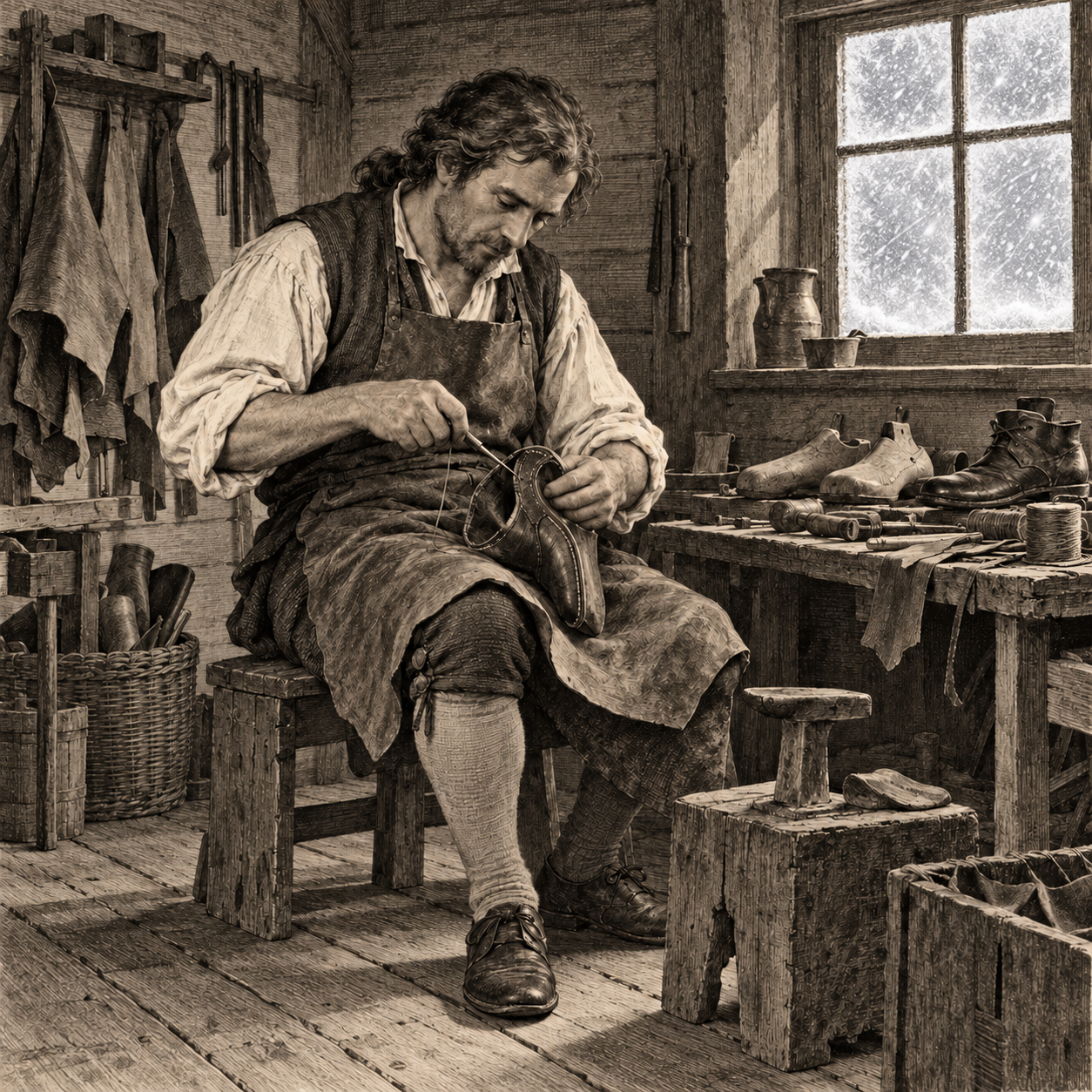
Charles Giroux, a shoemaker in Québec City in the early 18th century. Artistic reconstruction created by the author using artificial intelligence (October 2026, ChatGPT).
Death of Charles
After purchasing his property in 1704, Charles appeared only rarely in the archives, except in parish records concerning his children. He died on March 20, 1714, “after receiving the sacraments of the Church,” and was buried the next day in the parish cemetery in Québec City.
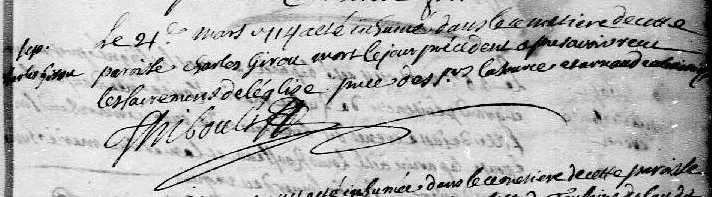
Burial of Charles Giroux (Généalogie Québec)
Charles and his daughters Françoise and Marie Thérèse died within a relatively short period during a major measles epidemic that struck the St. Lawrence Valley in 1714 and 1715, affecting infants and young children in particular. Although the burial records do not specify the cause of their deaths, it is possible that the epidemic contributed to these losses.
Marguerite’s Second Marriage
Following her husband’s death, Marguerite married Hilaire Martin, son of Pierre Martin dit Langoumois and Marie Madeleine Lemieux, on November 2 or 3, 1714, in Québec City. [The date of the marriage is partially obscured by an ink stain. The record appears between baptism records dated November 2 and 3.] Marguerite was 32 years old; Hilaire was 22. He signed the marriage record; she did not.
On the afternoon of November 4, 1714, notary Jean-Étienne Dubreuil drew up the marriage contract between Hilaire and Marguerite at her home on Rue Saint-Nicolas in Québec City. Marguerite was described as the widow of Charles Giroux, “a master shoemaker in this city.” Hilaire was assisted by his father, Pierre Martin; his uncle, Robert Fouchet; his cousin, Louis Pasquet; and Louis Guérin, a master tailor. On Marguerite’s side were her brother-in-law, Alexandre Derny; her nephew, Pierre [name illegible]; her sisters, Anne and Jeanne; and her daughter, Marguerite.
The contract stipulated that each of the future spouses would remain liable for debts incurred before the marriage. Marguerite also agreed to have an inventory drawn up of the community property she had shared with her first husband.
Hilaire granted his future wife a customary dower or a fixed dower (douaire préfix) of 300 livres, at her choice. The préciput, set at 200 livres, was reciprocal and was to be drawn from the assets of the future community, along with the “linens and clothing for her use and a furnished bed.”
Finally, out of affection for Hilaire and to reward him for the “trouble and care” he would have to devote to supporting her family, Marguerite granted him a gift during her lifetime (donation entre vifs) consisting of half of her property.
Two days later, on November 6, 1714, guardianship arrangements were made in Québec City for the four minor children of Charles and Marguerite, following an order issued the previous day. The children were Marguerite, aged 14; Charlotte, aged 9; Jean, aged 7; and Thérèse, aged one month. After taking an oath, the assembled relatives and friends appointed Marguerite as guardian of her children, along with a supervising guardian (subrogé tuteur), Timothé Provost.
The Inventory
On November 7, 1714, notary Jean-Étienne Dubreuil drew up an inventory of the community property of Marguerite and her late husband at their home in Québec City. The inventory was conducted in the presence of Timothée Prévost, the supervising guardian of the minor children, as well as the baker Jean Bonneau and Jean Leconte.
The items listed included:
two iron hooks used as a fireplace crane
a medium-sized iron fire shovel
two cooking pots, one medium-sized and one small, the latter with a lid
a small spoon
an old copper kettle and an old brass saucepan
a medium-sized grill
a medium-sized frying pan
a small roasting spit
a brass strainer
various kinds of dishes
a tinplate knife
a pinewood dough trough
a pinewood chest with hinges and locks
linens and clothing belonging to the aforementioned minor children and Marguerite, stored in the chest but excluded from the inventory
an old wool mattress covered with cloth, weighing approximately 35 pounds
an old straw mattress
a Normandy wool blanket
three horsehair blankets
a pair of bedsheets
two patterned linen towels
two pinewood chairs
a walnut table and a [illegible] made of pine
a small basin
four cords of firewood
an old cow, four years old
two suckling pigs, three months old
a small pinewood bedstead
two charcoal-heated clothes irons
The inventory also included the property on Rue Saint-Nicolas, acquired by Charles in 1704. It consisted of a lot approximately 23 feet wide and 28 to 34 feet deep, on which stood a small timber house built using pièce-sur-pièce construction, measuring approximately 12 feet wide by 14 feet deep, with an extension at the rear. The document then listed the marital community’s outstanding debts and amounts owed to it, as well as its important documents, including notarial deeds. [Pièce-sur-pièce was a traditional French-Canadian building technique in which horizontal squared timbers were stacked to form walls, with the ends fitted into vertical posts or joined at the corners.]
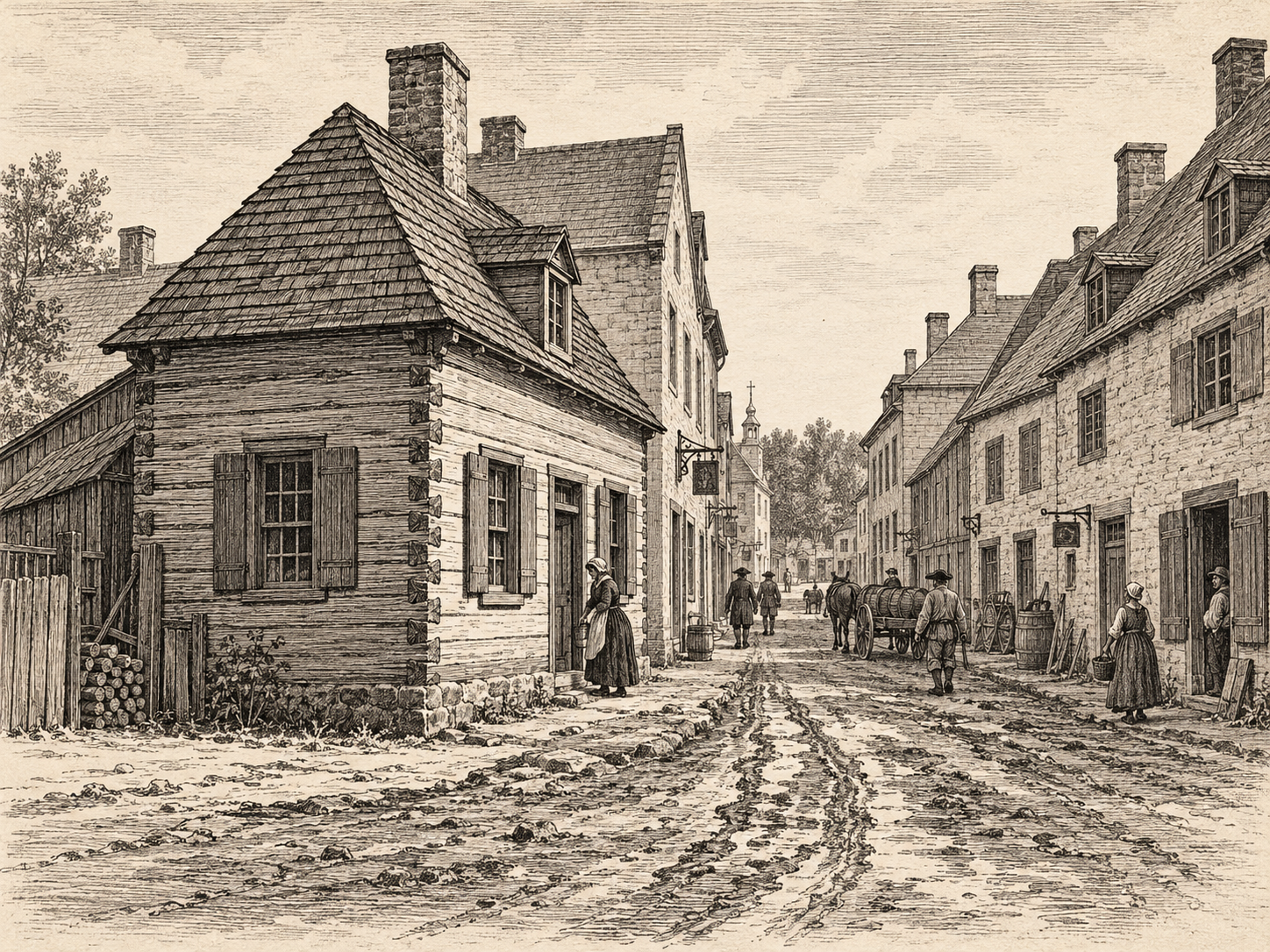
Artistic reconstruction of a small timber house built using pièce-sur-pièce construction on Rue Saint-Nicolas in Québec City, circa 1704. Illustration generated by the author using artificial intelligence (October 2026, ChatGPT).
Marguerite and Hilaire settled in Québec City, living in the house she owned. They had a son, François Joseph, born in 1716.
Death of Marguerite
Marguerite Bruneau died suddenly at the age of 36 on the shore at Sainte-Famille, on Île-d’Orléans. She was buried on April 12, 1718, in the parish cemetery of Sainte-Famille. [The date of death is not listed in the burial record.]
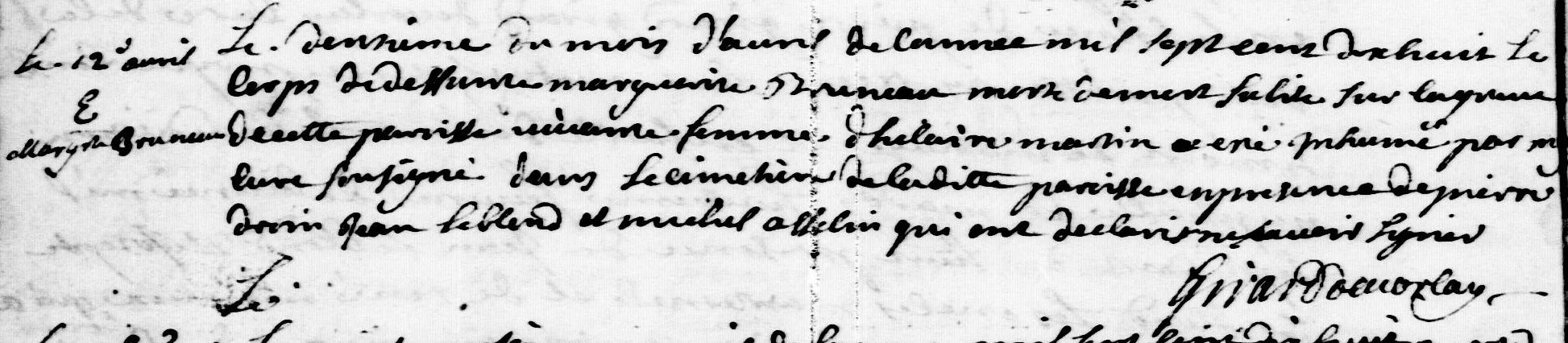
Burial of Marguerite Bruneau (Généalogie Québec)
An Ordinary Family, an Enduring Legacy
Charles Giroux and Marguerite Bruneau were among the ordinary men and women whose lives helped shape early New France. Arriving from the Perche region of France in the late seventeenth century, Charles established himself as a shoemaker in Québec City, where he married Marguerite in 1699. Together, they had six children and built a life in their modest home on Rue Saint-Nicolas. Their years together were marked by the familiar demands of work and family, as well as considerable hardship. Charles died in 1714, and two of their young daughters died within the following year.
Widowed at 32, Marguerite remarried and continued caring for her family until her own death in 1718. Although neither Charles nor Marguerite occupied a prominent place in colonial society, the surviving records reveal an unusually intimate picture of their lives. Their marriage contracts, property transactions, and household inventory tell us about their possessions, financial obligations, family relationships, and the practical realities of life in early eighteenth-century Québec. More than three centuries later, their story reminds us that the history of New France was shaped not only by its governors, soldiers, and seigneurs, but also by working families whose everyday experiences formed the foundation of French-Canadian society.
PDF version of biography located at: https://www.tfcg.ca/charlesgiroux-and-margueritebruneau.
Are you enjoying our articles and resources? Show your support by making a donation. Every contribution, regardless of its size, goes a long way in covering our website hosting expenses and enables us to create more content related to French-Canadian genealogy and history. Thank you! Merci!
Sources:
"Le LAFRANCE (Baptêmes, Mariages, Sépultures)," database and digital images, Généalogie Québec (https://www.genealogiequebec.com/Membership/LAFRANCE/acte/67609 : accessed 15 Oct 2026), marriage of Nicolas Foulon and Barbe Boyer, 29 Oct 1698, Québec (Notre-Dame-de-Québec); citing original data: Institut généalogique Drouin.
“Le LAFRANCE (Baptêmes, Mariages, Sépultures),” database and digital images, Généalogie Québec (https://www.genealogiequebec.com/Membership/LAFRANCE/acte/60010 : accessed 15 Oct 2026), baptism of Marguerite Bruneau, 25 Nov 1681, Québec (Notre-Dame-de-Québec); citing original data: Institut généalogique Drouin.
“Le LAFRANCE (Baptêmes, Mariages, Sépultures),” database and digital images, Généalogie Québec (https://www.genealogiequebec.com/Membership/LAFRANCE/acte/67627 : accessed 15 Oct 2026), marriage of Charles Girou and Marguerite Bruneau, 23 Feb 1699, Québec (Notre-Dame-de-Québec); citing original data: Institut généalogique Drouin.
“Le LAFRANCE (Baptêmes, Mariages, Sépultures),” database and digital images, Généalogie Québec (https://www.genealogiequebec.com/Membership/LAFRANCE/acte/71110 : accessed 15 Oct 2026), burial of Charles Girou, 21 Mar 1714, Québec (Notre-Dame-de-Québec); citing original data: Institut généalogique Drouin.
“Le LAFRANCE (Baptêmes, Mariages, Sépultures),” database and digital images, Généalogie Québec (https://www.genealogiequebec.com/Membership/LAFRANCE/acte/68037 : accessed 15 Oct 2026), marriage of Hilaire Martin and Marguerite Bruno, 2 or 3 Nov 1714, Québec (Notre-Dame-de-Québec); citing original data: Institut généalogique Drouin.
“Le LAFRANCE (Baptêmes, Mariages, Sépultures),” database and digital images, Généalogie Québec (https://www.genealogiequebec.com/Membership/LAFRANCE/acte/33318 : accessed 15 Oct 2026), burial of Marguerite Bruneau, 12 Apr 1718, Ste-Famille (Île d'Orléans); citing original data: Institut généalogique Drouin.
“Canada, Québec, registres paroissiaux catholiques, 1621-1979," digital images, FamilySearch (https://familysearch.org/ark:/61903/3:1:3QS7-899S-D3HZ?cc=1321742&wc=9RL4-829 : accessed 15 Oct 2026), ordinance of 1772 concerning the name of Charles Giroux's mother at the time of his marriage in 1699, Québec > Notre-Dame-de-Québec > Baptêmes, mariages, sépultures 1679-1790, part 1-25 > image 694 of 919; citing original data: Archives nationales du Québec, Montréal.
“Actes de notaire, 1682-1709 // François Genaple,” digital images, FamilySearch (https://www.familysearch.org/ark:/61903/3:1:3Q9M-CS56-VQ9B-W?cat=koha%3A1168969&view=explore&lang=en&groupId=TH-909-76008-102518-49 : accessed 15 Oct 2026), marriage contract of Charles Girou and Marguerite Bruneau, 15 Feb 1699, Québec, images 2345-2347 of 3410; citing original data: Bibliothèque et Archives nationales du Québec.
“Actes de notaire, 1682-1709 // François Genaple,” digital images, FamilySearch (https://www.familysearch.org/ark:/61903/3:1:3Q9M-CSTC-T3Z4-Q?cat=koha%3A1168969&view=explore&lang=en&groupId=TH-909-77696-89271-24 : accessed 15 Oct 2026), sale of a lot and house by Jean Dumets to Charles Girou, 17 Oct 1704, Québec, images 693-694 of 1695; citing original data: Bibliothèque et Archives nationales du Québec.
“Actes de notaire, 1708-1739 // Jean-Etienne Dubreuil,” digital images, FamilySearch (https://www.familysearch.org/ark:/61903/3:1:3QHV-R3LC-HNP7?cat=koha%3A746806&view=explore&lang=en&groupId=TH-7764-100178-11916-51 : accessed 19 Oct 2026), marriage contract of Hilaire Martin and Marguerite Bruneau, 4 Nov 1714, Québec, images 1596-1598 of 2988; citing original data: Bibliothèque et Archives nationales du Québec.
“Actes de notaire, 1708-1739 // Jean-Etienne Dubreuil,” digital images, FamilySearch (https://www.familysearch.org/ark:/61903/3:1:3QHV-R3LC-HNGK?cat=koha%3A746806&view=explore&lang=en&groupId=TH-7764-100178-11916-51 : accessed 19 Oct 2026), inventory of the goods of the community of Marguerite Bruneau, widow of Charles Girou, 7 Nov 1714, Québec, images 1601-1606 of 2988; citing original data: Bibliothèque et Archives nationales du Québec.
“Fonds Cour supérieure. District judiciaire de Québec. Tutelles et curatelles - Archives nationales à Québec,” digital images, Bibliothèque et Archives nationales du Québec (https://advitam.banq.qc.ca/notice/67134 : accessed 15 Oct 2026), “Tutelle aux mineurs de feu Charles Giroux, cordonnier, de Québec, et de Marguerite Bonneau (Bruneau),” 6 Nov 1714, reference CC301,S1,D314, Id 67134.
Université de Montréal, Programme de recherche en démographie historique (PRDH) database (https://www-prdh-igd-com.res.banq.qc.ca/Membership/en/PRDH/Famille/8315 : accessed 15 Oct 2026), dictionary entry for Charles GIROUX and Marie Marguerite BRUNEAU JOLICOEUR, union 8315.
Université de Montréal, Programme de recherche en démographie historique (PRDH) database (https://www-prdh-igd-com.res.banq.qc.ca/Membership/en/PRDH/Famille/11820 : accessed 15 Oct 2026), dictionary entry for Hilaire MARTIN LANGOUMOIS and Marie Marguerite BRUNEAU JOLICOEUR, union 11820.
Ryan Mazan, Alain Gagnon & Bertrand Desjardins, “The Measles Epidemic of 1714-1715 in New France,” Canadian Studies in Population (https://doi.org/10.25336/P63P5Q : accessed 15 Oct 2026), fall/winter 2009, vol. 36.4, 295-323.