Bertrand Guérin & Marguerite Gariépy
Discover the fascinating story of Bertrand Guérin, a merchant from Avranches, Normandie, who immigrated to New France in the early 18th century, and his wife, Marguerite Gariépy, born on Île-Jésus (present-day Laval, Québec). Married in 1739, the couple established a family and acquired property in the Montréal region. Through parish registers, marriage contracts, land transactions and detailed estate inventories, their biography offers a glimpse into everyday life in colonial Québec, including commerce, landownership, family relationships and the challenges of widowhood. Explore the lives of these early French-Canadian ancestors and the legacy they left through their descendants.
Cliquez ici pour la version en français
Bertrand Guérin & Marguerite Gariépy
From Avranches to Île-Jésus: A New Beginning
Bertrand Guérin, son of Guillaume Guérin and Françoise Le Hanneur, was baptized on June 16, 1699, in the parish of Notre-Dame-des-Champs in Avranches, Normandie, France. His father was recorded as a “marchand bourgeois,” or bourgeois merchant. His godparents were [Renaud?] [Adouin?], also a bourgeois merchant, and Madeleine Noël. Only the godmother signed the baptism record. [The date of birth was omitted from the baptism record.]
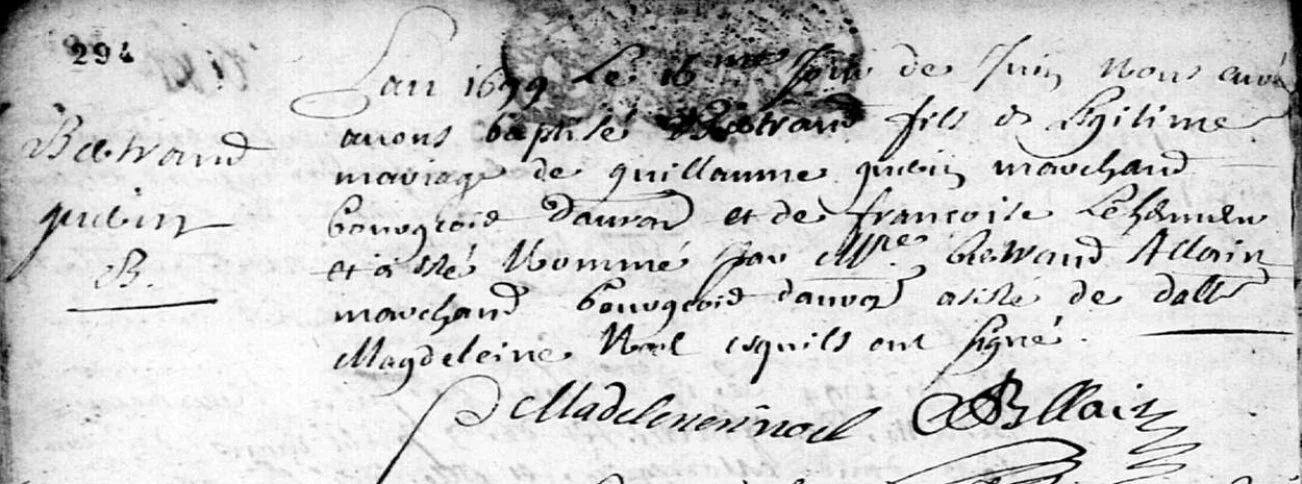
1699 baptism of Bertrand Guérin (Archives départementales de la Manche)
Avranches lies approximately 270 kilometres west of Paris, in the present-day department of Manche. It has a population of about 10,000 residents, called Avranchais or Avranchinais. It is situated on the Bay of Mont-Saint-Michel, facing the famous tidal island.
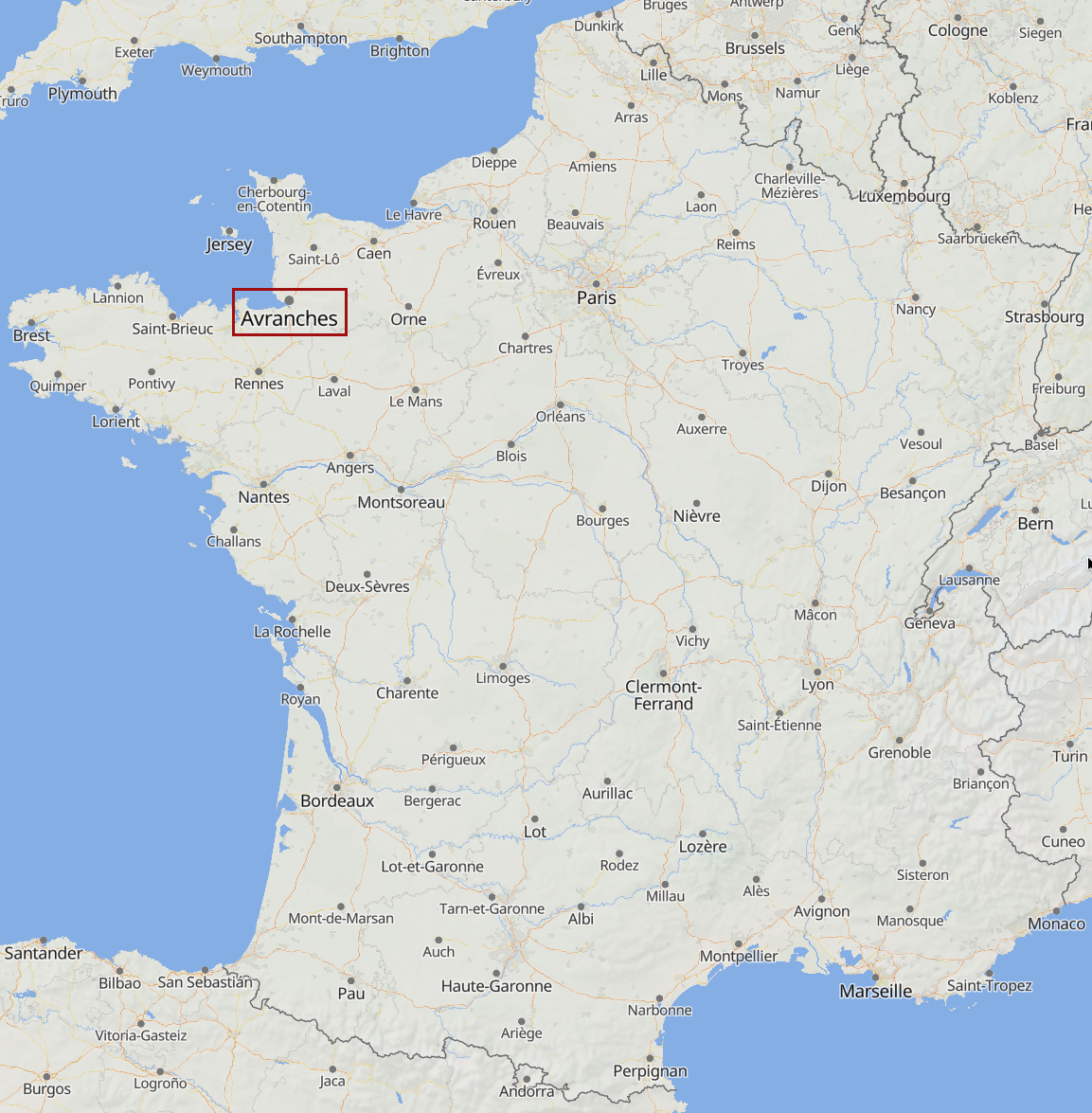
Location of Avranches in France (Mapcarta)
The parish of Notre-Dame-des-Champs dates to the Middle Ages, when a small chapel was established outside the southern walls of Avranches. Originally associated with a cemetery, it eventually became a parish church as the surrounding population grew. The modest church where Bertrand was baptized in 1699 was replaced in the 19th century by a much larger neo-Gothic building. Construction began in 1863, and the new church was consecrated in 1892. Damaged during the Second World War, the church was restored and remains an important landmark in Avranches.
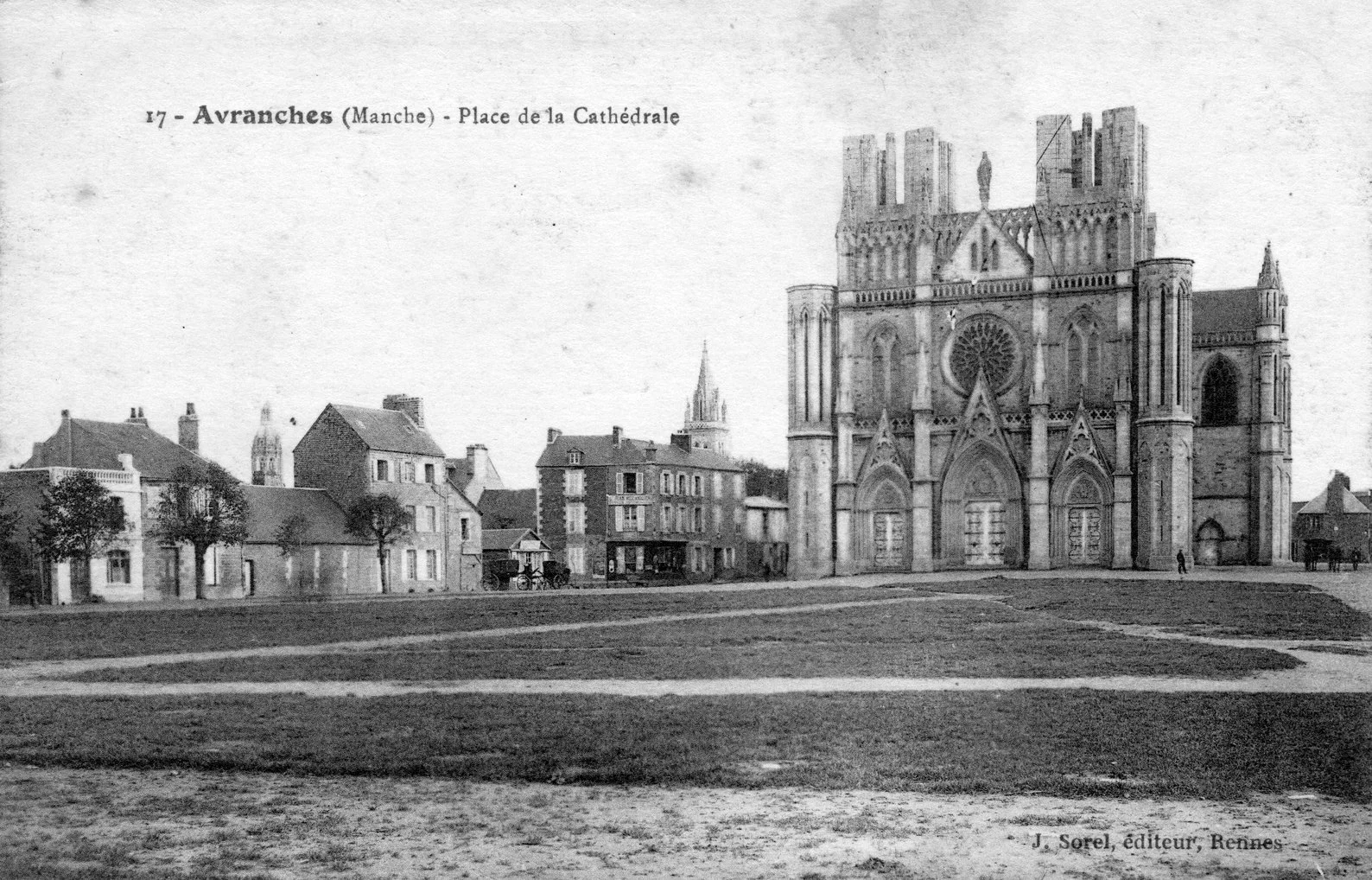
Église Notre-Dame-des-Champs in Avranches, postcard, 1915 (Geneanet)
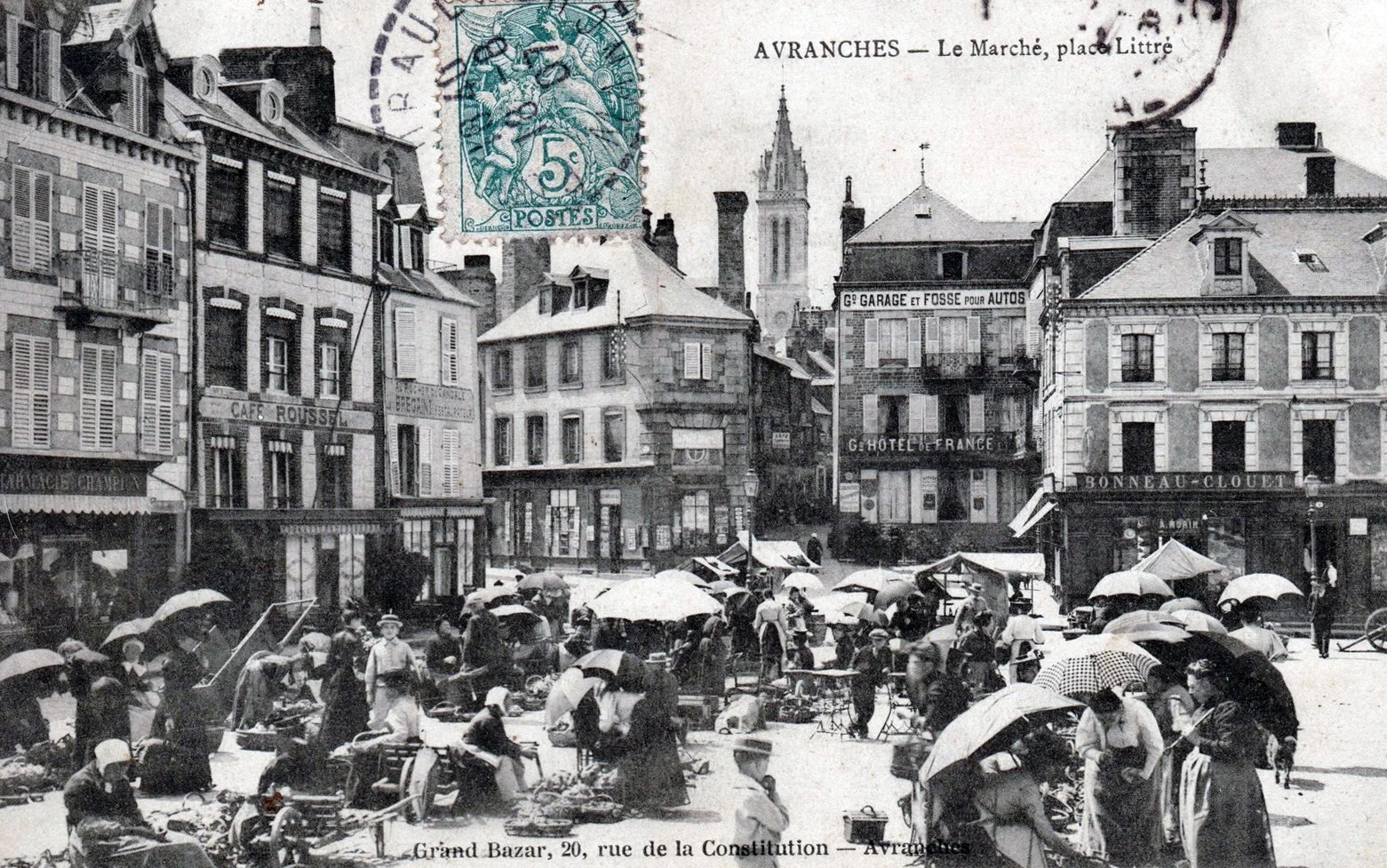
The market in Avranches, postcard, 1907 (Geneanet)
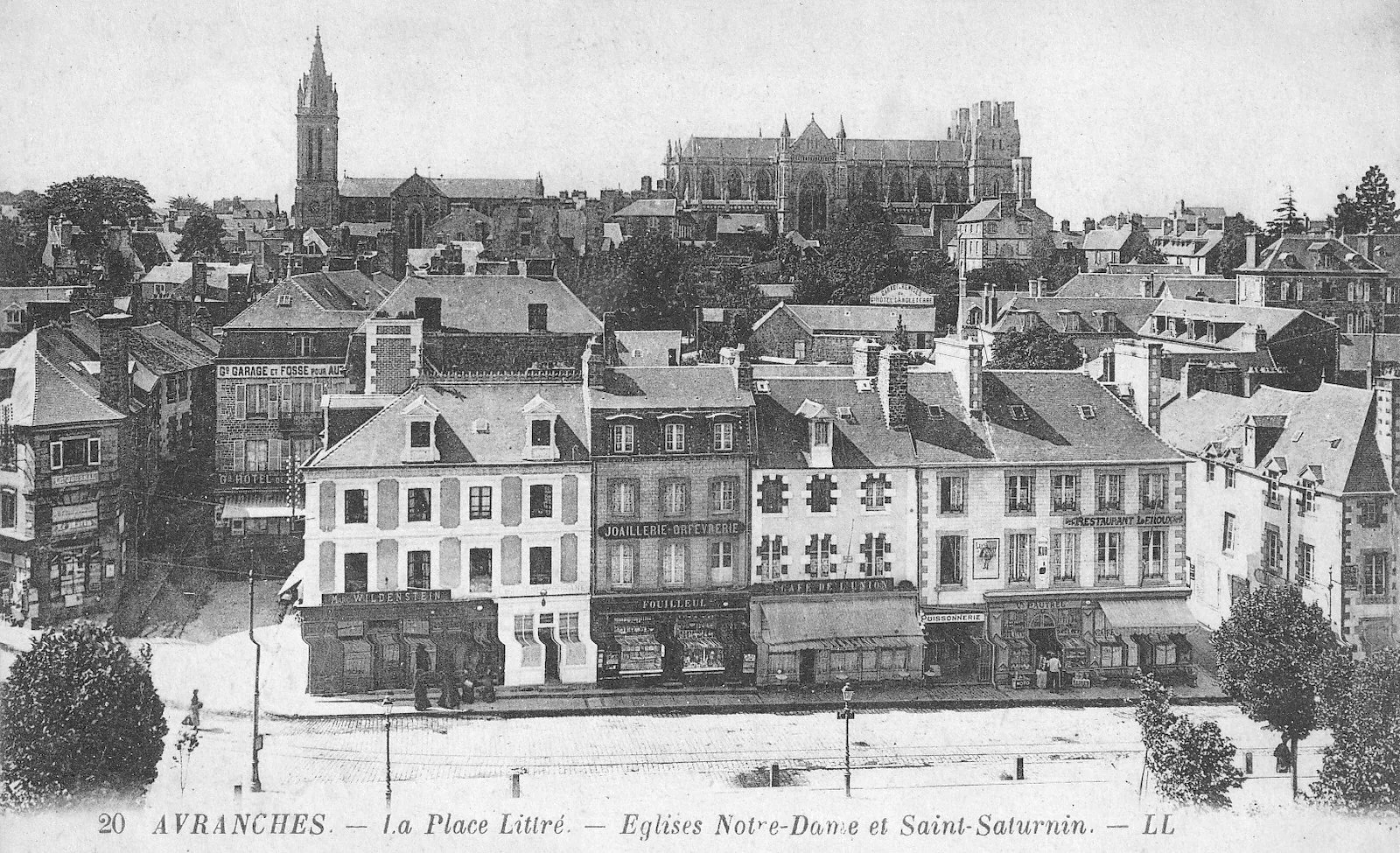
Place Littré in Avranches (Notre-Dame-des-Champs appears in the background on the right), postcard, 1921 (Geneanet)
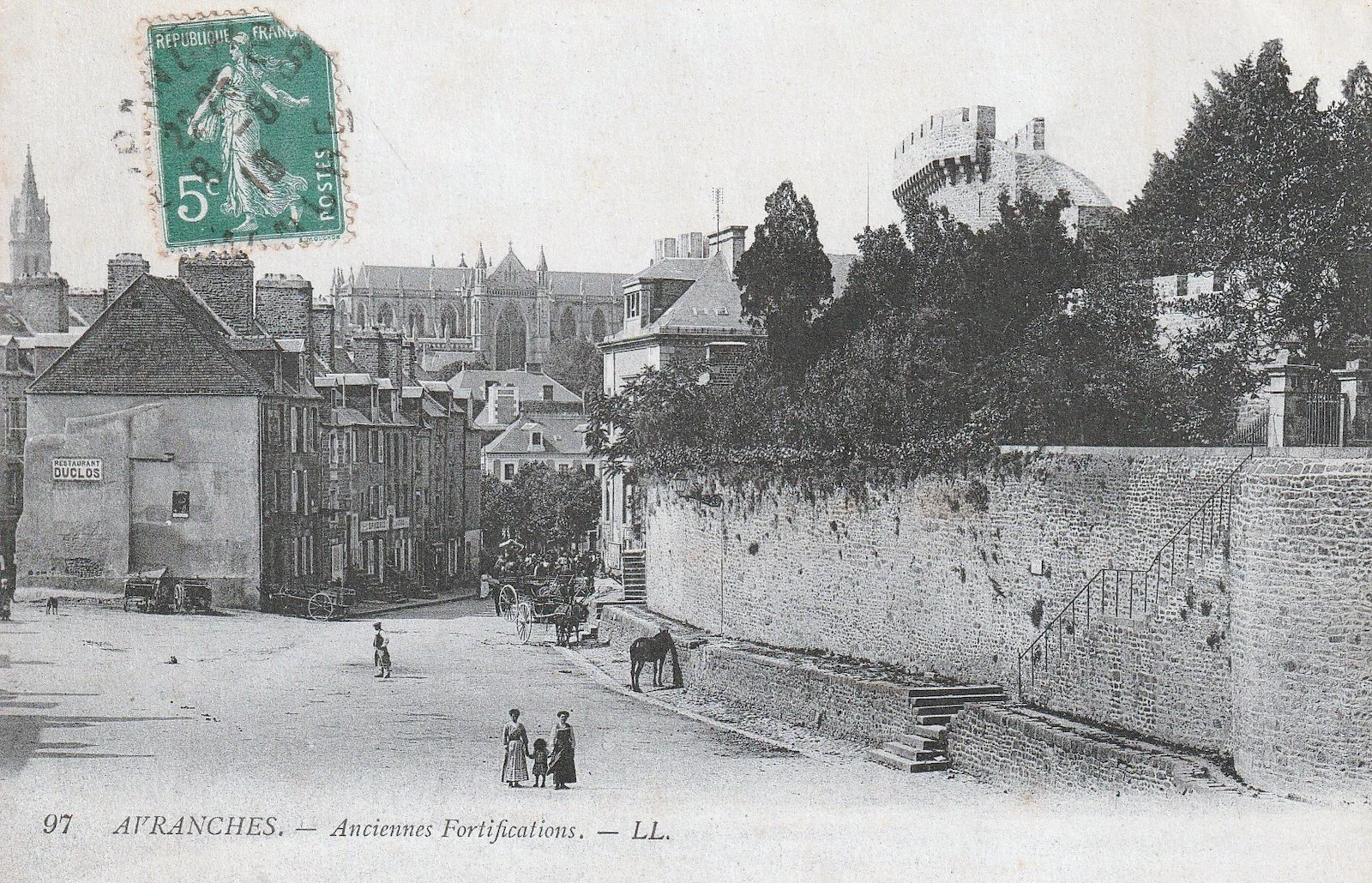
The old fortifications of Avranches, postcard, circa 1910 (Geneanet)
Bertrand’s parents, Guillaume Guérin and Françoise Le Hanneur, were married on October 24, 1690, in the same parish. The groom was 26 years old, while the bride was 24. Bertrand’s paternal grandparents were André Guérin and Anne Gautier. His maternal grandparents were Jean Le Hanneur and Françoise Houlier.
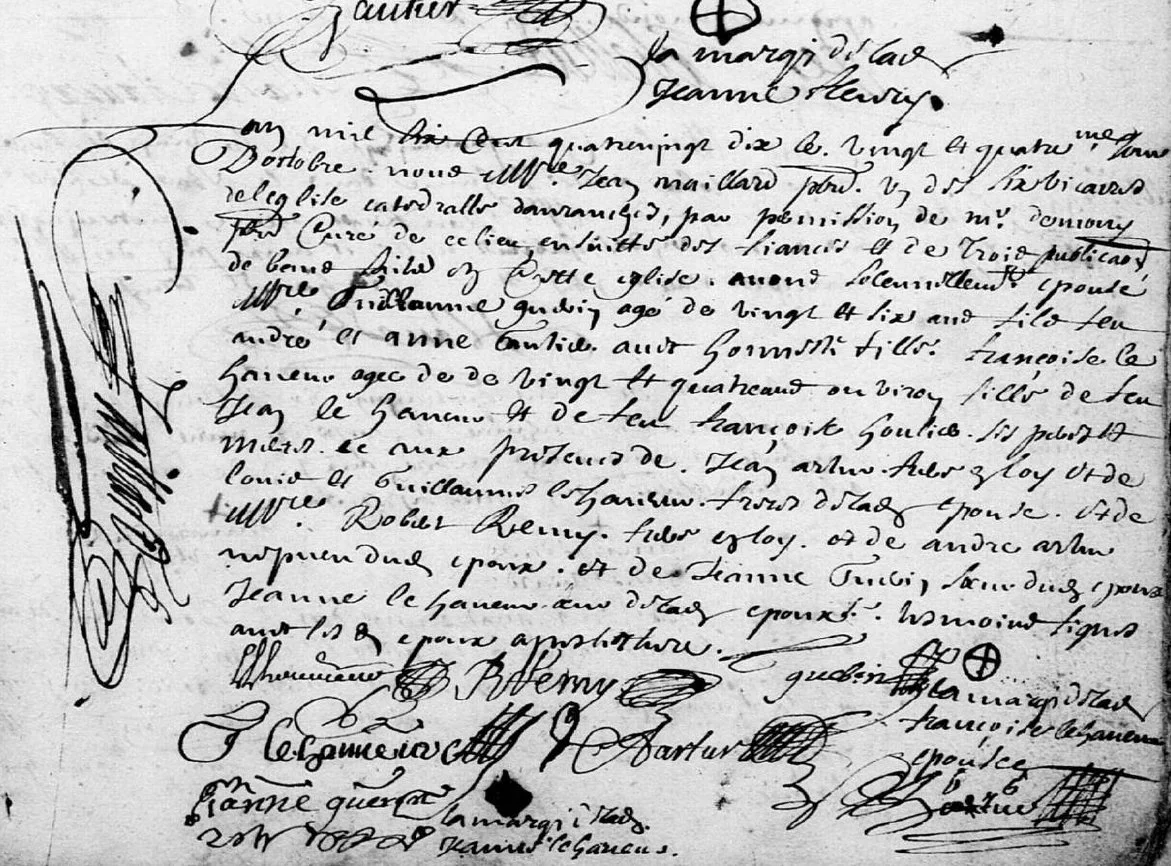
1690 marriage of Guillaume Guérin and Françoise Le Hanneur (Archives départementales de la Manche)
After their marriage, Guillaume and Françoise remained in Avranches, where they had five other children: Françoise Jeanne (baptized on November 18, 1691), Jean Baptiste (baptized on June 24, 1694), Marie Anne (baptized on November 20, 1697), Geneviève (baptized on December 18, 1702) and Guillaume (baptized on March 3, 1706).
Arrival in New France
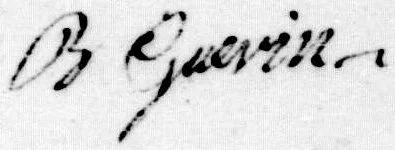
Bertrand’s signature in 1735 (Généalogie Québec)
The circumstances surrounding Bertrand's departure from France are unknown, as is the date of his arrival in New France. He first appears in colonial parish records on December 7, 1735, when he served as a godfather to Charles Amable Cusson, the son of Jacques Cusson and Michelle Cholet, in the parish of Saint-François-de-Sales on Île-Jésus [present-day Laval, Québec].
As the son of a bourgeois merchant, Bertrand may have been attracted by the commercial opportunities available in the growing colony, particularly in the fur trade or other mercantile activities. Alternatively, he may have sought greater economic independence or opportunities that were less readily available to him in France. Whatever his motivations, his presence in New France by 1735 marks the beginning of the Guérin family's documented history in the colony.
On the afternoon of December 31, 1737, Bertrand purchased land on the north side of Île-Jésus from Étienne Charles and Marie Françoise Leclerc for 145 livres. Bertrand was described as a merchant and resident of Île-Jésus. The land measured half an arpent of frontage by two arpents in depth, bordering the Rivière Jésus (now the Rivière des Mille Îles) in front, the land of Julien Rochon at the back and on one side, and the land of François Gibouleau on the other side.
The land included a small house, supported by posts driven into the ground, covered with boards and equipped with a stone stove, as well as a stable. Bertrand agreed to pay all future cens and rentes associated with the property. The deed was signed in the presence of Louis Filiatrault and Athanase Gravelle. Bertrand paid the purchase price in full.
Marguerite Gariépy, daughter of Pierre Gariépy and Marie Huboux, was born on June 25, 1714. She was baptized the following day in the parish of Saint-François-de-Sales on Île-Jésus. Her godparents were Charles Mathieu and Marguerite Goulet. Only the godmother was able to sign the baptism record.
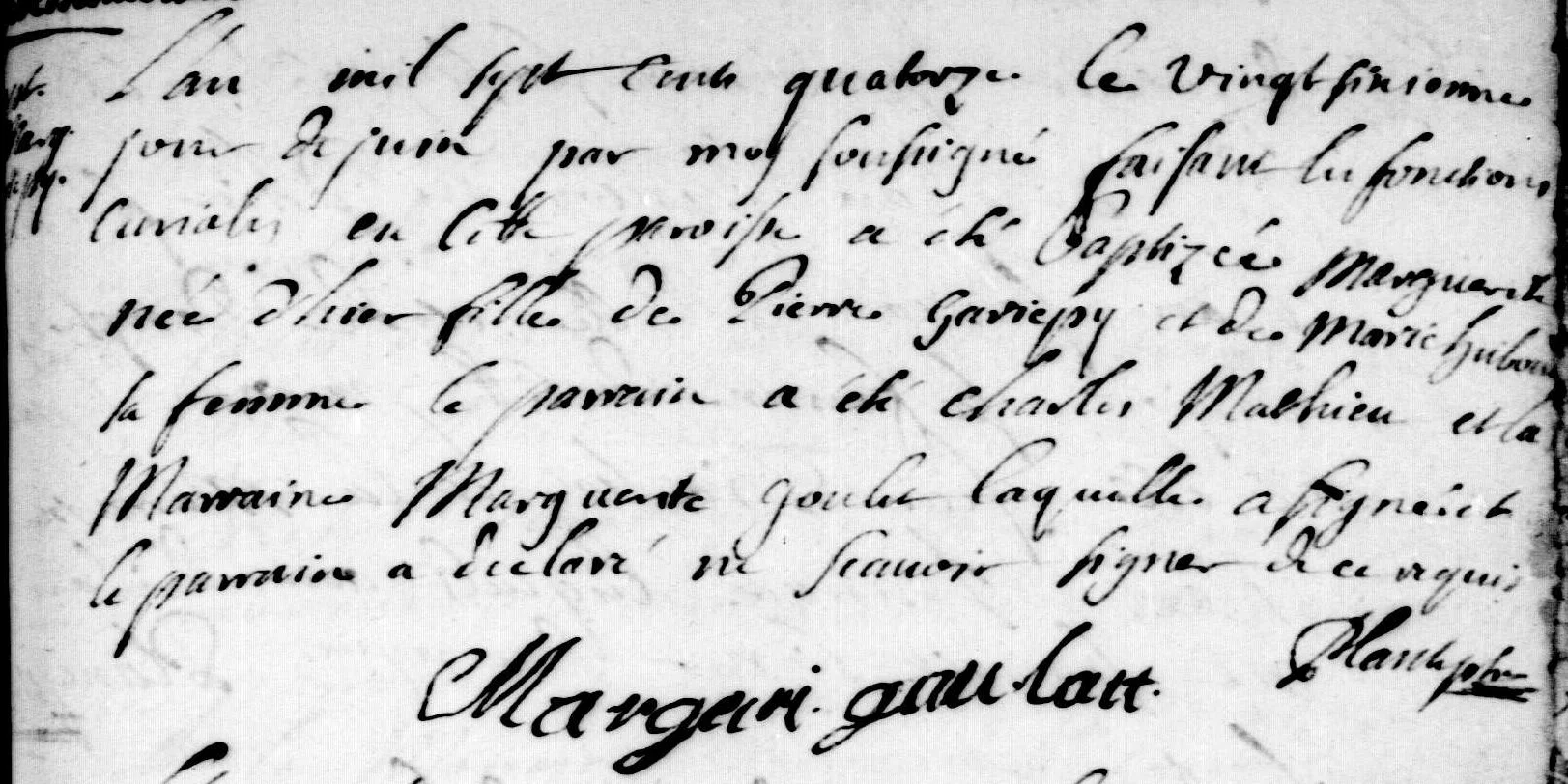
1714 baptism of Marguerite Gariépy (Généalogie Québec)
On the afternoon of February 1, 1739, notary Charles François Coron drew up the marriage contract between 39-year-old Bertrand Guérin and 24-year-old Marguerite Gariépy in his study on Île-Jésus. Pierre Gariépy, described as a “notable habitant de Lachenaie” (prominent resident of Lachenaie), acted on behalf of his daughter Marguerite. Bertrand’s witnesses were Antoine Parant, fiscal prosecutor; Toussaint Masta; and Joseph Charbonneau. Marguerite’s witness was Alexis Gariépy, militia major.
The contract followed the provisions of the Coutume de Paris (Custom of Paris), the legal system governing marital property in New France. Each spouse remained responsible for debts incurred before the marriage. Marguerite was entitled to a douaire préfix (fixed dower) of 300 livres if Bertrand died before her, while the surviving spouse would receive a préciput of 150 livres from the community’s movable property before its division. Bertrand included the land he had purchased on Île-Jésus in their future community of property.
Marguerite’s father promised to provide her with a milk cow, two sheep, a suckling pig and a bed with a quilt. Bertrand and several witnesses signed the contract, but Marguerite declared that she could not sign her name.
Bertrand and Marguerite were married eight days later on February 9, 1739, in Lachenaie. Their witnesses were Pierre and Alexis Gariépy, Noël Chapleau, Joseph Charbonneau, and Toussaint Limoges. Bertrand and several witnesses were able to sign their names.
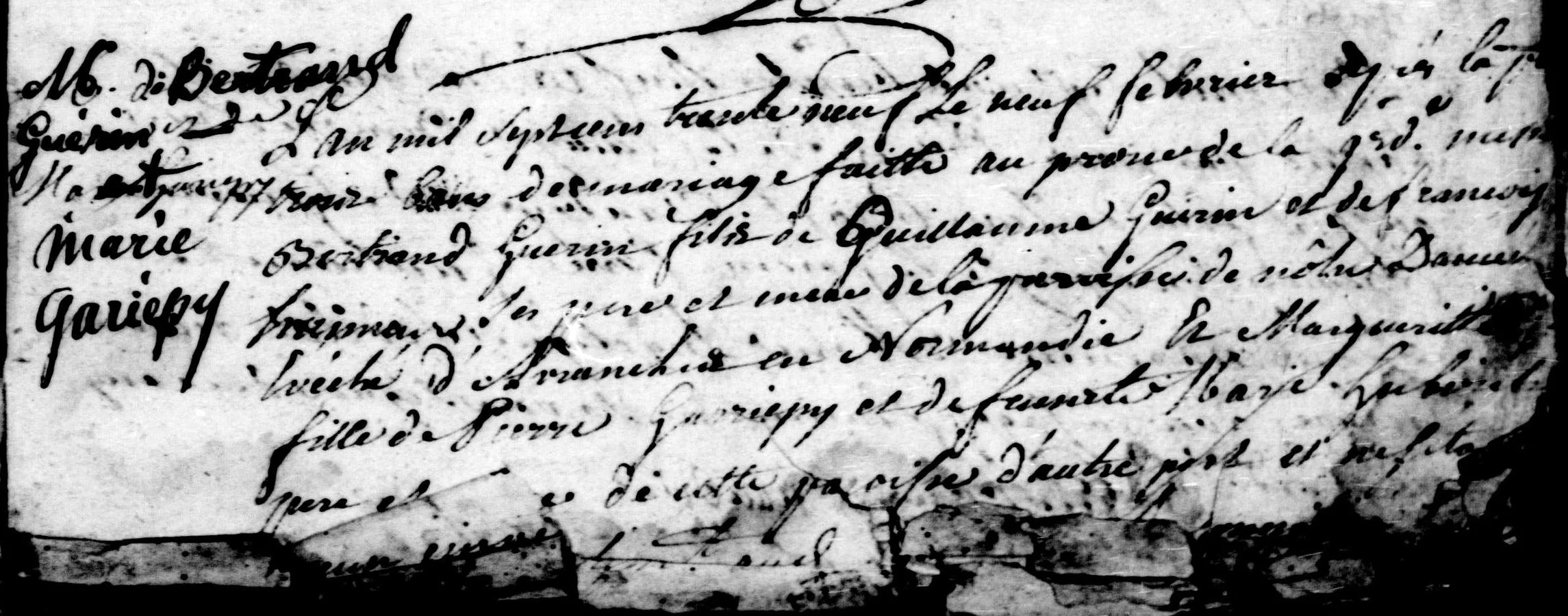
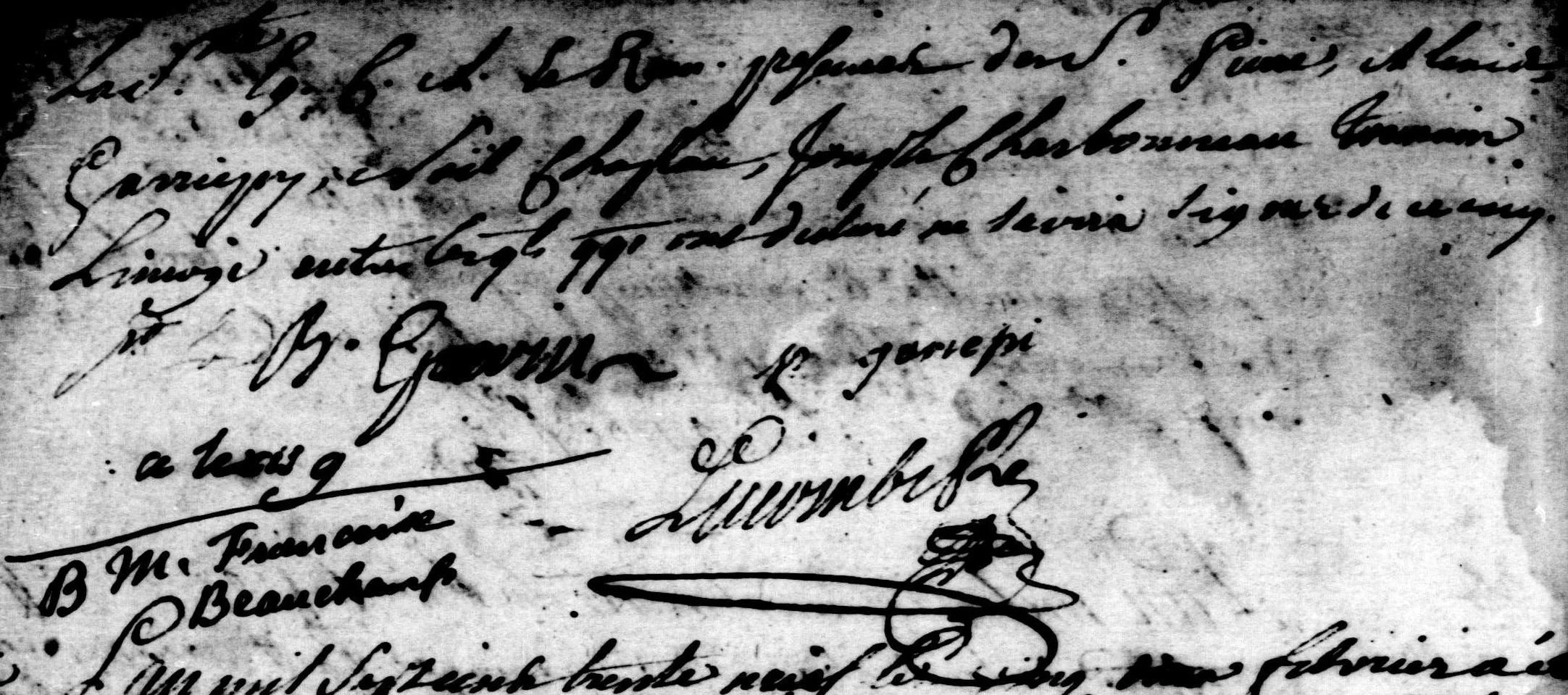
1739 marriage of Bertrand Guérin and Marguerite Gariépy (Généalogie Québec)
The couple had at least four children:
Marie Marguerite (1739–1812)
Marie Françoise (1742–1804)
Bertrand (1743–1818)
Guillaume (1745–1747)
Variances in son Bertrand’s Given Names
Bertrand Guérin appears under several different given names in parish records. Baptized Jean François in 1743, he was subsequently identified as Pierre in his 1773 marriage record and in the 1775 baptism of one of his children. He was also recorded as Jean François in 1773 and Jean in 1784. However, the name Bertrand appears most consistently, particularly in the baptismal records of his children from 1776 onward and in the marriage records of five of his children between 1799 and 1822. His 1773 marriage record is particularly unusual, as it also incorrectly identifies his father. Despite these discrepancies, the records appear to concern the same individual. He appears as Pierre Jean François Bertrand Guérin in the PRDH database.
All the Guérin children were baptized in Terrebonne, across the Mille Îles river from Île-Jésus, where the family was likely living (on Bertrand’s land).
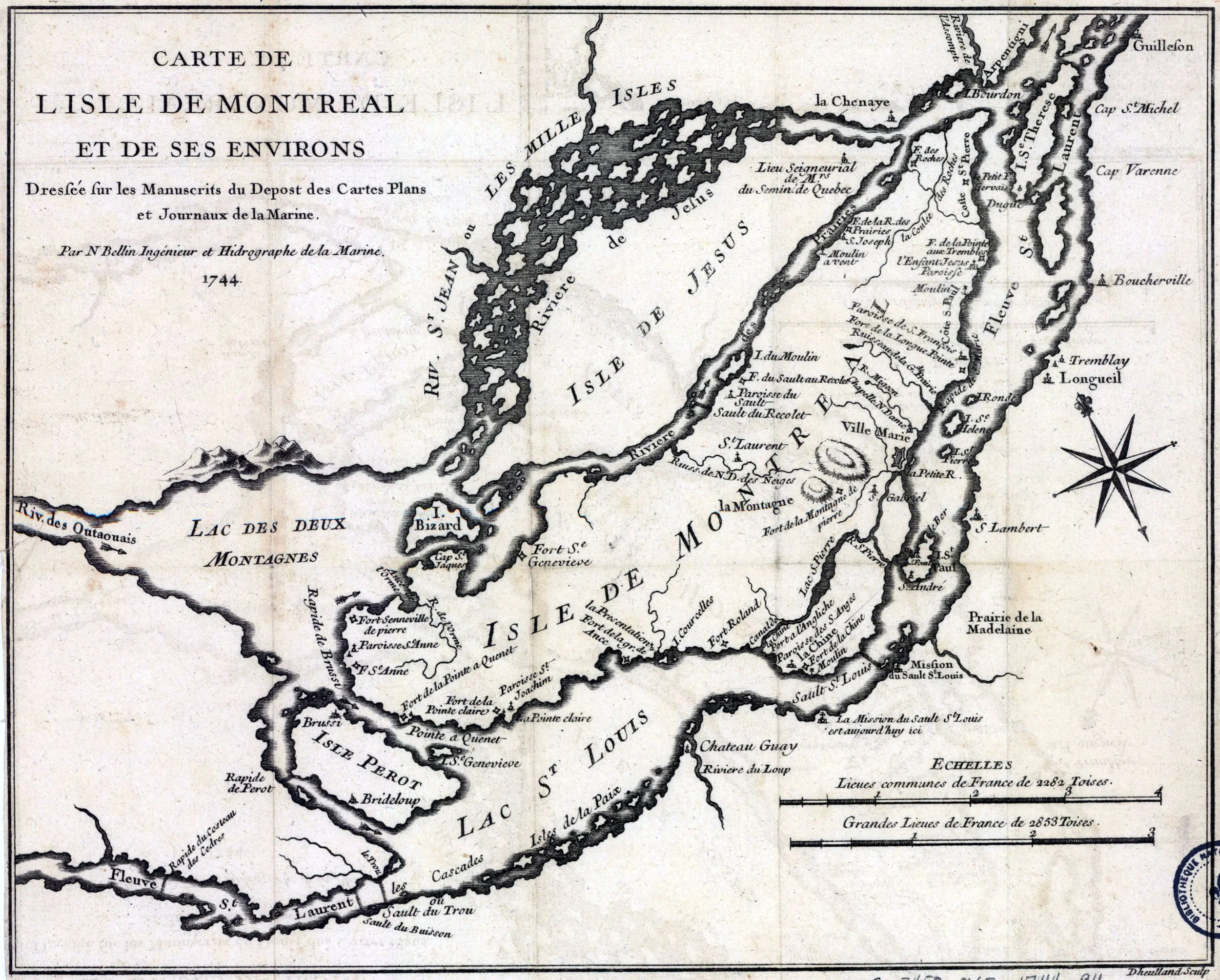
“Map of the Island of Montreal and Its Surroundings,” created by Jacques-Nicolas Bellin, 1744 (Bibliothèque et Archives nationales du Québec)
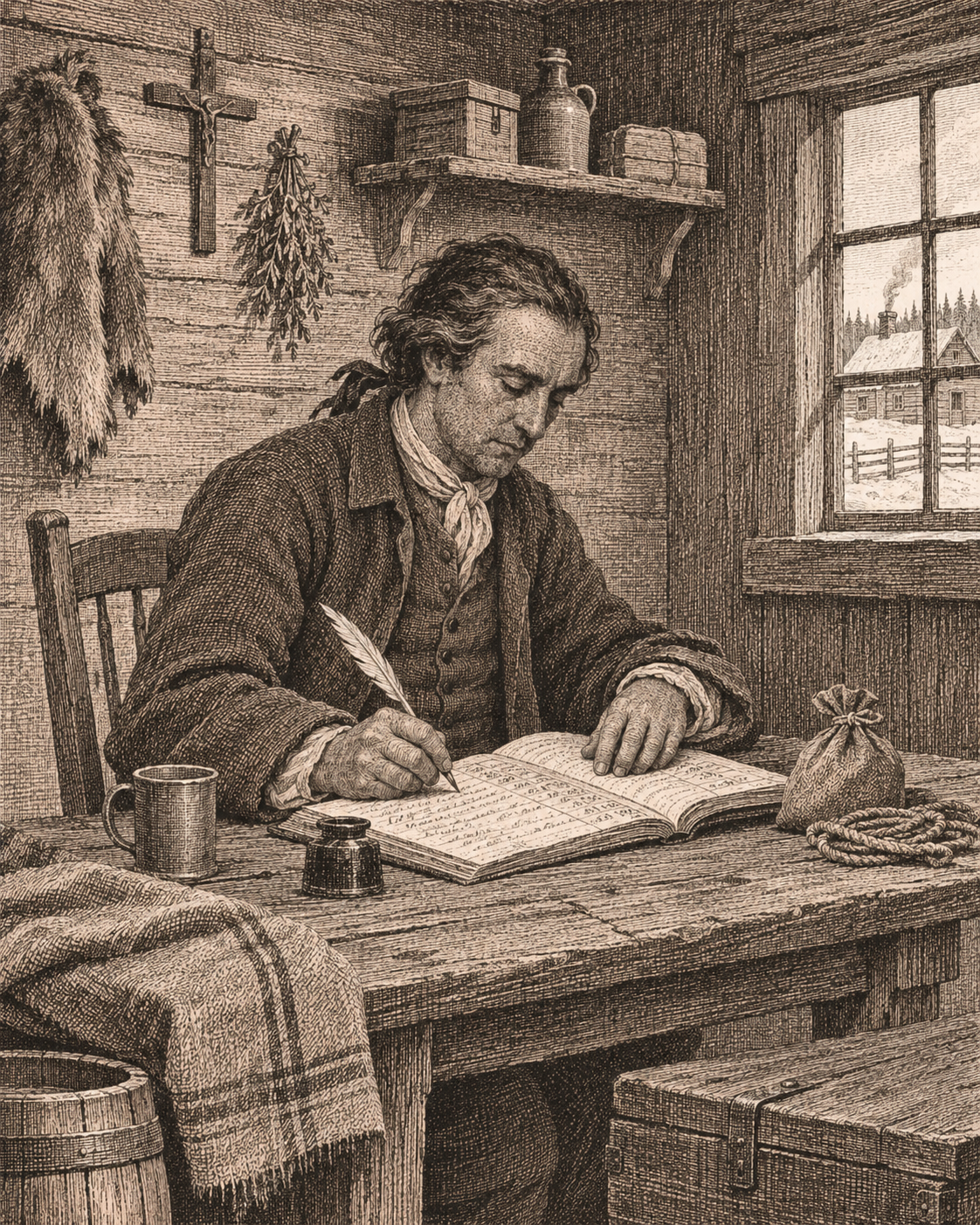
Illustration generated with artificial intelligence by the author, Nov 2026 (ChatGPT)
On June 26, 1743, Bertrand and his neighbour Julien Rochon purchased land on the north side of Île-Jésus from Michel Taillon and Marie Madeleine Masson for 53 livres. Bertrand was described as a négociant, or merchant, residing on Île-Jésus, while Rochon was described as an habitant.
The land measured two arpents of frontage by twenty arpents in depth. It was bordered by the land of Jean Baptiste Ménard dit Bellerose at the front, the côte Saint-François at the back, the purchasers’ existing property on one side, and Ménard’s land on the other. Bertrand received one arpent of frontage adjoining Ménard’s land, while Rochon received the other arpent, adjoining their existing property.
The property was subject to an annual rente of two sols per arpent of area and two sols in cens for the entire concession. The purchasers paid the full purchase price, and both Bertrand and Rochon signed the deed.
Death of Bertrand
Bertrand Guérin died at the age of 48, “having received the sacraments.” He was buried on April 15, 1748, in the parish cemetery of Terrebonne. [The date of death was omitted from the burial record, as was a cause of death.]
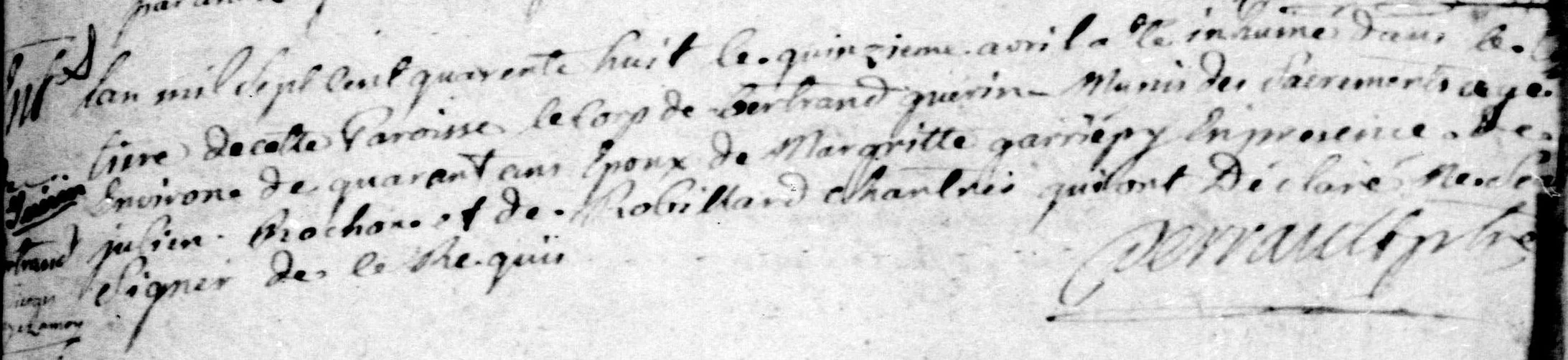
1748 burial of Bertrand Guérin (Généalogie Québec)
Marguerite’s Second Marriage
Two years after her husband’s death, on October 7, 1750, notary Coron drew up the marriage contract between 24-year-old Joseph Hébert dit Lecompte and 36-year-old Marguerite. Joseph was the son of Guillaume Hébert dit Lecompte and Marie Madeleine Laberge. He was assisted by François Laberge, his cousin, while Marguerite was assisted by her father Pierre, and her friend Julien Rochon. Again, the contract followed the provisions of the Coutume de Paris. Each spouse remained responsible for debts incurred before the marriage. Marguerite agreed to have an inventory drawn up of the property belonging to the former marital community between herself and Bertrand.
Marguerite was promised a douaire préfix (fixed dower) of 300 livres if Joseph died before her, while the surviving spouse would receive a préciput of 200 livres from the community’s movable property before its division. Joseph also agreed to feed, raise, care for and educate Marguerite's three minor children, Marguerite, Françoise and Bertrand (identified as Jean François in the contract), in the Catholic faith until they reached the age of 18. The witnesses were Jean Carrière, a weaver from Terrebonne, and Augustin Gaulin, a blacksmith from Île-Jésus. Joseph and several witnesses signed the contract, but Marguerite again declared that she could not sign her name.
Marguerite and Joseph were married five days later on October 12, 1750, in the parish of Sainte-Rose on Île-Jésus.
The couple initially settled in Lachenaie, then on Île-Jésus. They had at least three daughters: Marie Anne, Marie Hippolyte “Pauline,” and Marie Rose. The youngest two daughters died within a month of their birth.
Land Transactions
On July 10, 1753, Joseph and Marguerite sold a one-sixth share in a parcel of land in the seigneurie of Lachenaie to Toussaint Limoge for 250 livres. Marguerite had inherited this share following the death of her mother, Marie Huboux. The larger parcel measured one and a half arpents of frontage by twenty arpents deep, extending inland from the Rivière Jésus. It was bordered by the land of François Beauchamp on one side and Pierre Gariépy's land on the other. The contract was witnessed by Augustin Gaulin and Athanase Gravelle.
Three days later, on the afternoon of July 13, 1753, Joseph and Marguerite purchased land in the seigneurie des Mille Îles from Joachim Labelle for 550 livres. All three were residents of Île-Jésus. The property measured four arpents of frontage by twenty arpents in depth. It was bordered by the Rivière Jésus in front, ungranted land at the rear, the land of Joseph Coron on one side, and that of Noël Chapleau Jr. on the other. Joseph and Marguerite agreed to assume responsibility for all future cens and rentes payable to the seigneurs. François Guenet, a royal bailiff of Montréal, and Augustin Gaulin, a blacksmith from Île-Jésus, served as witnesses.
On April 21, 1756, Joachim Labelle acknowledged receiving the outstanding balance of 350 livres, completing payment for the property.
The Inventory
Between these two land transactions, on July 12, 1753, notary Charles François Coron recorded an inventory of the community property belonging to Marguerite Gariépy and her late husband, Bertrand Guérin. The household goods, livestock and landholdings were appraised by Joseph Brunet and Julien Rochon. The inventory provides a glimpse into the family's material circumstances, documenting everything from everyday cooking utensils and furniture to agricultural property and outstanding debts.
Cooking Utensils and Kitchen Equipment
The household contained a wide assortment of cooking equipment, including a pair of small andirons, two iron hooks and another piece of iron, a frying pan, a worn pot ladle, a small cooking grate, a tinplate strainer, a funnel, another strainer and a trivet. There were also two cooking pots, one with a lid, three kettles (including a small copper kettle with a hole in it), a pepper shaker and a barrel for storing salted pork.
A brick stove was described as being in poor condition. Its inventory entry also mentioned a door, a frame and a stovepipe made from three sheets of metal, although part of the description is illegible.
Dishes, Tableware and Household Lighting
The family's tableware included twenty-one pounds of old pewter, a covered pewter bowl, two small cups, a pewter salt cellar, five cracked earthenware plates, nine pewter spoons, six iron forks, a large drinking cup and a worn tinplate drinking cup. The inventory also listed eight flasks and two bottles. For lighting, the household possessed two candlesticks, one made of tinplate, along with a lantern and a lamp.
Furniture and Household Furnishings
The furniture included an old chest with a lock, a pinewood cupboard with a lock, a lockable sideboard, a dresser, a food cupboard, a worn dough chest, a medium-sized mirror, a worn table with folding supports, and eight worn chairs with elm-bark woven seats. The sleeping arrangements included a mattress made of coarse ticking stuffed with old cotton, a straw mattress, a quilt made from locally produced drugget, a worn bedstead (identification uncertain), a two-point wool blanket, two pairs of sheets (one described as old), and two worn tablecloths.
The household also contained two worn earthenware bowls (terrines) and a pot, a half-minot wooden measure bound with hoops, two small wicker baskets and another small basket.
Clothing Care, Textiles and Household Tools
Among the equipment used for textile production and maintenance were a large wool spinning wheel, a worn pair of wool carders, and a pair of ember-heated clothes irons (fers à flasquer). These items suggest that spinning and clothing maintenance formed part of the household's domestic activities.
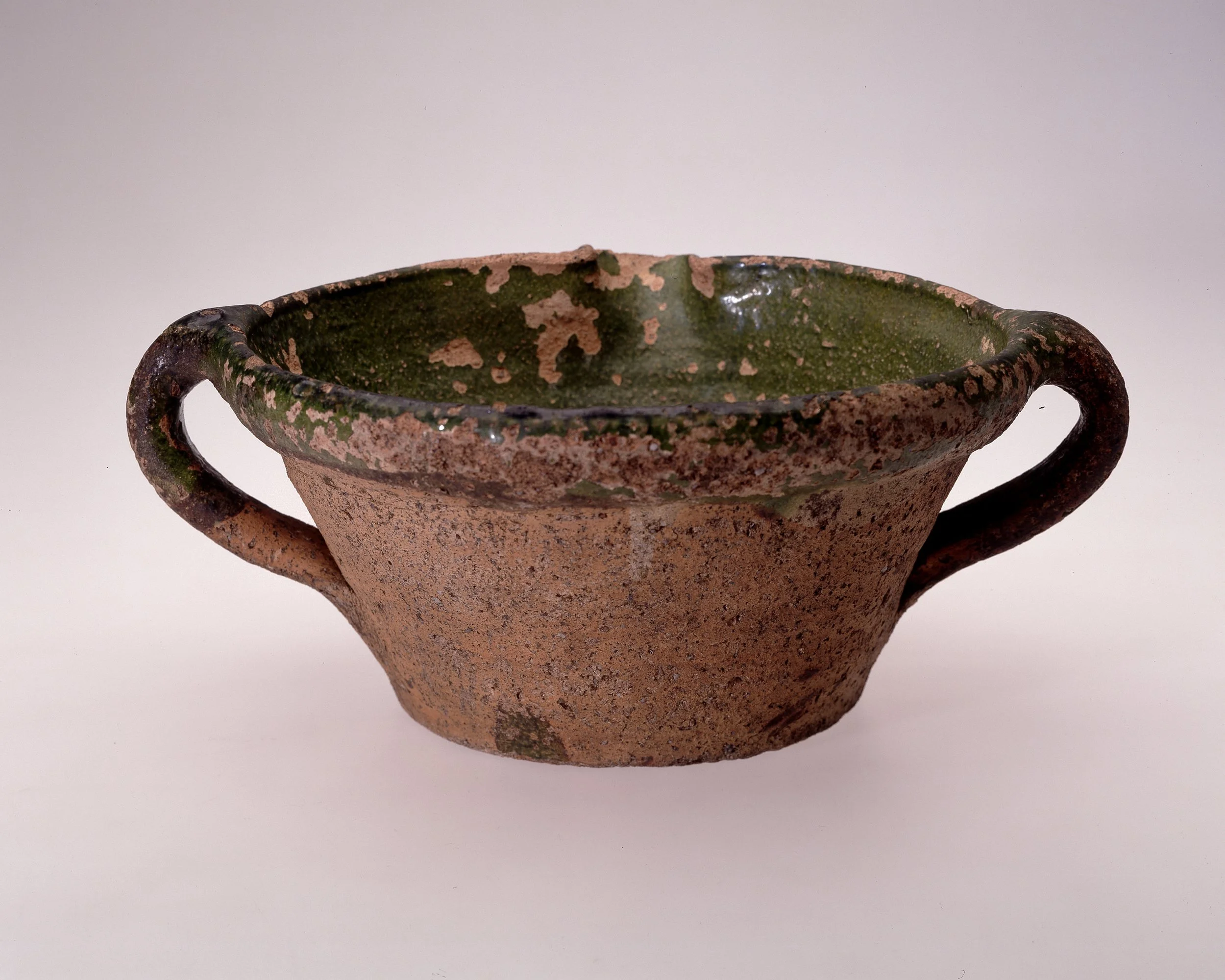
“Terrine,” dated 1601–1800 (McCord Stewart Museum)
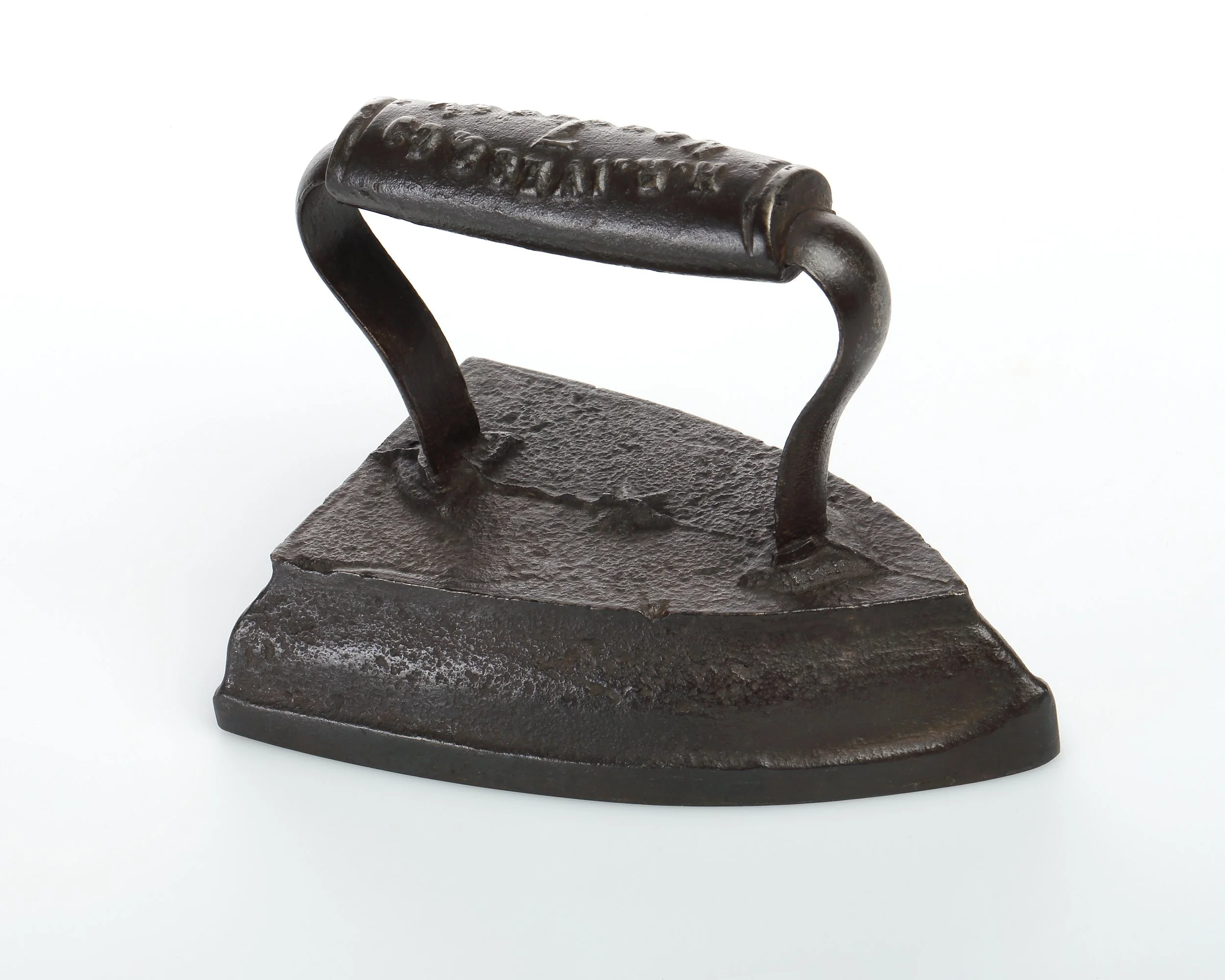
Clothes iron, dated 1859–1900 (McCord Stewart Museum)
Other tools and household articles included a spade, a worn axe, a pair of strap hinges, a worn sieve, a pair of brushes, several pieces of scrap iron, five sacks described as almost unserviceable, and two worn barrels and two half-barrels.
Livestock
The family owned a calf born the previous spring, three small pigs, a large sow, and two dairy cows. Together, these animals indicate that livestock raising and dairy production formed part of the household economy.
Land and Buildings
The inventory described two properties on Île-Jésus. The first was a parcel measuring half an arpent of frontage by two arpents deep, bounded in front by the Rivière Jésus, at the rear and on one side by the land of Jean Baptiste Rochon, and on the other side by the widow and heirs of an unidentified individual.
A house stood on this property, constructed with wooden posts set into the ground and covered with double boards. It had a stone chimney in the centre and measured 32 feet in length by 15 feet in width. The appraisers also noted a small stable that was falling into ruin. The property, including the house and stable, was valued at 300 livres.
The second property measured one arpent of frontage by twenty arpents deep. It bordered the land of Michel Taillon in front, côte Saint-François at the rear, Jean Baptiste Ménard on one side, and Rochon's land on the other. The property was entirely covered with mature timber and brushwood and was valued at 100 livres.
These two properties appear to correspond to land acquired by Bertrand in 1737 and 1743, respectively.
Outstanding Debts and Credits
The inventory also documented money owed to the estate, known as dettes actives. These included:
Michel Taillon: 47 livres, 5 sols
Antoine Masta: 11 livres, 9 sols
Louis Charles: 18 livres, 15 sols
Toussaint Masta Jr.: 34 livres
Joachim Labelle: 22 livres, 16 sols, 6 deniers
These outstanding amounts totalled 134 livres, 5 sols and 6 deniers.
The inventory also recorded one outstanding debt payable by the estate (dettes passives). Marguerite declared that 56 livres, 18 sols and 3 deniers were owed to sieur Le Guerrier.
Taken together, the inventory reveals a household equipped for domestic work, textile production and small-scale agriculture, with livestock, substantial landholdings and financial dealings with several local residents.
Land Sale
On October 15, 1753, Marguerite appeared before Jean Baptiste Auger, juge prévôt (provost judge) of the jurisdiction of Île-Jésus, seeking authorization to sell two properties belonging to the former community of goods between herself and Bertrand Guérin. These were the house and land on Île-Jésus, together with the separate woodland parcel, both described in the inventory of July 1753. Marguerite and Joseph intended to use the proceeds to pay for the land they had recently purchased from Joachim Labelle in the seigneurie des Mille Îles.
Because Bertrand's minor children had inheritance rights in these properties, a family council was convened to consider the proposed sale. Among those consulted were their maternal grandfather, Pierre Gariépy, their deputy guardian, Guillaume Le Guerrier, and several relatives. The assembled family members unanimously recommended that the properties be sold by public auction, with the proceeds applied toward the purchase from Labelle. The document records their approval of the proposed sale, but does not establish whether or when the auction took place.
Death of Joseph
Joseph Hébert dit Lecompte died at the age of 31 on August 22, 1757. He was buried the following day in the parish cemetery of Saint-François-de-Sales on Île-Jésus. [The burial record does not include a cause of death, as was customary at the time.]
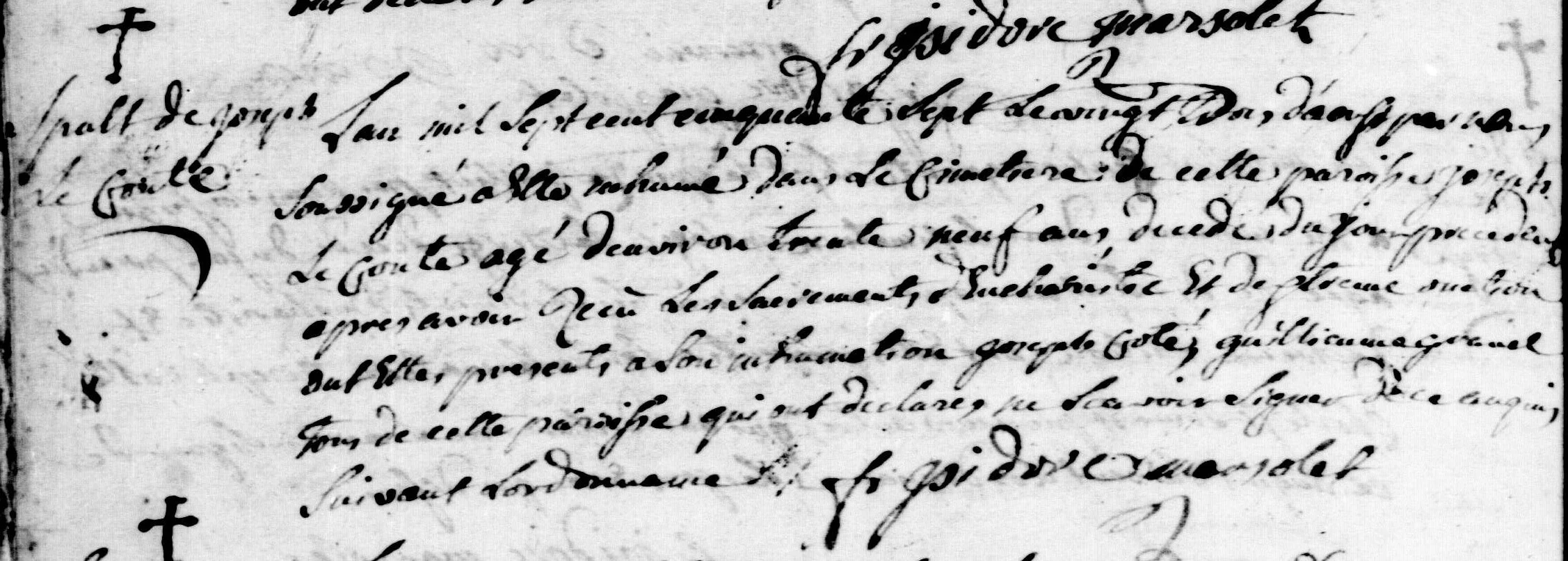
1757 burial of Joseph Hébert dit Lecompte (Généalogie Québec)
On February 14, 1758, notary Coron prepared an inventory of the community property belonging to Marguerite and her late husband, Joseph Hébert dit Lecompte. Marguerite was identified as the widow of both Joseph and Bertrand Guérin, and as guardian of her three minor children from her first marriage. The inventory listed household furnishings, kitchen utensils, tools and other possessions, together with outstanding debts and amounts owed to the estate. The document also referred to the earlier inventory of Marguerite’s community property with Bertrand, prepared on July 12, 1753. As with the previous inventory, the purpose was to establish the property and financial obligations of the marital community while protecting the inheritance rights of the children.
On March 11, 1758, Marguerite personally appeared in the surviving records for the last known time. On this date, she formally renounced her rights to the community of goods she had shared with her late husband, Joseph Hébert dit Lecompte, in accordance with the provisions of their marriage contract. Under the Coutume de Paris, a widow could renounce the marital community to protect herself from responsibility for its debts, although doing so also meant relinquishing her share of its assets. The inventory prepared the previous month documented substantial outstanding debts, suggesting that financial considerations may have influenced Marguerite's decision.
Death of Marguerite
Marguerite Gariépy died sometime after February 8, 1773, the date of her son Bertrand’s marriage. The marriage record identifies his father as deceased but does not describe his mother as such, suggesting that Marguerite was still living at the time. Her exact date and place of death remain unknown, as her burial record has not been located.
A Life Built on Île-Jésus
Bertrand Guérin's journey from Avranches, Normandie, to New France marked the beginning of a new chapter in his family's history. By the 1730s, he had established himself as a merchant on Île-Jésus, where he married Marguerite Gariépy and acquired land. Together, they built a household and raised four children, although their youngest died in childhood. Bertrand's death in 1748 brought their marriage to an early end, leaving Marguerite to manage the family's affairs and provide for their surviving children. Her subsequent remarriage, property transactions and efforts to protect her children's interests offer a glimpse into the responsibilities and challenges faced by a widow in eighteenth-century New France.
Although Marguerite's final years remain largely unknown, the family they established continued through their descendants, including their son Bertrand. Their story reflects both the opportunities and uncertainties of colonial life, from immigration and settlement to marriage, landownership and the preservation of family ties across generations.
PDF version of biography located at: https://www.tfcg.ca/bertrandguerin-and-margueritegariepy.
Are you enjoying our articles and resources? Show your support by making a donation. Every contribution, regardless of its size, goes a long way in covering our website hosting expenses and enables us to create more content related to French-Canadian genealogy and history. Thank you! Merci!
Sources:
“5 Mi 1798 > Avranches, Avranches, Notre-Dame-des-Champs > Baptêmes Mariages Sépultures 1693 – 1699," digital images, Archives départementales de la Manche (https://www.archives-manche.fr/ark:57115/s005e6ca7bbac45c/5e6ca7c04f5fc.fiche=arko_fiche_6577232566251.moteur=arko_default_635b873d1f4a7 : accessed 28 Oct 2026), baptism of Bertrand Guerin, 16 Jun 1699, Avranches, image 168 of 180.
“5 Mi 1798 > Avranches, Avranches, Notre-Dame-des-Champs > Baptêmes Mariages Sépultures 1690 – 1693," digital images, Archives départementales de la Manche (https://www.archives-manche.fr/ark:57115/s005e657c6436426/5e657c64be227.fiche=arko_fiche_657723255f925.moteur=arko_default_635b873d1f4a7 : accessed 29 Oct 2026), marriage of Guillaume Guerin and Françoise Le Hanneur, 24 Oct 1690, Avranches, image 22 of 77.
“Églises en Manche,” Patrimoine religieux du département de la Manche (https://www.eglisesenmanche.com/les-communes-de-la-manche/a/avranches-eglise-notre-dame-des-champs/ : accessed 29 Oct 2026).
“Le LAFRANCE (Baptêmes, Mariages, Sépultures)," database and digital images, Généalogie Québec (https://www.genealogiequebec.com/Membership/LAFRANCE/acte/129420 : accessed 29 Oct 2026), baptism of Charles Amable CUSSON, 7 Dec 1735, Laval (St-François-de-Sales); citing original data: Institut généalogique Drouin.
“Le LAFRANCE (Baptêmes, Mariages, Sépultures)," database and digital images, Généalogie Québec (https://www.genealogiequebec.com/Membership/LAFRANCE/acte/21745 : accessed 29 Oct 2026), baptism of Marguerite GARIEPY, 26 Jun 1714, Laval (St-François-de-Sales); citing original data: Institut généalogique Drouin.
“Le LAFRANCE (Baptêmes, Mariages, Sépultures)," database and digital images, Généalogie Québec (https://www.genealogiequebec.com/Membership/LAFRANCE/acte/126738 : accessed 29 Oct 2026), marriage of Bertrand GUERIN and Marguerite GARRIEPY, 9 Feb 1739, Lachenaie (St-Charles); citing original data: Institut généalogique Drouin.
“Le LAFRANCE (Baptêmes, Mariages, Sépultures)," database and digital images, Généalogie Québec (https://www.genealogiequebec.com/Membership/LAFRANCE/acte/180292 : accessed 29 Oct 2026), burial of Bertrand GUERIN, 15 Apr 1748, Terrebonne (St-Louis-de-France); citing original data: Institut généalogique Drouin.
“Le LAFRANCE (Baptêmes, Mariages, Sépultures)," database and digital images, Généalogie Québec (https://www.genealogiequebec.com/Membership/LAFRANCE/acte/291749 : accessed 2 Nov 2026), marriage of Joseph LECOMTE and Marguerite GARIEPY, 12 Oct 1750, Laval (Ste-Rose-de-Lima); citing original data: Institut généalogique Drouin.
“Le LAFRANCE (Baptêmes, Mariages, Sépultures)," database and digital images, Généalogie Québec (https://www.genealogiequebec.com/Membership/LAFRANCE/acte/288944 : accessed 2 Nov 2026), burial of Joseph LECOMTE, 23 Aug 1757, Laval (St-François-de-Sales); citing original data: Institut généalogique Drouin.
“Le LAFRANCE (Baptêmes, Mariages, Sépultures)," database and digital images, Généalogie Québec (https://www.genealogiequebec.com/Membership/LAFRANCE/acte/217539 : accessed 28 Oct 2026), marriage of Pierre GUERIN and Marguerite FIATRO, 8 Feb 1773, St-Eustache (St-Eustache); citing original data: Institut généalogique Drouin.
“Actes de notaire, 1734-1767 // Charles-François Coron,” digital images, FamilySearch (https://www.familysearch.org/ark:/61903/3:1:3QHV-P3JH-HT3Q?cat=koha%3A481208&view=explore&lang=en&groupId=TH-7763-96548-18788-92 : accessed 29 Oct 2026), land purchase by Bertrand Guérin from Étienne Charles and Marie Françoise Leclerc, 31 Dec 1737, images 1250-1252 of 3084 ; citing original data: Bibliothèque et Archives nationales du Québec.
“Actes de notaire, 1734-1767 // Charles-François Coron,” digital images, FamilySearch (https://www.familysearch.org/ark:/61903/3:1:3QHV-L3JH-H99C-G?cat=koha%3A481208&view=explore&lang=en&groupId=TH-7763-96548-18788-92 : accessed 29 Oct 2026), marriage contract of Bertrand Guérin and Marguerite Gariépy, 1 Feb 1739, images 2168-2172 of 3084 ; citing original data: Bibliothèque et Archives nationales du Québec.
“Actes de notaire, 1734-1767 // Charles-François Coron,” digital images, FamilySearch (https://www.familysearch.org/ark:/61903/3:1:3QHV-L3JH-C9QL-K?cat=koha%3A481208&view=explore&lang=en&groupId=TH-7761-96549-15385-18 : accessed 29 Oct 2026), land purchase by Bertrand Guérin and Julien Rochon from Michel Taillon and Marie Madeleine Masson, 26 Jun 1743, images 2943-2944 of 3206; citing original data: Bibliothèque et Archives nationales du Québec.
“Actes de notaire, 1734-1767 // Charles-François Coron,” digital images, FamilySearch (https://www.familysearch.org/ark:/61903/3:1:3QHV-P3JH-JL4Y?cat=koha%3A481208&view=explore&lang=en&groupId=TH-7761-96557-17269-43 : accessed 2 Nov 2026), marriage contract of Joseph Hébert dit Leconte and Marguerite Gariepy, 7 Oct 1750, images 141-144 of 3207; citing original data: Bibliothèque et Archives nationales du Québec.
“Actes de notaire, 1734-1767 // Charles-François Coron,” digital images, FamilySearch (https://www.familysearch.org/ark:/61903/3:1:3QHV-L3JH-J93F-Q?cat=koha%3A481208&view=explore&lang=en&groupId=TH-7761-96557-17269-43 : accessed 2 Nov 2026), land sale by Joseph Eberre Le Compte and Marguerite Gariepy to Toussaint Limoge, 10 Jul 1753, images 2930-2931 of 3207; citing original data: Bibliothèque et Archives nationales du Québec.
“Actes de notaire, 1734-1767 // Charles-François Coron,” digital images, FamilySearch (https://www.familysearch.org/ark:/61903/3:1:3QHV-L3JH-JK83?cat=koha%3A481208&view=explore&lang=en&groupId=TH-7761-96557-17269-43 : accessed 2 Nov 2026), land purchase by Joseph Eberre Le Compte and Marguerite Gariepy from Joachim Labelle, 13 Jul 1753, images 2945-2947 of 3207; citing original data: Bibliothèque et Archives nationales du Québec.
“Actes de notaire, 1734-1767 // Charles-François Coron,” digital images, FamilySearch (https://www.familysearch.org/ark:/61903/3:1:3QHV-L3JH-J9QY-N?cat=koha%3A481208&view=explore&lang=en&groupId=TH-7761-96557-17269-43 : accessed 2 Nov 2026), inventory of the community of goods of Marguerite Gariepy and the late Bertrand Guerin, 12 Jul 1753, images 2939-2943 of 3207; citing original data: Bibliothèque et Archives nationales du Québec.
“Actes de notaire, 1734-1767 // Charles-François Coron,” digital images, FamilySearch (https://www.familysearch.org/ark:/61903/3:1:3QHV-L3JH-JRX3?cat=koha%3A481208&view=explore&lang=en&groupId=TH-7761-96557-17269-43 : accessed 2 Nov 2026), family council regarding the proposed sale of property belonging to Bertrand Guérin’s estate, 15 Oct 1753, images 3023-3025 of 3207; citing original data: Bibliothèque et Archives nationales du Québec.
“Actes de notaire, 1734-1767 // Charles-François Coron,” digital images, FamilySearch (https://www.familysearch.org/ark:/61903/3:1:3Q9M-C375-695Z-Y?cat=koha%3A481208&view=explore&lang=en&groupId=TH-909-86233-35708-55 : accessed 2 Nov 2026), inventory of the community of goods of Marguerite Gariepy and the late Joseph Eberre Lecomte, 14 Feb 1758, images 1194-1199 of 3200; citing original data: Bibliothèque et Archives nationales du Québec.
“Actes de notaire, 1734-1767 // Charles-François Coron,” digital images, FamilySearch (https://www.familysearch.org/ark:/61903/3:1:3Q9M-C375-69DW-V?cat=koha%3A481208&view=explore&lang=en&groupId=TH-909-86233-35708-55 : accessed 2 Nov 2026), renunciation by Marguerite Guariepy of her rights to the community of goods with her late husband Joseph Eberre Lecomte, 11 Mar 1758, images 1320-1322 of 3200; citing original data: Bibliothèque et Archives nationales du Québec.
Fédération québécoise des sociétés de généalogie, Fichier Origine online database (http://www.fichierorigine.com : accessed 29 Oct 2026), entry for Bertrand GUÉRIN (reference 241930), updated on 14 Aug 2006.
Université de Montréal, Programme de recherche en démographie historique (PRDH) database (https://www-prdh-igd-com.res.banq.qc.ca/Membership/en/PRDH/Famille/21180 : accessed 29 Oct 2026), dictionary entry for Bertrand GUERIN and Marie Marguerite GARIEPY, union 21180.
Université de Montréal, Programme de recherche en démographie historique (PRDH) database (https://www-prdh-igd-com.res.banq.qc.ca/Membership/en/PRDH/Famille/28195 : accessed 2 Nov 2026), dictionary entry for Joseph HEBERT LECOMPTE and Marie Marguerite GARIEPY, union 28195.
André Lachance, Vivre, aimer et mourir en Nouvelle-France; Juger et punir en Nouvelle-France: la vie quotidienne aux XVIIe et XVIIIe siècles (Montréal, Québec: Éditions Libre Expression, 2004), 38-40.