Augustin Hébert dit Jolicoeur & Adrienne Duvivier
In 1642, a small band of French colonists sailed up the Saint Lawrence River to found a settlement on the island of Montréal. Among them was Augustin Hébert dit Jolicoeur, a young stonemason from Caen — and, though she wouldn't arrive for another five years, his future wife Adrienne Duvivier, a merchant's daughter from the small village of Corbeny, would soon follow. Their marriage, forged in Paris in 1646, would carry them across the Atlantic to help build Villemarie from the ground up: clearing land, raising a family, and standing witness to the young colony's earliest years. Augustin's life would be cut short within the decade, but Adrienne would go on to become one of Villemarie's most enduring figures, remarrying, raising a second family, and living to see the fortified outpost grow into a true town. Nearly four centuries later, their story survives in monuments, street signs, and the countless descendants who still carry their name forward.
Cliquez ici pour la version en français
Augustin Hébert dit Jolicoeur & Adrienne Duvivier
Pioneers of Villemarie
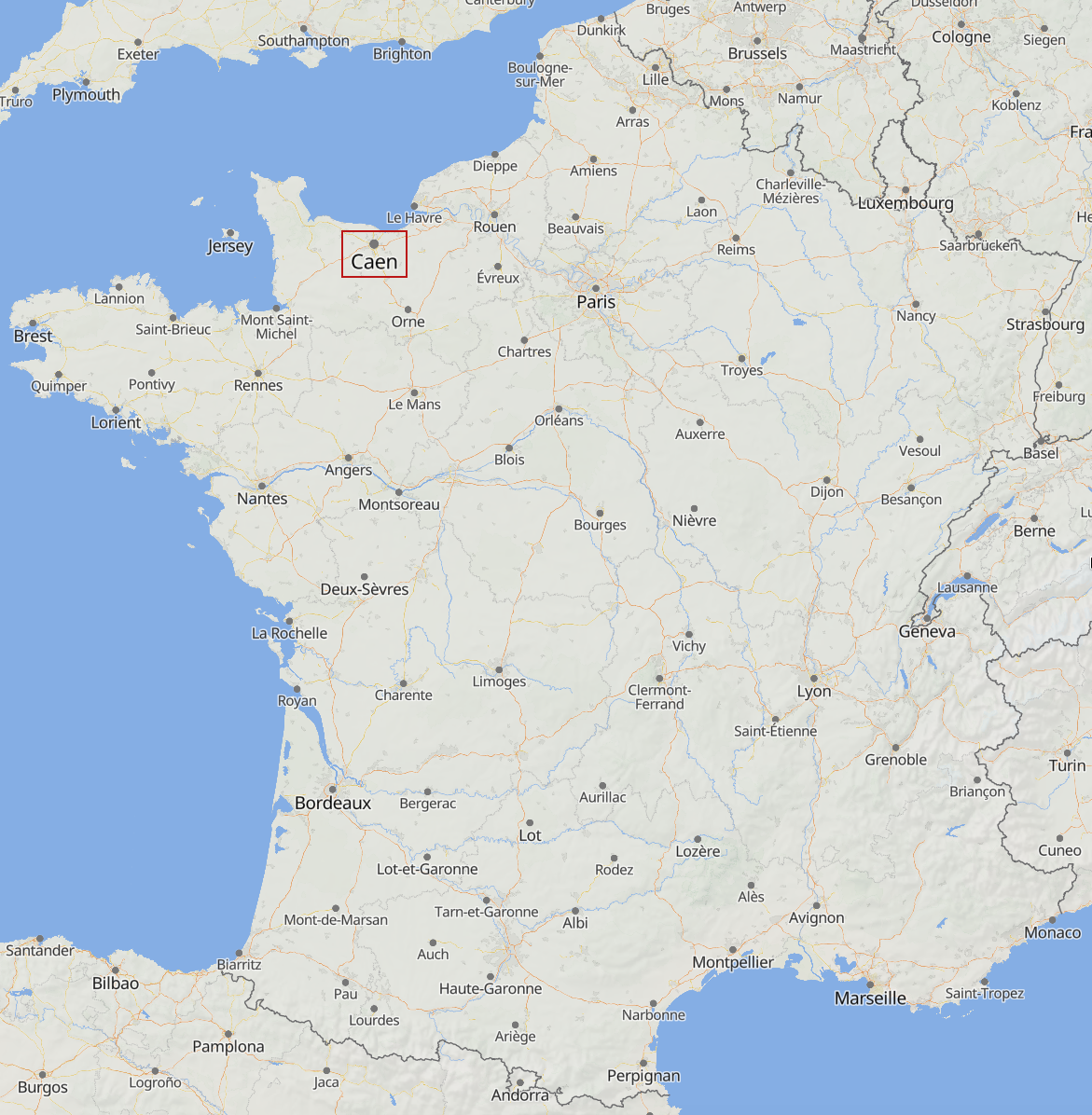
Location of Caen in France (Mapcarta)
Augustin Hébert dit Jolicoeur, son of Jean Hébert and Isabeau (or Ysabeau) Groussart, was born circa 1620 in Caen, Normandy, France. His father was a merchant in the city. His paternal grandparents were Marin Hébert and Françoise Blonville.
Located 210 kilometres west-northwest of Paris in the present-day department of Calvados, Caen is a port city that sits at the confluence of the Orne and the Odon rivers. Nicknamed the “Ville aux Cent Clochers” (City of a Hundred Steeples), it has a current municipal population of 110,000 residents, called Caennais and Caennaise.
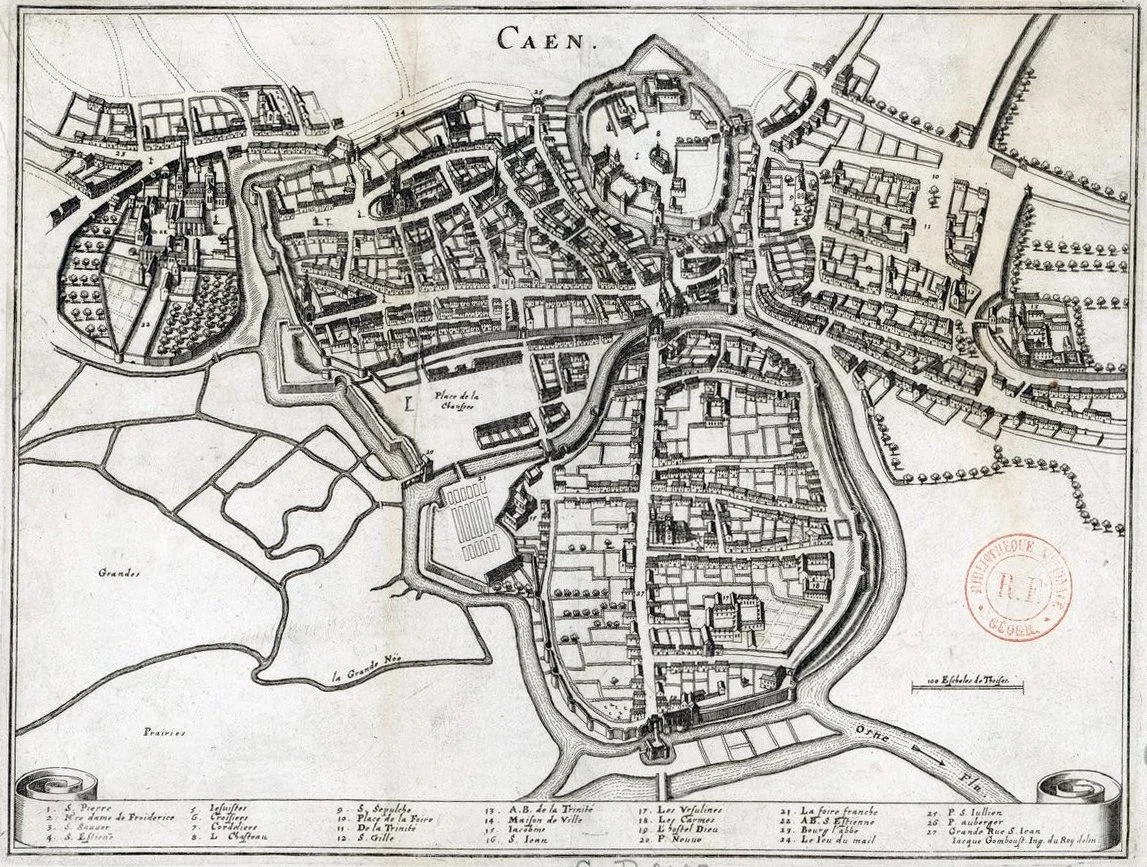
Map of Caen, 17th century, created by king’s engineer Jacques Gomboust (Bibliothèque nationale de France)
A Soldier in New France
In the mid-1630s, Augustin left his hometown and country for an opportunity in New France. He arrived in July 1637, hired as a soldier for the Québec garrison. The first mention of Augustin in the Canadian public record is on August 4, 1637, in Trois-Rivières, when he was named the godfather to a “little Montagnaise girl” baptized Marie Madeleine KhinecaȢat. “Jolicoeur” is recorded as a soldier from the fort of Québec.
After a few years in Québec, Augustin joined Paul de Chomedey de Maisonneuve, future governor of the island of Montréal, on his expedition to Villemarie in 1641. On a deposition dated February 3, 1642, he was described as “the man commonly known as Jolycoeur […] Augustin Hebert, a native of Caen in the province of Normandy, aged about twenty-one, a stonecutter in the service of the Compagnie de Mont Real under the command of Sieur de Maisonneufve […].”
Augustin was present at the official founding of Montréal on May 17, 1642. On October 24, 1645, he returned to France alongside Maisonneuve aboard the Notre-Dame.
Adrienne Duvivier
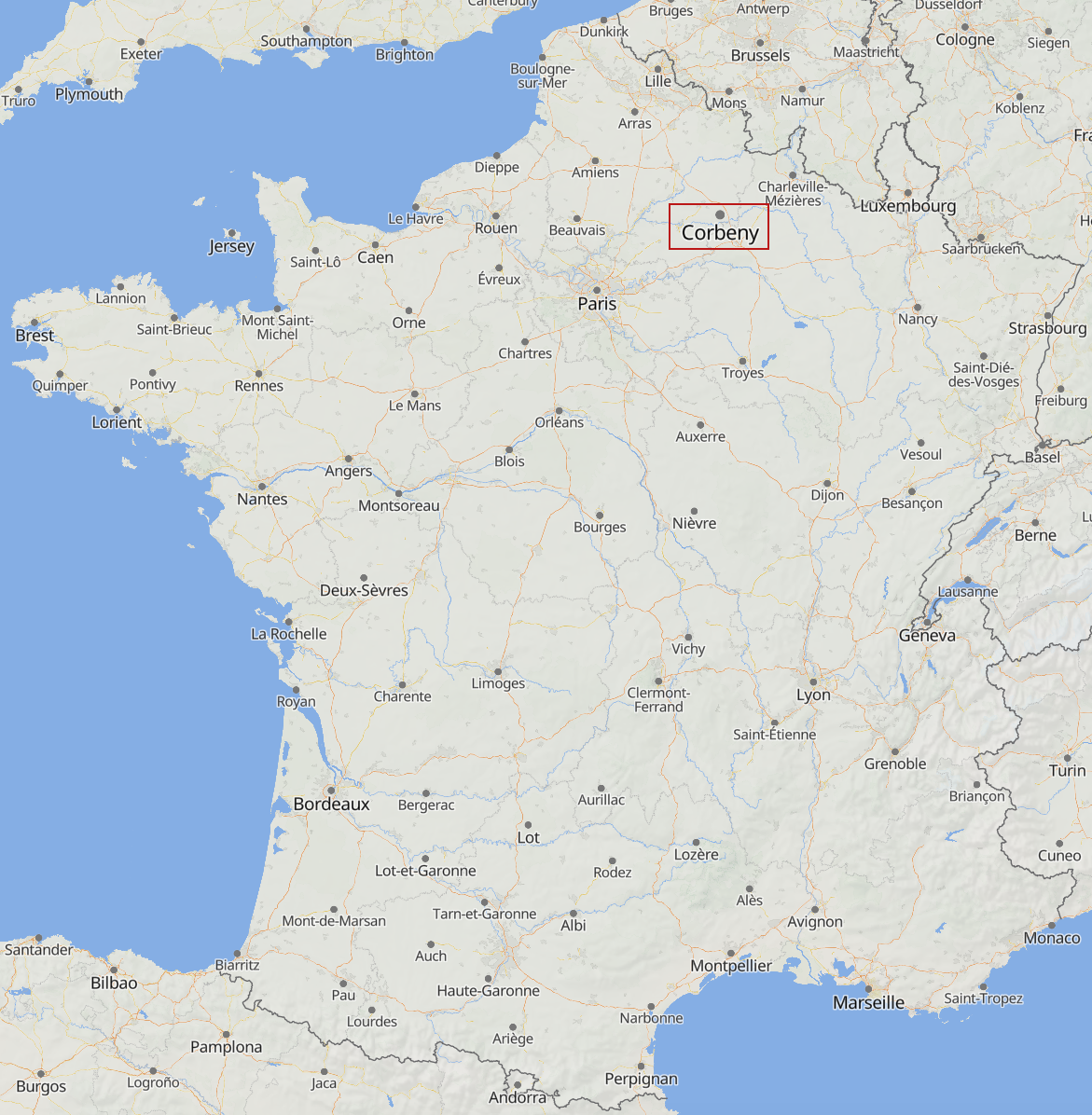
Location of Corbeny in France (Mapcarta)
Adrienne Duvivier (or Vivier), daughter of Antoine Duvivier and Catherine Journa (or Journet), was born circa 1626, in Corbeny, Île-de-France, France. Her father was a marchand sellier, or merchant saddler. She had one known sibling, Antoinette.
In contrast to the hometown of her future husband, Adrienne's place of birth is a small rural village with an ancient history, first mentioned as far back as the Carolingian period. It is located in the present-day Aisne department and has a current population of about 850 residents, called Corbéniens.
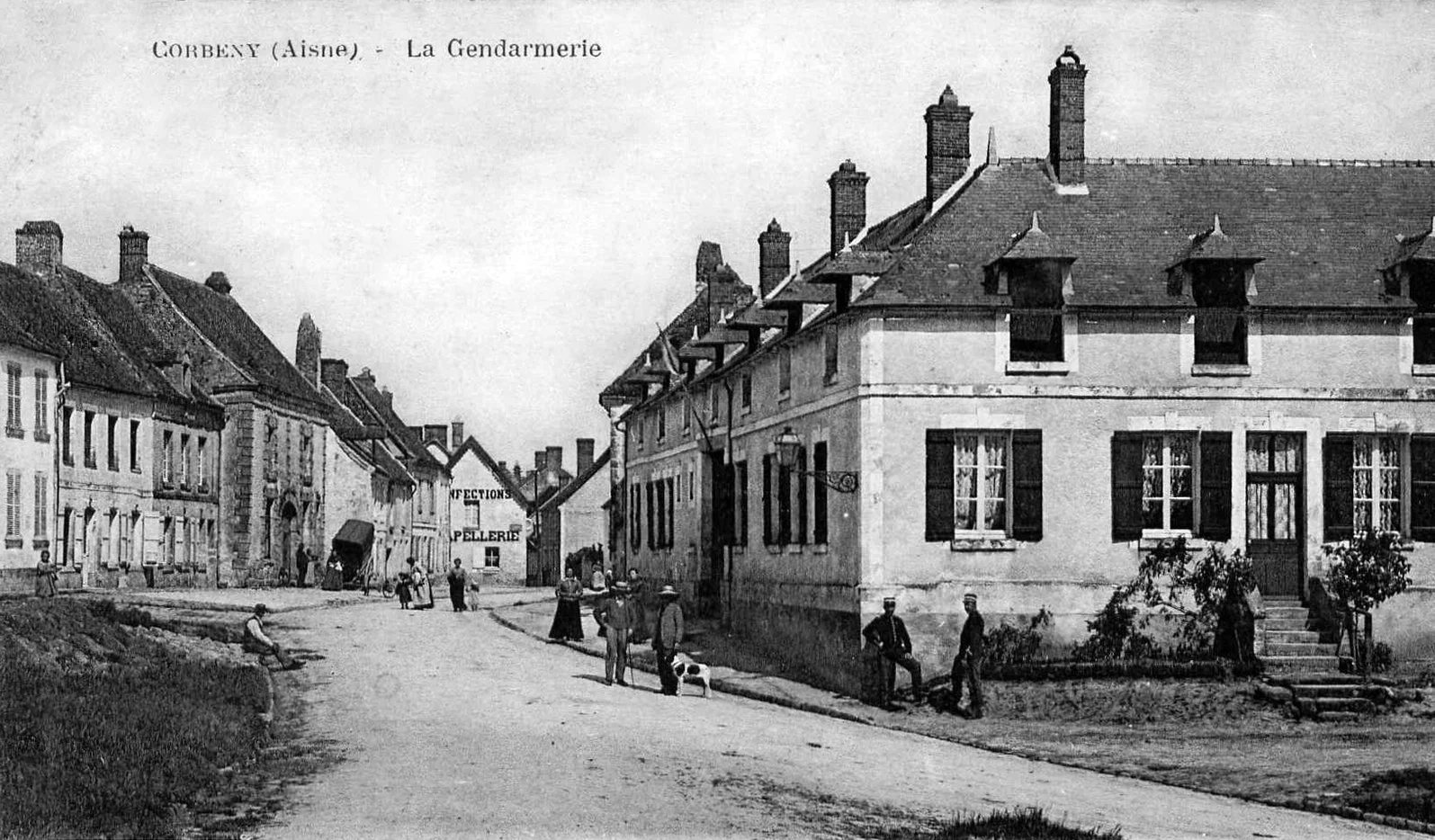
Postcard, Corbeny, circa 1910–1913 (Geneanet)
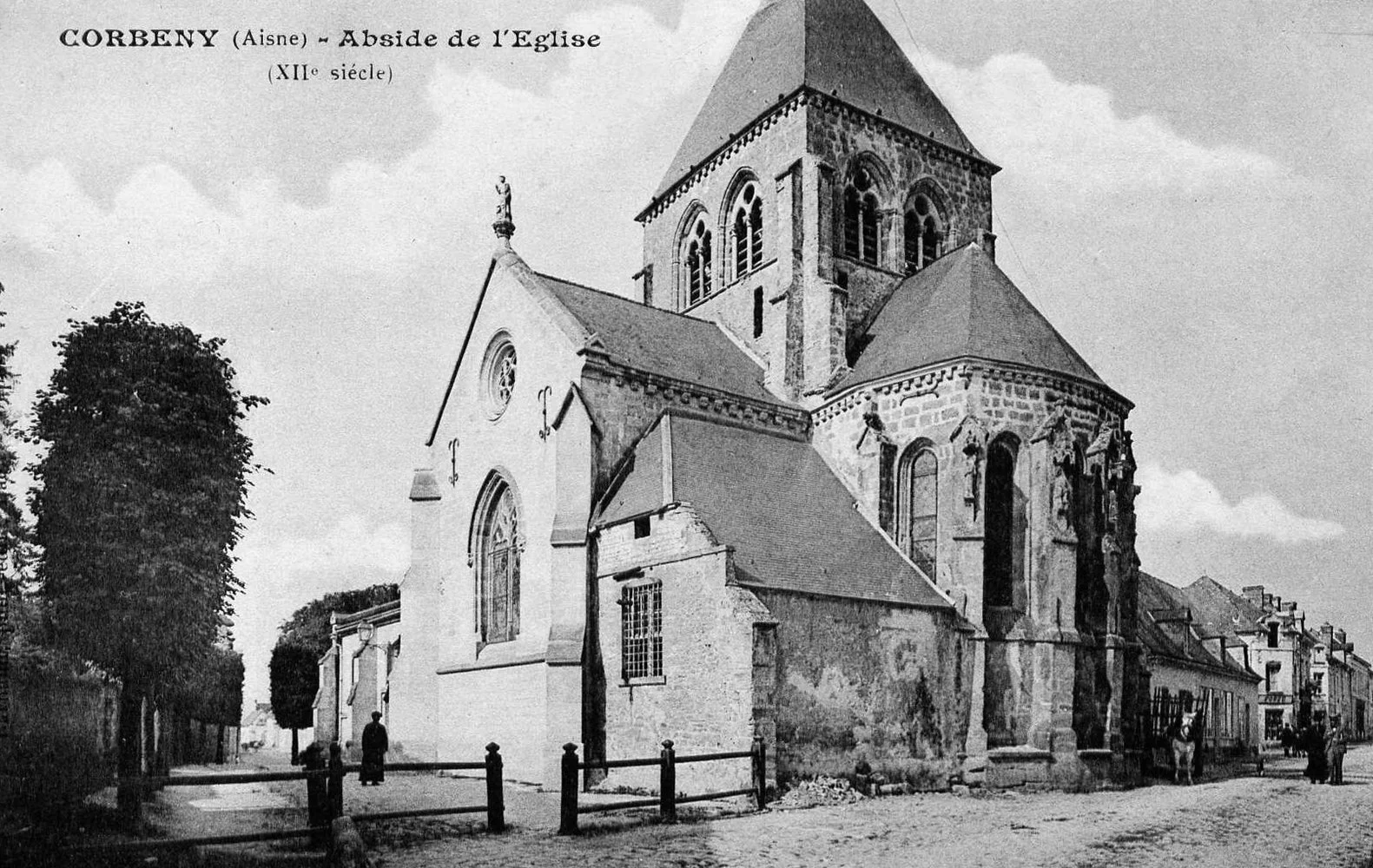
Postcard, Corbeny, circa 1921–1926 (Geneanet)
Marriage and Children
On January 13, 1646, Augustin Hébert and Adrienne Duvivier appeared before notary Étienne Paisant in Paris to draw up their marriage contract. Augustin was described as a 25-year-old tailleur de pierres, or stonecutter, living at Marché Neuf in the parish of Saint-Germain-le-Viel in Paris. Adrienne lived in the enclosure of the Palais de Justice, with her sister Antoinette and her husband Antoine Perrier, a coachman to the sieur du Four. Adrienne’s sister and brother-in-law gave the couple 200 livres in cash and 100 livres in clothing and linen. Augustin endowed his future wife with a fixed dower of 150 livres, payable once, to be drawn from all his property. The contract also granted the surviving spouse a préciput — the right to claim a preferential share of the couple's movable community property, up to 50 livres, before the rest of the estate was divided. The contract followed the norms of the Coutume de Paris. Augustin could sign the contract, but Adrienne could not.
The couple were likely married a few days later in the parish church of Saint-Barthélémy, the same parish where their daughter Jeanne would be born in 1647. Augustin and Adrienne would go on to have four children:
Jeanne (1647–1687)
Pauline (1649–1649)
Léger (1650–1719)
Ignace (1652–1722)
On May 2, 1647, Augustin and his family were in La Rochelle, where he hired carpenter René Pigneau for a five-year contract before notary Pierre Teuleron. Pigneau would be paid 75 livres per year, plus his upkeep and return passage. “Augustin Hebert dit Jolly Coeur” was recorded as an “habitant of Mont Royal in the country of New France,” and was able to sign his name.
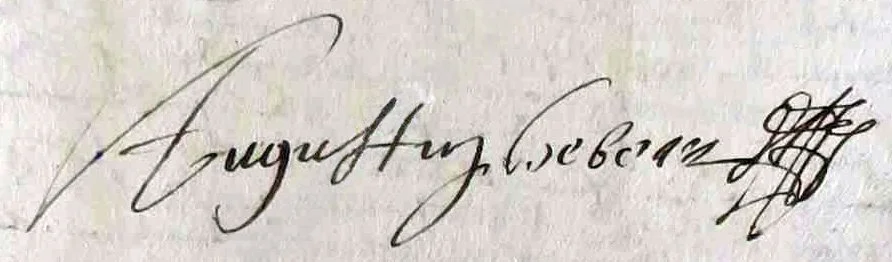
Augustin’s signature in 1647 (Archives départementales de la Charente-Maritime)
Still in La Rochelle on May 23, 1647, Augustin, described in the notarial record as "living in Paris," borrowed 60 livres from Noël Juchereau, sieur des Chastellets, who was recorded as ordinarily residing in New France and serving as director and attorney general for the Communauté des Habitants. The loan was intended to cover "goods and commodities purchased by him in this city" and loaded onto the ships of the fleet belonging to the Habitants, then ready to depart the harbour for Québec and return to La Rochelle. Augustin undertook to repay the sum to his creditor 15 days after his return to Montréal, and to this end he "pledged all his assets."
The Hébert Family in Montréal
In June of 1647, Augustin, Adrienne and their daughter Marie Jeanne set sail from La Rochelle aboard La Marguerite, arriving at Québec on August 6, 1647. A few days later, the family was in Montréal.
Ville-Marie or Montréal?
In seventeenth-century records, Ville-Marie (or Villemarie) and Montréal refer to the same place: the fortified settlement founded by Paul de Chomedey de Maisonneuve and Jeanne Mance on the site of present-day Old Montréal. Maisonneuve himself referred to the colony as "Villemarie on the Island of Montréal in New France." The name Ville-Marie first appears in printed sources in 1643, including Les véritables motifs de messieurs et dames de la Société de Nostre Dame de Montreal pour la conversion des sauvages de la Nouvelle-France and that year's Relations des Jésuites. Throughout the seventeenth century, both names coexisted and were often used to refer to the same settlement.
Originally, Montréal referred to the mountain—named Mont Royal by Jacques Cartier—and later to the island itself. Over time, the name also came to designate the settlement, particularly in civil and ecclesiastical records. This usage became increasingly common after the Sulpicians became seigneurs of the island in 1663 and the parish was named Notre-Dame de Montréal. By the late seventeenth century, and even more so in the early eighteenth, official records increasingly favoured Montréal, although Ville-Marie continued to appear, especially when referring to the original missionary settlement or its fortifications.
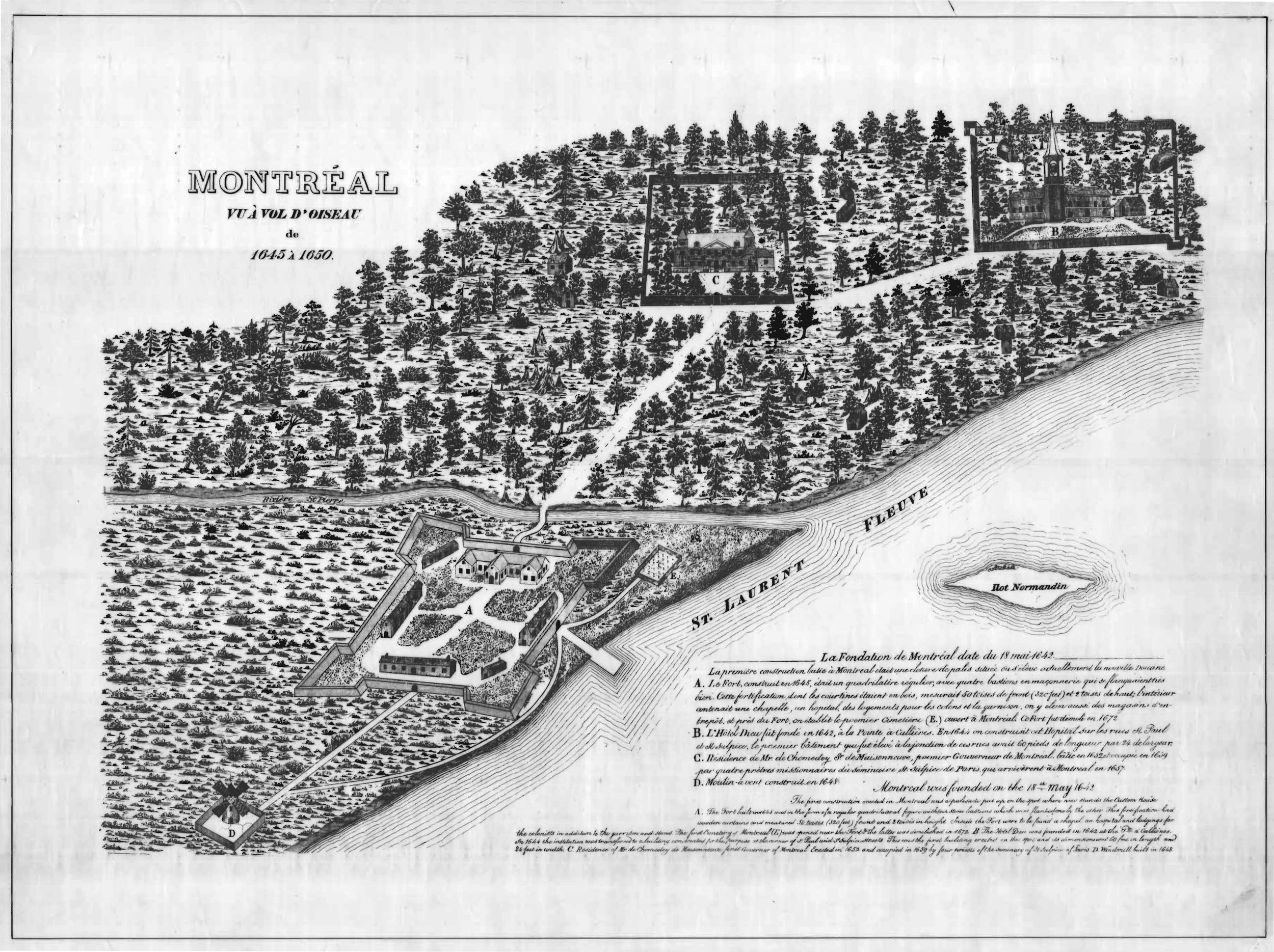
“Bird's Eye View of Montreal from 1645 to 1650,” drawn by P.-L. Morin in 1884 and published by H. Beaugrand (Archives de Montréal)
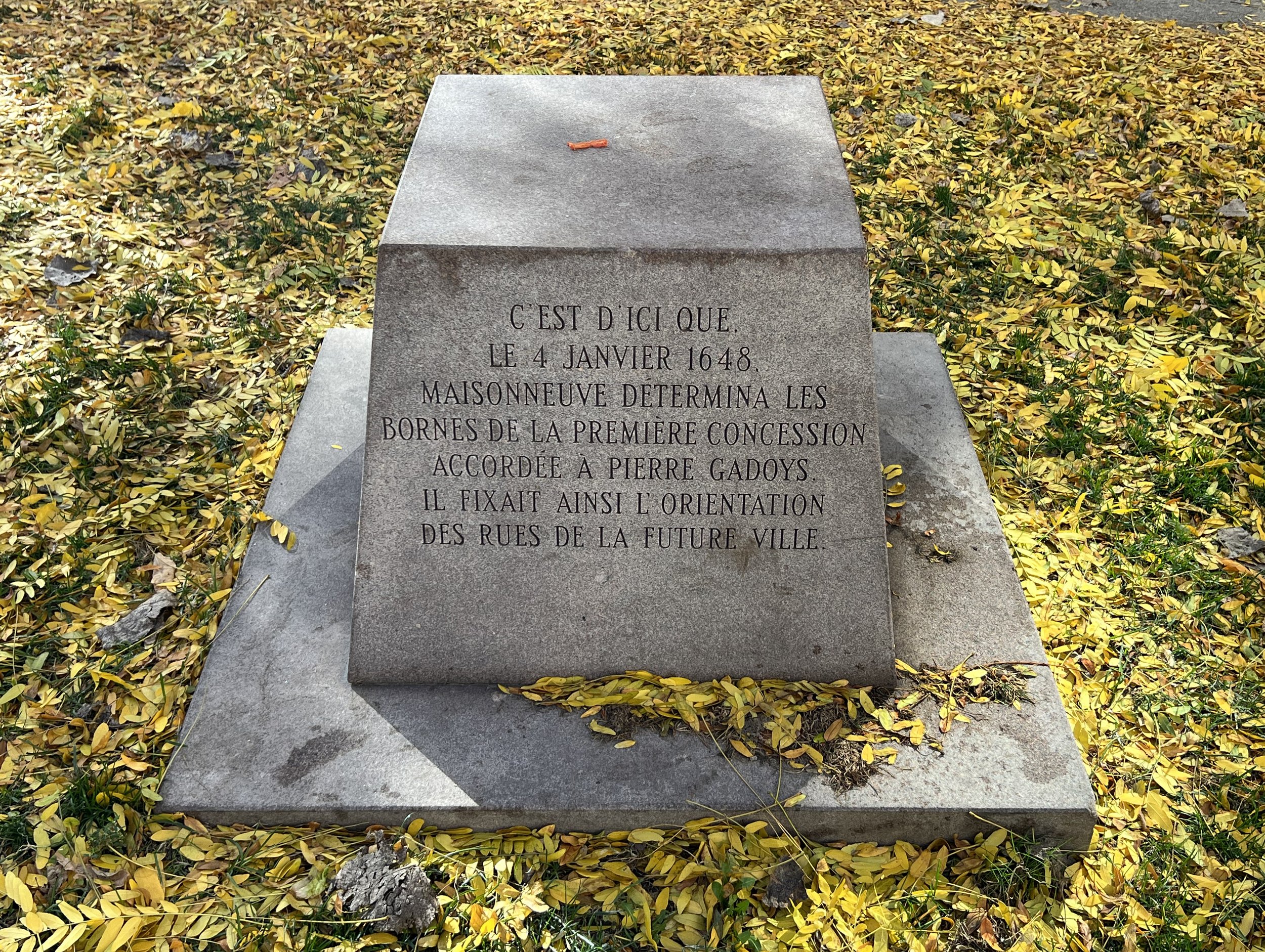
Marker showing the original location of Pierre Gadoys’s land in Montréal, the first concession given by Maisonneuve and neighbouring that of Augustin Hébert and Adrienne Duvivier, located at Place d’Youville today, corner of rue Saint-Nicolas (© The French-Canadian Genealogist)
By 1651, Augustin already had a home in Montréal. He had likely been given a land concession by Governor Maisonneuve years prior. On the afternoon of November 9, 1651, a marriage contract was penned “in the house of Augustin Hebert” by notary Lambert Closse between Gabriel Decelles, sieur Duclos, and Barbe Poisson.
Augustin’s land was the concession later given to Adrienne and her future husband after his death: a 40-arpent plot located “near Villemarie,” neighbouring Pierre Gadoys and Jean Desroches. By 1653, the family had eight of those arpents under cultivation, along with several farm animals and a handful of weapons, and lived in a house measuring 50 feet long by 20 feet wide.
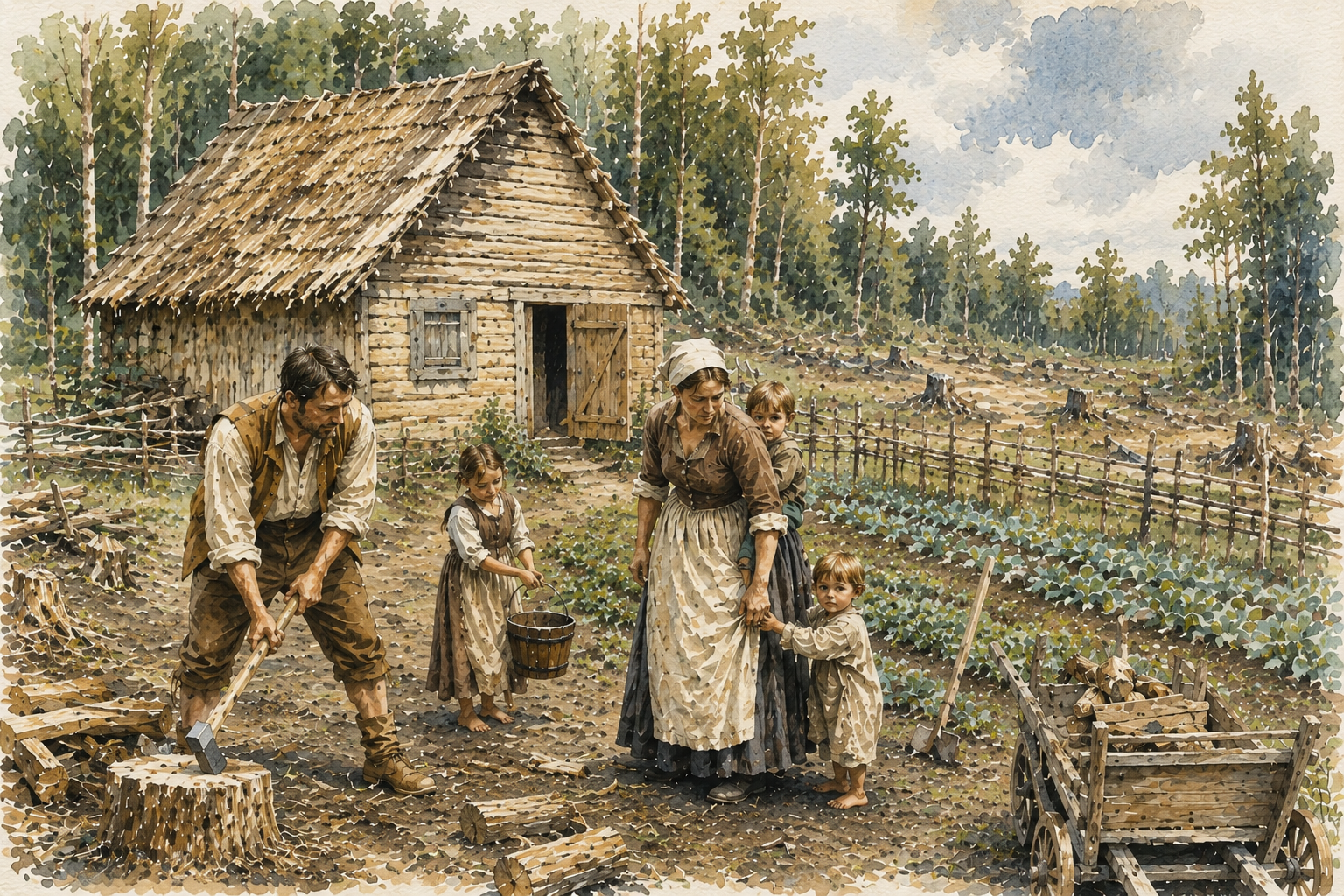
Illustration generated with artificial intelligence by the author, July 2026 (ChatGPT)
Death of Augustin
Augustin Hébert dit Jolicoeur died in his early 30s, in 1653. No burial record exists to document his death. He was still alive on July 19, 1653, when Adrienne, “wife of Augustin Hébert,” was named godmother to Madeleine Tessier. [Normally the baptism record would indicate if her husband was deceased.] A November 1653 entry in the Journal des Jésuites reads:
Unconfirmed murders
The 23rd. The Flibot arrives in Trois-Rivières from Montreal, bringing with it a savage from the Nation of the Wolf, dressed in European style, who is a relative of the Mahingan killed by the Hurons. News is received of the death, capture or shipwreck of Jolycoeur and Aras, residents of Montreal.
Augustin died sometime between July and November 1653, likely in or near Trois-Rivières. He and Aras, whose identity remains uncertain, were probably on a fur trading expedition. Although hope may have lingered that he would return, Augustin was considered deceased about seven months later, when notary Lambert Closse was asked to draw up an inventory of his goods on June 2, 1654. Two friends were tasked as estimators: Pierre Gadoys, his neighbour, and Antoine Primot.
The relatively short, three-page document enumerated all of Augustin and Adrienne’s movable property. The list includes:
Unthreshed grain and land sown with various types of grain (estimated at 500 livres)
Two cows and two calves (200 livres)
Four pigs and twelve hens (80 livres)
Several old kitchen utensils (25 livres)
Three old arquebuses and two pistols (80 livres)
Fifty pounds of old pewter (45 livres)
Several old tools and scrap metal (22 livres)
Two new mattresses, a feather bed, a bolster (20 livres)
A leather coat (30 livres)
A suit and a doublet (54 livres)
Two “beaver robes” (70 livres)
Several debts are also enumerated, as well as a few legal documents. Adrienne confirmed the inventory two days later, on June 4, 1654.
Adrienne’s Second Marriage
On October 30, 1654, notary Closse penned a marriage contract between Adrienne and Robert Lecavelier dit Deslauriers. Both were recorded as being 28 years old. Robert was from Cherbourg in Normandy, France. The couple agreed to each be responsible for their own debts contracted before the marriage. “And as regards any other matrimonial agreements, the said future spouses have submitted, and hereby submit, to the customs of the provostship and viscounty of Paris.” The contract was signed in the presence of Governor Maisonneuve, co-founder of Montréal Jeanne Mance, sergeant Jacques Vautier from the Montréal garrison, master surgeon Étienne Bouchard, and habitant Jean Gervaise.
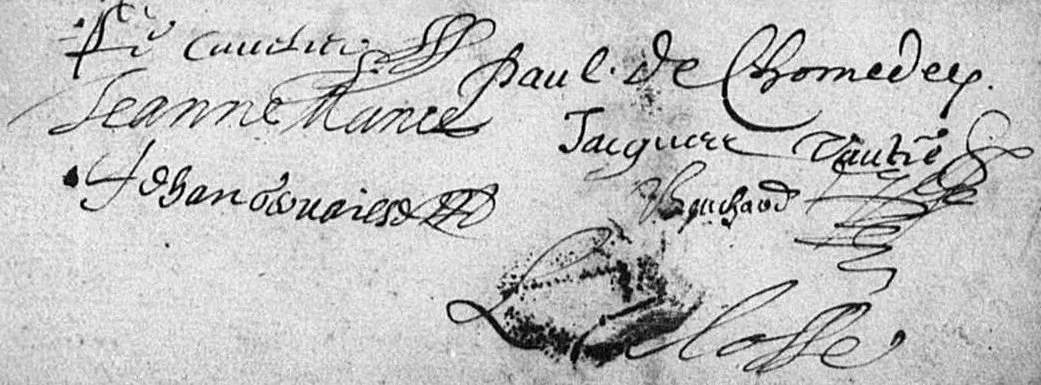
Signatures on the 1654 marriage contract, featuring several of early Montréal's most prominent residents, including Governor Maisonneuve and co-founder Jeanne Mance
The couple married a few weeks later on November 19, 1654, in Montréal, before several witnesses: Governor Maisonneuve, notary Lambert Closse, and René Giroux.
Notary Closse drew up another document just six days before Adrienne and Robert’s marriage contract, on October 24, 1654: a land concession from Maisonneuve to “Robert Lecavelier dit Desloriers and Adrienne du vivier, widow of the late Augustin Hébert.” Curiously, the pair was not yet married. This was the concession given to Augustin Hébert by Maisonneuve years prior. Located “near Villemarie,” the 40-arpent plot of land neighboured that of Pierre Gadoys and Jean Desroches. It started at “fifteen perches from the small river which flows near the fort of the said Villemarie, twenty perches wide and continuing at the same width, extending north-westwards until the said quantity of forty arpents of land.”
The above-mentioned “small river” is the former Saint-Pierre River, now channelled and flowing beneath Place d’Youville before emptying into the St. Lawrence. Today, the concession would begin at Rue Saint-Paul, on the east side of Rue Saint-Pierre, and extend north for twenty arpents — placing its northern edge a little above today's Rue Sainte-Catherine. On the west side, it would run along Rue Bleury.
Life in Montréal
Adrienne and Robert settled on their concession in Montréal and had at least seven children between 1655 and 1671: Anne, Marie Madeleine, Jean Baptiste, Pierre, Louis Michel, Jeanne, and Anne.
Over the years, Adrienne also served as a godmother to several newborns in Montréal:
August 29, 1649: godmother to Marie Boudard, daughter of Jean Boudart and Catherine Mercier, alongside godfather Paul de Chomedey, sieur de Maisonneuve.
June 5, 1650: godmother to Adrienne Oskennontonhast (an indigenous child), daughter of Athanase Oskennontonhast Hounitiek and [unnamed] Usondakouanen, alongside godfather Pierre Royer.
July 1, 1650: godmother to Marie Lucos, daughter of Léonard Lucos and Barbe Poisson, alongside godfather Paul de Chomedey.
August 20, 1652: godmother to Adrienne Barbier, daughter of Gilbert Barbier and Catherine Laveau, alongside godfather Jean St-Père.
July 19, 1653: godmother to Madeleine Tessier, daughter of Urbain Tessier and Marie Archambault, alongside godfather Lambert Closse.
September 30, 1657: godmother to Marie Milot, daughter of Jean Milot and Marie Marthe Pinson, alongside godfather Nicolas Godé.
June 24, 1677: godmother to Jean Baptiste Forestier, son of Antoine Forestier and Marie Madeleine Cavelier, alongside godfather Jean Gervaise.
March 19, 1682: godmother to her grandson Ignace Hébert, son of Ignace Hébert and Jeanne Messier, alongside godfather and seigneur Michel Messier dit St-Michel.
In 1666, Adrienne and Robert appeared in the census of New France, living in Montréal with their children and one domestic servant. [Three of the Lecavelier children were mistakenly called Hébert by the enumerator.] Robert was recorded as an arquebusier and habitant.
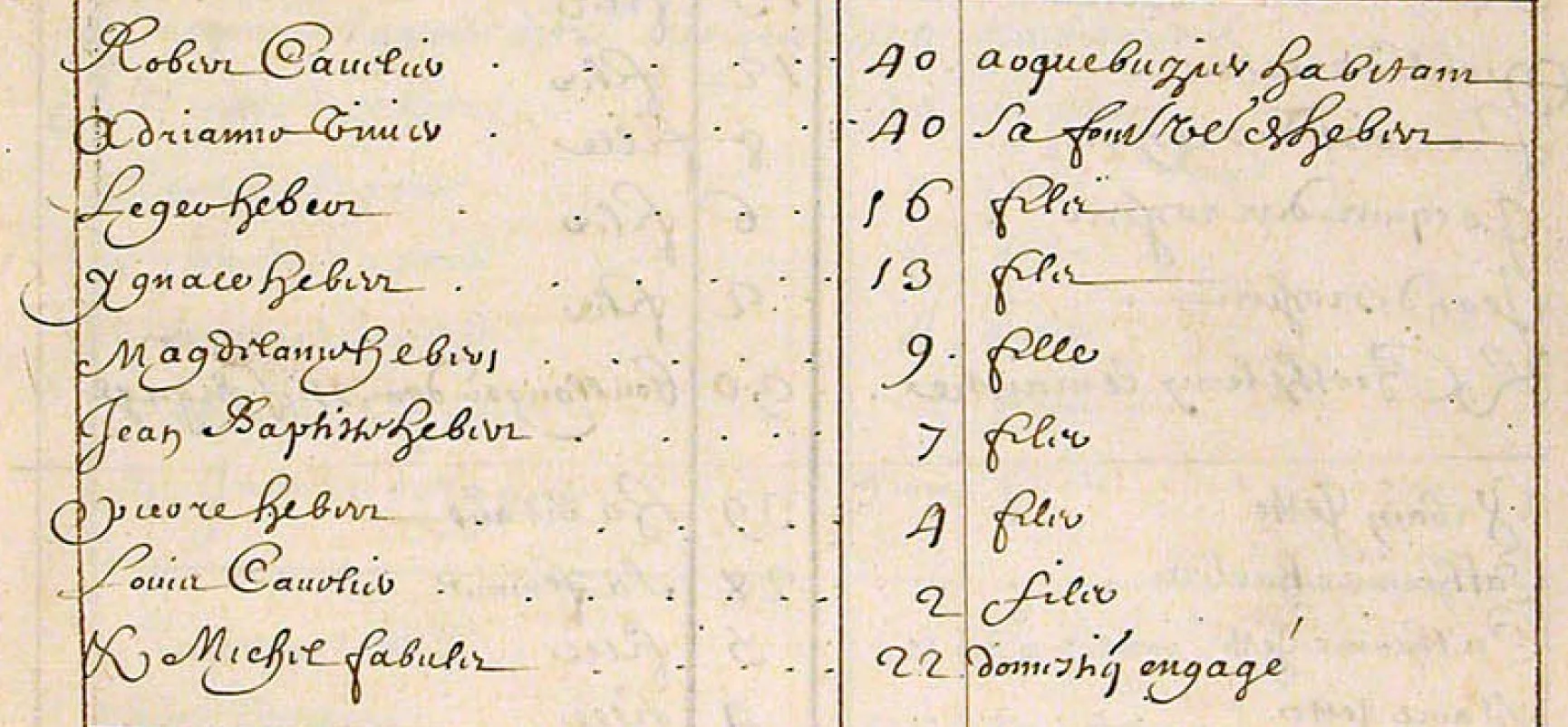
1666 Census of New France for the “Cavelier” household (Library and Archives Canada)
The following year, another census recorded the couple still living in Montréal with their children and one domestic servant. They owned forty arpents of “valuable” land (cleared or under cultivation) and eight farm animals.
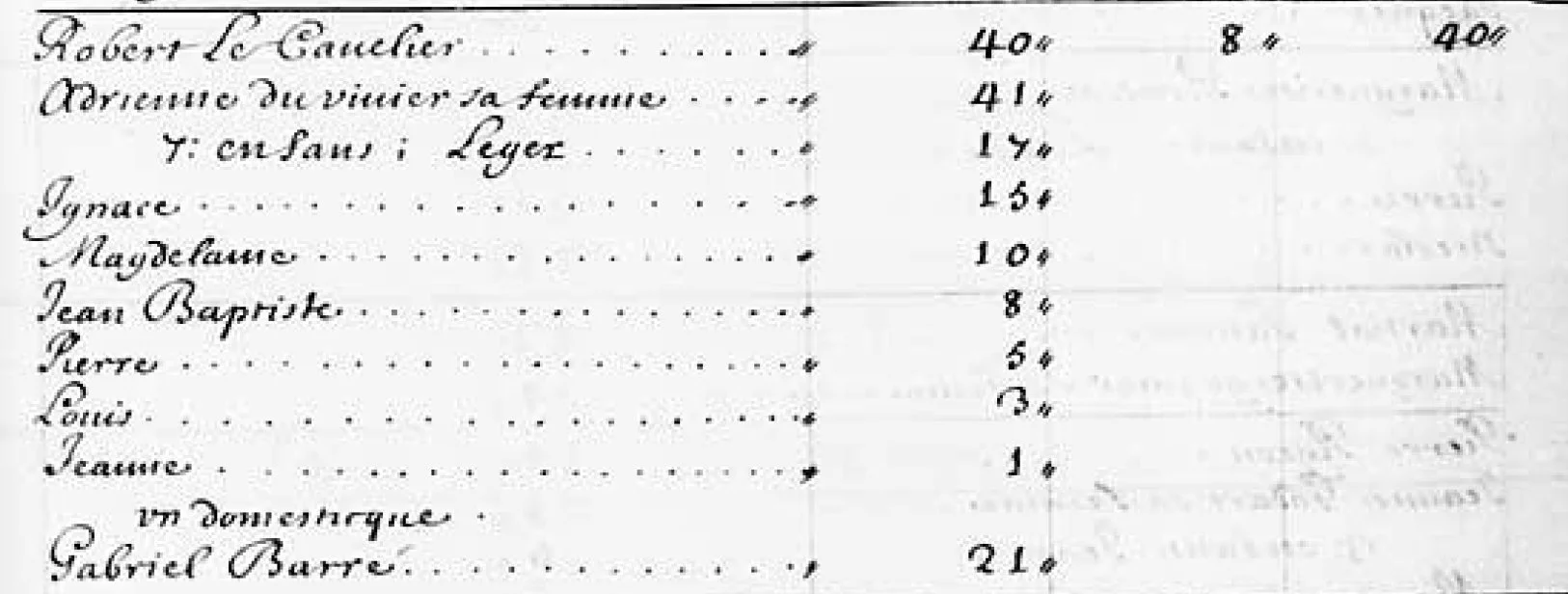
1667 Census of New France for the “Le Cavelier” household (Library and Archives Canada)
On March 4, 1675, Adrienne and Robert sold a plot of land to the Séminaire de St-Sulpice de Montréal, seigneurs of the island, for 202 livres 10 sols. The land, measuring four and a half arpents, was commonly called “la Grange” (the Barn). It bordered land belonging to the seigneurs, as well as to Jean Milot, Nicolas Godé, and Antoine Forestier. Robert was described in the document as a laboureur, or ploughman.
Adrienne and Robert were enumerated in the 1681 census of New France, still living in Montréal with six children. The family owned two guns, six head of cattle, four horses, and sixty arpents of “valuable” land.
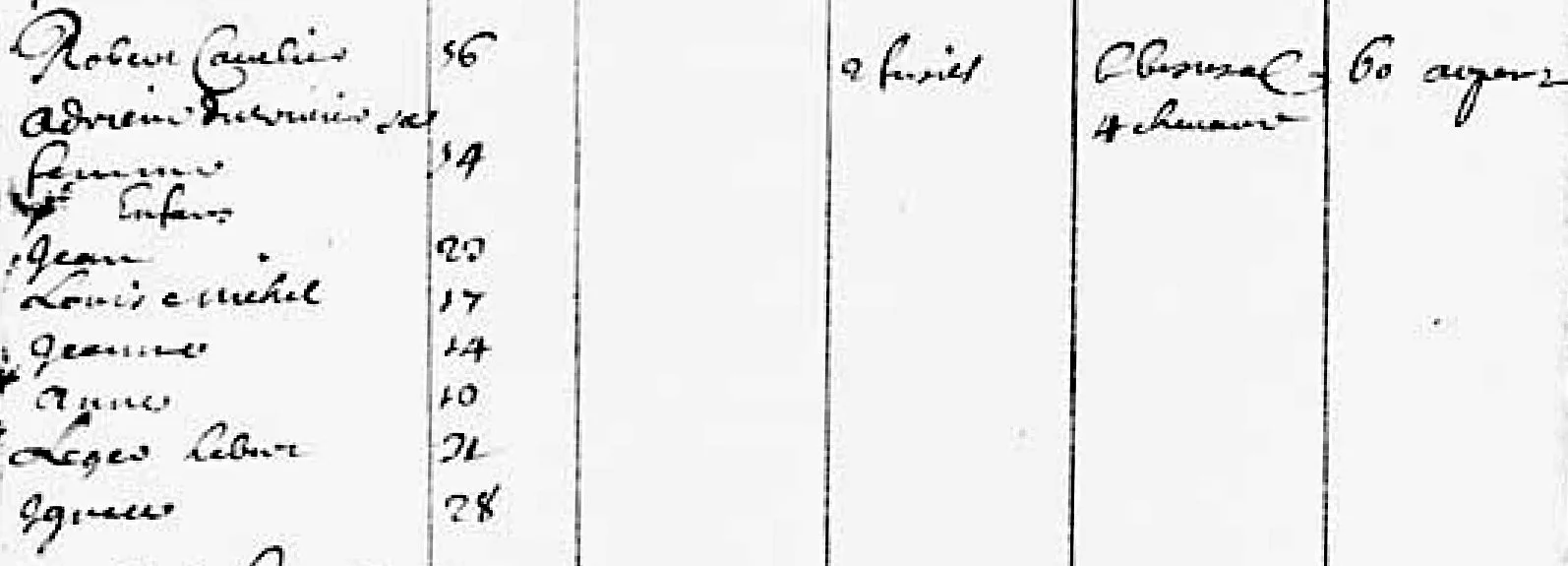
1681 Census of New France for the “Cavelier” household (Library and Archives Canada)
Buying and Selling in Villemarie
In the following two decades, Adrienne and Robert were involved in numerous of land transactions in the town of Villemarie:
April 15, 1687: Adrienne and Robert gave a plot of land to their children Marie Madeleine (and her husband Antoine Forestier), Jean Baptiste, Louis, Jeanne, and Anne Lecavelier.
June 9, 1689: Adrienne and Robert transferred land to her son Ignace Hébert and his wife Jeanne Messier, who then sold it to merchant Claude de Couagne.
April 3, 1692: Adrienne and Robert sold a lot near the gunpowder store to Jacques-Alexis de Fleury-Deschambault, bailiff and civil and criminal judge of the island of Montréal.
May 1, 1692: Adrienne and Robert sold a lot located near the gunpowder store to Jean Leduc.
July 4, 1692: Adrienne and Robert sold a plot of land near rue Saint-Pierre and rue du Saint-Sacrement to the Récollets.
April 12, 1695: Adrienne and Robert sold a remnant of land located near rue Saint-Pierre and rue du Saint-Sacrement to Catherine Gauchet, widow of Jean Baptiste Migeon de Branssat, former Lieutenant General of the island of Montréal.
August 8, 1695: Adrienne and Robert sold a piece of land located on rue du Saint-Sacrement to merchant Claude de Couagne.
November 9, 1695: Adrienne and Robert sold a portion of land located on rue Notre-Dame to their daughter Marie Madeleine and her husband Antoine Forestier, surgeon.
November 15, 1695: Adrienne and Robert sold a lot to merchant Bertrand Arnaud.
January 23, 1698: Adrienne and Robert sold a lot to daughters Jeanne and Anne Lecavelier.
April 24, 1698: Adrienne and Robert sold a plot of land on rue Notre-Dame to Guillaume Lecavelier, master armorer and arquebusier.
April 24, 1698: Adrienne and Robert sold a lot located in the enclosure of the town to Jean Baptiste Lecavelier, their son.
April 24, 1698: Adrienne and Robert sold a lot located in the enclosure of the town to Louis Michel Lecavelier, their son.
April 26, 1698: Adrienne and Robert sold a plot of land located just outside the town to Louis Michel Lecavelier, their son.
Death of Robert
Robert Lecavelier dit Deslauriers died at the age of 74 on July 25, 1699. He was buried the same day inside the church of the Reverend Récollet Fathers. Given the speed of his burial, Robert may have been a victim of the smallpox epidemic that devastated Canada in 1699.
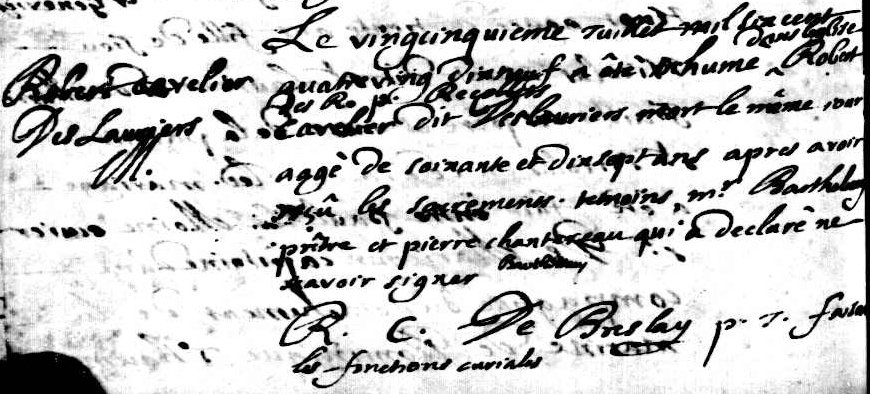
1699 burial of Robert Lecavelier dit Deslauriers (Généalogie Québec)
Adrienne’s Final Years
After her husband’s death, Adrienne put her financial affairs in order. On the afternoon of February 6, 1700, she dictated her last will and testament to notary Pierre Raimbault at her home on rue Notre-Dame, as she sat in an armchair in a ground-floor room of the house, feeling indisposed. Declaring her "nevertheless sound of mind, memory, and understanding," the notary recorded that Adrienne began, "firstly, as a true Christian Catholic," by commending her soul to God.
She directed that her debts be paid by her executor, with priority given to the sum of 220 livres she had borrowed from her daughters Jeanne and Anne Lecavelier following her husband's death. She asked to be buried in the church of the Récollets, alongside her late husband. She bequeathed 30 livres to the Chapelle Notre-Dame du Tiers-Ordre, within the church of the Reverend Récollet Fathers, to be used for the decoration of that chapel, and a further 150 livres to have ten masses said for the repose of her soul at the same Récollets church.
As for the remainder of her movable and immovable property, whether acquired or inherited, and wherever it might be situated, Adrienne ordered that it be divided equally among her children and heirs, regardless of any gifts or advantages she had previously made to her son Louis. She declared that she had never intended to favour one child over another, that she had been taken advantage of in making those earlier sales and gifts, and that Louis had, moreover, failed to fulfill any of the conditions she had attached to them.
To execute her will, Adrienne named Charles de Couagne, a bourgeois merchant of Villemarie and her good friend, as her executor, entrusting all her property into his hands until the will's value and provisions were fully carried out.
On June 11, 1700, Adrienne owed 450 livres to merchant Charles de Couagne, consolidating her late husband's debts and supplies extended to her as a widow. This debt may help explain the estate reorganization reflected in her will and codicil later that year.
Later that year, on September 27, 1700, an agreement was penned by notary Antoine Adhémar between Jean Baptiste Le Cavelier and his mother Adrienne, along with his siblings Louis Michel, Jeanne, and Anne Le Cavelier. Jean Baptiste renounced all his rights and claims to immovable property located on the island of Montréal, outside the town walls of Villemarie, whether inherited from his late father, Robert Le Cavelier, or expected from his mother after her death. In exchange, Adrienne, Louis Michel, Jeanne, and Anne bound themselves jointly to indemnify Jean Baptiste against any debts of the estate, and granted him a three-arpent-wide land concession in the Seigneurie du Cap-Saint-Michel, bordered on one side by the land of the seigneur himself and on the other by the land of Sieur Ignace Hébert, Jean Baptiste's own half-brother through his mother's first marriage. The settlement also included a payment of 300 livres, a horse with its harness, plow, cart, and other farm tools, four saws, and a quarter of the hay stored in the barn.
The agreement further divided the produce and livestock of the family estate. Jean Baptiste ceded to his siblings his share of a wheat harvest already sown that year on the estate's land, while Adrienne and the others ceded to him their claim on half of a separate wheat harvest supplied under an agreement with a man named Bouat. Jean Baptiste also relinquished his share of two horses, an ox, a calf, pigs, and household furniture belonging to the estate, and renounced any prior agreements he may have made with his late father and mother. Antoine Forestier, surgeon, and his wife Marie Madeleine Le Cavelier, Jean Baptiste's sister, also consented to the agreement. Jean Baptiste, Louis Michel, and Anne signed the document themselves, while Adrienne, consistent with her other notarized acts, did not sign.
Following this agreement, Adrienne amended her last will and testament on October 17, 1700. Notary Adhémar recorded her codicil, in which she revoked her previous will — dictated February 6, 1700, before notary Pierre Raimbault — in its entirety, with one exception: she confirmed that the 150-livre bequest to the Récollets was to remain in full effect, payable once, after her death, from her estate.
Death of Adrienne
Adrienne Duvivier was approximately 80 years old when she died. She was buried on October 20, 1706, in Montréal.
The burial record reads:
On the twentieth day of October in the year one thousand seven hundred and six, the body of Adrienne Devivier, aged eighty-six [sic], widow of the late Robert Le Cavelier, was buried, having received the sacraments of the Church. Witnesses: messire Henry Meriel, priest, and Jean Baptiste Queneville, who declared that he did not know how to sign.
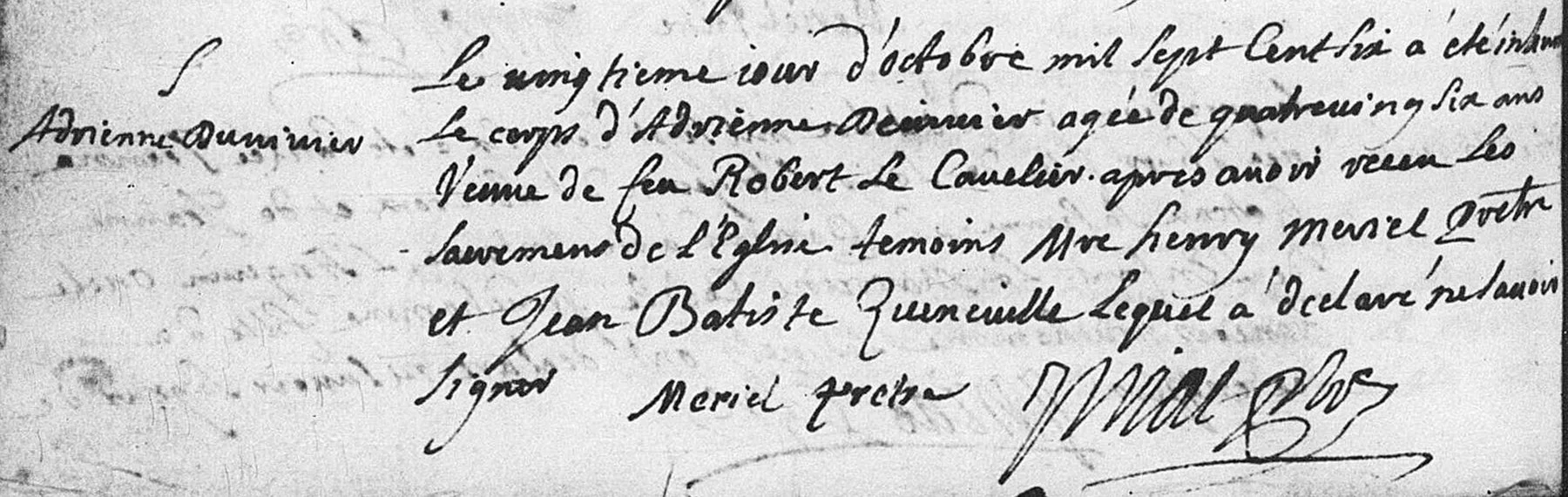
1706 burial of Adrienne Duvivier (FamilySearch)
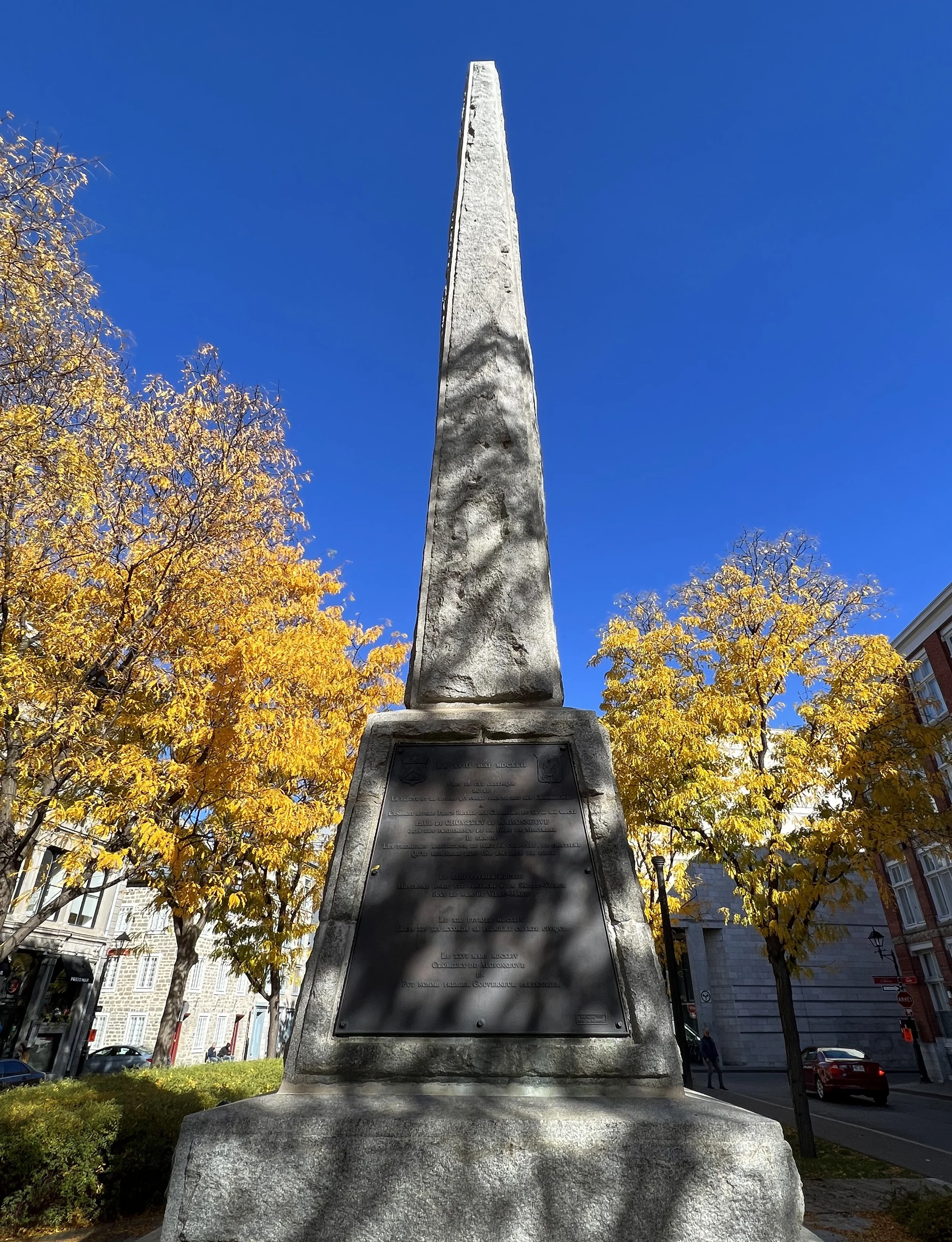
The Monument aux pionniers (© The French-Canadian Genealogist)
Plaques and Monuments
The names of Augustin Hébert and Adrienne Duvivier appear on Montréal’s Monument aux pionniers, which lists the first colonists of Montréal in 1642. As Adrienne was not in Montréal until 1647, her name should not be on the plaque. The obelisk was erected by the Société historique de Montréal in 1893, to celebrate the 250th anniversary of Montréal’s founding. It is located in Place d’Youville in Old Montréal.
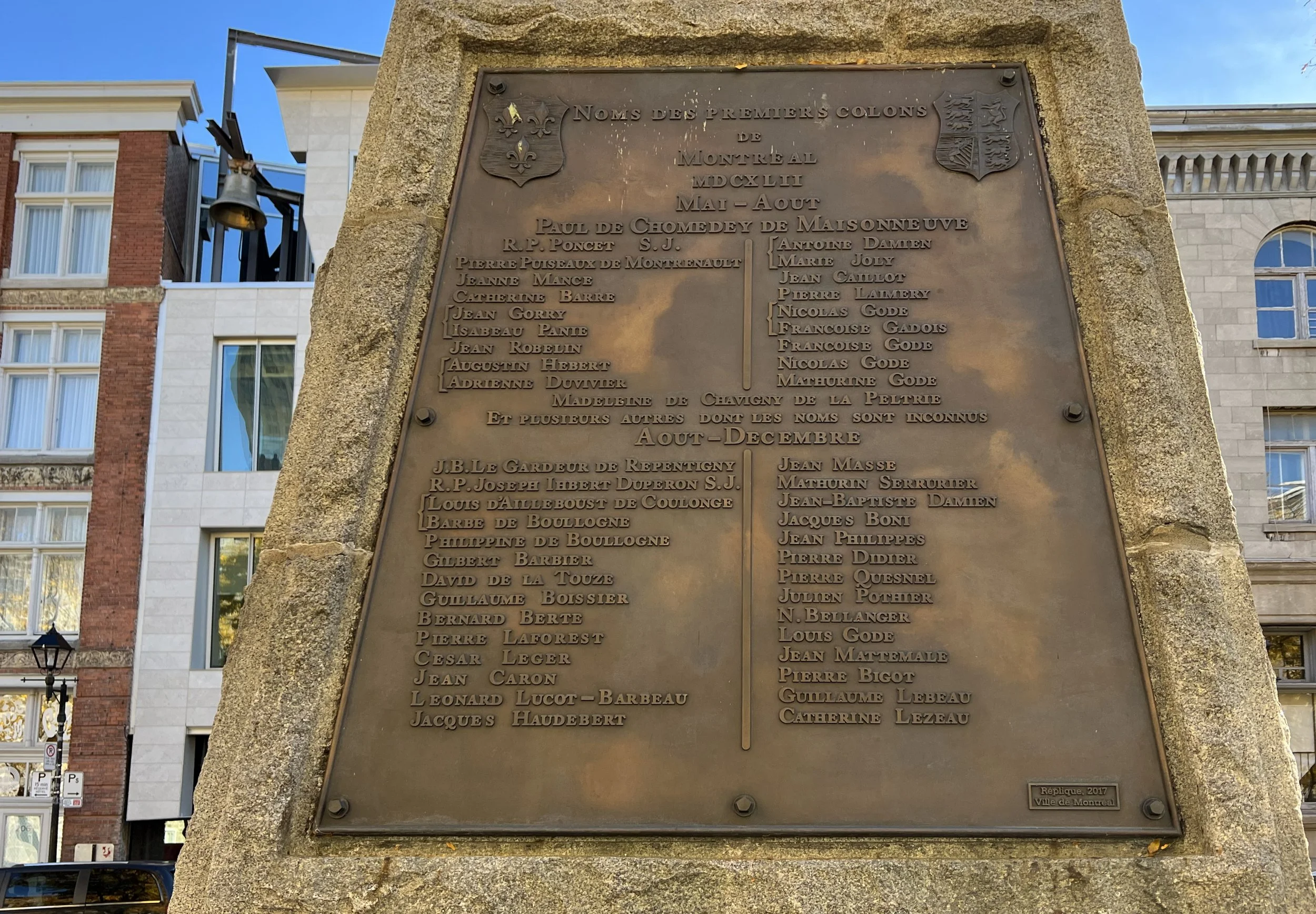
Close-up of the plaque commemorating Montréal’s first settlers (© The French-Canadian Genealogist)
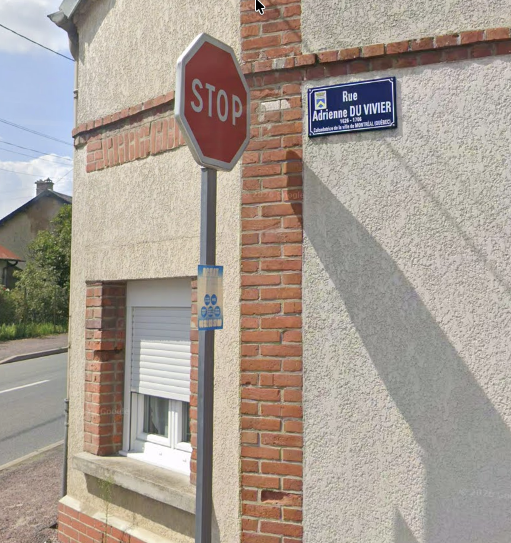
Rue Adrienne DU VIVIER in Corbeny (Google Street View)
Adrienne's birthplace of Corbeny has also honoured her memory. On May 21, 2009, the village unveiled a street sign naming "Rue Adrienne Du Vivier (1626–1706), co-founder of the city of Montréal," in a ceremony organized by the Association LXXI Corbunei et Saint-Marcoul, attended by local and regional officials including the mayor of Corbeny, the mayor of Laon, and representatives of the Commission de la mémoire franco-québécoise. Mayor Philippe Deboudt presented a short biography of Adrienne at the inauguration, and the village has since proposed developing "le Vivier," a rest area near the site, with maple trees and an interpretive panel telling her story, an effort to keep New France's memory alive in her home village.
From France to Villemarie
Augustin Hébert and Adrienne Duvivier began their life together an ocean away from where it would end. A stonecutter from Caen and a merchant's daughter from the small village of Corbeny, they married in Paris in 1646 and crossed the Atlantic the following year, drawn by the promise of a fledgling settlement clinging to the edge of a vast and unfamiliar land. Augustin helped build Villemarie with his own hands before disappearing into the wilderness near Trois-Rivières, never to return. Of all the pioneers who arrived at Villemarie in 1642, he is the only one whose surname still lives on today, carried forward by generations of descendants.
Adrienne, left a young widow with small children, remarried, rebuilt, and spent the next five decades as one of the colony's most enduring presences, buying and selling land, raising a second family, and standing as godmother to more than a dozen of Montréal's children. She outlived her second husband by seven years, dying in 1706 at the edge of ninety, having watched the outpost she helped found grow into a true town. Nearly four centuries later, her name endures in two places at once: carved into a monument in the city she helped build, and written on a street sign in the village she left behind.
PDF version of biography located at: https://www.tfcg.ca/augustinhebert-and-adrienneduvivier.
Are you enjoying our articles and resources? Show your support by making a donation. Every contribution, regardless of its size, goes a long way in covering our website hosting expenses and enables us to create more content related to French-Canadian genealogy and history. Thank you! Merci!
Sources:
"Les engagés XVIIe et XVIIIe siècles," database and digital images, Archives départementales de la Charente Maritime (http://www.archinoe.net/v2/ark:/18812/d138390b41b0ed91ade61b5ddc0ca052 : accessed 21 Jul 2026), work contract between René Pigneau and Augustin Hébert, 2 May 1647, La Rochelle, notary Pierre Teuléron, 3 E 1295 fol. 65.
"Collection Pièces judiciaires et notariales - Archives nationales à Québec," digital images, Bibliothèque et Archives nationales du Québec (https://advitam.banq.qc.ca/notice/389640 : accessed 22 Jul 2026), "Obligation par Augustin Hébert dit Jolicoeur, demeurant à Paris, à Noël Juchereau des Chatelets, demeurant ordinairement au pays de la Nouvelle-France, directeur et procureur général de la communauté de messieurs les Habitants du pays, pour 60 livres, qui seront employées pour payer les marchandises et commodités par lui achetées en cette ville et chargées dans les navires de la flotte appartenant aux habitants qui sont prêts à partir de cette rade pour aller à Québec et retourner à La Rochelle," 23 May 1647, reference TL5,D2156, Id 389640.
“Le LAFRANCE (Baptêmes, Mariages, Sépultures)," database and digital images, Généalogie Québec. (https://www.genealogiequebec.com/Membership/LAFRANCE/acte/86717 : accessed 21 Jul 2026), baptism of Marie Madeleine KHINECAOUAT, 4 Aug 1637, Trois-Rivières (Immaculée-Conception); citing original data: Institut généalogique Drouin.
“Le LAFRANCE (Baptêmes, Mariages, Sépultures)," database and digital images, Généalogie Québec. (https://www.genealogiequebec.com/Membership/LAFRANCE/acte/47203 : accessed 22 Jul 2026), marriage of Robert Lecavelier and Adrienne Duvivier, 19 Nov 1654, Montréal (Notre-Dame-de-Montréal); citing original data: Institut généalogique Drouin.
“Le LAFRANCE (Baptêmes, Mariages, Sépultures)," database and digital images, Généalogie Québec. (https://www.genealogiequebec.com/Membership/LAFRANCE/acte/49734 : accessed 22 Jul 2026), burial of Robert CAVELIER DESLAURIERS, 25 Jul 1699, Montréal (Notre-Dame-de-Montréal); citing original data: Institut généalogique Drouin.
“Canada, Quebec, Catholic Parish Registers, 1621-1979,” FamilySearch (https://www.familysearch.org/ark:/61903/3:1:3QS7-L9MY-Y9SF?cat=46693&view=explore&lang=en&groupId=TH-1961-27837-68-1 : accessed 22 Jul 2026), burial of Adrienne Devivier, 20 Oct 1706, Montreal (Notre-Dame), image 403 of 692; citing original data: Bibliothèque et Archives nationales du Québec.
"Actes de notaire, 1651-1657 // Raphaël-Lambert Closse," digital images, FamilySearch (https://www.familysearch.org/ark:/61903/3:1:3Q9M-CS5F-5QW2-X?cat=koha%3A481205&view=explore&lang=en&groupId=M9M4-8RV : accessed 21 Jul 2026), marriage contract of Gabriel LeSaille and Barbe Poisson, 9 Nov 1651, Montréal, image 2890 of 2984; citing original data: Bibliothèque et Archives nationales du Québec.
"Actes de notaire, 1651-1657 // Raphaël-Lambert Closse," digital images, FamilySearch (https://www.familysearch.org/ark:/61903/3:1:3Q9M-CS5F-5QWK-3?cat=koha%3A481205&view=explore&lang=en&groupId=M9M4-8RV : accessed 21 Jul 2026), inventory of the community of goods of Augustin Hebert dit Jolicoeur and Adrienne Duvivier, 2 Jun 1654, Montréal, images 2923-2925 of 2984; citing original data: Bibliothèque et Archives nationales du Québec.
"Actes de notaire, 1651-1657 // Raphaël-Lambert Closse," digital images, FamilySearch (https://www.familysearch.org/ark:/61903/3:1:3Q9M-CS5F-5QHM-Q?cat=koha%3A481205&view=explore&lang=en&groupId=M9M4-8RV : accessed 21 Jul 2026), marriage contract of Adrienne Duvivier and Robert Lecavelier dit Deslauriers, 30 Oct 1654, Montréal, image 2950 of 2984; citing original data: Bibliothèque et Archives nationales du Québec.
"Actes de notaire, 1651-1657 // Raphaël-Lambert Closse," digital images, FamilySearch (https://www.familysearch.org/ark:/61903/3:1:3Q9M-CS5F-5QH9-1?cat=koha%3A481205&view=explore&lang=en&groupId=M9M4-8RV : accessed 21 Jul 2026), land concession by Paul de Chomedey to Robert le Cavelier and Adrienne Duvivier, 24 Oct 1654, Montréal, images 2936-2938 of 2984; citing original data: Bibliothèque et Archives nationales du Québec.
"Actes de notaire, 1657-1699 // Bénigne Basset," digital images, FamilySearch (https://www.familysearch.org/ark:/61903/3:1:3Q9M-CST7-NQTL?cat=koha%3A426906&view=explore&lang=en&groupId=TH-909-77566-3928-96 : accessed 22 Jul 2026), land transfer by Robert le Cavelier and Adrienne Duvivier to the Séminaire de St-Sulpice de Montréal, 4 Mar 1675, Montréal, images 2315-2317 of 3072; citing original data: Bibliothèque et Archives nationales du Québec.
"Actes de notaire, 1697-1727 // Pierre Raimbault," digital images, FamilySearch (https://www.familysearch.org/ark:/61903/3:1:3Q9M-CS5V-SV8?cat=koha%3A675517&view=explore&lang=en&groupId=M9DC-F8Z : accessed 22 Jul 2026), testament of Adrienne Duvivier, 6 Feb 1700, Montréal, images 1145-1147 of 3137; citing original data: Bibliothèque et Archives nationales du Québec.
"Actes de notaire, 1668-1714 // Antoine Adhémar," digital images, FamilySearch (https://www.familysearch.org/ark:/61903/3:1:3Q9M-CSTH-53NN-4?cat=koha%3A541271&view=explore&lang=en&groupId=TH-909-77664-90300-17 : accessed 23 Jul 2026), obligation (debt) of Adrienne Duvivier to Charles de Couagnes, 11 Jun 1700, Montréal, images 825-826 of 3103; citing original data: Bibliothèque et Archives nationales du Québec.
"Actes de notaire, 1668-1714 // Antoine Adhémar," digital images, FamilySearch (https://www.familysearch.org/ark:/61903/3:1:3Q9M-CSTH-53DR-B?cat=koha%3A541271&view=explore&lang=en&groupId=TH-909-77664-90300-17 : accessed 22 Jul 2026), agreement between Adrienne Duvivier and her children, 27 Sep 1700, Montréal, images 1429-1432 of 3103; citing original data: Bibliothèque et Archives nationales du Québec.
"Actes de notaire, 1668-1714 // Antoine Adhémar," digital images, FamilySearch (https://www.familysearch.org/ark:/61903/3:1:3Q9M-CSTH-53JC-L?cat=koha%3A541271&view=explore&lang=en&groupId=TH-909-77664-90300-17 : accessed 22 Jul 2026), codicil of Adrienne Duvivier, 17 Oct 1700, Montréal, images 1542-1543 of 3103; citing original data: Bibliothèque et Archives nationales du Québec.
Parchemin, notarial database of ancient Québec (1626-1801), Société de recherche historique Archiv-Histo (https://archiv-histo.com : accessed 22 Jul 2026), "Donation d'une terre située en la ville de Villemarie; par Robert Lecavellier et Adrienne Duvivier, son épouse, à Antoine Forestier, chirurgien et Marie-Madeleine Lecavelier, son épouse, leurs gendre et fille, Jean-Baptiste Lecavelier, Jeanne Lecavelier et Anne Lecavelier, leurs fils et filles, ladite Madeleine Cavelier faisant tant pour eux que pour Louis Lecavelier, leur frère absent," notary P. Cabazié, 15 Apr 1687.
Parchemin, notarial database of ancient Québec (1626-1801), Société de recherche historique Archiv-Histo (https://archiv-histo.com : accessed 22 Jul 2026), "Cession et délaissement portant quittance de terre située en la ville de Villemarie; par Robert Lecavelier dit Deslaurier et Adrienne Duvivier, son épouse, de la ville de Villemarie, épouse antérieure de Augustin Hebert, à Ignace Hebert et Jeanne Messier, son épouse, fils de ladite Duvivier et dudit défunt, et vente de ladite terre par ledit Ignace Hebert à Claude de Couagne, marchand bourgeois, de la ville de Villemarie," notary A. Adhémar de Saint-Martin, 9 Jun 1689.
Parchemin, notarial database of ancient Québec (1626-1801), Société de recherche historique Archiv-Histo (https://archiv-histo.com : accessed 22 Jul 2026), "Vente d'un emplacement situé en la ville de Villemarie vers le magasin aux poudres; par Robert Lecavellier dit Deslaurier et Adrienne Duvivier, son épouse, de la ville de Villemarie, à Jacques-Alexis de Fleury-Deschambault, écuyer, licencié en loi, avocat au parlement de Paris, bailli et juge civil et criminel de l'île de Montréal," notary A. Adhémar de Saint-Martin, 3 Apr 1692.
Parchemin, notarial database of ancient Québec (1626-1801), Société de recherche historique Archiv-Histo (https://archiv-histo.com : accessed 22 Jul 2026), "Vente d'un emplacement situé en la ville de Villemarie vers le magasin aux poudres; par Robert Lecavelier dit Delorier et Adrienne Duvivier, son épouse, de Villemarye, à Jean Leduc, demeurant près de la ville de Villemarie," notary A. Adhémar de Saint-Martin, 1 May 1692.
Parchemin, notarial database of ancient Québec (1626-1801), Société de recherche historique Archiv-Histo (https://archiv-histo.com : accessed 22 Jul 2026), "Vente de terre située dans la ville de Villemarie sur le niveau des rues St Pierre et du St Sacrement; par Robert Lecavellier dit Deslaurier et Adrienne Duvivier, son épouse, de Villemarie, aux Récollets," notary A. Adhémar de Saint-Martin, 4 Jul 1692.
Parchemin, notarial database of ancient Québec (1626-1801), Société de recherche historique Archiv-Histo (https://archiv-histo.com : accessed 22 Jul 2026), "Vente d'un restant de terre situé sur les rues St-Pierre et St-Sacrement en la ville de Villemarie; par Robert Lecavellier dit Deslaurier et Adrienne Duvivier, son épouse, de Villemarie, à Catherine Gauchet, veuve de Jean-Baptiste Migeon de Branssat, avocat au parlement et lieutenant général de l'île de Montréal, absente, acceptant pour elle Charles Juchereau, écuyer et conseiller du Roi et lieutenant général de l'île de Montréal," notary A. Adhémar de Saint-Martin, 12 Apr 1695.
Parchemin, notarial database of ancient Québec (1626-1801), Société de recherche historique Archiv-Histo (https://archiv-histo.com : accessed 22 Jul 2026), "Vente d'un morceau de terre situé en la ville de Villemarie sur la rue du St Sacrement; par Robert Lecavelier dit Deslauriers, habitant et Adrienne Duvivier, son épouse, de Villemarie, à Charles de Couagne, marchand bourgeois, de Villemarie," notary B. Basset dit Deslauriers, 8 Aug 1695.
Parchemin, notarial database of ancient Québec (1626-1801), Société de recherche historique Archiv-Histo (https://archiv-histo.com : accessed 22 Jul 2026), "Vente d'une portion de terre située en la ville de Villemarie sur le niveau de la rue Nostre Dame; par Robert Lecavellier dit Deslaurier et Adrienne Duvivier, son épouse, de Villemarie, à Antoine Forestier, chirurgien et Marie-Madeleine Lecavelier, son épouse, de Villemarie," notary A. Adhémar de Saint-Martin, 9 Nov 1695.
Parchemin, notarial database of ancient Québec (1626-1801), Société de recherche historique Archiv-Histo (https://archiv-histo.com : accessed 22 Jul 2026), "Vente d'un emplacement situé en la ville de Villemarie; par Robert Lecavellier dit Deslaurier, habitant et Adrienne Duvivier, son épouse, de Villemarie, à Bertrand Arnaud, marchand, de Villemarie," notary A. Adhémar de Saint-Martin, 15 Nov 1695.
Parchemin, notarial database of ancient Québec (1626-1801), Société de recherche historique Archiv-Histo (https://archiv-histo.com : accessed 22 Jul 2026), "Vente d'un emplacement situé en la ville de Villemarie; par Robert Lecavelier dit Deslaurier et Adrienne Duvivier, son épouse, de Villemarie, à Jeanne Lecaveliers et Anne Lecaveliers, soeurs, leurs filles.," notary A. Adhémar de Saint-Martin, 23 Jan 1698.
Parchemin, notarial database of ancient Québec (1626-1801), Société de recherche historique Archiv-Histo (https://archiv-histo.com : accessed 22 Jul 2026), "Vente de terre située en la ville de Villemarie sur le niveau de la rue Notre Dame; par Robert Lecavelier dit Deslaurier et Adrienne Duvivier, son épouse, de Villemarie, à Guillaume Lecavelier, maître armurier et arquebusier, de Villemarie," notary A. Adhémar de Saint-Martin, 24 Apr 1698.
Parchemin, notarial database of ancient Québec (1626-1801), Société de recherche historique Archiv-Histo (https://archiv-histo.com : accessed 22 Jul 2026), "Vente d'un emplacement situé dans l'enclos de la ville de Villemarie; par Robert Lecavellier dit Deslaurier et Adrienne Duvivier, son épouse, de Villemarie, à Jean-Baptiste Lecavelier, son fils," notary A. Adhémar de Saint-Martin, 24 Apr 1698.
Parchemin, notarial database of ancient Québec (1626-1801), Société de recherche historique Archiv-Histo (https://archiv-histo.com : accessed 22 Jul 2026), "Vente d'un emplacement situé dans l'enclos de la ville de Villemarie; par Robert Lecavelier dit Deslaurier et Adrienne Duvivier, son épouse, de Villemarie, à Louis-Michel Lecavelier, de Villemarie," notary A. Adhémar de Saint-Martin, 24 Apr 1698.
Parchemin, notarial database of ancient Québec (1626-1801), Société de recherche historique Archiv-Histo (https://archiv-histo.com : accessed 22 Jul 2026), "Vente de terre située par-devant à la clôture de la ville de Villemarie; par Adrienne Duvivier et Robert Lecavellier dit Deslaurier, son époux, de Villemarie, à Louis-Michel Lecavelier, de Villemarie, son fils," notary A. Adhémar de Saint-Martin, 26 Apr 1698.
"Recensement du Canada, 1666," digital images, Library and Archives Canada (https://recherche-collection-search.bac-lac.gc.ca/fra/accueil/notice?idnumber=2318856&app=fonandcol : accessed 22 Jul 2026), household of Robert Cavelier, Montreal, page 121 (of PDF), Finding aid no. MSS0446, MIKAN no. 2318856; citing original data: Centre des archives d'outre-mer (France) vol. 460.
"Recensement du Canada, 1667," digital images, Library and Archives Canada (https://www.bac-lac.gc.ca/eng/CollectionSearch/Pages/record.aspx?app=fonandcol&IdNumber=2318857&new=-8585951843764033676 : accessed 22 Jul 2026), household of Robert Le Cavelier, 1667, Montréal, page 161 (of PDF), Finding aid no. MSS0446, Item ID number: 2318857; citing original data: Centre des archives d'outre-mer (France) vol. 460.
"Recensement du Canada fait par l'intendant Du Chesneau," digital images, Library and Archives Canada (https://www.bac-lac.gc.ca/eng/CollectionSearch/Pages/record.aspx?app=fonandcol&IdNumber=2318858&new=-8585855146497784530 : accessed 22 Jul 2026), household of Robert Cavelier, 14 Nov 1681, Montréal, page 158 (of PDF), Finding aid no. MSS0446, MIKAN no. 2318858; citing original data: Centre des archives d'outre-mer (France) vol. 460.
Roland-Yves Gagné, "Les origines d’Augustin Hébert dit Jolicœur et d’Adrienne Duvivier," Mémoires de la Société généalogique canadienne-française, volume 68, number 2, booklet 292, summer 2017, page 120-124.
Marcel Fournier, Les Premiers Montréalistes : 1642-1643 (Montréal, Société de recherche historique Archiv-Histo Inc., 2013), 128-129.
P. J.-Paul Hébert, "AUGUSTIN HEBERT-DIT-JOLYCOEUR : Montréalais de la première heure," Mémoires de la Société Généalogique Canadienne-Française, Jan-Mar 1968, Vol. XIX, number 1, page 11.
Journal des Jésuites (Québec, Léger Brousseau Imprimeur-Éditeur, 1871), 192-193.
Frédéric Poidevin, "Hommage à Adrienne Duvivier, pionnière de Ville-Marie, rendu par le village de Corbeny," Commission de la mémoire franco-québécoise (https://cfqlmc.org/hommage-a-adrienne-duvivier-pionniere-de-ville-marie-rendu-par-le-village-de-corbeny/ : accessed 22 Jul 2026), 6 Dec 2009.
Fédération québécoise des sociétés de généalogie, Fichier Origine online database (https://www.fichierorigine.com/fr/repertoire/duvivier/-vivier : accessed 21 Jul 2026), entry for DUVIVIER / VIVIER, Adrienne (person #310101), updated on 7 Oct 2018.
Université de Montréal, Programme de recherche en démographie historique (PRDH) online database (https://www-prdh-igd-com.res.banq.qc.ca/Membership/en/PRDH/Famille/509 : accessed 21 Jul 2026), dictionary entry for Augustin Auguste HEBERT JOLICOEUR and Adrienne VIVIER, union 509.
Université de Montréal, Programme de recherche en démographie historique (PRDH) online database (https://www-prdh-igd-com.res.banq.qc.ca/Membership/en/PRDH/acte/39503 : accessed 21 Jul 2026), baptism of Madeleine Tessier, 19 Jul 1653, Montréal (Notre-Dame-de-Montréal), record 39503.
Université de Montréal, Programme de recherche en démographie historique (PRDH) online database (https://www-prdh-igd-com.res.banq.qc.ca/Membership/en/PRDH/Famille/897 : accessed 22 Jul 2026), dictionary entry for Robert CAVELIER DESLAURIERS and Adrienne VIVIER, union 897.
Université de Montréal, Programme de recherche en démographie historique (PRDH) online database (https://www-prdh-igd-com.res.banq.qc.ca/Membership/en/PRDH/acte/39433 : accessed 21 Jul 2026), baptism of Marie Boudard, 29 Aug 1649, Montréal (Notre-Dame-de-Montréal), record 39433.
Université de Montréal, Programme de recherche en démographie historique (PRDH) online database (https://www-prdh-igd-com.res.banq.qc.ca/Membership/en/PRDH/acte/39443 : accessed 21 Jul 2026), baptism of Adrienne OSKENNONTONHAST, 5 Jun 1650, Montréal (Notre-Dame-de-Montréal), record 39443.
Université de Montréal, Programme de recherche en démographie historique (PRDH) online database (https://www-prdh-igd-com.res.banq.qc.ca/Membership/en/PRDH/acte/39444 : accessed 21 Jul 2026), baptism of Marie Lucos, 1 Jul 1650, Montréal (Notre-Dame-de-Montréal), record 39444.
Université de Montréal, Programme de recherche en démographie historique (PRDH) online database (https://www-prdh-igd-com.res.banq.qc.ca/Membership/en/PRDH/acte/39500 : accessed 21 Jul 2026), baptism of Adrienne Barbier, 20 Aug 1652, Montréal (Notre-Dame-de-Montréal), record 39500.
Université de Montréal, Programme de recherche en démographie historique (PRDH) online database (https://www-prdh-igd-com.res.banq.qc.ca/Membership/en/PRDH/acte/39503 : accessed 21 Jul 2026), baptism of Madeleine Tessier, 19 Jul 1653, Montréal (Notre-Dame-de-Montréal), record 39503.
Université de Montréal, Programme de recherche en démographie historique (PRDH) online database (https://www-prdh-igd-com.res.banq.qc.ca/Membership/en/PRDH/acte/39550 : accessed 21 Jul 2026), baptism of Marie Milot, 30 Sep 1657, Montréal (Notre-Dame-de-Montréal), record 39550.
Université de Montréal, Programme de recherche en démographie historique (PRDH) online database (https://www-prdh-igd-com.res.banq.qc.ca/Membership/en/PRDH/acte/40446 : accessed 21 Jul 2026), baptism of Jean Baptiste Forestier, 24 Jun 1677, Montréal (Notre-Dame-de-Montréal), record 40446.
Université de Montréal, Programme de recherche en démographie historique (PRDH) online database (https://www-prdh-igd-com.res.banq.qc.ca/Membership/en/PRDH/acte/2181 : accessed 21 Jul 2026), baptism of Ignace Hébert, 19 Mar 1682, Montréal (Notre-Dame-de-Montréal), record 2181.