Louis Gasnier & Marie Michel
Follow the story of Louis Gasnier and Marie Michel, ancestors of the Gagné family, from the Perche region of France to early Québec, Sainte-Anne-de-Beaupré, and Bellechasse. This biography traces their lives, hardships, and legacy in 17th-century New France, including Louis’s sudden and mysterious death, perhaps at the hands of the Iroquois, during a period of violence in the colony.
Cliquez ici pour la version en français
Louis Gasnier & Marie Michel
From the Perche to the St. Lawrence
Louis Gasnier, the son of Louis Gasnier and Marie Launay, was baptized on September 13, 1612, in the parish of Saint-Martin in Igé, Perche, France. His godfathers were François Vaillant and René Laireau, and his godmother was Françoise Launay. His father worked as a miller. Louis had three known brothers: Noël, Jacques, and Pierre, who would also become a pioneer in New France. Over time, the Gasnier name evolved into Ganier, Gaigné, Gagnier, and finally Gagné.

1612 baptism of Louis Gasnier (Archives et patrimoine culturel de l'Orne)
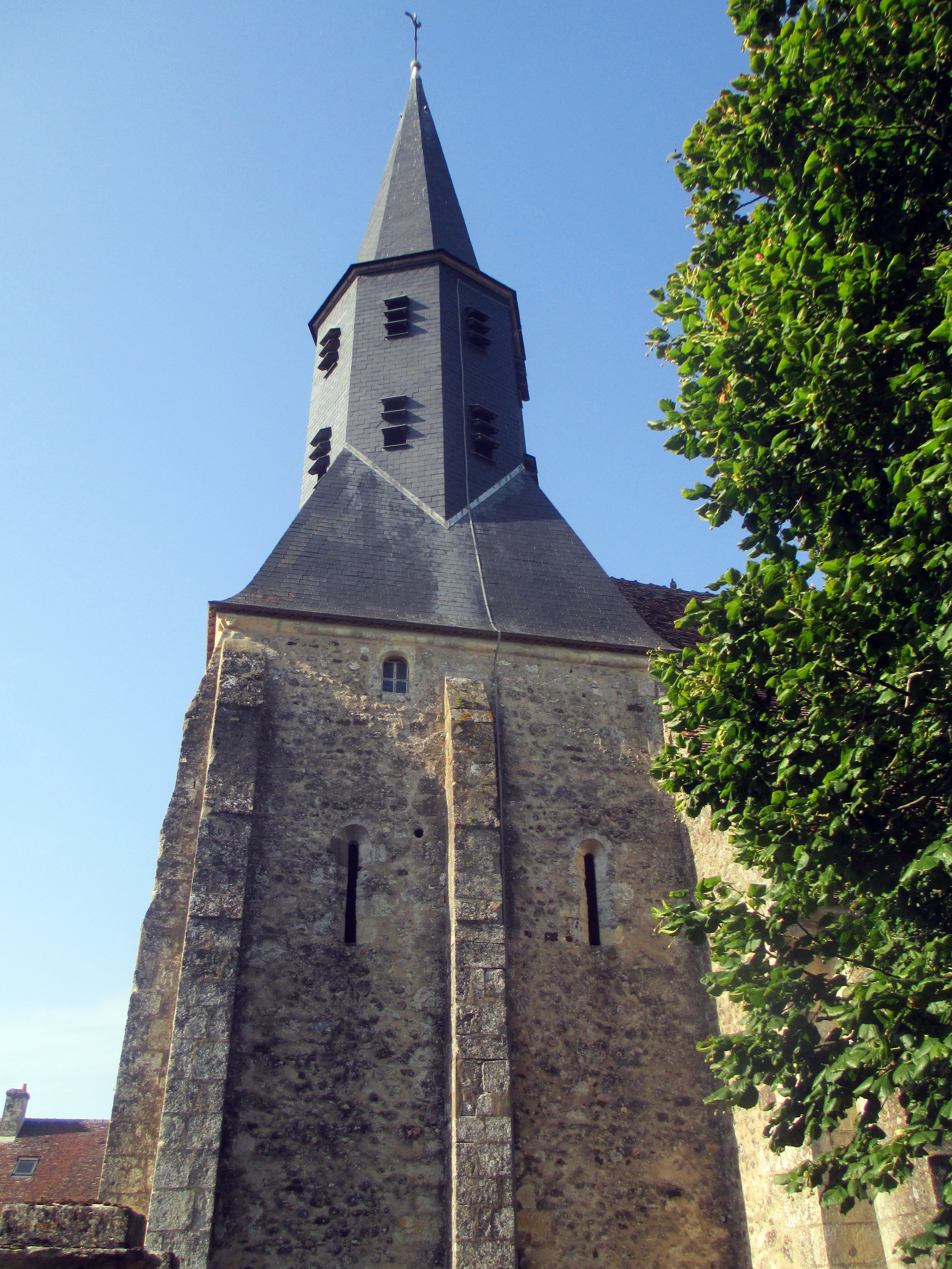
The Church of Saint-Martin in Igé (photo by Pucesurvitaminee CC BY-SA 3.0, Wikimedia Commons)
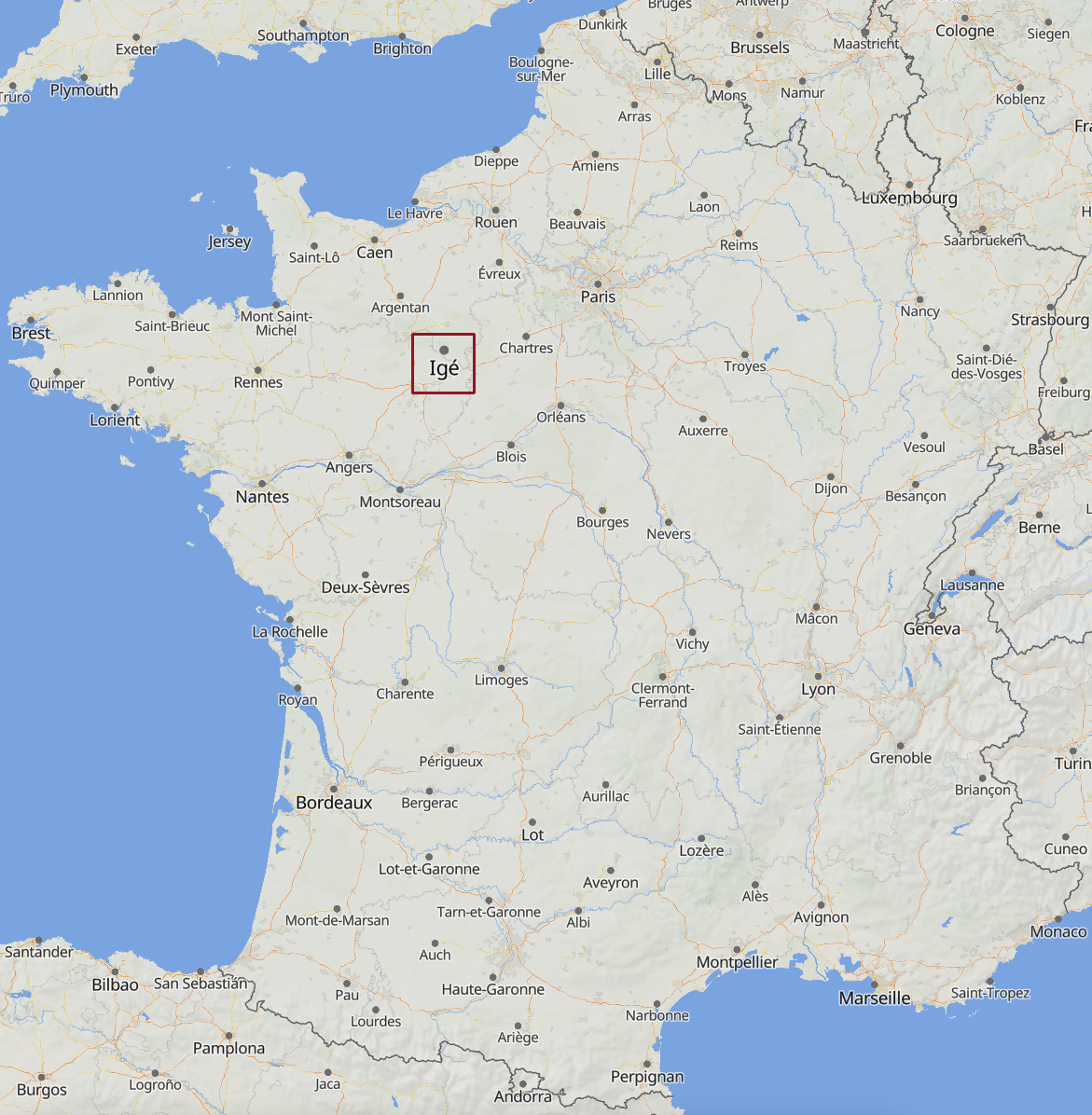
Location of Igé in France (Mapcarta)
Like his father, Louis worked as a miller at the nearby Guémançais and Courtoulin mills.
Located approximately 140 kilometres southwest of Paris, Igé is in the present-day department of Orne. A small, rural commune, it has fewer than 600 inhabitants.
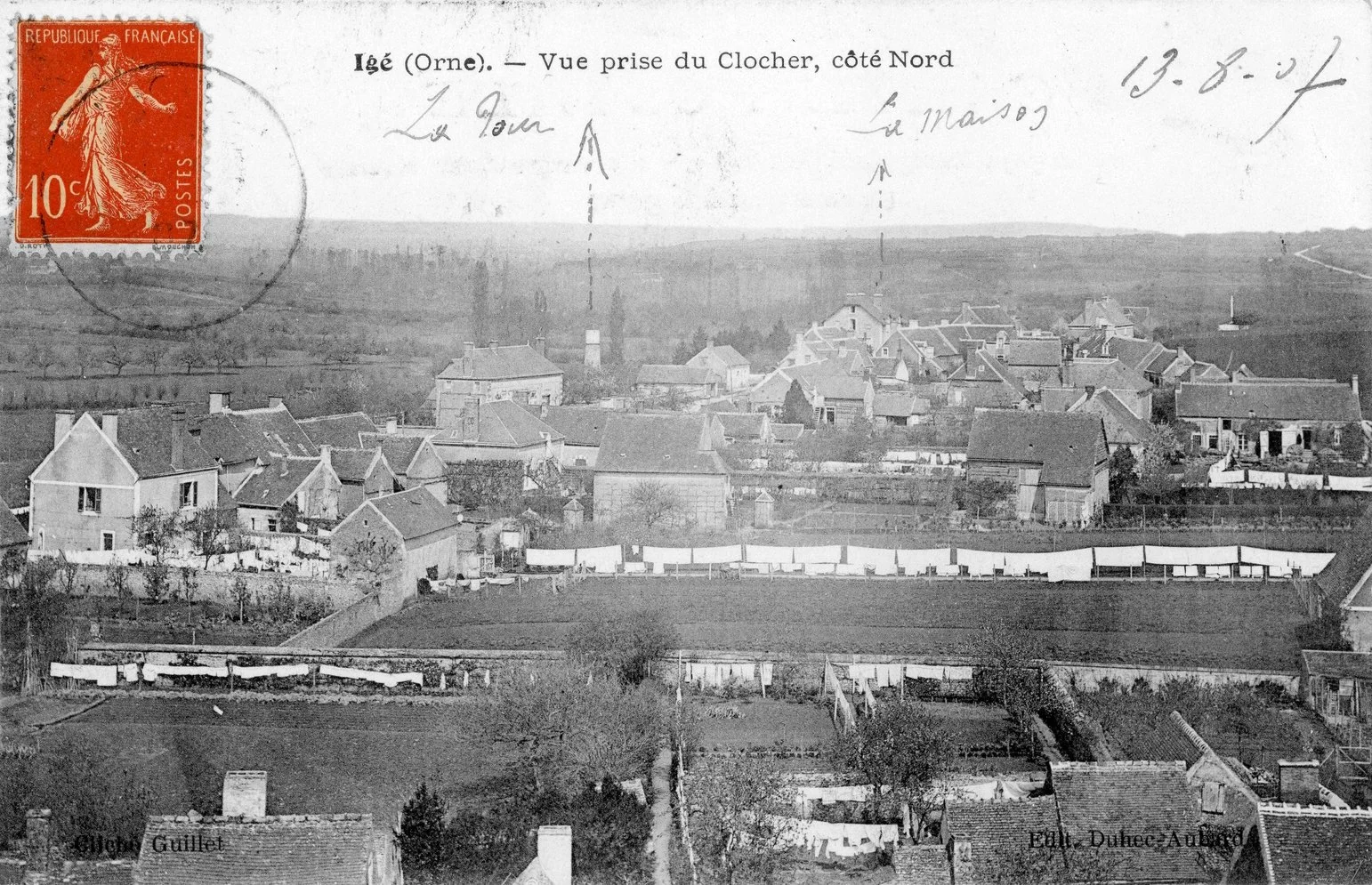
Postcard of Igé, 1907 (Geneanet)
Marie Michel, the daughter of Pierre Michel and Louise Gurry, was born around 1622 in Saint-Martin-du-Vieux-Bellême, Perche, France, approximately 6 kilometres north of Igé.
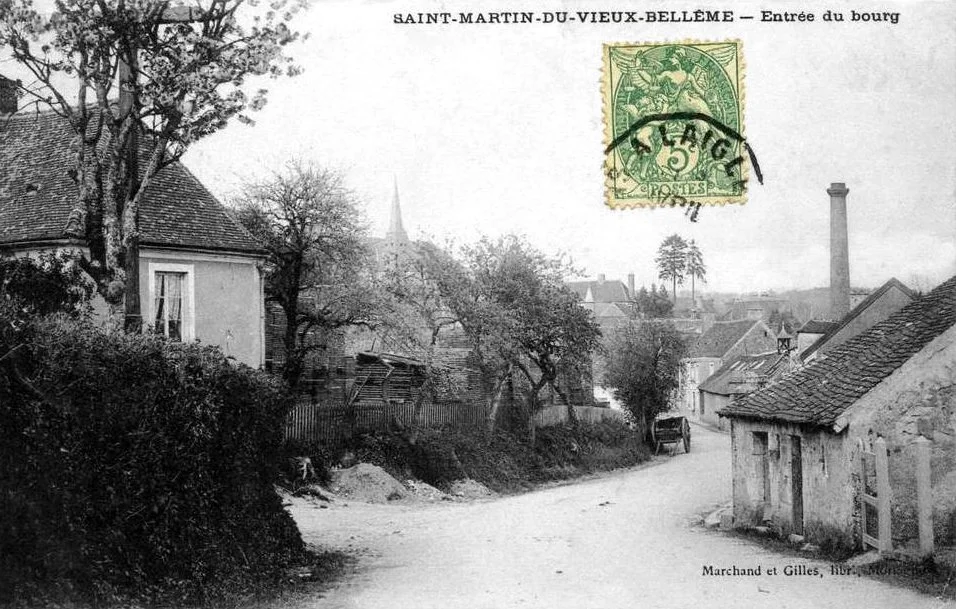
Postcard of Saint-Martin-du-Vieux-Bellême, circa 1907 (Geneanet)
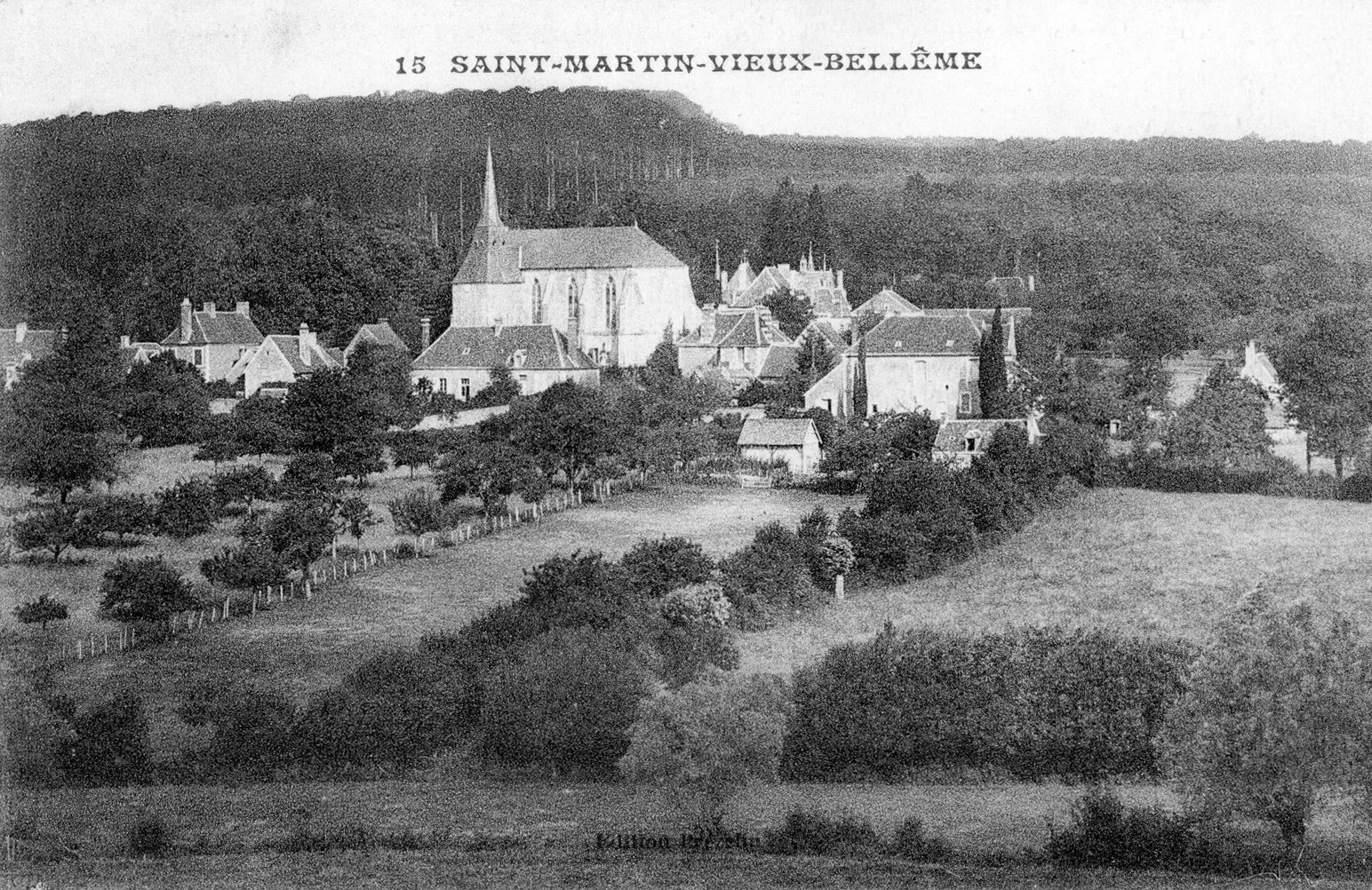
Postcard of Saint-Martin-du-Vieux-Bellême, circa 1909 (Geneanet)
On June 11, 1638, notary Regnard drew up a marriage contract in Saint-Martin-du-Vieux-Bellême between Louis and Marie. Louis was 25 years old, and Marie was about 16.
The couple had two children in France: Louis, who died before 1644, and Louise. Both were baptized in the parish church of Saint-Martin in Igé.
Louis and Marie would have at least nine children in total:
Louis Gagné (1639-d. in France)
Louise Gagné (1642-1721)
Marie Gagné (1644-1717)
Pierre Gagné (1647-bef. 1714)
Olivier Gagné (1649-bef. 1730)
Louis Gagné (1651-bef. 1721)
Anne Gagné (1653-aft. 1723)
Ignace Gagné (1656-1702)
Joachim Gagné (ca. 1660-1688)
A Fateful Decision to Leave France
As a newly married couple, Louis and Marie would have faced limited prospects in the Perche. The region was densely settled, land was increasingly subdivided, and younger men often struggled to establish independent households. For a young family, economic stability was difficult to achieve within the local system. Louis’s trade as a miller may help explain the decision to emigrate. In France, mills were seigneurial monopolies, and positions were few, tightly regulated, and often inherited or controlled by patronage. In New France, by contrast, skilled tradesmen such as millers were actively sought to support expanding grain production. The same occupation that offered little mobility in France could provide steadier work and greater opportunity in the colony.
Louis and Marie’s ages and family size also made migration feasible. A wife of sixteen and a husband in his mid-twenties were typical for the period, and with only one child the household remained relatively mobile. This was precisely the demographic most likely to migrate successfully. The Perche also had well-established migration networks to New France by the 1630s and 1640s, often involving notaries and parish connections that reduced uncertainty. Combined with broader pressures of war, taxation, and economic instability in France, emigration offered the young family a realistic opportunity for stability and social advancement that was unlikely to be achieved in the Igé area.
The Percheron Emigration: From France to the Shores of Canada
The old province of Perche was deeply connected to 17th-century French emigration to Canada and emerged as a major emigration hub. Many early Canadian settlers originated in this region and departed France from the port of La Rochelle. Key figures in this migration included Robert Giffard, a seigneur and surgeon, and the Juchereau brothers, Jean and Noël, merchants who were granted large land concessions in Canada. They required men to clear their lands, build homes and other structures, and begin cultivation. Their primary aim was to bring as many colonists and families to Canada as possible. The Compagnie des Cent-Associés partly funded the migration of these colonists, including Zacharie Cloutier, Jean Guyon, Noël Langlois, and many others. The Museum of French Emigration to Canada in Tourouvre au Perche celebrates these pioneers and their stories.
Louis, Marie, and their daughter Louise likely arrived in Canada in 1644. Marie was probably pregnant during the crossing and may have given birth to their daughter Marie onboard. This would explain why Marie, born on September 5, 1644, was not baptized until fifteen days later in Québec. Her godparents were Noël Juchereau, Geneviève Juchereau (daughter of Jean), and Marie Langlois (wife of Jean Juchereau).
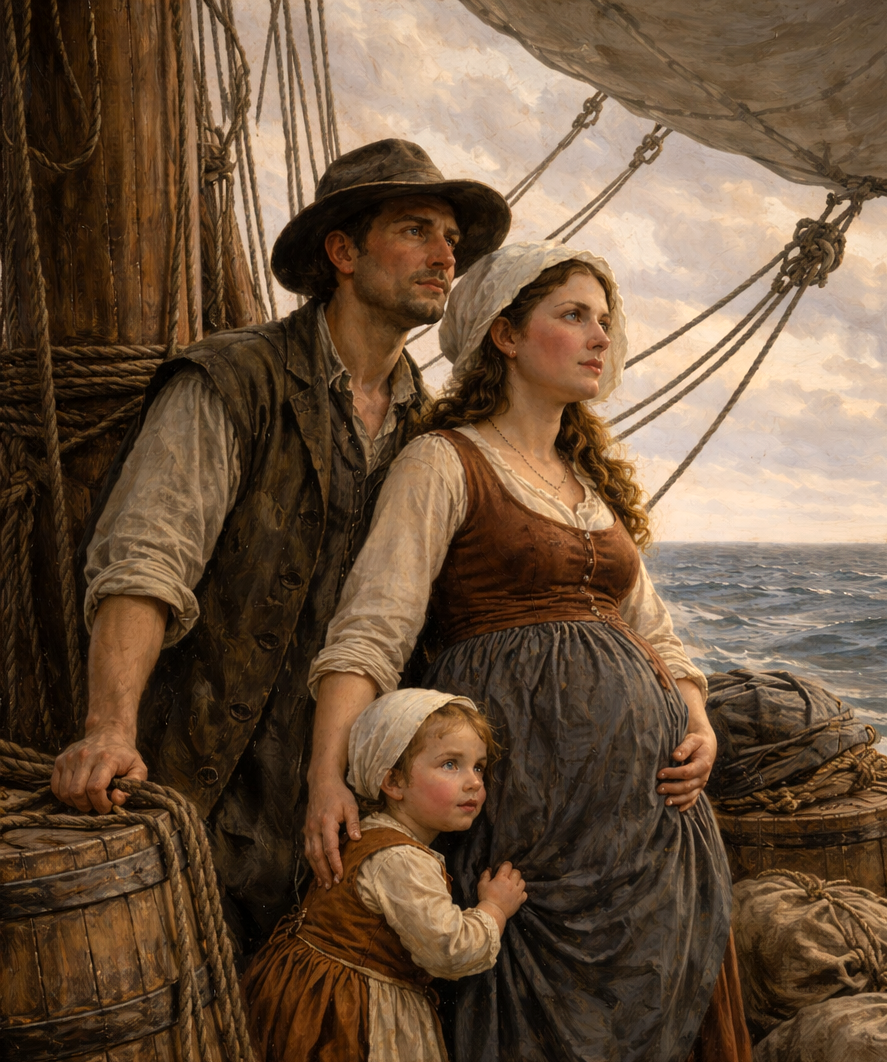
Artificial intelligence image created by the author with ChatGPT (January 2026)
A New Home in New France
The Gagné family lived in the settlement of Québec for a few years before moving to the côte de Beaupré.
On October 3, 1647, Louis accepted a six-year farm lease in Beaupré from Olivier Letardif, clerk of the Compagnie des Cent-Associés, to begin on the following All Saints Day. Louis was recorded as a laboureur, or ploughman. The farm, called “Saint-Charles,” included meadows, arable land, a stable, a barn, a yard, a garden, and a house, as well as oxen, cows, and pigs.
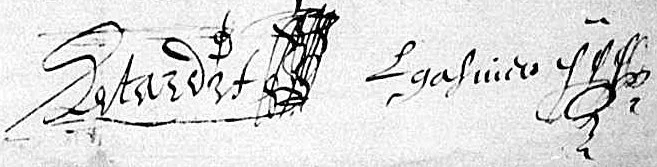
Letardif and Gasnier signatures and paraphs on the 1647 lease (FamilySearch)
Three years later, on October 20, 1650, Letardif granted Louis a land concession measuring five arpents of frontage, facing the St. Lawrence. The land was located west of the Grande Rivière, which would later become Sainte-Anne du Petit-Cap, and then Sainte-Anne-de-Beaupré. Louis promised to clear the land and build a house. In 1653, the Gagné family finally moved to the new property. Their neighbours were Pierre Picard and Julien Mercier.
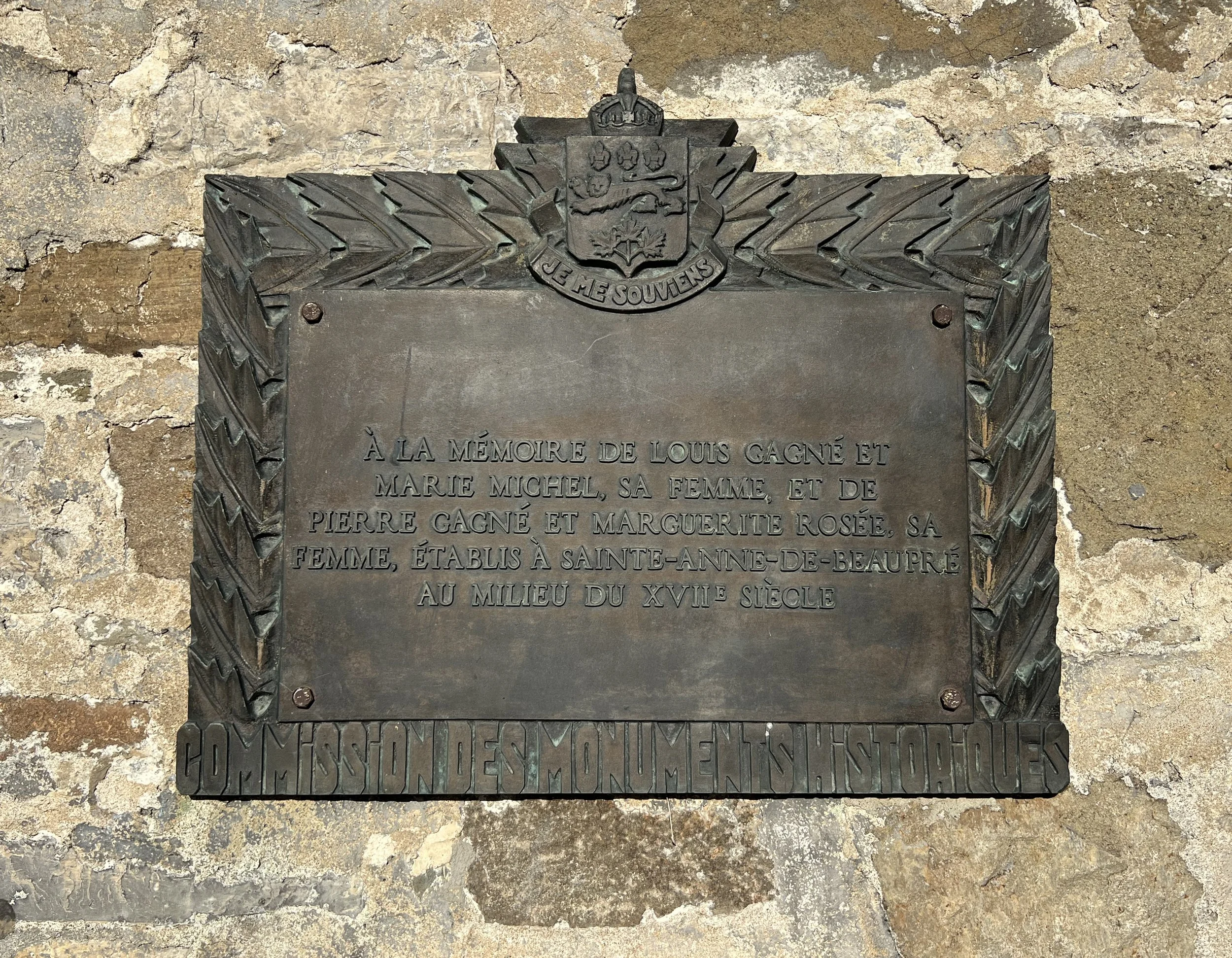
Plaque dedicated to Louis Gagné and Marie Michel, and Pierre Gagné and Marguerite Rosée, at Sainte-Anne-de-Beaupré (© The French-Canadian Genealogist)
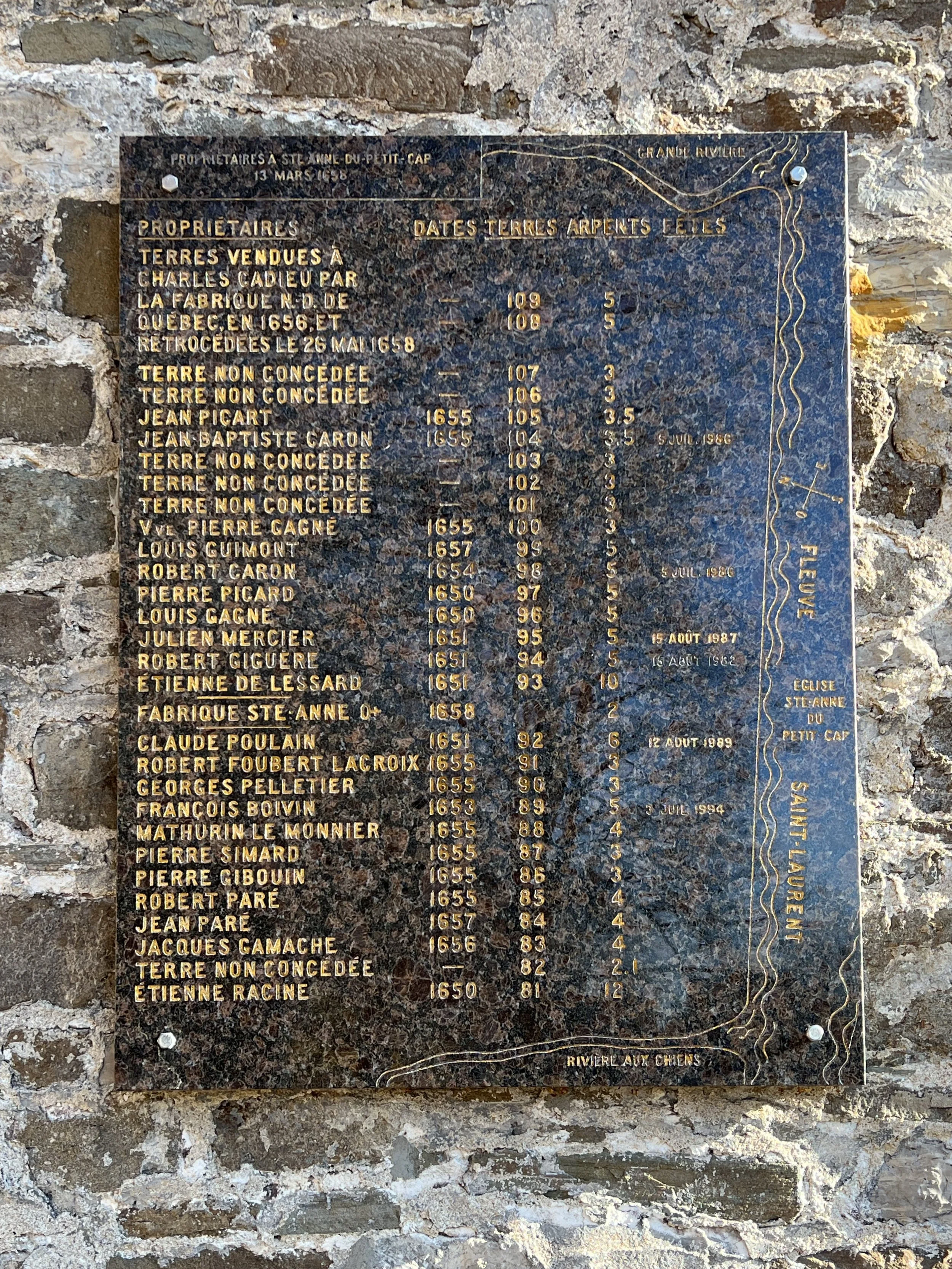
Commemorative plaque of the landowners at Sainte-Anne-du-Petit-Cap as of March 13, 1658, at Sainte-Anne-de-Beaupré (© The French-Canadian Genealogist)
On February 2, 1660, the Gagné family went to the church of Château-Richer to receive the sacrament of confirmation from the “François de Montmorency-Laval, Monsignor the Illustrious and Most Reverend Bishop of Petrée, Vicar Apostolic in the whole of New France,” along with 175 other people.
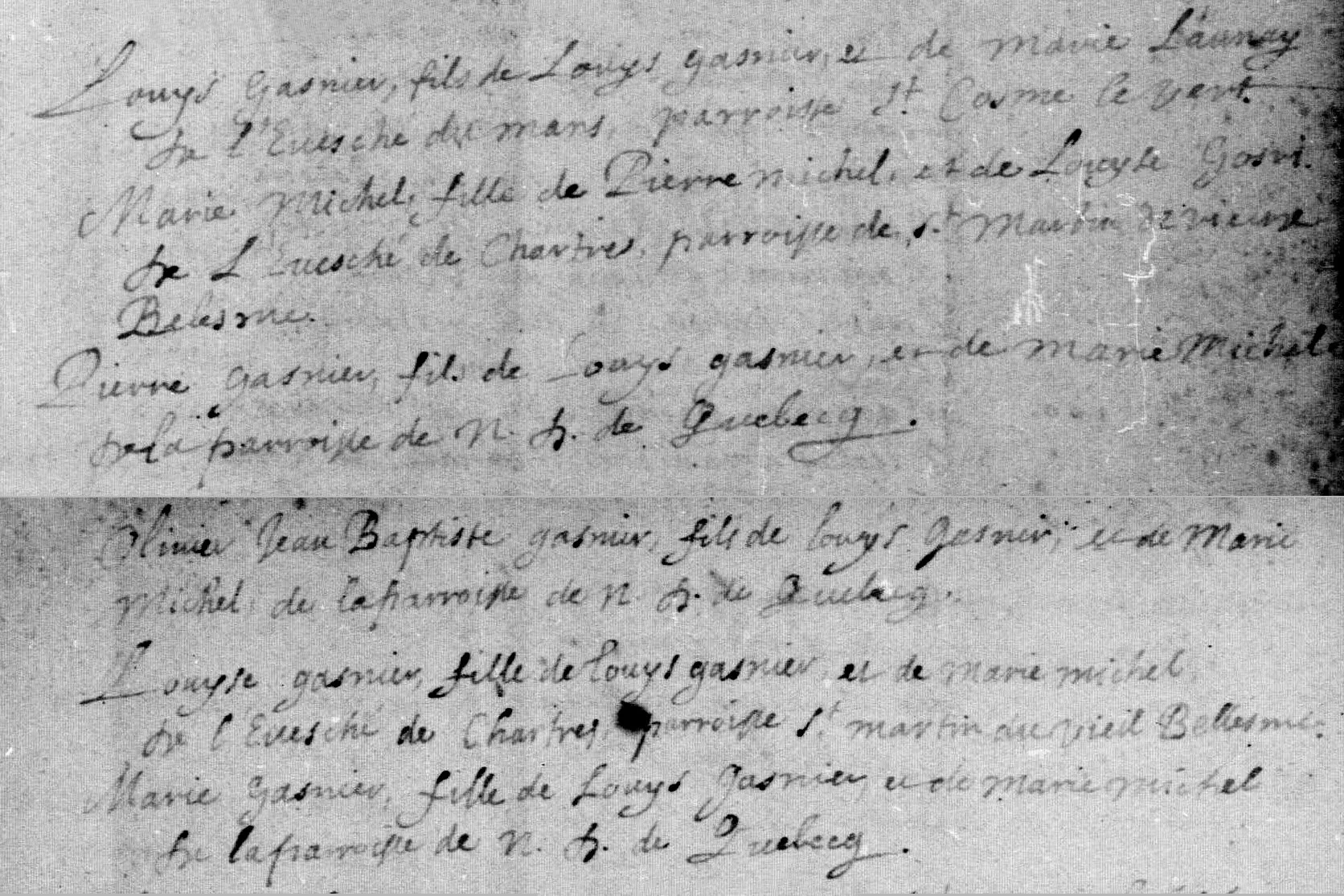
Confirmation of Louis, Marie, Pierre, Olivier, Louise, and Marie in 1660 (Généalogie Québec)
The Mysterious Death of Louis Gasnier
Louis Gasnier died sometime between February 2, 1660 (the date of his confirmation) and July 14, 1661 (the date of his inventory). French researcher Françoise Lamarche discovered a manuscript dated June 1661, preserved at the Séminaire de Québec, which states that “on the 18th of this month at 8 o’clock in the morning, the massacre or capture of several people in Beaupré and Île d’Orléans began by the Iroquois who had descended from Tadoussac […] There was talk of eight in Beaupré and seven on Île d’Orléans, which proved to be true.” Louis Gasnier and his neighbour Louis Guimont, whose after-death inventories were drawn up on the same day, were thought to be part of this group. Unfortunately, no burial record remains.
On July 14, 1661, notary Claude Auber drew up the inventory of the community of goods belonging to the late Louis Gasnier and his wife, Marie Michel, in Château-Richer. The very short inventory included a handful of animals, including two milk cows, two heifers, and an ox, as well as a few pieces of furniture, including three beds and a chest, linens, and kitchen utensils and pots. Among his debts, Louis owed the Sieur de la Chesnaye over 259 livres, the Jesuits over 134 livres, and the hospital 25 livres.
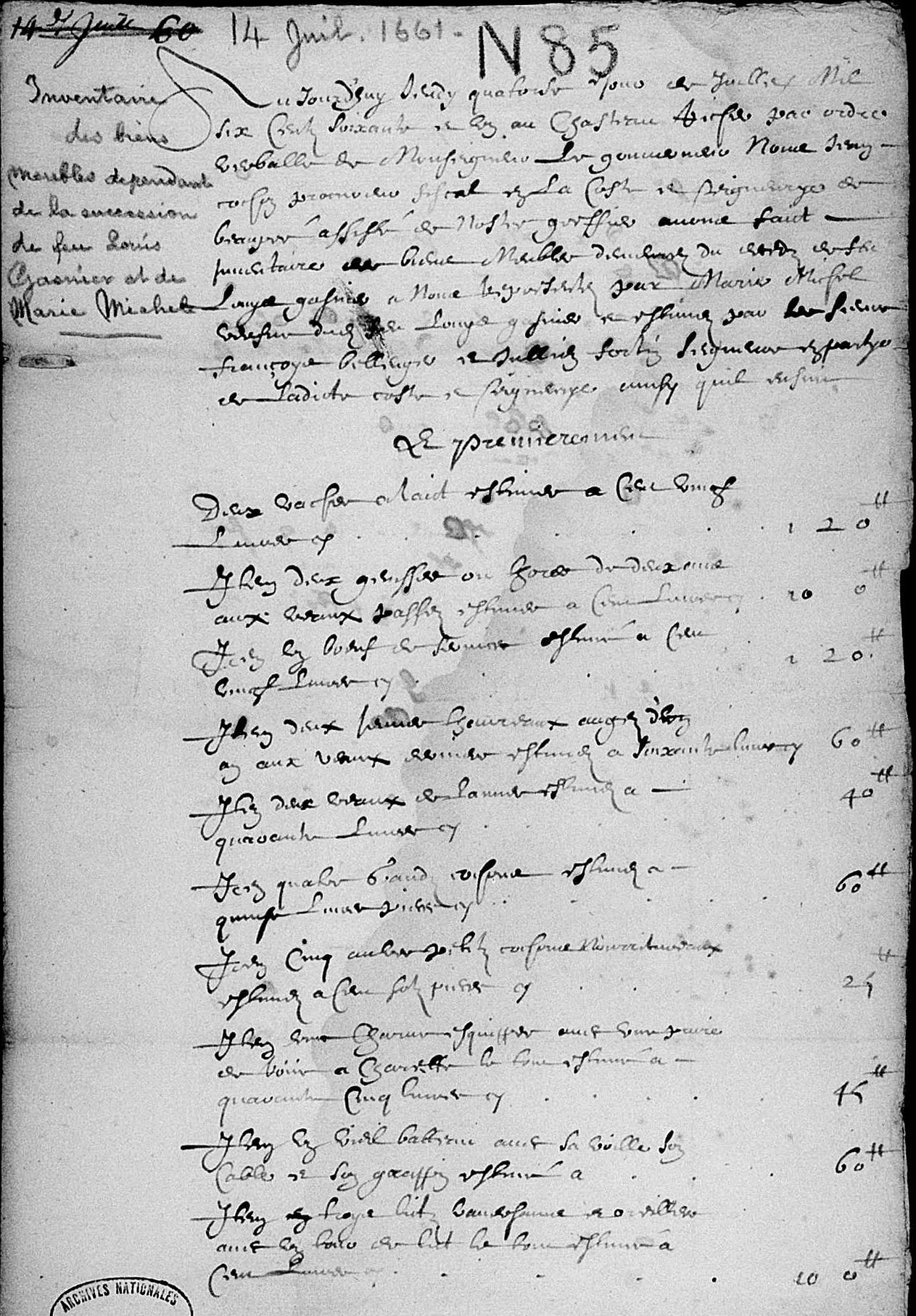
Page 1 of Louis and Marie’s inventory (FamilySearch)
After her husband’s death, Marie continued to live on the côte de Beaupré. In 1666, she was enumerated in the census of New France, living there with her eight children.
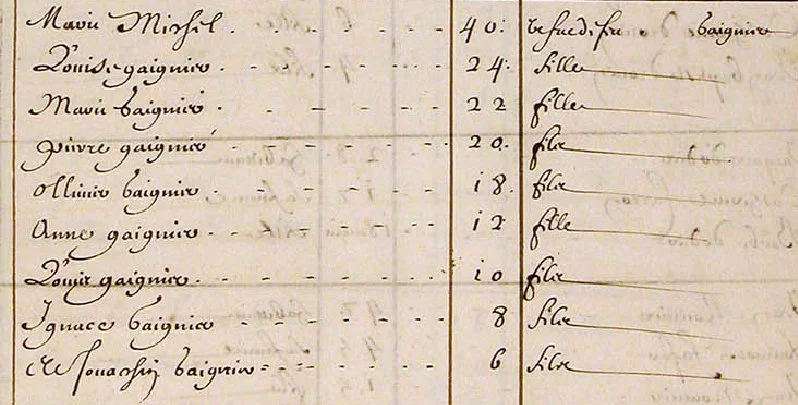
1666 census of New France for the household of Marie Michel (Library and Archives Canada)
A few months later, on the afternoon of September 1, 1666, notary Michel Fillion wrote up a marriage contract between Marie, then about 44 years old, and Paul de Rainville, the widower of Roline Poète, then about 47 years old. Marie’s witnesses were her sons Pierre and Olivier, her neighbours Pierre Picard and his wife Renée Desuranne, and Étienne Lessard. Paul’s witnesses were his son Jean and René Langlois.
The contract followed the standards of the Coutume de Paris. The prefix dower was set at 300 livres. Marie brought a cow and a feather bed into the community. Paul was able to sign his name, but Marie could not. The date of their wedding ceremony is unknown, as a marriage record no longer exists.
The Coutume de Paris (Custom of Paris) governed the transmission of family property in New France. Whether or not a couple had a marriage contract, they were subject to the “community of goods,” meaning all property acquired during the marriage became part of the community. Upon the death of the parents, the community property was divided equally among all children, both sons and daughters. If one spouse died, the surviving spouse retained half of the community property, while the other half was shared among the children. When the surviving spouse passed away, their share was also divided equally among the children. The dower referred to the portion of property reserved by the husband for his wife in the event she outlived him.
In the 1667 census, Paul and Marie were enumerated in “Coste de Beauport, Nostre Dame des anges and other places,” living with two of Marie’s children and one of Paul’s sons. They owned one head of cattle and seven arpents of “valuable” land (cleared or under cultivation).
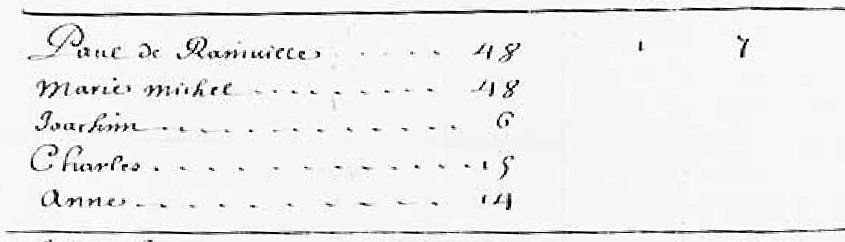
1667 census of New France for the household of Paul de Rainville (Library and Archives Canada)
In the 1670s, Marie and Paul’s names appear in several notarial documents, mostly relating to land transactions:
January 18, 1672: Paul and Marie sold a 20-arpent land concession located near the village of Fargy (Beauport) to Jean de Rainville, Paul’s son, for 800 livres. The land included a house, a barn, a garden, and a small cabin.
April 2, 1675: Marie sold half of her land located in the seigneurie of Beaupré to her son Louis Gasnier for 400 livres. The land measured two and a half arpents of frontage, facing the St. Lawrence.
January 31, 1677: Paul and Marie registered a mutual donation before notary Michel Fillion. The donation included all their movable and immovable property, notably a piece of land and concession located in l’anse de Bellechasse. Noël Langlois and Jean Côté served as witnesses. [This don mutuel reflects a practical decision made by a couple who had no children together, but who each had children from earlier marriages. Under the Custom of Paris, spouses were not legal heirs of one another, and without special provisions the death of one spouse could have left the survivor financially vulnerable, with the estate immediately divided among the deceased’s children. By making a reciprocal donation, each spouse ensured that the other would be protected at death and able to retain use of the household and property, while preserving the inheritance rights of their respective children.]
July 6, 1679: Marie’s son Louis Gasnier transferred back the land he had purchased from her in 1675. Marie and Paul then sold the same plot of land to Joseph Paré for 400 livres.
By 1681, Marie and Paul had moved to the seigneurie of Bellechasse. They were enumerated there in the census of New France, living near Marie’s son Joachim. The couple owned six arpents of “valuable” land and one gun.

1681 census of New France for the household of Paul “d’Erainville” (Library and Archives Canada)
Marie’s Final Years
On April 17, 1684, likely in declining health, Paul and Marie donated a plot of land located in the seigneurie of Bellechasse to their neighbour Pierre Bazin. The land measured three arpents of frontage, facing the St. Lawrence River, by approximately 40 arpents deep. It included a house, a barn, and a stable. The land was subject to a seigneurial cens et rente of three capons, plus three livres and three sols. In return, Bazin promised to house, feed, and care for Paul and Marie until their deaths.
A year and a half later, on November 30, 1685, Paul and Marie exchanged a land concession in the seigneurie of Bellechasse for a concession located in the village of Saint Joseph, in the parish of Beauport, with Pierre Bazin and his wife, Marguerite Leblanc.
Paul de Rainville died at the age of about 67 on December 10, 1686. He was buried two days later in the parish cemetery of Beauport. Notary Paul Vachon attended the burial.
Death of Marie Michel
Marie Michel died the following year, at the age of about 65, on November 12, 1687. She was buried the same day in the parish cemetery of Sainte-Anne-de-Beaupré, “after receiving the holy sacraments of penance, viaticum and extreme unction.” Her son Louis attended the burial, as did her son-in-law François Lacroix. Marie was likely living with her daughter Anne and her husband François in Sainte-Anne-de-Beaupré at the time of her death. The burial record states that she was 72 years old. [Given the speed of her burial, it’s possible that Marie was a victim of the 1687–1688 winter smallpox outbreak in Canada.]
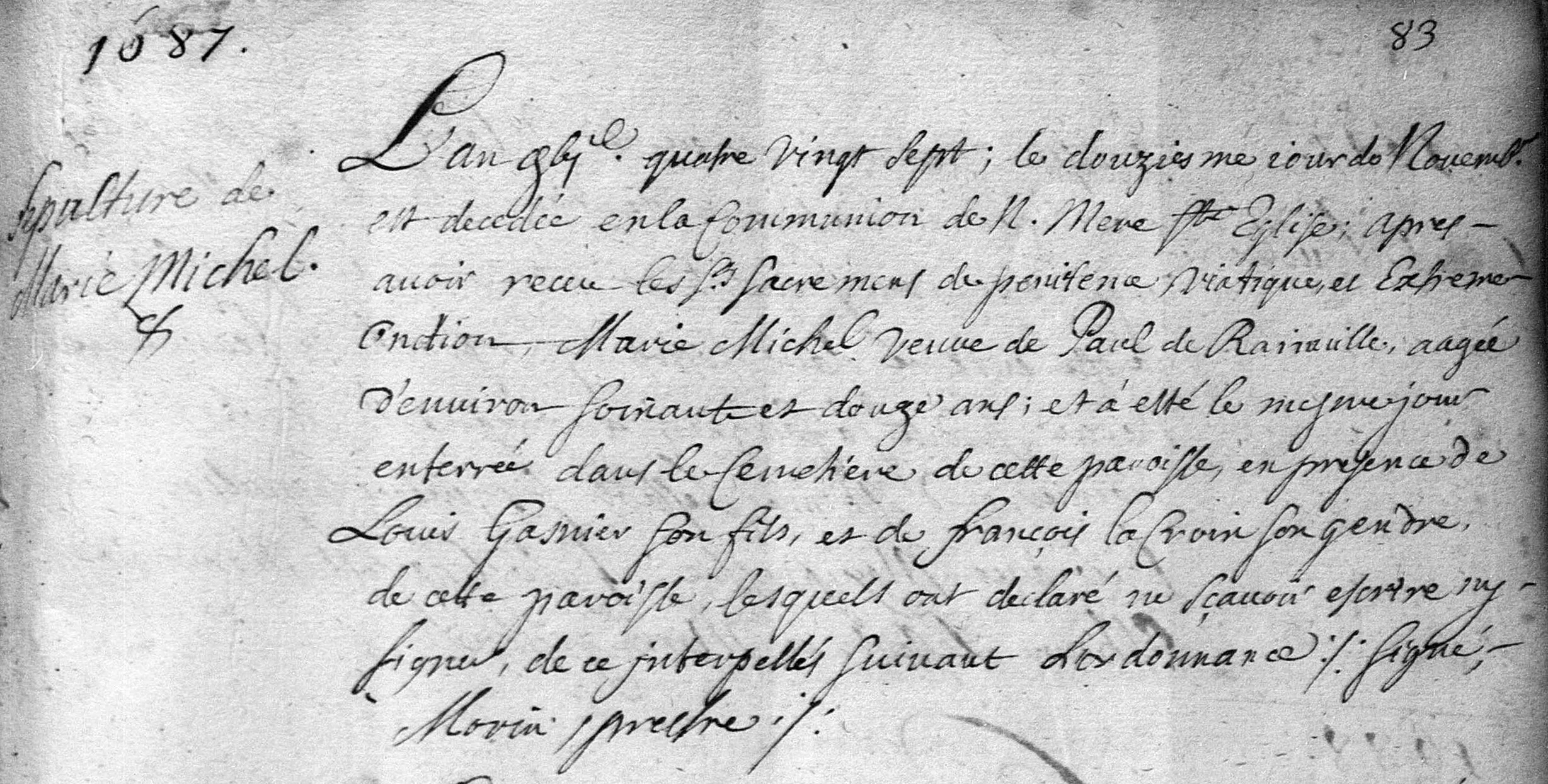
Burial of Marie Michel in 1687 (FamilySearch)
A Legacy Forged in Uncertain Times
Louis Gasnier and Marie Michel’s story is one of courage, uncertainty, and endurance at the very beginning of New France. Leaving the Perche to build a life along the St. Lawrence, they faced the risks of frontier settlement, including Louis’s sudden and mysterious death during a period of violence in the colony. Widowed with young children, Marie continued on, rebuilding her life through remarriage, hard work, and careful decisions that ensured her family’s survival. Her death in 1687, possibly during the winter smallpox outbreak, marked the end of a life shaped by migration, loss, and perseverance. Together, their lives form a lasting legacy carried forward by the generations that followed.
PDF version of article located at https://www.tfcg.ca/louis-gagne-and-marie-michel.
Enjoying our articles and resources? Consider showing your support by making a donation. Every contribution, no matter how small, helps us pay for website hosting and allows us to create more content relating to French-Canadian genealogy and history.
Thank you! Merci!
Sources:
“Igé, Registre paroissial, 1584-1625,” digital images, Archives et patrimoine culturel de l'Orne (https://gaia.orne.fr/mdr/index.php/docnumViewer/calculHierarchieDocNum/374741/1057:358061:371693:374741/1440/3440 : accessed 2 Jan 2026), baptism of Louis Gasnier, 13 Sep 1612, Igé (Saint-Martin), image 129 of 233.
“Actes de notaire, 1647-1648 // Claude Lecoustre," digital images, FamilySearch (https://www.familysearch.org/ark:/61903/3:1:3Q9M-CSVN-Q8L8?cat=koha%3A1175227&i=48&lang=en : accessed 2 Jan 2026), farm lease by Olivier Letardif to Louis Gagnier, 3 Oct 1647, images 49-51 of 2056 ; citing original data: Bibliothèque et Archives nationales du Québec.
“Actes de notaire, 1652-1692 // Claude Auber," digital images, FamilySearch (https://www.familysearch.org/ark:/61903/3:1:3QHV-R3L2-697Z-M?cat=koha%3A1175225&i=258&lang=en : accessed 4 Jan 2026), inventory of the community of goods of the late Louis Gagnier and Marie Michel, 14 Jul 1661, images 259-261 of 1368; citing original data: Bibliothèque et Archives nationales du Québec.
“Actes de notaire, 1660-1688 // Michel Fillion," digital images, FamilySearch (https://www.familysearch.org/ark:/61903/3:1:3Q9M-CSVN-QHQT?cat=koha%3A1176077&i=1683&lang=en : accessed 4 Jan 2026), marriage contract of Paul de Rainville and Marie Michel, 1 Sep 1666, images 1684-1685 of 2056; citing original data: Bibliothèque et Archives nationales du Québec.
“Archives de notaires : Paul Vachon (1655-1693),” digital images, Bibliothèque et Archives nationales du Québec (https://numerique.banq.qc.ca/patrimoine/details/52327/4215635?docref=MXsYvbXb-nQcjBQJQRxSxA : accessed 5 Jan 2026), sale of land concession by Paul de Rainville and Marie Michel to Jean de Rainville, 18 Jan 1672, images 744-748 of 1169.
“Actes de notaire, 1660-1688 // Michel Fillion," digital images, FamilySearch (https://www.familysearch.org/ark:/61903/3:1:3Q9M-CSVN-Q4JT?cat=koha%3A1176077&i=1851&lang=en : accessed 5 Jan 2026), sale of land by Marie Michel to her son Louis Gasnier, 2 Apr 1675, image 1852 of 2056; citing original data: Bibliothèque et Archives nationales du Québec.
“Actes de notaire, 1660-1688 // Michel Fillion," digital images, FamilySearch (https://www.familysearch.org/ark:/61903/3:1:3Q9M-CSVN-Q84L?cat=koha%3A1176077&i=1869&lang=en : accessed 5 Jan 2026), mutual donation between Paul D'errainville and Marie Michel, 31 Jan 1677, image 1870 of 2056; citing original data: Bibliothèque et Archives nationales du Québec.
“Actes de notaire, 1652-1692 // Claude Auber," digital images, FamilySearch (https://www.familysearch.org/ark:/61903/3:1:3QHV-53L2-69QN-J?cat=koha%3A1175225&i=1137&lang=en : accessed 5 Jan 2026), transfer of land from Louis Gasnier back to Marie Michel, 6 Jul 1679, images 1138-1139 of 1368; citing original data: Bibliothèque et Archives nationales du Québec.
“Actes de notaire, 1652-1692 // Claude Auber," digital images, FamilySearch (https://www.familysearch.org/ark:/61903/3:1:3QHV-53L2-6931-2?cat=koha%3A1175225&i=1139&lang=en : accessed 5 Jan 2026), sale of land from Paul de Rainville and Marie Michel to Joseph Parée, 6 Jul 1679, images 1140-1142 of 1368; citing original data: Bibliothèque et Archives nationales du Québec.
“Actes de notaire, 1666-1691 // Gilles Rageot," digital images, FamilySearch (https://www.familysearch.org/ark:/61903/3:1:3QHV-P3NF-49FG-M?cat=koha%3A1171570&i=464&lang=en : accessed 5 Jan 2026), land donation by Paul de Rienville and Marie Michel to Pierre Bazin, 17 Apr 1684, images 465-467 of 1327; citing original data: Bibliothèque et Archives nationales du Québec.
“Archives de notaires : Paul Vachon (1655-1693),” digital images, Bibliothèque et Archives nationales du Québec (https://numerique.banq.qc.ca/patrimoine/details/52327/4215637?docref=VE-HqdlPg48nsx9qnhUHuw : accessed 5 Jan 2026), land concession exchange between Paul de Rainville and Marie Michel, and Pierre Bazin and Marguerite Leblanc, 30 Nov 1685, images 678-680 of 1195.
"Registre des confirmations 1649-1662", digital images, Généalogie Québec (https://www.genealogiequebec.com/membership/fr/fonds-drouin/REGISTRES : accessed 4 Jan 2026), confirmation of the Gagné family, 2 Feb 1660, Château-Richer; citant original data : Registre des confirmations, Diocèse de Québec, Registres du Fonds Drouin.
"Recensement du Canada, 1666," digital images, Library and Archives Canada (https://recherche-collection-search.bac-lac.gc.ca/fra/accueil/notice?idnumber=2318856&app=fonandcol : accessed 4 Jan 2026), household of Marie Michel, 1666, côte de Beaupré, page 53 (of PDF), Finding aid no. MSS0446, MIKAN no. 2318856; citing original data: Centre des archives d'outre-mer (France) vol. 460.
"Recensement du Canada, 1667," digital images, Library and Archives Canada (https://www.bac-lac.gc.ca/eng/CollectionSearch/Pages/record.aspx?app=fonandcol&IdNumber=2318857&new=-8585951843764033676 : accessed 4 Jan 2026), household of Paul de Rainville, 1667, Coste de Beauport, Nostre Dame des anges, page 57 (of PDF), Finding aid no. MSS0446, Item ID number: 2318857; citing original data: Centre des archives d'outre-mer (France) vol. 460.
"Recensement du Canada fait par l'intendant Du Chesneau," digital images, Library and Archives Canada (https://www.bac-lac.gc.ca/eng/CollectionSearch/Pages/record.aspx?app=fonandcol&IdNumber=2318858&new=-8585855146497784530 : accessed 5 Jan 2026), household of Paul d’Erainville, 14 Nov 1681, seigneurie de Bellechasse, page 231 (of PDF), Finding aid no. MSS0446, MIKAN no. 2318858; citing original data: Centre des archives d'outre-mer (France) vol. 460.
"Le LAFRANCE (Baptêmes, Mariages, Sépultures)," database and digital images, Généalogie Québec (https://www.genealogiequebec.com/Membership/LAFRANCE/acte/77575 : accessed 5 Jan 2026), burial of Paul Derainville, 12 Dec 1686, Beauport (Nativité-de-Notre-Dame); citing original data: Fonds Drouin, Institut généalogique Drouin, Montréal.
"Canada, Québec, registres paroissiaux catholiques, 1621-1979," digital images, FamilySearch (https://www.familysearch.org/ark:/61903/3:1:3QS7-L999-3Z3Z?lang=en&i=104 : accessed 5 Jan 2026), burial of Marie Michel, 12 Nov 1687, Sainte-Anne-de-Beaupré > Sainte-Anne-de-Beaupré > Baptêmes, mariages, sépultures 1657-1789 > image 105 of 1237; Archives nationales du Quebec, Montréal.
Fédération québécoise des sociétés de généalogie, Fichier Origine online database (https://www.fichierorigine.com/fr/repertoire/gagne/-gasnier-2 : accessed 2 Jan 2026), entry for GAGNÉ / GASNIER, Louis (reference #241616), updated on 21 May 2018.
Université de Montréal, Programme de recherche en démographie historique (PRDH) online database, (https://www-prdh-igd-com.res.banq.qc.ca/Membership/fr/PRDH/Famille/300 : accessed 2 Jan 2026), dictionary entry for Louis GAGNE and Marie MICHEL, union #300.
Madame Pierre Montagne [Françoise Lamarche], Tourouvre et les Juchereau : Un chapitre de l’émigration percheronne au Canada (Québec, Société Canadienne de Généalogie, 1965), 40.
Marcel Trudel, Catalogue des Immigrants, 1632-1662 (Montréal: Éditions Hurtubise HMH, 1983), 142.
Thomas J. Laforest, Our French-Canadian Ancestors vol. XII (Palm Harbor, FLorida, The LISI Press, 1991), 130.