Claude Mathias Fanef & Catherine Charpentier
Claude Mathias Fanef (born Mathias Farnsworth) and Catherine Charpentier were the founding ancestors of the Phaneuf family. This biography traces Mathias’s journey from New England captivity to life in New France, his conversion, naturalization, landholdings, and integration into French-Canadian society, alongside Catherine Charpentier’s family background and role in establishing a lasting lineage rooted in Rivière-des-Prairies. All Phaneufs in Québec, Canada, the United States, and Europe descend from this couple.
Cliquez ici pour la version en français
Claude Mathias Fanef & Catherine Charpentier
At the Origin of the Phaneuf Family
Mathias Farnsworth, son of Mathias Farnsworth and Sarah Nutting, was born on August 6, 1690, in Groton, Middlesex County, in the Province of Massachusetts Bay [present-day Groton, Massachusetts, USA].
Mathias’s parents married around 1681, likely in Groton. His father, Mathias Farnsworth Sr., worked as a weaver. Mathias had four known siblings: Joseph, Ebenezer, Josiah, and Sarah. His paternal grandparents, Mathias Farnsworth and Mary Farr, immigrated from England to New England sometime around 1650.
Groton Roots
Settled in 1655 by English colonists, Groton was named after Groton in Suffolk, England. The region offered fertile land and access to fish, and its economy developed primarily around farming and local milling. By the late 17th century, Groton remained a small frontier settlement centred on its Puritan meetinghouse and a vital gristmill. Several fortified garrison houses provided refuge for inhabitants during periods of conflict. Groton was severely damaged during King Philip’s War in 1676, when most of the town was burned. Although rebuilt, it remained exposed on the northern edge of English settlement. By 1692, the local militia garrison numbered 91 men, reflecting the town’s highly militarized character and its vulnerability to attack.
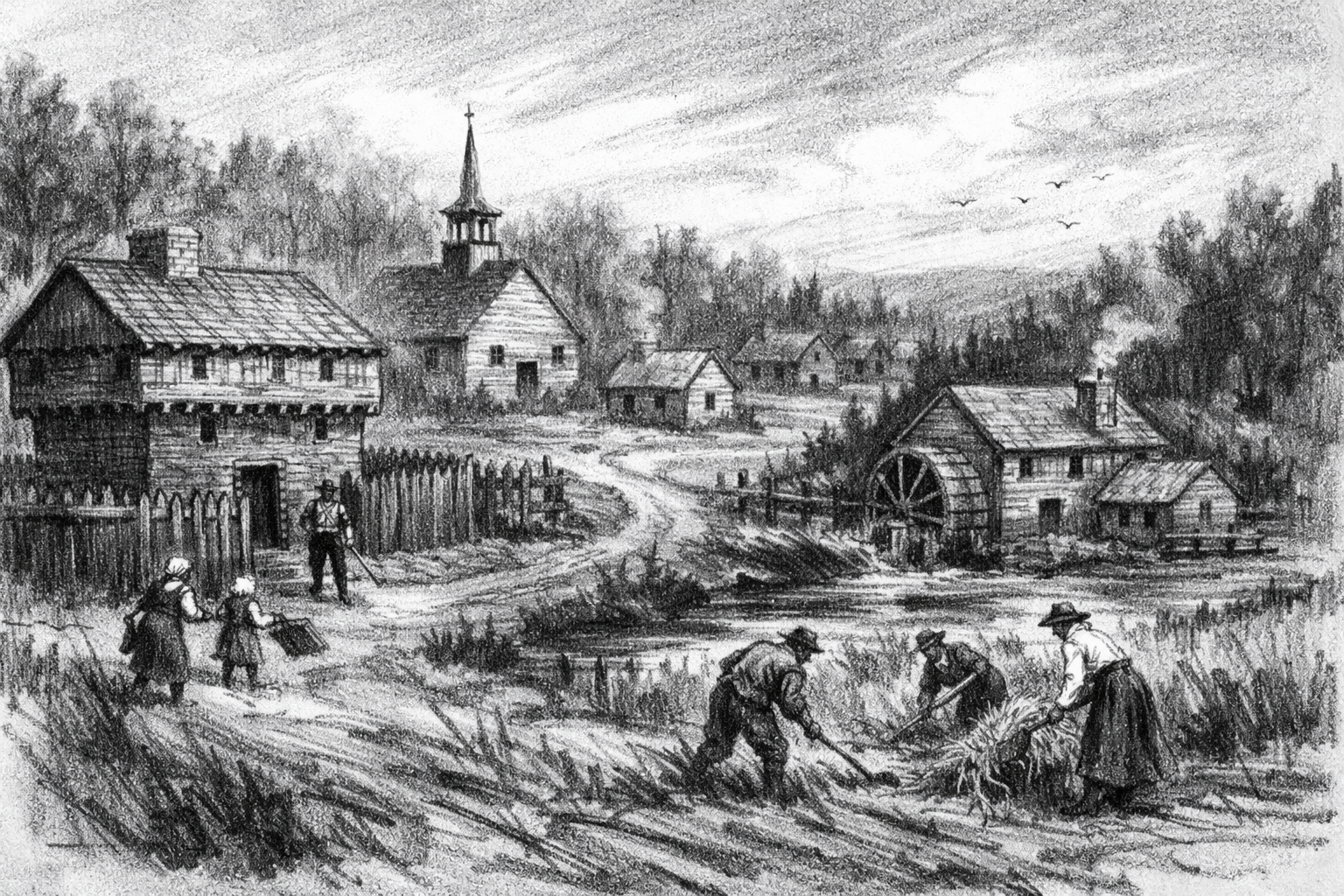
Artificial intelligence image created by the author with ChatGPT (January 2026)
This level of militarization reflected the realities of frontier life. Groton was repeatedly drawn into French and Indigenous conflicts in New England at the turn of the 18th century. In July 1694, during King William’s War, French-allied Abenaki forces raided the town at dawn, killing approximately 20 inhabitants and taking a dozen captives. Queen Anne’s War (1702–1713) brought further instability, with repeated attacks on frontier communities by French-aligned Indigenous raiding parties.
Mathias grew up in this environment of sustained violence. That climate culminated regionally in the well-known raid on Deerfield on February 29, 1704, when a combined force of French and allied Indigenous warriors destroyed the settlement and killed or captured more than 100 residents.
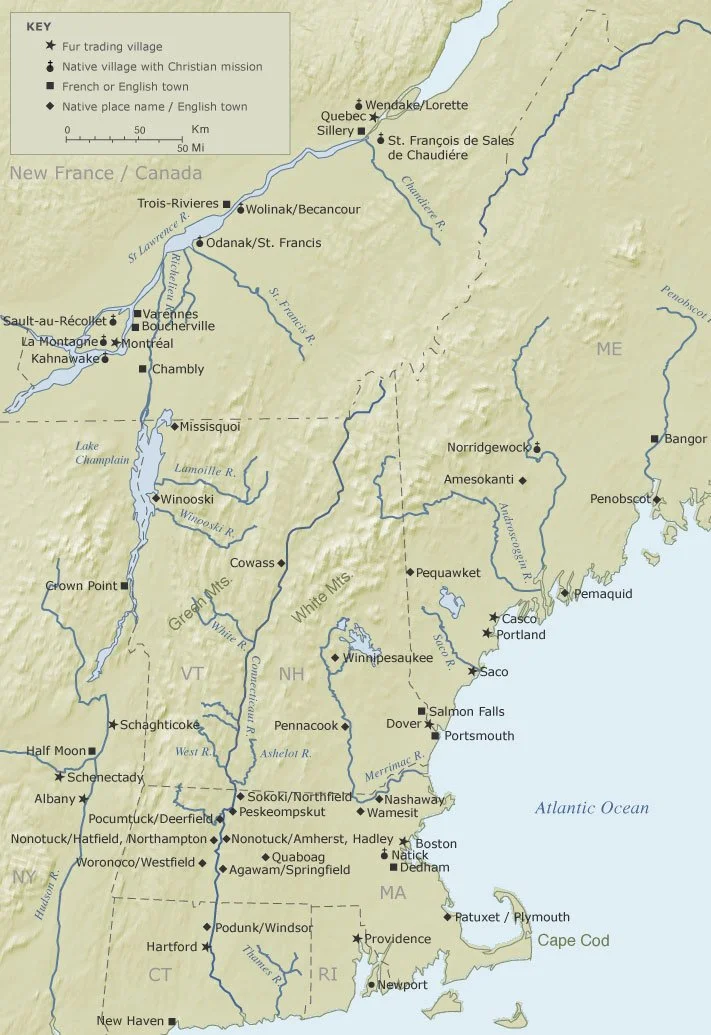
“Colonial Northeast, circa 1660 - 1725.
This map shows English and French settlements and centres of Native habitation.” [Groton was located just west of Wamesit, shown on the map (now Lowell)]
Map: Juliet Jacobson, artist, from the website Raid on Deerfield: The Many Stories of 1704 (http://1704.deerfield.history.museum/). Used with permission from the Pocumtuck Valley Memorial Association, Deerfield, MA.
Was Mathias Taken During the Deerfield Attack?
Although some secondary sources have suggested that Mathias was taken during the Deerfield raid, the evidence does not support this conclusion. He does not appear on any surviving lists of Deerfield captives. The Deerfield prisoners are extensively documented in contemporary and later sources, and no individual named Farnsworth (or variant spellings) appears among them.
Mathias’s family resided in Groton, not Deerfield, and there is no evidence that he was present in Deerfield at the time of the February 1704 attack. Moreover, his 1706 baptismal record in Montréal explicitly states that he was taken in August 1704, not February.
In March 1711, colonial authorities compiled a list of New England prisoners known to be held in Canada. This list includes “Matt. Farnsworth,” alongside Groton captives Sarah, John, and Zechariah Tarbell, and Lydia Longley. The Tarbell siblings were taken in 1707, and Longley in 1694, suggesting that Farnsworth’s capture occurred during a separate, unrelated incident. Significantly, the list provides no date or location for Farnsworth’s capture, indicating that Massachusetts officials themselves lacked precise information at the time.
Early historian Samuel A. Green later observed that this 1711 entry was “the only record of the fact” of Farnsworth’s abduction, with the circumstances of his capture unknown in official records. In other words, colonial documentation does not associate Farnsworth’s capture with Deerfield. His appearance among Groton-area captives instead strongly suggests that he was taken during a raid directed at Groton itself.
Just months after the Deerfield attack, Groton was again targeted. On August 11, 1704, 14-year-old Mathias was likely taken captive during a raid by approximately 20 Indigenous warriors, likely Abenaki, allied with the French, while harvesting crops in the fields. He is believed to have been taken alongside Samuel Butterfield, a soldier from nearby Chelmsford.
“A third was of Samuel Butterfield, who being sent to Groton as a Soldier, was with others attackt, as they were gathering in the Harvest; his bravery was such, that he kill’d one and wounded another, but being overpower’d by strength, was forc’d to submit; and it hapned that the slain Indian was a Sagamore, and of great dexterity in War, which caused matter of Lamentation, and enrag’d them to such degree that they vow’d the utmost revenge; Some were for whipping him to Death; others for burning him alive; but differing in their Sentiments, they submitted the Issue to the Squaw Widow, concluding she would determine something very dreadful, but when the matter was opened, and the Fact considered, her Spirits were so moderate as to make no other reply, than, ‘Fortune L’ guare.’ Upon which some were uneasy; to whom she answered, ‘If by killing him, you can bring my Husband to life again, I beg you to study what Death you please; but if not let him be my Servant’; which he accordingly was, during his Captivity, and had favour shewn him.”
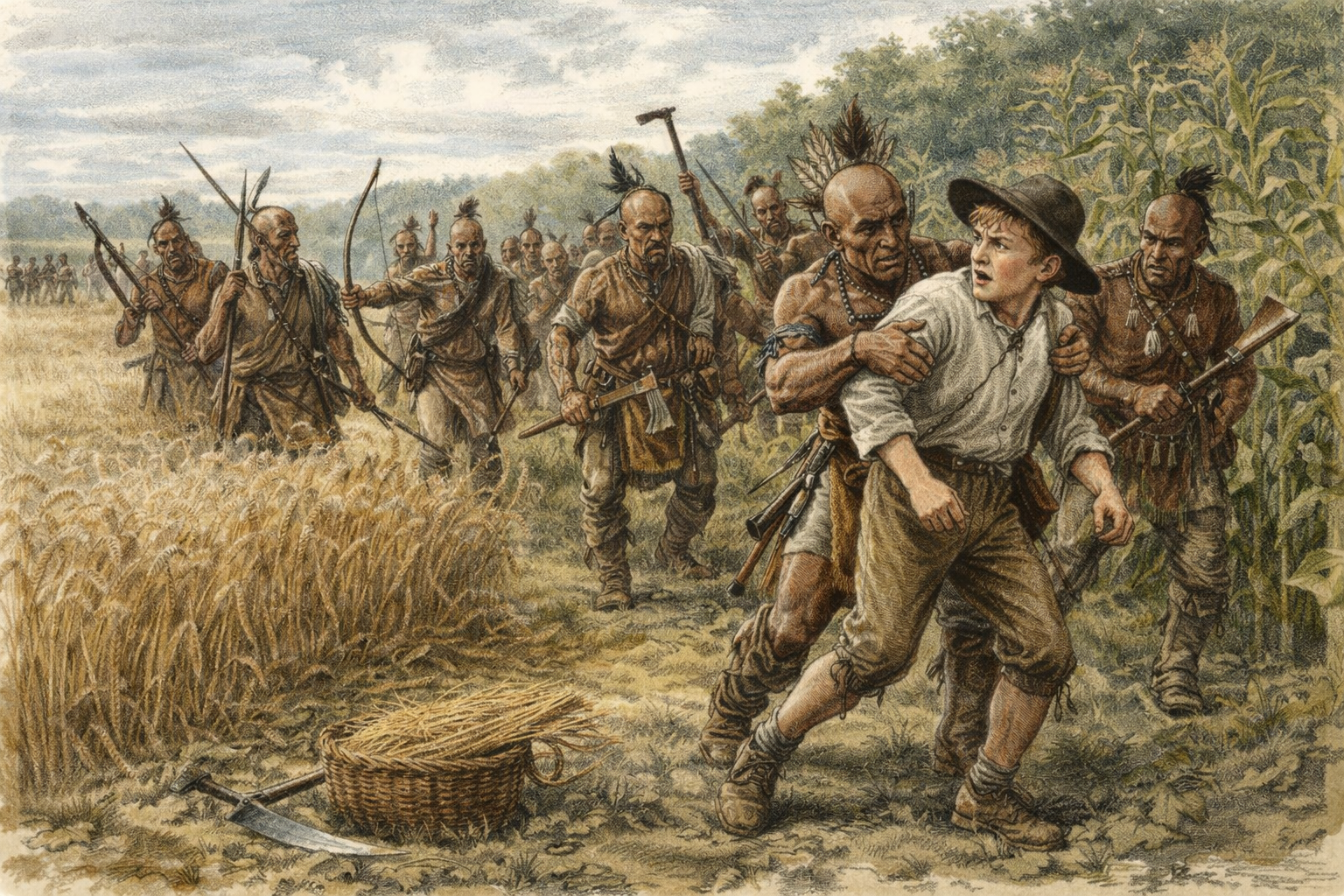
Artificial intelligence image created by the author with ChatGPT (February 2026)
Butterfield’s captivity lasted more than a year, after which he returned to New England, either by escape or through prisoner exchange. The details of Mathias’s own journey to Canada remain unknown. As a 14-year-old civilian rather than a soldier, his capture attracted far less attention in English records. For a time, his family assumed he had been killed. Groton’s town records contain no reference to the raid or to Farnsworth’s fate.
Only later, when information reached New England that he was alive in Canada, did his family learn that he had survived. Mathias’s appearance on the 1711 prisoner list provided the first official confirmation to Massachusetts authorities that he was being held by the French in Canada rather than dead.
As historian Samuel Abbott Green later noted:
“These children [on the 1711 prisoner list] were carried to Canada, where, it would seem, they were treated kindly, as no inducement afterward was strong enough to make them return permanently to their old home.”
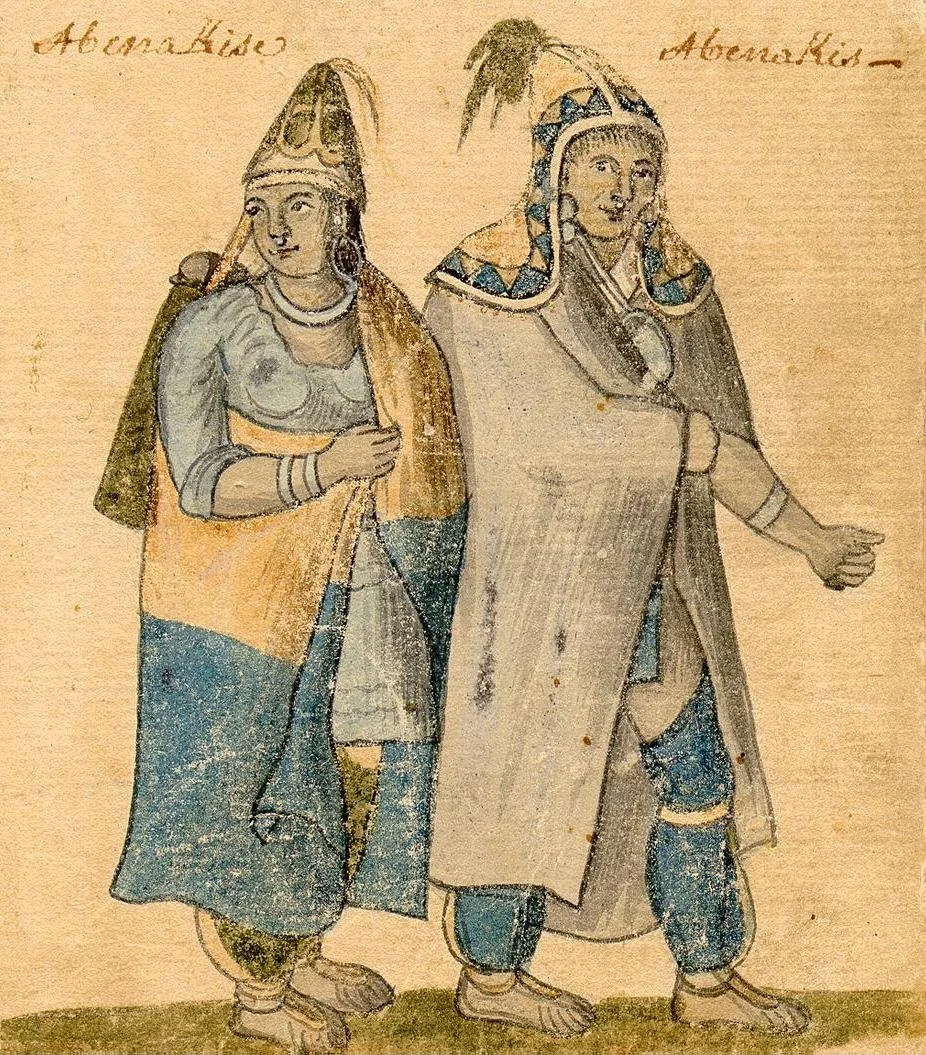
“The Abenaki,” 18th-century watercolour (City of Montreal Records Management & Archives)
Assimilation into French-Canadian Society
Mathias was taken to Sault-au-Récollet, a mission village near Montréal, sometime in late 1704. He remained there for more than a year among his Indigenous captors, until the end of 1705 (or very early 1706). During this period, he was purchased by the Sulpician missionaries who administered the mission. As was common practice for captive children, he was housed and educated at the mission school at Sault-au-Récollet, an institution that received many young captives with the explicit objective of converting them to Catholicism. In addition to religious instruction, Mathias likely performed general labour for the priests. His time at the mission marked a sustained process of religious instruction and cultural assimilation, culminating in his formal admission into the Catholic Church. On January 10, 1706, “Mathias Farneth” was baptized in a Catholic ceremony at the church of Notre-Dame in Montréal. The translated record reads:
“On Sunday, the tenth day of January in the year one thousand seven hundred and six, the baptismal ceremonies were performed by me, the undersigned priest, on Mathias Farneth, who was born in Grotten, New England, in the year one thousand six hundred and eighty [blank space] to the late Mathias Farneth, weaver, and Sara Nutting, having been taken on [blank] of August in the year one thousand seven hundred and four and brought to Canada, he resides at the Mission of Notre-Dame de Lorette on the Island of Montreal. His godfather was Sir Claude de Ramezay, Knight of the Order of Saint Louis, Lord of La Geste Boisfleurant and Governor of the Island of Montreal and other places, who added the name Claude to his name. His godmother was Dame Elisabeth Souart, wife of Charles Lemoine [Lemoyne], Knight of the Order of Saint Louis, Baron of Longueuil and Captain of a Company of the Marine Detachment, who signed”
The record was signed by “DeRamezay,” “Elisabeth Soüart”, and “Meriel priest.” Mathias left his mark.
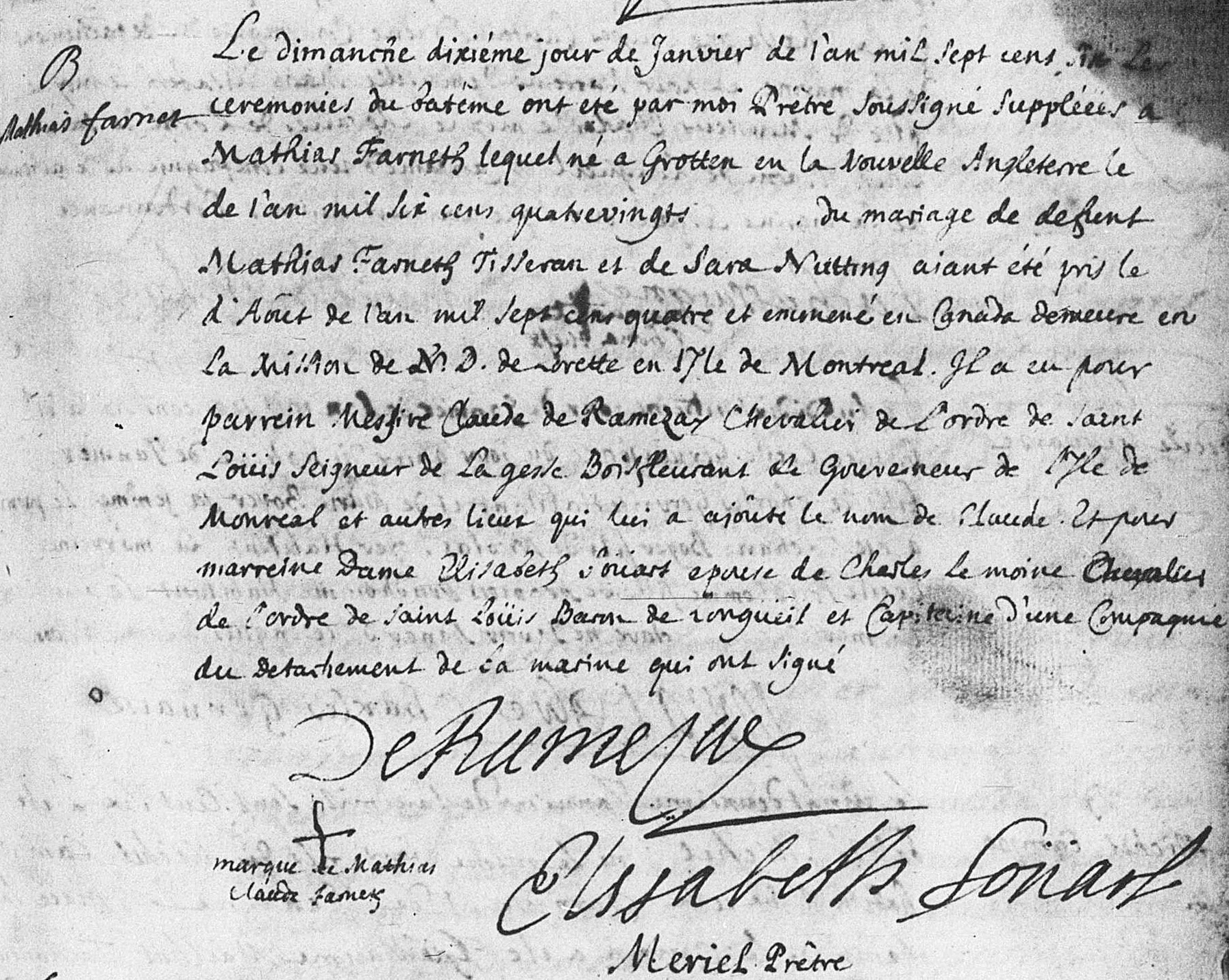
1706 baptism of Mathias “Farneth” (FamilySearch)
Following his baptism, Mathias—now recorded as Claude Mathias—moved rapidly through the formal processes required for integration into French colonial society. Later that same year, on October 30, 1706, he requested French naturalization. In May 1710, his name appeared on letters of naturalization granted by His Majesty King Louis XIV to a group of English Catholics residing in New France. According to these letters, Claude Mathias was granted the rights and privileges of a Frenchman by birth, with the explicit restriction that he could not leave New France without written authorization.
A subsequent and more specific record of naturalization followed several years later. On June 25, 1715, letters of naturalization addressed solely to Claude Mathias were formally registered with the Conseil Souverain. The record states:
“The Council has seen the letters of naturalization granted by His Majesty to Claude Mathias Fanef, an Englishman settled in Montreal, issued in Versailles in March 1714, signed Louis and, on the fold, by the King, Phelypeaux, next to Phelypeaux’s visa and sealed with the great seal in green wax, on red and green silk lacquer, and having heard the King’s Attorney General; the Council has ordered and orders that the said letters of naturalization be registered on the Council’s register, so that the said Claude Mathias Fanef may enjoy the benefits thereof, according to their form and content.”
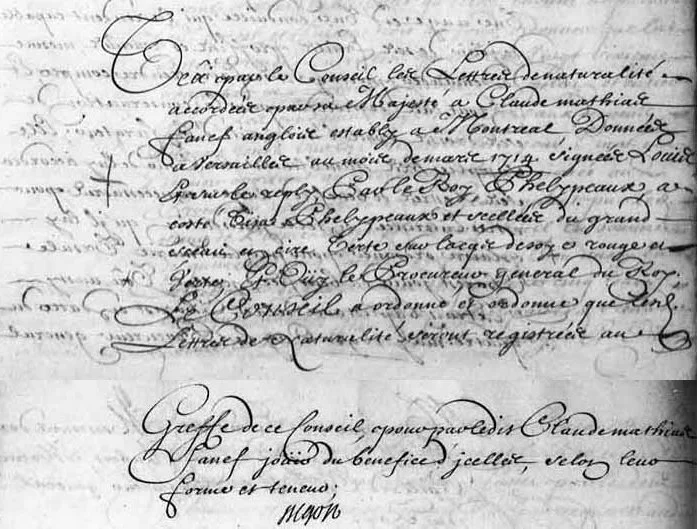
1715 French letters of naturalization (Bibliothèque et Archives nationales du Québec)
A First Land Concession
On July 19, 1711, Claude Mathias received a land concession at Rivière-des-Prairies, on the island of Montréal, from the Séminaire de Saint-Sulpice de Montréal (the Sulpicians), seigneurs and owners of the island. The act was stipulated and accepted on Claude Mathias’s behalf by Robert Legay, senior priest of the “mission of the savages” at Sault-au-Récollet. In the concession, Claude Mathias was described as “an Englishman by birth, currently in the service of the priests of the Mission du Sault-au-Récollet, after having been purchased from the Savages who had enslaved him.”
The concession measured approximately three arpents of frontage facing the St. Lawrence River by twenty arpents in depth. The land lay between the properties of men identified as Allard and [Jean] Charpentier. The grant was subject to an annual seigneurial rente of 10 sols and half a minot of wheat per 20 arpents in area. Claude Mathias further agreed to establish himself on the land and to “live a Christian life.”
[A minot was a unit of measure formerly used for dry goods such as grain and flour. It contained half of a mine, which corresponded to approximately 78.73 litres.]
Two years later, on September 14, 1713, the Sulpicians granted Claude Mathias a “continuation” of land—an additional 20 arpents in depth adjoining his original concession, with three arpents of frontage. The Sulpicians reserved the right to take firewood freely from the property, and Claude Mathias was required to have his grain ground at the seigneurial mill. He agreed to pay an annual rente of 30 sols and one and a half minots of wheat, payable on November 11. Claude Mathias was present when notary Nicolas Senet drew up the agreement, and he signed his name: c.m fanef.
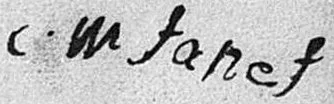
Claude Mathias’s signature in September 1713
In present-day terms, Claude Mathias’s land would be located at approximately the height of 94th Avenue in the Montréal borough of Rivière-des-Prairies, extending along Gouin Boulevard for roughly 192 metres of frontage and reaching nearly 2,195 metres in depth to Henri-Bourassa Boulevard.
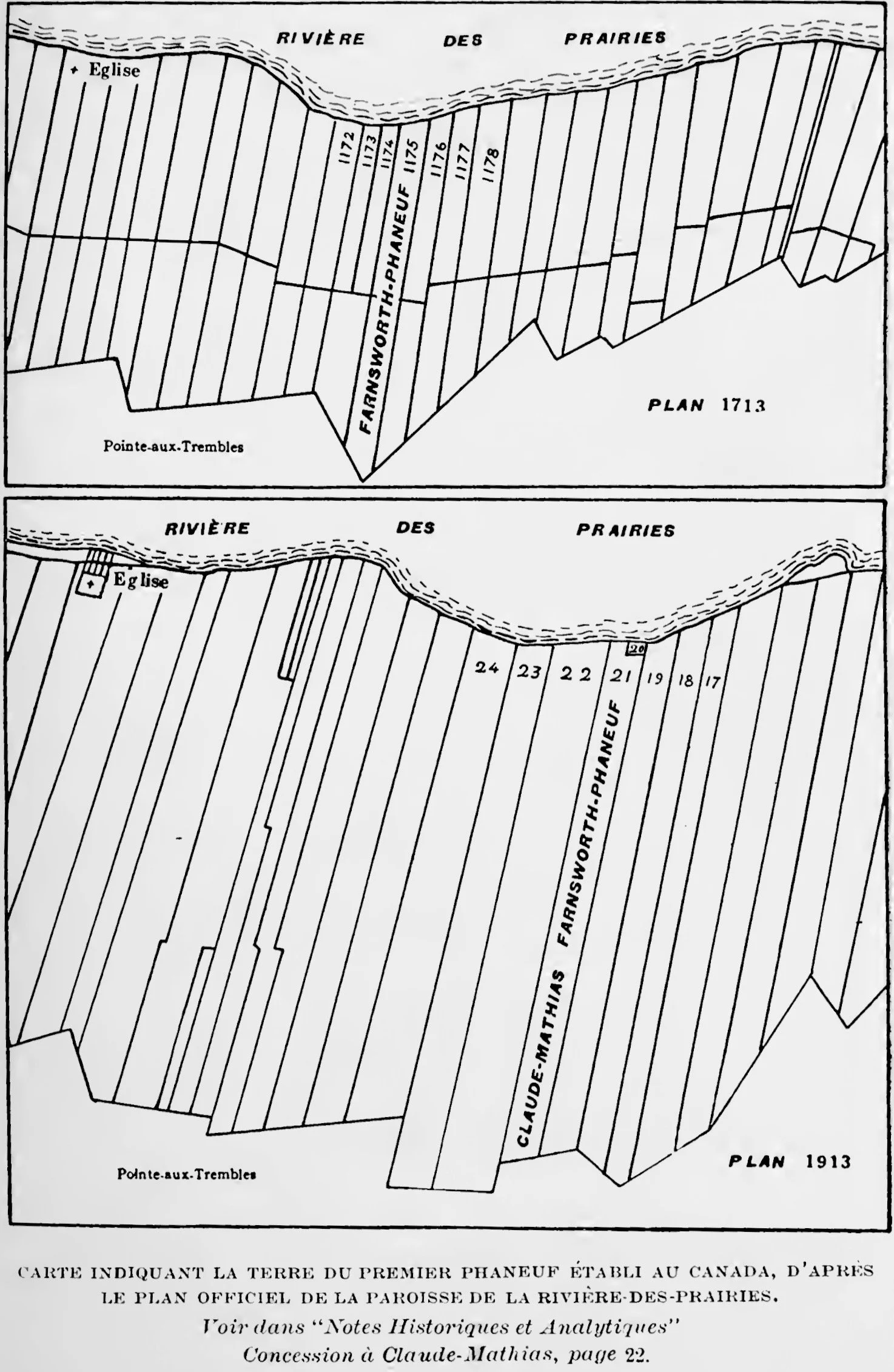
“Map indicating the land of the first Phaneuf established in Canada, according to the official map of the parish of Rivière-des-Prairies” (La Famille Phaneuf-Farnsworth)
Catherine Charpentier
Catherine Charpentier, daughter of Jean Charpentier and Marie Françoise Huneau, was born around 1692 in Canada, New France. Her baptism record has not been located. She grew up in the Montréal area in a large, blended family that included ten full siblings (two of whom died within a year of birth) and four half-siblings. [Her surname was often spelled Charpantier.]
Catherine’s family, like that of her future husband, was directly affected by the frontier wars of the late 17th century. Nicolas Joly, Marie Françoise Huneau’s first husband, was killed by Iroquois warriors in 1690 during an attack at Pointe-aux-Trembles. Two years later, in 1692, Françoise’s sister, Jeanne Huneau, was captured by the Iroquois and held for several years before being ransomed.
Catherine’s father, Jean Charpentier, owned a parcel of land at Rivière-des-Prairies adjoining that of Claude Mathias Fanef. It was likely in this setting that Catherine and her future husband became acquainted.
Marriage and Children
On September 25, 1713, notary Pierre Raimbault drew up a marriage contract between Claude Mathias and Catherine Charpentier at his study in Villemarie [Montréal]. Claude Mathias was 23 years old; Catherine was about 20. Her parents were present and stipulated on her behalf. Claude de Ramezay, governor of Montréal and godfather of Claude Mathias, and François Vachon de Belmont, superior of the Montréal Sulpicians, were also present and gave their consent.
Claude Mathias’s witnesses were Mr. Dion, bourgeois, and Daniel Madox, described as an “English cooper established in this town.” Catherine’s witnesses were Pierre Taillefer, her maternal uncle; Jean Baptiste Joly, her [step-]brother; Jacques Vaudry, her brother-in-law [husband of her step-sister Marie François Joly]; and Françoise Quevillon, her cousin.
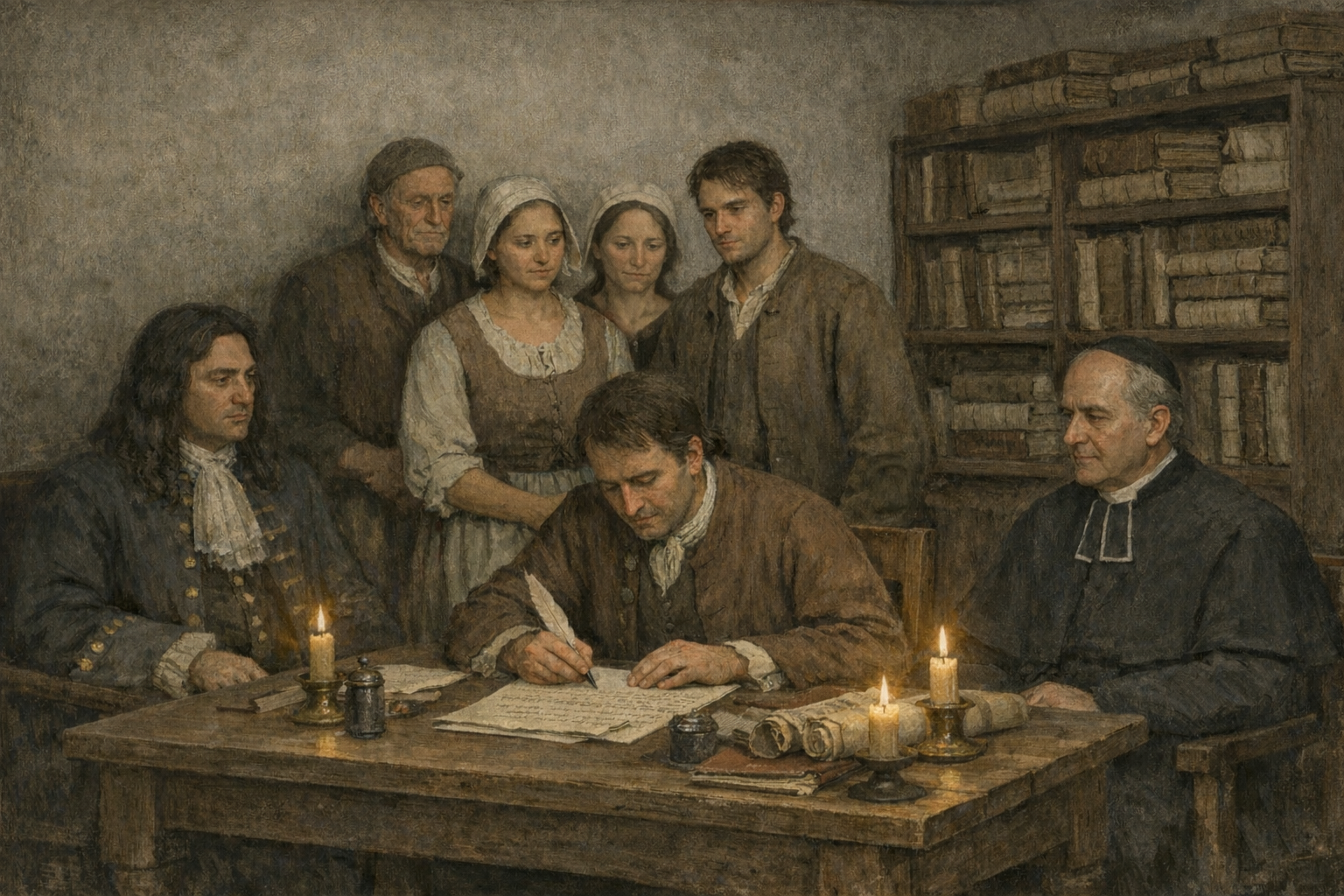
Artificial intelligence image created by the author with ChatGPT (January 2026)
The marriage contract indicates that Claude Mathias owned an habitation at Rivière-des-Prairies, consisting of land measuring three arpents and two perches of frontage by 40 arpents in depth, as well as a four-year-old cow. In addition, the Sulpicians undertook to “build on the said habitation a barn fifty feet long by twenty-five feet wide of stakes or planks in coulisse [illegible] and next year’s harvest, and also a log building twenty-eight feet long by twenty feet wide at the request of the said future husband.”
As part of Catherine’s marriage portion, her parents granted her a parcel of land measuring three arpents of frontage by 40 arpents in depth, adjoining the land of her future husband. She also received two 18-month-old bulls, a four-year-old cow, an 18-month-old pig, and two ewes.
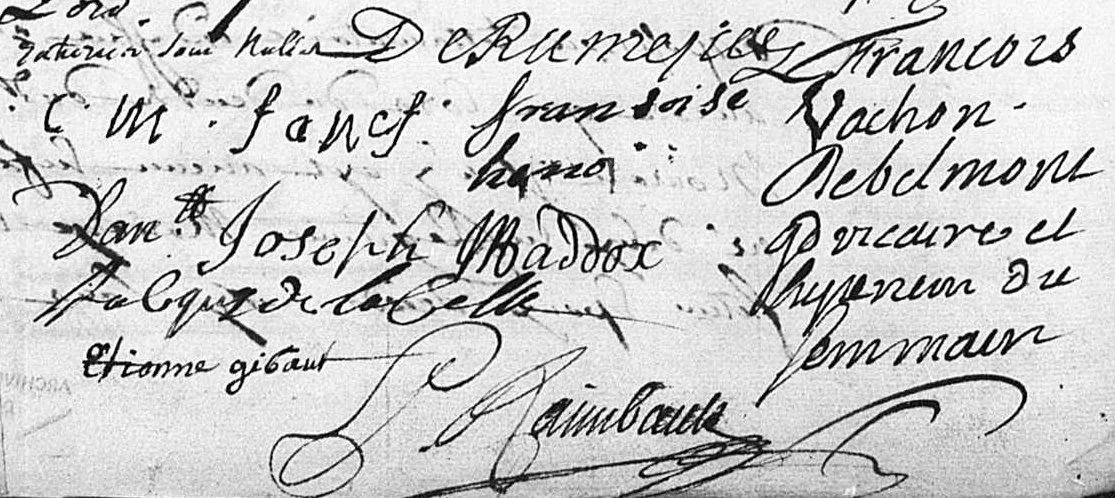
Signature portion of the 1713 marriage contract
A few weeks later, on October 2, 1713, Claude Mathias and Catherine married in the church of Saint-Joseph in Rivière-des-Prairies. Their witnesses were Catherine’s father; Pierre Hénault; Pierre Taillefer; Jacques Vaudry; Jean Baptiste Joly; Paul Dazé; Charles Dazé; Simon Allard; Daniel Joseph Maddox; and Thomas Huot.
Claude Mathias and Catherine settled at Rivière-des-Prairies, where they had at least twelve children:
Marie Catherine (1714–1799)
Marie Josèphe (1715–1789)
Claude (1717–1793)
Jean Baptiste (1719–1786)
François (1721–1785)
Joseph Marie (1723–1756)
Marie Françoise (1725–1755)
Marie Anne (1727–1804)
Pierre (1729–1802)
François (1731–1731)
Marie Mathias (1732–?)
Paul (1734–1803)
Godparents to Many Children
Over the years, Claude Mathias and Catherine served as godparents on numerous occasions, reflecting their close integration into the social, familial, and spiritual life of Rivière-des-Prairies and neighbouring parishes:
March 28, 1713: Catherine served as godmother to Marie Catherine Joly, daughter of Jean Baptiste Joly and Marie Poupeau, in Rivière-des-Prairies.
July 11, 1713: Catherine served as godmother to Gabriel Cadieux, son of Pierre Cadieux and Jeanne Marsan, in Rivière-des-Prairies.
July 6, 1723: Claude Mathias and Catherine served as godparents to Marie Louise Joly, daughter of Jean Baptiste Joly and Marie Anne Richer, in Rivière-des-Prairies.
September 3, 1724: Claude Mathias served as godfather to Marie Hurst, daughter of Thomas Hurst (a captive from the 1704 Deerfield raid) and Marie Françoise Rouleau, in Rivière-des-Prairies.
April 27, 1728: Claude Mathias served as godfather to François Louveteau, son of François Louveteau and Marie Anne Brunet, in Rivière-des-Prairies.
July 5, 1729: Catherine served as godmother to her nephew Jean Baptiste Charpentier, son of Joseph Charpentier and Marie Françoise Cadieux, on Île-Jésus (parish of Saint-François-de-Sales).
September 17, 1739: Catherine served as godmother to her grandson Joseph Vaillancourt, son of Joseph Vaillancourt and Marie Josèphe Fanef, on Île-Jésus (parish of Saint-François-de-Sales).
October 11, 1740: Claude Mathias served as godfather to his grandson François Marie Cadieux, son of François Cadieux and Marie Catherine Fanef, in Rivière-des-Prairies.
January 21, 1744: Catherine served as godmother to her grandson Joseph Marie Cadieux, son of François Cadieux and Marie Catherine Fanef, in Rivière-des-Prairies.
May 25, 1744: Claude Mathias served as godfather to Marie Véronique Charpentier, daughter of Joseph Charpentier and Marie Véronique Payet, in Rivière-des-Prairies.
February 13, 1745: Claude Mathias served as godfather to his grandson Claude Marie Fanef, son of Claude Fanef and Marie Bousquet, in Rivière-des-Prairies.
March 9, 1747: Claude Mathias and Catherine served as godparents to their granddaughter Marie Françoise Foran, daughter of André Foran and Marie Françoise Fanef, in Rivière-des-Prairies; the child was born in Claude Mathias and Catherine’s home.
August 10, 1747: Claude Mathias served as godfather to his grandson Mathias Fanef, son of Claude Fanef and Marie Bousquet, on Île-Jésus (parish of Saint-François-de-Sales).
November 12, 1747: Claude Mathias served as godfather to his grandson Louis Renaud, son of Louis Renaud dit Locas and Marie Anne Fanef, in Rivière-des-Prairies.
September 1, 1748: Claude Mathias served as godfather to his granddaughter Marie Anne Fanef, daughter of Joseph Fanef and Marie Anne Payet, in Rivière-des-Prairies.
June 16, 1749: Catherine served as godmother to her granddaughter Marie Anne Renaud, daughter of Louis Renaud dit Locas and Marie Anne Fanef, in Rivière-des-Prairies.
November 15, 1755: Claude Mathias and Catherine served as godparents to their grandson Mathias Fanef, son of Paul Fanef and Marie Anne Blais, in Rivière-des-Prairies.
September 2, 1757: Catherine served as godmother to her granddaughter Marie Fanef, daughter of Pierre Fanef and Catherine Blais, in Rivière-des-Prairies.
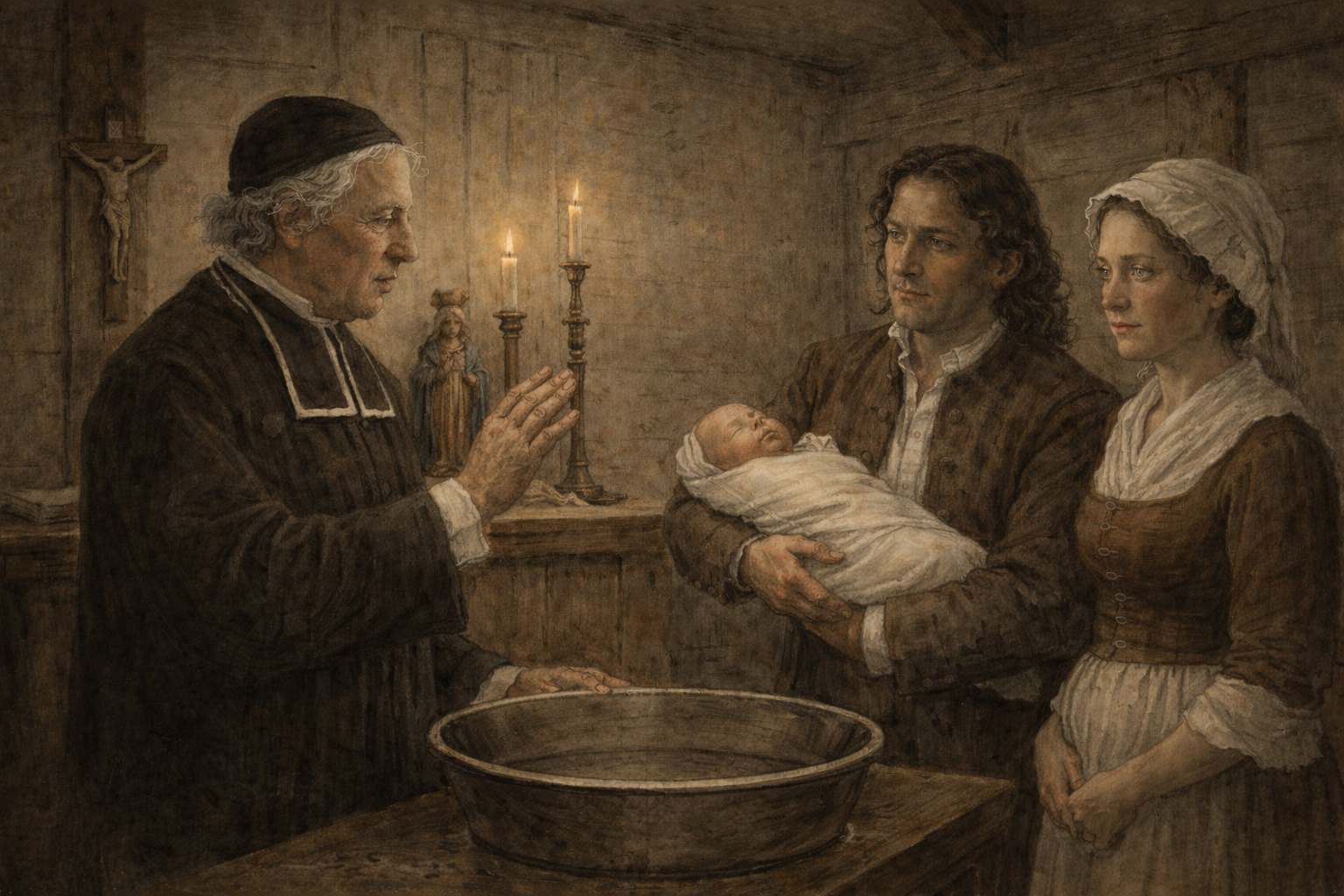
Artificial intelligence image created by the author with ChatGPT (January 2026)
Claude Mathias and Catherine were respected members of their community. On May 10, 1724, they received the concession of a pew in the church of Saint-Joseph in Rivière-des-Prairies. The concession document identifies Claude Mathias as a marguillier, or churchwarden, of the parish, a role that reflected both trust and standing within the local community.
Land Transactions
During the 1730s and 1740s, Claude Mathias and Catherine appear in multiple notarial acts involving land in Rivière-des-Prairies and across the river on Île-Jésus. At this time, the Séminaire de Québec, seigneur and owner of Île-Jésus, was actively pursuing the settlement of the island through land concessions and the establishment of parishes, with the objective of transforming it into a productive agricultural seigneurie.
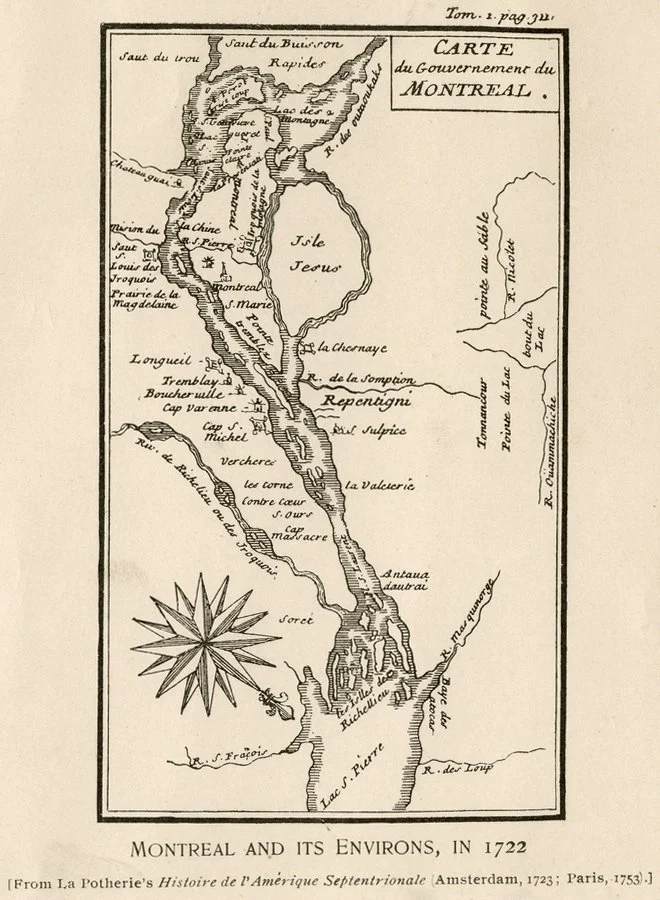
Map of the Government of Montréal showing Île-Jésus, 1722 (Bibliothèque et Archives nationales du Québec)
On July 8, 1735, Claude Mathias received a land concession on Île-Jésus from the Séminaire de Québec. He was described as an habitant of Rivière-des-Prairies. The concession measured three arpents of frontage, facing Rivière Jésus [now Rivière des Mille Îles], by 20 arpents in depth, on the northern side of the island. It bordered the land of Gabriel Charpentier, his brother-in-law. Claude Mathias agreed to pay an annual rente of 2 sols per arpent of land area, in addition to 3 sols in cens for the entire concession, payable annually on October 20.
As part of the agreement, Claude Mathias undertook to “tenir feu et lieu,” obligating him to build a dwelling on the land and reside there. He was also required to have his grain ground at the seigneurial mill and agreed not to sell, directly or indirectly, “intoxicating beverages to the Savages.” The seigneurs reserved the right to take wood freely from the land as needed. Notably, Claude Mathias declared not knowing how to write or sign, despite having previously signed other notarial acts, including a land concession and his marriage contract.
On July 20, 1736, Gabriel Charpentier sold his own land concession on Île-Jésus to Claude Mathias for 50 livres. Claude Mathias was again described as an habitant of Rivière-des-Prairies, indicating that he had not relocated to the island. The parcel, adjoining his existing land and that of Joseph Desjardins, measured four arpents of frontage by 20 arpents in depth. It carried an annual rente of 2 sols per arpent of land area, plus 4 sols in cens for the entire concession, payable each year on October 20.
On September 20, 1736, Claude Mathias entered into a five-year lease with his father-in-law, Jean Charpentier, for a parcel of farmland in Rivière-des-Prairies. The land measured six and a half arpents of frontage by 40 arpents in depth and was bordered by the lands of Joseph Charpentier (Jean’s son) and Augustin Maquet. Under the terms of the lease, Claude Mathias agreed to deliver annually 130 minots of wheat and 200 bales of hay. He also undertook to fence the property. Jean Charpentier further supplied him with four lean pigs and 30 minots of peas “to fatten them up,” in return for which Claude Mathias agreed to deliver 600 pounds of lard over the term of the lease.
On April 1, 1740, the Séminaire de Québec granted Claude Mathias a “continuation” of land on Île-Jésus, consisting of an additional four arpents of frontage by 20 arpents in depth adjoining the parcel he had purchased from Gabriel Charpentier in 1736. This addition was subject to the same annual obligations: 2 sols in rente per arpent of land area, plus 4 sols in cens for the entire concession.
The following day, April 2, 1740, the Séminaire granted Claude Mathias a second continuation, consisting of an additional three arpents of frontage by 20 arpents in depth adjoining his original concession of 1735. For this parcel, he agreed to pay an annual rente of 2 sols per arpent of land area, plus 3 sols in cens for the entire concession.
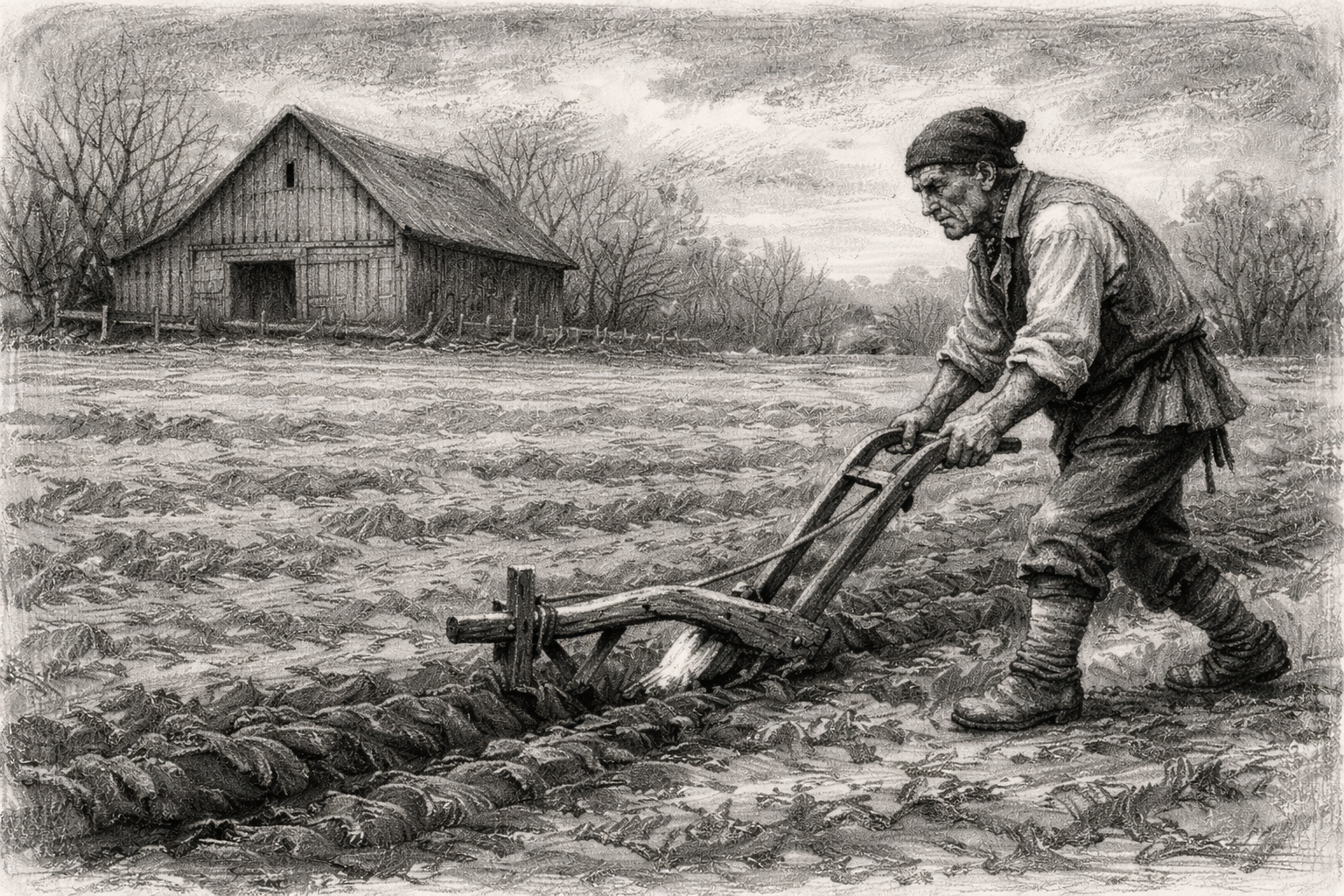
Artificial intelligence image created by the author with ChatGPT (January 2026)
Death of Catherine’s Father
Jean Charpentier, Catherine’s father, died suddenly in December 1741. In May of the following year, an inventory of the community of goods between him and his wife, Françoise Huneau, was drawn up. On May 8, 1742, the succession was formally divided between Françoise and the Charpentier children.
The estate included a parcel of land in Rivière-des-Prairies measuring four arpents of frontage by 20 arpents in depth. On the property stood a small house measuring 15 square feet, valued at 30 livres, built with posts driven into the ground, covered with planks, and fitted with a stone chimney. The land also contained a barn measuring 50 feet long by 25 feet wide, valued at 60 livres, as well as a second barn and a stable described as “almost unusable.” One half of the land was allotted to Françoise, while the remaining half was divided among the Charpentier children and their respective spouses.
Only weeks later, on May 22, 1742, Gabriel Charpentier sold his portion of the inherited land to Claude Mathias for 269 livres and 10 sols. Gabriel’s share represented one-ninth of a parcel measuring two arpents of frontage by 20 arpents in depth.
On February 17, 1745, Marie Louise Charpentier and her husband, Pierre Forget dit Dépaty, sold their portion of the inherited land in Rivière-des-Prairies—measuring 41 feet of frontage facing the river by 20 arpents in depth—for 217 livres [11?] sols.
Catherine’s Brother Accused of Murder
Later that same year, the Fanef–Charpentier family was affected by a series of events recorded in the colonial criminal courts. In November 1745, Catherine’s brother, Michel Charpentier, was accused—along with his wife, Angélique Marsan dite Lapierre—of the murder of Guillaume Joquin on Île Saint-Ignace. Joquin was found in his home, killed by repeated blows from a hatchet.
A judicial investigation followed, including a site inspection, medical testimony from a surgeon, and multiple witness depositions. Among the physical evidence cited in the record was the discovery by Claude Phaneuf, son of Claude Mathias and Catherine and a neighbour of Charpentier, of two sacks of flour, one of which bore traces of blood and was presumed to originate from the crime scene.
Angélique Marsan was arrested in Sorel and interrogated on several occasions. She stated that her husband, who had fled, later confessed the crime to her, allegedly committed in order to steal documents (ordonnances). Michel Charpentier failed to appear before the court and was tried par contumace. In early 1746, he was convicted of murder and sentenced in absentia to have “his arms, legs, thighs and kidneys broken while alive on a scaffold that will be placed for this purpose in the market square.” The sentence was carried out symbolically through the execution of an effigy.
Angélique was absolved of all charges and transferred to Québec as part of the closing judicial procedures. The court explicitly recorded concerns that Michel Charpentier might defect to English territory and provide intelligence detrimental to the colony. No document within the surviving criminal dossier records his capture or the physical execution of the sentence.
According to the PRDH, Michel Charpentier died in Rivière-des-Prairies in 1748. His burial act is defective and unsigned, with the surname supplied from the margin. If this burial corresponds to Catherine’s brother, it suggests that Michel ultimately returned quietly to the Montréal area rather than fleeing permanently to English territory. Given the legal and social context, several possibilities remain open: he may have lived discreetly, benefited from community silence, or relied on local networks willing to reintegrate him once active judicial pursuit had lapsed. It is also possible that the earlier conviction par contumace was never enforced due to the passage of time or limited enforcement capacity.
Claude Mathias and Catherine’s Final Years
On October 27, 1751, Claude Mathias and Catherine donated land in Rivière-des-Prairies to their youngest sons, Pierre and Paul, with the formal consent of their other children and their spouses. The property measured three and a half arpents of frontage facing the river by [blank] arpents in depth and lay between the lands of Joseph Charpentier and Jean Baptiste Allard. The donation included a house, a barn, a stable, a sheepfold, and “any other buildings on the entirety of the land.” Livestock transferred with the property consisted of oxen, cows, calves, sheep, and pigs.
Under the terms of the agreement, Pierre and Paul assumed responsibility for all future cens and rentes owed to the seigneurs. Pierre further undertook to provide annual support to his parents in the amount of 400 livres, payable half in cash and half in wheat, the latter to be delivered to their attic. In addition, he agreed to supply 18 pots of eau de vie (brandy) and six pots of “good red wine” each year, as well as a milk cow, a pig, firewood as required, and a horse with harness “to go wherever they please.” The sons also committed to having 75 low masses said for the repose of each parent’s soul within one year of their respective deaths.
On the afternoon of May 10, 1753, Claude Mathias and Catherine donated their land on the northern half of Île-Jésus to their son Joseph. He assumed responsibility for all future cens and rentes attached to the property. The act was recorded by notary Charles François Coron at his study on Île-Jésus.
In 1764, Claude Mathias and Catherine left rural Rivière-des-Prairies and relocated to Saint-Antoine-sur-Richelieu. They may have resided with their son Jean Baptiste and his family.
Deaths of Claude Mathias and Catherine
Mathias Farnsworth, later known as Claude Mathias Fanef, died at the age of 83 on the morning of August 7, 1773. He was buried the following day inside the parish church of Saint-Antoine-de-Padoue in Saint-Antoine-sur-Richelieu. His sons Jean Baptiste and François attended the burial. [The burial record mistakenly states that he was 85 years old.]
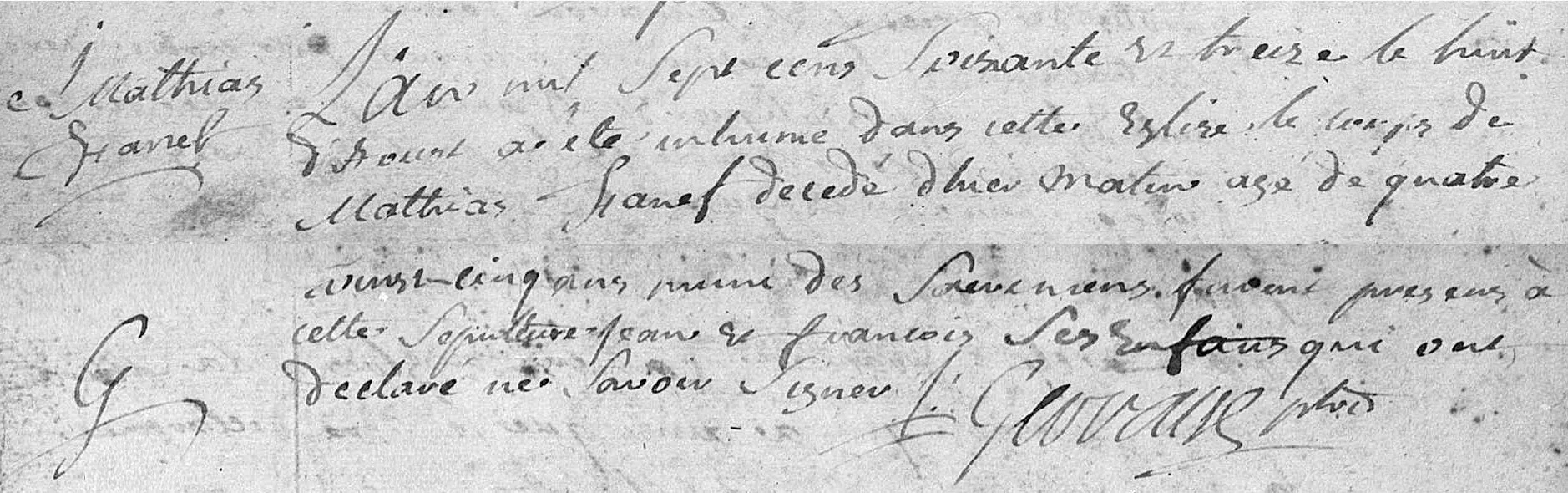
1773 burial of Claude Mathias Fanef (FamilySearch)
Catherine Charpentier died at approximately 85 years of age on the night of June 29, 1777. She was buried the following day inside the same church. Her son Paul attended the burial.
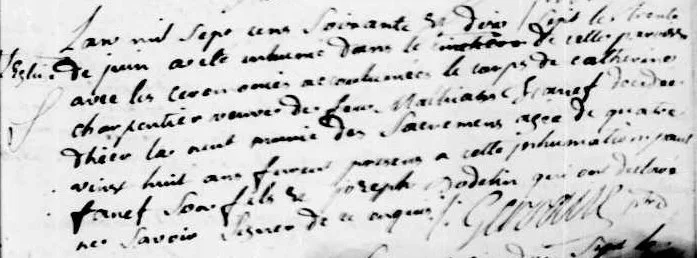
1777 burial of Catherine Charpentier (Généalogie Québec)
Buried inside the church?
Intramural church burials are an ancient Christian tradition that early colonists brought from France. In France, this privilege was primarily reserved for clergy and nobles. However, in New France, burials within church walls were not limited to these elite groups. They were performed for those belonging to the most powerful social groups (which could even include farmers), successful tradespeople, and those devoted to their church and community. Bodies were typically placed in crypts located under the church floor or in graves dug after raising the floor or moving a church bench.
The funeral rites for such burials were generally more elaborate and expensive than those for cemetery burials. These rites often included special masses, processions, and other ceremonies that underscored the social status and community contributions of the deceased. The practice of intramural church burials began to decline by the mid-nineteenth century, primarily due to public hygiene concerns, a lack of space, and changing attitudes towards burial practices. By this time, many communities started to favour dedicated cemeteries away from populated areas.
Evolution of a Name
During his lifetime in Canada, Claude Mathias’s surname appears in the records under numerous spellings, including Fanef, Farneth, Farnet, Faneuf, Faneffe, Phaneuf, Faremont, and Faneuffe. He was most frequently identified as “Mathias Fanef.” Over subsequent generations, the surname in Canada gradually stabilized as Phaneuf.
In the United States, surname variation remained far more pronounced. Documented forms include Fanef, Faneff, Faneuf, Fanney, Fanophe, Farneth, Farnets, Farnsworth, Farnum, Farsworth, Feaneur, Fineuff, Finif, Finiff, Finuf, Finuff, Phanost, and Makenine.
A Life Recast in New France
The lives of Claude Mathias Fanef and Catherine Charpentier unfolded against a backdrop of war, displacement, settlement, and endurance. Taken from New England as a teenager, Mathias Farnsworth arrived in New France under coercive circumstances, yet over time became Claude Mathias Fanef: a Catholic convert, a naturalized subject of the French Crown, a landholder, churchwarden, husband, and father. Although he held land on Île-Jésus, he was consistently identified as an habitant of Rivière-des-Prairies, where his household, labour, and parish life were centred. By the mid-18th century, Claude Mathias stood out as one of the very few English-born captives who had fully entered mainstream French-Canadian society. Unlike many other captives—some of whom returned to New England if ransomed, or who remained within Indigenous communities rather than colonial parishes—he lived, worked, worshipped, and raised his family as a French-Canadian censitaire, embedded in the legal, religious, and social structures of the colony.
Catherine Charpentier brought with her land, kinship networks, and deep local roots, but also family turmoil. The criminal proceedings surrounding her brother Michel Charpentier in the mid-1740s, including a conviction par contumace for murder, placed the extended family under intense judicial and social scrutiny. Despite this, Claude Mathias and Catherine maintained their standing within the community, a position reflected in Mathias’s service as churchwarden, the concessions and donations made during their lifetime, and the honours accorded to them at their deaths. Their children and grandchildren remained anchored in the same parishes and landscapes, and over time the family name stabilized as Phaneuf. From this couple descended a lineage that produced farmers, voyageurs, and local officials across Québec and beyond. Claude Mathias Fanef and Catherine Charpentier stood as the foundational ancestral couple from whom all Phaneufs descend, in Québec, elsewhere in Canada, the United States, and Europe—an enduring legacy born of adaptation, resilience, and full integration into French-Canadian society.
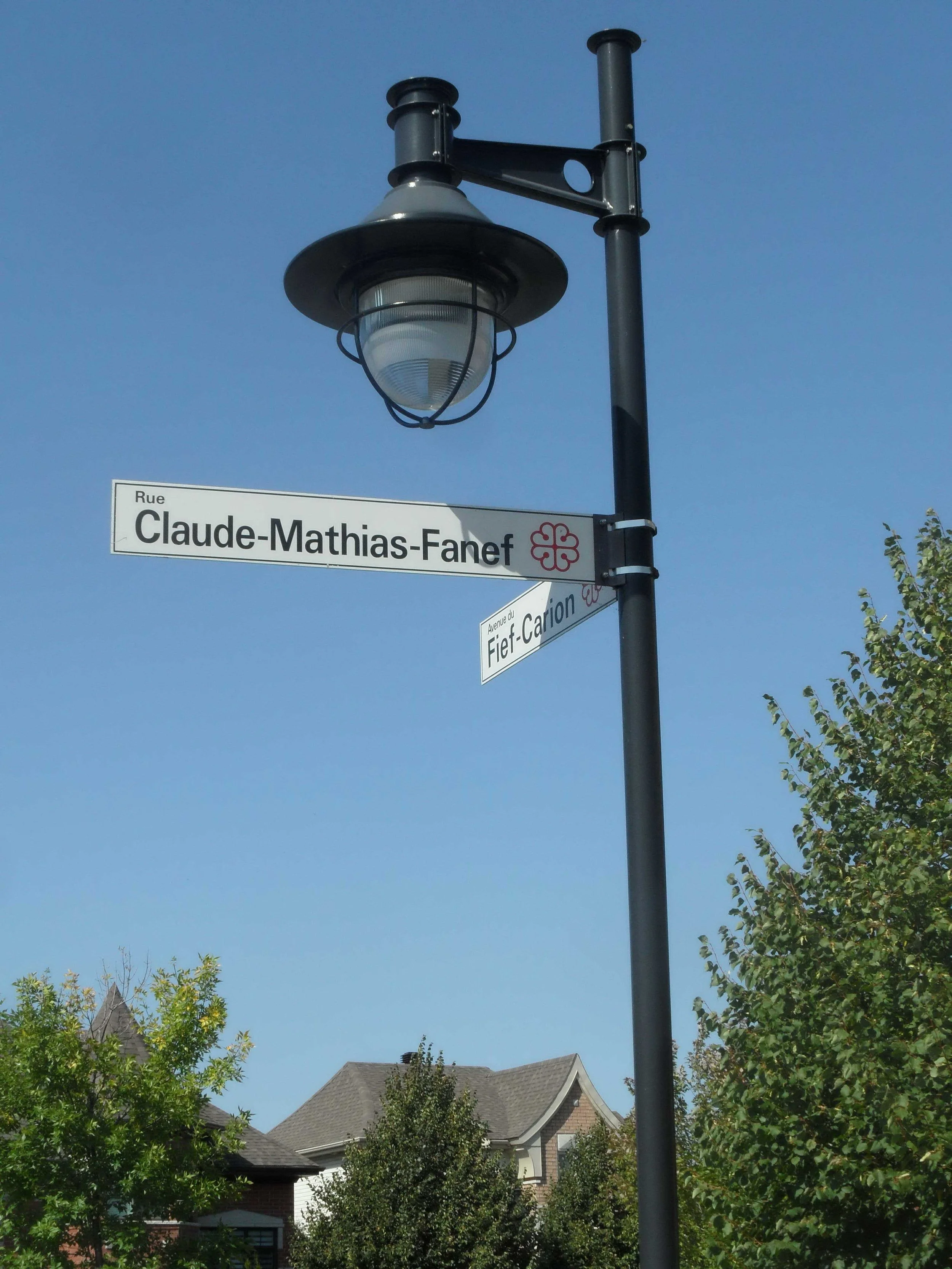
Rue Claude-Mathias-Fanef in Montréal (Wikimedia Commons, CC BY-SA 4.0)
Commemoration
In 2006, the city of Montréal named a street in Claude Mathias’s honour: rue Claude-Mathias-Fanef. It is located in the Rivière-des-Prairies–Pointe-aux-Trembles borough of the city. The short street is located on land that was part of Claude Mathias’s original farm (near 89e and 94e Avenue).
PDF version of article located at https://www.tfcg.ca/claudemathiasfanef-and-catherinecharpentier.
Are you enjoying our articles and resources? Show your support by making a donation. Every contribution, regardless of its size, goes a long way in covering our website hosting expenses and enables us to create more content related to French-Canadian genealogy and history. Thank you! Merci!
Sources:
"Massachusetts, U.S., Compiled Birth, Marriage, and Death Records, 1700-1850,” digital images, Ancestry.ca (https://www.ancestry.ca/imageviewer/collections/61401/images/dvm_primsrc000079-00077?pId=1396122 : accessed 30 Jan 2026), birth of Matthias Farnsworth, 6 Aug 1690, Groton; citing original data: New England Historical Genealogical Society; Boston, Massachusetts; Massachusetts Vitals to 1850.
Claudius Buchanan Farnsworth, Matthias Farnsworth and his descendants in America (Pawtucket, self-published, 1891).
“A Brief History of Groton, MA,” Town of Groton Massachusetts (https://www.grotonma.gov/community/about/groton-history/ : accessed 30 Jan 2026).
William L. Wolkovich-Valkavicius, “The Groton Indian Raid of 1694 and Lydia Longley,” Historical Journal of Massachusetts, Volume 30, No. 2 (Summer 2002), digitized by Westfield (https://www.westfield.ma.edu/historical-journal/wp-content/uploads/2018/06/Wolkovich-Valkavicius-Summer-2002-complete.pdf : accessed 31 Jan 2026).
Emma Lewis Coleman, New England Captives Carried to Canada Between 1677 and 1760 During the French and Indian Wars, Volume One (Portland, Maine, The Southworth Press, 1925), 91.
Samuel Abbott Green, Groton during the Indian wars (Groton, Massachusetts, self-published, 1883), 109-124.
Samuel Penhallow, The history of the wars of New-England, with the Eastern Indians. Or, A narrative of their continued perfidy and cruelty, from the 10th of August, 1703. to the peace renewed 13th of July, 1713. And from the 25th of July, 1722. to their submission 15th December, 1725. Which was ratified August 5th 1726 (Boston, T. Fleet, 1726), digitized by Evans Early American Imprint Collection, University of Michigan Library (https://name.umdl.umich.edu/n02356.0001.001 : accessed 31 Jan 2026).
"Canada, Québec, registres paroissiaux catholiques, 1621-1979," digital images, FamilySearch (https://www.familysearch.org/ark:/61903/3:1:3QSQ-G9MY-Y92F?cat=46693&i=363&lang=en : accessed 30 Jan 2026), baptism of Mathias Farneth, 10 Jan 1706, Montréal > Notre-Dame > Baptêmes, mariages, sépultures 1700-1712 > image 364 of 1388; citing original data : Archives nationales du Québec, Montréal.
"Canada, Québec, registres paroissiaux catholiques, 1621-1979," digital images, FamilySearch (https://www.familysearch.org/ark:/61903/3:1:3QSQ-G99Q-QQW8?lang=en&i=505 : accessed 3 Feb 2026), burial of Mathias FANEF, 8 Aug 1773, Saint-Antoine-sur-Richelieu > Saint-Antoine-sur-Richelieu > Index 1741-1876 Baptêmes, mariages, sépultures 1741-1779 > image 506 of 605; citing original data : Archives nationales du Québec, Montréal.
“Le LAFRANCE (Baptêmes, Mariages, Sépultures)," database and digital images, Généalogie Québec (https://www.genealogiequebec.com/Membership/LAFRANCE/acte/12847 : accessed 31 Jan 2026), marriage of Claude Mathias FANEF and Catherine CHARPENTIER, 2 Oct 1713, Montréal, Rivière-des-Prairies (St-Joseph); citing original data: Institut généalogique Drouin.
“Le LAFRANCE (Baptêmes, Mariages, Sépultures)," database and digital images, Généalogie Québec (https://www.genealogiequebec.com/Membership/LAFRANCE/acte/379318 : accessed 3 Feb 2026), burial of Catherine Charpentier, 30 Jun 1777, St-Antoine-sur-Richelieu (St-Antoine-de-Padoue); citing original data: Institut généalogique Drouin.
“Fonds Conseil souverain - BAnQ Québec”, digital images, Bibliothèque et Archives nationales du Québec (https://advitam.banq.qc.ca/notice/400045 : accessed 30 Jan 2026), “Lettres de naturalité accordées par Sa Majesté,” 1 May 1710 – 31 May 1710, reference: TP1,S36,P463, ID 400045; citing original data: Pièce provenant du Registre des insinuations du Conseil supérieur de Québec (10 mars 1691 au 20 février 1714), volume C, f. 47v-50.
"Fonds Conseil souverain - Archives nationales à Québec," digital images, Bibliothèque et Archives nationales du Québec (https://advitam.banq.qc.ca/notice/409704 : accessed 31 Jan 2026), "Ordre d'enregistrer au greffe du Conseil les lettres de naturalisation accordées à Mathias Phaneuf (Fanef), Anglais établi à Montréal, par Sa Majesté," 25 Jun 1715, reference TP1,S28,P9611, Id 409704.
"Fonds Juridiction royale de Montréal - Archives nationales à Montréal," digital images, Bibliothèque et Archives nationales du Québec (https://advitam.banq.qc.ca/notice/703306 : accessed 2 Feb 2026), "Procès contre Michel Charpentier, tonnelier, habitant de la rivière Chambly dans la seigneurie de Contrecoeur, et son épouse Angélique Mersan, accusés du meurtre d'un nommé Joquin, habitant de l'Ïle St-Ignace," 25 Nov 1745 to 25 Feb 1746, reference TL4,S1,D5189, Id 703306.
"Actes de notaire, 1697-1727 // Pierre Raimbault," digital images, FamilySearch (https://www.familysearch.org/ark:/61903/3:1:3Q9M-CS5V-4SVC-7?cat=koha%3A675517&i=292&lang=en : accessed 30 Jan 2026), land concession to Claude Mathias by the Séminaire de St-Sulpice de Montréal, 19 Jul 1711, images 293-299 of 3060; citing original data: Bibliothèque et Archives nationales du Québec.
"Actes de notaire, 1704-1731 // Nicolas Senet," digital images, FamilySearch (https://www.familysearch.org/ark:/61903/3:1:3Q9M-CSTW-ZSQ4-X?cat=koha%3A529332&i=598&lang=en : accessed 31 Jan 2026), land concession continuation to Claude Mathias Fanef by the Séminaire de St-Sulpice de Montréal, 14 Sep 1713, images 599-601 of 3212; citing original data: Bibliothèque et Archives nationales du Québec.
"Actes de notaire, 1697-1727 // Pierre Raimbault," digital images, FamilySearch (https://www.familysearch.org/ark:/61903/3:1:3Q9M-CS5V-4SPP-V?cat=koha%3A675517&i=1234&lang=en : accessed 31 Jan 2026), marriage contract between Claude-Mathias Fanef; et Catherine Charpentier, 25 Sep 1713, images 1235-1240 of 3060; citing original data: Bibliothèque et Archives nationales du Québec.
"Actes de notaire, 1734-1767 // Charles-François Coron," digital images, FamilySearch (https://www.familysearch.org/ark:/61903/3:1:3QHV-P3JH-H5KM?cat=koha%3A481208&i=47&lang=en : accessed 2 Feb 2026), land concession to Mathias Fanef from the Séminaire de Québec, 8 Jul 1735, images 48-50 of 3084; citing original data: Bibliothèque et Archives nationales du Québec.
"Actes de notaire, 1734-1767 // Charles-François Coron," digital images, FamilySearch (https://www.familysearch.org/ark:/61903/3:1:3QHV-L3JH-HLFL?cat=koha%3A481208&i=487&lang=en : accessed 2 Feb 2026), land sale by Gabriel Charpentier to Mathias Faneffe, 20 Jul 1736, images 488-489 of 3084; citing original data: Bibliothèque et Archives nationales du Québec.
"Actes de notaire, 1734-1767 // Charles-François Coron," digital images, FamilySearch (https://www.familysearch.org/ark:/61903/3:1:3QHV-L3JH-HYZ8?cat=koha%3A481208&i=592&lang=en : accessed 2 Feb 2026), farm lease by Jean Charpentier to Mathias Faneffe, 27 Oct 1736, images 593-596 of 3084; citing original data: Bibliothèque et Archives nationales du Québec.
"Actes de notaire, 1734-1767 // Charles-François Coron," digital images, FamilySearch (https://www.familysearch.org/ark:/61903/3:1:3QHV-L3JH-H99F-V?cat=koha%3A481208&i=2851&lang=en : accessed 2 Feb 2026), land concession continuation to Mathias Faneuf by the Séminaire de Québec, 1 Apr 1740, images 2852-2854 of 3084; citing original data: Bibliothèque et Archives nationales du Québec.
"Actes de notaire, 1734-1767 // Charles-François Coron," digital images, FamilySearch (https://www.familysearch.org/ark:/61903/3:1:3QHV-P3JH-HTSR?cat=koha%3A481208&i=2855&lang=en : accessed 2 Feb 2026), land concession continuation to Mathias Faneuf by the Séminaire de Québec, 2 Apr 1740, images 2856-2858 of 3084; citing original data: Bibliothèque et Archives nationales du Québec.
"Actes de notaire, 1734-1767 // Charles-François Coron," digital images, FamilySearch (https://www.familysearch.org/ark:/61903/3:1:3QHV-P3JH-C9SW-J?cat=koha%3A481208&i=1744&lang=en : accessed 2 Feb 2026), inventory requested by Françoise Hunau and the heirs of Jean Charpentier, 9 May 1740, images 1745-1749 of 3206; citing original data: Bibliothèque et Archives nationales du Québec.
"Actes de notaire, 1734-1767 // Charles-François Coron," digital images, FamilySearch (https://www.familysearch.org/ark:/61903/3:1:3QHV-L3JH-CKDF?cat=koha%3A481208&i=1750&lang=en : accessed 2 Feb 2026), land division between Françoise Henau and her children with Jean Charpentier, 8 May 1742, images 1751-1756 of 3206; citing original data: Bibliothèque et Archives nationales du Québec.
"Actes de notaire, 1734-1767 // Charles-François Coron," digital images, FamilySearch (https://www.familysearch.org/ark:/61903/3:1:3QHV-L3JH-C9H2-G?cat=koha%3A481208&i=1765&lang=en : accessed 2 Feb 2026), sale of a portion of land by Gabriel Charpentier to Mathias Faneuf, 22 May 1742, images 1766-1767 of 3206; citing original data: Bibliothèque et Archives nationales du Québec.
"Actes de notaire, 1734-1767 // Charles-François Coron," digital images, FamilySearch (https://www.familysearch.org/ark:/61903/3:1:3QHV-L3JH-F9CQ-G?cat=koha%3A481208&i=1286&lang=en : accessed 2 Feb 2026), sale of a portion of land by Marie Louise Charpantier and Pierre Forgette to Mathias Faneuf, 17 Feb 1745, images 1287-1298 of 3088; citing original data: Bibliothèque et Archives nationales du Québec.
"Actes de notaire, 1734-1767 // Charles-François Coron," digital images, FamilySearch (https://www.familysearch.org/ark:/61903/3:1:3QHV-P3JH-J99D-Q?cat=koha%3A481208&i=1253&lang=en : accessed 2 Feb 2026), land donation by Paul Mathias Faneuf and Marie Catherine Charpantier to their sons Pierre and Paul Faneuffe, 27 Oct 1751, images 1254-1258 of 3207; citing original data: Bibliothèque et Archives nationales du Québec.
"Actes de notaire, 1734-1767 // Charles-François Coron," digital images, FamilySearch (https://www.familysearch.org/ark:/61903/3:1:3QHV-P3JH-JY6V?cat=koha%3A481208&i=2775&lang=en : accessed 2 Feb 2026), land donation by Mathias Faneuf and Catherine Charpantier to Joseph Phaneuf, 10 May 1753, images 2776-2777 of 3207; citing original data: Bibliothèque et Archives nationales du Québec.
Parchemin, notarial database of ancient Québec (1626-1801), Société de recherche historique Archiv-Histo (https://archiv-histo.com : accessed 2 Feb 2026), " Concession d'un banc; par la Fabrique de la paroisse St-Joseph-de-la-Rivière-des-Prairies, à Mathias Fanef, marguillier et Marie-Catherine Charpentier, son épouse, de la paroisse St Joseph de la Rivier des Presries," notary N. Senet dit Laliberté, 10 May 1724.
Université de Montréal, Programme de recherche en démographie historique (PRDH) database (https://www-prdh-igd.com/Membership/fr/PRDH/Famille/11557 : accessed 31 Jan 2026), dictionary entry for Claude Mathias PHANEUF FARNSWORTH and Marie Catherine CHARPENTIER, union 11557.
Université de Montréal, Programme de recherche en démographie historique (PRDH) database (https://www-prdh-igd.com/Membership/fr/PRDH/acte/12336 : accessed 1 Feb 2026), baptism of Marie Catherine JOLI, 28 Mar 1713, Montréal, Rivière-des-Prairies (St-Joseph).
Université de Montréal, Programme de recherche en démographie historique (PRDH) database (https://www-prdh-igd.com/Membership/fr/PRDH/acte/123432 : accessed 1 Feb 2026), baptism of Gabriel CADIEUX, 11 Jul 1713, Montréal, Rivière-des-Prairies (St-Joseph).
Université de Montréal, Programme de recherche en démographie historique (PRDH) database (https://www-prdh-igd.com/Membership/fr/PRDH/acte/12646 : accessed 1 Feb 2026), baptism of Marie Louise JOLY, 6 Jul 1723, Montréal, Rivière-des-Prairies (St-Joseph).
Université de Montréal, Programme de recherche en démographie historique (PRDH) database (https://www-prdh-igd.com/Membership/fr/PRDH/acte/12673 : accessed 1 Feb 2026), baptism of Marie UST, 3 Sep 1724, Montréal, Rivière-des-Prairies (St-Joseph).
Université de Montréal, Programme de recherche en démographie historique (PRDH) database (https://www-prdh-igd.com/Membership/fr/PRDH/acte/12779 : accessed 1 Feb 2026), baptism of Francois LOUFTEAU, 27 Apr 1728, Montréal, Rivière-des-Prairies (St-Joseph).
Université de Montréal, Programme de recherche en démographie historique (PRDH) database (https://www-prdh-igd.com/Membership/fr/PRDH/acte/22313 : accessed 1 Feb 2026), baptism of Jean Baptiste CHARPENTIER, 5 Jul 1729, Laval (St-François-de-Sales).
Université de Montréal, Programme de recherche en démographie historique (PRDH) database (https://www-prdh-igd.com/Membership/fr/PRDH/acte/129542 : accessed 1 Feb 2026), baptism of Joseph VAILLANCOUR, 17 Sep 1739, Laval (St-François-de-Sales).
Université de Montréal, Programme de recherche en démographie historique (PRDH) database (https://www-prdh-igd.com/Membership/fr/PRDH/acte/113281 : accessed 1 Feb 2026), baptism of Francois Marie CADIEUX, 11 Oct 1740, Montréal, Rivière-des-Prairies (St-Joseph).
Université de Montréal, Programme de recherche en démographie historique (PRDH) database (https://www-prdh-igd.com/Membership/fr/PRDH/acte/113393 : accessed 1 Feb 2026), baptism of Joseph Marie CADIEUX, 21 Jan 1744, Montréal, Rivière-des-Prairies (St-Joseph).
Université de Montréal, Programme de recherche en démographie historique (PRDH) database (https://www-prdh-igd.com/Membership/fr/PRDH/acte/113411 : accessed 1 Feb 2026), baptism of Marie Veronique CHARPENTIER, 25 May 1744, Montréal, Rivière-des-Prairies (St-Joseph).
Université de Montréal, Programme de recherche en démographie historique (PRDH) database (https://www-prdh-igd.com/Membership/fr/PRDH/acte/113433 : accessed 1 Feb 2026), baptism of Claude Marie FANEF, 11 Feb 1745, Montréal, Rivière-des-Prairies (St-Joseph).
Université de Montréal, Programme de recherche en démographie historique (PRDH) database (https://www-prdh-igd.com/Membership/fr/PRDH/acte/1135495 : accessed 1 Feb 2026), baptism of Marie Francoise FORANT, 9 Mar 1747, Montréal, Rivière-des-Prairies (St-Joseph).
Université de Montréal, Programme de recherche en démographie historique (PRDH) database (https://www-prdh-igd.com/Membership/fr/PRDH/acte/129801 : accessed 1 Feb 2026), baptism of Mathias FANEF, 10 Aug 1747, Laval (St-François-de-Sales).
Université de Montréal, Programme de recherche en démographie historique (PRDH) database (https://www-prdh-igd.com/Membership/fr/PRDH/acte/113520 : accessed 1 Feb 2026), baptism of Louis RENAUD, 12 Nov 1747, Montréal, Rivière-des-Prairies (St-Joseph).
Université de Montréal, Programme de recherche en démographie historique (PRDH) database (https://www-prdh-igd.com/Membership/fr/PRDH/acte/113546 : accessed 1 Feb 2026), baptism of Marie Anne FANEF, 1 Sep 1748, Montréal, Rivière-des-Prairies (St-Joseph).
Université de Montréal, Programme de recherche en démographie historique (PRDH) database (https://www-prdh-igd.com/Membership/fr/PRDH/acte/113566 : accessed 1 Feb 2026), baptism of Marie Anne RENAUD, 16 Jun 1749, Montréal, Rivière-des-Prairies (St-Joseph).
Université de Montréal, Programme de recherche en démographie historique (PRDH) database (https://www-prdh-igd.com/Membership/fr/PRDH/acte/271814 : accessed 1 Feb 2026), baptism of Mathias FANEUF, 15 Nov 1755, Montréal, Rivière-des-Prairies (St-Joseph).
Université de Montréal, Programme de recherche en démographie historique (PRDH) database (https://www-prdh-igd.com/Membership/fr/PRDH/acte/271868 : accessed 1 Feb 2026), baptism of Marie Faneuf, 2 Sep 1757, Montréal, Rivière-des-Prairies (St-Joseph).
Université de Montréal, Programme de recherche en démographie historique (PRDH) database (https://www-prdh-igd.com/Membership/fr/PRDH/acte/15142 : accessed 2 Feb 2026), burial of Charpentier, 10 Dec 1758, Montréal, Rivière-des-Prairies (St-Joseph).
"Who Was Claude-Mathias Fanef ?," Histoire et généalogie de la famille Phaneuf (https://la-famille-phaneuf-farnsworth.ca/the-capture-of-matthias/ : accessed 1 Feb 2026).
Gérard Lebel, Nos Ancêtres 2 (Ste-Anne-de-Beaupré, Revue Sainte Anne de Beaupré, 1981), 126.
Thomas J. Laforest, Our French-Canadian Ancestors vol. 2 (Palm Harbor, Florida, The LISI Press, 1990), 221.
Marcel Fournier, De la Nouvelle-Angleterre à la Nouvelle-France : L’Histoire des captifs anglo-américains au Canada entre 1675 et 1760 (Montréal, Société généalogique canadienne-française, 1992), 128-129.
“Rue Claude-Mathias-Fanef,” Commission de toponymie (https://toponymie.gouv.qc.ca/ct/ToposWeb/Fiche.aspx?no_seq=396460 : accessed 3 Feb 2026), Gouvernement du Québec.
Thuot, Jean-René, "La pratique de l’inhumation dans l’église dans Lanaudière entre 1810 et 1860 : entre privilège, reconnaissance et concours de circonstances," 2006, Études d'histoire religieuse, 72, 75–96, digitized by Érudit (https://doi.org/10.7202/1006589ar).