John Clark, Pilot of the Mayflower
Discover the life of John Clark, English pilot of the Mayflower, from Virginia and Spanish captivity to Clark’s Island and Plymouth Colony.
John Clark: An English Pilot in the Atlantic World
Virginia, Spanish Captivity, the Mayflower, and a Life at Sea
John Clark (or Clarke) was a native of London, England. His year of birth is uncertain, as the two surviving declarations he made while in Spanish custody give conflicting ages:[1]
On July 23, 1611, he stated that he was 35 years old, suggesting a birth around 1575 or 1576;
On February 18, 1613, he stated that he was 40 years old, suggesting a birth around 1572 or 1573.
According to the same declarations, Clark was either “of the same religion as his King,” or a Roman Catholic. The latter statement was made in 1613, after he had been held in Spanish custody for more than a year, and is therefore less likely to reflect his original religious affiliation. The circumstances surrounding these conflicting statements will be examined later.
Family Life
A FamilySearch abstract records the marriage of a John Clarke and Mary Mowton on February 19, 1598, at St Dunstan and All Saints in Stepney, Middlesex, a date conventionally rendered 1598/9 in modern dual dating.[2] The original parish-register image is not available through FamilySearch, so the spelling of Mary’s surname in the original entry has not been independently verified. Genealogist John Insley Coddington, writing in 1966, identified the couple as John Clarke of Stepney and Mary “Morton” of St. Ellins, London, and stated that the original registers of St Dunstan’s had been thoroughly searched on his behalf. The reason for the discrepancy between Mowton in the FamilySearch abstract and Morton in Coddington’s account is therefore uncertain.[3]
Just over a year later, a Thomas Clarke, son of John Clarke “of Ratclif” [Ratcliff], was baptized at St Dunstan’s on March 8, 1599/1600.[4] Given the proximity in time and place, it is plausible that this Thomas was the son of the John Clarke and Mary Mowton/Morton who had married there the previous year. The baptism, however, names only his father, so even this first parent-child identification cannot be demonstrated from the baptism and marriage records alone.
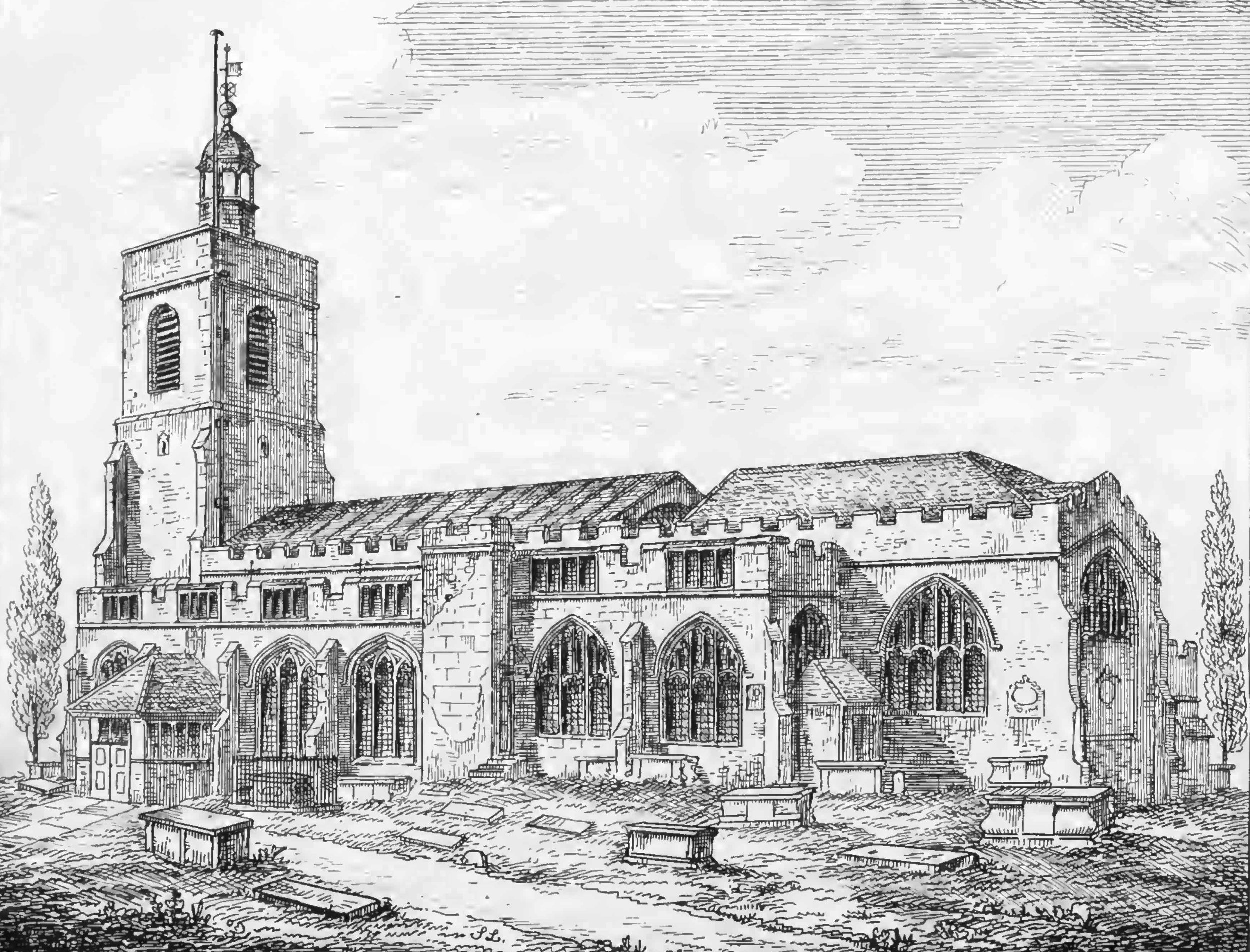
“The parish church of St Dunstan, Stepney, England in 1795,” from Daniel Lysons’s The Environs of London
The more difficult question is whether this Thomas was the same man as Thomas Clarke who arrived at Plymouth Colony aboard the Anne in 1623. In 1966, Coddington explicitly proposed that identification. He described Thomas of Plymouth, later Boston and then Plymouth again, as a carpenter, yeoman, merchant and gentleman, and wrote that he was, “we believe,” the Thomas baptized at St Dunstan’s in 1599/1600. Several circumstances are consistent with the theory. Thomas of Plymouth reportedly died in March 1697/98 at about ninety-eight years of age, placing his birth around 1600, and Ratcliff was a riverside district of Stepney that Coddington described as inhabited largely by seafaring men. Neither fact, however, establishes that the Plymouth colonist and the Stepney child were the same person.[5]
Coddington went one step further. He wrote that he also believed the father of the Stepney child, John Clark or Clarke, was the man who served as mate and pilot of the Mayflower in 1620. He then suggested that when Thomas sailed to Plymouth aboard the Anne in 1623, he may actually have been travelling to Virginia to join his father, only to learn of John’s death and decide to remain in New England. Significantly, Coddington introduced this latter scenario as a “surmise.” His article cites no record identifying the Mayflower pilot as the John Clarke of Ratcliff, no record naming Mary Mowton or Morton as the pilot’s wife, and no record identifying Thomas of Plymouth as the pilot’s son.[6]
There is evidence that the Mayflower pilot did have a family. After John Clark’s death in Virginia, a petition presented in 1623/24 described his widow as being in “great distresse & misery” with “a great Charge of poore Children.” The petition does not, however, name either the widow or the children. It therefore confirms that Clark left a wife and several children, but does not connect that family to Mary Mowton/Morton or to Thomas Clarke of Plymouth.[7]
Later genealogists repeated Coddington’s theory without resolving these gaps. In 1971, Donald Lines Jacobus reported Coddington’s identification of Thomas of Plymouth with the Stepney baptism and observed that the Mayflower pilot “may well have been father of Thomas.” Jacobus did not offer new evidence establishing the relationship; his article was primarily concerned with tracing Thomas Clarke’s descendants and establishing that Nathaniel Clark of Lyme, Connecticut, was his grandson.[8] A 1973 article by Jean Rumsey supplied further evidence and corrections concerning this American family but did not add evidence concerning Thomas’s English parentage or his possible relationship to the Mayflower pilot.[9]
John G. Hunt’s 1966 article “Origin of Three Early Plymouth Families: Cole, Collier, and Clarke,” which has also been cited in discussions of Thomas Clarke, does not resolve the question. Hunt’s Clarke research concerned a family associated with St. Olave’s parish in Southwark through Jane Clarke, wife of Plymouth colonist William Collier. Although he identified several members of that family, including a John Clarke who married Elizabeth Hobson in 1589, Hunt himself characterized the evidence concerning the Clarke ancestry as “very inconclusive.”[10]
The proposed relationship therefore rests on three separate, plausible but unproven identifications: first, that the John Clarke who married Mary Mowton/Morton at St. Dunstan's in 1598/9 was the same John Clarke named as the father of Thomas in the Stepney baptismal record of 1599/1600; second, that the Thomas baptized there was the same man as Thomas Clarke who arrived at Plymouth Colony in 1623; and third, that the John Clarke named as the child's father was John Clark, pilot of the Mayflower. The dates, locations, maritime associations, and known existence of a wife and children in the pilot's family are compatible with the theory, but no record examined to date directly connects the individuals at any of these three points. Thomas Clarke of Plymouth should therefore be considered a possible son of John Clark, rather than a proven one.
First Voyage to Virginia
Clark was a pilot by profession. The first documented mention of his seafaring activities was around 1609, when he stated he was in Málaga, Spain, although he does not clarify why he was there or what ship he was serving on.[11] His own testimony, given during his 1613 Madrid interrogation, suggests his career began somewhat earlier: he described having been a pilot for four years by that date, and before that, having "sailed in different parts of the world" for four years more, placing the start of his seafaring life around 1605, and the start of his work specifically as a pilot at roughly the same time as the Málaga sighting.[12]
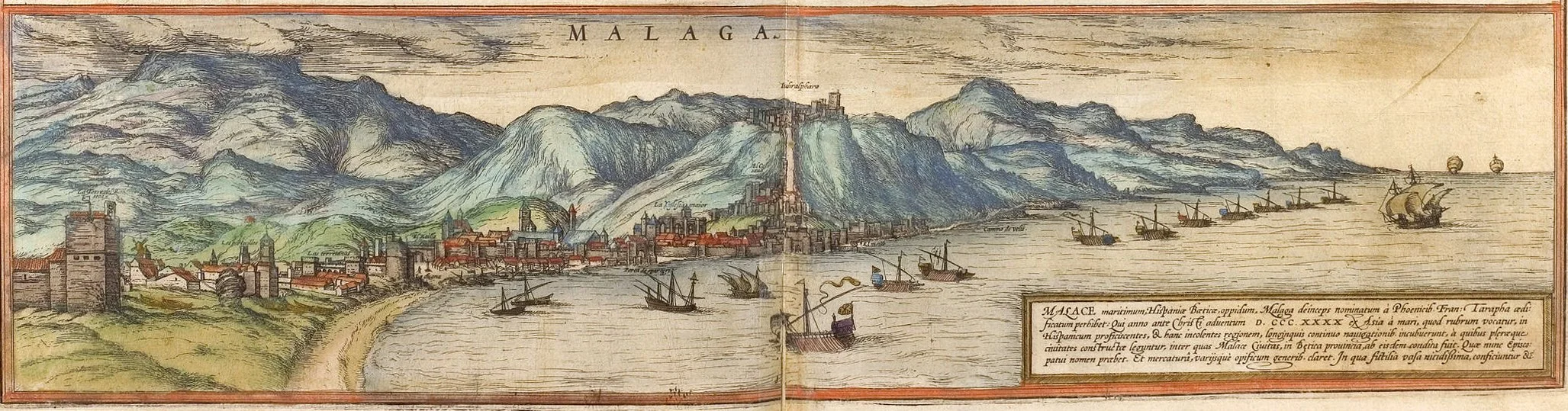
Málaga, Spain, 1572. Published in Georg Braun and Frans Hogenberg’s Civitates Orbis Terrarum (Wikimedia Commons)
In March 1611, Clark sailed for Virginia with Sir Thomas Dale and approximately 300 colonists and soldiers. He served as pilot of the Star, alongside the Prosperous and Elizabeth. The three vessels were reported as being 300, 150 and 90 tons.[13] Captain Christopher Newport, vice-admiral of Virginia, was in charge of the voyage, while Dale was being sent to serve as deputy governor of the colony. The ships were loaded with supplies and animals (horses, cattle, goats, conies, pigeons, and poultry). Dale’s men were described as “honest sufficient artificers,” “honest and industrious men, carpenters, smiths, coopers, fishermen, tanners, shoemakers, shipwrights, brickmen, gardeners, husbandmen, and laboring men of all sorts.”[14]
The ships’ route took them to the Canary Islands, Dominica, Nevis, and Puerto Rico, before finally reaching Point Comfort, Virginia, on the night of May 22, 1611.[15]
The voyage and the first months in Virginia took a heavy toll on Dale's contingent. In his August report to Salisbury, Dale complained that many of the 300 people he had brought with him were sick and debilitated, estimating that fewer than sixty were fit for labour or service.[16]
Virginia in Crisis
Four years prior to Clark’s arrival, the English colony of Virginia began in 1607, when the Virginia Company of London established Jamestown on the James River. It became the first permanent English settlement in North America, originally intended as a commercial venture. However, its first years were marked by severe hardship. Disease, food shortages, inadequate supplies, internal disputes, and increasingly strained relations with the Powhatan peoples repeatedly threatened the colony’s survival. Captain John Smith played an important role in keeping the settlement functioning during 1608 and 1609, but after he returned to England in the autumn of 1609, conditions deteriorated sharply.
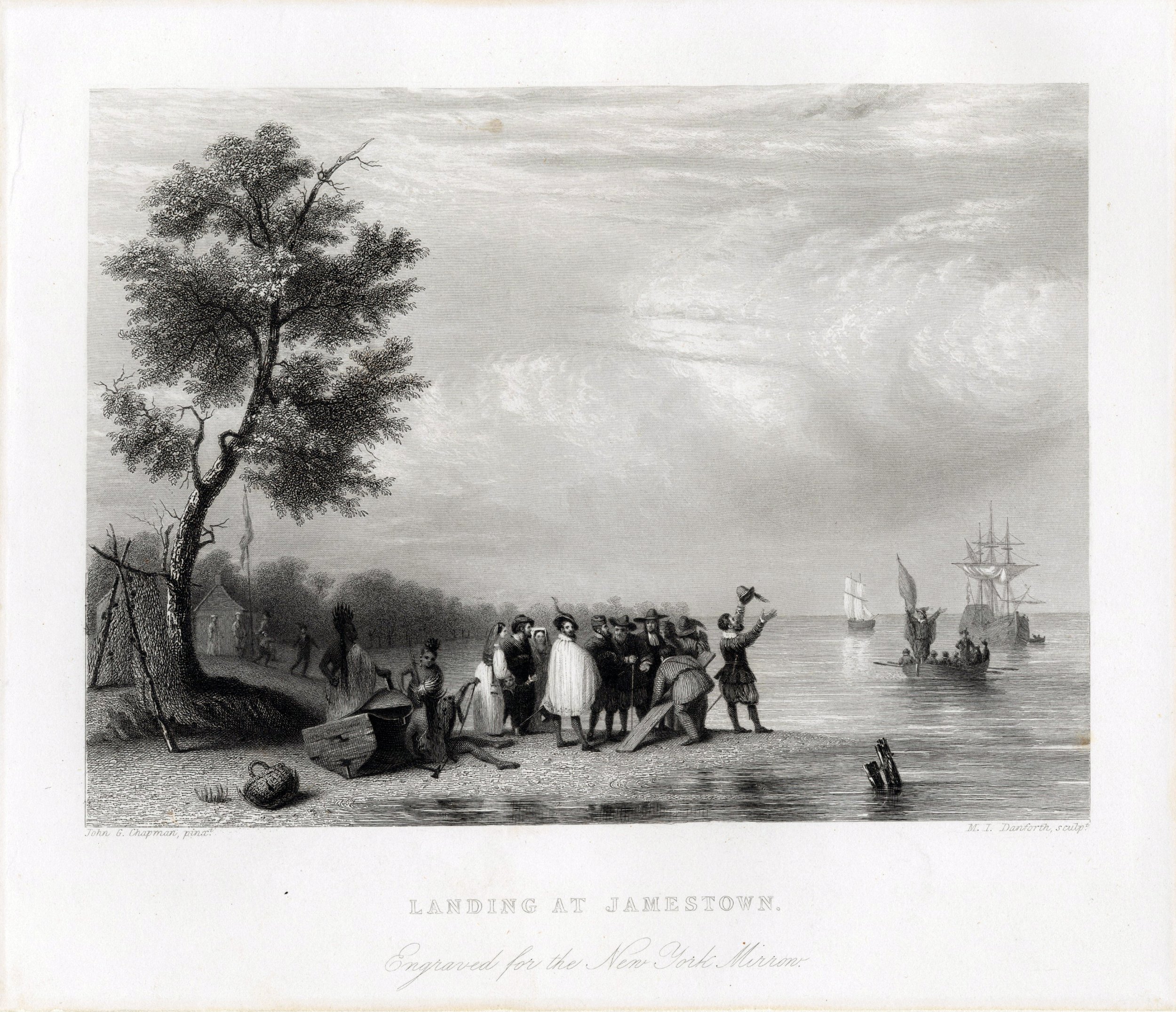
“Landing at Jamestown: engraving for the New York Mirror,” engraving by Moseley Isaac Danforth after John Gadsby Chapman, mid-nineteenth century (New York Public Library)
The winter of 1609–1610 became known as the “Starving Time.” Cut off from adequate food and surrounded by hostile Powhatan forces, the colonists suffered catastrophic losses; only about sixty of several hundred settlers survived. In May 1610, Sir Thomas Gates and other survivors of the Sea Venture, which had been wrecked in Bermuda while carrying reinforcements to Virginia, finally reached Jamestown. Finding the colony in desperate condition, Gates decided to abandon it. The settlers had begun sailing down the James River when they encountered a relief fleet commanded by Lord De La Warr, Virginia’s new governor, and returned to Jamestown. During the following months the colony was reorganized, resupplied and placed under stricter military discipline, but it remained fragile.[17]
The arrival of Dale and his ships marked a turning point in the colony. He ordered crops to be planted, livestock to be raised and goods to be manufactured. To impose greater discipline, Dale enforced the civil orders introduced by Sir Thomas Gates and Lord De La Warr in 1610 and, on June 22, 1611, added a detailed military code for the colony's soldiers. These regulations were published together the following year as Lawes Divine, Morall and Martiall.
Clark later described the Virginia he encountered in considerable detail:[18]
“At the mouth of the said harbor, in one of these rivers, there are four fortifications on the north side, all on one bank, and that the first fort [Algernon Fort] is at the mouth of the river, where there are fifty persons settled, men and women, of whom forty are fit to bear arms, and that the fort is of palisades and timber, without stone or brick, and has seven pieces of artillery [...] and that the second fort is two-thirds of a league from there, and another at a distance of one musket-shot, and the fourth at another musket-shot, each having one cast-iron piece for defense against the Indians, and the principal settlement [Jamestown], where there is another fortification, is twenty leagues up the river from the first fort, and in it there are sixteen pieces, and it is also surrounded by palisades, and the houses of the settlement are all wood and the cannon of cast-iron like the rest, and ships of deep draft go up to the said settlement.”
Clark stated that within all of the settlements and fortifications, there were “1,000 persons, 600 of them fit to bear arms and the rest women, boys, and old men,” although this is generally considered to be an exaggerated number, which was likely closer to 500 persons.[19]
Point Comfort was strategically important because it guarded the entrance to the James River and, therefore, access to the colony’s principal settlements farther inland. Dale considered the position important enough that he proposed strengthening its fortifications in order to “hold open the mouth of our River to lett shipping into us.”[20]
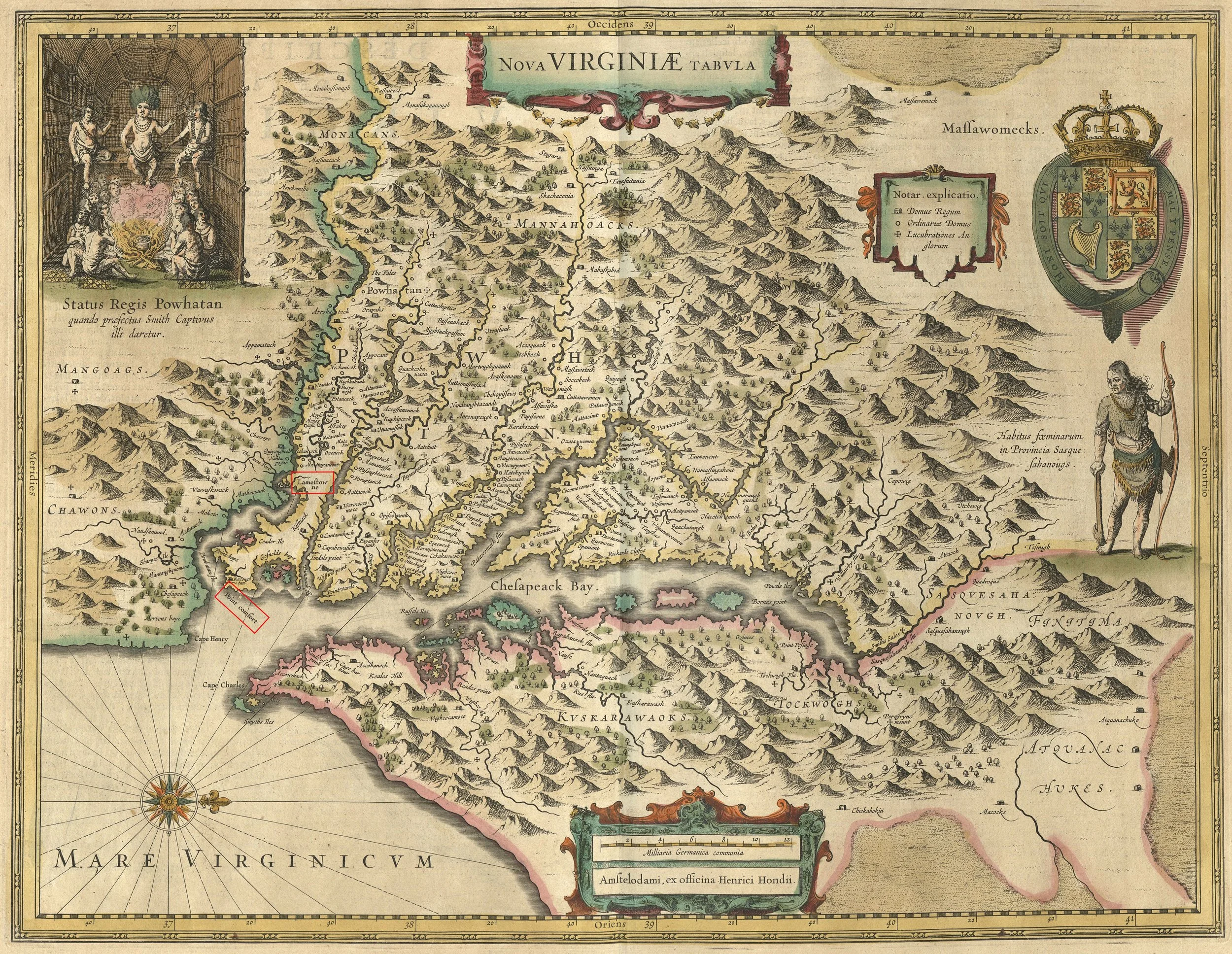
“New Virginia Map,” 1630 atlas map published by Hendricus Hondius (David Rumsey Map Collection)
John Clark’s time in the colony would be cut short after about forty days, when a Spanish ship arrived at Point Comfort around June 27, 1611 (the exact date is uncertain).[21] At the time of the encounter, Clark had come down from Jamestown with a barge carrying flour to provision the English garrisons at Point Comfort.[22]
Spain had been watching the English settlement in Virginia with concern almost from its founding. Officials feared that the colony could threaten Spain’s territorial claims and, potentially, its shipping and possessions in the Americas. Although some advisers urged King Philip III to destroy the settlement, the king initially chose instead to gather intelligence. Spain conducted a reconnaissance in 1609, and when the Virginia enterprise appeared to revive in late 1610, officials decided that further information was needed about the colony’s strength and fortifications. In 1611, Captain Diego de Molina and Ensign Marco Antonio Pérez were therefore sent aboard the caravel Nuestra Señora del Rosario to “reconnoitre” Virginia, under the pretext that they were searching for artillery from a wrecked Spanish ship.[23]
When the Spanish vessel reached Point Comfort, Molina, Pérez, and Francisco Lembri, an English pilot in Spanish service, went ashore and were seized by the English. Clark was then sent out to the Spanish caravel to pilot it closer to the fort. The Spanish master, suspicious when his companions were not returned, refused to come ashore. When Clark was taken back toward the caravel, he apparently realized that he too was becoming a prisoner and attempted to throw himself into the sea; he was restrained and prevented from calling out to those on shore. The following day, the Spaniards brought Clark back toward land in an attempt to exchange him for Molina and his companions. When the Spanish master threatened to fight unless Molina and his companions were released, Captain James Davis reportedly told him to “go to the Devil.” Clark again tried to escape into the water, but was prevented from doing so. When the English still refused to release the Spanish prisoners, and another vessel was seen approaching from farther up the river, the Spanish crew abandoned the negotiations and sailed for Havana with Clark aboard.[24]
In an August 17, 1611, letter to Robert Cecil, 1st Earl of Salisbury, Dale emphasized the danger posed by the incident:[25]
“What may be the daunger of this unto us, who are here so few, so weake, and unfortified, since they have by this meanes sufficiently instructed themselves concerning our just height and seate, and know the readie way unto us both by this discoverer, and by the help likewise of our owne Pilott, I refer me to your owne honorable knowledg.”
Prisoner in Havana
By July 23, 1611, Clark was in Havana, where he was ordered confined “in a safe place, where he could not communicate with anyone,” particularly other Englishmen. That day, he was interrogated with the assistance of John “Lak,” another English prisoner who served as interpreter.
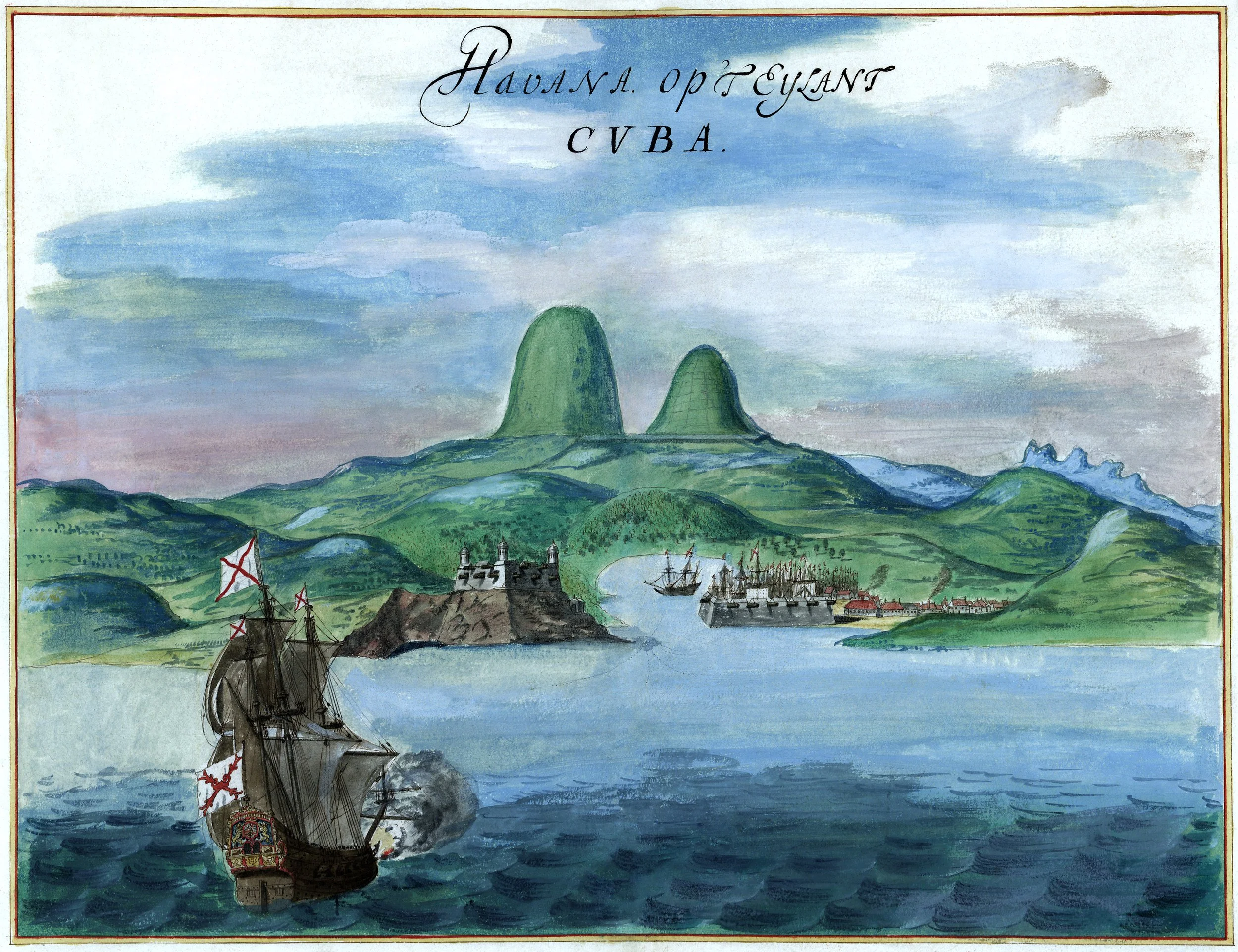
Havana Harbour, 1639 watercolour by Johannes Vingboons (Wikimedia Commons)
Clark identified himself as a 35-year-old pilot, a native of London and “of the same religion as his King.” He then provided the Spanish authorities with a considerable amount of intelligence about Virginia. He described the route he had sailed from England, the approaches and soundings of Chesapeake Bay, the colony’s forts and artillery, its population and military strength, the ships then in Virginia, its supplies and trade, and its sometimes-hostile relations with the Indigenous population. He also reported that Sir Thomas Gates was expected to arrive in August with four additional ships carrying colonists and livestock.
Some of the figures Clark supplied appear to have been exaggerated. Wright considered his estimate of the colony’s population too high, while Brown noted that he also overstated its military strength and the tonnage of some of its ships. Whether this was deliberate is impossible to know, although presenting Virginia as more formidable than it actually was would have been to the colony’s advantage. Clark also reported that the English had searched for gold and silver but had found none.
The Spaniards took Clark’s information seriously. His account of the harbour, coastline and navigational conditions was compared with the testimony of the Spanish master, pilot and sailor in the presence of Governor Gaspar de Pereda and chief pilot Caspar de Vargas, using charts and compasses. According to the report, Vargas was particularly satisfied with Clark’s information. The examination was later repeated before the Marqués de Salinas, president of the Council of the Indies, and Licentiate Maldonado de Torres; the witnesses remained consistent in their statements.
Clark’s value to the Spanish went beyond the information he had already supplied. During the unsuccessful negotiations for his exchange at Point Comfort, he had described himself as “the chief Pilot of the English in that Bay and the coast of Xacan.” Whether this was an official title or simply Clark’s description of his own importance is unclear, but his knowledge of the Chesapeake and its approaches plainly made him a useful prisoner.
Spanish officials therefore decided that Clark should remain in Havana, isolated from other Englishmen. Their report gives two possible uses for him: he could be exchanged for Spanish prisoners held by the English, or he might himself “be used as a pilot for anything that might present itself and might be undertaken.”[26]
From Havana to Madrid
While Clark remained confined in Havana, his capture had become the subject of diplomatic negotiations between England and Spain. By early November 1611, Spanish authorities had learned that Molina, Pérez, and Lembri were still being held in Virginia. Over the following weeks, King Philip III, the Duke of Lerma and the Spanish ambassador in London pressed for their release, while Sir John Digby, the English ambassador in Spain, corresponded with English officials about Clark. Salisbury eventually informed the Spanish ambassador that the three prisoners in Virginia would be returned once the English pilot was released.[27]
Clark therefore became, in effect, a bargaining chip in the negotiations. On January 6, 1612, Philip III ordered that “the Virginia Pilot, who is in the Havannah” be brought to Spain so that he could be surrendered when the Spanish prisoners were returned.[28] The exchange was not quickly accomplished, however. Clark remained a prisoner for much of 1612 before being transferred across the Atlantic; surviving Spanish records place him in Seville by December of that year and in Madrid by February 1613. There, his imprisonment and interrogation would continue.
On February 18, 1613, Clark was interrogated in Madrid by Don Francisco de Texada, a member of His Majesty’s Royal Council of the Indies and its Council for War in the Indies. Clark, who was then in the custody of Captain Don Alonso Flores, was placed under oath before being questioned. He gave his name as Juan Clarque and described himself as an inhabitant of London. When asked whether he was a Roman Catholic, he replied that he was.[29]
Clark said that he was a pilot by profession and had followed that occupation for four years. Before that, he explained, he had already acquired experience at sea, having “sailed in different parts of the world” for four years. He once again detailed his voyage from London to Virginia, the journey from Point Comfort to Jamestown, and the events surrounding his capture by the Spanish. His answers demonstrate considerable practical knowledge of navigation: he described the currents and variation of the compass encountered on the Atlantic crossing, the approaches to Chesapeake Bay, the depths and anchorages around Point Comfort, and the navigability of the James River.[30]
When asked to describe Jamestown, Clark’s account differed somewhat from the one he had given in Havana. He now estimated that there were about 1,000 men capable of bearing arms—merchants, soldiers, and labourers—along with only thirty women, living in approximately 100 wooden houses. He said that Jamestown was defended by about sixteen pieces of artillery, ten of them heavy, and that the fortifications at Point Comfort and nearby were protected by stout, closely joined palisades. Some of the Indigenous people, he said, were friendly to the English and others were not. As before, he identified timber and sassafras as the principal commodities being shipped to England, while flour, munitions, and livestock were brought into Virginia.[31]
The Spanish also questioned Clark about the purpose and strategic value of the colony. He said he understood that the English had been settling Virginia for about six years and that their purposes were “to acquire land and build ships.” He added that Virginia was situated so that ships could reach the Windward Islands within fifteen days at most. Asked about the return voyage to England, Clark estimated that it took about a month and described the usual Atlantic route by way of the Azores.[32]
Clark also confirmed that the 1611 expedition had been his first voyage to Virginia and that he had spent only about forty days there before his capture. He recalled finding another ship of about 150 tons preparing to sail for England with timber and sassafras. When asked what he thought had happened to Molina and the other Spaniards left behind in Virginia, Clark replied that he was certain they would not have been badly treated, “because the English do not ill-treat prisoners.”[33]
Finally, Clark was asked his age. He now said that he was forty years old and signed the deposition with his own name, “JOHN CLARK.”[34] Both answers raise interesting questions when compared with his Havana interrogation eighteen months earlier. In July 1611, he had given his age as thirty-five and described himself as being “of the religion of his King”; in Madrid, he claimed to be forty and a Roman Catholic. Whether Clark had genuinely converted to Catholicism during his captivity, was simply giving his interrogators the answer most advantageous to him, or whether one of the records was inaccurate cannot now be determined.
Clark’s circumstances in Madrid appear to have changed abruptly at about the same time. On February 18, the very day of his interrogation, English ambassador Sir John Digby reported that Clark, who had previously been treated well and allowed some liberty while accompanied by a keeper, had been “clapped up into close prison.” The change appears to have been connected to the continuing dispute over the Spanish prisoners in Virginia and to renewed Spanish deliberations over the English colony itself.[35]
By May, Clark was clearly being used as leverage in the negotiations. Digby reported that Spanish officials had concluded that the Virginia settlement ultimately “must bee remooved,” although they intended to postpone action until they had obtained better information about its condition. At the same time, Clark remained in close confinement in the hope that his friends would press for the release of Molina and the other Spanish prisoners. Digby had even heard that the Spaniards intended to send Clark to the galleys. Their object, he explained, was to recover the men held in Virginia, from whom they hoped to obtain more current intelligence about the colony.[36]
Release from Spanish Captivity
By January 1616, after more than four years in Spanish custody, Clark was finally released. The exchange had been under discussion since early 1612, but negotiations dragged on for several years. Of the three men originally left in English hands, Marco Antonio Pérez had died in captivity in Virginia, while Francis Lembri was eventually returned to England and was reportedly hanged by Sir Thomas Dale during the voyage home. Don Diego de Molina therefore became the principal Spanish prisoner involved in Clark’s eventual release.
On January 26, 1616, Sir John Digby certified that Clark had been safely delivered into his custody and was then “freely in his house,” able to go wherever he pleased. Molina was not to be surrendered to the Spanish ambassador in London until the English had received confirmation that Clark was free. In June, Antonio da Costa presented Digby’s certificate to the English Privy Council as proof that Clark had been released. After nearly five years, the captivity that had begun with Clark’s seizure at Point Comfort in 1611 was finally over.[37]
Clark appears to have quickly returned to his former occupation. A later record of the Virginia Company recalled that, following his captivity, he had performed "good service in many voyages to Virginia," although the individual voyages are not identified. By 1619, he was in Ireland buying cattle on the Company's behalf, and early the following year he sailed for Virginia aboard the Falcon, a 150-ton vessel carrying livestock, a voyage still reckoned within 1619 by contemporaries, since the calendar year did not turn over until March 25. The following June, while preparations were underway for the Pilgrims' departure, Robert Cushman reported that they had hired "another pilote here, one Mr. Clarke, who went last year to Virginia with a ship of Kine," a reference historians have linked to the Falcon voyage, as it was the only cattle ship to sail in that period. Clark's previous experience in Virginia and repeated Atlantic crossings would have made him an obvious asset for the voyage that followed.[38]
Pilot of the Mayflower
The voyage on which John Clark was about to embark had its origins several years earlier among a congregation of English Separatists living in Leiden in the Netherlands. Having fled religious persecution in England, they had found freedom to worship in Holland, but life there was difficult. Future Governor of Plymouth Colony and Pilgrim William Bradford later recalled the long hours and economic hardship endured by the community, the advancing age of many of its members, and fears that their children were being drawn away from their families and faith. They also hoped to establish a new community where they might help to “propagate and advance” the Christian gospel. By 1617, they had begun planning a settlement in America. They ultimately arranged to establish a separate colony within the territory of the Virginia Company and secured financial backing from a group of English merchants called the London Adventurers, who would provide the ships, supplies and other necessities for the undertaking. The Mayflower was chartered in England for the voyage in June 1620, which was intended to carry the first group of settlers to establish the new colony.[39]
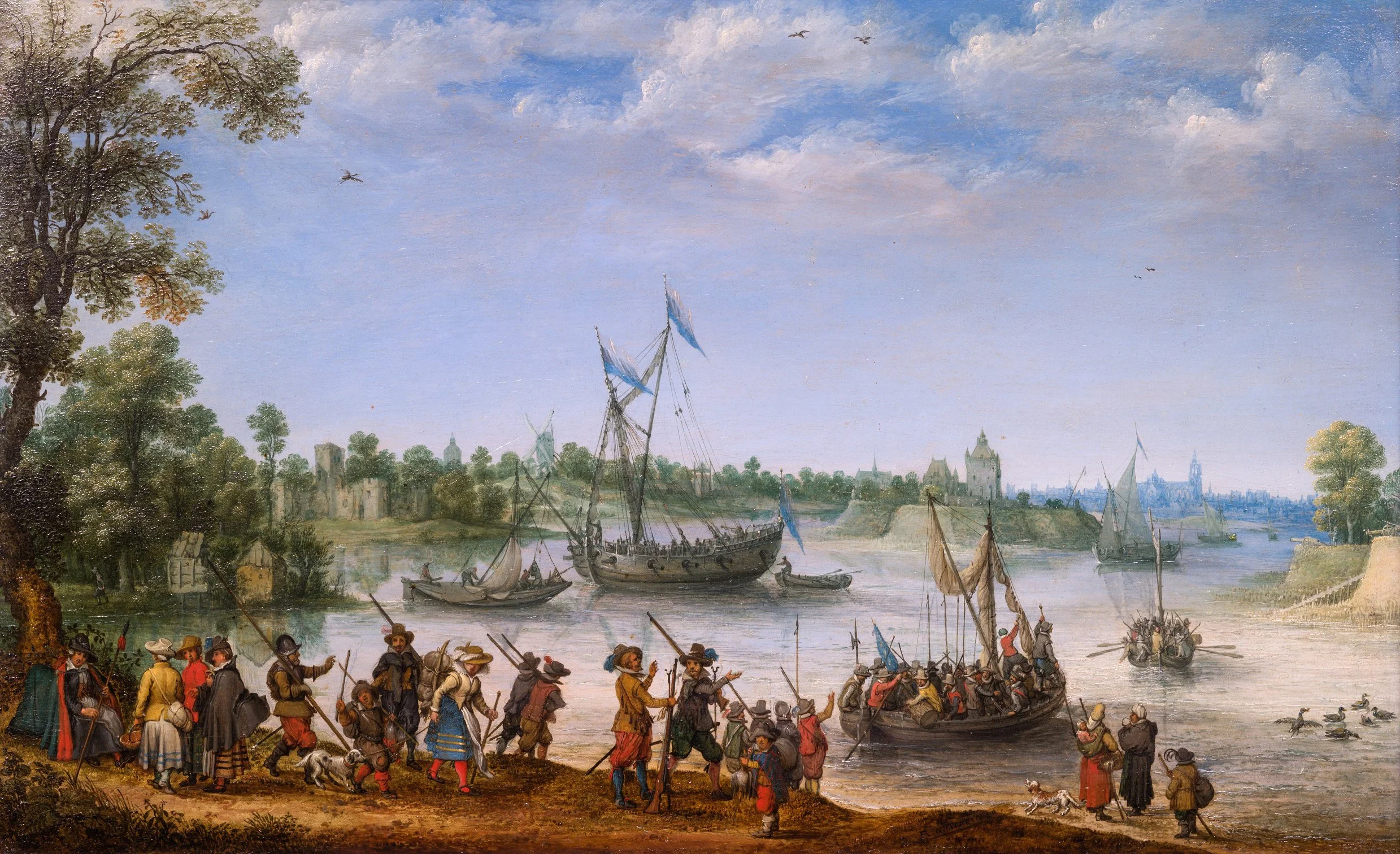
“The Departure of the Pilgrim Fathers from Delfshaven on Their Way to America,” oil painting by Adam Willaerts, 1620 (Museum of Fine Arts, Boston)
Christopher Jones was hired to command the ship as master, with John Clark serving as master’s mate or pilot, Robert Coppin as second mate, and Giles Heale as the ship’s surgeon. On board were 102 passengers, along with their provisions and personal belongings.[40]
As the ship’s master’s mate and pilot, Clark would have been one of the Mayflower’s senior seamen, assisting Captain Jones with the navigation and handling of the ship. Contemporary descriptions of a mate’s duties included helping to determine the vessel’s course, supervising the sailors as they steered and adjusted the sails, and sharing responsibility for the safe working of the ship. As pilot, Clark’s expertise would have been particularly important when approaching land: pilots were expected to recognize coasts and hazards, take soundings to determine water depth, and guide a vessel through unfamiliar coastal waters and into safe anchorages. His previous experience sailing to Virginia would therefore have been especially valuable on a voyage originally intended to end in the northern part of the Virginia Company’s territory.[41]
After earlier attempts to sail with the smaller ship Speedwell were abandoned because of persistent leaks, the Mayflower left Plymouth, England, alone on September 6, 1620. The voyage lasted 66 days. Fair weather at first gave way to strong winds and severe storms that left the ship’s upper works leaking and cracked one of the main beams amidships. The damage was repaired with a large iron screw carried by the passengers, allowing the voyage to continue. During another storm, passenger John Howland was swept overboard but managed to grasp a trailing line and was pulled back aboard. Only one passenger, William Butten, died during the crossing. When Cape Cod was sighted in November, the crew initially attempted to sail south toward the Hudson River, where the colonists had intended to settle, but dangerous shoals and worsening conditions forced them to turn back. The Mayflower entered Cape Cod Harbor on November 11, 1620.[42]
Before anyone went ashore, forty-one of the male passengers signed an agreement that became known as the Mayflower Compact, establishing a civil government for the proposed settlement. As a member of the ship’s crew rather than one of the colonists, Clark was not among its signatories.[43]
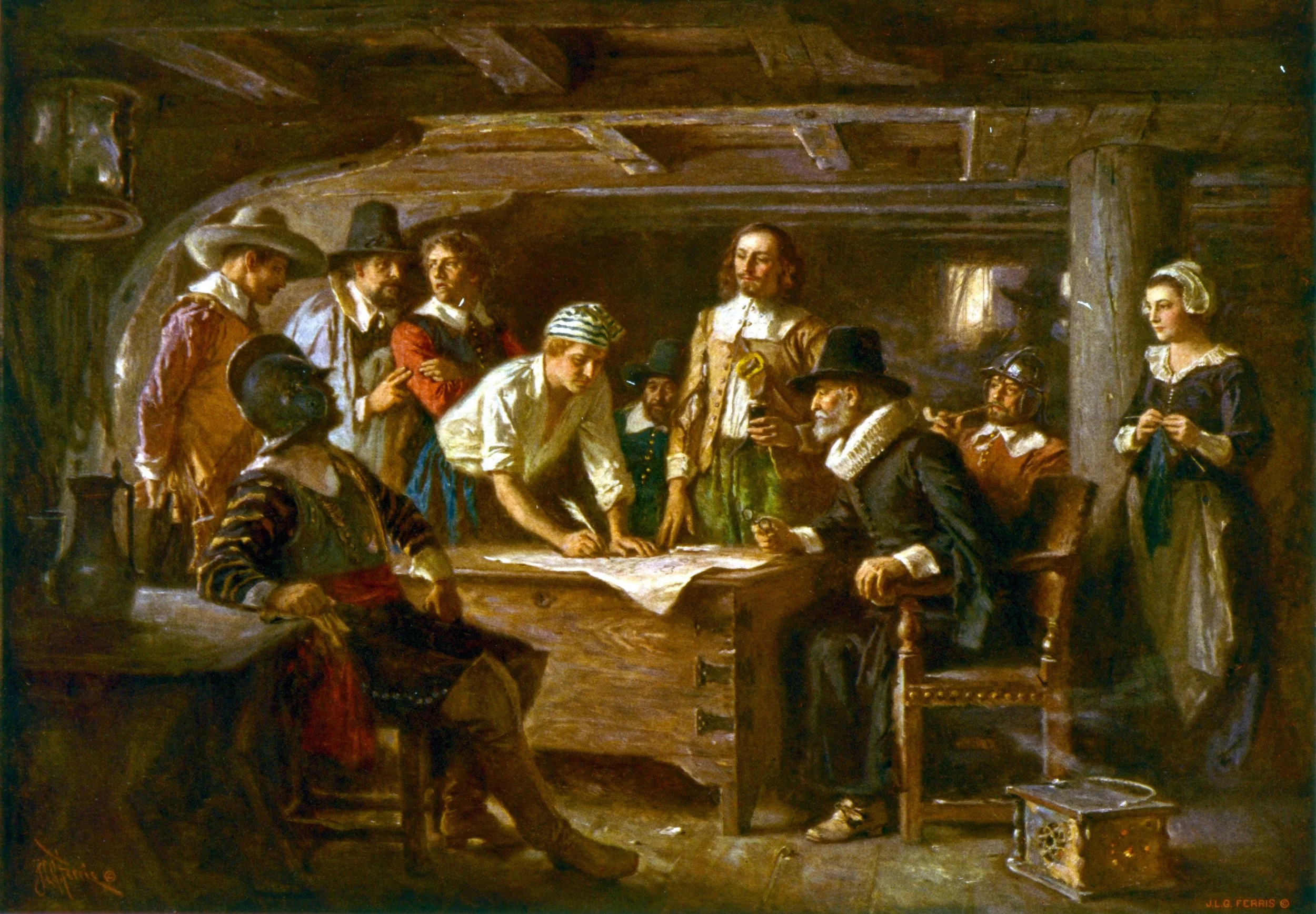
“Signing the Mayflower Compact 1620,” 1899 painting by Jean Leon Gerome Ferris (Wikimedia Commons)
After the Mayflower anchored in Cape Cod Harbor, several men went ashore to search for a suitable settlement. Clark does not emerge in the historic record until the third exploring expedition, which left in a shallop on December 6, during bitter winter conditions. Aboard the small boat were colonists Miles Standish, John Carver, William Bradford, Edward Winslow, John Tilley, Edward Tilley, John Howland, Richard Warren, Stephen Hopkins, and Edward Doty; two seamen, John Alderton and Thomas English; Clark, Coppin, a master gunner, and three sailors.[44]
The expedition departed in the open boat, drenched with rain and salt water spray. They sailed along the shore for two days, from Provincetown to Truro, from Truro to Wellfleet, then from Wellfleet to Eastham. They saw a group of Indigenous people on shore, harvesting what was likely a pilot whale. The encounter came after earlier exploration parties from the Mayflower had taken stored corn and other objects from Native sites on Cape Cod, although the colonists recorded their intention to repay the owners. The crew slept on bare ground at night, in freezing conditions, surrounding themselves with a circular barricade of tree trunks and branches. On the third morning, as they were getting ready to leave their campsite, the English party was attacked by a group of Nauset men. As one account puts it, “arquebus-shot and arrow flights were exchanged without harm to either party,” in an incident that became known as the “First Encounter.”[45]
“From this point they sailed along the coast for fifteen leagues, on Friday [December 8], and, seeing no good harbor, stood on in search of that which Coppin said he knew. The day was stormy; in the course of it the rudder of the boat was unshipped, and, before they made land on the other side of the bay, she carried away her mast, split her sail, and was near being lost altogether. At nightfall they reached and landed upon an island, since known as Clark's Island, because Clark, the Mayflower’s chief mate, was the first to step ashore. The next day, the 9th, they explored the island, and on Sunday, the 10th, they rested, as men would be sure to rest who, on week-days, never forgot, under any circumstances, to ask in outspoken prayer the blessing of God upon their labors.”[46]
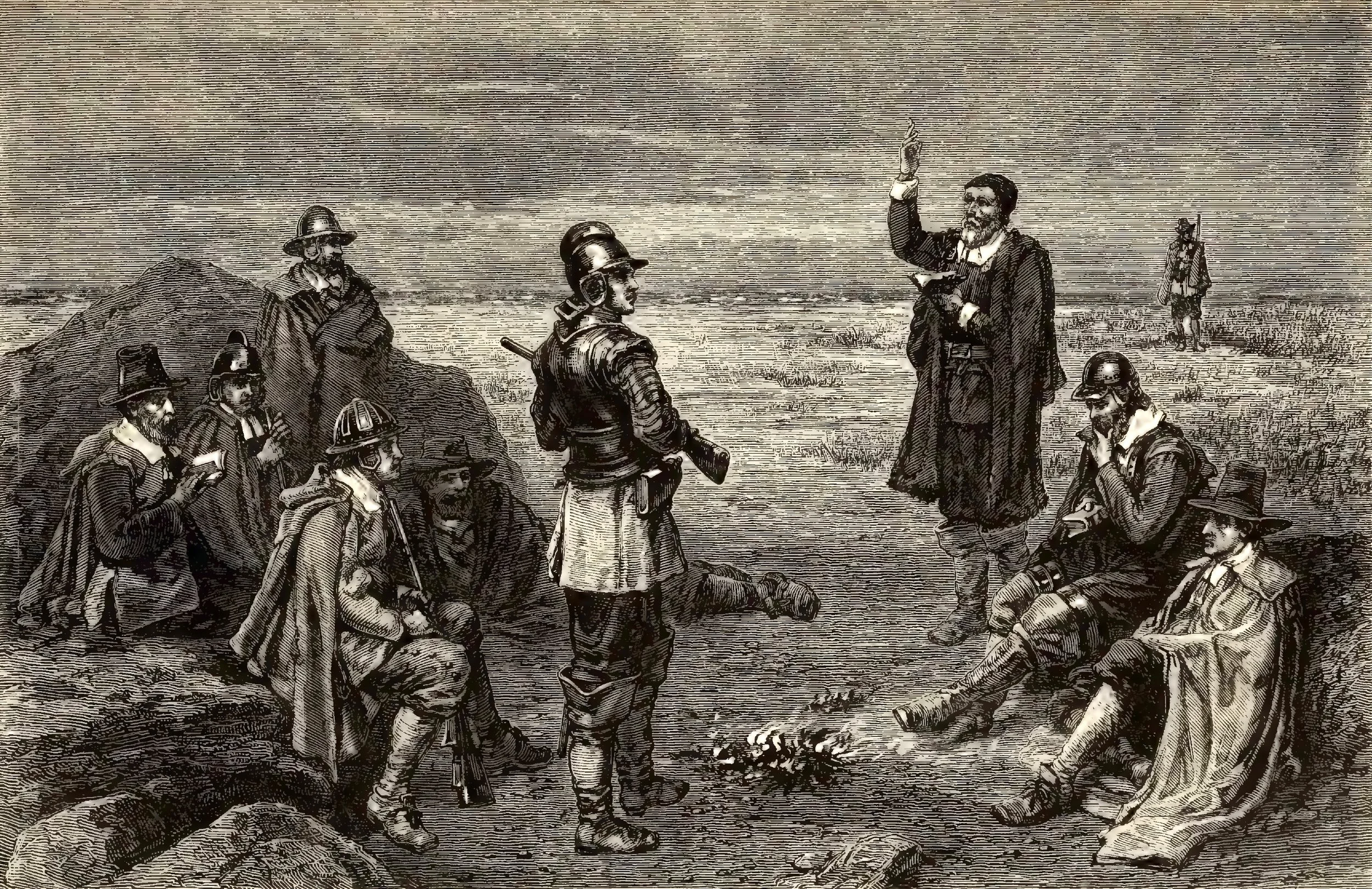
“The Sabbath on Clark’s Island,” in William Cullen Bryant and Sydney Howard Gay’s A Popular History of the United States
After spending the Sabbath on the island, the exploration party continued into Plymouth Harbor on December 11. They sounded the harbour and went ashore, finding cleared fields, several freshwater streams, and what they considered “a place very good for situation.” They then returned across Cape Cod Bay to the Mayflower with news of what they had found.[47]
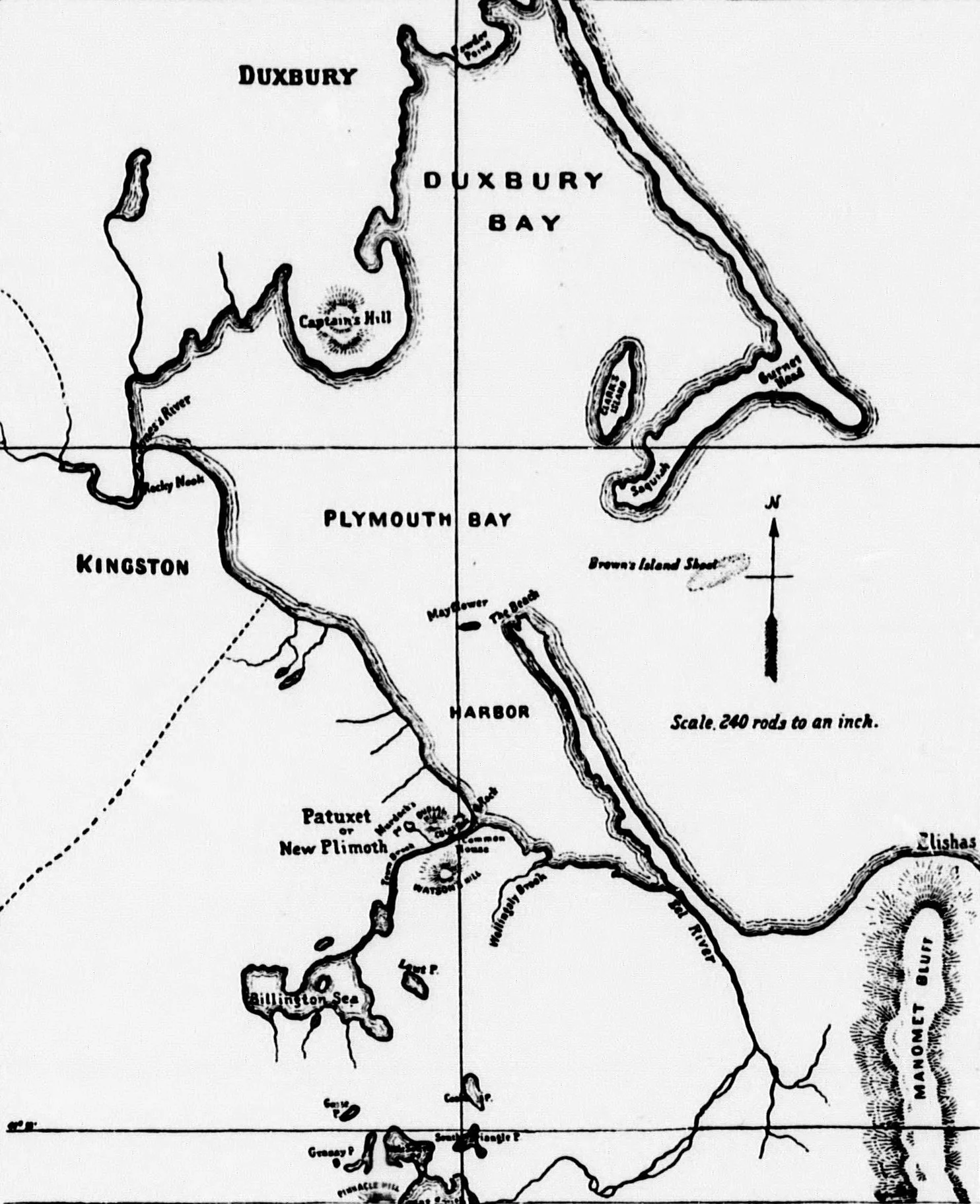
Plymouth Harbor, from Justin Winsor, ed., in Narrative and Critical History of America
The Mayflower attempted to sail for the newly discovered harbour on December 15, but high winds forced it back. The following day it entered Plymouth Harbor safely. Over the next several days, further parties explored the surrounding coastline and waterways. A river later named Jones River in honour of Captain Christopher Jones was considered as a possible settlement site but rejected. The colonists eventually chose a tract of already-cleared land beside a freshwater brook, overlooked by a hill suitable for mounting their artillery.[48]
The land they selected was the site of the former Wampanoag village of Patuxet, although the newcomers did not yet know its Indigenous name. Once a thriving community, Patuxet had been devastated by the epidemic that swept coastal New England between 1616 and 1619.[49]
The Mayflower moved from Cape Cod Harbor into Plymouth Harbor on December 16, 1620. The passengers then began building ashore, while many continued sleeping aboard the ship during the winter. Disease swept through both colonists and crew. About half of the colonists died, while the Mayflower also lost many of its sailors and officers, including its boatswain, gunner, three quartermasters, and cook. Captain Jones delayed the return voyage until his surviving men had recovered sufficiently to put to sea.[50]
Pilgrim William Bradford wrote, “But that which was most sadd & lamentable was, that in 2. or 3. moneths time halfe of their company dyed, espetialy in Jan: & February, being ye depth of winter, and wanting houses & other comforts; being infected with ye scurvie & other diseases, which this long vioage & their inacomodate condition had brought upon them; so as ther dyed some times 2. or 3. of a day, in ye foresaid time; that of 100. & odd persons, scarce 50. remained. And of these in ye time of most distres, ther was but 6. or 7. sound persons, who, to their great comendations be it spoken, spared no pains, night nor day, but with abundance of toyle and hazard of their owne health, fetched them woode, made them fires, drest them meat, made their beads, washed their lothsome cloaths, cloathed & uncloathed them; in a word, did all ye homly & necessarie offices for them wch dainty & quesie stomacks cannot endure to hear named; and all this willingly & cherfully, without any grudging in ye least, shewing herein their true love unto their friends & bretheren. A rare example & worthy to be remembred. Two of these 7. were Mr. William Brewster, ther reverend Elder, & Myles Standish, ther Captein & military comander, unto whom my selfe, & many others, were much beholden in our low & sicke condition.”[51]
The Mayflower remained in Plymouth Harbor until April 5, 1621, when Captain Jones and the surviving crew sailed back to England, evidently with John Clark aboard.
After the Mayflower
The Mayflower returned to England on May 6, 1621. Clark resumed his association with the Virginia Company. At a meeting of the Company on February 13, 1622, officials recalled that since his Spanish captivity he had performed “good service in many voyages to Virginia” and had recently travelled to Ireland in connection with the transportation of cattle to the colony. Clark was deemed “an humble suitor to this court, that he might be admitted a free brother of the companie, and have some shares of land bestowed upon him.” Clark was admitted as a free member of the Company and awarded two shares. The grant not only recognized his years of service but gave him a personal stake in the Virginia enterprise.[52]
John Clark returned to Virginia in 1623, although it is uncertain which ship he sailed on: the Providence or the Guidance (sources differ).[53]
Clark did not live long after his return to Virginia. By early February 1623/24, he was dead. A petition presented to Governor Sir Francis Wyatt by John Barnett described the deceased as “John Clarke of London Mariner” and stated that Daniel Gookin and John Ewing had hired him as pilot of the Guidance of Bristol. Clark had successfully brought the vessel into Virginia but was still owed £48 for twelve months' wages. Barnett asked that the money be paid for the benefit of Clark's widow, who had been left “in great distresse & misery” with “a great Charge of poore Children.” Significantly, the petition also recalled the losses Clark had previously suffered through Virginia, specifically his having been “Caried away in a spanish Caruell.” The reference leaves little doubt that the deceased mariner was the same John Clark whose Spanish captivity had begun at Point Comfort twelve years earlier.[54]
The circumstances of John Clark’s death remain unknown. Some later accounts have associated his death with conflict between the English colonists and the Powhatan peoples. He cannot, however, have been killed in the major coordinated attack of March 22, 1622, in which 347 English colonists were reported killed, because surviving records place him returning to Virginia in 1623. Clark apparently died in Virginia at some point following his return. Although armed conflict continued during 1623, no contemporary evidence located to date identifies Clark as a casualty of an Indigenous attack. Disease, food shortages, and other causes of death were also widespread in the colony, so the circumstances of his death cannot presently be determined.
The End of a Mariner’s Story
John Clark’s life was shaped by the dangerous and rapidly expanding Atlantic world of the early seventeenth century. A professional pilot, he sailed to Virginia, survived nearly five years of Spanish captivity, returned to transatlantic service, and in 1620 helped guide the Mayflower to New England. His later work for the Virginia Company and final return to Virginia show that the Mayflower voyage was only one episode in a much longer maritime career.
Much about Clark remains uncertain, particularly his family origins and private life, but the surviving records reveal an experienced seaman whose skills repeatedly placed him at the centre of important events. From Point Comfort to Havana, Madrid, Plymouth, and Virginia, his career connected some of the most significant English colonial ventures of his generation.
Sources:
[1] Irene A. Wright, "Spanish Policy Toward Virginia, 1606-1612; Jamestown, Ecija, and John Clark of the Mayflower," American Historical Review 25, no. 3 (April 1920): 455, digitized by JSTOR (https://www.jstor.org/stable/1836882 : accessed 24 August 2026).
[2] "England Marriages, 1538–1973", FamilySearch (https://www.familysearch.org/ark:/61903/1:1:NJ8N-BLJ : accessed 24 Aug 2026), marriage of John Clarke and Mary Mowton, 19 Feb 1598, Stepney, Middlesex, England, United Kingdom.
[3] John Insley Coddington, “The Widow Mary Ring, of Plymouth, Mass., and Her Children,” The American Genealogist 42 (1966): 193–205
[4] "England, Middlesex, Parish Registers, 1539-1988", FamilySearch (https://www.familysearch.org/ark:/61903/1:1:66J9-ZZL1 : accessed 24 Aug 2026), baptism of Thomas Clarke (son of John Clarke), 8 Mar 1599, Middlesex, England.
“London, England, Church of England Baptisms, Marriages and Burials, 1538-1812,” digital images, Ancestry.ca (https://www.ancestry.com/imageviewer/collections/1624/images/31280_194793-00079?pId=553522 : accessed 25 Aug 2026), baptism of Thomas Clark, 8 Mar 1599, St Dunstan and All Saints, Stepney, Tower Hamlets, Middlesex, England, reference 17555659, additional reference number 172724; citing original data: London Metropolitan Archives; London, England, UK; London Church of England Parish Registers; Reference Number: P93/DUN/255.
[5] John Insley Coddington, “The Widow Mary Ring, of Plymouth, Mass., and Her Children,” The American Genealogist 42 (1966): 193–205
[6] John Insley Coddington, “The Widow Mary Ring, of Plymouth, Mass., and Her Children,” The American Genealogist 42 (1966): 193–205
[7] Library of Congress, The Records of the Virginia Company of London, Volume III, Documents, 1, edited by Susan Myra Kingsbury (Washington, Government Printing Services, 1933), 456-457, digitized by FamilySearch (https://www.familysearch.org/ark:/61903/3:1:3QS7-L9CL-TFPL?lang=en : accessed 25 Aug 2026).
[8] Donald Lines Jacobus, “Thomas Clark(e) of Plymouth and Boston in the Line of Nathaniel³ of Lyme, Connecticut,” The American Genealogist, volume 47 (1971): 3–16.
[9] Jean Rumsey, “Thomas Clarke—Some Extra Bits and Pieces,” The American Genealogist, volume 49 (1973): 143–149.
[10] John G. Hunt, “Origin of Three Early Plymouth Families: Cole, Collier, and Clarke,” The American Genealogist, volume 42 (1966): 119–121.
[11] Irene A. Wright, "Spanish Policy Toward Virginia, 1606-1612; Jamestown, Ecija, and John Clark of the Mayflower," American Historical Review 25, no. 3 (April 1920): 455, digitized by JSTOR (https://www.jstor.org/stable/1836882 : accessed 24 August 2026).
[12] Irene A. Wright, "Spanish Policy Toward Virginia, 1606-1612; Jamestown, Ecija, and John Clark of the Mayflower," American Historical Review 25, no. 3 (April 1920): 476-477, digitized by JSTOR (https://www.jstor.org/stable/1836882 : accessed 24 August 2026).
[13] Martha W. McCartney, Documentary History of Jamestown Island; Volume III: Biographies of Owners and Residents (Williamsburg, Virginia, 2000), 82.
[14] Alexander Brown, The First Republic in America: An Account of the Origin of this Nation, Written from the Records Then (1624) Concealed by the Council, Rather Than from the Histories Then Licensed by the Crown (Houghton, Harvard University, 1898), 149, digitized by Google (https://books.google.ca/books?id=JcWKBTb8X90C&dq : accessed 25 Aug 2026).
[15] Alexander Brown, The First Republic in America: An Account of the Origin of this Nation, Written from the Records Then (1624) Concealed by the Council, Rather Than from the Histories Then Licensed by the Crown (Houghton, Harvard University, 1898), 149, digitized by Google (https://books.google.ca/books?id=JcWKBTb8X90C&dq : accessed 25 Aug 2026).
[16] Alexander Brown, The genesis of the United States; a narrative of the movement in England, 1605-1616, which resulted in the plantation of North America by Englishmen, disclosing the contest between England and Spain for the possession of the soil now occupied by the United States of America; set forth through a series of historical manuscripts now first printed together with a reissue of rare contemporaneous tracts, accompanied by bibliographical memoranda, notes, and brief biographies (Boston, Houghton Mifflin, 1890), 506-507, digitized by Archive.org (https://archive.org/details/genesisofuniteds01brow : accessed 3 Sep 2026).
[17] Brendan Wolfe, “Early Jamestown Settlement,” Encyclopedia Virginia (https://encyclopediavirginia.org/entries/jamestown-settlement-early/ : accessed 28 Aug 2026).
[18] Irene A. Wright, "Spanish Policy Toward Virginia, 1606-1612; Jamestown, Ecija, and John Clark of the Mayflower," American Historical Review 25, no. 3 (April 1920): 470-471, digitized by JSTOR (https://www.jstor.org/stable/1836882 : accessed 24 August 2026).
[19] Irene A. Wright, "Spanish Policy Toward Virginia, 1606-1612; Jamestown, Ecija, and John Clark of the Mayflower," American Historical Review 25, no. 3 (April 1920): 471, digitized by JSTOR (https://www.jstor.org/stable/1836882 : accessed 24 August 2026).
[20] Alexander Brown, The genesis of the United States; a narrative of the movement in England, 1605-1616, which resulted in the plantation of North America by Englishmen, disclosing the contest between England and Spain for the possession of the soil now occupied by the United States of America; set forth through a series of historical manuscripts now first printed together with a reissue of rare contemporaneous tracts, accompanied by bibliographical memoranda, notes, and brief biographies (Boston, Houghton Mifflin, 1890), 503, digitized by Archive.org (https://archive.org/details/genesisofuniteds01brow : accessed 4 Sep 2026).
[21] Alexander Brown, The First Republic in America: An Account of the Origin of this Nation, Written from the Records Then (1624) Concealed by the Council, Rather Than from the Histories Then Licensed by the Crown (Houghton, Harvard University, 1898), 152, digitized by Google (https://books.google.ca/books?id=JcWKBTb8X90C&dq : accessed 25 Aug 2026).
[22] Irene A. Wright, "Spanish Policy Toward Virginia, 1606-1612; Jamestown, Ecija, and John Clark of the Mayflower," American Historical Review 25, no. 3 (April 1920): 477, digitized by JSTOR (https://www.jstor.org/stable/1836882 : accessed 24 August 2026).
[23] Irene A. Wright, "Spanish Policy Toward Virginia, 1606-1612; Jamestown, Ecija, and John Clark of the Mayflower," American Historical Review 25, no. 3 (April 1920): 449-456, digitized by JSTOR (https://www.jstor.org/stable/1836882 : accessed 24 August 2026).
[24] Irene A. Wright, "Spanish Policy Toward Virginia, 1606-1612; Jamestown, Ecija, and John Clark of the Mayflower," American Historical Review 25, no. 3 (April 1920): 472, digitized by JSTOR (https://www.jstor.org/stable/1836882 : accessed 24 August 2026).
Alexander Brown, The genesis of the United States; a narrative of the movement in England, 1605-1616, which resulted in the plantation of North America by Englishmen, disclosing the contest between England and Spain for the possession of the soil now occupied by the United States of America; set forth through a series of historical manuscripts now first printed together with a reissue of rare contemporaneous tracts, accompanied by bibliographical memoranda, notes, and brief biographies (Boston, Houghton Mifflin, 1890), 516-517, digitized by Archive.org (https://archive.org/details/genesisofuniteds01brow : accessed 25 Aug 2026).
Alexander Brown, The First Republic in America: An Account of the Origin of this Nation, Written from the Records Then (1624) Concealed by the Council, Rather Than from the Histories Then Licensed by the Crown (Houghton, Harvard University, 1898), 152, digitized by Google (https://books.google.ca/books?id=JcWKBTb8X90C&dq : accessed 25 Aug 2026).
[25] Alexander Brown, The genesis of the United States; a narrative of the movement in England, 1605-1616, which resulted in the plantation of North America by Englishmen, disclosing the contest between England and Spain for the possession of the soil now occupied by the United States of America; set forth through a series of historical manuscripts now first printed together with a reissue of rare contemporaneous tracts, accompanied by bibliographical memoranda, notes, and brief biographies (Boston, Houghton Mifflin, 1890), 501-508, digitized by Archive.org (https://archive.org/details/genesisofuniteds01brow : accessed 25 Aug 2026).
[26] Martha W. McCartney, Documentary History of Jamestown Island; Volume III: Biographies of Owners and Residents (Williamsburg, Virginia, 2000), 82.
Alexander Brown, The genesis of the United States; a narrative of the movement in England, 1605-1616, which resulted in the plantation of North America by Englishmen, disclosing the contest between England and Spain for the possession of the soil now occupied by the United States of America; set forth through a series of historical manuscripts now first printed together with a reissue of rare contemporaneous tracts, accompanied by bibliographical memoranda, notes, and brief biographies (Boston, Houghton Mifflin, 1890), 511-522, digitized by Archive.org (https://archive.org/details/genesisofuniteds01brow : accessed 25 Aug 2026).
[27] Alexander Brown, The First Republic in America: An Account of the Origin of this Nation, Written from the Records Then (1624) Concealed by the Council, Rather Than from the Histories Then Licensed by the Crown (Houghton, Harvard University, 1898), 161, digitized by Google (https://books.google.ca/books?id=JcWKBTb8X90C&dq : accessed 25 Aug 2026).
[28] Alexander Brown, The First Republic in America: An Account of the Origin of this Nation, Written from the Records Then (1624) Concealed by the Council, Rather Than from the Histories Then Licensed by the Crown (Houghton, Harvard University, 1898), 163, digitized by Google (https://books.google.ca/books?id=JcWKBTb8X90C&dq : accessed 25 Aug 2026).
[29] Irene A. Wright, "Spanish Policy Toward Virginia, 1606-1612; Jamestown, Ecija, and John Clark of the Mayflower," American Historical Review 25, no. 3 (April 1920): 476, digitized by JSTOR (https://www.jstor.org/stable/1836882 : accessed 24 August 2026).
[30] Irene A. Wright, "Spanish Policy Toward Virginia, 1606-1612; Jamestown, Ecija, and John Clark of the Mayflower," American Historical Review 25, no. 3 (April 1920): 476-477, digitized by JSTOR (https://www.jstor.org/stable/1836882 : accessed 24 August 2026).
[31] Irene A. Wright, "Spanish Policy Toward Virginia, 1606-1612; Jamestown, Ecija, and John Clark of the Mayflower," American Historical Review 25, no. 3 (April 1920): 478, digitized by JSTOR (https://www.jstor.org/stable/1836882 : accessed 24 August 2026).
[32] Irene A. Wright, "Spanish Policy Toward Virginia, 1606-1612; Jamestown, Ecija, and John Clark of the Mayflower," American Historical Review 25, no. 3 (April 1920): 478-479, digitized by JSTOR (https://www.jstor.org/stable/1836882 : accessed 24 August 2026).
[33] Irene A. Wright, "Spanish Policy Toward Virginia, 1606-1612; Jamestown, Ecija, and John Clark of the Mayflower," American Historical Review 25, no. 3 (April 1920): 479, digitized by JSTOR (https://www.jstor.org/stable/1836882 : accessed 24 August 2026).
[34] Irene A. Wright, "Spanish Policy Toward Virginia, 1606-1612; Jamestown, Ecija, and John Clark of the Mayflower," American Historical Review 25, no. 3 (April 1920): 479, digitized by JSTOR (https://www.jstor.org/stable/1836882 : accessed 24 August 2026).
[35] Alexander Brown, The Genesis of the United States; v 2 (Boston, Houghton, 1890), 607, digitized by Archive.org (https://archive.org/details/TheGenesisOfTheUnitedStates : accessed 25 Aug 2026).
[36] Alexander Brown, The Genesis of the United States; v 2 (Boston, Houghton, 1890), 635, digitized by Archive.org (https://archive.org/details/TheGenesisOfTheUnitedStates : accessed 25 Aug 2026).
[37] Alexander Brown, The First Republic in America: An Account of the Origin of this Nation, Written from the Records Then (1624) Concealed by the Council, Rather Than from the Histories Then Licensed by the Crown (Houghton, Harvard University, 1898), 234, digitized by Google (https://books.google.ca/books?id=JcWKBTb8X90C&dq : accessed 25 Aug 2026).
[38] Irene A. Wright, "Spanish Policy Toward Virginia, 1606-1612; Jamestown, Ecija, and John Clark of the Mayflower," American Historical Review 25, no. 3 (April 1920): 455, digitized by JSTOR (https://www.jstor.org/stable/1836882 : accessed 24 August 2026).
Azel Ames, The May-Flower and Her Log: July 15, 1620–May 6, 1621, Chiefly from Original Sources (Boston: Houghton, Mifflin, 1901), pages 53, 99-100, digitized by Internet Archive (https://sail1620.org/images/downloads/Early_Records_of_Plymouth_Colony_and_Massachusetts_Bay/the_may_flower_and_her_log__july_15__1620_may_6__1621__chiefly_from_original_sources___a._ames__1901_.pdf : accessed 4 Sep 2026).
[39] William Bradford, Bradford’s History of ‘Plimoth Plantation’ (Boston: Wright & Potter Printing Co., State Printers, 1898), digitized by Project Gutenberg (https://www.gutenberg.org/cache/epub/24950/pg24950-images.html : accessed 9 Sep 2026).
Britannica Editors, "Mayflower", Encyclopedia Britannica (https://www.britannica.com/topic/Mayflower-ship : accessed 9 Sep 2026).
[40] Nathaniel Philbrick, Mayflower : a story of courage, community, and war (New York, Viking, 2006), 24—25, digitized by Archive.org (https://archive.org/details/mayflowerstoryof00phil : accessed 25 Aug 2026).
[41] John Smith, An Accidence or The Path-way to Experience: Necessary for All Young Sea-men (London, 1627), digitized by Folger Shakespeare Library (https://catalog.folger.edu/record/425644 : accessed 10 Sep 2026).
Centre for Maritime Historical Studies, “Sailing into Modernity: Comparative Perspectives on the Sixteenth and Seventeenth Century European Economic Transition,” University of Exeter (https://www.exeter.ac.uk/research/centres/maritime/research/modernity/roles/ : accessed 10 Sep 2026).
[42] William Bradford, Bradford’s History of ‘Plimoth Plantation’ (Boston: Wright & Potter Printing Co., State Printers, 1898), digitized by Project Gutenberg (https://www.gutenberg.org/cache/epub/24950/pg24950-images.html : accessed 9 Sep 2026).
“Mayflower and Mayflower Compact,” Plimoth Patuxet Museums (https://plimoth.org/for-students/homework-help/mayflower-and-mayflower-compact : accessed 9 Sep 2026).
[43] Nathan Dorn, “The 400th Anniversary of the Mayflower Compact,” Library of Congress (https://blogs.loc.gov/law/2020/11/the-400th-anniversary-of-the-mayflower-compact/ : accessed 10 Sep 2026).
[44] William Cullen Bryant and Sydney Howard Gay, A popular history of the United States : from the first discovery of the western hemisphere by the Northmen, to the end of the first century of the union of the states ; preceded by a sketch of the prehistoric period and the age of the mound builders (New York : Scribner, Armstrong, and Company, 1876), 393, digitized by Archive.org (https://archive.org/details/popularhistoryof00brya : accessed 25 Aug 2026).
[45] William Cullen Bryant and Sydney Howard Gay, A popular history of the United States : from the first discovery of the western hemisphere by the Northmen, to the end of the first century of the union of the states ; preceded by a sketch of the prehistoric period and the age of the mound builders (New York : Scribner, Armstrong, and Company, 1876), 392-393, digitized by Archive.org (https://archive.org/details/popularhistoryof00brya : accessed 25 Aug 2026).
[46] Ibid.
[47] William Bradford and Edward Winslow, Mourt’s Relation or Journal of the Plantation at Plymouth, ed. Henry Martyn Dexter (Boston: John Kimball Wiggin, 1865), 58-59, digitized by Library of Congress (https://www.loc.gov/resource/gdcmassbookdig.mourtsrelationor00brad/?st=gallery : accessed : 10 Sep 2026).
[48] William Bradford and Edward Winslow, Mourt’s Relation or Journal of the Plantation at Plymouth, ed. Henry Martyn Dexter (Boston: John Kimball Wiggin, 1865), 60, digitized by Library of Congress (https://www.loc.gov/resource/gdcmassbookdig.mourtsrelationor00brad/?st=gallery : accessed : 10 Sep 2026).
William Henry Cavanagh, Colonial Expansion: Including the Rise and Fall of Historic Settlements (Boston, The Gorham Press, 1924), 107-108, digitized by FamilySearch (https://www.familysearch.org/ark:/61903/3:1:3QHV-R3LG-K98G-B?lang=en&i=59 : accessed 25 August 2026).
[49] “Patuxet,” Pilgrim Hall Museum (https://www.pilgrimhall.org/patuxet/ : accessed 10 Sep 2026).
[50] William Bradford, Bradford’s History “Of Plimoth Plantation”: From the Original Manuscript (Boston: Wright & Potter Printing Co., State Printers, 1898), 112–113, digitized by Project Gutenberg (https://www.gutenberg.org/cache/epub/24950/pg24950-images.html : accessed 10 Sep 2026).
[51] “Winter of 1621,” Pilgrim Hall Museum (https://www.pilgrimhall.org/winter-of-1621/ : accessed 10 Sep 2026).
[52] Alexander Brown, The First Republic in America: An Account of the Origin of this Nation, Written from the Records Then (1624) Concealed by the Council, Rather Than from the Histories Then Licensed by the Crown (Houghton, Harvard University, 1898), 444, digitized by Google (https://books.google.ca/books?id=JcWKBTb8X90C&dq : accessed 25 Aug 2026).
Alexander Brown, The Genesis of the United States; v 2 (Boston, Houghton, 1890), 854-855, digitized by Archive.org (https://archive.org/details/TheGenesisOfTheUnitedStates : accessed 25 Aug 2026).
[53] Alexander Brown, The First Republic in America: An Account of the Origin of this Nation, Written from the Records Then (1624) Concealed by the Council, Rather Than from the Histories Then Licensed by the Crown (Houghton, Harvard University, 1898), 512, digitized by Google (https://books.google.ca/books?id=JcWKBTb8X90C&dq : accessed 25 Aug 2026).
Alexander Brown, The Genesis of the United States; v 2 (Boston, Houghton, 1890), 854-855, digitized by Archive.org (https://archive.org/details/TheGenesisOfTheUnitedStates : accessed 25 Aug 2026).
Library of Congress, The Records of the Virginia Company of London, Volume III, Documents, 1, edited by Susan Myra Kingsbury (Washington, Government Printing Services, 1933), 456-457, digitized by FamilySearch (https://www.familysearch.org/ark:/61903/3:1:3QS7-L9CL-TFPL?lang=en : accessed 25 Aug 2026).
[54] Library of Congress, The Records of the Virginia Company of London, Volume III, Documents, 1, edited by Susan Myra Kingsbury (Washington, Government Printing Services, 1933), 456-457, digitized by FamilySearch (https://www.familysearch.org/ark:/61903/3:1:3QS7-L9CL-TFPL?lang=en : accessed 25 Aug 2026).