Simon Baxter & Prudence Fox
Simon Baxter
Loyalist, Refugee, and Settler of the Kennebecasis
Simon Baxter was a New England settler whose life was deeply shaped by the political upheaval of the American Revolution. A resident of Connecticut and later New Hampshire, he became an outspoken Loyalist during the Revolutionary period, resulting in imprisonment, confiscation of property, and eventual exile to Nova Scotia. In later life, he established extensive landholdings along the Kennebecasis River in present-day New Brunswick, where he spent his remaining years.
Growing Up in British America
Simon Baxter Jr., son of Simon Baxter and Abigail Mann, was born on May 6, 1730, in Hebron, Hartford County, Colony of Connecticut (British America).[1] His father was a farmer. Simon Jr. grew up in Hebron alongside four older siblings; Abigail, Richard, William and David, and one younger sister, Margaret. Margaret, born in 1732, had a twin sister, Elizabeth, who died in infancy.
The Baxter children were likely raised in a typical agrarian household, where daily life revolved around farming, religious observance, and family labour. From a young age, they would have contributed to the household economy, with older siblings assuming responsibilities for both work and childcare within a community centred on a Congregational parish, where religious and civic life were closely intertwined.
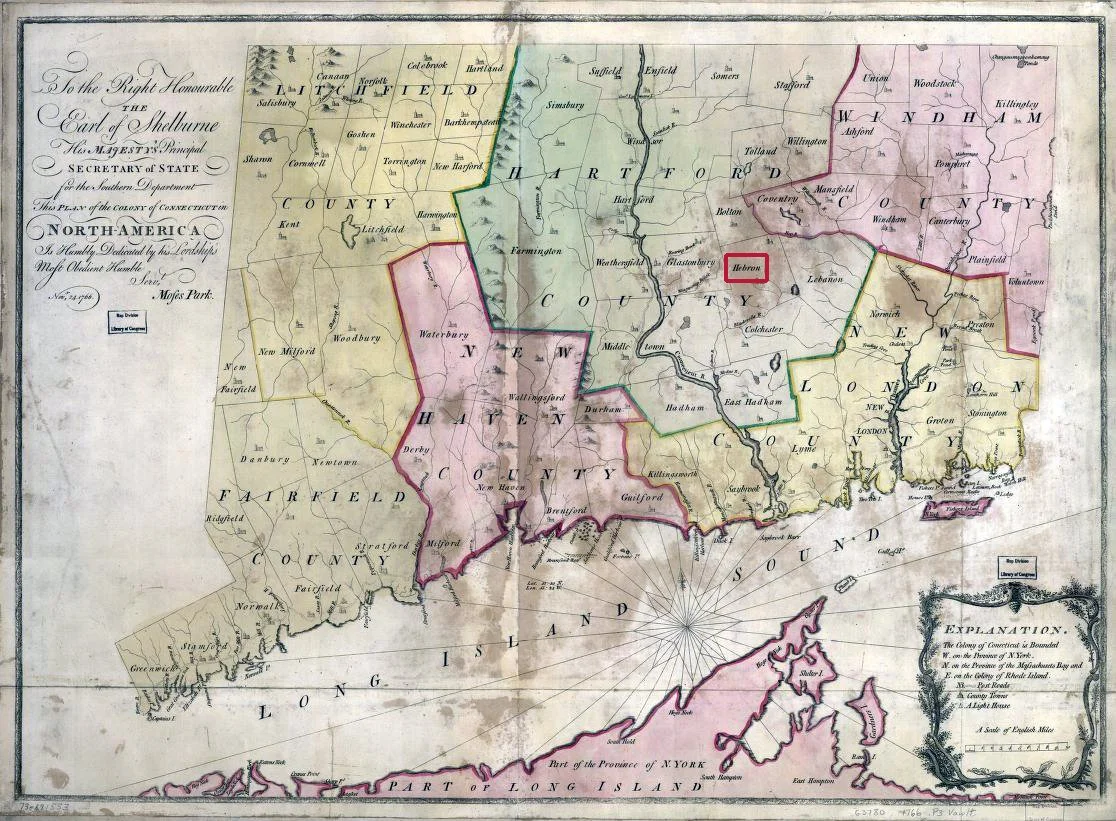
Plan of the Colony of Connecticut (Hebron in red), drawn by Moses Park, circa 1766 (Wikimedia Commons)
The Baxter household went through some tempestuous events in the early 1740s. When he was just 10 years old, Simon’s mother Abigail filed for divorce on September 1, 1740:[2]
“The petition of Abigail Baxter of Hebron in the County aforesaid Humbly Sheweth that she was on or about the 6th day of April in the year 1721 married to one Simon Baxter of the same Hebron, ever since which time until [illegible] then nine months last past: and during all which time your petitioner performed to her said Husband the duties of a loving and obedient wife, yet notwithstanding the said Baxter not regarding the covenant he had entered into with your petitioner, nor the duties he was bound to thee by, did on or about the [first?] day of February last past carnally know and commit fornication with Rebeckah Burge of Hebron aforesaid, whereby he hath broken his marriage covenant aforesaid, wherefore your petitioner humbly prays that your honor would declare your petitioner’s marriage covenant aforesaid to be null and void, and that your honor would grant to your petitioner a Bill of Divorce from her Husband aforesaid and discharge here from all obligations she is under to her said husband by force of the covenant aforesaid and she of in duty bound shall ever pray.”
Six months later, the Superior Court in Hartford granted the divorce.[3]
In the Colony of Connecticut, divorce in the early eighteenth century was legally permitted but remained relatively uncommon. Jurisdiction rested with the Superior Court, such as that sitting at Hartford, which granted divorces only on specific, clearly defined grounds. Among these, sexual misconduct, typically described in the records as adultery or fornication, was one of the most frequently cited causes and required convincing evidence before the court would dissolve a marriage. While only a small proportion of marriages ended in divorce, likely well under one percent, New England colonies such as Connecticut nonetheless exhibited higher divorce rates than England or most other British American colonies. Cases like Abigail’s petition in 1740, citing her husband’s “fornication with Rebeckah Burge,” therefore fell squarely within established legal practice. Although such proceedings carried social stigma and were not undertaken lightly, the courts recognized marital breakdown arising from proven infidelity as sufficient cause for dissolution, after which remarriage, sometimes to the named partner in the offence, was not uncommon.
Simon’s father went on to marry Rebecca Burge (née Tarbox) on October 25, 1741, in Hebron.[4] They had six children: Aaron, Nathan, William J.P., John, William J.P., and George.
Simon’s mother, Abigail Mann, died in 1748, likely in Hebron, when he was about 18 years old. The inventory of her estate was drawn up on October 19, 1748, and totalled 138 pounds. The estate consisted primarily of livestock, sheep’s wool, clothing, and household goods, which were divided among her children. Simon received five sheep as his portion. The probate proceedings suggest that Abigail retained her own household and property following her divorce from Simon Baxter Sr.[5]
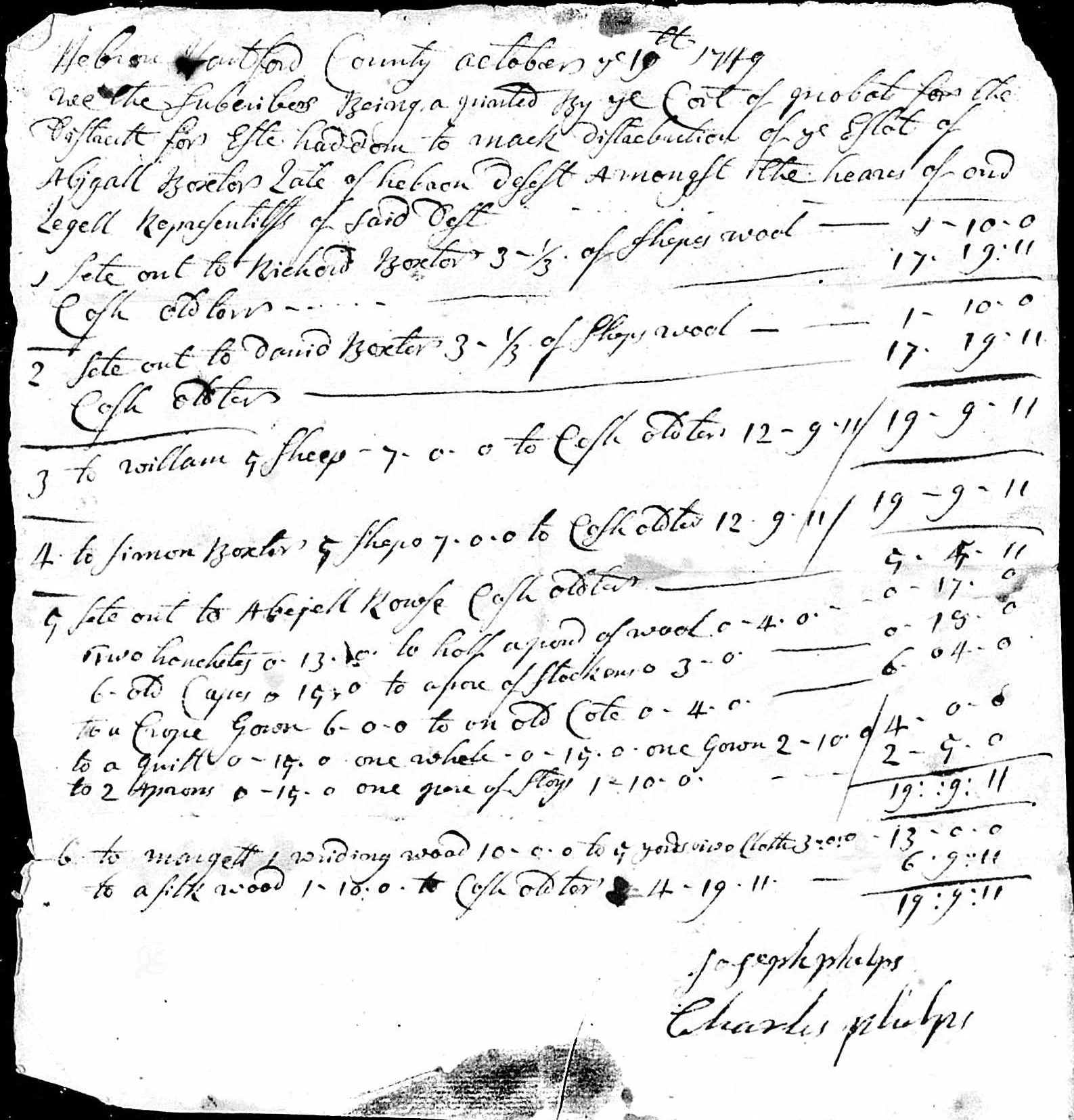
Inventory of Abigail Mann’s estate (Ancestry)
Abigail Mann was buried in Andover Road Cemetery in Hebron.[6]
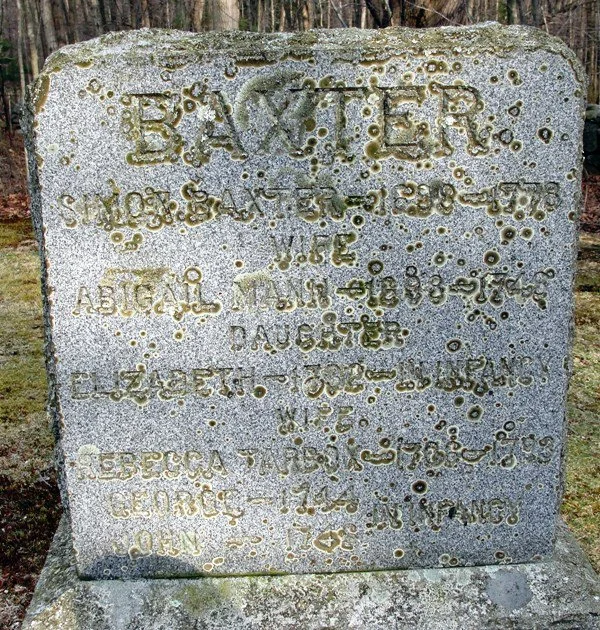
Baxter tombstone, Andover Road Cemetery (Find a Grave)
Settlement in Hartland
The year following his mother’s death, Simon married Prudence Fox on April 20, 1749, in Hebron. He was 18 years old; she was 16.[7] Prudence’s parentage is uncertain; several online trees name Abraham Fox and Dorothy Hollister of Glastonbury, but no contemporary record has been found establishing this.
According to great-great-grandson and author John B. M. Baxter, “this was the beginning of more than half a century of married life destined to be disturbed by events momentous in the history of this continent and in which he was an active participant and she, a patient sufferer.”[8]
Simon and Prudence had at least nine children:[9]
Prudence (ca. 1750–1833)
Simon (ca. 1753–1817)
Benjamin (ca. 1754–1816)
William (ca. 1760–1832)
Joseph (ca. 1762–1833)
Dorothy (ca. 1764–1825)
Abigail (ca. 1766–1850)
Elijah (ca. 1768–1852)
Abraham (1771–1836)
In 1755, Simon and Prudence settled in Hartland, Connecticut, roughly 55 miles (88 km) northwest of Hebron. They were said to be the second settlers of the town, which had a population of 12 residents in 1756.
In May 1761, Simon Baxter, Joseph Taylor, and other inhabitants of Hartland in Litchfield County petitioned the Colony of Connecticut to formalize their settlement as an incorporated town. They reported that 37 families, comprising approximately 212 residents, were already settled there, with additional families expected shortly, and requested the same governing privileges enjoyed by other towns in the colony. The Assembly granted the petition, officially creating the Town of Hartland and conferring upon it full municipal rights and powers. Simon Baxter and Joseph Taylor were appointed to notify the inhabitants to convene a town meeting, at which local officers would be elected in accordance with colonial law, thereby establishing formal local governance.[10]
The first town meeting was held in the Baxter home on July 14, 1761.[11] Simon was chosen selectman and appointed to a committee responsible for laying out highways. In September 1761, he travelled to New Haven with a petition concerning a tax bill. The following year, Simon served on a committee appointed to petition the county court regarding the establishment of a place of public worship. He continued to hold various minor town offices until 1770.[12]
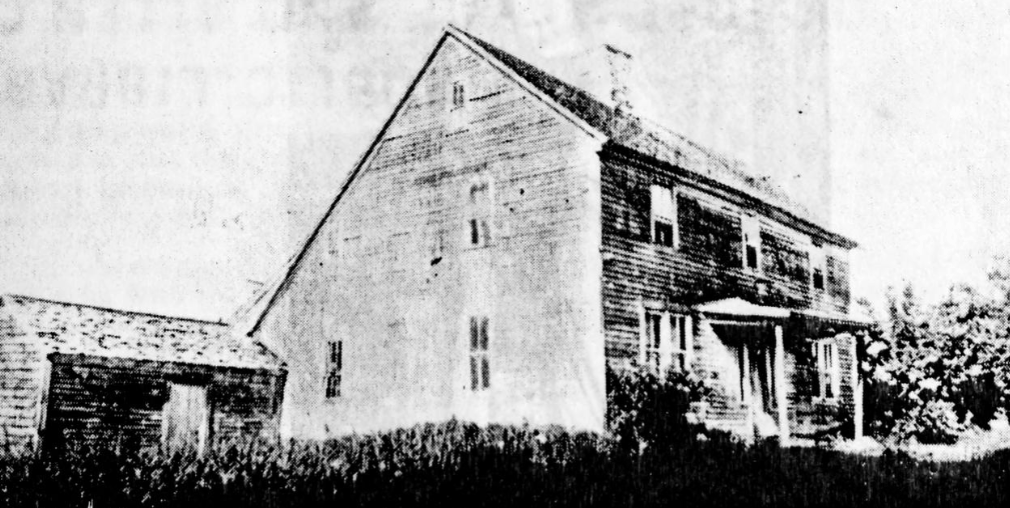
“Simon Baxter’s House, East Hartland” (Simon Baxter (the first United empire loyalist to settle in New Brunswick) his ancestry and descendants)
Expanding Landholdings in Connecticut and New Hampshire
By the early 1760s, Simon had become firmly established in Hartland and increasingly active in land transactions connected to the expanding frontier settlements of northwestern Connecticut and western New Hampshire. In all of the following records, he is identified as “Simon Baxter of Hartland.”
August 3, 1762: a long-term proprietors’ lease was granted to Simon following a vote of the Barkhamsted proprietors at a meeting held in Windsor on April 20, 1762. Seeking to raise £60 to defray proprietors’ expenses, the proprietors authorized the leasing of portions of the town’s undivided common lands for a term of 999 years. Benjamin Griswold, William Stoughton, and Henry Allen were appointed as agents to conduct the leases. On August 3, 1762, they leased to Simon Baxter two adjoining 50-acre lots in Barkhamsted after a public auction process. The parcels were described in detail by metes and bounds and lay within the proprietors’ undivided lands. Under the lease, Baxter, his heirs, and assigns received the right to “use occupy possess & enjoy” the lands and their profits for the duration of the 999-year term, while remaining responsible for any taxes or rates assessed on the property. These long-term proprietary leases effectively gave settlers hereditary control over lands that technically remained part of the proprietors’ common holdings.[13]
August 11, 1762: only days after obtaining the leasehold interests described above, Simon expanded his Barkhamsted holdings through a substantial purchase from Edward White of Hartford, Connecticut. White sold four parcels of land in Barkhamsted to Simon for £144 5s. The properties included two 95-acre tracts, additional parcels described in earlier Barkhamsted proprietors’ records, and a 9½-acre parcel originally laid out on the Samuel Bancroft right. One 95-acre tract was bounded east by a highway, north by land laid out to Joseph Hoskins, west by proprietors’ land, and south by land laid out to Josiah Pinney. Another tract was likewise bounded east and west by highways, while two additional parcels were identified by reference to Barkhamsted proprietor records. The final parcel, containing approximately 9½ acres, was bounded by highways and adjoining lands laid out to Jacob Gibbs and Simon Chapman. White conveyed all four tracts to Simon in fee simple together with their appurtenances.[14]
September 11, 1762: about one month later, Simon sold two of the Barkhamsted parcels acquired from Edward White to Thomas Goss of Granville, Massachusetts Bay, for the sum of £85 10s. The first tract contained approximately 35 acres and was bounded in part south by land laid out to Joseph Steadman or his assigns. The second tract contained about 30 acres, situated on the end of the “fourth tier,” bounded south by land laid out to Josiah Pinney and otherwise by highways. Simon stated that he had recently purchased both parcels from Edward White and that they had originally been laid out on the Samuel Bancroft right. The transaction indicates that Baxter was already actively buying, consolidating, and reselling frontier lands.[15]
November 23, 1762: Simon entered into a probate bond at Middletown, Connecticut, in the penal sum of £50, binding himself to Tobey Hamlin, Judge of the Probate Court for the District of Middletown. The obligation arose from Baxter’s appointment as guardian to James Higgins, a minor son of the late Ichabod Higgins of Durham. Under the terms of the bond, Baxter agreed to “well, truly and faithfully execute and discharge” his duties as guardian in accordance with the law, and to render a true account of his administration either to the court or to the ward upon reaching majority. The bond would become void if these conditions were met; otherwise, it would remain in full force. The appointment indicates that Baxter was considered sufficiently established and trustworthy to administer the affairs of a minor child.[16]
December 13, 1763: Pelatiah Allyn of Barkhamsted leased a 50-acre tract in Barkhamsted to Simon for the term of 999 years in exchange for the sum of £25. The deed explained that the transaction originated from the same 1762 vote of the Barkhamsted proprietors to lease portions of the town’s common and undivided lands. Committees appointed by the proprietors auctioned off fifty-acre lots on long leases, and Pelatiah Allyn became the highest bidder for this parcel before transferring the leasehold interest to Baxter. The tract was described in detail near the Hartland boundary and adjoined another parcel already leased to Simon Baxter on August 3, 1762. Under the agreement, Baxter, his heirs, executors, and assigns obtained the right to “hold use occupy possess & enjoy” the land and all associated profits and privileges from the date of the lease until December 13, 2760, provided they paid all taxes and rates assessed during the term. This acquisition further consolidated Baxter’s growing interests in Barkhamsted proprietary lands.[17]
December 13, 1763: on the same day, Simon sold a small parcel of land in Barkhamsted to Pelatiah Allyn of Barkhamsted for the sum of £8 11s. The tract contained approximately 9½ acres and formed part of the division originally laid out to Samuel Bancroft. The land was bounded east and west by a highway, north by land belonging to the heirs of Simon Chapman, and south by land laid out to the heirs of Jacob Gibbs. The transaction likely formed part of the broader exchange connected to the leasehold transfer described above.[18]
May 28, 1766: Elijah Flowers of New Hartford, Connecticut, quitclaimed to Simon Baxter all of his interest in forty-four pounds “right or list” in the undivided common or proprietors’ lands of Barkhamsted for the nominal sum of eight shillings. The deed transferred Flowers’s full claim to the proprietary interest, including all associated profits and privileges, to Baxter and his heirs in fee simple. Such proprietary rights represented shares in the town’s remaining undivided lands and could later result in additional allotments.[19]
February 20, 1767: continuing to expand his proprietary interests, Simon acquired another share in Barkhamsted’s common lands. On that date, Pelatiah Allyn of Barkhamsted, Litchfield County, Connecticut, quitclaimed to Simon all rights to a “two hundred pounds right or list” in the undivided proprietors’ common lands of Barkhamsted for the sum of £2. The deed conveyed Baxter a proprietary share in the town’s unallocated common lands, together with all associated profits and privileges, to hold in fee simple for himself and his heirs forever.[20]
Landholding in Alstead and the Connecticut Valley
By the close of the 1760s, Simon had become deeply involved in the acquisition, leasing, and resale of frontier lands in northwestern Connecticut. His transactions increasingly centred on Barkhamsted, just south of Hartland, where he appears regularly in proprietors’ records and land deeds. This activity continued into the early 1770s as Simon expanded both his landholdings and his connections to the developing settlements of western New Hampshire.
April 5, 1770: Samuel Lawrance of Simsbury and Bigelow Lawrance of Barkhamsted sold two parcels of land in Barkhamsted, Connecticut, to Simon Baxter, then described as “formerly of Enfield in Hartford County now resident in Barkhamsted,” for the sum of £100. The first parcel consisted of combined one-seventh and one-fourteenth interests in the original “home lot” laid out to John Huntington, a tract containing approximately 71½ acres in total. Baxter’s share amounted to roughly 15 acres and 51 rods and remained undivided with the heirs of Dr. Samuel Mather of Windsor. The second parcel was Lot No. 86, originally laid out to John Hoskins Jr., containing approximately 66 acres near the Simsbury boundary, bounded in part by highways, undivided lands, and adjoining proprietors’ lots.[21]
September 14, 1770: Simon, a resident of Barkhamsted, conveyed two parcels of land in Barkhamsted to his son Simon Baxter Jr. of Suffield, Hartford County, for the sum of £150. The first parcel consisted of fractional interests, specifically “one full seventh part & one full fourteenth part,” in the original “home lot” laid out to John Huntington, containing approximately 71½ acres in total. Baxter’s share amounted to roughly 15 acres and 51 rods and remained undivided with the heirs of Dr. Samuel Mather of Windsor. The second parcel was Lot No. 86, originally laid out to John Hoskins, containing about 65 acres near the Simsbury boundary. Baxter noted that this tract had recently been purchased from Samuel and Bigelow Lawrance.[22]
September 17, 1770: Simon, a resident of Barkhamsted, leased a 50-acre parcel in Barkhamsted to Captain Abraham Pinney of Simsbury for the term of 999 years in exchange for the sum of £150. The transaction stemmed from a 1762 decision by the Barkhamsted proprietors to lease portions of the town’s undivided common lands in order to raise funds to cover proprietors’ expenses. Pelatiah Allyn had originally acquired the parcel as the highest bidder and subsequently transferred his interest to Baxter. The tract was carefully bounded by the proprietors’ common and undivided lands near the Hartland boundary. Under the lease, Pinney, his heirs, and assigns received the right to “hold occupy possess & enjoy” the property and its profits until December 13, 2760, provided they paid all taxes and rates assessed on the land during the term.[23]
January 1, 1771: Simon, a resident of Barkhamsted, sold a 95-acre tract in Barkhamsted to Joseph Pease of Suffield, for £100. The property, originally laid out to Samuel Bancroft, was bounded east by a highway, north by land laid out to Joseph Hoskins, west by proprietors’ land, and south by land laid out to Josiah Pinney.[24]
February 13, 1771: Simon, a resident of Barkhamsted, and his son Simon Baxter Jr., of Suffield, conveyed several parcels of land in Barkhamsted to Israel Jones of Enfield for £100. The deed transferred interests in two separate tracts. The first consisted of fractional shares in the original “home lot” laid out to John Huntington, containing about 71½ acres in total, of which the conveyed portion amounted to approximately 15 acres and 51 rods and remained undivided with the heirs of Dr. Samuel Mather of Windsor. The second tract formed part of Lot No. 86, originally laid out to John Hoskins, containing about 66 acres near the Simsbury boundary.[25]
February 13, 1771: on the same day, Simon executed a second deed to Jones for an additional £100. In this transaction, Baxter conveyed a 95-acre lot in Barkhamsted originally laid out to Samuel Bancroft, situated between branches of the Farmington River near Beaver Brook. The deed also included rights associated with “six hundred pounds on the Proprietors list” of Barkhamsted, representing Baxter’s share in the town’s common and undivided lands.[26]
February 13, 1771: on the same day, Jones conveyed to Simon Baxter of Barkhamsted and Simon Baxter Jr. of Suffield all of his interest in two adjoining tracts in Alstead, New Hampshire: Lot No. 5 in the sixth range and the north half of Lot No. 5 in the seventh range. The transaction, valued at £400 or equivalent land exchanged, included both a grist mill and a sawmill standing on the property, along with all future “after draughts” or additional divisions attached to the lots. Jones reserved for himself a one-quarter interest in the sawmill during the life of the existing timber used to operate it, after which the mill irons would pass entirely to the Baxters. The deed further specified that Simon Baxter Jr. was to hold a one-quarter share of the overall property. The transaction expanded the Baxter family’s holdings in Alstead and gave them control of valuable milling operations critical to settlement and local commerce.[27]
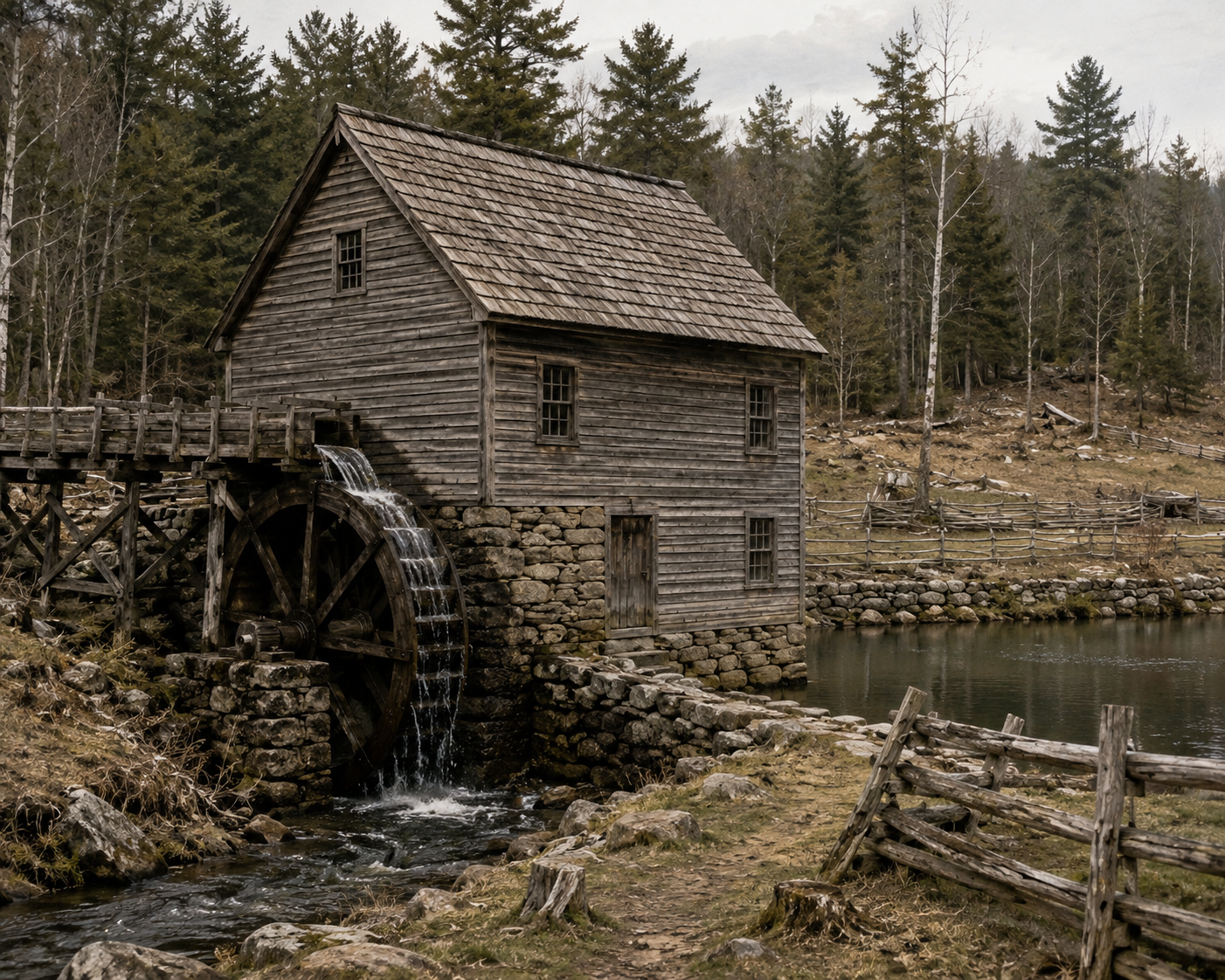
18th century grist mill (artificial intelligence illustration generated with ChatGPT by the author, May 2026)
Move to New Hampshire
After this purchase, Simon moved from Barkhamsted to Alstead, about 90 miles (145 km) to the north. Settled only a few years earlier, about 1764, Alstead was still a young frontier community in the early 1770s, attracting settlers seeking land, mills, and new opportunities. In the years that followed, however, the town would become deeply divided by the political tensions of the Revolutionary era, and several of its inhabitants — including Simon Baxter — would find themselves drawn into the growing conflict over loyalty and independence.
Until the outbreak of the war, Simon was still active in buying and selling land. In all of the records below, he is described as a resident of Alstead.
June 15, 1771: Joseph Pease of Suffield, Connecticut, executed a quitclaim deed in favour of Simon Baxter, then described as “late of Barkhamsted in the County of Litchfield now of Elstead [Alstead] in the province of New Hampshire.” In consideration of £100, Pease relinquished all his “right estate title and demand whatsoever” in a 95-acre tract in Barkhamsted. The land had originally been laid out to Samuel Bancroft and was bounded east by a highway, north by land of Joseph Hoskins, south by land of Josias Pinney, and west by proprietors’ land. The deed transferred all of Pease’s remaining interest in the property to Simon Baxter, his heirs, and assigns forever, and barred any future claims by Pease or his heirs.[28]
July 20, 1771: Joseph Warner of Charlestown, New Hampshire, sold to Simon all of his right, title, and interest in the east half of Lot No. 4 in the fourth range of Alstead, including all future “after draughts” or additional allotments attached to that half-right. The transaction was made for £95.[29]
July 21, 1771: Simon sold the same 95-acre Barkhamsted tract originally laid out to Samuel Bancroft to Joseph Warner of Alstead for £95. The property was bounded east by a highway, north by land of Joseph Haskins, west by proprietors’ land, and south by land of Josiah Pinney. Baxter stated that his claim derived from a prior deed executed by Edward White. In the deed, Baxter conveyed all his “right title interest claim challenge or demand” in the land to Warner, his heirs, and assigns forever, and covenanted that he was lawfully seized of the premises in fee simple, free of encumbrances, with full authority to sell the property. He further guaranteed and defended the title against all future claims. The deed was acknowledged before Justice B. Bellows in New Hampshire shortly afterward in July 1771.[30]
May 26, 1772: Simon Baxter Jr. of Alstead conveyed to his father Simon, all of his interest in the north half of Lot No. 5 in the seventh range of Alstead, together with all privileges, appurtenances, and future undivided allotments attached to the property. The consideration for the transfer was £120. The deed suggests a consolidation of the Baxter family’s holdings in Alstead, particularly in lands previously acquired through the 1771 exchange with Israel Jones.[31]
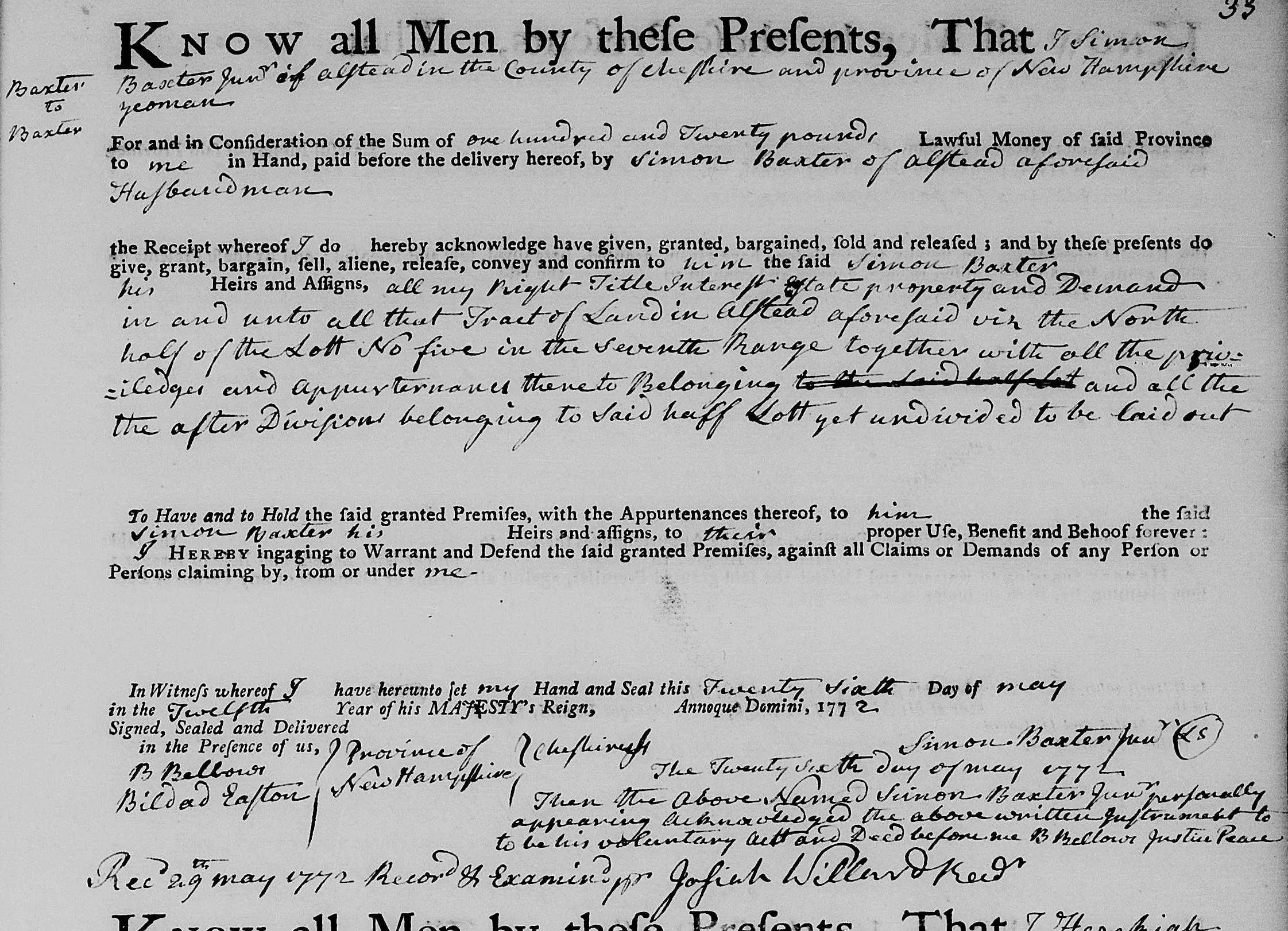
1772 deed from Simon Baxter Jr. to his father (FamilySearch)
May 26, 1772: on the same day, Simon and his son Simon Baxter Jr. jointly sold Lot No. 5 in the sixth range of Alstead to Bildad Easton of Alstead for £45. This second transaction appears to have reorganized the family’s Alstead holdings by transferring one tract to Easton while consolidating ownership of another under Simon Baxter Sr. alone.[32]
June 23, 1773: Joseph Warner of Charlestown, Cheshire County, New Hampshire, quitclaimed to Simon all his right, title, and interest in a 95-acre tract in Barkhamsted, Litchfield County, Connecticut, for £100. The property was the same Samuel Bancroft lot referenced in earlier Baxter transactions, bounded east by a highway, north by land laid out to Joseph Hoskins, west by proprietors’ land, and south by land laid out to Josiah Pinney.[33]
August 12, 1773: Simon sold a 97-acre tract in Barkhamsted to Joseph Kingsbury of Enfield for £72. The property was described in detail, beginning at a heap of stones marking the southeast corner, extending north along a highway, west along land laid out to Joseph Hoskins, south along proprietors’ land, and east along land laid out to Josiah Pinney back to the point of beginning.[34]
January 13, 1774: Jonathan Chase of Cornish, New Hampshire, sold to Simon the west half of Lot No. 6 in the eighth range of Alstead’s first division for £35. The tract contained approximately 125 acres and was described by reference to the official Alstead town records.[35]
November 7, 1774: Simon sold 150 acres of land in Marlow, New Hampshire, to Solomon Gee of Marlow for £60. The property consisted of two tracts: a 100-acre parcel originally laid out on the right of Joseph Clerk in the town’s first division, and an additional 50-acre parcel laid out on the right of Mashfield Parsons, one of Marlow’s original proprietors. The deed carefully described the boundaries of the smaller tract by marked trees, stone markers, and adjoining lots, while also reserving a road through the property.[36]
January 3, 1775: Moses Brown of Walpole, New Hampshire, sold to Simon the south part of Lot No. 4 in the seventh range of Alstead, containing approximately 100 acres, for £18.[37]
January 30, 1775: Simon sold to John Moffatt of Portsmouth, New Hampshire, a 250-acre tract identified as Lot No. 3 in the third range of Alstead for £8 16s. Baxter stated that he had originally acquired the property at a legally notified public tax sale conducted by Absolom Kingsbury, Collector of Taxes for the town of Alstead. The lot had originally been laid out on the proprietary right of Nathaniel Barrel Esq. Baxter conveyed the tract together with its appurtenances and warranted the title against claims arising through himself or the original proprietor. The deed was witnessed by William Whipple and Joseph Perie and acknowledged before Justice Wentworth at Portsmouth on the same day.[38]
First Signs of Toryism
By 1774, growing political unrest in New Hampshire had begun to affect the operation of local courts and civil authority. According to Baxter’s later Loyalist claim, he “raised Men to go and Protect the Courts in 1774,” helping ensure that the Cheshire County court was able to continue its proceedings despite growing revolutionary unrest. The action reportedly made him “very obnoxious” among local Patriot committees and marked the beginning of years of political persecution.[39]
By 1775, Simon Baxter had accumulated and transferred property across a wide geographic area extending from northwestern Connecticut into the Connecticut River valley of western New Hampshire. His transactions involved not only farmland, but also proprietary rights, mills, long-term leaseholds, and undeveloped frontier lots. These activities, combined with his increasingly visible political position, placed him among the more prominent and controversial settlers of the region on the eve of the Revolutionary War.
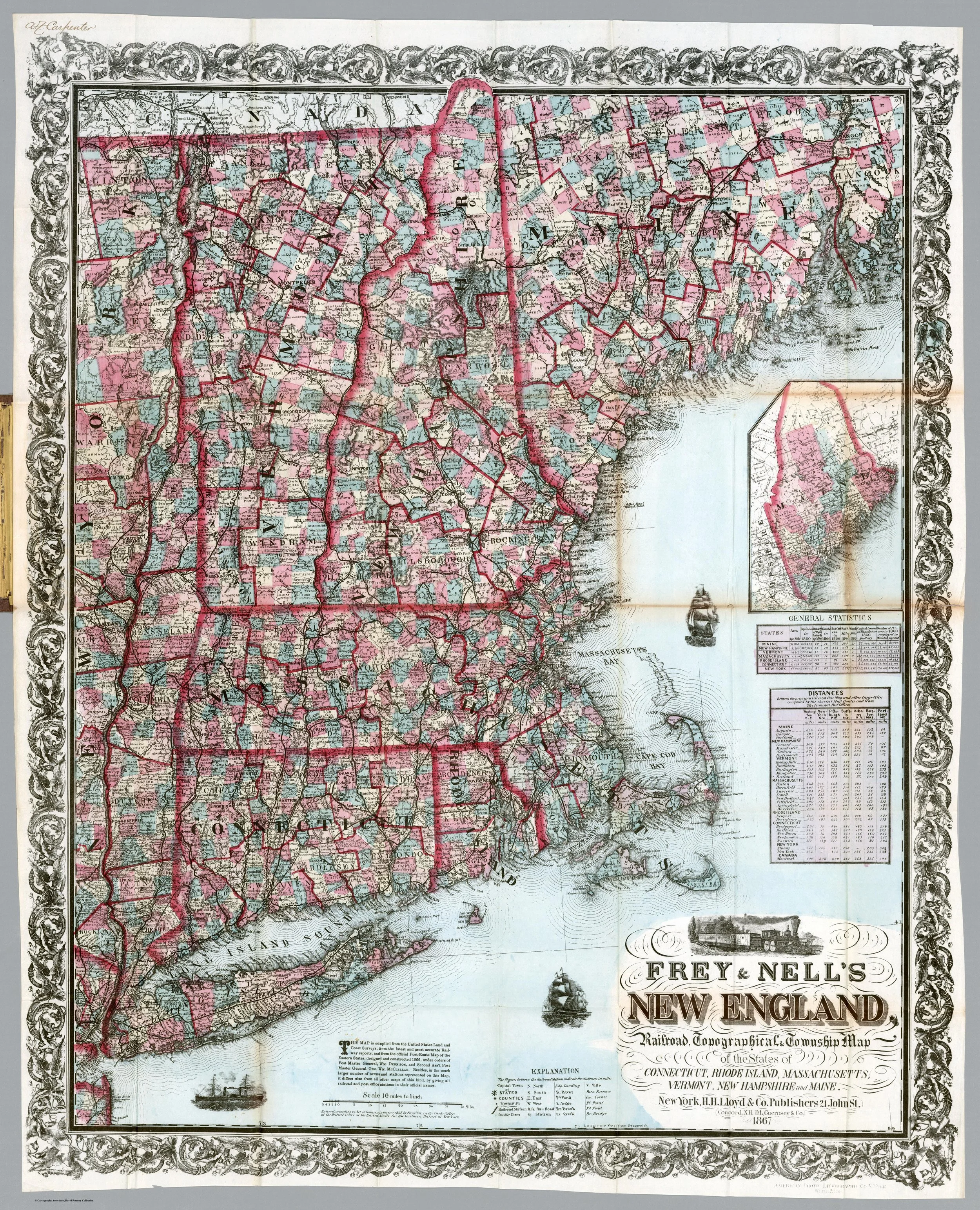
Frey & Nell's New England, 1867 map (David Rumsey Map Collection). Locations related to Simon Baxter in blue numbered squares: 1-Hebron 2-Hartland 3-Barkhamsted 4-Alstead 5-Charlestown.
Simon Baxter and the Revolutionary War
By the summer of 1775, political tensions in Alstead had become increasingly severe as the conflict between Great Britain and the colonies escalated into open rebellion. Simon Baxter openly expressed Loyalist sympathies at a time when local Committees of Inspection and Correspondence were actively monitoring political dissent and enforcing support for the Patriot cause. According to later testimony and local accounts, Baxter made repeated statements viewed as hostile to the American resistance, including declarations favouring the British Army and criticism of the colonial movement. His views alarmed many inhabitants of Alstead and neighbouring towns, particularly as revolutionary committees sought to suppress expressions of loyalty to the Crown and prevent suspected Loyalists from aiding British forces. Amid growing suspicion and public hostility, complaints against Baxter were formally brought before the Alstead Committee of Inspection in August 1775, leading to a public hearing into his conduct and political principles. In his later Loyalist memorial, Baxter claimed that he had been brought before revolutionary committees “thirteen different times” before finally being imprisoned at Charlestown in 1777.[40]
“The Committee of Correspondence for the Town Alstead being applied to, by complaint sundry times from sundry persons, against Simon Baxter of said Alstead, he being inimical to his country in a most dangerous manner, accordingly appointed Friday, 18th of August, inst., for a time to examine into the matter: and after having served a citation upon said Baxter to attend and answer to any allegation that might be laid against him on that account, accordingly met with the Town in general, and a number of persons from adjacent towns , and went into a full hearing of said matter. And after hearing the evidence against said Baxter, with his own declaration, which was that he would victual Gage's Army had he an opportunity, with sundry other open and dangerous declarations against the peace and good of the Country, under the present unhappy situation, therefore determined , with the advice of all present, that the said Simon Baxter's conduct has been, and still his avowed principles by his open and dangerous declaration before this body, is highly inimical, &c.; and adjudge that the said Baxter be confined to his farm in Alstead, and that he give up his arms, and that all persons be cautioned to withhold commerce and dealings with him, the said Baxter, until the advice of three adjacent Towns, by their Committees, be known, which shall be immediately called in.
NATHANIEL PRENCE
OLIVER SHEPARD,
SIMON BROOKS,
Committee of Inspection
Alstead, August 18, 1775.
N. B. Notwithstanding the aforegoing determination, the said Simon Baxter is deserted and gone off from the Town of Alstead; and it is suspected that he, the said Simon Baxter, is gone off with contempt, and upon some bad design against his country, therefore all persons, friends to the Country, are desired to take notice and beware of the said offender, that he may be brought to a sense of his duty.
NATHANIEL PRENCE
OLIVER SHEPARD,
SIMON BROOKS,
Committee of Inspection”[41]
Following the August 1775 proceedings, Simon’s position in Alstead became increasingly precarious. As the Revolutionary movement expanded, local committees assumed growing authority over political dissent and demanded public demonstrations of loyalty to the American cause. Men suspected of Loyalist sympathies faced surveillance, restrictions on movement, economic boycotts, and, in some cases, imprisonment. In this atmosphere, the colony of New Hampshire introduced the “Association Test” in 1776, requiring adult males to affirm their support for the Revolutionary cause and the defence of American liberties.
On March 14, 1776, the Continental Congress passed the following resolution:
“That it be recommended to the several Assemblies, Conventions and Councils, or Committees of Safety of the United Colonies, immediately to cause all persons to be disarmed, within their respective Colonies, who are notoriously disaffected to the cause of AMERICA.”
On April 12, 1776, the New Hampshire Committee of Safety transmitted the following declaration, later commonly known as the “Association Test,” to the selectmen of towns throughout the colony:
“WE, THE SUBSCRIBERS, DO HEREBY SOLEMNLY ENGAGE AND PROMISE, THAT WE WILL, TO THE UTMOST OF OUR POWER, AT THE RISQUE OF OUR LIVES AND FORTUNES, WITH ARMS, OPPOSE THE HOSTILE PROCEEDINGS OF THE BRITISH FLEETS AND ARMIES AGAINST THE UNITED AMERICAN COLONIES.”
According to surviving returns, every man above 21 years of age in the neighbouring towns of Surry and Gilsum signed the declaration. In Alstead, however, four men refused: Simon Baxter Sr., Samuel Chandler, John Thomson, and Samuel Miller.[42]
Simon’s refusal to sign the Association Test publicly identified him as one of the few openly disaffected inhabitants of Alstead. As the Revolution progressed and New Hampshire moved toward full independence from Great Britain, local and provincial authorities intensified efforts to suppress Loyalist activity. Men suspected of sympathizing with the Crown increasingly faced surveillance, restrictions, confiscation of arms, and imprisonment. Against this backdrop, complaints against Simon Baxter continued to accumulate during 1776 and 1777, eventually drawing the attention of the New Hampshire Committee of Safety.
By 1777, Revolutionary authorities in New Hampshire had intensified efforts to suppress suspected Loyalist activity, particularly as fears grew that supporters of the Crown might assist British operations advancing from Canada during the Saratoga campaign. Across Cheshire County, men accused of being “unfriendly to the American Cause” were investigated, disarmed, restricted in movement, or imprisoned. Simon Baxter, already publicly identified as a Loyalist following the Alstead Committee proceedings and his refusal to sign the Association Test, became one of several men targeted during this crackdown.
The surviving records suggest that Baxter and several other suspected Loyalists were being moved or held under guard in the region during the spring of 1777. A contemporary entry in the History of Barnet, Vermont recorded that on May 13, 1777, “several Gentlemen came into town under guard for Toryism, to be kept confined till further orders. Capt. Smith, Elijah King, Prentice Willard, Elijah Willard, Josiah Butler, Simon Baxter and Mr. Sanger, were the persons confined.”[43]
A few weeks later, New Hampshire’s Committee of Safety issued a formal decision concerning several of the same men. Referring to evidence gathered at a special session held at Keene on June 3, 1777, the Committee concluded that Simon Baxter and others had demonstrated “so unfriendly a disposition to the Cause in which the United States of America are engaged” that they should be “closely confined till further orders.” The Committee ordered that Baxter, Samuel Smith, Elijah Willard, and Abner Sanger be delivered to the keeper of the jail at Charlestown, New Hampshire, where they were to remain imprisoned until January 1, 1778, or until further action by the Committee of Safety or General Court.
“Upon examination of the Evidences transmitted to this Committee by the Justices of a Special Sessions held at Keen, June 3d, 1777, for enquiring into the conduct of sundry persons represented as unfriendly to the American Cause, and by said Justices were ordered to be kept under guard, and the evidences respecting their conduct laid before this Committee for their further order. It appears to this Committee That Samuel Smith of Winchester, gentleman, Simon Baxter of Alstead, Yeoman, Elijah Willard of Winchester, Yeoman, and Abner Sanger of Keen, Yeoman, have discovered so unfriendly a disposition to the Cause in which the United States of America are engaged as makes it necessary they should be closely confined till further orders ; and that Elijah King of Charlestown, Yeoman, and Prentice Willard of Winchester, Yeoman, should be confined within certain limits, all of them within the County of Cheshire : --
It is therefore ordered by the Committee that the said Elijah King give Bond in the sum of £ 500, with two sufficient sureties, to the Speaker of the House of Representatives. That he will be of the good behaviour towards all the subjects of the United States, and of this in particular, And that he will not go more than one half mile from the house of his residence, until the first day of Jan next or further order of the Committee of Safety or General Court, or leave obtained of the Commissioner of the Town ; and in case he shall refuse to give such Bond with sureties, then that he be committed to Goal in Charlestown in County till he shall give the same; and the Keeper of said Goal is hereby required to receive & detain him accordingly; and it is further ordered, That Prentice Willard give bond to the Speaker of the House of Representatives in the sum of £ 500 with two sufficient sureties to be of the good behaviour towards all the subjects of the United States of America, and of this in particular, and that he will not go beyond the limits of the said Town of Winchester until the first day of January next, or further order of the Committee of Safety or General Court : and in case he shall refuse to give such Bond then that he be committed to the Goal in Charlestown aforesaid, till he shall give the same; and the keeper of said Goal is hereby required to receive and detain him accordingly.
And it is further Ordered, That the said Samuel Smith, Simon Baxter, Elijah Willard & Abner Sanger be delivered by the Guard who now have the care of them to the keeper of the Goal in Charlestown aforesaid; and the said keeper is hereby required to receive them into his custody, and them safely to keep until the first day of January next or further order of the Committee of Safety or General Court of this State. By order of the Committee.”[44]
Imprisonment and Escape
Following the June 1777 orders of the New Hampshire Committee of Safety, Simon Baxter was placed under guard with several other suspected Loyalists from Cheshire County. Contemporary accounts suggest that local authorities considered some of the prisoners particularly dangerous because of the “more decided and offensive expressions of their views.” Baxter was therefore among the small number ordered confined in the jail at Charlestown, New Hampshire.
The jail itself was reportedly in poor condition, and local officials struggled to securely detain prisoners. Rather than keeping all suspects imprisoned, authorities released most on heavy bonds of £500 to remain within prescribed limits. Simon Baxter, however, became one of only a few exceptions. According to the account, Baxter eventually “slipped the guard, and ran away,” escaping confinement along with another prisoner named Butler.[45]
After his escape, Simon reportedly concealed himself on a wooded height near Warren Pond in Alstead that later became locally known as “Tory Hill,” a name said to preserve the memory of his Loyalist activities during the Revolution.
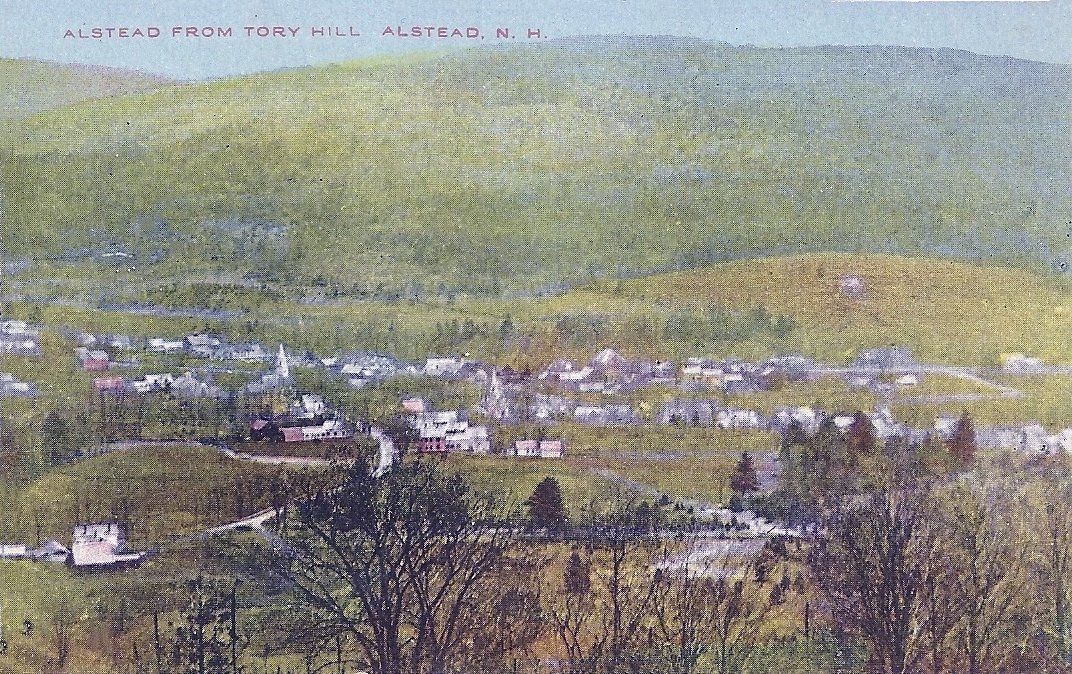
“Alstead from Tory Hill,” circa 1910 postcard
Skenesborough, Bennington, and Saratoga
By now, Simon Baxter appears to have attached himself more openly to the British cause. In the late summer of 1777, he left the country and threw in his lot with the British army then advancing southward from Canada. The campaign of Lieutenant-General John Burgoyne, intended to drive down the Lake Champlain–Hudson corridor and cut off the rebellious New England colonies from those to the south, carried Baxter through three of its defining engagements — Skenesborough, Bennington, and Saratoga — within the space of about ten weeks. The campaign is generally regarded as a turning point of the Revolution, and Baxter's place in it, though documented chiefly through his own later testimony and the accusations of his enemies, puts him at the centre of those events.[46]
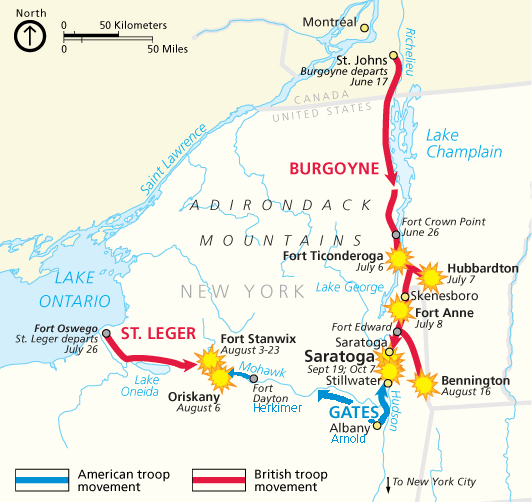
Map of Burgoyne's Campaign, June–October 1777 (National Park Service)
Skenesborough
After capturing Fort Ticonderoga without a fight on July 6, 1777, Burgoyne's forces pursued the retreating Americans to Skenesborough (present-day Whitehall, New York), at the southern end of Lake Champlain. British gunboats broke through the boom protecting the harbour, landed troops, and engaged Colonel Pierse Long's mixed force of Continentals and refugees. The Americans burned their vessels, fortifications, and supplies and fell back toward Fort Anne, while the British secured the village and the lower lake.[47] The easy victory deepened Burgoyne's confidence that his campaign would succeed.[48]
According to his own Loyalist memorial, it was at Skenesborough, in July 1777, that Baxter joined Burgoyne's army, having made his way there after slipping from confinement in New Hampshire. He claimed to have arranged for some two hundred men to rally to the British, of whom roughly ninety eventually did so. Baxter’s arrival placed him among the New England Loyalists who attached themselves to Burgoyne during the army's advance through the disputed lands east of the Hudson.[49]
Bennington
His supply line to Canada overextended and his army short of horses and provisions, Burgoyne dispatched a detachment of about seven hundred men — German dragoons under Lieutenant-Colonel Friedrich Baum, together with British marksmen, Canadians, Indigenous allies, and Loyalist volunteers, and accompanied by the Loyalist Philip Skene — to seize stores at Bennington, in the New Hampshire Grants (Vermont).[50] There they met Brigadier-General John Stark's New Hampshire militia, reinforced by Colonel Seth Warner's Continentals and the Green Mountain Boys, numbering well over two thousand. On August 16, 1777, after a day of rain, Stark assaulted Baum's hilltop positions; the Loyalist and Indigenous detachments were overrun, Baum was mortally wounded, and a relief column under Lieutenant-Colonel Heinrich von Breymann was likewise driven off. Some two hundred of Burgoyne's men were killed and more than seven hundred taken prisoner, against fewer than one hundred American casualties. The loss of close to a thousand men and the failure to gather supplies crippled Burgoyne's prospects, and Bennington is rightly counted a precursor to his ruin at Saratoga.[51]
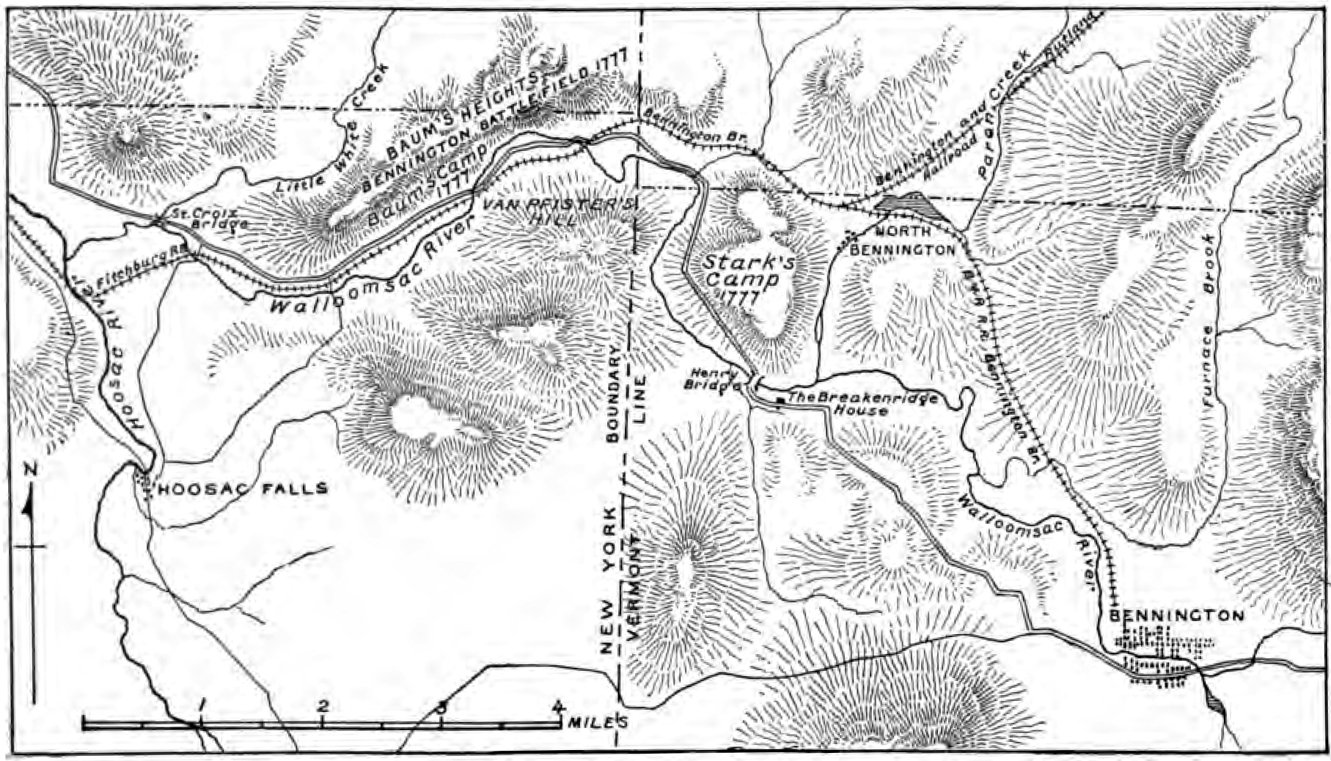
Map of Bennington Battlefield, created in 1912 (Wikimedia Commons)
Loyalists were prominent in Baum's force, and those who fell into Continental hands were treated harshly, often as traitors rather than prisoners of war.[52] Two separate testimonials place Baxter at the head of a party in the action: a certificate later given against him by Absolom Kingsbury alleged that he had served "at the head of a party in the Brittish Service in the Bennington Battle" of August 1777, while a letter from a Colonel Schean (almost certainly the Loyalist Philip Skene) stated that he had "played the part of a good officer at the head of a party in that battle."[53] He was not, however, taken at Bennington. He survived the battle and served from August to October 1777 as a lieutenant in Captain Fraser's company of the King's Rangers.[54]
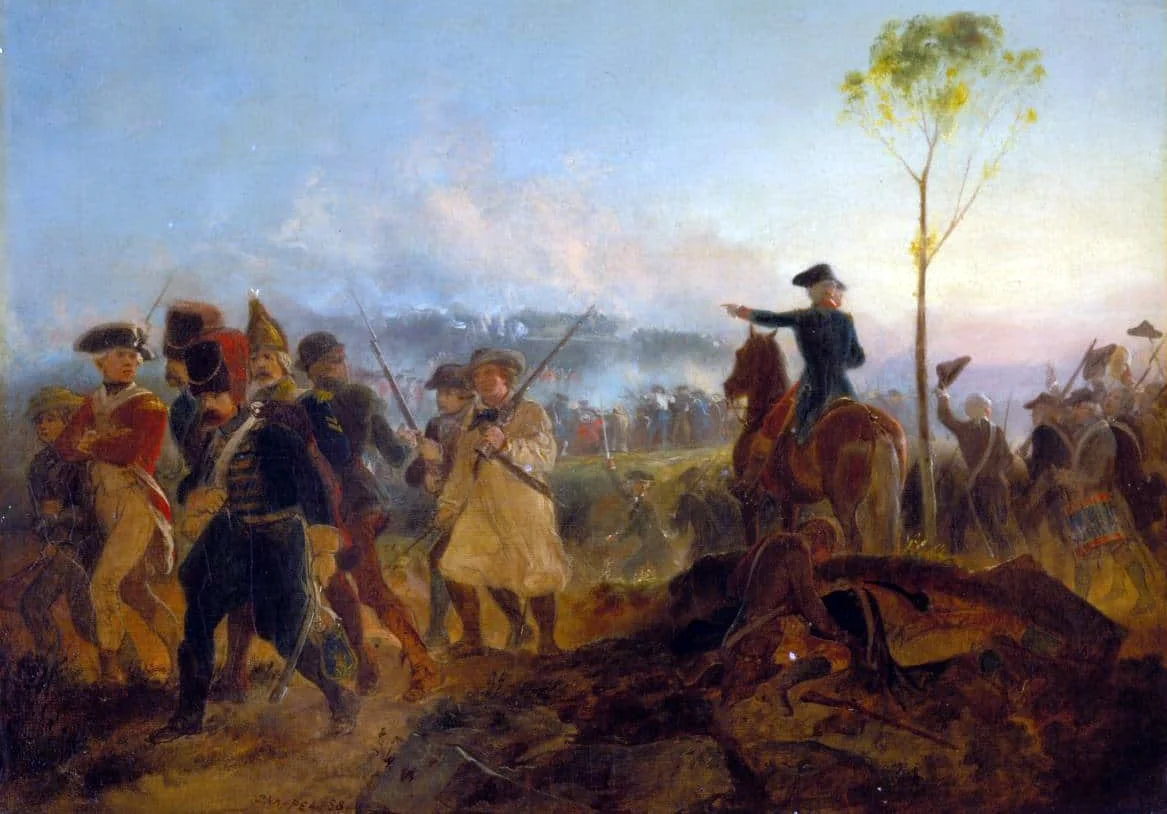
“Battle of Bennington” (Wikimedia Commons)
Saratoga
Crossing to the west bank of the Hudson in mid-September, Burgoyne advanced against the American army of Major-General Horatio Gates, entrenched on Bemis Heights near Stillwater. Two battles followed on the same ground, eighteen days apart. At Freeman's Farm (the First Battle of Saratoga, on September 19, 1777), the British held the field but at a cost they could not sustain and without breaking the American line. At Bemis Heights (the Second Battle, on October 7, 1777), Burgoyne's reconnaissance-in-force was repulsed, Brigadier-General Simon Fraser was mortally wounded, and the British were driven back upon their works.[55]
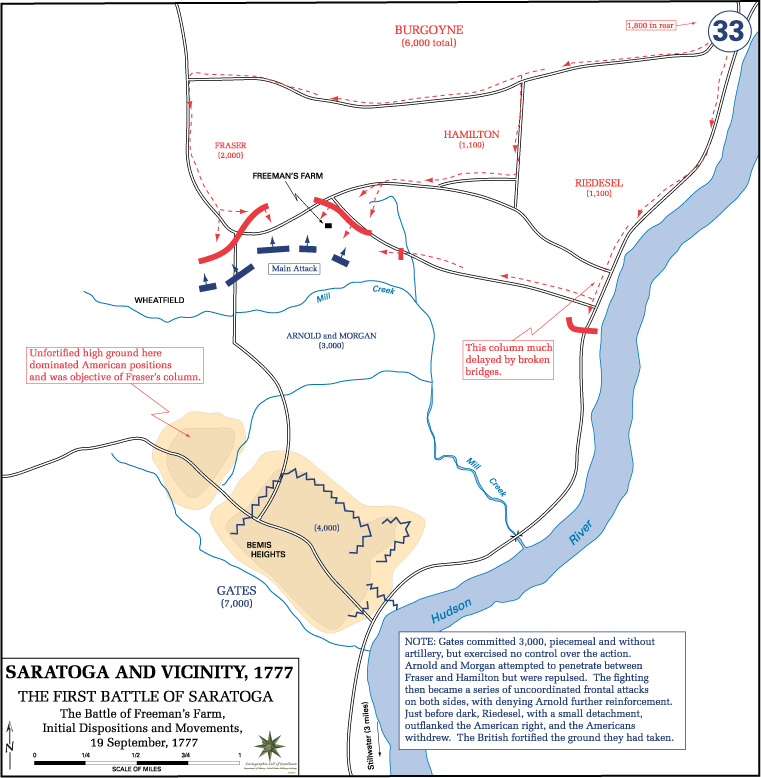
“Troop Movements at the First Battle of Saratoga, 19 September 1777” (United States Military Academy)
His army reduced, his supplies nearly gone, and no relief arriving from the south, Burgoyne withdrew to Saratoga (present-day Schuylerville), where he was surrounded and, on October 17, 1777, surrendered his entire army under the Convention of Saratoga. By its terms his troops, the so-called "Convention Army," were marched to the vicinity of Boston, ostensibly to await passage to Britain.[56]
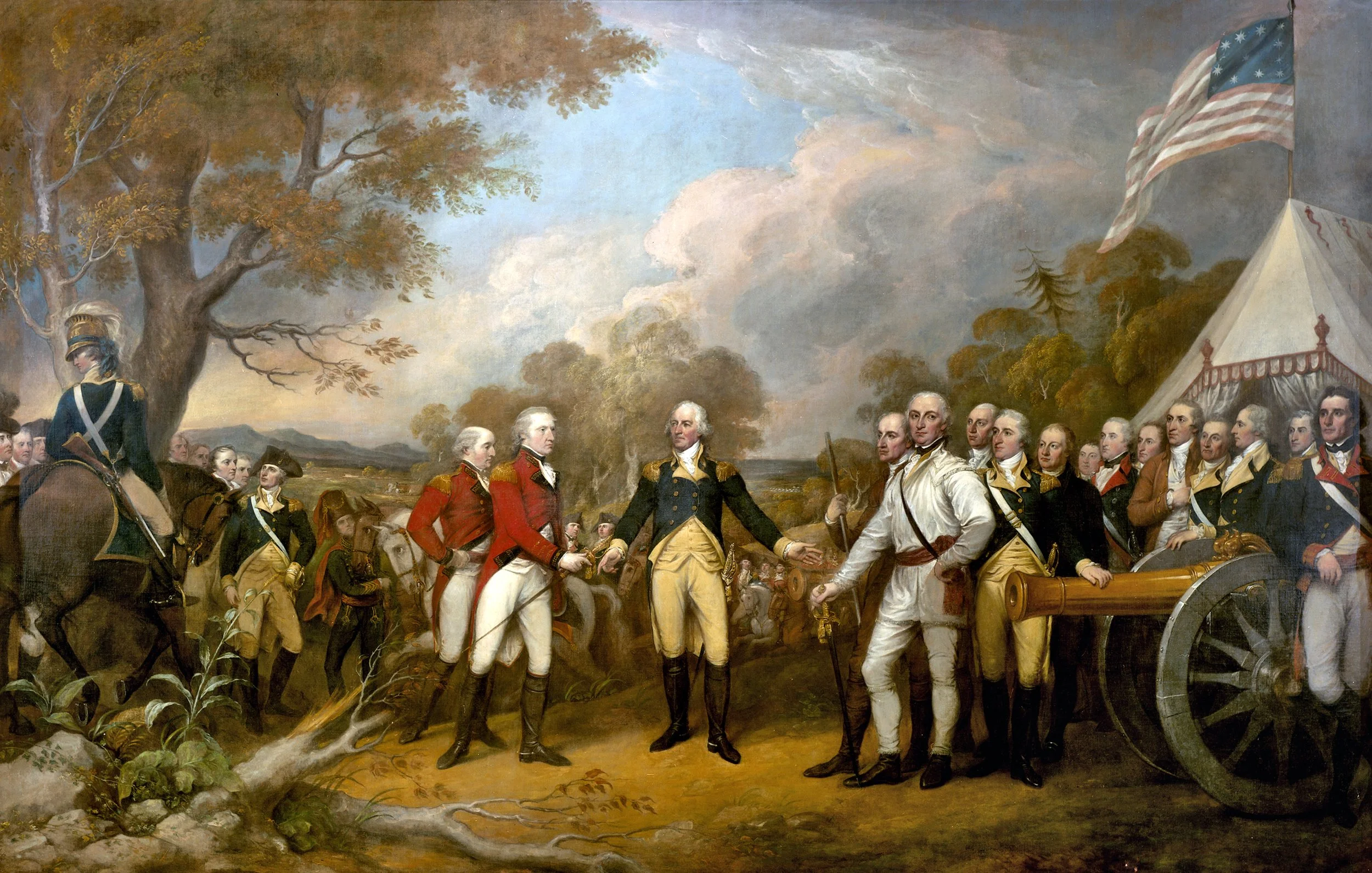
“Surrender of General Burgoyne,” painting by John Trumbull (Wikimedia Commons)
Baxter was included in this surrender. By the ninth article of the Convention, which permitted Canadians and the many "followers of the army" to return to Canada by the shortest route, he expected, by his own account, to be sent north. [57] His course after the surrender is, in the words of his family historian, difficult to trace, and he did not in fact reach Canada. He and his son Benjamin instead appear on a list of prisoners sent from Newport, Rhode Island, in the prison ship Lord Sandwich, which landed them at Bristol, Rhode Island, on March 7, 1778.[58]
Note: The circumstances of Simon’s identification as a prisoner are not easily reconciled and warrant caution. Newport was held by the British from December 1776 until October 1779, while Bristol, on the mainland, lay outside the British lines; a vessel carrying prisoners from Newport to be landed at Bristol would ordinarily indicate men being released out of British custody into American territory under a flag of truce. Baxter, however, was a Loyalist who had surrendered with Burgoyne to the Americans at Saratoga, and who, by his son William's later confession, was at Cambridge, Massachusetts, awaiting exchange as late as the end of March 1778. Whether the entry reflects an exchange whose direction the compilation's heading records incorrectly, a movement of Loyalist prisoners the surviving records do not fully explain, or some stage in the protracted negotiations over his release, cannot be determined from the printed abstract. J. B. M. Baxter himself remarked that after the surrender it was "difficult to trace his course."
The significance of Saratoga extended far beyond the field. The surrender of an entire British army is widely regarded as the turning point of the Revolution: it convinced France that the American cause was viable, leading directly to the Franco-American Treaty of Alliance of February 1778 and the open military and financial support that would prove decisive at Yorktown in 1781.[59] Strategically, Burgoyne's defeat shattered the British design to control the Hudson corridor and cut New England off from the middle colonies — a failure that left Washington free to draw recruits and supplies from across the states through the hard winters that followed. For a Loyalist such as Baxter, the same victory marked the collapse of the cause to which he had committed himself, and the beginning of the long sequence of imprisonment, exile, and confiscation that would define the rest of his life.
Confiscation of Property
By this stage, New Hampshire authorities increasingly regarded prominent Loyalists not merely as political dissenters, but as potential military collaborators. In the aftermath of Burgoyne’s defeat at Saratoga, the state intensified efforts to punish and dispossess those considered dangerous to the Revolutionary cause, leading ultimately to the confiscation of Baxter’s property.[60]
In November 1778, the State of New Hampshire passed an act formally confiscating the estates of a number of Loyalists, including Simon Baxter of Alstead. The legislation declared that those named had “left this and the other United States and gone over to and joined the enemy thereof” and had aided the British “to the utmost of their power.”
The act further stated that the individuals named had “justly forfeited all right to protection” from the state, as well as “their right to any further enjoyment of their interest and property being within this state.” As a result, “the whole estate, real and personal” belonging to Simon Baxter and the other Loyalists was confiscated for the use of New Hampshire.[61]
Under Revolutionary confiscation laws, Loyalists who had joined or assisted British forces were commonly treated as absentees or enemies of the state, allowing their estates to be seized and sold by public authority.
The legislation authorized county officials to locate, seize, inventory, manage, and sell confiscated Loyalist property. They were empowered to dispose of personal estate at public auction, although the act directed them to leave families with whatever household goods were considered “necessary for the use and support” of their households.[62]
In Cheshire County, Isaac Temple, Timothy Fletcher, and Absalom Kingsbury were appointed commissioners over Baxter’s estate, with Fletcher serving as trustee. An inventory of the confiscated property included “a part of the 5th Lot in the eighth Range, about 100 Acres,” one-half of Lot No. 17 in the North Range of Lots in Alstead, two acres in the “Citidal” lots, and “one Dwelling House in the Highway.”[63]
The bill passed the House of Representatives on November 27, 1778, and was enacted by the Council the following day.[64]
Prudence Baxter’s Petition
The confiscation proceedings left Prudence Baxter and her children in an increasingly precarious position. By late 1778, Simon remained separated from his family and associated with the British side, while New Hampshire authorities moved to seize his estate and strip him of legal protection within the state. Hoping to obtain clemency for her husband, Prudence submitted a petition to the New Hampshire Council and Assembly on December 14, 1778, pleading for mercy and emphasizing Simon’s alleged repentance and previous kindness toward American prisoners:
“To the Honble Council and assembly for the State of New Hampshire—the humble petition of Prudence Baxter of Alstead in the County of Cheshire humbly shews and gives your Honours to be informed that your petitioner doth not send this prayer to your honours for riches nor honours—but for mercy and I may say forfeited mercy might be extended to Simon Baxter the husband of your petitioner—who did in July 1777 go over to the enemy—but has ever since the repentance his error with a flood of tears—I do not mean to trouble your honours with any thing but the truth, and Capt Holmes of Walpole and Capt Gilbert of Littleton can and will if called upon testify that the said Simon Baxter has for a long time past been a friend to America and Capt Wait of this town who is now in the army and has been a prisoner with the enemy can testify the kindness the said Baxter shew to the prisoners of the united states and ever since has had a desire to return and swear allegiance to the united states and is now detained in a flag in Boston harbour—and does earnestly pray for mercy—and as their is none that is guilty has less than he so none a fairer plea for pardon—spare him humbly pray—I ask not for his estate—only for his life under such limitations as you in your wisdom shall see proper to allow—the said Baxter did while he was in the war as my family has since with our complaining—suffer him I humbly pray to be once more a subject of this state and have the liberty of the oath of allegiance to the united states—
Alstead, December ye 14th, 1778.”
Prudence Baxter[65]
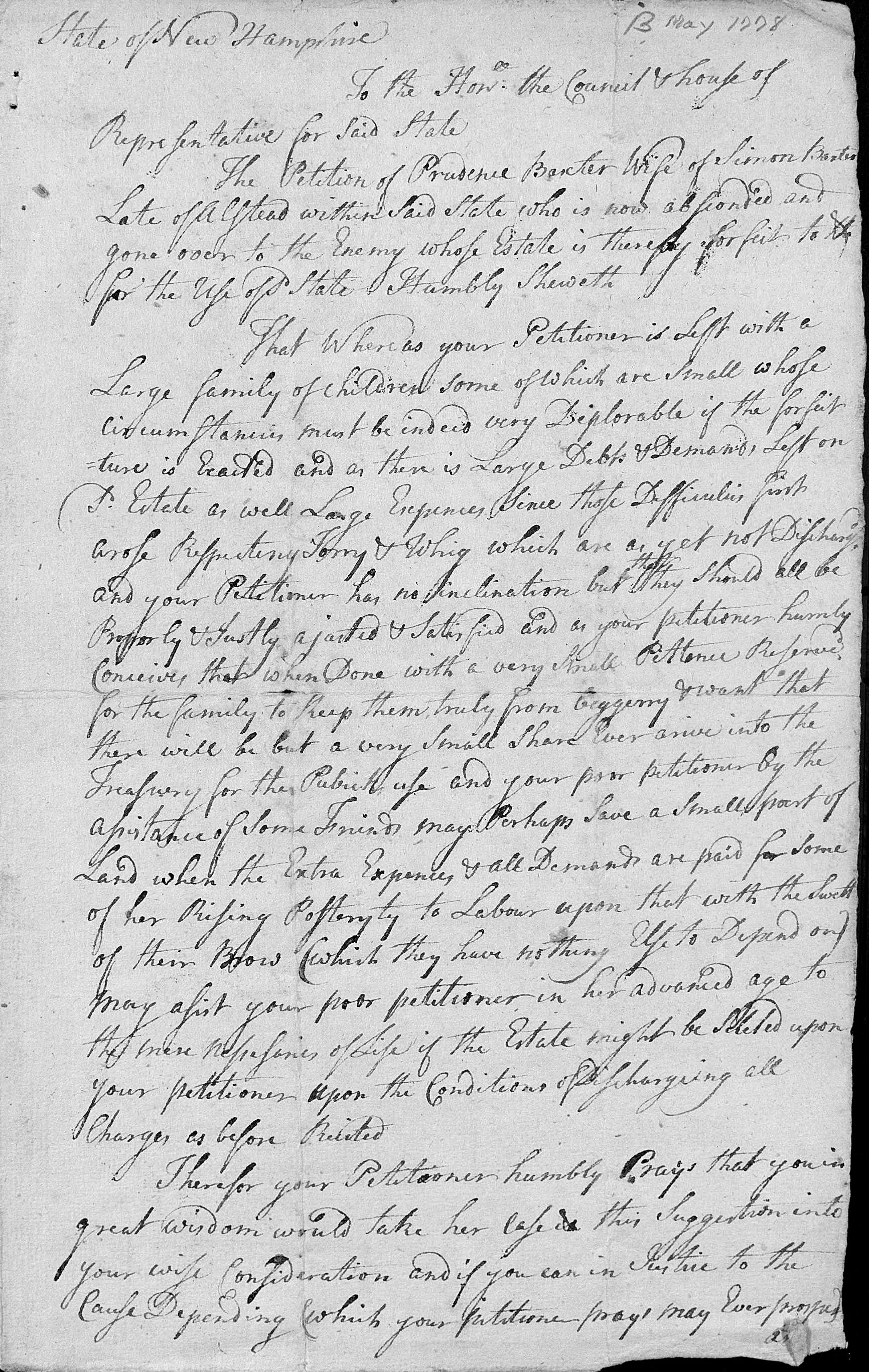
Page 1 of Prudence Baxter’s petition (FamilySearch)
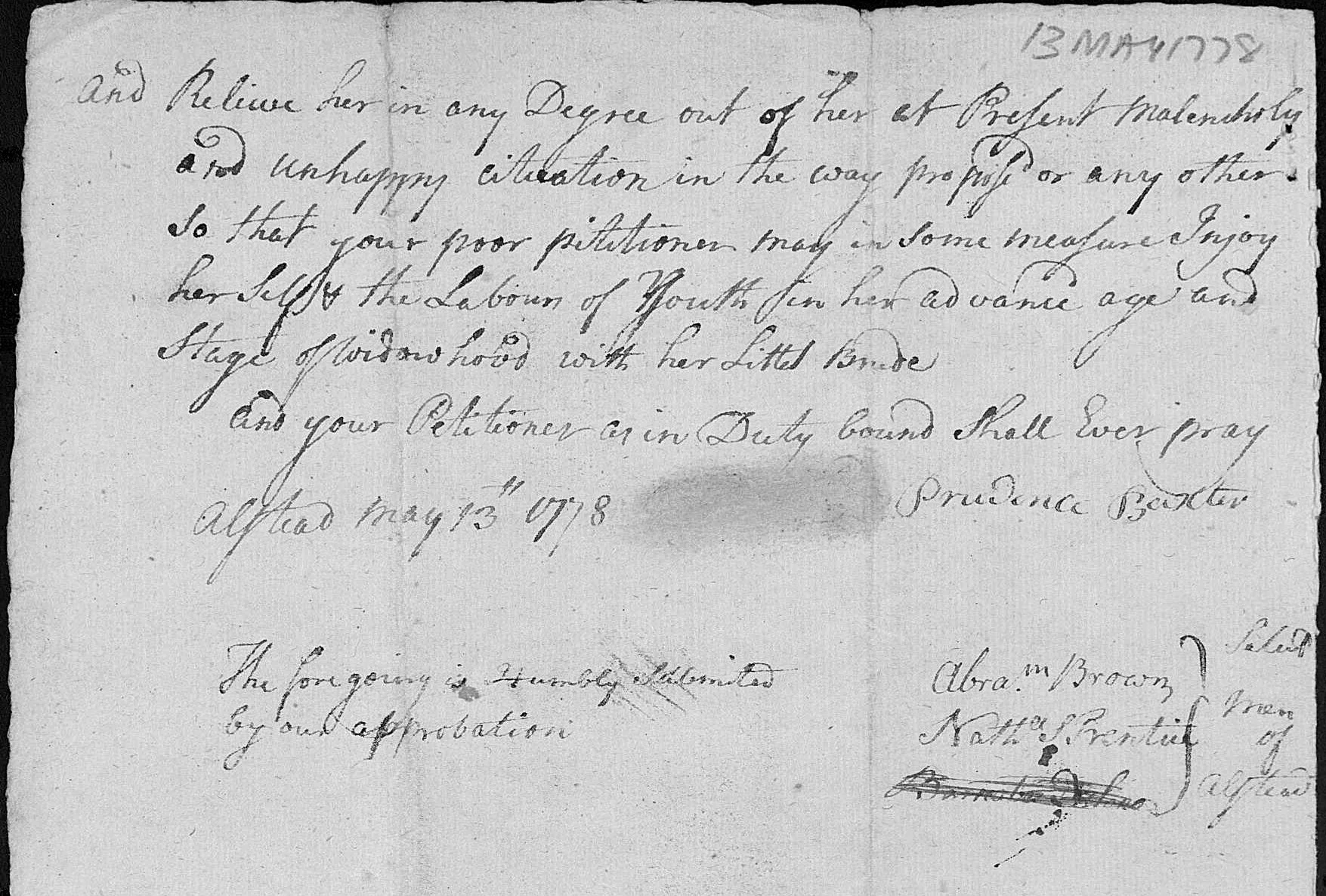
Page 2 of Prudence Baxter’s petition (FamilySearch)
Although Simon Baxter disappears from most surviving New Hampshire civil records after his escape in 1777, the later confession of his son William Baxter provides a rare glimpse into Simon’s movements during this period. Given before Revolutionary authorities in January 1779, William’s testimony traced his father’s movements from Cambridge, Massachusetts, to Rhode Island, New York City, and Long Island while associating with Loyalists, exchanged prisoners, and refugees connected to the British side during the war. The confession also suggests that Simon attempted to return to New England after becoming disillusioned with British service, stating that the British “would not exchange him unless he would go into their servis” and that “he said he would not do that.” The document further connects Simon to the possession and circulation of large quantities of suspected counterfeit Continental currency, an accusation that would soon lead to criminal proceedings against both father and son.
Confession of William Baxter
“I left home 28th of March 1778 & went to Cambridge there I found my father and he was to be exchanged and said I must go with him I told him I did not love to leave my mother he said I had better go with him & I finally concluded to go with him to Rhode Island which I did when I got to Rhode Island I worked with one...
Seaven or Eight Days my father did not do any business that I know of then he and I went to N York and had the Small pox together and was in N. York about A month then he told me I must go to Long Island and look out for myself and Dr. Pomroy [Doctor Josiah Pomroy was an absentee from Keene] would get me a place to live at and I went to Long Island with Dr. Pomroy and left my father at N York and I lived with one Abraham Brinkroff about a week and then my father came to me and told me he intended to return to Cambridge for they meaning the regulars would not exchange him unless he would go into their servis an he said he would not do that—
He had drawn rations till then and because he would not go into the regular service they stopt his rations then he worked in the same house with me till we went on board the Carteal that lay at Newtown and went to N York before we went from Newtown my father & Dr Pomroy went somewhere and then my father gave me five hundred £ N York currency and told me he had it of Dr Pomroy for which he told me he gave Dr Pomroy a note for twenty pounds in hard money and my father told me to put it where the people of the house could not find it and said when we got back to Cambridge we could live well I told him we should be found out he was very angry with me & said he brought me to be a help to him but instead of that I was nothing but a plague and said he wished I was at home again—
Then we went to York and while we were waiting for the flag to come off I went to work to help lode the vessel and my father went back to Dr Pomroy at Newtown and when he came back he brought about a thousand dollars more as near as I can remember and told me to hide it and said he was to have some more as soon as it was struck off and signed—
The next day he went of again and brought so much as with what he told me to hide the day before Made up a thousand pounds that I saw but how much more I dont know then he had some hard money and with that bought cloathing to send by me home to his famely—
While we lay at N York one evening Bejn whiting Saml Tarbull Will Stark Robt L. Fowle—Blair two Cummins Benjn Trow my father and myself ware togather at Jno Strouts in New York and I see Benjn Whiting have one thousand Dollars in forty Dollar Bills and offered my father if he would take the Money and put it of att Cambridge or anywhere in ye Country he would give him five hundred Dollars of it which my father took but told me he returned it Back then the said Benjamin Whiting Said if he could not get any Body to fetch it Meaning the money he would fetch it himself or all the Dd Rebels would be overcome before Next year was out—
The next Day we Sailed for Boston and after we had got to Boston I told my father I would not go back he said he believed I had as good go home and told me to take the Cloathing with me and carry it home to Mother and he counted some money to me vis ten forty Dollar Bills & Seaventeen twenty Dᵒ and about Ninety five Dollars in good Money and told me to be carefull I said I was afraid it would hurt me he said the money would do him no good and if I was like to be hurt by it I might burn it—
And then I set off for Cambridge and went to Joseph Welches and he was going to Boston and said he wanted some paper money and Asked me if I had any that I could spare I told him yes and I gave him fifty six Dollars for a Joannes and he went to Boston and came and told me he had got a hors for me and a boy to Carry me to Littleton for twenty Dollars and said if I would give him twenty more he would find another hors for my baggage and said he had some hard money & if I would change fifty paper Dollars he would let me have another Joannes which I Did and if I would give him fifty six Dollars he would let me have two Guinnes which I Did I saw a hessian in Cambridge and changed fifty paper Dollars for two Guinnes then I left Cambridge and went to Littleton and Capᵗ Gilbert and I went to Boston to get my father out of the flag but Genl Heath would not Permit him to come out and there I bought 3 ydˢ of Salloon & 3 yds of Lace & Exchanged 3 twenty Dollar Bills
Then I Returned to Cambridge and there I met a Negro fellow with a watch and I gave him four twenty Dollar Bills and 2 Eight Dollar Bills & one four Dollar bill for ye watch then I returned to Littleton & from there to Keene and got to Benjn Halls and his Son Annanias asked me if I had got any Catchett meaning Counterfit money I told him yes he Looked on it and told me he would put it of for me & Return me two thirds of it in good money which I consented to Do
After that Zibia Hall his brother asked me if I had any Catchett I told him I had not for Anna’ had got it he said he was the wrong Person to give it too for he would be to Ventersome I saw Anny after that he told me that Zibia wanted it for he had put a large Some of it which if I mistake not was four Hundred Dollars & that 30 Dollars was returned Back which he could not put of so I went home and was Immediately taken up and then I sent my Brother Joseph to Anna hall for the money I left with him and he brought 7 forty Dol bills & 1 twenty Do & 1 good Do & Keept two I had Left ten forty Dollar Bills with him & one twenty—
My Brother Joseph & I hid the money he brought from Annas Hall in the barn Namely 7 forty Dollar bills & 1 twenty Do all the Money I mentioned in the foregoing Account that I have not Called good I suppose was Counterfit—
While I was at Cambridge at Joseph Welches Welch Inquired of me About the Monmouth Battle & about yᵉ Brittish troops I told him they Suffered a Good Deal he said the Rebels had it in there papers that they ware beat but he Did not Believe it and said he wished to God that he was at New York with his famely and Enquired if there was any Houses to be Let I told him yes but they ware very Dear he Repeated he Wished he was there Dear as they was—
While I was in New-York I saw one Timothy Lovell of Rockingham and one Hubbard of Windsor in yᵉ State of Vermont two Refugees and they have both stole out since and I saw Lovell in Littleton and he told me not to Mention to any Body that he was out of New York for it might hurt him and would not Do me any Good and he enquired where Majʳ Joseph Blanchard Lived & said he was going there to Holles but nobody suspected that Hubbard had been to N York that I know of and he now Lives peaceably at home as I have heard I Likewise saw one Joseph Durfey of New London in yᵉ State of Connecticut in New York He said he Did not know what the Rebells would Do to him when he came out nor Did not care a Dᵈ t—d.
the foregoing Relation is to the Best of my Remembrance the truth the whole truth and Nothing but the truth which I can attest before the Almighty God.
January 8ᵗʰ 1779
William Baxter.
N.B. Said Baxter confessed that his brother Joseph told him that annaniass Hall told him he put off a 40 Dollar bill to one Hall a sadler in Keen, in the following way the Sadler gave a good 40 Dollar Bill to said annaniass to change into small Bills—and anns said after taking the good Bill & could not change it, and then gave him a Counterfeit in Lieu.”[66]
Additional testimony given during William Baxter’s examination partly corroborated his account. Although William’s formal confession was dated January 8, 1779, he had already been arrested and examined by New Hampshire authorities several weeks earlier. On November 11, 1778, Captain Lemuel Holmes stated that while he himself was being held on Long Island, William Baxter “lived with a farmer on Longisland & Laboured for him for hier” and “did not join in the Brittish servis or Draw Either Money or Provision from them.” Holmes further testified that Simon Baxter had concluded it was “more Difficult to support him there Than he Expected” and therefore believed it best that William return home. Holmes recalled that William had arrived on Long Island “some time in June Last Past.”[67]
William Baxter was arrested in Alstead on November 11, 1778, by constable Joel Chandler under a warrant issued by Nathaniel S. Prentice. After examination, he was sent before the General Assembly. On November 18, 1778, the House of Representatives ordered that William be delivered to the sheriff to be “sent back to New York by the first conveyance.” He ultimately appears not to have been deported, however, and was later released on bail under restrictions limiting his movement to Exeter. Over the following two years, the authorities appear gradually to have relaxed these restrictions. In 1779 he received temporary passes permitting travel between Exeter and Alstead, and by April 1780 he was employed by the Committee of Safety to carry official correspondence summoning the General Court to Cheshire County.[68]
William Baxter’s testimony provides one of the clearest surviving accounts of Simon Baxter’s movements during the Revolutionary War. It places Simon in British-controlled New York during 1778 among Loyalists, exchanged prisoners, and refugees while also suggesting growing frustration with his circumstances after British authorities allegedly pressured him to enter military service in exchange for continued support. The confession further tied Simon to the circulation of suspected counterfeit Continental currency through Loyalist networks operating between New York and New England, allegations that would soon result in criminal proceedings against both father and son.
William Baxter’s confession intensified suspicions that Simon Baxter had become involved in the circulation of counterfeit Continental currency while moving between British-controlled New York and New England. Massachusetts authorities soon initiated formal criminal proceedings against him.
Indicted for Counterfeiting
In 1779, Simon Baxter of Alstead, New Hampshire, was indicted in Massachusetts for knowingly passing a counterfeit Continental bill. According to the indictment, he uttered a forged eight-dollar bill in Boston to Archibald McDonald while allegedly aware that it was counterfeit and fabricated to imitate official currency issued by the United States Congress. Baxter pleaded not guilty, but after trial the jury found him guilty. In his later Loyalist memorial, Baxter claimed that upon arriving at Boston he was “thrown into Boston Goal” and remained imprisoned there for approximately nine months. He further stated that he had been indicted for both high treason and passing counterfeit currency, although only the counterfeiting prosecution resulted in conviction. The court sentenced him to pay a £90 fine to the state, compensate McDonald with treble damages amounting to £7 4s., serve six months in prison, stand for one hour on the gallows with a rope around his neck as a form of public humiliation, and pay the costs of prosecution. He was to remain imprisoned until the sentence was fully carried out.[69]
Baxter later alleged that after his release from Boston confinement he was sent to Rutland Barracks and briefly paroled to visit his family in New Hampshire. According to the memorial, local inhabitants attacked him during this visit, tied him to a tree, wounded him with bayonets and a sword, and severely whipped him before returning him to custody. He claimed that he was subsequently confined at Rutland and Worcester before eventually escaping and making his way to Penobscot, from which he reached Nova Scotia in September 1781.[70]
Following these proceedings, Baxter continued to move through a series of imprisonments, paroles, and escapes while attempting to leave the revolutionary states. His later memorial indicates that he was confined at Rutland and Worcester before eventually escaping to Penobscot and reaching Nova Scotia in September 1781. By that time, his New Hampshire estate had been confiscated and sold, effectively ending his life in the United States.
Exile and Resettlement in Canada
By 1781, Simon Baxter appears to have aligned his future firmly with the Loyalist evacuation and resettlement movement then unfolding in British North America. Having lost his New Hampshire property through confiscation and become increasingly unwelcome in the revolutionary states, he sought both official recognition of his earlier military service and permission to establish himself permanently along the Saint John River in Nova Scotia.
On October 9, 1781, Simon Baxter submitted a memorial to Sir Andrew Snape Hamond requesting a land grant on the Saint John River. In his petition, Baxter stated that he was entitled to 2,000 acres of land agreeable to His Majesty’s Proclamation of October 7, 1763, and emphasized that he had never previously received such a grant in any of His Majesty’s American provinces. He therefore “humbly prays, he may have a grant thereof on St. Johns River.” In support of the request, Baxter swore an affidavit affirming his earlier military service, declaring that he had “served in the late War as Lieutenant and Adjutant in General Lyman’s Provincial Regiment” and that his commissions had been “taken from him by Rebels when he was a Prisoner amongst them.” The memorial establishes Baxter’s claim to land as a former provincial officer and situates his later settlement along the Saint John River within the broader framework of Loyalist-era land grants tied to military service.[71]
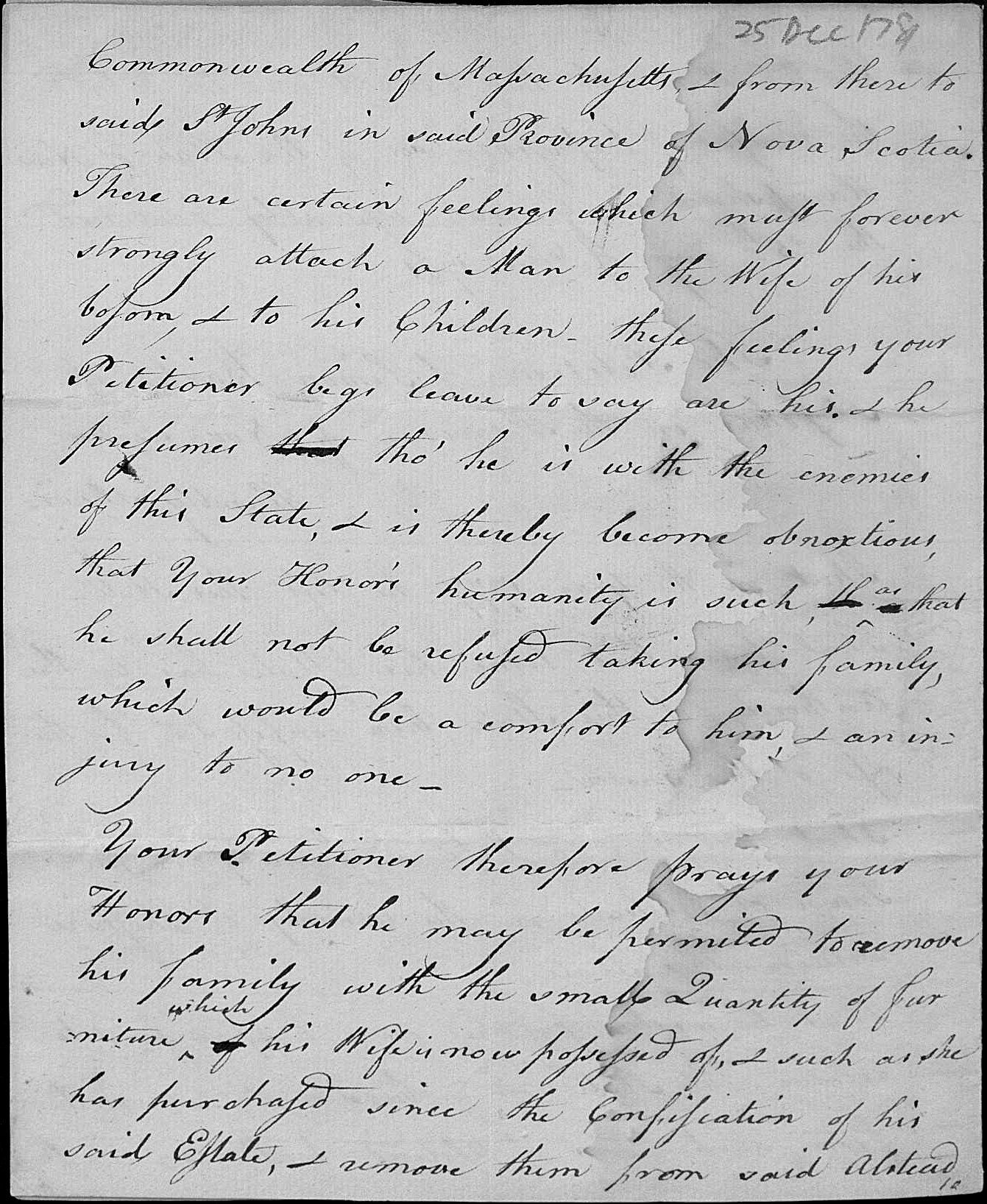
While seeking land on the Saint John River, Baxter also attempted to reunite his family and remove them from New Hampshire into British territory. In December 1781, he petitioned the New Hampshire General Assembly for permission to transport his wife, children, and remaining household goods from Alstead to Nova Scotia. The petition reveals both the emotional strain of the family’s separation and Baxter’s growing determination to establish himself permanently in British North America.
“To the Honorable the Council and the Honble the House of Representatives of the State of New Hampshire in General Assembly Convened the 25th day of December 1781.
The Petition of Simon Baxter of St Johns in the Province of Nova Scotia Humbly Shews,
That in the year 1777 he left this State.
That since that time his Estate has, by the authority of this State, been confiscated for the use of the same.
That he has a Wife & family in the Town of Alstead in the County of Cheshire within this State
That he wishes for his own happiness, & to relieve the State of a burden, to remove them from said town of Alstead to Boston in the Commonwealth of Massachusetts, & from there to said St Johns in said Province of Nova Scotia.
There are certain feelings which must forever strongly attach a Man to the Wife of his bosom & to his Children. These feelings your Petitioner begs leave to say are his & the presumes though he is with the enemies of this State & is thereby become obnoxtious, that your Honor's humanity is such as that he shall not be refused taking his family, which would be a comfort to him & an injury to no one.
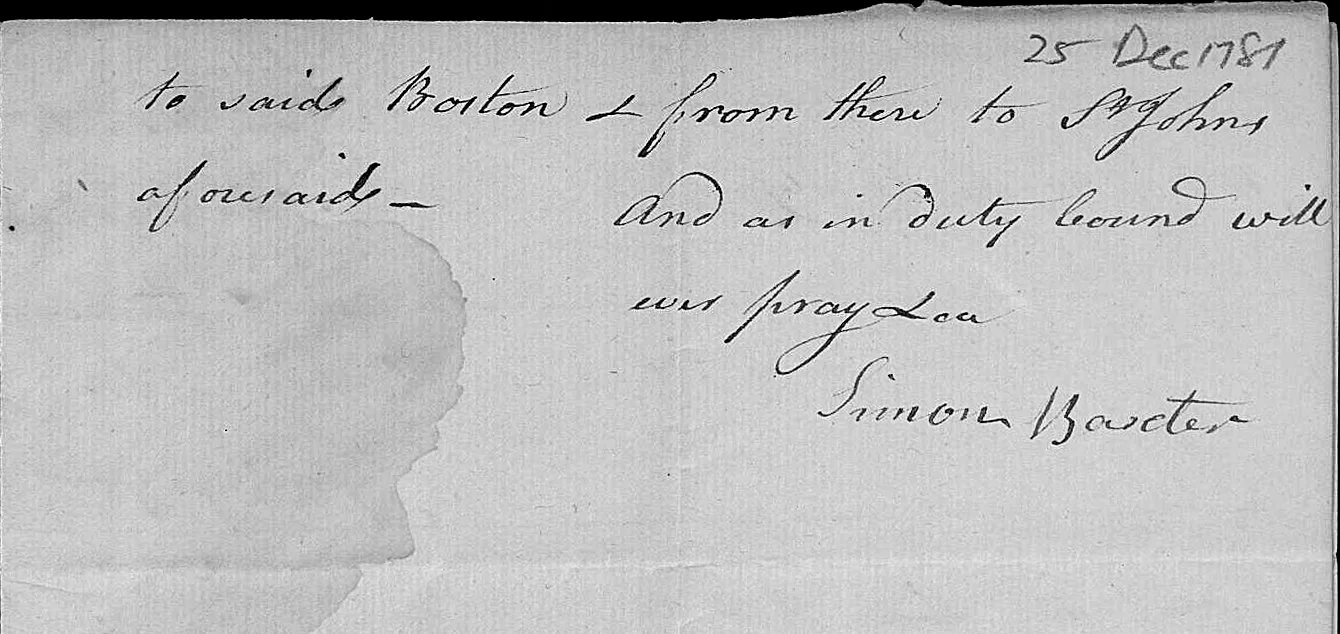
Your Petitioner therefore prays your Honors that he may be permited to remove which his family with the small Quantity of our furniture which his Wife is now possessed of, & such as she has purchased since the Confiscation of his said Estate, & remove them from said Alstead aforesaid to said Boston & from there to St Johns and aforesaid.
And as in duty bound will ever pray &c.
Simon Baxter”[72]
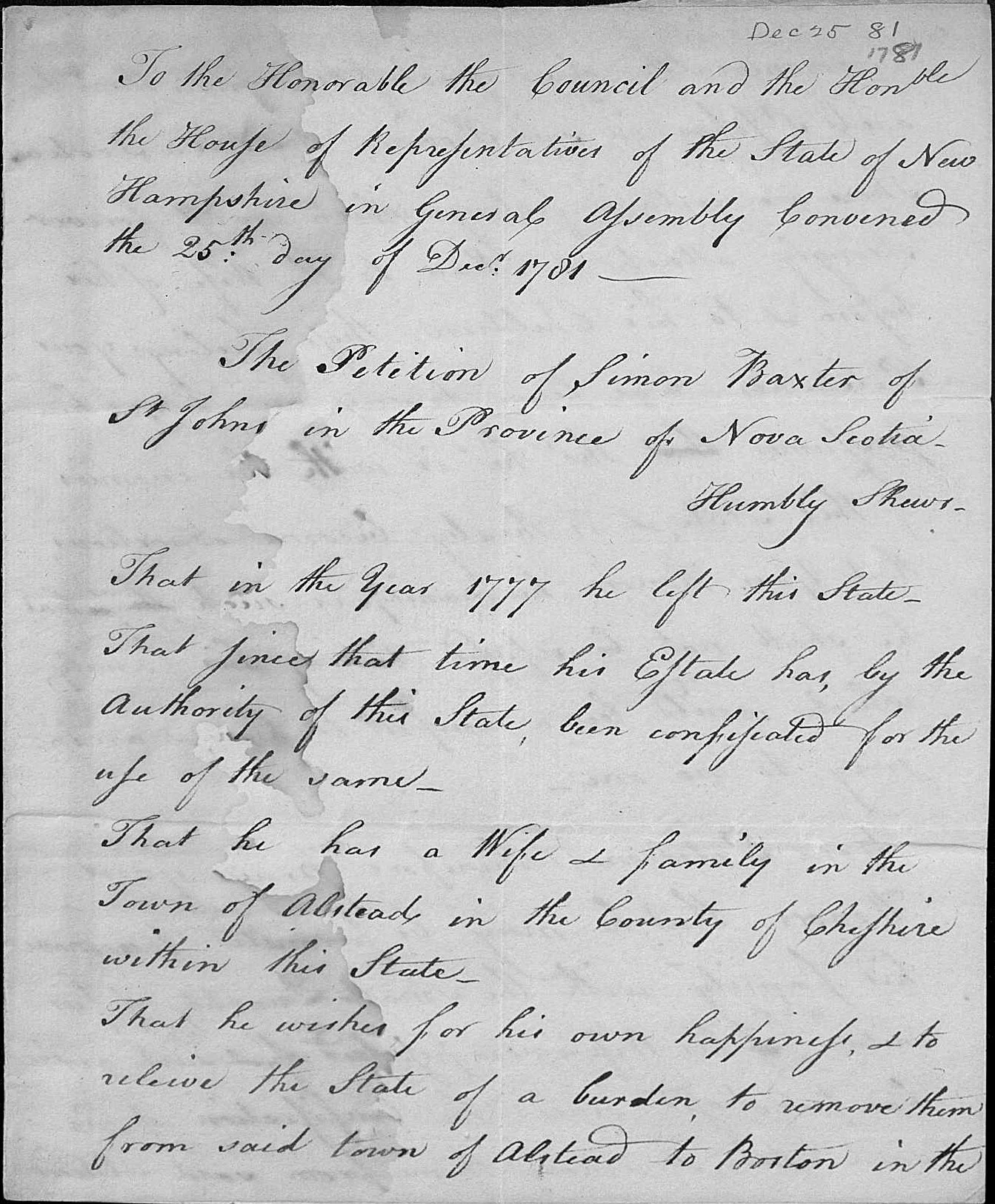
Page 1 of Simon’s Petition to the State of New Hampshire (FamilySearch)
Page 2 of Simon’s Petition to the State of New Hampshire (FamilySearch)
Page 3 of Simon’s Petition to the State of New Hampshire (FamilySearch)
Simon’s petition was approved by the State of New Hampshire. According to John B. M. Baxter’s family history, Simon travelled from Halifax to Boston in December 1781 carrying a letter from Governor Hamond. He received permission to proceed to Alstead, collect his family, and remove them to Nova Scotia by way of New York.[73]
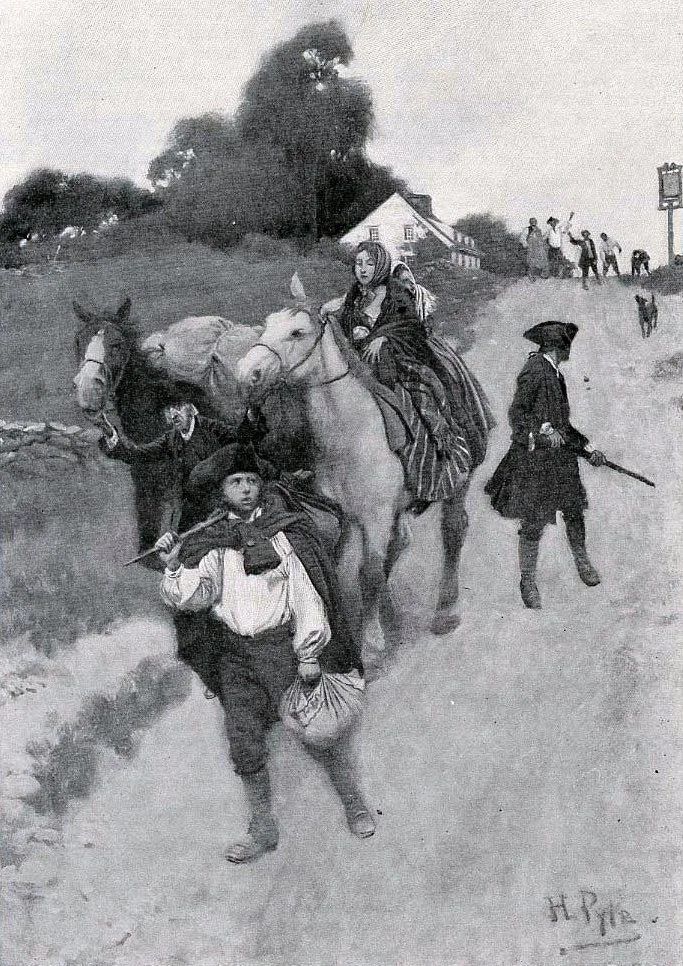
"Tory Refugees on the Way to Canada" by Howard Pyle (Wikimedia Commons)
Loyalist Settlement on the Kennebecasis
By 1782, Simon Baxter had firmly aligned his future with the Loyalist resettlement movement unfolding along the Saint John River. Following years of political persecution, imprisonment, confiscation proceedings, and separation from his family during the Revolutionary War, he emerged among the early Loyalist settlers receiving Crown-supported land grants in what would soon become New Brunswick. The grants issued to Baxter and his associates formed part of a broader British effort to establish stable settlements for displaced Loyalists while securing imperial control over the Saint John River valley in the aftermath of the American Revolution.
In 1782, Simon Baxter was the subject of a warrant issued under the authority of Sir Andrew Snape Hamond directing the survey of land in accordance with “His Majesty’s Proclamation of the seventh of October 1763.” The warrant instructed the chief surveyor to “admeasure and lay out unto Simon Baxter a reduced Lieutenant a Plantation containing two thousand Acres of Land,” thereby recognizing his entitlement as a former provincial officer. A subsequent return of survey indicates that this allocation formed part of a much larger, contiguous tract on the Kennebecasis River, in which land was laid out not only to Baxter but also to several associates.
The surveyor reported that he had “caused to be surveyed and laid out unto… Simeon Baxter Five Thousand Acres,” alongside smaller parcels granted to William Baxter, Benjamin Baxter, Benjamin Snow, Duncan Campbell, and John Hazen, together comprising approximately 9,500 acres in a single block. The land was described as wilderness, with allowances made for roads and unfit ground, and was not considered suitable for fortifications or naval use. Additional warrants issued the same year further confirm the coordinated granting of land to Baxter and other Loyalist refugees, situating his holdings within a broader settlement scheme along the Saint John and Kennebecasis rivers.[74]
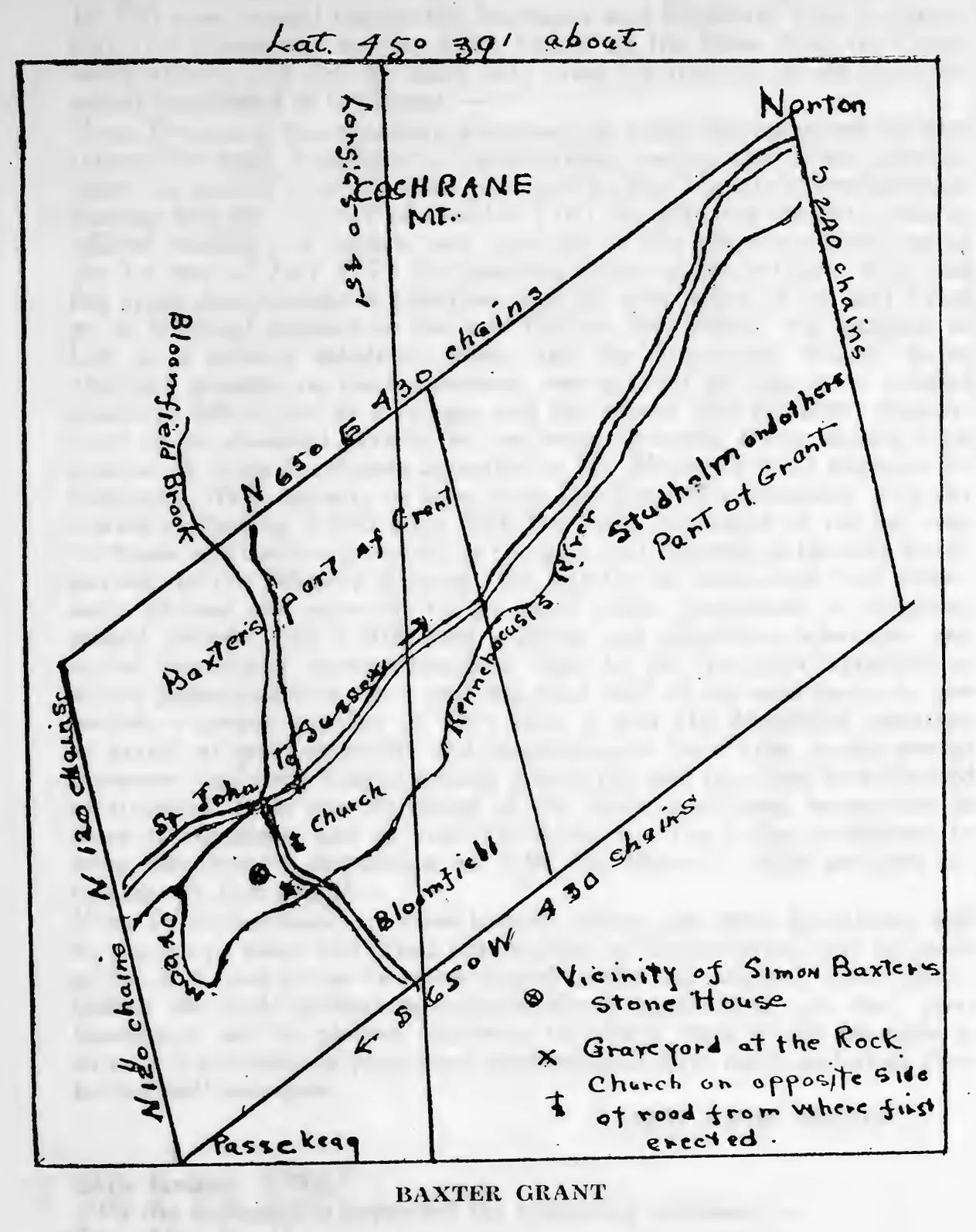
“Baxter Grant” (Simon Baxter (the first United empire loyalist to settle in New Brunswick) his ancestry and descendants)
On August 15, 1782, Sir Andrew Snape Hamond issued a formal Crown grant to Simon Baxter and several associates, establishing the legal foundation of Baxter’s later landholdings in present-day New Brunswick. Acting “by Virtue of the Power and authority… under the Great Seal of Great Britain,” and pursuant both to “His Majesty’s Proclamation… of the seventh day of October one thousand seven hundred and sixty three for granting Lands to reduced Officers” and to later directions “for granting Lands to Refugees who have fled from the Colonies in rebellion,” the grant conveyed a large tract of approximately 9,500 acres on the Kennebecasis River. The land was granted jointly to Gilfred Studholme, Simon Baxter, William Baxter, Benjamin Baxter, Benjamin Snow, Duncan Campbell, and John Hazen, with specific allotments assigned within the tract. Notably, Simon Baxter received 5,000 acres, described explicitly as granted to him “as a reduced Subaltern officer and as a Refugee,” while Studholme received 2,000 acres and the remaining grantees 500 acres each.
The grant defined the tract by boundary markers beginning at the eastern line of a township on the Saint John River and extending in a large parallelogram block, “allowance being made for Sunken lands and for all such roads as may hereafter be deemed necessary.” It conveyed the land in fee simple, together with appurtenances and most mineral rights, subject to standard Crown reservations. In return, the grantees were required to pay a nominal quit rent of one farthing per acre, beginning ten years after the date of the grant, failing which “this Grant shall be null and void.” More significantly, the grant imposed detailed settlement and improvement conditions: within three years, the grantees were required to “clear and work three Acres for every fifty acres,” or alternatively drain swamp or marsh land, maintain livestock, construct a dwelling house of specified dimensions, or engage in quarrying or mining operations. Compliance with these requirements was necessary to secure the land against forfeiture, and proof of such “seating, planting, Cultivation and improvement” was to be entered in the public record.
This instrument, registered on September 3, 1782, constitutes the original legal grant under which Simon Baxter and his associates acquired title, forming the legal basis for Baxter’s subsequent landholdings within the broader framework of Loyalist settlement policy and Crown land distribution following the American Revolution.[75]
Following his arrival on the Saint John River, Simon continued to expand and consolidate his landholdings along the Kennebecasis. Like many early Loyalist settlers, he acquired additional property through private transactions while also becoming involved in disputes arising from overlapping settlement claims and informal occupation prior to the formal issuance of Crown grants.
On May 28, 1783, Robert Charlton conveyed a tract of land to Simon Baxter for a stated consideration of £1 3s. 4d., with the remaining balance otherwise secured to Charlton’s satisfaction. The property, comprising approximately 700 acres, was described as land previously conveyed to Charlton by John Hays and situated in the Kennebecasis region. The deed transferred the land to Simon Baxter, his heirs, and assigns forever, together with all associated privileges and appurtenances, and included a covenant by Charlton to warrant and defend the title against all lawful claims.[76]
On November 15, 1785, Ebenezer [Howe?] submitted a petition to Governor Thomas Carleton concerning a tract of land on the Kennebecasis River that had been granted to Simon Baxter. Howe stated that he had previously settled on the property with his family and had made improvements at considerable expense, including planting a crop of wheat, before being dispossessed after the land was formally granted to Baxter. He further alleged that Baxter refused to compensate him either for the improvements or for the crop. Howe therefore petitioned the government for redress and compensation for his losses. Although the outcome of the petition is not stated, the document illustrates the often contested nature of early Loyalist-era land grants, where formal Crown allocations sometimes overlapped with earlier informal settlement and improvement claims.[77]
Memorial of a Loyalist Refugee
In 1786, Simon Baxter submitted a formal memorial to the British Commissioners for Enquiring into the Losses and Services of American Loyalists. Established after the Revolutionary War, the commission investigated claims by Loyalist refugees seeking compensation for confiscated property, wartime losses, and service to the Crown. Claimants were required to provide sworn testimony, documentary evidence, and witness statements detailing both their loyalty and the losses they had suffered during the conflict. Baxter’s memorial, taken at Saint John on November 18, 1786, summarized his political activities in New Hampshire, imprisonment, military service, confiscated property, and eventual resettlement on the Kennebecasis River.
In his sworn testimony, Baxter stated that he had supported the British government “from the first,” opposed the revolutionary movement, and helped protect the Cheshire County courts in 1774 by raising armed supporters. He claimed that these actions made him “very obnoxious” to Patriot authorities and that he was brought before revolutionary committees “thirteen different times” before finally being imprisoned at Charlestown in 1777. After escaping confinement, he joined General Burgoyne’s army at Skeensborough in July 1777 and remained with the British forces until the surrender at Saratoga.
Baxter further described his imprisonment in Boston, conviction for passing counterfeit currency, confinement at Rutland and Worcester, violent attacks by local mobs while on parole, and eventual escape to Penobscot before settling with his family on the Kennebecasis River in 1781. The memorial also documented the confiscation and sale of his New Hampshire property, including multiple lots in Alstead, a large dwelling house, livestock, mills, and farming equipment. Witnesses supporting the claim described Baxter as “exceedingly zealous in his attachment to the British Government” and affirmed that he had suffered heavily because of his loyalty to the Crown.
The commissioners ultimately recognized Baxter as a Loyalist who had “bore arms & rendered services to Great Britain.” His proven losses totalled £358.
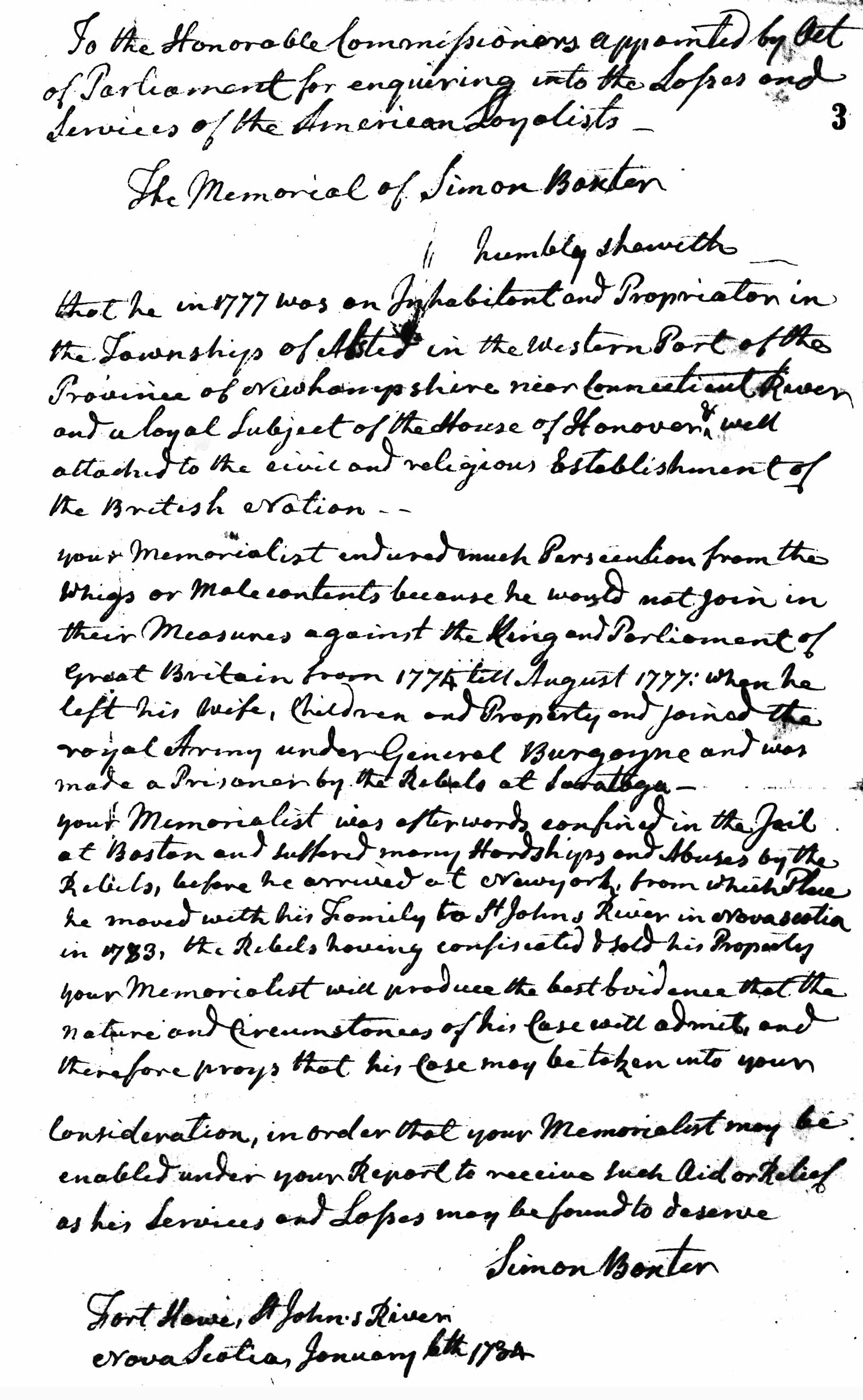
Extract from Simon Baxter’s memorial (Ancestry)
Landholding on the Kennebecasis
Simon continued to engage in numerous land transactions along the Kennebecasis and Saint John river system following his settlement in Nova Scotia (later New Brunswick). The surviving records from 1787 through 1802 reflect the continued expansion, transfer, mortgage, and gradual redistribution of his landholdings among family members. By the 1790s, many of these transactions increasingly involved his children and appear to reflect efforts by Simon and Prudence Baxter to settle portions of their estate while still reserving support and occupancy rights for themselves in later life.
February 14, 1787: Simon and Prudence conveyed approximately 424 acres of land in Kings County to John Smith for £106. The property, situated along the Kennebecasis River and Paticake Creek, formed part of the larger Loyalist grant previously issued to Simon Baxter and his associates. Prudence separately acknowledged the deed, thereby relinquishing any dower interest in the property.[78]
1787: Later that same year, Simon consolidated additional portions of the original Loyalist grant by purchasing Benjamin Snow’s interest in approximately 500 acres on the Kennebecasis River for £50, of which £35 was paid immediately and the balance due within three months. The deed stated that Simon was already in possession of the land and confirmed that the tract formed part of the larger grant originally issued to Major Studholm, Simon Baxter, and others under provincial authority.[79]
December 31, 1787: Simon mortgaged approximately 2,786 acres of land in Kings County to Thomas Spragg for £100, with repayment due by December 31, 1789. Failing repayment, title would pass permanently to Spragg. The mortgage illustrates both the substantial scale of Baxter’s holdings and the financial pressures often associated with developing Loyalist lands in the post-Revolutionary period.[80]
By the early 1790s, Simon and Prudence increasingly began transferring portions of their estate to their children while reserving varying degrees of support, occupancy, or maintenance for themselves. These conveyances frequently combined gifts based upon “love, good will, and natural affection” with carefully structured provisions intended to secure the couple’s livelihood during old age.
December 6, 1793: Simon conveyed a tract of land along the Kennebecasis River to his son Abraham Baxter “for love, good will, and natural affection.” The deed describes the property in detail, beginning at a marked tree on the north side of the river and extending through part of Simon’s larger grant. The conveyance appears to have been intended as a family settlement rather than a commercial sale.[81]
December 6, 1793: On the same day, Simon conveyed approximately 600 acres in Sussex Parish to his son Elijah Baxter, likewise “for love, good will, and natural affection.” Although Elijah received title to the property in fee simple, Simon and Prudence expressly reserved for themselves the use and enjoyment of the portions already under cultivation for the remainder of their lives. Upon the death of both parents, Elijah was to receive full possession of the improved lands without restriction.[82]
A series of transactions involving William Baxter followed in 1794 and 1796.
September 20, 1794: William Baxter, likely the son of Simon and Prudence, of Kings County conveyed approximately 500 acres along the Kennebecasis River to Simon for £10 currency. The tract formed part of the original Hammond grant and lay near the residence of Joseph Baxter, indicating the continued concentration of Baxter family holdings within the same settlement area. On that same day, Simon and Prudence transferred approximately 1,300 acres in Sussex Parish to William Baxter for £100 currency, while reserving for themselves during their lifetimes the use and enjoyment of one half of the property, including a proportional share of the buildings and privileges attached to it. The identity of this William Baxter is somewhat uncertain from the surviving records alone. Given the chronology and geographic context, he was most likely Simon and Prudence’s son William Baxter rather than another relative of the same name.[83]
February 12, 1795: Simon and Prudence conveyed approximately 500 acres to their son Joseph “for love, good will, and natural affection.” The property formed part of the family’s larger Kennebecasis holdings and appears to have included an established working farm. Although ownership passed immediately to Joseph, Simon and Prudence reserved for themselves the lifetime use of a strip twenty-seven rods in width extending across the property, thereby ensuring their continued residence and support.[84]
September 2, 1795: Simon conveyed approximately 500 acres in Norton Parish to his daughter Abigail Baxter Fahy for nominal consideration together with “love, good will, and natural affection.” The deed was structured to provide support both for Abigail and for her husband Martin Fahy during their lifetimes, while also establishing provisions for the future inheritance of their children. The conveyance divided the property into two equal 250-acre portions, one intended for the couple’s lifetime use and the other effectively held in trust for their children until adulthood. Simon additionally undertook to erect a dwelling house on part of the land.[85]
September 3, 1795: Simon modified the earlier 1793 conveyance to Elijah Baxter by relinquishing the life interest that he and Prudence had retained in the improved portions of Elijah’s property. In exchange, Elijah agreed to pay £20 annually for the support and maintenance of his father during his lifetime and, should she survive him, for the support of Prudence Baxter thereafter. The deed effectively transformed the earlier family settlement into a formal maintenance agreement intended to secure the parents’ financial support in old age.[86]
June 14, 1796: William Baxter, likely the son of Simon and Prudence, formerly of Kings County, reconveyed approximately 1,300 acres in Sussex Parish to Simon for £100 current money of New Brunswick. The deed transferred the property in fee simple together with all buildings and improvements. This transaction appears closely connected to the earlier 1794 conveyances between Simon and William and may reflect either a reorganization of family holdings or the unwinding of an earlier settlement arrangement.[87]
September 27, 1796: Simon conveyed approximately 200 acres in Norton Parish to Jonathan Shipman for £150. The property formed part of the original 9,500-acre Loyalist grant issued to Simon, Guilfred Studholm, and others and was situated near the highway leading from Kingston to Sussex Vale..[88]
October 15, 1796: Simon and Prudence conveyed approximately 800 acres on the west side of the Kennebecasis River to their son Elijah Baxter for £150. The tract formed part of the original 1782 Loyalist grant issued under the Great Seal of the Province of Nova Scotia. Later the same day, Elijah conveyed approximately 90 acres on the east side of the river to his brother Abraham Baxter for £60, suggesting a continuing redistribution of the family’s lands among the next generation.[89]
October 15, 1796: Elijah Baxter conveyed a parcel of land to his brother Abraham Baxter for the sum of £60 of the Province of New Brunswick. The property, situated on the east side of the Kennebecasis River in Norton Parish, Kings County, contained approximately 90 acres and formed part of a larger grant originally issued to Simon, Guilfred Studholm, and others under the Great Seal of the Province of Nova Scotia. The deed provides a detailed metes-and-bounds description, referencing marked boundary trees, Patucake Creek, and the limits of the original grant. It is structured as an outright sale, conveying the land to Abraham Baxter and his heirs and assigns in fee simple, together with all appurtenances.[90]
Simon continued managing and transferring portions of the family estate into the early nineteenth century. On April 21, 1801, he conveyed another approximately 800-acre tract along the Kennebecasis River to Elijah Baxter for £150.[91] Later that year, on September 28, 1801, Simon mortgaged his approximately 1,000-acre farm in Norton Parish to Munson Jarvis and Samuel Miles as security for debts totalling £269 9s. 9d., payable in annual instalments between 1802 and 1805.[92]
In March 1802, Simon and Prudence made additional transfers to younger family members. On March 20, they conveyed approximately 200 acres in Norton Parish to Simon Baxter Hays for nominal consideration together with “love and affection.” The relationship is not explicitly stated in the deed, though Simon Baxter Hays was likely a grandson.[93] Simon and Prudence's daughter Dorothy had married John Cook Hays, a doctor with the British Royal Navy and also a “purveyor of masts,” in 1781. Together they had ten children, all born in New Brunswick, of whom Simon Baxter Hays was number four.
Three days later, on March 23, 1802, Simon and Prudence conveyed approximately 113 acres adjoining Abraham Baxter’s existing property to Abraham for £28 8s. 9d. of New Brunswick.
Deaths of Prudence and Simon
Simon wrote his last will and testament on June 8, 1802.
“In the name of God, Amen. I Simon Baxter of the Parish of Norton in Kings County in the Province of New Brunswick, Farmer, being of sound mind and memory (praised be God for the same) and being desirous to settle my worldly affairs whilst I have strength and capacity so to do—do make and publish this my last Will and Testament hereby making void and revoking all former wills by me at any time heretofore made—And first and principally I commit my Soul into the hands of my Creator who gave it and my body to the earth at the discretion of my executors herein after named—And as to such worldly Estate and property wherewith it has pleased God to entrust me, I dispose of the same as follows:
Imprimis I will and declare that all my just debts shall be paid.
Secondly I do give and bequeath unto my wife Prudence in case she survives me—for and during her natural life, the use of all my household furniture and the one third part of the profits which shall arise from yearly income of the farm whereon I dwell which I call the Homestead, which third part of the same profits shall be paid to her by my Executor hereinafter named as it shall accrue and he may judge expedient.
Thirdly To my sons Simon Baxter, Benjamin Baxter, Elijah Baxter, and Abraham Baxter I give and bequeath one shilling each to be paid by my executor hereinafter named.
Fourthly I do give and bequeath unto my son Joseph Baxter all that piece and parcel of land on the South side of the Kennebeccasis River which adjoins the said Joseph’s farm and lies between his east boundary and a lot of land laid out for and granted to Duncan Campbell to have the same to him the said Joseph Baxter his heirs and assigns forever.
Fifthly I do give and bequeath unto my daughter Prudence Hustis all that lot of land which lies between Joseph Baxter’s farm and a farm lately owned by Captain John Smith the same being about twelve hundred acres of land to have the same during her natural life and at her decease the same to be equally divided amongst her surviving children they to have the same in fee simple to them and their heirs after the decease of their said mother Prudence forever.
Sixthly I do give and bequeath unto my son William Baxter the sum of one shilling.
Seventhly I do give and bequeath unto my daughter Abigail Fahey the farm on which she now lives—consisting of five hundred acres of land during her natural life and at her decease the same to go to her children then alive, to be divided equally between them—they to have the same in fee simple to them and their heirs forever.
Eighthly I do give and bequeath unto my daughter Dorothy Hays the farm on which she now lives and all my right, title and every claim that I have to the same—during her natural life,—and at her decease the same to be equally divided amongst her children then alive to be to them in fee simple and their heirs forever.
Ninthly I do give and bequeath unto my Trusty and Worthy Friend Samuel Miles of the City of Saint John, Merchant, whom I do also nominate my sole executor of this my last Will and Testament—All the rest and residue of my estate and property both real and personal which I have or to which I am entitled in this Province of New Brunswick to have and to hold the same to him the said Samuel Miles his heirs and assigns forever—he thereout paying all my just debts, legacies and funeral expenses,
IN WITNESS WHEREOF I have to this my last Will and Testament set my hand and seal this eighth day of June in the year of our Lord one thousand eight hundred and two—
Signed sealed published and declared by the said testator Simon Baxter as and for his last Will and Testament in the presence of us who likewise in his presence and at his request have subscribed our names as witnesses thereto.
GEORGE HARDING Junr.
WILLIAM SECORD
CHARLES J. PETERS”
(Signed)
SIMON BAXTER (L.S.)[94]
Prudence Fox died at the age of 70 on January 31, 1804.[95] She was buried in Big Rock Cemetery in Bloomfield, Kings County, located along the north bank of the Kennebecasis River. The cemetery’s entrance sign reads “1803,” meaning that Prudence and Simon were likely among the first residents to be interred there.
Simon Baxter died at the age of 73, less than two months after his wife, on March 20, 1804. He was also buried in Big Rock Cemetery.
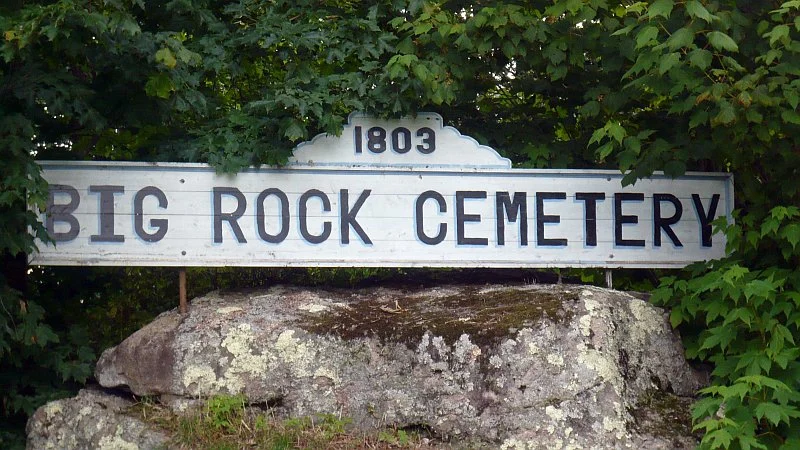
Big Rock Cemetery in Bloomfield (Find a Grave)
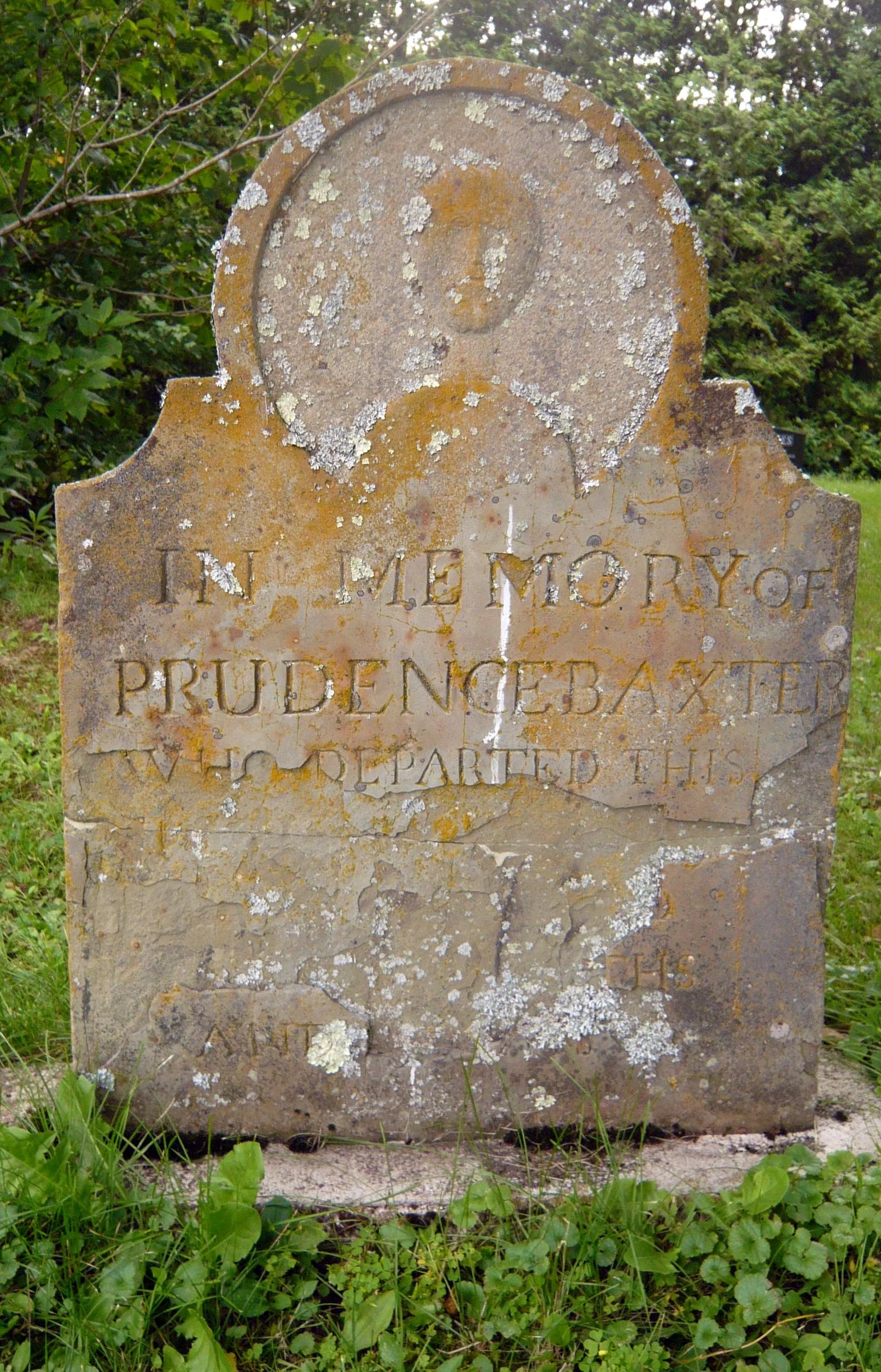
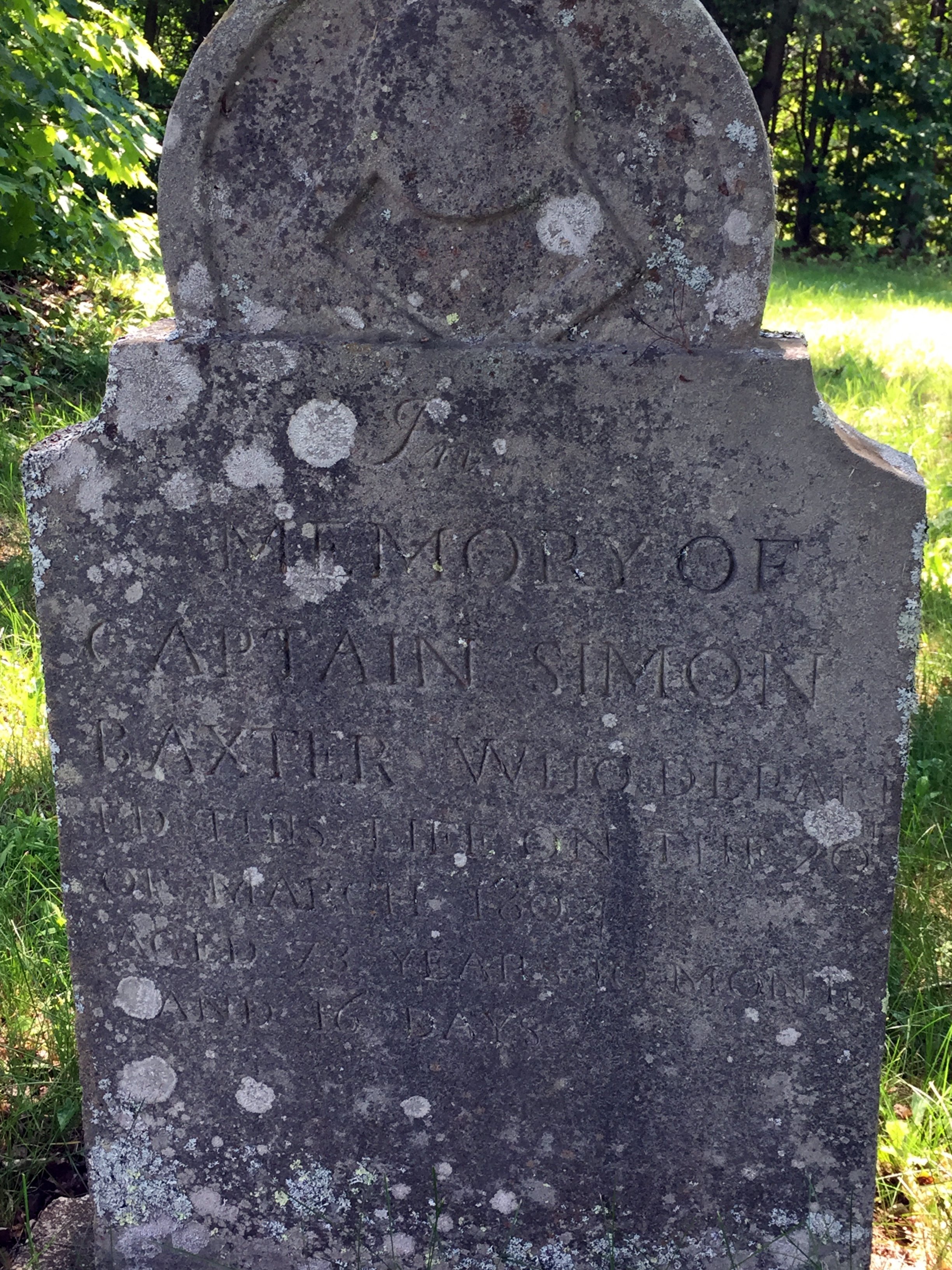
Tombstones in Big Rock Cemetery (Ancestry)
Legacy of a Loyalist
Simon Baxter’s life reflects the upheaval experienced by many Loyalists whose fortunes were irrevocably altered by the American Revolution. Born in colonial Connecticut, he helped establish frontier communities in both Connecticut and New Hampshire, accumulated substantial property holdings, and became deeply involved in the civic and economic development of the settlements in which he lived. His outspoken loyalty to the British Crown during the Revolutionary period, however, brought repeated imprisonment, public hostility, confiscation of property, and eventual exile from the United States.
Despite these losses, Simon rebuilt his life along the Kennebecasis River in present-day New Brunswick, where he secured extensive Loyalist land grants and re-established himself as a prominent landholder. The surviving records of his later years reveal a man focused increasingly on settling property among his children and ensuring support for Prudence, his wife of more than fifty years. His will, drafted in 1802, reflects both the considerable estate he had reconstructed in British North America and the enduring importance of family ties after decades marked by political conflict, displacement, and uncertainty.
By the time of his death in 1804, Simon Baxter had lived through the transformation of British America from a collection of colonies into two separate nations divided by revolution and loyalty. His descendants remained in New Brunswick and beyond, while the documentary trail he left behind — petitions, land grants, court proceedings, confiscation records, and Loyalist claims — preserves the story of a man whose life was profoundly shaped by the political divisions of his age.
[1] “Connecticut, U.S., Town Birth Records, pre-1870 (Barbour Collection),” digital images, Ancestry.ca (https://www.ancestry.ca/imageviewer/collections/1034/images/VBMDUSACT1634_0018-0128?pId=95084 : accessed 30 Apr 2026), birth of Simon Baxter, 6 May 1730, Hebron, father: Simon, citing original data: White, Lorraine Cook, ed. The Barbour Collection of Connecticut Town Vital Records. Vol. 1-55. Baltimore, MD, USA: Genealogical Publishing Co., 1994-2002.
[2] “Divorce: Hartford. Divorce Records 1725–1772,” digital images, FamilySearch (https://www.familysearch.org/ark:/61903/3:1:3Q9M-CSPC-49P1-V : accessed 12 May 2026), petition for divorce by Abigail Baxter, 1 Sep 1740, image 191 of 790, Image Group Number 008237564; citing original data: Connecticut. Superior Court (Hartford County).
[3] Gerald F. Cahill, The Connecticut Baxters - Part I: The Descendants of Simon Baxter of Hebron, CT (https://freepages.rootsweb.com/~jcahill/genealogy/simon.htm : accessed 30 Apr 2026); citing “court records of their divorce of 3 Mar 1741.”
[4] “Vital Statistics Index, Births, Marriages, Deaths,” digital images, FamilySearch (familysearch.org/ark:/61903/3:1:3QSQ-G9K7-B5GZ : accessed 12 May 2026), marriage (index) of Rebecah Burge and Simon Baxter, 25 Oct 1741, Hebron; citing original data: Hebron (Connecticut). Town Clerk, volumes 2-4.
[5] “Connecticut, U.S., Wills and Probate Records, 1609-1999,” digital images, Ancestry.ca (https://www.ancestry.ca/imageviewer/collections/9049/images/007626406_00111?pId=2920143 : accessed 30 Apr 2026), probate of Abigail Baxter, 1748, Colchester, case 156, item description: Probate Packets, Ballard-Bigelow, H, 1741-1880; citing original data: Probate Files Collection, Early to 1880; Author: Connecticut State Library (Hartford, Connecticut).
[6] Find a Grave, database and images (https://www.findagrave.com/memorial/45186138/abigail-baxter : accessed 30 Apr 2026), memorial page for Abigail Mann Baxter (23 Feb 1698–1748), Find a Grave Memorial ID 45186138, citing Andover Road Cemetery, Hebron, Tolland County, Connecticut, USA; Maintained by debbi (contributor 47529459).
[7] “Connecticut, U.S., Marriage Index, 1620-1926,” digital images, Ancestry.ca (https://www.ancestry.ca/imageviewer/collections/61367/images/TH-1942-44278-21982-20?pId=20722 : accessed 30 Apr 2026), marriage (index) of Simon Baxter and Prudence Fox, 20 Apr 1749, 1748, Hebron, film number 001376165; citing original data: Connecticut Marriages. Various Connecticut County collections.
[8] Hon. John B. M. Baxter, Simon Baxter (the first United empire loyalist to settle in New Brunswick) his ancestry and descendants (St. John, The New Brunswick Museum, 1943), 13.
[9] Hon. John B. M. Baxter, Simon Baxter (the first United empire loyalist to settle in New Brunswick) his ancestry and descendants (St. John, The New Brunswick Museum, 1943), 90-106.
[10] Charles J. Hoadly, ed., The Public Records of the Colony of Connecticut, from May, 1757, to March, 1762, Inclusive, vol. 11 (Hartford: Press of the Case, Lockwood & Brainard Company, 1880), 558.
[11] “Fairfield. History Records 1881, 1880 | Hartford. History Records 1633–1884,” digital images, FamilySearch (https://www.familysearch.org/ark:/61903/3:1:3QS7-99DF-299Z : accessed 13 May 2026), Memorial History of Hartford County, page 238, Image Group Number 007549120, image 1442 of 1646.
[12] “United States. Genealogies 1838, 1879, 1896, 1855, Family Histories 1871 | Connecticut. Genealogies 1879 | District of Columbia. Genealogies 1983 | Lebanon. Genealogies 1877,” digital images, FamilySearch (https://www.familysearch.org/ark:/61903/3:1:3QHK-93P2-NNX9 : accessed 14 May 2026), citing Baxter Genealogy, page 61, image 186 of 285, Image Group Number 008924010.
[13] “Barkhamsted. Land Records 1781–1789, 1732–1833,” digital images, FamilySearch (https://www.familysearch.org/ark:/61903/3:1:3Q9M-CSLG-G5LK : accessed 12 May 2026), proprietor committee leave to Simon Baxter, 20 Apr 1762, Barkhamsted, images 277-278 of 727, Image Group Number 008199538; citing original data: Barkhamsted (Connecticut). Town Clerk.
[14] “Barkhamsted. Land Records 1781–1789, 1732–1833,” digital images, FamilySearch (https://www.familysearch.org/ark:/61903/3:1:3Q9M-CSLG-G5G6 : accessed 12 May 2026), deed by Edward White to Simon Baxter, 11 Aug 1762, Barkhamsted, image 272 of 727, Image Group Number 008199538; citing original data: Barkhamsted (Connecticut). Town Clerk.
[15] “Barkhamsted. Land Records 1781–1789, 1732–1833,” digital images, FamilySearch (https://www.familysearch.org/ark:/61903/3:1:3Q9M-CSLG-G522 : accessed 12 May 2026), deed by Simon Baxter to Thomas Goss, 11 Sep 1762, Barkhamsted, images 286-287 of 727, Image Group Number 008199538; citing original data: Barkhamsted (Connecticut). Town Clerk.
[16] “Probate packets: Connecticut. Probate Records 1752–1880,” FamilySearch (https://www.familysearch.org/ark:/61903/3:1:3QS7-8925-GQ77 : accessed 1 May 2026), probate bond by Simon Baxter to Tobey Hamlin, 23 Nov 1762, image 642 of 1509, Image Group Number: 007628515; citing original data: Probate packets (volume: Hickcox, J.-Hubbard, Catharine). Connecticut State Library (Hartford, Connecticut).
[17] “Barkhamsted. Land Records 1781–1789, 1732–1833,” digital images, FamilySearch (https://www.familysearch.org/ark:/61903/3:1:3Q9M-CSLG-G5G6 : accessed 12 May 2026), lease by Pelatiah Allyn to Simon Baxter, 13 Dec 1763, Barkhamsted, images 272-273 of 727, Image Group Number 008199538; citing original data: Barkhamsted (Connecticut). Town Clerk.
[18] “Barkhamsted. Land Records 1781–1789, 1732–1833,” digital images, FamilySearch (https://www.familysearch.org/ark:/61903/3:1:3Q9M-CSLG-G52P : accessed 12 May 2026), deed by Simon Baxter to Pelatiah Allyn, 12 Dec 1763, Barkhamsted, image 304 of 727, Image Group Number 008199538; citing original data: Barkhamsted (Connecticut). Town Clerk.
[19] “Barkhamsted. Land Records 1781–1789, 1732–1833,” digital images, FamilySearch (https://www.familysearch.org/ark:/61903/3:1:3Q9M-CSLG-G5VF : accessed 13 May 2026), deed by Elijah Flowers to Simon Baxter, 28 May 1766, Barkhamsted, images 342-343 of 727, Image Group Number 008199538; citing original data: Barkhamsted (Connecticut). Town Clerk.
[20] “Barkhamsted. Land Records 1781–1789, 1732–1833,” digital images, FamilySearch (https://www.familysearch.org/ark:/61903/3:1:3Q9M-CSLG-G5KH : accessed 12 May 2026), quitclaim by Pelatiah Allyn to Simon Baxter, 20 Feb 1767, Barkhamsted, images 343-344 of 727, Image Group Number 008199538; citing original data: Barkhamsted (Connecticut). Town Clerk.
[21] “Barkhamsted. Land Records 1781–1789, 1732–1833,” digital images, FamilySearch (https://www.familysearch.org/ark:/61903/3:1:3Q9M-CSLG-G5PV : accessed 12 May 2026), deed by Samuel Lawrance to Simon Baxter, 5 Apr 1770, Barkhamsted, image 250 of 727, Image Group Number 008199538; citing original data: Barkhamsted (Connecticut). Town Clerk.
[22] “Barkhamsted. Land Records 1781–1789, 1732–1833,” digital images, FamilySearch (https://www.familysearch.org/ark:/61903/3:1:3Q9M-CSLG-G5L3 : accessed 12 May 2026), land deed from Simon Baxter to Simon Baxter Jr., 14 Sep 1770, Barkhamsted, images 276-277 of 727, Image Group Number 008199538; citing original data: Barkhamsted (Connecticut). Town Clerk.
[23] “Barkhamsted. Land Records 1781–1789, 1732–1833,” digital images, FamilySearch (https://www.familysearch.org/ark:/61903/3:1:3Q9M-CSLG-G528 : accessed 12 May 2026), lease by Simon Baxter to Abraham Pinney, 17 Sep 1770, Barkhamsted, images 287-288 of 727, Image Group Number 008199538; citing original data: Barkhamsted (Connecticut). Town Clerk.
[24] “Barkhamsted. Land Records 1781–1789, 1732–1833,” digital images, FamilySearch (https://www.familysearch.org/ark:/61903/3:1:3Q9M-CSLG-G5LC : accessed 12 May 2026), land deed by Simon Baxter to Joseph Pease, 1 Jan 1771, Barkhamsted, image 315 of 727, Image Group Number 008199538; citing original data: Barkhamsted (Connecticut). Town Clerk.
[25] “Barkhamsted. Land Records 1781–1789, 1732–1833,” digital images, FamilySearch (https://www.familysearch.org/ark:/61903/3:1:3Q9M-CSLG-G55W : accessed 12 May 2026), land deed by Simon Baxter & Simon Baxter Jr to Israel Jones, 13 Feb 1771, Barkhamsted, images 279-280 of 727, Image Group Number 008199538; citing original data: Barkhamsted (Connecticut). Town Clerk.
[26] “Barkhamsted. Land Records 1781–1789, 1732–1833,” digital images, FamilySearch (https://www.familysearch.org/ark:/61903/3:1:3Q9M-CSLG-G525 : accessed 12 May 2026), land deed by Simon Baxter to Israel Jones, 13 Feb 1771, Barkhamsted, image 280 of 727, Image Group Number 008199538; citing original data: Barkhamsted (Connecticut). Town Clerk.
[27] “Cheshire. Deeds 1771–1786, 1770–1780,” digital images, FamilySearch (https://www.familysearch.org/ark:/61903/3:1:3Q9M-CS3L-R9TL-M : accessed 13 May 2026), deed Jones, Baxter and Baxter Jr., 13 Feb 1771, image 571 of 574, Image Group Number 007836171; citing original data: Cheshire County (New Hampshire). Register of Deeds.
[28] “Barkhamsted. Land Records 1781–1789, 1732–1833,” digital images, FamilySearch (https://www.familysearch.org/ark:/61903/3:1:3Q9M-CSLG-G5LJ : accessed 12 May 2026), land deed from Joseph Pease to Simon Baxter, 15 Jun 1771, Barkhamsted, image 292 of 727, Image Group Number 008199538; citing original data: Barkhamsted (Connecticut). Town Clerk.
[29] “Cheshire. Deeds 1771–1786, 1770–1780,” digital images, FamilySearch (https://www.familysearch.org/ark:/61903/3:1:3Q9M-CS3L-R9B7-K : accessed 13 May 2026), deed Warner to Baxter, 20 Jul 1770/1771?, image 23 of 574, Image Group Number 007836171; citing original data: Cheshire County (New Hampshire). Register of Deeds.
[30] “Barkhamsted. Land Records 1781–1789, 1732–1833,” digital images, FamilySearch (https://www.familysearch.org/ark:/61903/3:1:3Q9M-CSLG-G5LJ : accessed 12 May 2026), land deed from Simon Baxter to Joseph Warner, 21 Jul 1771, Barkhamsted, image 292 of 727, Image Group Number 008199538; citing original data: Barkhamsted (Connecticut). Town Clerk.
[31] “Cheshire. Deeds 1771–1786, 1770–1780,” digital images, FamilySearch (https://www.familysearch.org/ark:/61903/3:1:3Q9M-CS3L-R9B7-K : accessed 13 May 2026), deed Baxter Jr. to Baxter, 26 May 1772, image 23 of 574, Image Group Number 007836171; citing original data: Cheshire County (New Hampshire). Register of Deeds.
[32] “Cheshire. Deeds 1771–1786, 1770–1780,” digital images, FamilySearch (https://www.familysearch.org/ark:/61903/3:1:3Q9M-CS3L-R9B6-G : accessed 13 May 2026), deed Baxter and Baxter Jr. to Easton, 26 May 1772, image 22 of 574, Image Group Number 007836171; citing original data: Cheshire County (New Hampshire). Register of Deeds.
[33] “Barkhamsted. Land Records 1781–1789, 1732–1833,” digital images, FamilySearch (https://www.familysearch.org/ark:/61903/3:1:3Q9M-CSLG-G5KH : accessed 12 May 2026), land deed from Joseph Warner to Simon Baxter, 23 Jun 1773, Barkhamsted, image 343 of 727, Image Group Number 008199538; citing original data: Barkhamsted (Connecticut). Town Clerk.
[34] “Barkhamsted. Land Records 1781–1789, 1732–1833,” digital images, FamilySearch (https://www.familysearch.org/ark:/61903/3:1:3Q9M-CSLG-G5VB : accessed 12 May 2026), deed by Simon Baxter to Joseph Kingsbury, 12 Aug 1773, Barkhamsted, image 345 of 727, Image Group Number 008199538; citing original data: Barkhamsted (Connecticut). Town Clerk.
[35] “Cheshire. Deeds 1777–1780, 1780–1782,” digital images, FamilySearch (https://www.familysearch.org/ark:/61903/3:1:3Q9M-CS3L-5S54-6 : accessed 13 May 2026), deed Chase to Baxter, image 66 of 697, Image Group Number 007836173; citing original data: Cheshire County (New Hampshire). Register of Deeds, vol. 5-6.
[36] “Cheshire. Deeds 1777–1780, 1780–1782,” digital images, FamilySearch (https://www.familysearch.org/ark:/61903/3:1:3Q9M-CS3L-P9G8-8 : accessed 13 May 2026), deed Chase to Gee, image 651 of 697, Image Group Number 007836173; citing original data: Cheshire County (New Hampshire). Register of Deeds, vol. 5-6.
[37] “Cheshire. Deeds 1777–1780, 1780–1782,” digital images, FamilySearch (https://www.familysearch.org/ark:/61903/3:1:3Q9M-CS3L-5S5X-F : accessed 13 May 2026), deed Brown to Baxter, image 569 of 697, Image Group Number 007836173; citing original data: Cheshire County (New Hampshire). Register of Deeds, vol. 5-6.
[38] “Cheshire. Deeds 1777–1780, 1780–1782,” digital images, FamilySearch (https://www.familysearch.org/ark:/61903/3:1:3Q9M-CS3L-5S54-3 : accessed 13 May 2026), deed Baxter to Moffatt, image 77 of 697, Image Group Number 007836173; citing original data: Cheshire County (New Hampshire). Register of Deeds, vol. 5-6.
[39] “UK, American Loyalist Claims, 1776-1835,” digital images, Ancestry.ca (https://www.ancestry.com/imageviewer/collections/3712/images/40939_307177-00352 : accessed 15 May 2026), claim of Simon Baxter, New Hampshire; citing original data: American Loyalist Claims, 1776–1835. AO 12–13. The National Archives of the United Kingdom, Kew, Surrey, England.
[40] Hon. John B. M. Baxter, Simon Baxter (the first United empire loyalist to settle in New Brunswick) his ancestry and descendants (St. John, The New Brunswick Museum, 1943), 18.
[41] “United States. History Records, Military Histories, Reference Materials,” digital images, FamilySearch (https://www.familysearch.org/ark:/61903/3:1:3Q9M-CS84-J51D : accessed 14 May 2026), citing Correspondence, Proceedings, &c., August, 1775, pages 165-166, images 1132-1133 of 1608, Image Group Number 007953531.
[42] “Surry. Genealogies, History Records,” digital images, FamilySearch (https://www.familysearch.org/ark:/61903/3:1:3Q9M-CSDM-V7M9-S : accessed 14 May 2026), chapter VII, Surry During The Revolutionary War, page 87, image 54 of 558, Image Group Number 007968342.
[43] “Barnet, Caledonia, Vermont, United States records,” digital images, FamilySearch (https://www.familysearch.org/ark:/61903/3:1:3QS7-898Y-8WB4 : accessed 14 May 2026), image 200 of 421, Image Group Number: 007541473. Citing original data: History of Barnet, Vermont.
[44] "Cornish, Sullivan, New Hampshire, United States records," digital images, FamilySearch (https://www.familysearch.org/ark:/61903/3:1:3QS7-L9DF-94N?view=explore : accessed 13 May 2026), images 571-572 of 766, Image Group Number: 007549262.
[45] “Charlestown. Genealogies, History Records,” digital images, FamilySearch (https://www.familysearch.org/ark:/61903/3:1:3Q9M-CS8H-8S38-C : accessed 13 May 2026), history of the old jail, image 398 of 436, Image Group Number 007954752.
[46] "Burgoyne's Campaign: June–October 1777," U.S. National Park Service (https://www.nps.gov/articles/burgoyne-s-campaign-june-october-1777.htm : accessed 7 Jun 2026).
[47] "Skenesborough," American Battlefield Trust (https://www.battlefields.org/learn/revolutionary-war/battles/skenesborough : accessed 7 Jun 2026).
[48] "Burgoyne's Campaign: June–October 1777," U.S. National Park Service (https://www.nps.gov/articles/burgoyne-s-campaign-june-october-1777.htm : accessed 7 Jun 2026).
[49] “UK, American Loyalist Claims, 1776-1835,” digital images, Ancestry.ca (https://www.ancestry.com/imageviewer/collections/3712/images/40939_307177-00352 : accessed 15 May 2026), claim of Simon Baxter, New Hampshire; citing original data: American Loyalist Claims, 1776–1835. AO 12–13. The National Archives of the United Kingdom, Kew, Surrey, England.
[50] "Battle of Bennington (1777)," Encyclopædia Britannica (https://www.britannica.com/event/Battle-of-Bennington-1777 : accessed 7 Jun 2026).
[51] "Bennington," American Battlefield Trust (https://www.battlefields.org/learn/revolutionary-war/battles/bennington : accessed 7 Jun 2026)
"Battle of Bennington (1777)," Encyclopædia Britannica (https://www.britannica.com/event/Battle-of-Bennington-1777 : accessed 7 Jun 2026).
[52] "British Prison Ships: A Season in Hell," HistoryNet (https://www.historynet.com/british-prison-ships-a-season-in-hell/ : accessed 7 Jun 2026).
[53] “UK, American Loyalist Claims, 1776-1835,” digital images, Ancestry.ca (https://www.ancestry.com/imageviewer/collections/3712/images/40939_307177-00352 : accessed 15 May 2026), claim of Simon Baxter, New Hampshire; citing original data: American Loyalist Claims, 1776–1835. AO 12–13. The National Archives of the United Kingdom, Kew, Surrey, England.
[54] Hon. John B. M. Baxter, Simon Baxter (the first United empire loyalist to settle in New Brunswick) his ancestry and descendants (St. John, The New Brunswick Museum, 1943), 30.
[55] "Battles of Saratoga," Encyclopædia Britannica (https://www.britannica.com/event/Battles-of-Saratoga : accessed 7 Jun 2026)
"Battles of Saratoga," World History Encyclopedia (https://www.worldhistory.org/article/2386/battles-of-saratoga/ : accessed 7 Jun 2026)
"Saratoga," American Battlefield Trust (https://www.battlefields.org/learn/revolutionary-war/battles/saratoga : accessed 7 Jun 2026).
[56] "Articles of Convention between Lieutenant-General Burgoyne and Major-General Gates, 16 October 1777," The Avalon Project, Yale Law School (https://avalon.law.yale.edu/18th_century/burgoyne_gates.asp : accessed 7 Jun 2026)
"Burgoyne's Campaign: June–October 1777," U.S. National Park Service (https://www.nps.gov/articles/burgoyne-s-campaign-june-october-1777.htm : accessed 7 Jun 2026).
[57] Hon. John B. M. Baxter, Simon Baxter (the first United empire loyalist to settle in New Brunswick) his ancestry and descendants (St. John, The New Brunswick Museum, 1943), 30; citing: the ninth article of the Convention (covering Canadians and "followers of the army") from Charles Neilson, An Original, Compiled and Corrected Account of Burgoyne's Campaign (Albany, 1844), 214.
[58] Massachusetts Soldiers and Sailors of the Revolutionary War: A Compilation from the Archives, 17 vols. (Boston: Wright & Potter, for the Secretary of the Commonwealth, 1896–1908), 1:826, entry "Baxter, Simon": "List of prisoners sent from Newport, R.I., in the prison ship 'Lord Sandwich' and landed at Bristol, March 7, 1778," Archive.org (https://archive.org/details/massachusettssol01mass : accessed 7 Jun 2026).
[59] "Battles of Saratoga," Encyclopædia Britannica (https://www.britannica.com/event/Battles-of-Saratoga : accessed 7 Jun 2026)
"Battles of Saratoga," World History Encyclopedia (https://www.worldhistory.org/article/2386/battles-of-saratoga/ : accessed 7 Jun 2026)
"Saratoga," American Battlefield Trust (https://www.battlefields.org/learn/revolutionary-war/battles/saratoga : accessed 7 Jun 2026).
[60] Hon. John B. M. Baxter, Simon Baxter (the first United empire loyalist to settle in New Brunswick) his ancestry and descendants (St. John, The New Brunswick Museum, 1943), 24.
[61] "Cornish, Sullivan, New Hampshire, United States records," digital images, FamilySearch (https://www.familysearch.org/ark:/61903/3:1:3QS7-89DF-984?view=explore : accessed 13 May 2026), images 680-681 of 766, Image Group Number 007549262.
[62] "Cornish, Sullivan, New Hampshire, United States records," digital images, FamilySearch (https://www.familysearch.org/ark:/61903/3:1:3QS7-89DF-984?view=explore : accessed 13 May 2026), images 680-681 of 766, Image Group Number 007549262.
[63] Hamilton Child, Gazetteer of Cheshire County, N.H., 1736–1885 (Syracuse, N.Y.: Journal Office, 1885), 116.
[64] "Cornish, Sullivan, New Hampshire, United States records," digital images, FamilySearch (https://www.familysearch.org/ark:/61903/3:1:3QS7-89DF-984?view=explore : accessed 13 May 2026), images 680-681 of 766, Image Group Number 007549262.
[65] “New Hampshire. Town Records October 1776–July 1778,” digital images, FamilySearch (https://www.familysearch.org/ark:/61903/3:1:3QS7-89QD-59HM-H : accessed 15 May 2026), petition of Prudence, the wife of Simon Baxter, images 799-800 of 882, Image Group Number: 005835012.
[66] “New Hampshire, History Records 1886,” digital images, FamilySearch (https://www.familysearch.org/ark:/61903/3:1:3QSQ-G9DF-9FFT : accessed 15 May 2026), confession of William Baxter, image 85 of 607, Image Group Number: 007549255; citing: History of Cheshire County, New Hampshire, pages 116-117.
[67] “New Hampshire, History Records 1886,” digital images, FamilySearch (https://www.familysearch.org/ark:/61903/3:1:3QSQ-G9DF-9FFT : accessed 15 May 2026), testimony of Lemuel Holmes, images 85-86 of 607, Image Group Number: 007549255; citing: History of Cheshire County, New Hampshire, pages 116-117.
[68] Ibid.
[69] “Suffolk. Court Records 1778–1780,” digital images, FamilySearch (https://www.familysearch.org/ark:/61903/3:1:3Q9M-CSZF-YSB2-M : accessed 13 May 2026), indictment of Simon Baxter for counterfeiting, image 153 of 568, Image Group Number 007942993; citing original data: Massachusetts. Supreme Judicial Court (Suffolk County).
[70] “UK, American Loyalist Claims, 1776-1835,” digital images, Ancestry.ca (https://www.ancestry.com/imageviewer/collections/3712/images/40939_307177-00352 : accessed 15 May 2026), claim of Simon Baxter, New Hampshire; citing original data: American Loyalist Claims, 1776–1835. AO 12–13. The National Archives of the United Kingdom, Kew, Surrey, England.
[71] “Nova Scotia. Land Records 1784 | Halifax. Land Records 1765,” FamilySearch (https://www.familysearch.org/ark:/61903/3:1:3Q9M-CSL6-B33X-6 : accessed 1 May 2026), memorial by Simon Baxter for a land grant, 9 Oct 1781, images 97-99 of 924, Image Group Number: 008191875; citing original data: Nova Scotia. Department of Crown Lands.
[72] “New Hampshire. Town Records June 1780–November 1782,” digital images, FamilySearch (https://www.familysearch.org/ark:/61903/3:1:3QS7-89QD-59CY-S : accessed 13 May 2026), petition of Simon Baxter, 25 Dec 1781, images 570-572 of 911, Image Group Number 005835014.
[73] Hon. John B. M. Baxter, Simon Baxter (the first United empire loyalist to settle in New Brunswick) his ancestry and descendants (St. John, The New Brunswick Museum, 1943), 40.
[74] “Nova Scotia. Land Records 1784 | Halifax. Land Records 1765,” digital images, FamilySearch (https://www.familysearch.org/ark:/61903/3:1:3Q9M-CSL6-B3ST-T : accessed 1 May 2026), land warrant to Simon Baxter and others, 1782, images 305-312 of 924, Image Group Number: 008191875; citing original data: Nova Scotia. Department of Crown Lands.
[75] “Nova Scotia. Land Records 1771-1785,” digital images, FamilySearch (https://www.familysearch.org/ark:/61903/3:1:3Q9M-CSVF-BQ1B : accessed 1 May 2026), land grant to Simon Baxter and others, 15 Aug 1782, images 510-511 of 944, Image Group Number: 008123372; citing original data: Nova Scotia. Department of Crown Lands.
[76] “Kings. Deeds 1789–1793,” digital images, FamilySearch (https://www.familysearch.org/ark:/61903/3:1:S3HT-6Q9Q-CJG : accessed 1 May 2026), land conveyance by Robert Charlton to Simon Baxter, 28 May 1783, image 136 of 136, Image Group Number: 004137564; citing original data: King County (New Brunswick). Registrar of Deeds. Service New Brunswick. Book C1, no. 227-436.
[77] “New Brunswick. Land Petitions 1785,” digital images, FamilySearch (https://www.familysearch.org/ark:/61903/3:1:3Q9M-CSL6-1SD4-J : accessed 1 May 2026), petition by Ebenezer [Howe?], 15 Nov 1785, image 788 of 900, Image Group Number: 008191393; citing original data: New Brunswick. Crown Land Office.
[78] “Kings. Deeds 1785–1787,” digital images, FamilySearch (https://www.familysearch.org/ark:/61903/3:1:S3HY-6Q7L-B1 : accessed 30 Apr 2026), land conveyance by Simon and Prudence Baxter to John Smith, 14 Feb 1787, images 144-145 of 263, Image Group Number: 004137556; citing original data: King County (New Brunswick). Registrar of Deeds. Service New Brunswick. book A1, no. 1-103.
[79] “Kings. Deeds 1785–1787,” digital images, FamilySearch (https://www.familysearch.org/ark:/61903/3:1:S3HY-6Q7L-B1 : accessed 30 Apr 2026), Acquisition of Simon Baxter of the interest of Benjamin Snow in a tract of land, 1787, images 144-145 of 263, Image Group Number: 004137556; citing original data: King County (New Brunswick). Registrar of Deeds. Service New Brunswick. book A1, no. 1-103.
[80] “Kings. Deeds 1787–1789,” digital images, FamilySearch (https://www.familysearch.org/ark:/61903/3:1:S3HT-64KW-QJM : accessed 30 Apr 2026), agreement between Simon Baxter and Thomas Spragg, 31 Dec 1787, images 62-64 of 284, Image Group Number: 004137558; citing original data: King County (New Brunswick). Registrar of Deeds. Service New Brunswick. Book B1, no. 104-226.
[81] “Kings. Deeds 1793–1795,” digital images, FamilySearch (https://www.familysearch.org/ark:/61903/3:1:S3HY-DZVQ-8YV : accessed 30 Apr 2026), land conveyance by Simon Baxter to Abraham Baxter, 6 Dec 1793, images 176-177 of 373, Image Group Number: 004137571; citing original data: King County (New Brunswick). Registrar of Deeds. Service New Brunswick. Book D1, no. 437-616.
[82] “Kings. Deeds 1793–1795,” digital images, FamilySearch (https://www.familysearch.org/ark:/61903/3:1:S3HY-DZVQ-8F3 : accessed 1 May 2026), land conveyance by Simon Baxter to his son Elijah Baxter, 6 Dec 1793, images 111-113 of 373, Image Group Number: 004137571; citing original data: King County (New Brunswick). Registrar of Deeds. Service New Brunswick. Book D1, no. 437-616.
[83] “Kings. Deeds 1793–1795,” digital images, FamilySearch (https://www.familysearch.org/ark:/61903/3:1:S3HY-DZVQ-81D : accessed 30 Apr 2026), land conveyance by William Baxter to Simon Baxter, 20 Sep 1794, images 237-238 of 373, Image Group Number: 004137571; citing original data: King County (New Brunswick). Registrar of Deeds. Service New Brunswick. Book D1, no. 437-616.
“Kings. Deeds 1793–1795,” digital images, FamilySearch (https://www.familysearch.org/ark:/61903/3:1:S3HY-DZVQ-8V9 : accessed 1 May 2026), land conveyance by Simon and Prudence Baxter to William Baxter, 20 Sep 1794, images 218-220 of 373, Image Group Number: 004137571; citing original data: King County (New Brunswick). Registrar of Deeds. Service New Brunswick. Book D1, no. 437-616.
[84] “Kings. Deeds 1793–1795,” digital images, FamilySearch (https://www.familysearch.org/ark:/61903/3:1:S3HY-DZVQ-8RQ : accessed 30 Apr 2026), land transfer by Simon and Prudence Baxter to their son Joseph Baxter, 12 Feb 1795, images 288-289 of 373, Image Group Number: 004137571; citing original data: King County (New Brunswick). Registrar of Deeds. Service New Brunswick. Book D1, no. 437-616.
[85] “Kings. Deeds 1795–1798,” digital images, FamilySearch (https://www.familysearch.org/ark:/61903/3:1:S3HT-XX8Q-K5J : accessed 30 Apr 2026), deed by Simon Baxter in favour of his daughter Abigail Fahy, 2 Sep 1795, images 28-29 of 367, Image Group Number: 004137574; citing original data: King County (New Brunswick). Registrar of Deeds. Service New Brunswick. Book E1, no. 617-794.
[86] “Kings. Deeds 1795–1798,” digital images, FamilySearch (https://www.familysearch.org/ark:/61903/3:1:S3HT-XX8Q-2NZ : accessed 30 Apr 2026), deed by Simon Baxter in favour of his son Elijah Baxter, 3 Sep 1795, images 86-87 of 367, Image Group Number: 004137574; citing original data: King County (New Brunswick). Registrar of Deeds. Service New Brunswick. Book E1, no. 617-794.
[87] “Kings. Deeds 1795–1798,” digital images, FamilySearch (https://www.familysearch.org/ark:/61903/3:1:S3HT-XX8Q-VCN : accessed 30 Apr 2026), land conveyance by William Baxter to Simon Baxter, 14 Jun 1796, images 103-104 of 367, Image Group Number: 004137574; citing original data: King County (New Brunswick). Registrar of Deeds. Service New Brunswick. Book D1, no. 617-794.
[88] “Kings. Deeds 1795–1798,” digital images, FamilySearch (https://www.familysearch.org/ark:/61903/3:1:S3HT-XX8Q-2WK : accessed 1 May 2026), land conveyance by Simon Baxter to Jonathan Shipman, 27 Sep 1796, images 128-129 of 367, Image Group Number: 004137574; citing original data: King County (New Brunswick). Registrar of Deeds. Service New Brunswick. Book D1, no. 617-794.
[89] “Kings. Deeds 1795–1798,” digital images, FamilySearch (https://www.familysearch.org/ark:/61903/3:1:S3HT-XX8Q-VQY : accessed 30 Apr 2026), land conveyance by Simon Baxter to his son Elijah Baxter, 15 Oct 1796, images 133-135 of 367, Image Group Number: 004137574; citing original data: King County (New Brunswick). Registrar of Deeds. Service New Brunswick. Book D1, no. 617-794.
[90] “Kings. Deeds 1795–1798,” digital images, FamilySearch (https://www.familysearch.org/ark:/61903/3:1:S3HT-XX8Q-KN1 : accessed 30 Apr 2026), land conveyance by Elijah Baxter to his brother Abraham Baxter, 15 Oct 1796, images 136-137 of 367, Image Group Number: 004137574; citing original data: King County (New Brunswick). Registrar of Deeds. Service New Brunswick. Book D1, no. 617-794.
[91] “Kings. Deeds 1799–1802,” digital images, FamilySearch (https://www.familysearch.org/ark:/61903/3:1:S3HT-6Q59-JBP : accessed 30 Apr 2026), land conveyance by Simon Baxter to his son Elijah Baxter, 21 Apr 1801, images 261-263 of 370, Image Group Number: 004137580; citing original data: King County (New Brunswick). Registrar of Deeds. Service New Brunswick. Book G1, no. 888-1045.
[92] “Kings. Deeds 1799–1802,” digital images, FamilySearch (https://www.familysearch.org/ark:/61903/3:1:S3HT-6Q59-JTH : accessed 30 Apr 2026), agreement between Simon Baxter, and Munson Jarvis and Samuel Miles, 28 Sep 1801, images 324-328 of 370, Image Group Number: 004137580; citing original data: King County (New Brunswick). Registrar of Deeds. Service New Brunswick. Book G1, no. 888-1045.
[93] “Kings. Deeds 1802-1805,” digital images, FamilySearch (https://www.familysearch.org/ark:/61903/3:1:S3HY-6PM4-54R : accessed 30 Apr 2026), conveyance from Simon Baxter to Simon Baxter Hayes, 20 Mar 1802, images 56-57 of 379, Image Group Number: 004137585; citing original data: King County (New Brunswick). Registrar of Deeds. Service New Brunswick. Book H1, no. 1046-1226.
[94] Hon. John B. M. Baxter, Simon Baxter (the first United empire loyalist to settle in New Brunswick) his ancestry and descendants (St. John, The New Brunswick Museum, 1943), 72-73.
[95] Find a Grave, database and images (https://www.findagrave.com/memorial/85417793/prudence-baxter : accessed 15 May 2026), memorial page for Prudence Fox Baxter (18 Apr 1733–31 Jan 1804), Find a Grave Memorial ID 85417793, citing Big Rock Cemetery, Bloomfield, Kings County, New Brunswick, Canada; Maintained by Boylston Cemetery Research Project (contributor 49749019).